Submitted by:
:
What Kyoto Protocol stands for ?
The Kyoto Protocol was an international treaty that expanded the 1992
United Nations Framework Convention on Climate Change (UNFCCC).
It required participating countries to reduce greenhouse gas emissions.
The protocol was based on scientific evidence showing that global
warming is happening and that human activities, especially carbon
dioxide (CO₂) emissions, are the main cause. The Kyoto Protocol was
adopted in Kyoto, Japan, on 11 December 1997 and came into force on
16 February 2005. By 2020, 192 countries were parties to the protocol,
although Canada withdrew from it in December 2012.
The Kyoto Protocol applied to seven greenhouse gases listed in
Annex A. These gases are carbon dioxide (CO₂), methane (CH₄),
nitrous oxide (N₂O), hydrofluorocarbons (HFCs),
perfluorocarbons (PFCs), sulfur hexafluoride (SF₆), and nitrogen
trifluoride (NF₃). These gases are responsible for trapping heat
in the atmosphere and contributing to global warming.
Objectives
•To reduce emissions of major human-made (anthropogenic) greenhouse gases.
•To reflect differences among countries in emissions levels, economic strength, and
capacity to reduce emissions.
•To implement the principles of the 1992 United Nations Framework Convention on
Climate Change (UNFCCC).
•To set legally binding emission limitation targets for Annex I countries during the
first commitment period (2008–2012).
•To take the first concrete step toward stabilizing greenhouse gas concentrations in
the atmosphere.
•To establish a framework for future and stronger emission reduction commitments.
•To ultimately prevent dangerous human interference with the climate system.
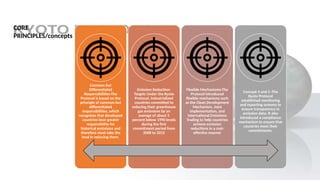
CORE
PRINCIPLES/concepts
Common but
Differentiated
Responsibilities-The
Protocol is based on the
principle of common but
differentiated
responsibilities, which
recognizes that developed
countries bear greater
responsibility for
historical emissions and
therefore must take the
lead in reducing them.
Emission Reduction-
Targets Under the Kyoto
Protocol, industrialized
countries committed to
reducing their greenhouse
gas emissions by an
average of about 5
percent below 1990 levels
during the first
commitment period from
2008 to 2012
Flexible Mechanisms-The
Protocol introduced
flexible mechanisms such
as the Clean Development
Mechanism, Joint
Implementation, and
International Emissions
Trading to help countries
achieve emission
reductions in a cost-
effective manner
Concept 4 and 5 -The
Kyoto Protocol
established monitoring
and reporting systems to
ensure transparency in
emission data. It also
introduced a compliance
mechanism to ensure that
countries meet their
commitments.
Impacts of Kyoto protocol
 Established the first legally binding international framework to reduce
greenhouse gas emissions.
 Set mandatory emission reduction targets for developed (Annex I)
countries.
 Introduced market-based mechanisms such as Emissions Trading, Clean
Development Mechanism (CDM), and Joint Implementation (JI).
 Encouraged technology transfer and sustainable development in
developing countries through CDM projects.
 Improved monitoring, reporting, and verification of greenhouse gas
emissions.
 Raised global awareness and political commitment to climate change
mitigation.
 Laid the foundation for future climate agreements, including the Paris
Agreement.
Still a question arises? why India comes under Non annex I where as other countries comes at annex 1
India is classified as a Non-Annex I country under the
Kyoto Protocol because of historical, economic, and
equity-based reasons.
1. Level of Economic Development
•When the Kyoto Protocol was adopted (1997), India
was a developing country with:
• Low per-capita income
• High poverty levels
• Large population dependent on agriculture
•Annex I countries were industrialized nations or
economies in transition.
2. Historical Responsibility for Emissions
•Climate policy is based on the principle of
“Common but Differentiated Responsibilities
(CBDR)”.
•Annex I countries:
• Industrialized much earlier (since the 19th
century)
• Produced the major share of historical
greenhouse gas emissions
•India’s historical contribution to global emissions
was very small.
3.Low Per-Capita Emissions
•India’s per-capita emissions were (and still are)
much lower than those of Annex I countries.
•The protocol focused on total historical
emissions, not just current emissions.
4.Development Priority
India needed flexibility to:
• Reduce poverty
• Improve infrastructure
• Provide electricity, transport, and basic services
Binding emission cuts could have slowed economic development.
5. UN Classification at the Time
Annex I list was largely based on OECD membership in 1992 and former Soviet economies.
India was not an OECD country and was officially recognized as developing.
Challenges and Limitations
 limited participation by major emitters
 Some countries, including the USA, did not ratify; Canada withdrew in 2012.
 Emission reduction targets were modest and insufficient to stabilize global
greenhouse gas concentrations.
 Flexibility mechanisms (CDM, JI, Emissions Trading) reduced costs but faced
concerns over effectiveness and local impacts.
 Developing countries like China and India had no binding targets, which drew
criticism.
Connection with sustainability
 Promoted environmental sustainability by reducing greenhouse
gas emissions.
 Encouraged the use of renewable energy and energy-efficient
technologies.
 Supported sustainable development projects in developing
countries through the Clean Development Mechanism (CDM).
 Improved global awareness of climate change and sustainable
practices.
 Helped integrate economic development with environmental
protection.
 Strengthened international cooperation for long-term sustainability.
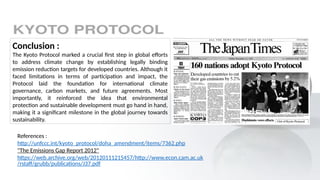
Conclusion :
The Kyoto Protocol marked a crucial first step in global efforts
to address climate change by establishing legally binding
emission reduction targets for developed countries. Although it
faced limitations in terms of participation and impact, the
Protocol laid the foundation for international climate
governance, carbon markets, and future agreements. Most
importantly, it reinforced the idea that environmental
protection and sustainable development must go hand in hand,
making it a significant milestone in the global journey towards
sustainability.
References :
http://unfccc.int/kyoto_protocol/doha_amendment/items/7362.php
"The Emissions Gap Report 2012"
https://web.archive.org/web/20120111215457/http://www.econ.cam.ac.uk
/rstaff/grubb/publications/J37.pdf


kyoto protocol in sustainable development.pptx

  • 1.
  • 2.
    What Kyoto Protocolstands for ? The Kyoto Protocol was an international treaty that expanded the 1992 United Nations Framework Convention on Climate Change (UNFCCC). It required participating countries to reduce greenhouse gas emissions. The protocol was based on scientific evidence showing that global warming is happening and that human activities, especially carbon dioxide (CO₂) emissions, are the main cause. The Kyoto Protocol was adopted in Kyoto, Japan, on 11 December 1997 and came into force on 16 February 2005. By 2020, 192 countries were parties to the protocol, although Canada withdrew from it in December 2012. The Kyoto Protocol applied to seven greenhouse gases listed in Annex A. These gases are carbon dioxide (CO₂), methane (CH₄), nitrous oxide (N₂O), hydrofluorocarbons (HFCs), perfluorocarbons (PFCs), sulfur hexafluoride (SF₆), and nitrogen trifluoride (NF₃). These gases are responsible for trapping heat in the atmosphere and contributing to global warming.
  • 3.
    Objectives •To reduce emissionsof major human-made (anthropogenic) greenhouse gases. •To reflect differences among countries in emissions levels, economic strength, and capacity to reduce emissions. •To implement the principles of the 1992 United Nations Framework Convention on Climate Change (UNFCCC). •To set legally binding emission limitation targets for Annex I countries during the first commitment period (2008–2012). •To take the first concrete step toward stabilizing greenhouse gas concentrations in the atmosphere. •To establish a framework for future and stronger emission reduction commitments. •To ultimately prevent dangerous human interference with the climate system.
  • 4.
    CORE PRINCIPLES/concepts Common but Differentiated Responsibilities-The Protocol isbased on the principle of common but differentiated responsibilities, which recognizes that developed countries bear greater responsibility for historical emissions and therefore must take the lead in reducing them. Emission Reduction- Targets Under the Kyoto Protocol, industrialized countries committed to reducing their greenhouse gas emissions by an average of about 5 percent below 1990 levels during the first commitment period from 2008 to 2012 Flexible Mechanisms-The Protocol introduced flexible mechanisms such as the Clean Development Mechanism, Joint Implementation, and International Emissions Trading to help countries achieve emission reductions in a cost- effective manner Concept 4 and 5 -The Kyoto Protocol established monitoring and reporting systems to ensure transparency in emission data. It also introduced a compliance mechanism to ensure that countries meet their commitments.
  • 5.
    Impacts of Kyotoprotocol  Established the first legally binding international framework to reduce greenhouse gas emissions.  Set mandatory emission reduction targets for developed (Annex I) countries.  Introduced market-based mechanisms such as Emissions Trading, Clean Development Mechanism (CDM), and Joint Implementation (JI).  Encouraged technology transfer and sustainable development in developing countries through CDM projects.  Improved monitoring, reporting, and verification of greenhouse gas emissions.  Raised global awareness and political commitment to climate change mitigation.  Laid the foundation for future climate agreements, including the Paris Agreement.
  • 6.
    Still a questionarises? why India comes under Non annex I where as other countries comes at annex 1 India is classified as a Non-Annex I country under the Kyoto Protocol because of historical, economic, and equity-based reasons. 1. Level of Economic Development •When the Kyoto Protocol was adopted (1997), India was a developing country with: • Low per-capita income • High poverty levels • Large population dependent on agriculture •Annex I countries were industrialized nations or economies in transition. 2. Historical Responsibility for Emissions •Climate policy is based on the principle of “Common but Differentiated Responsibilities (CBDR)”. •Annex I countries: • Industrialized much earlier (since the 19th century) • Produced the major share of historical greenhouse gas emissions •India’s historical contribution to global emissions was very small. 3.Low Per-Capita Emissions •India’s per-capita emissions were (and still are) much lower than those of Annex I countries. •The protocol focused on total historical emissions, not just current emissions. 4.Development Priority India needed flexibility to: • Reduce poverty • Improve infrastructure • Provide electricity, transport, and basic services Binding emission cuts could have slowed economic development. 5. UN Classification at the Time Annex I list was largely based on OECD membership in 1992 and former Soviet economies. India was not an OECD country and was officially recognized as developing.
  • 7.
    Challenges and Limitations limited participation by major emitters  Some countries, including the USA, did not ratify; Canada withdrew in 2012.  Emission reduction targets were modest and insufficient to stabilize global greenhouse gas concentrations.  Flexibility mechanisms (CDM, JI, Emissions Trading) reduced costs but faced concerns over effectiveness and local impacts.  Developing countries like China and India had no binding targets, which drew criticism.
  • 8.
    Connection with sustainability Promoted environmental sustainability by reducing greenhouse gas emissions.  Encouraged the use of renewable energy and energy-efficient technologies.  Supported sustainable development projects in developing countries through the Clean Development Mechanism (CDM).  Improved global awareness of climate change and sustainable practices.  Helped integrate economic development with environmental protection.  Strengthened international cooperation for long-term sustainability.
  • 9.
    Conclusion : The KyotoProtocol marked a crucial first step in global efforts to address climate change by establishing legally binding emission reduction targets for developed countries. Although it faced limitations in terms of participation and impact, the Protocol laid the foundation for international climate governance, carbon markets, and future agreements. Most importantly, it reinforced the idea that environmental protection and sustainable development must go hand in hand, making it a significant milestone in the global journey towards sustainability. References : http://unfccc.int/kyoto_protocol/doha_amendment/items/7362.php "The Emissions Gap Report 2012" https://web.archive.org/web/20120111215457/http://www.econ.cam.ac.uk /rstaff/grubb/publications/J37.pdf