www.aqhuman.com
Key performance indicators
Aqhuman financial training & coaching
www.aqhuman.com
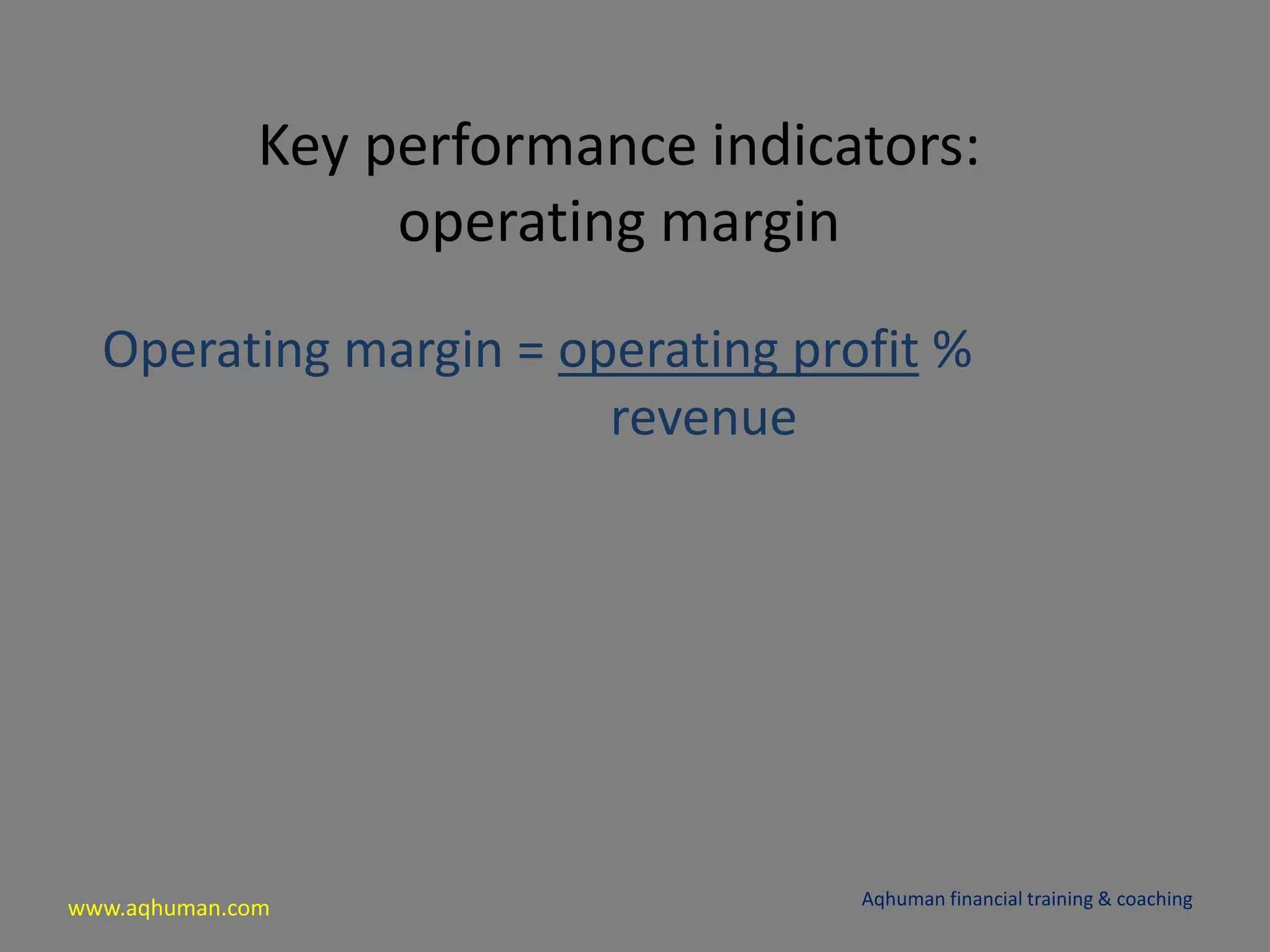
Key performance indicators:
operating margin
Operating margin = operating profit %
revenue
Aqhuman financial training & coaching
www.aqhuman.com
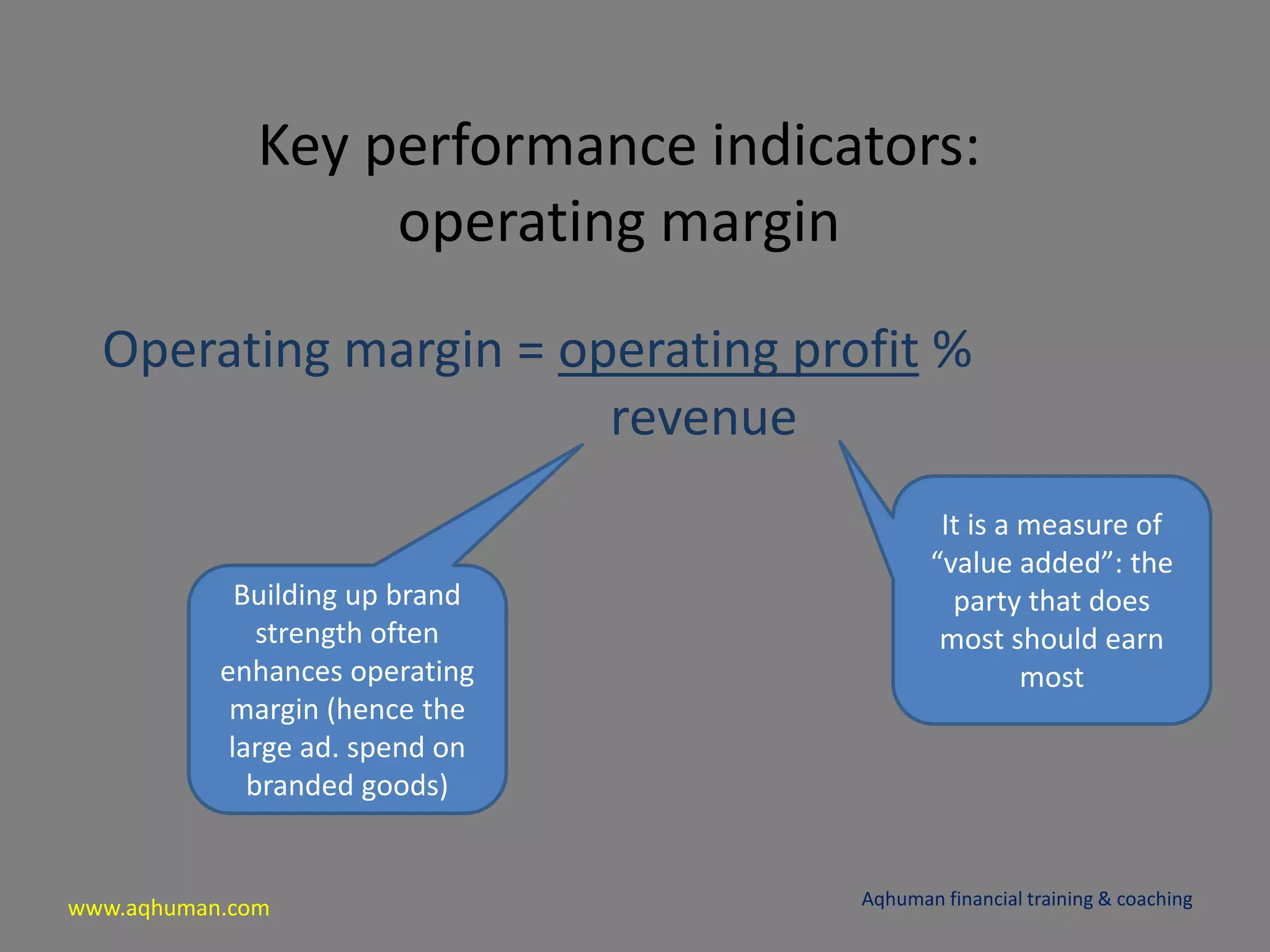
Key performance indicators:
operating margin
Operating margin = operating profit %
revenue
Aqhuman financial training & coaching
It is a measure of
“value added”: the
party that does
most should earn
most
Building up brand
strength often
enhances operating
margin (hence the
large ad. spend on
branded goods)
www.aqhuman.com
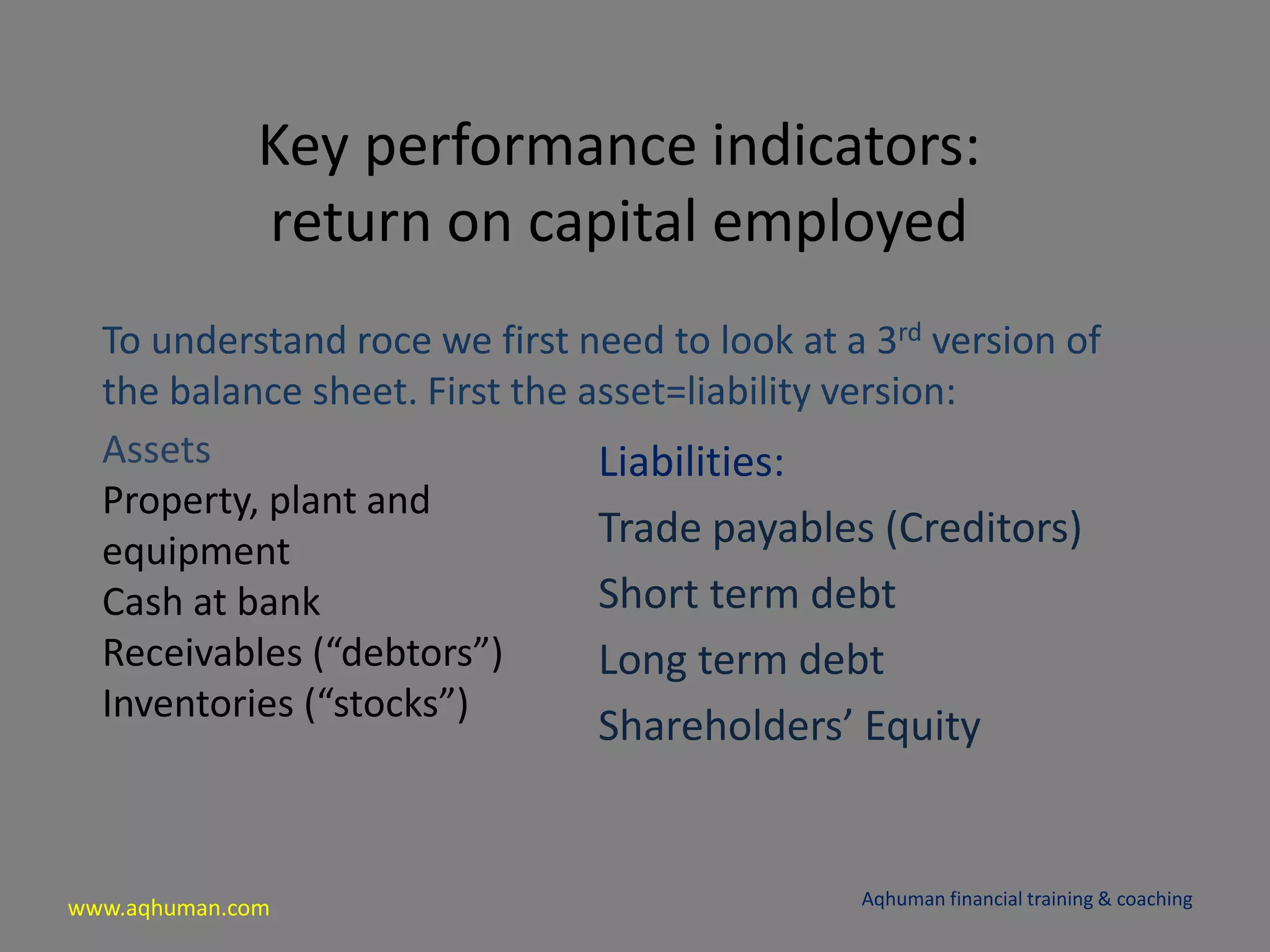
Key performance indicators:
return on capital employed
To understand roce we first need to look at a 3rd version of
the balance sheet. First the asset=liability version:
Aqhuman financial training & coaching
Assets
Property, plant and
equipment
Cash at bank
Receivables (“debtors”)
Inventories (“stocks”)
Liabilities:
Trade payables (Creditors)
Short term debt
Long term debt
Shareholders’ Equity
www.aqhuman.com
Key performance indicators:
return on capital employed
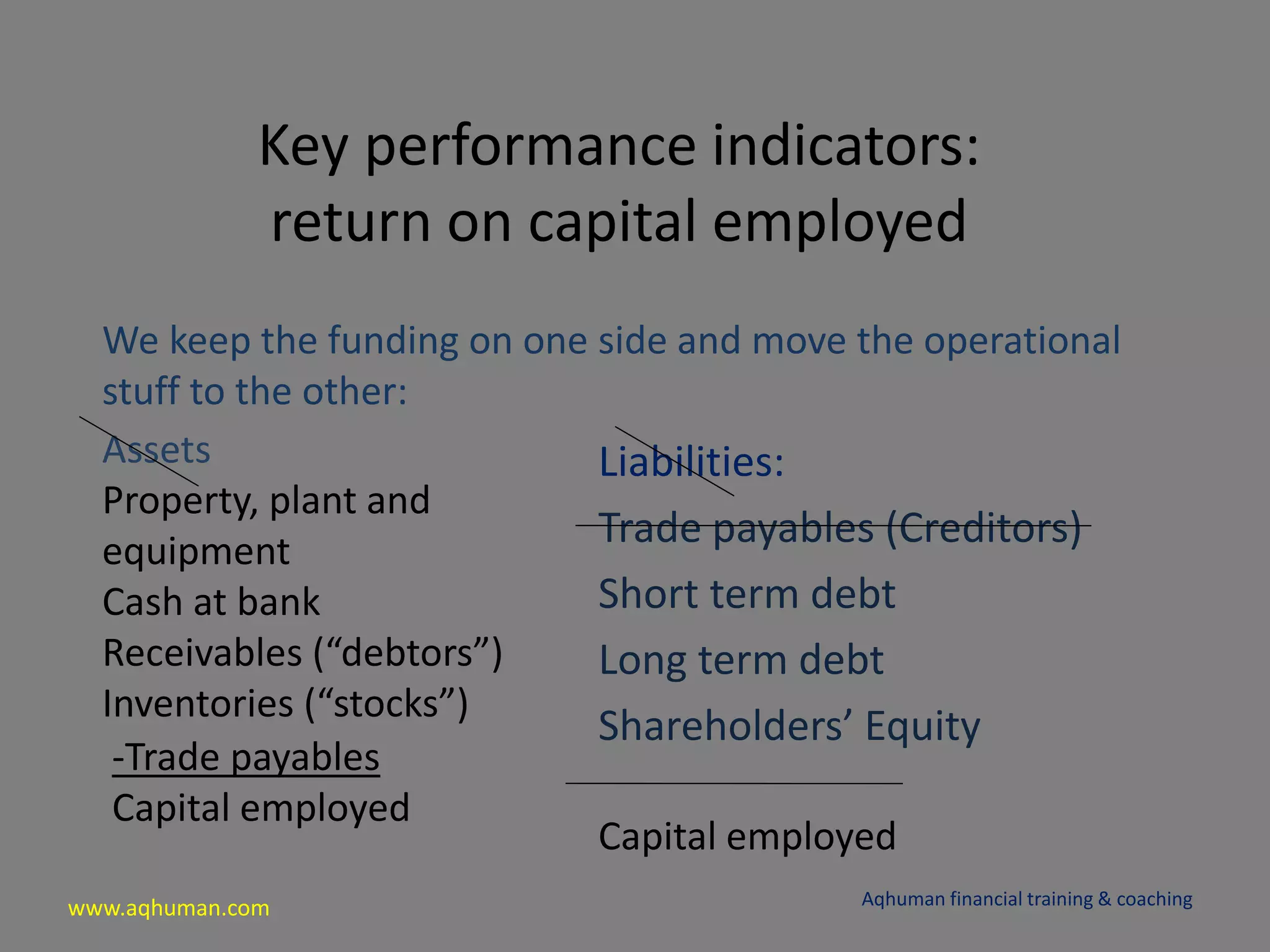
We keep the funding on one side and move the operational
stuff to the other:
Aqhuman financial training & coaching
Assets
Property, plant and
equipment
Cash at bank
Receivables (“debtors”)
Inventories (“stocks”)
Liabilities:
Trade payables (Creditors)
Short term debt
Long term debt
Shareholders’ Equity
-Trade payables
Capital employed
Capital employed
www.aqhuman.com
Key performance indicators:
return on capital employed
We keep the funding on one side and move the operational
stuff to the other:
Aqhuman financial training & coaching
Assets
Property, plant and
equipment
Cash at bank
Receivables (“debtors”)
Inventories (“stocks”)
Liabilities:
Trade payables (Creditors)
Short term debt
Long term debt
Shareholders’ Equity
-Trade payables
Capital employed
Capital employed
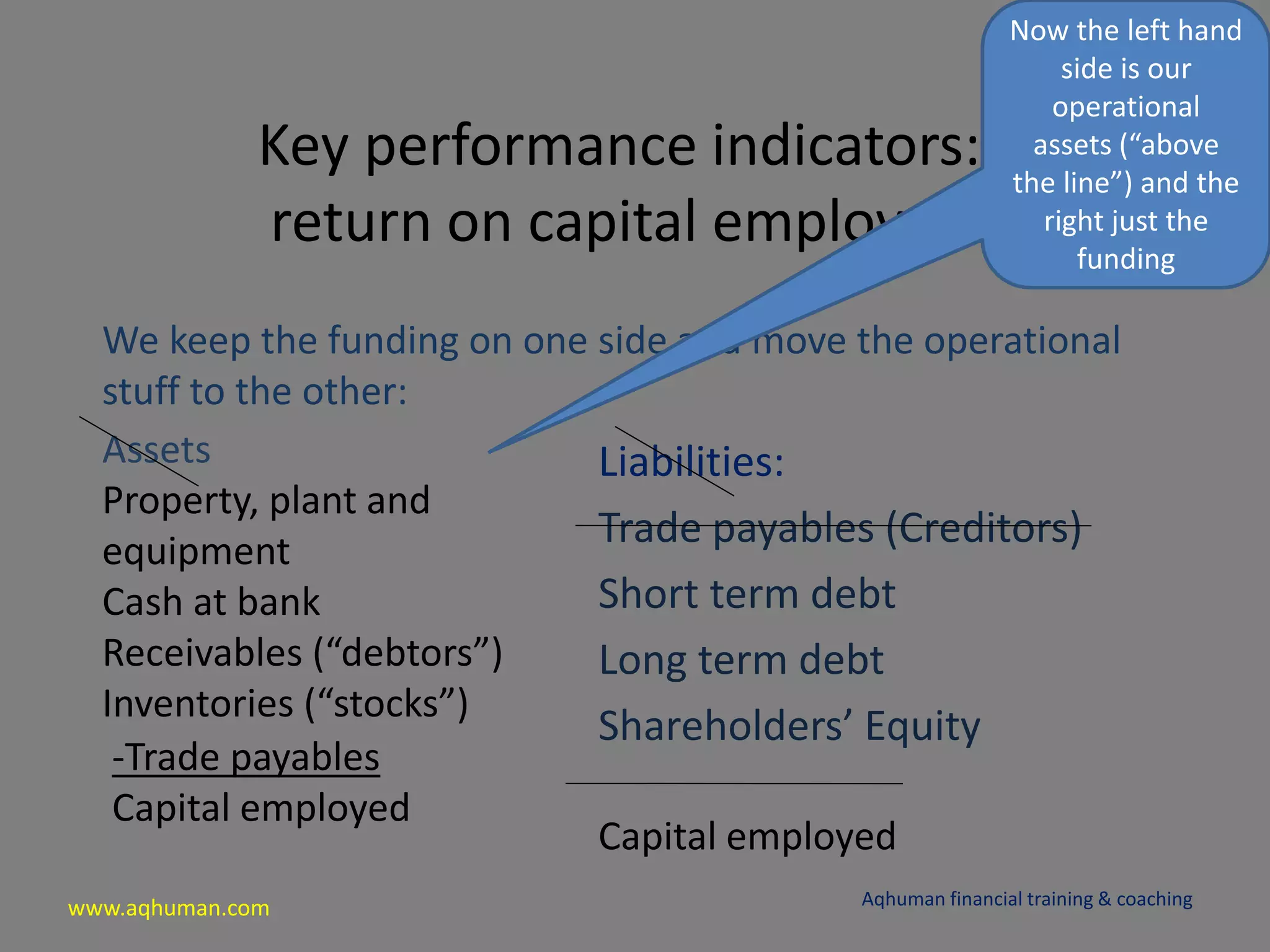
Now the left hand
side is our
operational
assets (“above
the line”) and the
right just the
funding
www.aqhuman.com
Key performance indicators:
return on capital employed
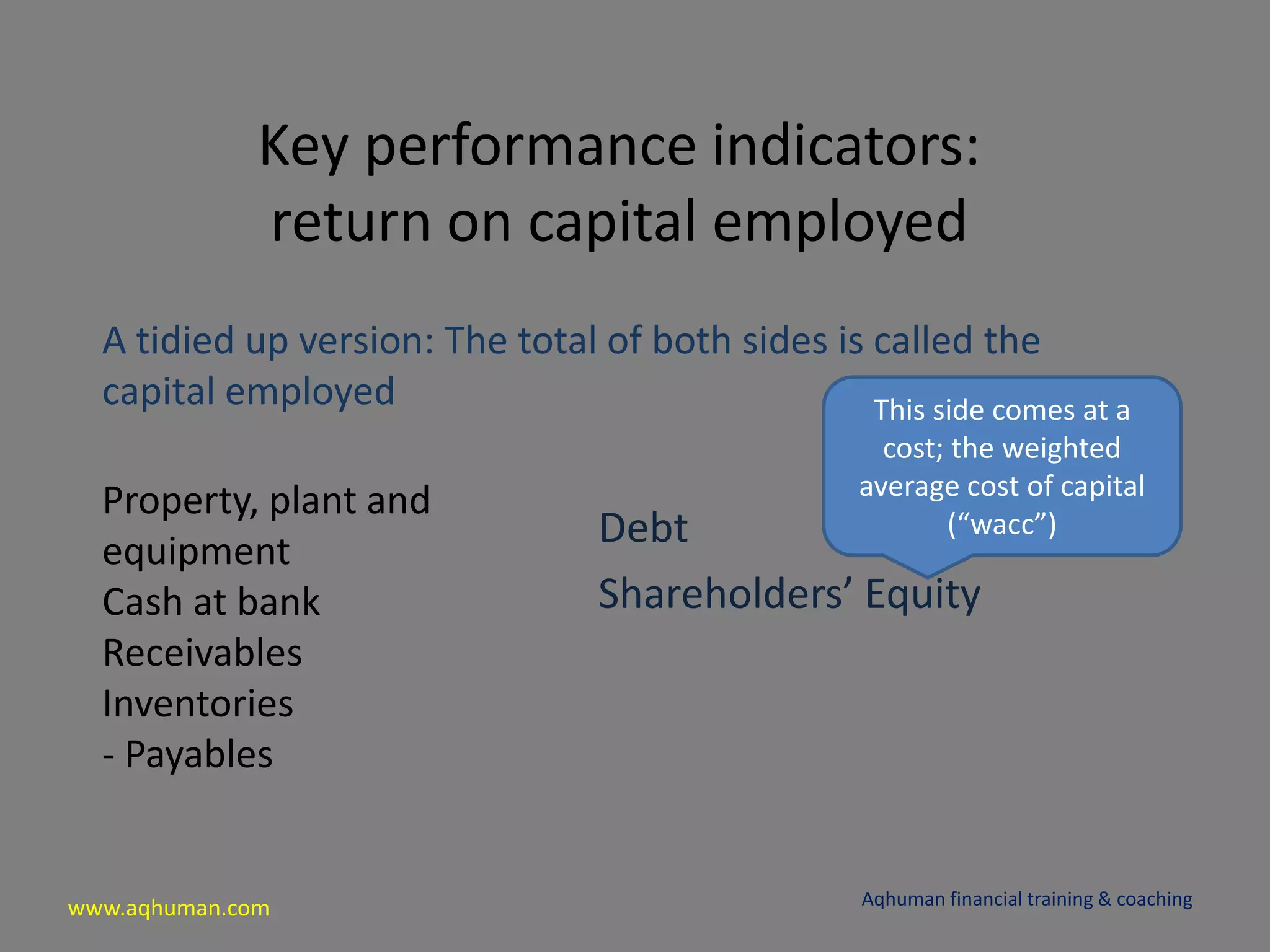
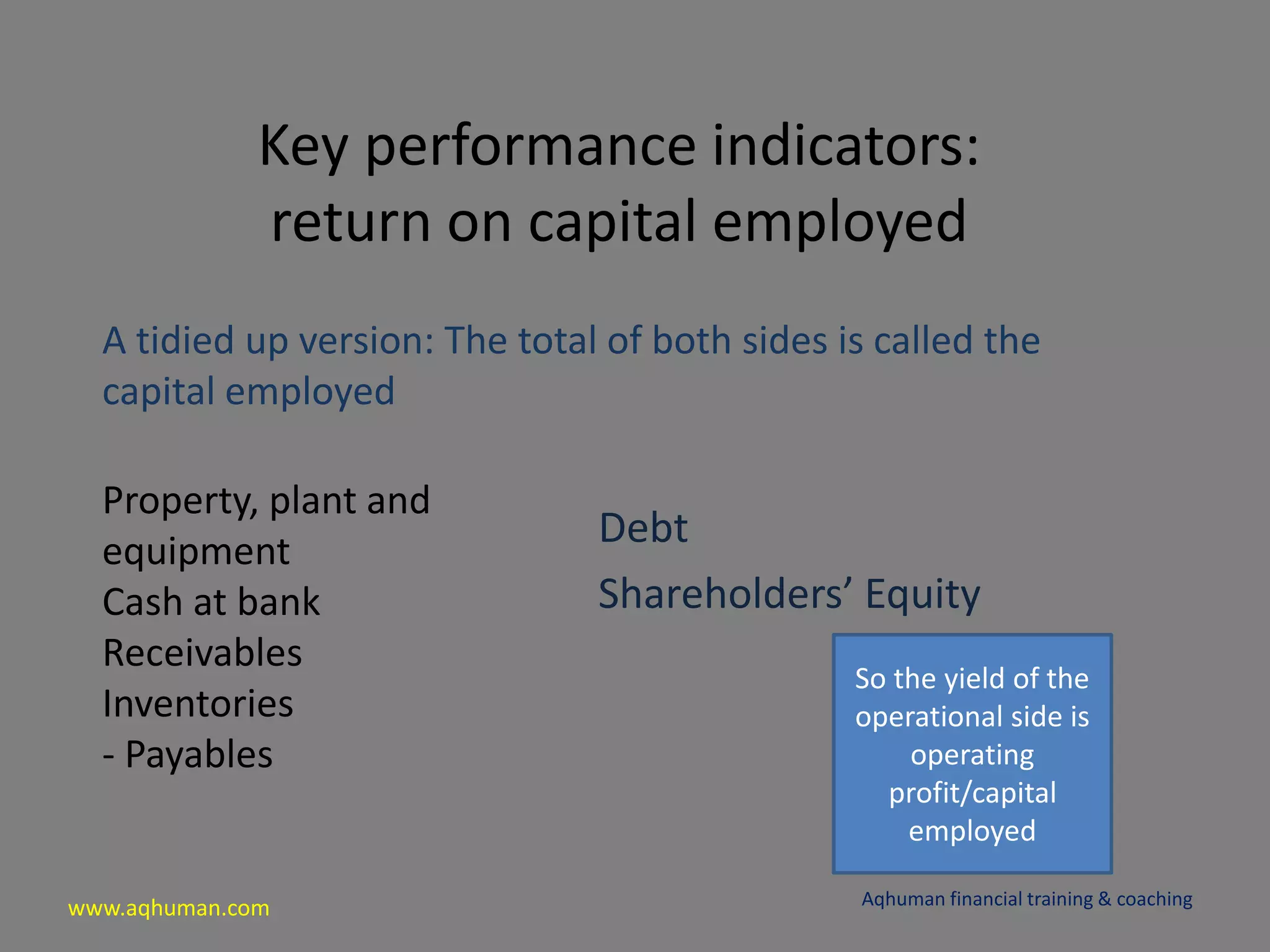
A tidied up version: The total of both sides is called the
capital employed
Aqhuman financial training & coaching
Property, plant and
equipment
Cash at bank
Receivables
Inventories
- Payables
Debt
Shareholders’ Equity
This side comes at a
cost; the weighted
average cost of capital
(“wacc”)
www.aqhuman.com
Key performance indicators:
return on capital employed
A tidied up version: The total of both sides is called the
capital employed
Aqhuman financial training & coaching
Property, plant and
equipment
Cash at bank
Receivables
Inventories
- Payables
Debt
Shareholders’ Equity
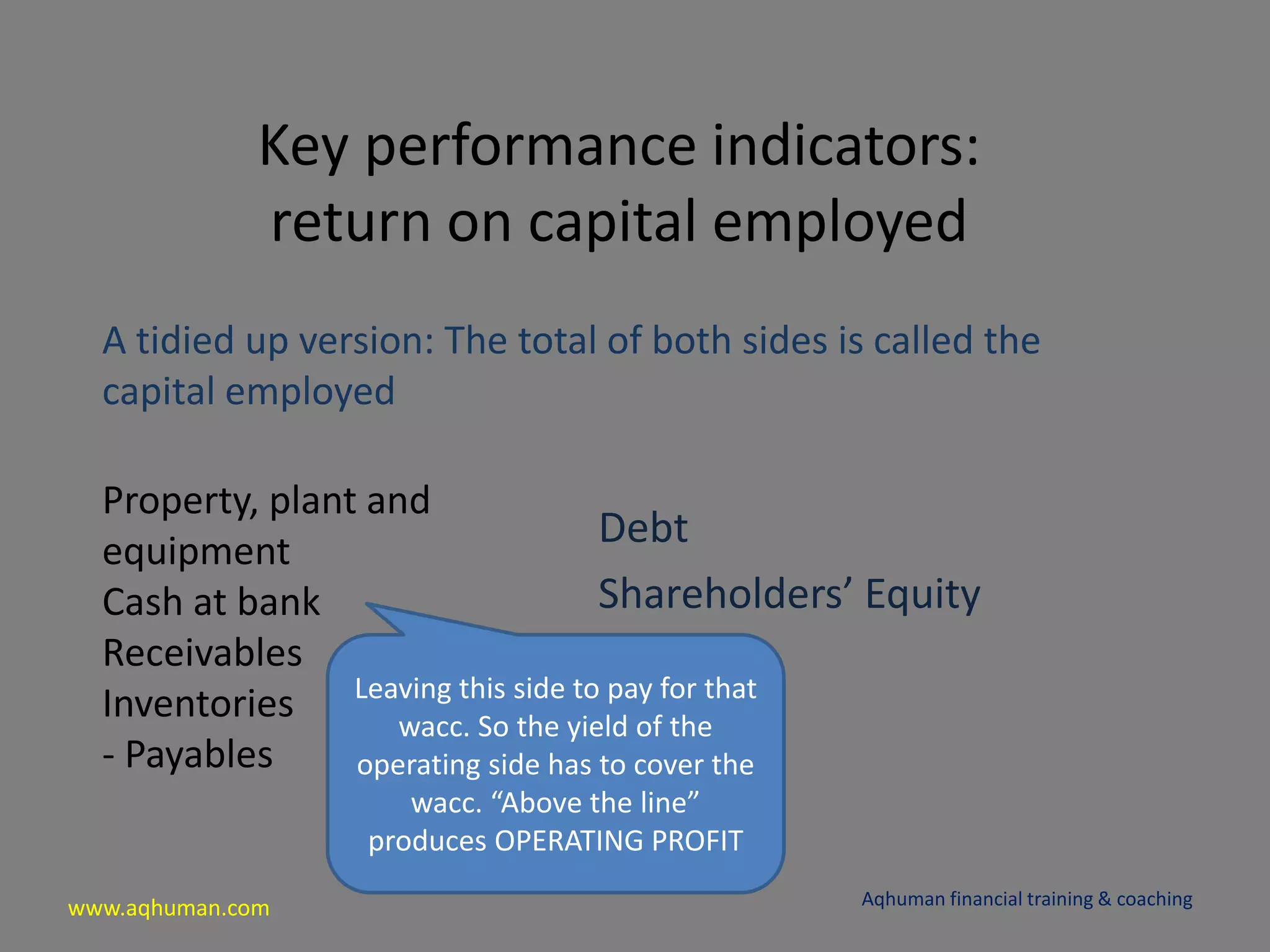
Leaving this side to pay for that
wacc. So the yield of the
operating side has to cover the
wacc. “Above the line”
produces OPERATING PROFIT
www.aqhuman.com
Key performance indicators:
return on capital employed
A tidied up version: The total of both sides is called the
capital employed
Aqhuman financial training & coaching
Property, plant and
equipment
Cash at bank
Receivables
Inventories
- Payables
Debt
Shareholders’ Equity
So the yield of the
operational side is
operating
profit/capital
employed
www.aqhuman.com
Key performance indicators:
return on capital employed
Aqhuman financial training & coaching
Property, plant and
equipment
Cash at bank
Receivables
Inventories
- payables
Debt
Shareholders’ Equity
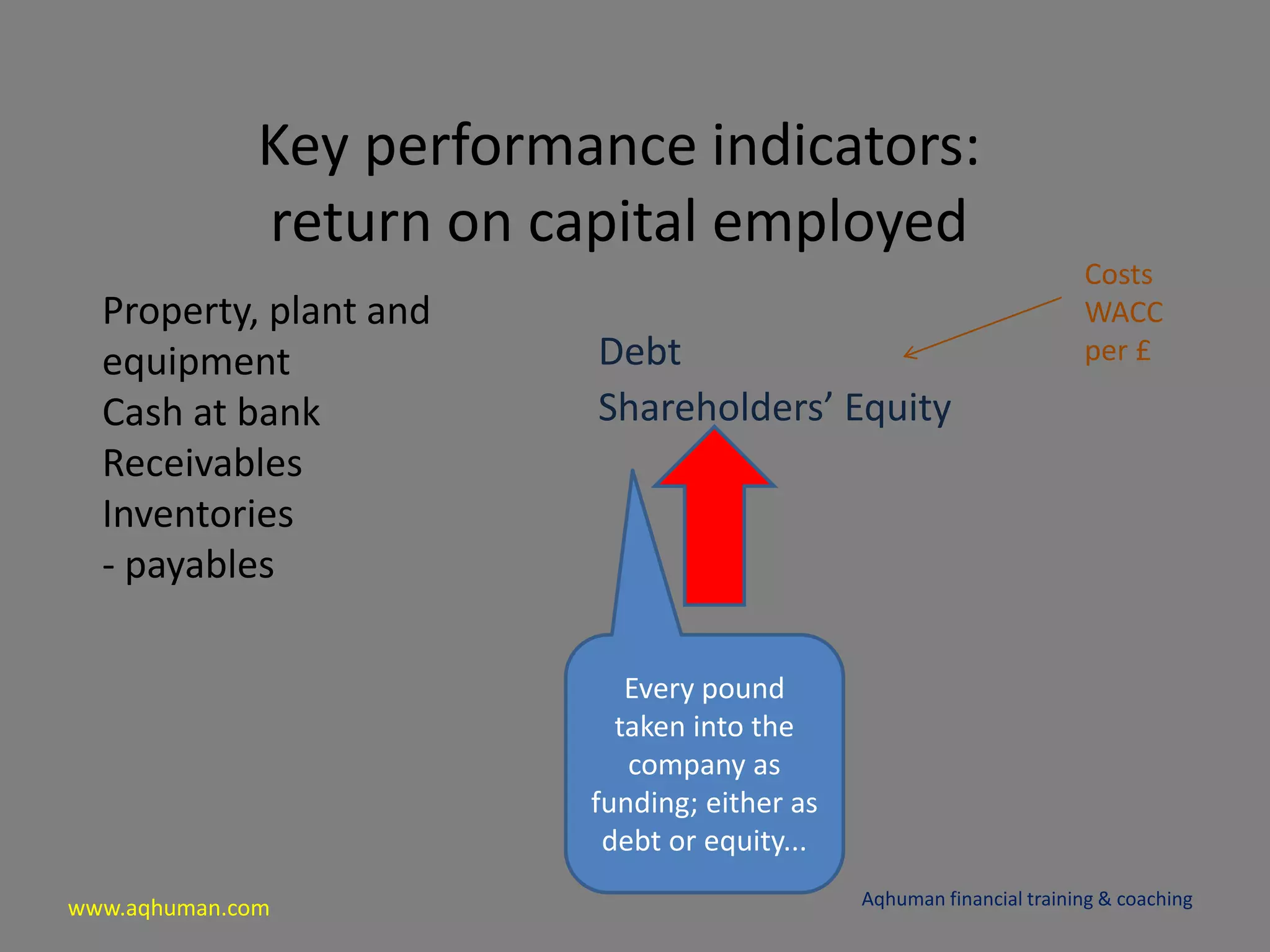
Every pound
taken into the
company as
funding; either as
debt or equity...
Costs
WACC
per £
www.aqhuman.com
Key performance indicators:
return on capital employed
Aqhuman financial training & coaching
Property, plant and
equipment
Cash at bank
Receivables
Inventories
- payables
Debt
Shareholders’ Equity
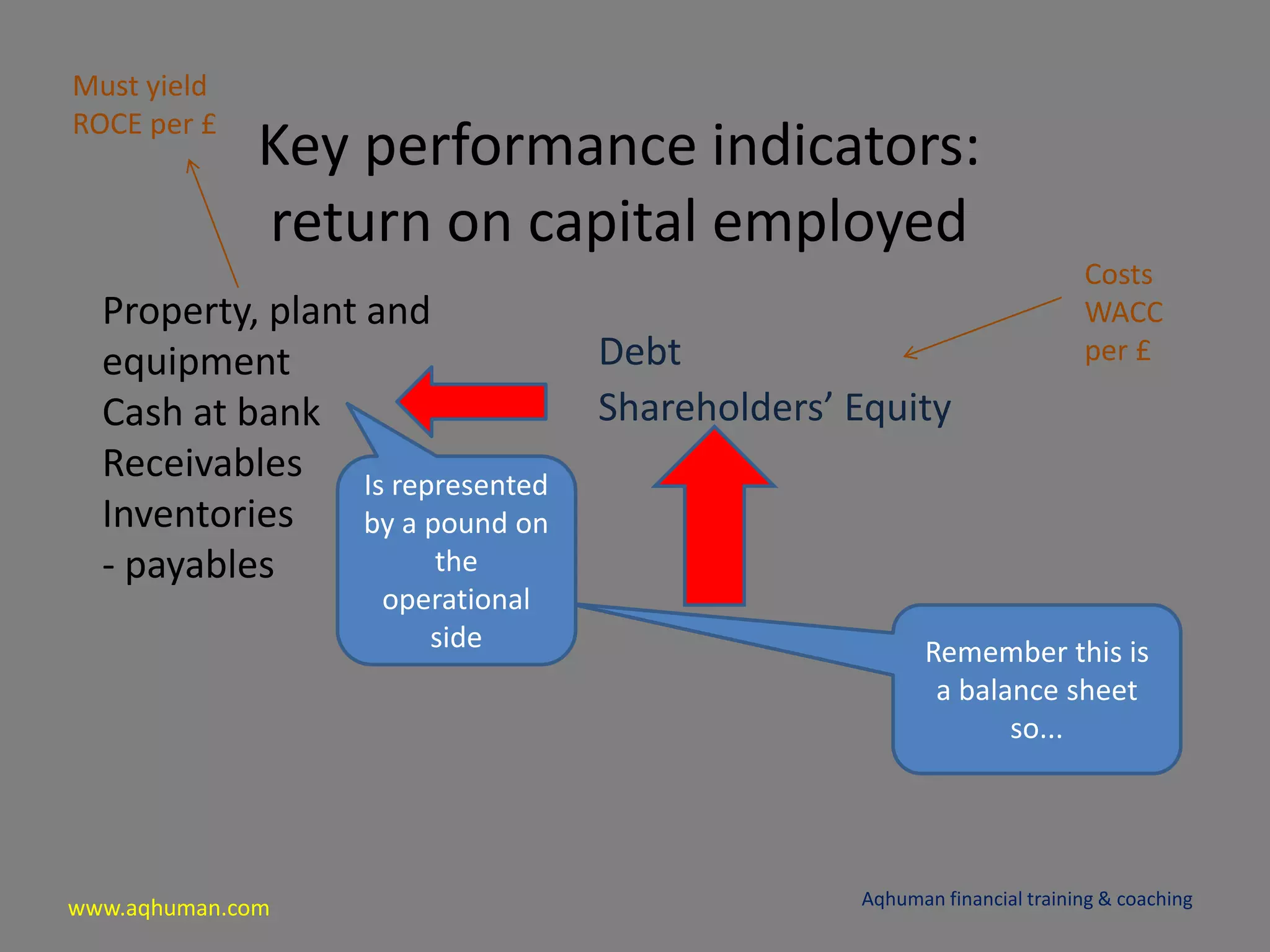
Remember this is
a balance sheet
so...
Is represented
by a pound on
the
operational
side
Must yield
ROCE per £
Costs
WACC
per £
www.aqhuman.com
Key performance indicators:
return on capital employed
Aqhuman financial training & coaching
Property, plant and
equipment
Cash at bank
Receivables
Inventories
- payables
Debt
Shareholders’ Equity
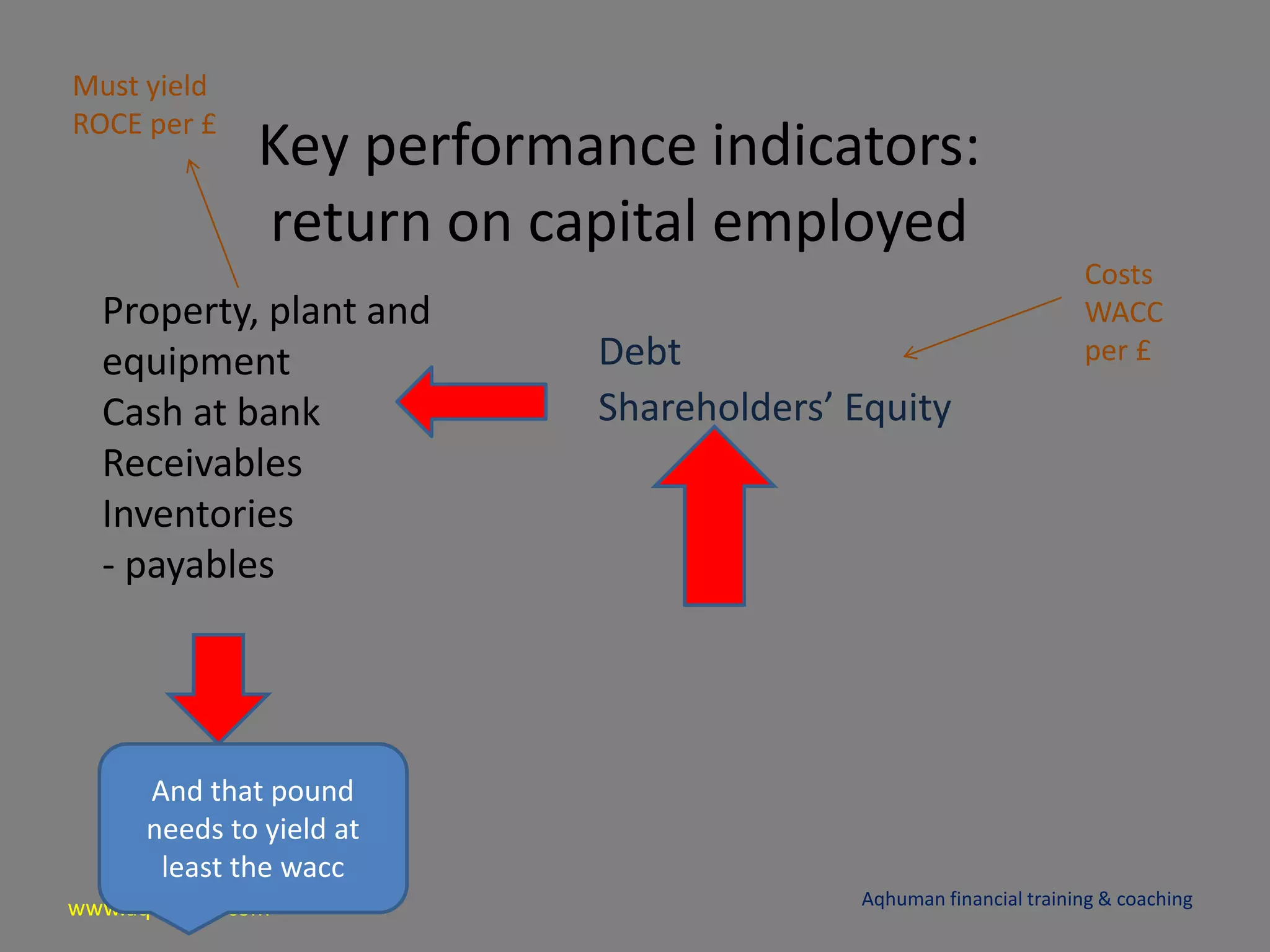
And that pound
needs to yield at
least the wacc
Must yield
ROCE per £
Costs
WACC
per £
www.aqhuman.com
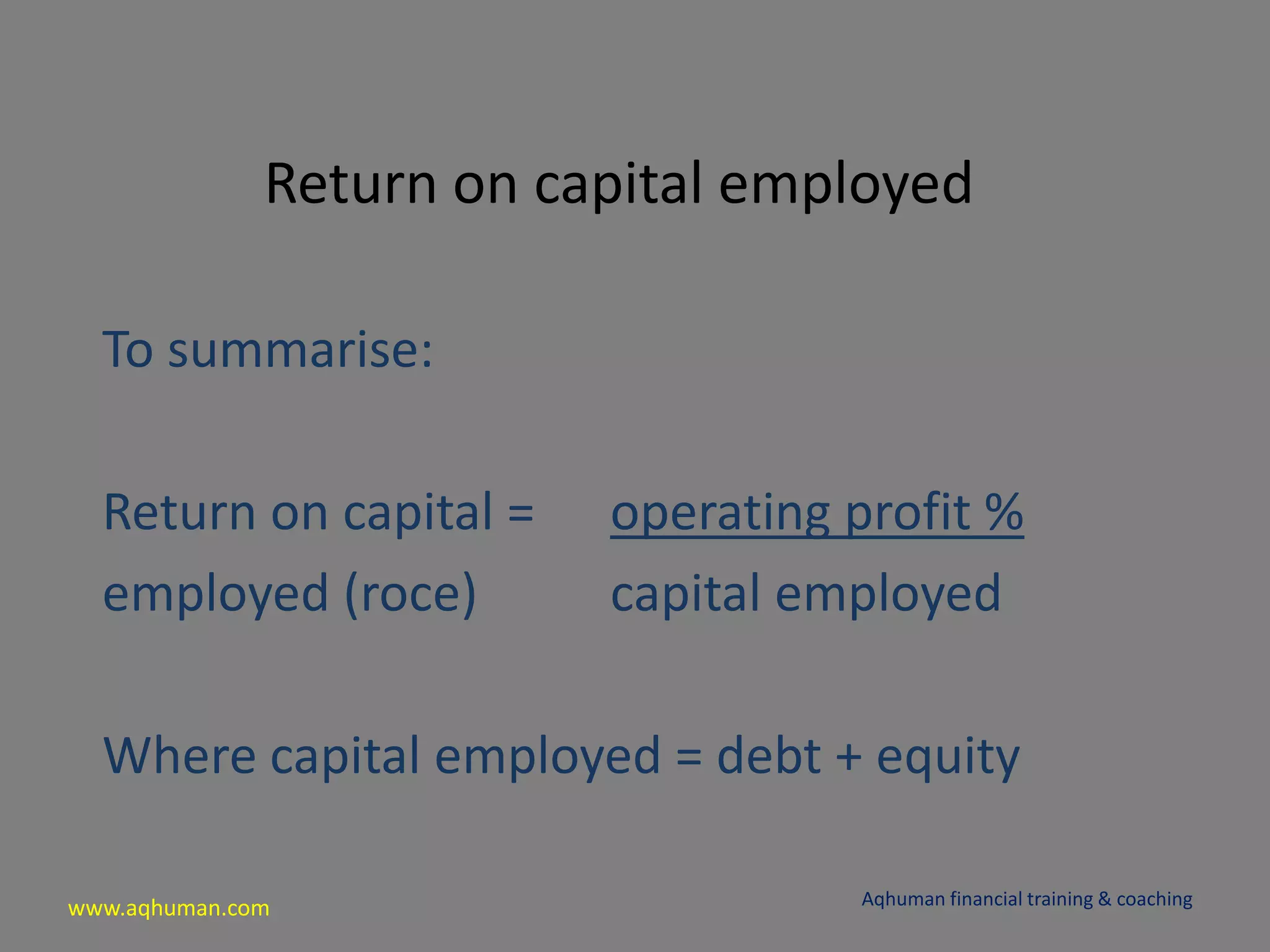
Return on capital employed
To summarise:
Return on capital = operating profit %
employed (roce) capital employed
Where capital employed = debt + equity
Aqhuman financial training & coaching
www.aqhuman.com
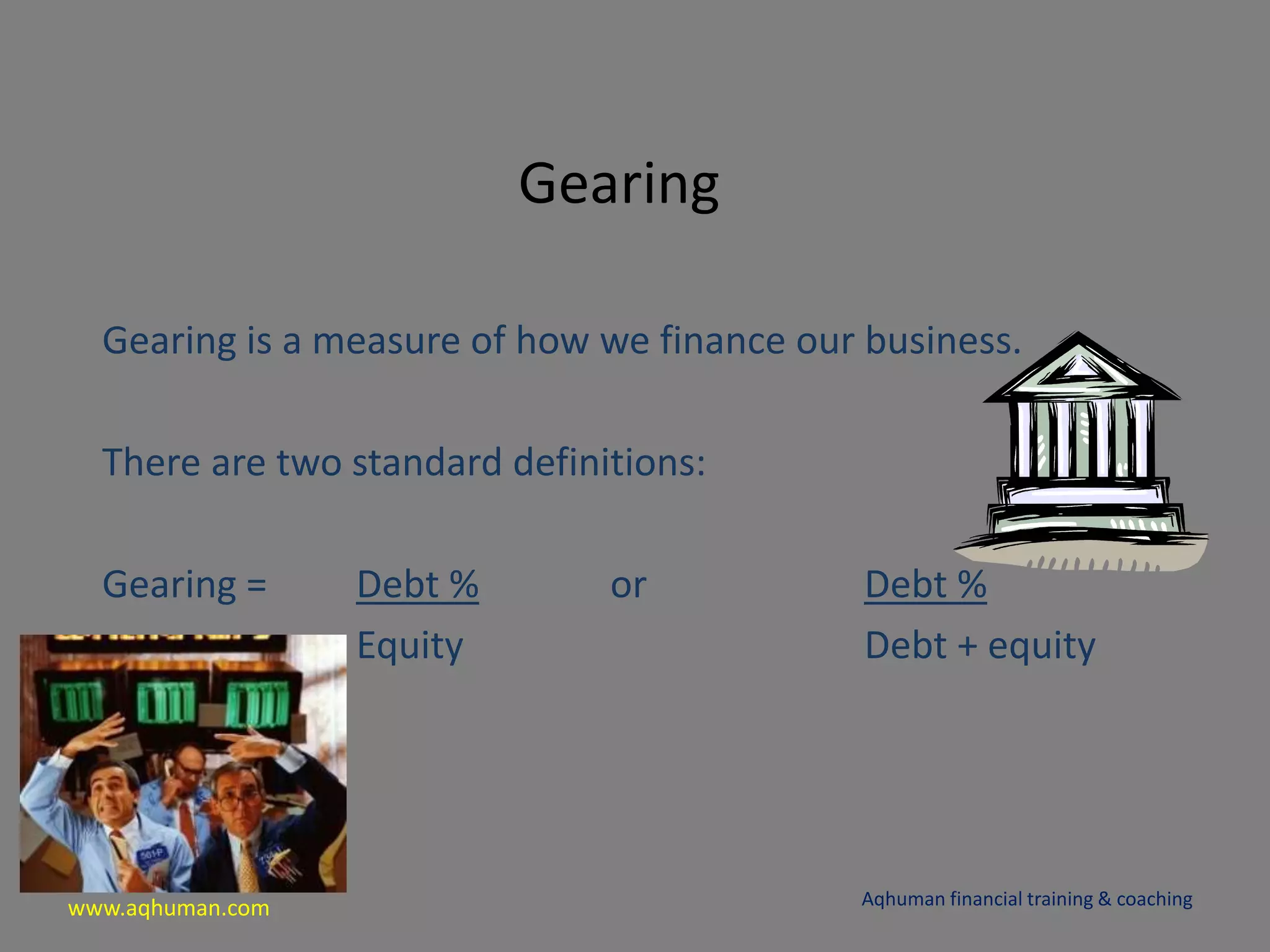
Gearing
Gearing is a measure of how we finance our business.
There are two standard definitions:
Gearing = Debt % or Debt %
Equity Debt + equity
Aqhuman financial training & coaching
www.aqhuman.com
Gearing
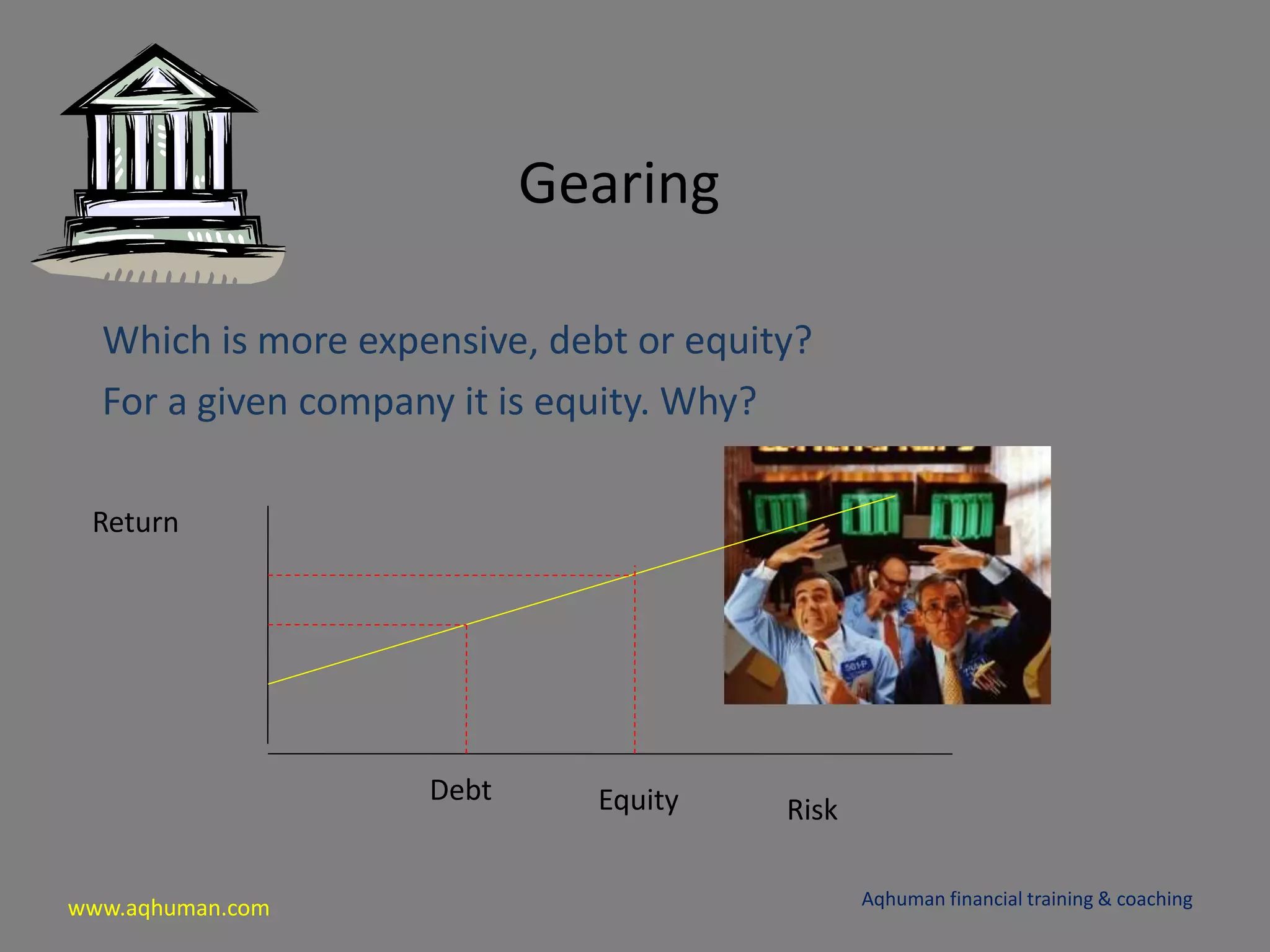
Which is more expensive, debt or equity?
For a given company it is equity. Why?
Aqhuman financial training & coaching
Return
RiskEquityDebt
www.aqhuman.com
Gearing
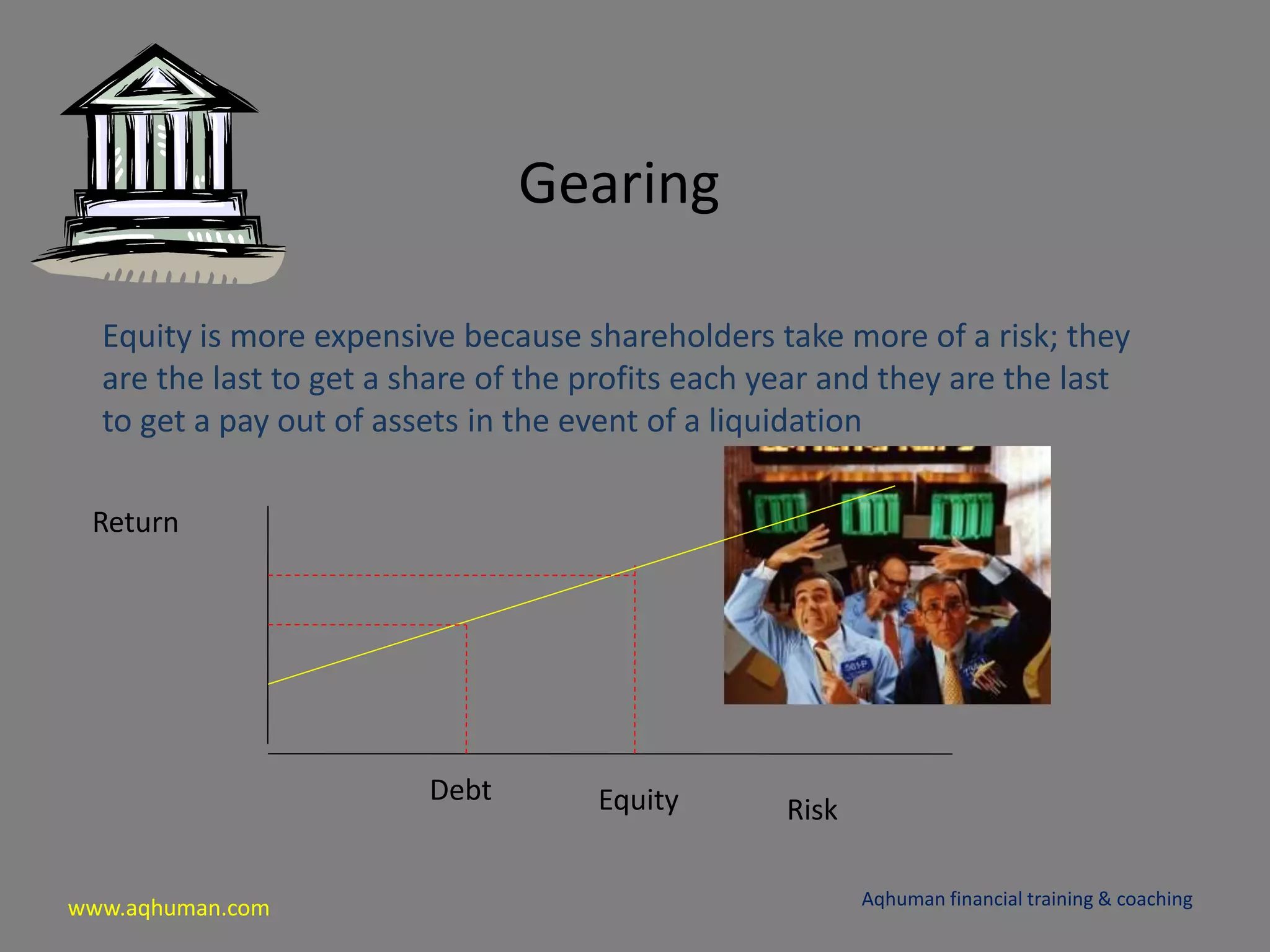
Equity is more expensive because shareholders take more of a risk; they
are the last to get a share of the profits each year and they are the last
to get a pay out of assets in the event of a liquidation
Aqhuman financial training & coaching
Return
RiskEquityDebt
www.aqhuman.com
Gearing
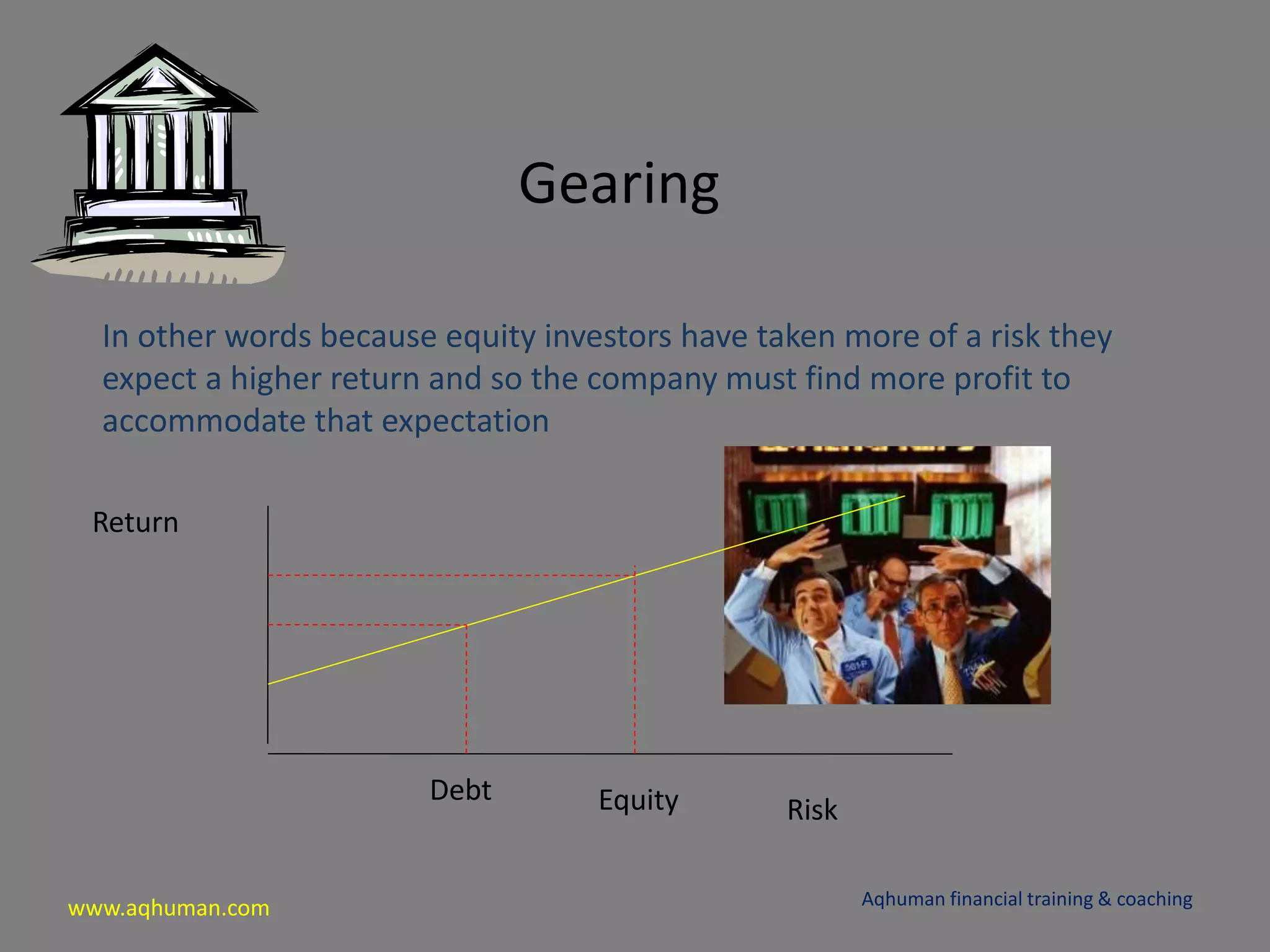
In other words because equity investors have taken more of a risk they
expect a higher return and so the company must find more profit to
accommodate that expectation
Aqhuman financial training & coaching
Return
RiskEquityDebt
www.aqhuman.com
Gearing
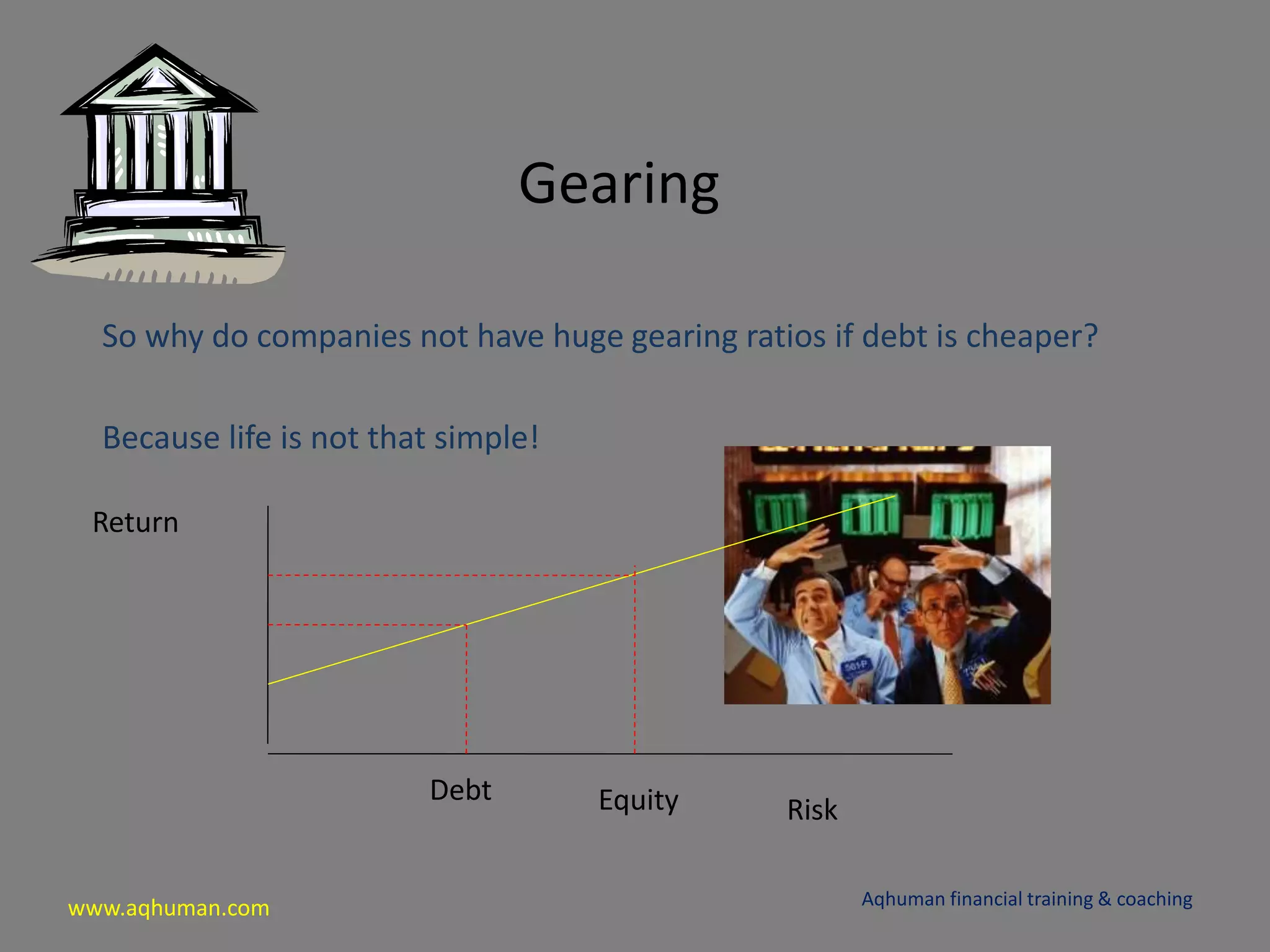
So why do companies not have huge gearing ratios if debt is cheaper?
Because life is not that simple!
Aqhuman financial training & coaching
Return
RiskEquityDebt
www.aqhuman.com
Gearing
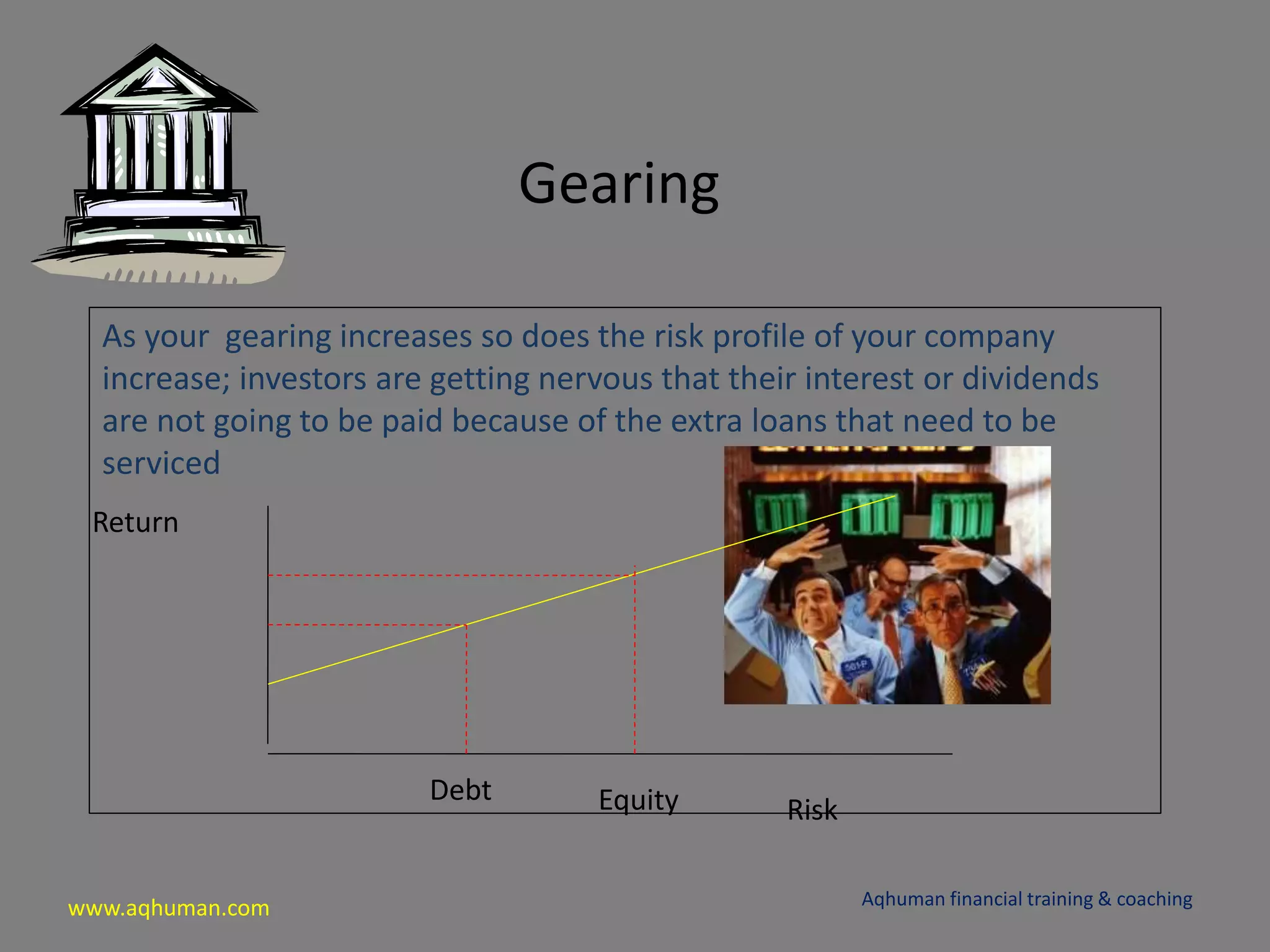
As your gearing increases so does the risk profile of your company
increase; investors are getting nervous that their interest or dividends
are not going to be paid because of the extra loans that need to be
serviced
Aqhuman financial training & coaching
Return
RiskEquityDebt
www.aqhuman.com
Gearing
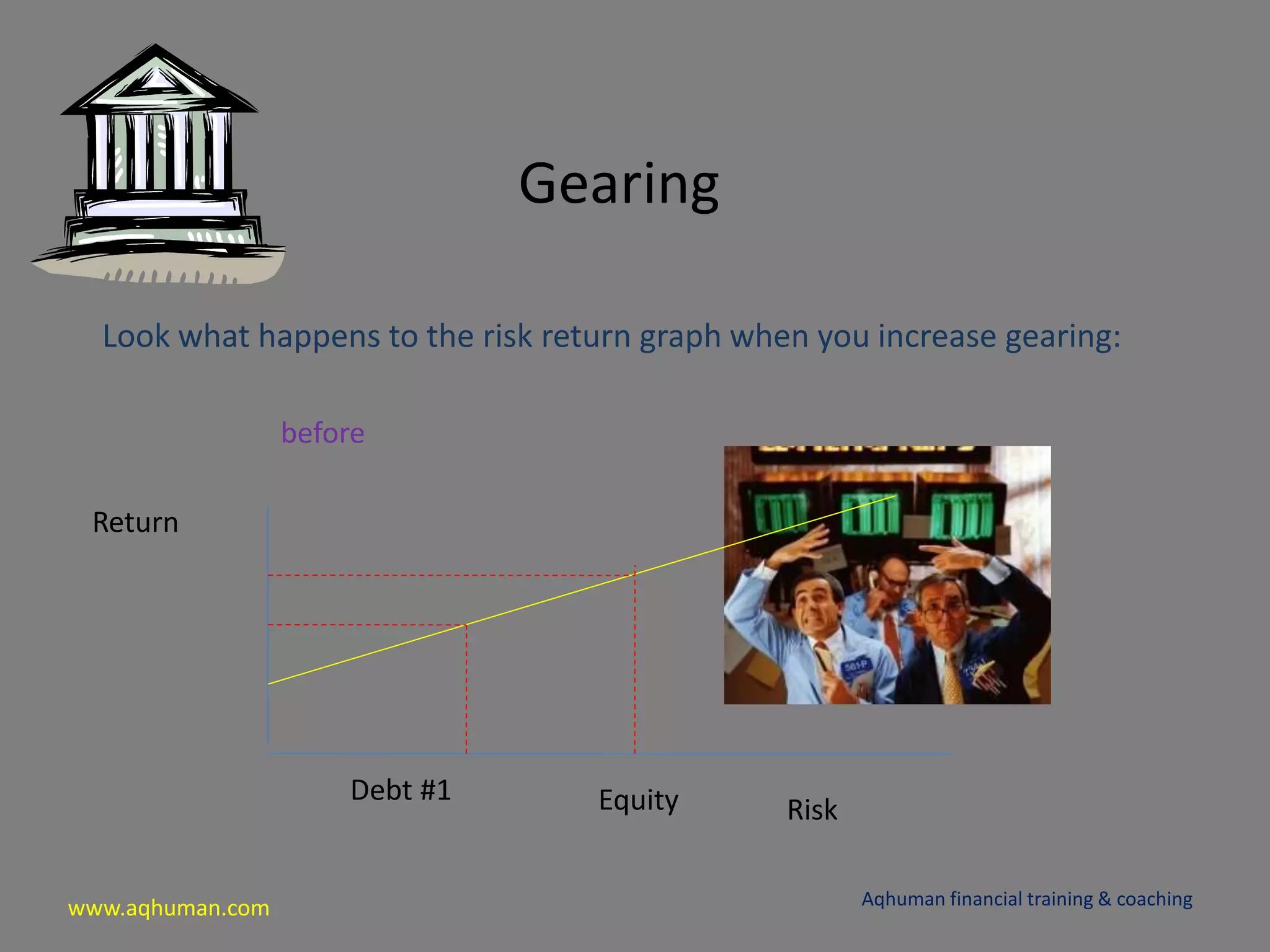
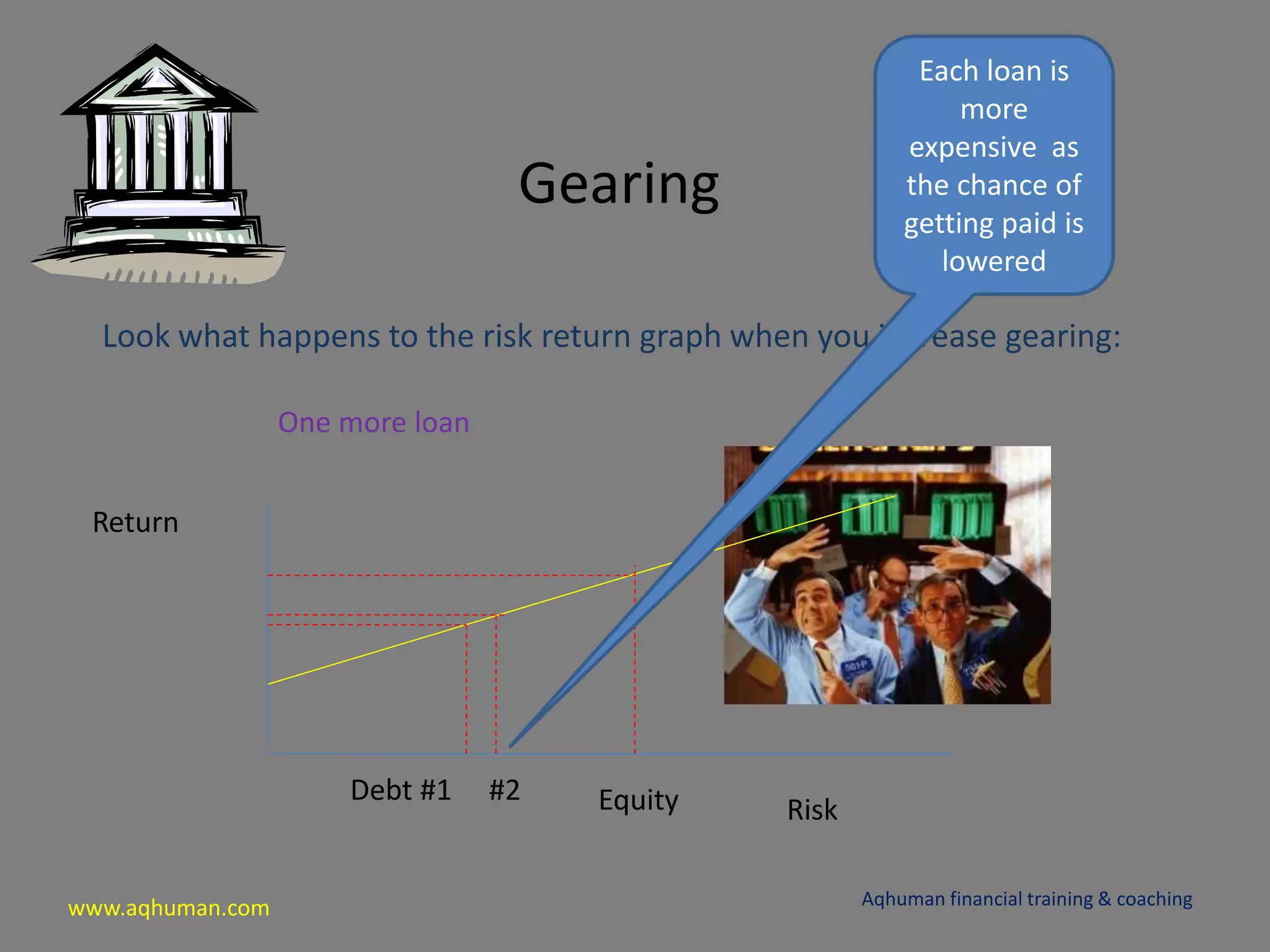
Look what happens to the risk return graph when you increase gearing:
Aqhuman financial training & coaching
Return
RiskEquityDebt #1
before
www.aqhuman.com
Gearing
Look what happens to the risk return graph when you increase gearing:
Aqhuman financial training & coaching
Return
RiskEquityDebt #1
One more loan
#2
Each loan is
more
expensive as
the chance of
getting paid is
lowered
www.aqhuman.com
Gearing
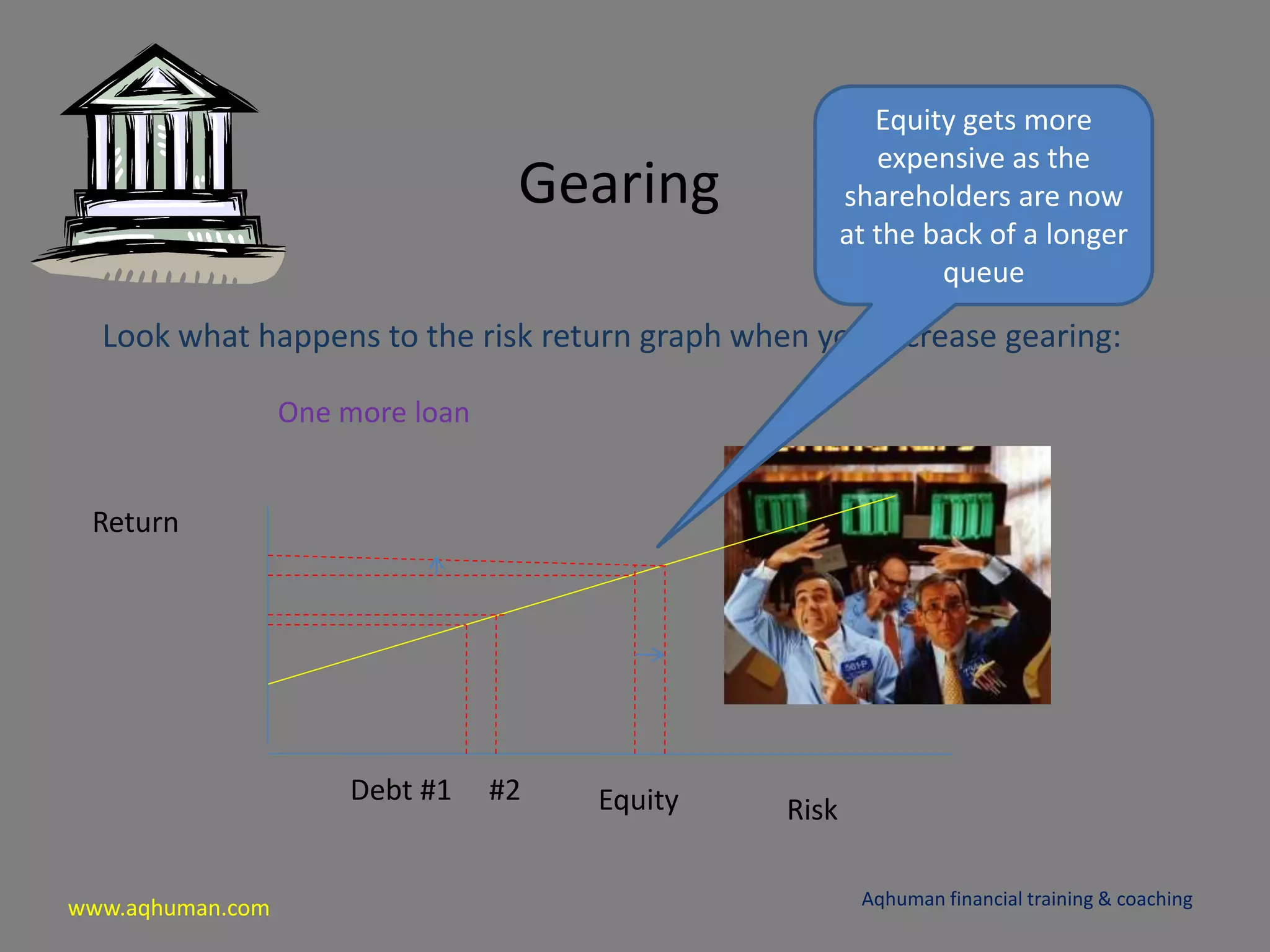
Look what happens to the risk return graph when you increase gearing:
Aqhuman financial training & coaching
Return
RiskEquityDebt #1
One more loan
#2
Equity gets more
expensive as the
shareholders are now
at the back of a longer
queue
www.aqhuman.com
Gearing
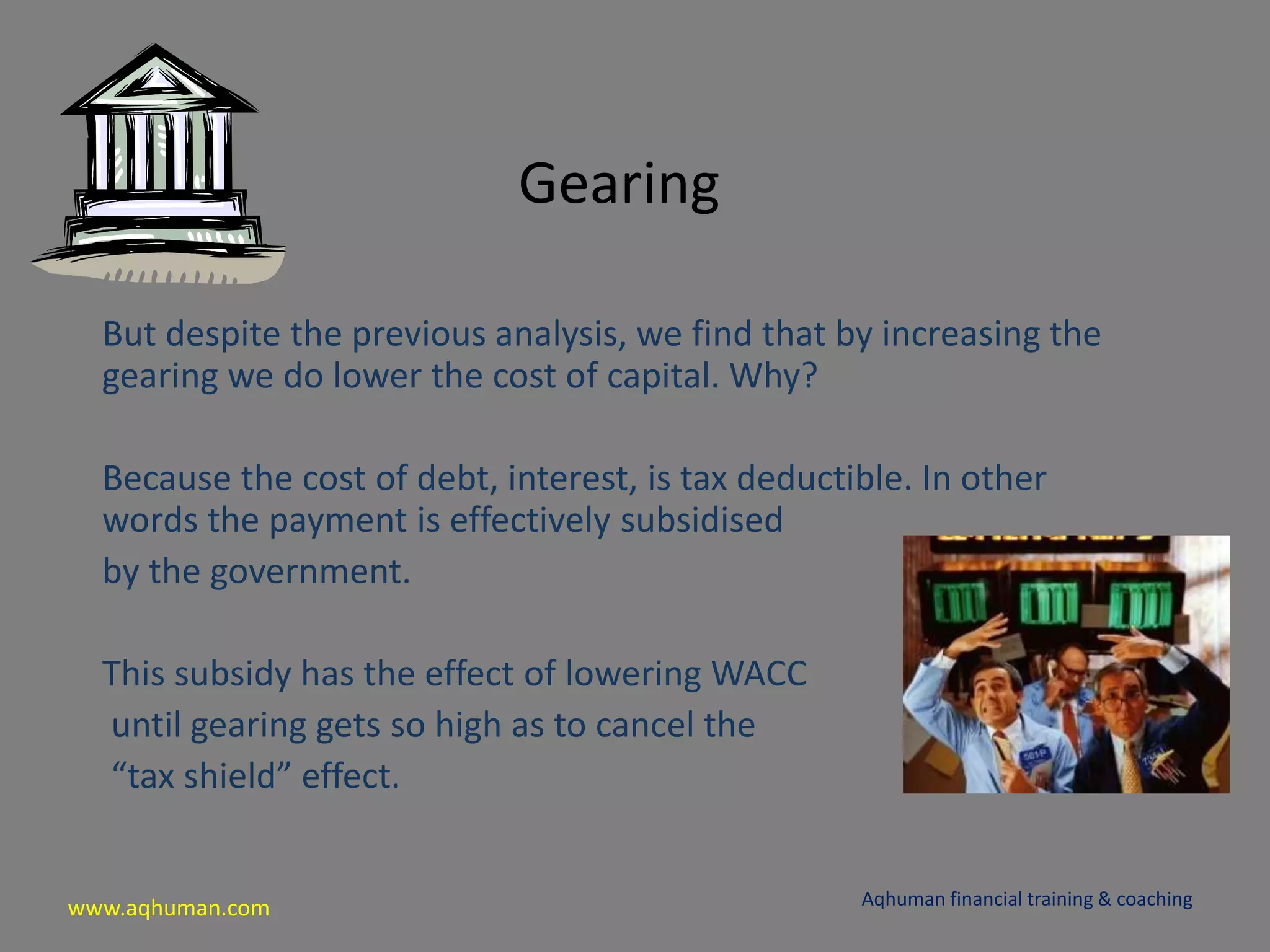
But despite the previous analysis, we find that by increasing the
gearing we do lower the cost of capital. Why?
Because the cost of debt, interest, is tax deductible. In other
words the payment is effectively subsidised
by the government.
This subsidy has the effect of lowering WACC
until gearing gets so high as to cancel the
“tax shield” effect.
Aqhuman financial training & coaching
www.aqhuman.com
Free cash flow
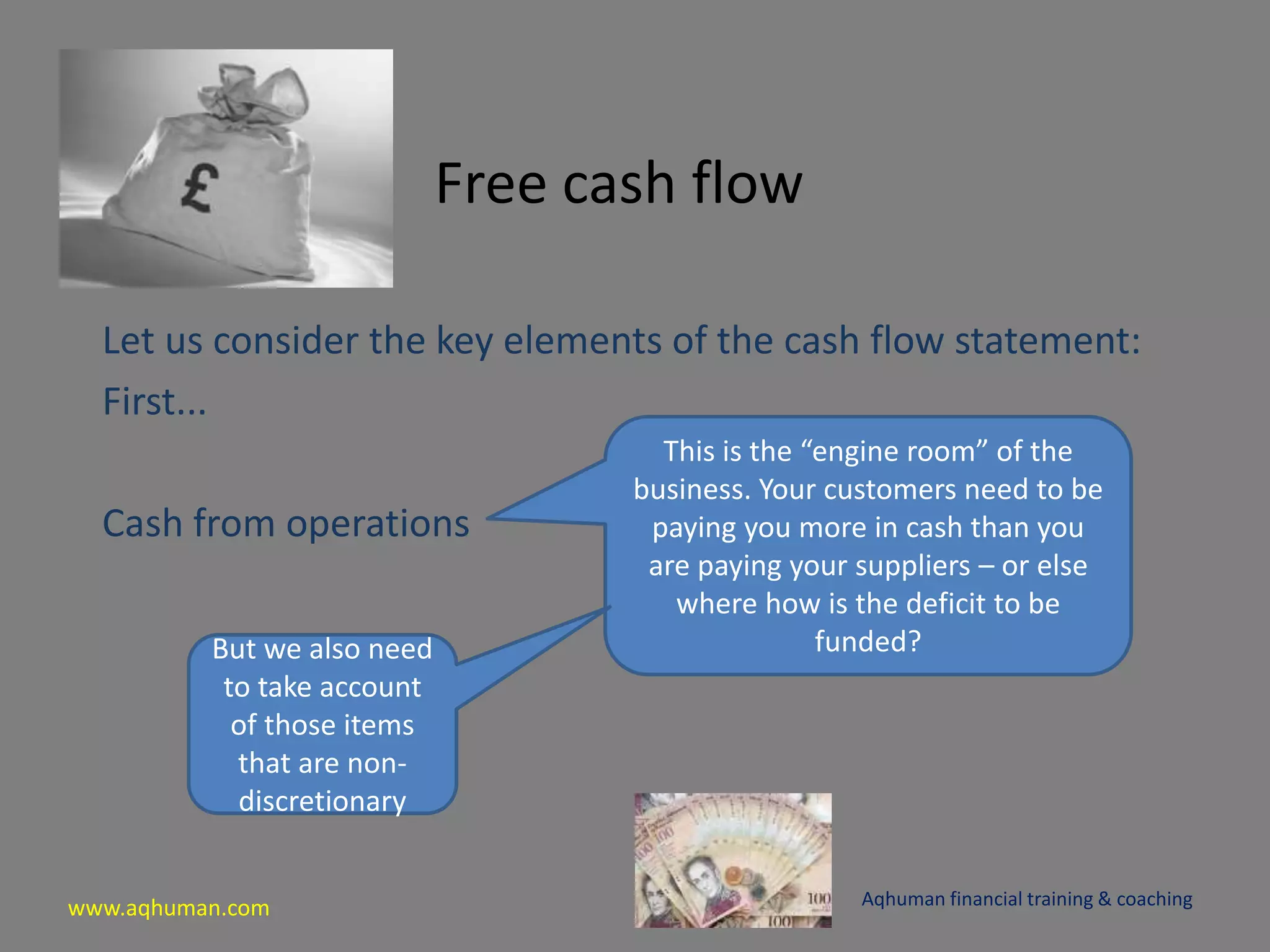
Let us consider the key elements of the cash flow statement:
First...
Cash from operations
Aqhuman financial training & coaching
This is the “engine room” of the
business. Your customers need to be
paying you more in cash than you
are paying your suppliers – or else
where how is the deficit to be
funded?But we also need
to take account
of those items
that are non-
discretionary
www.aqhuman.com
Free cash flow
Cash from operations
Less interest
Less tax
Less depreciation
= Free cash flow
Aqhuman financial training & coaching
But why
depreciation?
www.aqhuman.com
Free cash flow
Cash from operations
Less interest
Less tax
Less depreciation
= Free cash flow
Aqhuman financial training & coaching
It gives us an estimate of how much we
need to spend each year just to replace
existing fixed assets (we take the
replacement of old assets as non-
discretionary otherwise our business
becomes non-productive)
www.aqhuman.com
Aqhuman Financial Training
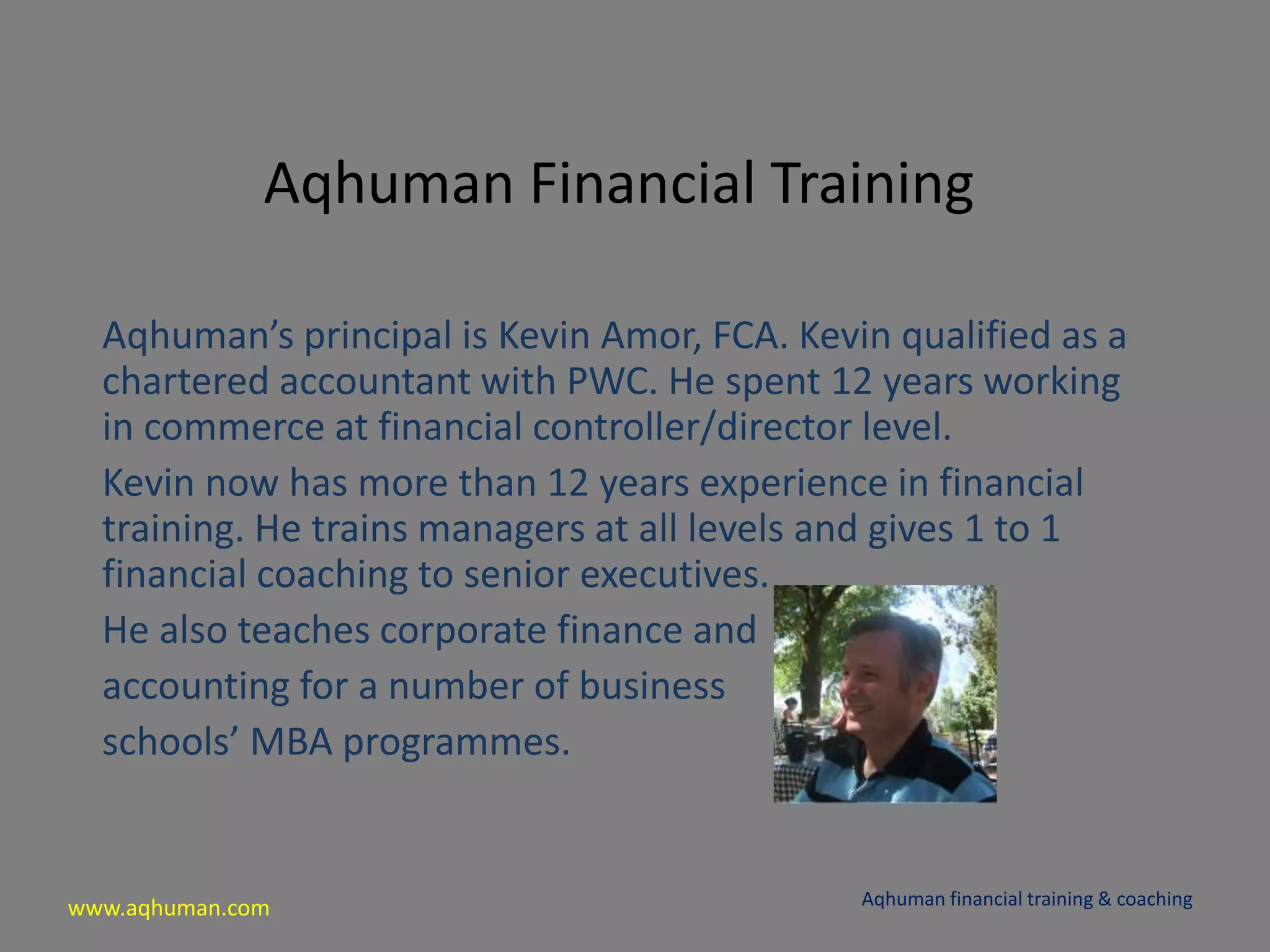
Aqhuman’s principal is Kevin Amor, FCA. Kevin qualified as a
chartered accountant with PWC. He spent 12 years working
in commerce at financial controller/director level.
Kevin now has more than 12 years experience in financial
training. He trains managers at all levels and gives 1 to 1
financial coaching to senior executives.
He also teaches corporate finance and
accounting for a number of business
schools’ MBA programmes.
Aqhuman financial training & coaching

Key Performance Indicators

  • 1.
  • 2.
    www.aqhuman.com Key performance indicators: operatingmargin Operating margin = operating profit % revenue Aqhuman financial training & coaching
  • 3.
    www.aqhuman.com Key performance indicators: operatingmargin Operating margin = operating profit % revenue Aqhuman financial training & coaching It is a measure of “value added”: the party that does most should earn most Building up brand strength often enhances operating margin (hence the large ad. spend on branded goods)
  • 4.
    www.aqhuman.com Key performance indicators: returnon capital employed To understand roce we first need to look at a 3rd version of the balance sheet. First the asset=liability version: Aqhuman financial training & coaching Assets Property, plant and equipment Cash at bank Receivables (“debtors”) Inventories (“stocks”) Liabilities: Trade payables (Creditors) Short term debt Long term debt Shareholders’ Equity
  • 5.
    www.aqhuman.com Key performance indicators: returnon capital employed We keep the funding on one side and move the operational stuff to the other: Aqhuman financial training & coaching Assets Property, plant and equipment Cash at bank Receivables (“debtors”) Inventories (“stocks”) Liabilities: Trade payables (Creditors) Short term debt Long term debt Shareholders’ Equity -Trade payables Capital employed Capital employed
  • 6.
    www.aqhuman.com Key performance indicators: returnon capital employed We keep the funding on one side and move the operational stuff to the other: Aqhuman financial training & coaching Assets Property, plant and equipment Cash at bank Receivables (“debtors”) Inventories (“stocks”) Liabilities: Trade payables (Creditors) Short term debt Long term debt Shareholders’ Equity -Trade payables Capital employed Capital employed Now the left hand side is our operational assets (“above the line”) and the right just the funding
  • 7.
    www.aqhuman.com Key performance indicators: returnon capital employed A tidied up version: The total of both sides is called the capital employed Aqhuman financial training & coaching Property, plant and equipment Cash at bank Receivables Inventories - Payables Debt Shareholders’ Equity This side comes at a cost; the weighted average cost of capital (“wacc”)
  • 8.
    www.aqhuman.com Key performance indicators: returnon capital employed A tidied up version: The total of both sides is called the capital employed Aqhuman financial training & coaching Property, plant and equipment Cash at bank Receivables Inventories - Payables Debt Shareholders’ Equity Leaving this side to pay for that wacc. So the yield of the operating side has to cover the wacc. “Above the line” produces OPERATING PROFIT
  • 9.
    www.aqhuman.com Key performance indicators: returnon capital employed A tidied up version: The total of both sides is called the capital employed Aqhuman financial training & coaching Property, plant and equipment Cash at bank Receivables Inventories - Payables Debt Shareholders’ Equity So the yield of the operational side is operating profit/capital employed
  • 10.
    www.aqhuman.com Key performance indicators: returnon capital employed Aqhuman financial training & coaching Property, plant and equipment Cash at bank Receivables Inventories - payables Debt Shareholders’ Equity Every pound taken into the company as funding; either as debt or equity... Costs WACC per £
  • 11.
    www.aqhuman.com Key performance indicators: returnon capital employed Aqhuman financial training & coaching Property, plant and equipment Cash at bank Receivables Inventories - payables Debt Shareholders’ Equity Remember this is a balance sheet so... Is represented by a pound on the operational side Must yield ROCE per £ Costs WACC per £
  • 12.
    www.aqhuman.com Key performance indicators: returnon capital employed Aqhuman financial training & coaching Property, plant and equipment Cash at bank Receivables Inventories - payables Debt Shareholders’ Equity And that pound needs to yield at least the wacc Must yield ROCE per £ Costs WACC per £
  • 13.
    www.aqhuman.com Return on capitalemployed To summarise: Return on capital = operating profit % employed (roce) capital employed Where capital employed = debt + equity Aqhuman financial training & coaching
  • 14.
    www.aqhuman.com Gearing Gearing is ameasure of how we finance our business. There are two standard definitions: Gearing = Debt % or Debt % Equity Debt + equity Aqhuman financial training & coaching
  • 15.
    www.aqhuman.com Gearing Which is moreexpensive, debt or equity? For a given company it is equity. Why? Aqhuman financial training & coaching Return RiskEquityDebt
  • 16.
    www.aqhuman.com Gearing Equity is moreexpensive because shareholders take more of a risk; they are the last to get a share of the profits each year and they are the last to get a pay out of assets in the event of a liquidation Aqhuman financial training & coaching Return RiskEquityDebt
  • 17.
    www.aqhuman.com Gearing In other wordsbecause equity investors have taken more of a risk they expect a higher return and so the company must find more profit to accommodate that expectation Aqhuman financial training & coaching Return RiskEquityDebt
  • 18.
    www.aqhuman.com Gearing So why docompanies not have huge gearing ratios if debt is cheaper? Because life is not that simple! Aqhuman financial training & coaching Return RiskEquityDebt
  • 19.
    www.aqhuman.com Gearing As your gearingincreases so does the risk profile of your company increase; investors are getting nervous that their interest or dividends are not going to be paid because of the extra loans that need to be serviced Aqhuman financial training & coaching Return RiskEquityDebt
  • 20.
    www.aqhuman.com Gearing Look what happensto the risk return graph when you increase gearing: Aqhuman financial training & coaching Return RiskEquityDebt #1 before
  • 21.
    www.aqhuman.com Gearing Look what happensto the risk return graph when you increase gearing: Aqhuman financial training & coaching Return RiskEquityDebt #1 One more loan #2 Each loan is more expensive as the chance of getting paid is lowered
  • 22.
    www.aqhuman.com Gearing Look what happensto the risk return graph when you increase gearing: Aqhuman financial training & coaching Return RiskEquityDebt #1 One more loan #2 Equity gets more expensive as the shareholders are now at the back of a longer queue
  • 23.
    www.aqhuman.com Gearing But despite theprevious analysis, we find that by increasing the gearing we do lower the cost of capital. Why? Because the cost of debt, interest, is tax deductible. In other words the payment is effectively subsidised by the government. This subsidy has the effect of lowering WACC until gearing gets so high as to cancel the “tax shield” effect. Aqhuman financial training & coaching
  • 24.
    www.aqhuman.com Free cash flow Letus consider the key elements of the cash flow statement: First... Cash from operations Aqhuman financial training & coaching This is the “engine room” of the business. Your customers need to be paying you more in cash than you are paying your suppliers – or else where how is the deficit to be funded?But we also need to take account of those items that are non- discretionary
  • 25.
    www.aqhuman.com Free cash flow Cashfrom operations Less interest Less tax Less depreciation = Free cash flow Aqhuman financial training & coaching But why depreciation?
  • 26.
    www.aqhuman.com Free cash flow Cashfrom operations Less interest Less tax Less depreciation = Free cash flow Aqhuman financial training & coaching It gives us an estimate of how much we need to spend each year just to replace existing fixed assets (we take the replacement of old assets as non- discretionary otherwise our business becomes non-productive)
  • 27.
    www.aqhuman.com Aqhuman Financial Training Aqhuman’sprincipal is Kevin Amor, FCA. Kevin qualified as a chartered accountant with PWC. He spent 12 years working in commerce at financial controller/director level. Kevin now has more than 12 years experience in financial training. He trains managers at all levels and gives 1 to 1 financial coaching to senior executives. He also teaches corporate finance and accounting for a number of business schools’ MBA programmes. Aqhuman financial training & coaching