Dealing with  Competition Noel C. Cruz, M.D. Ateneo Graduate School of Business May 8, 2010 drnoelcruz.com/ Marketing Concepts
Dealing with Competition… 10 Concepts: The 5 Competitive Forces  Identifying Competitors Analyzing Competitors High growth through value innovation Classify market roles
Dealing with Competition… 10 Concepts: Competitive Strategies for Market Leaders Market-Challenger Strategies Market-Follower Strategies Market-Nicher Strategies Balancing Customer and Competitor Orientations
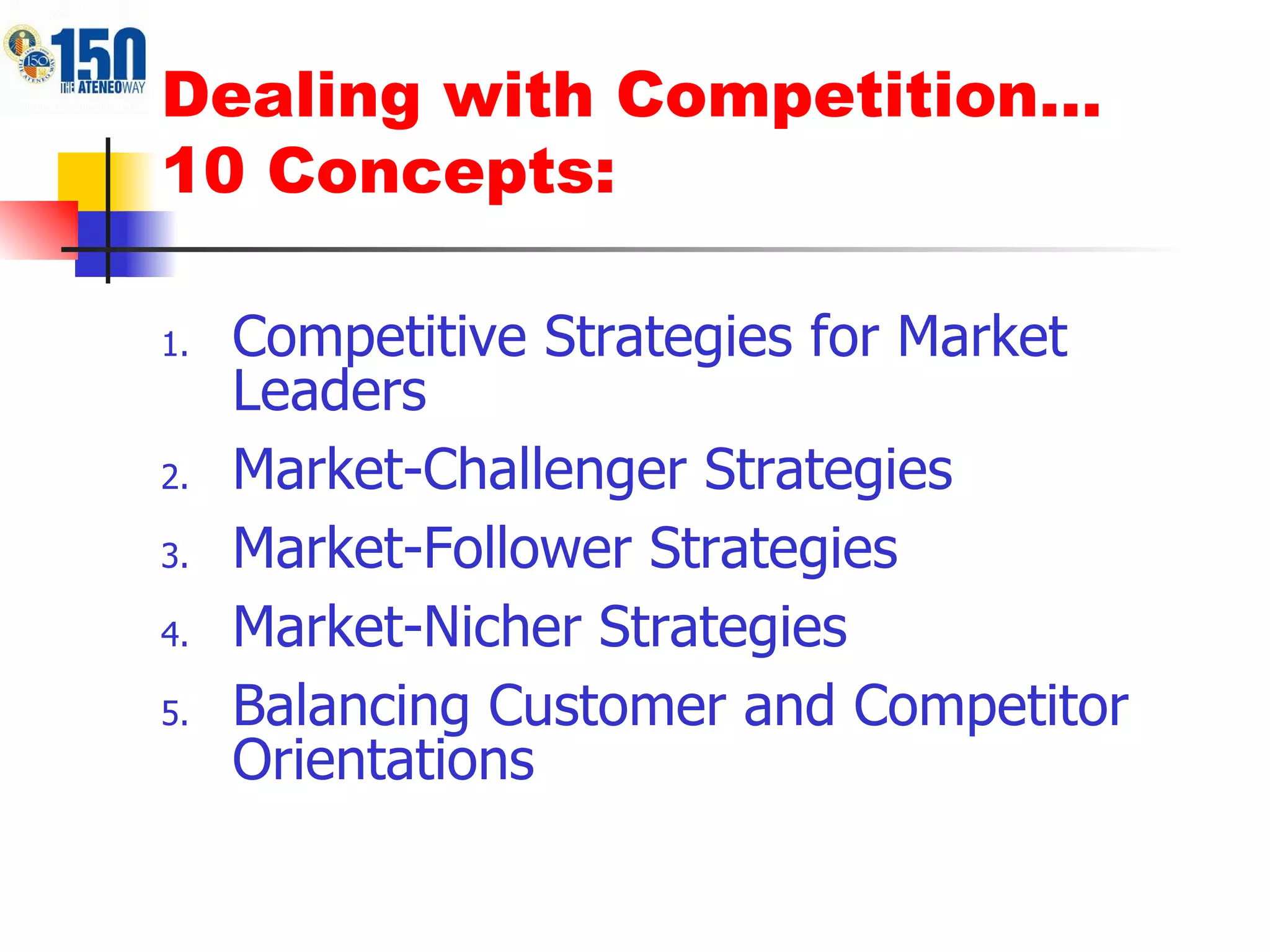
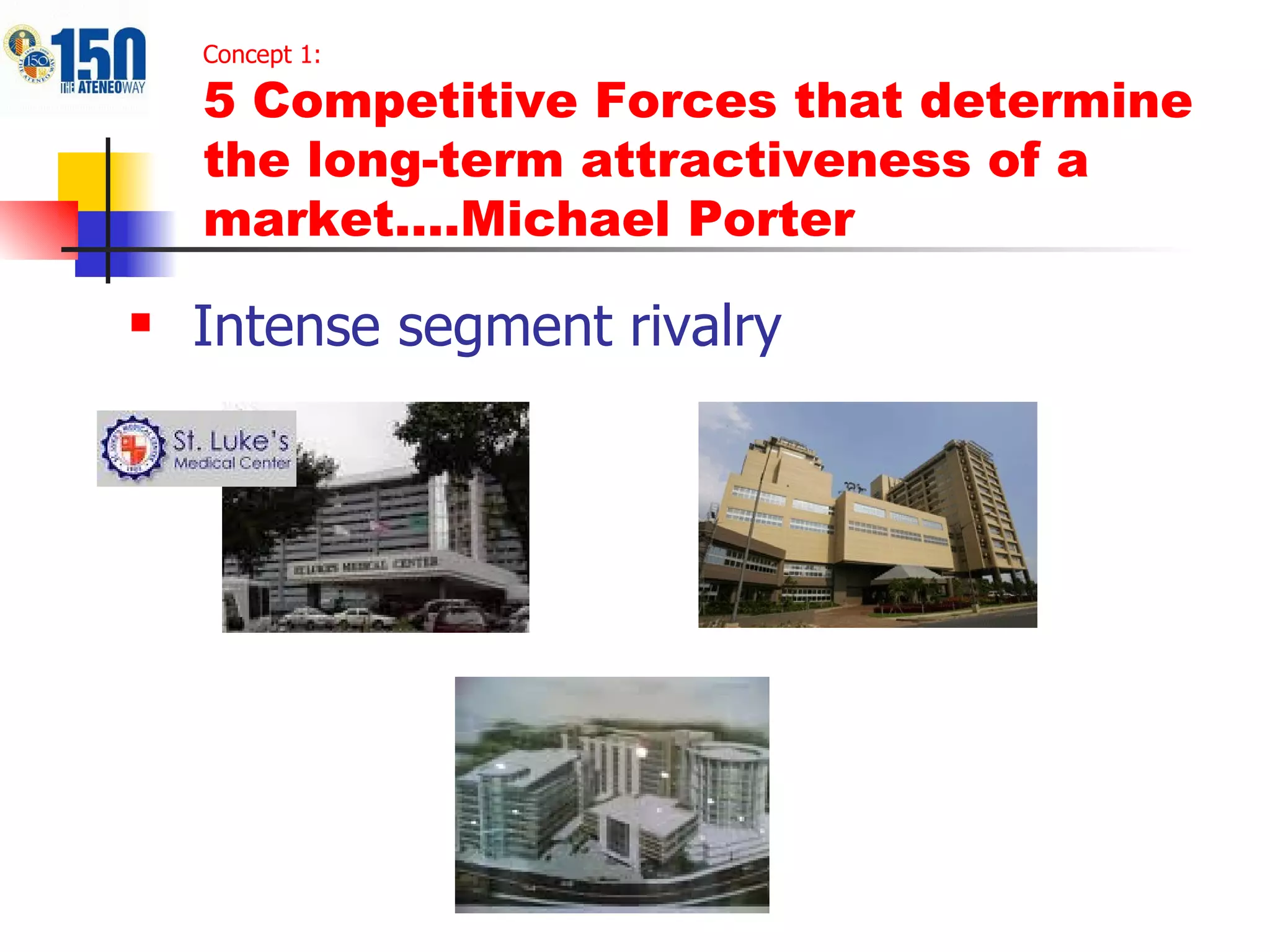
Intense segment rivalry Concept 1: 5 Competitive Forces that determine the long-term attractiveness of a market….Michael Porter
Intense segment rivalry New Entrants Concept 1: 5 Competitive Forces that determine the long-term attractiveness of a market
Intense segment rivalry New Entrants Substitute products Concept 1: 5 Competitive Forces that determine the long-term attractiveness of a market
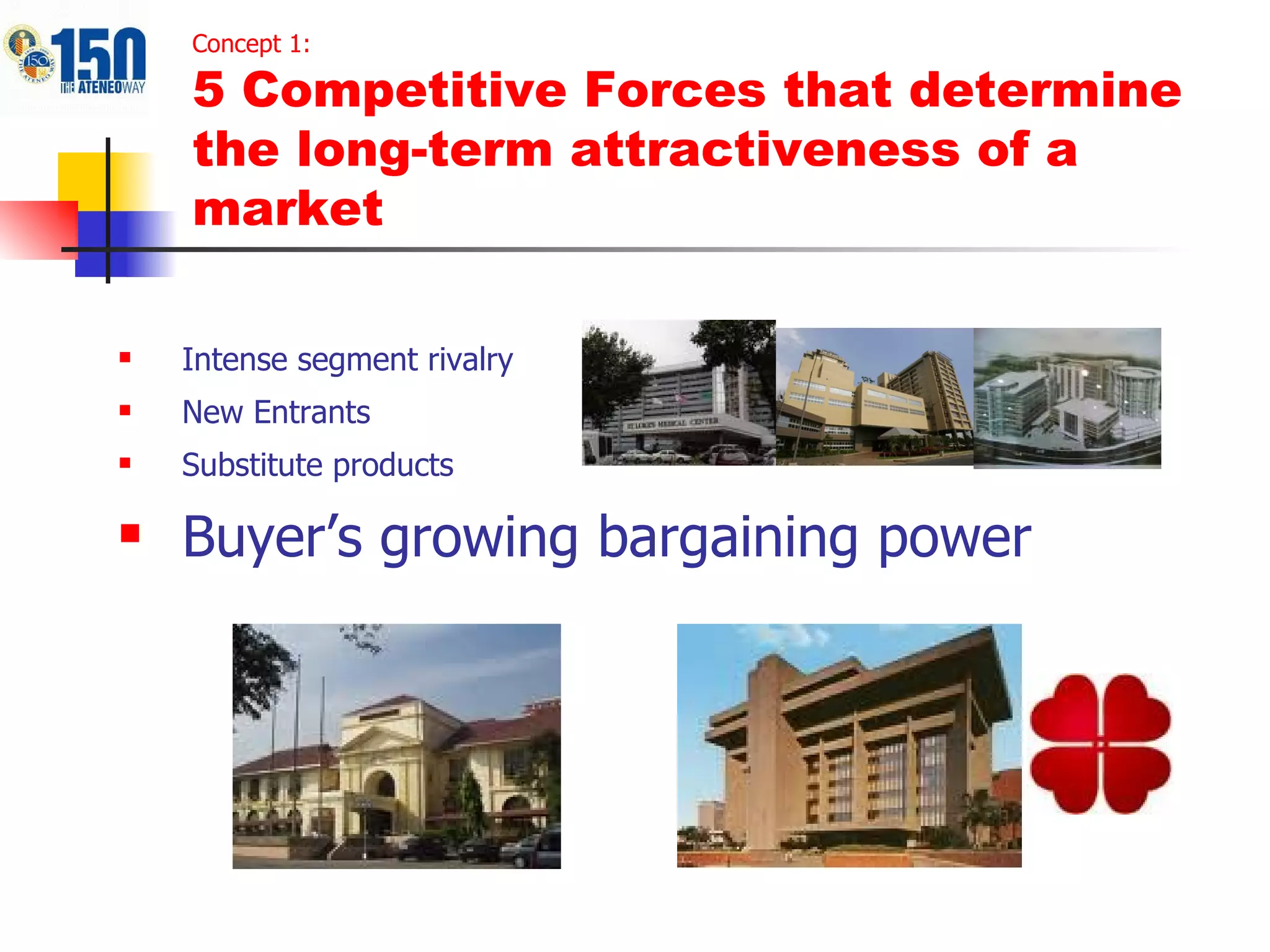
Intense segment rivalry New Entrants Substitute products Buyer’s growing bargaining power  Concept 1: 5 Competitive Forces that determine the long-term attractiveness of a market
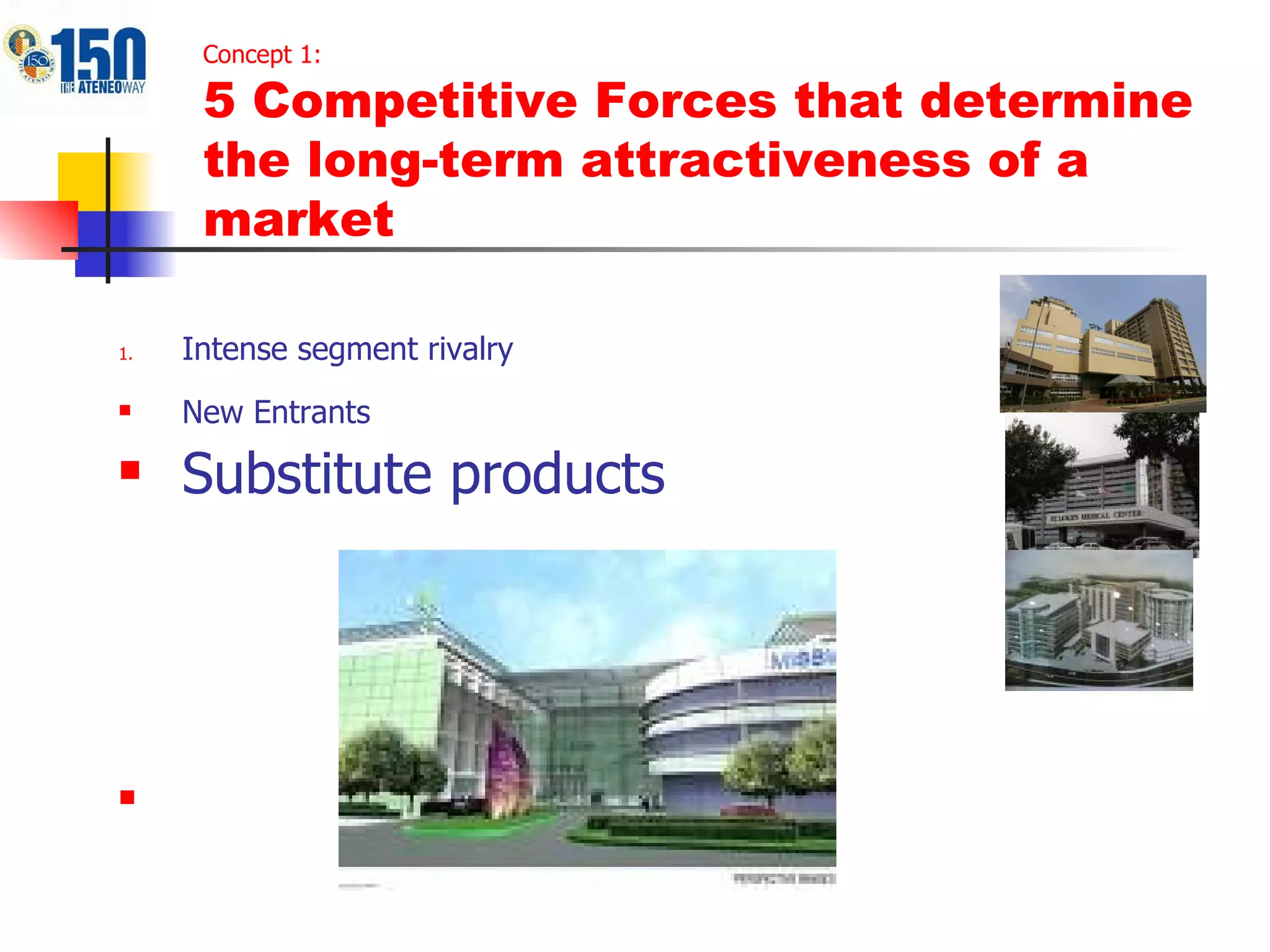
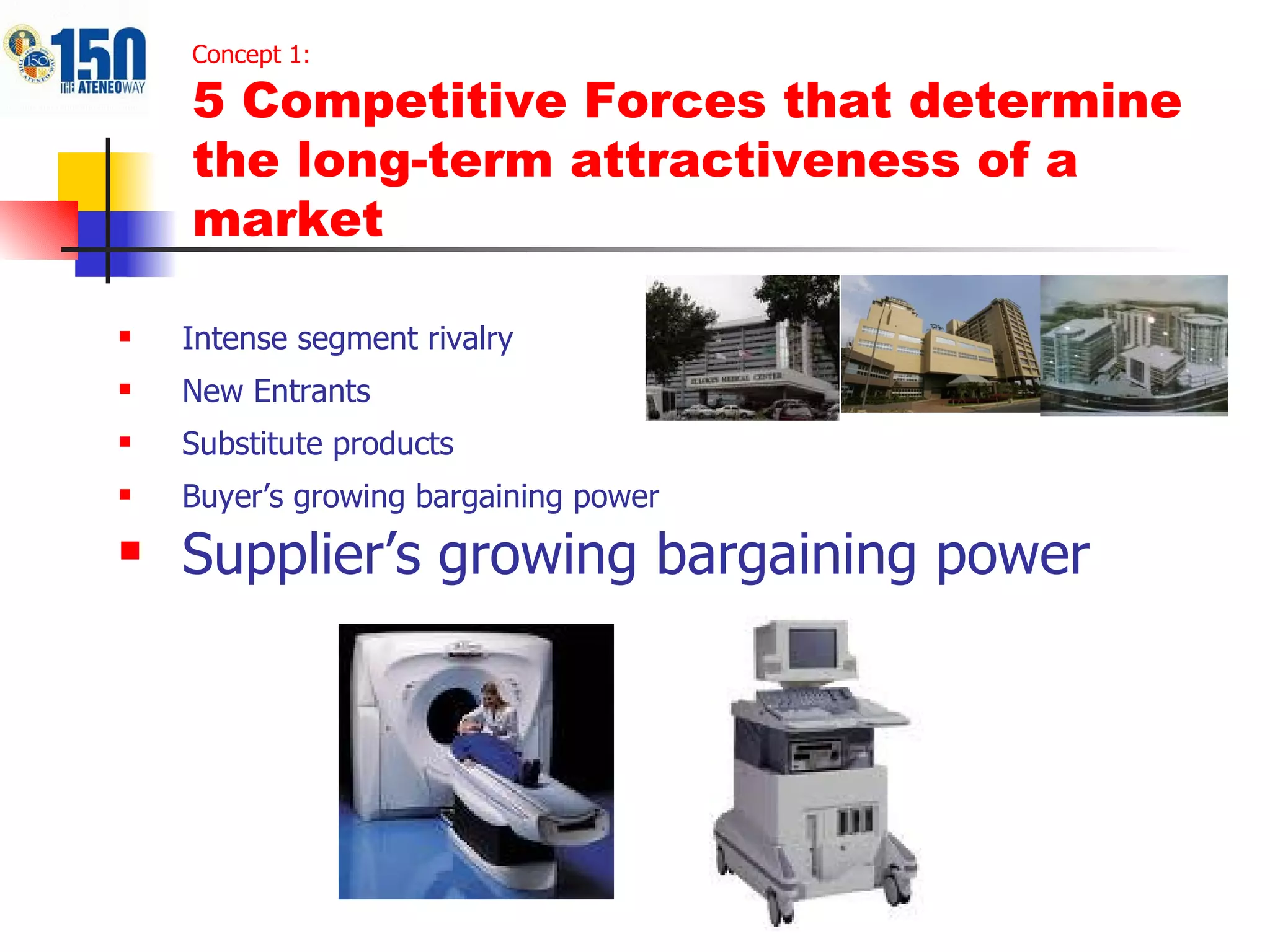
Intense segment rivalry New Entrants Substitute products Buyer’s growing bargaining power  Supplier’s growing bargaining power Concept 1: 5 Competitive Forces that determine the long-term attractiveness of a market
Industry and market point of view Concept 2: Marketers need to identify competitors
Number of sellers and degree of differentiation Presence or absence of entry, mobility and exit barriers Cost structure Degree of vertical integration Degree of globalization Concept 2: Industry concept of competition
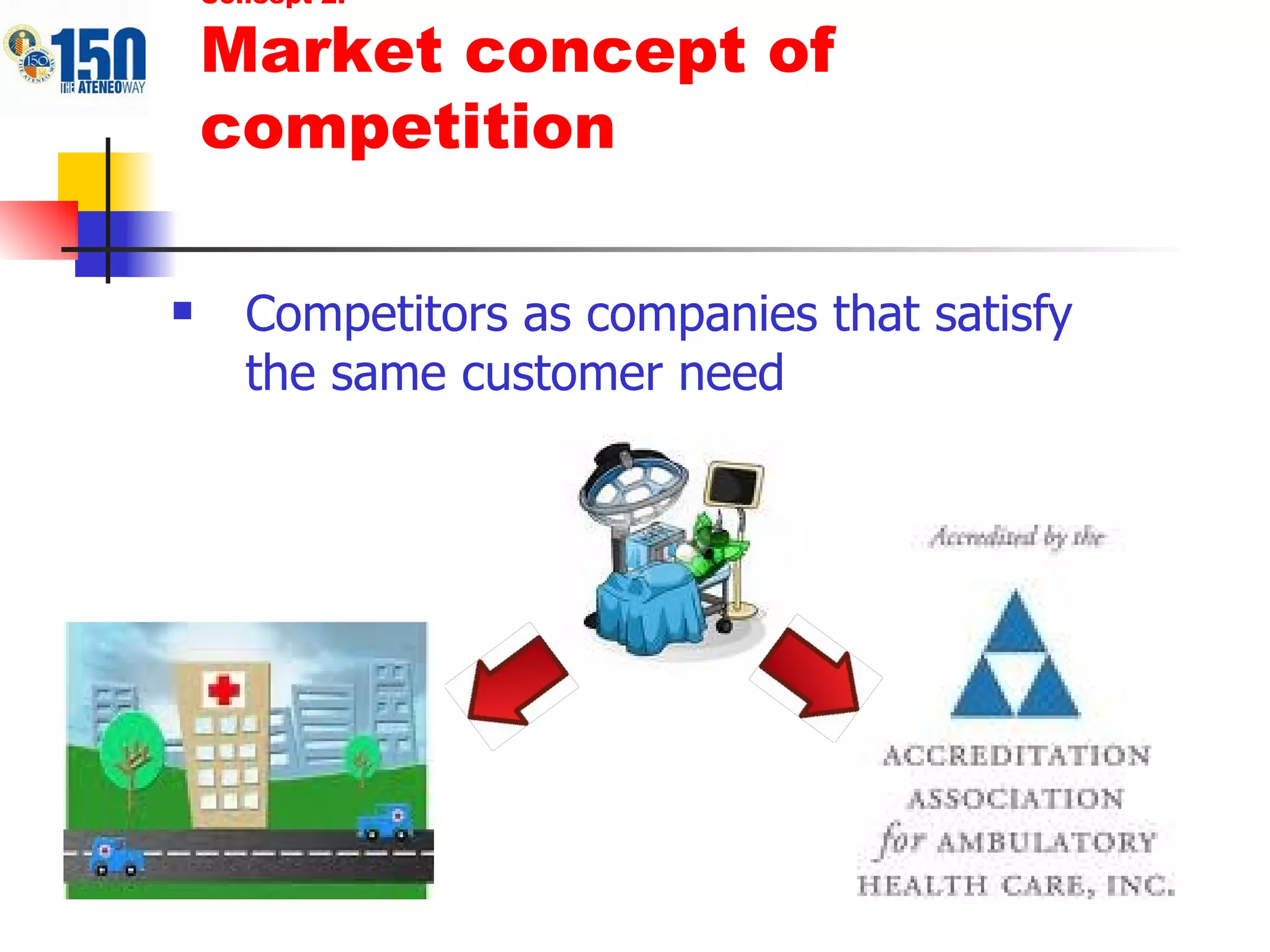
Competitors as companies that satisfy the same customer need Concept 2: Market concept of competition
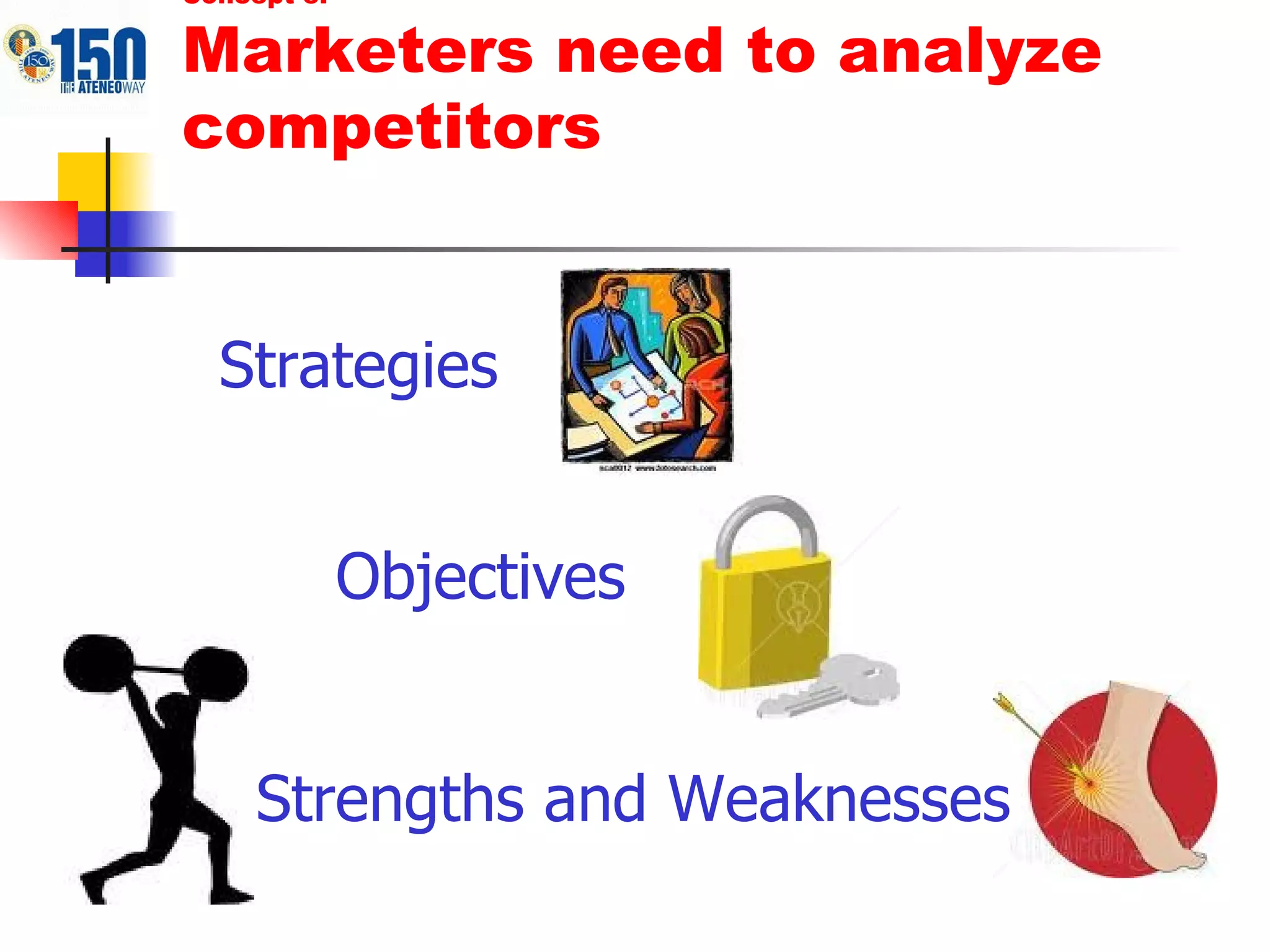
Objectives Concept 3: Marketers need to analyze competitors Strategies Strengths and Weaknesses
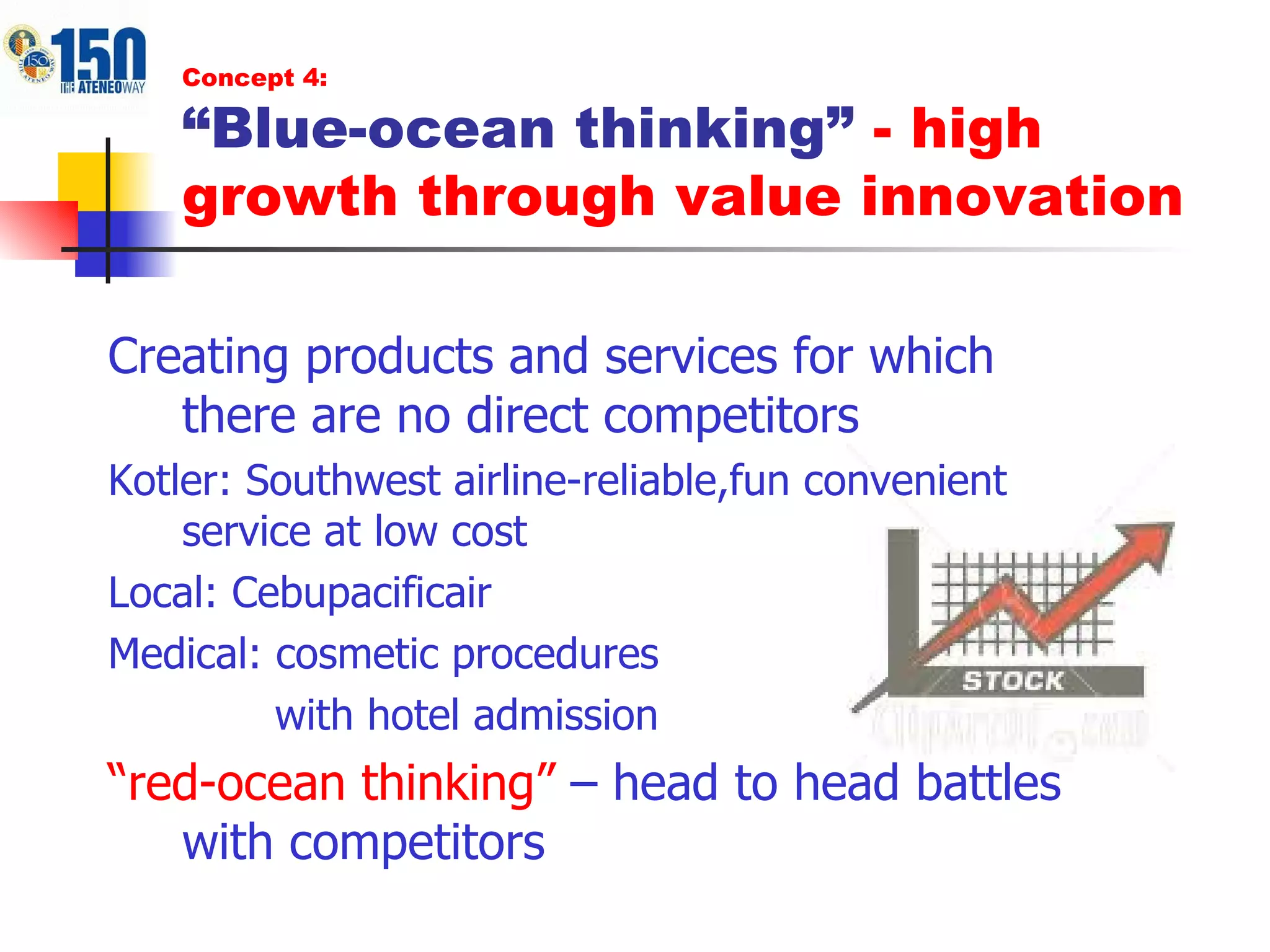
Creating products and services for which there are no direct competitors Kotler: Southwest airline-reliable,fun convenient service at low cost Local: Cebupacificair Medical: cosmetic procedures   with hotel admission “ red-ocean thinking”  – head to head battles with competitors Concept 4: “Blue-ocean thinking”  - high growth through value innovation
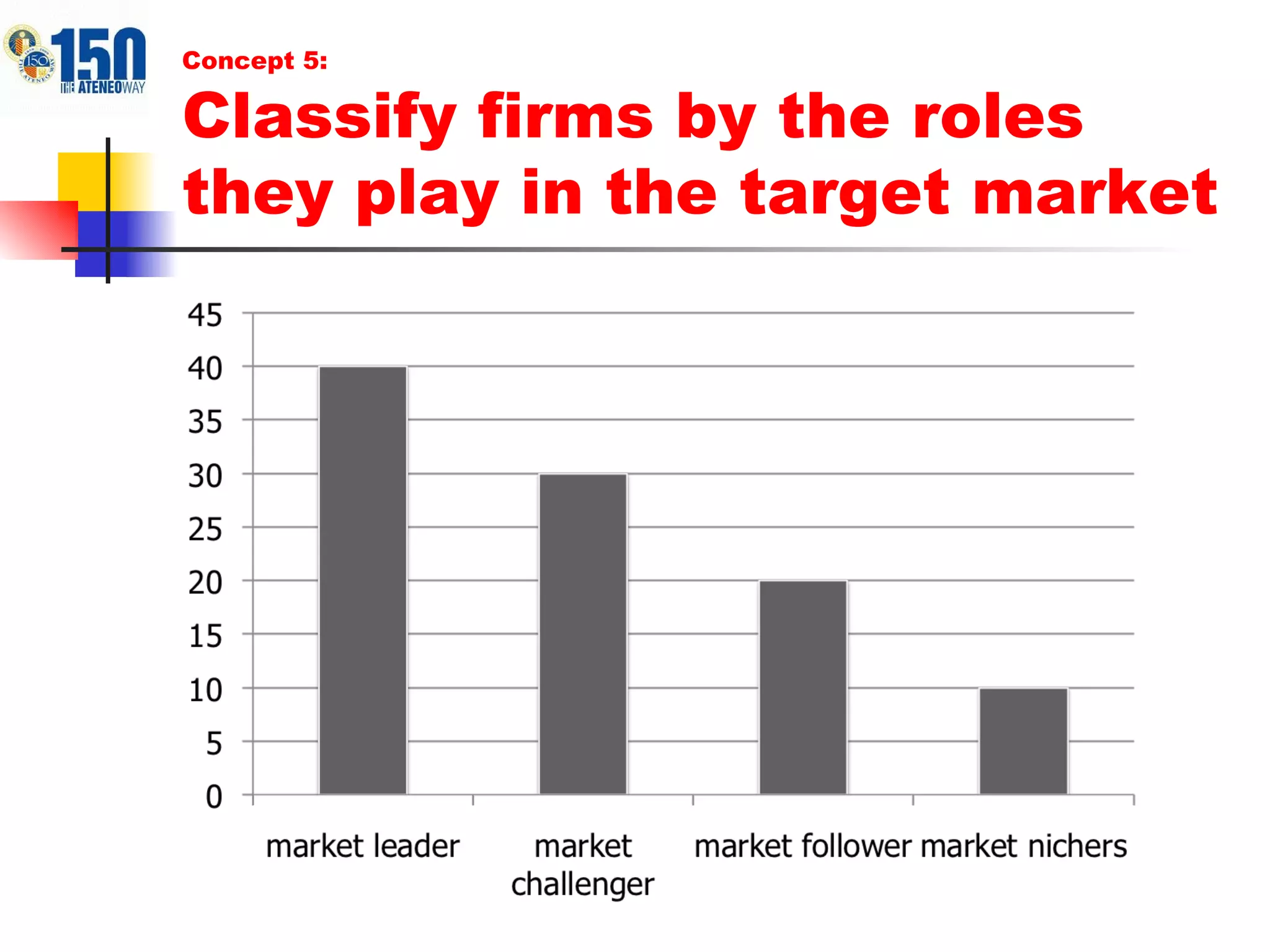
Concept 5: Classify firms by the roles they play in the target market
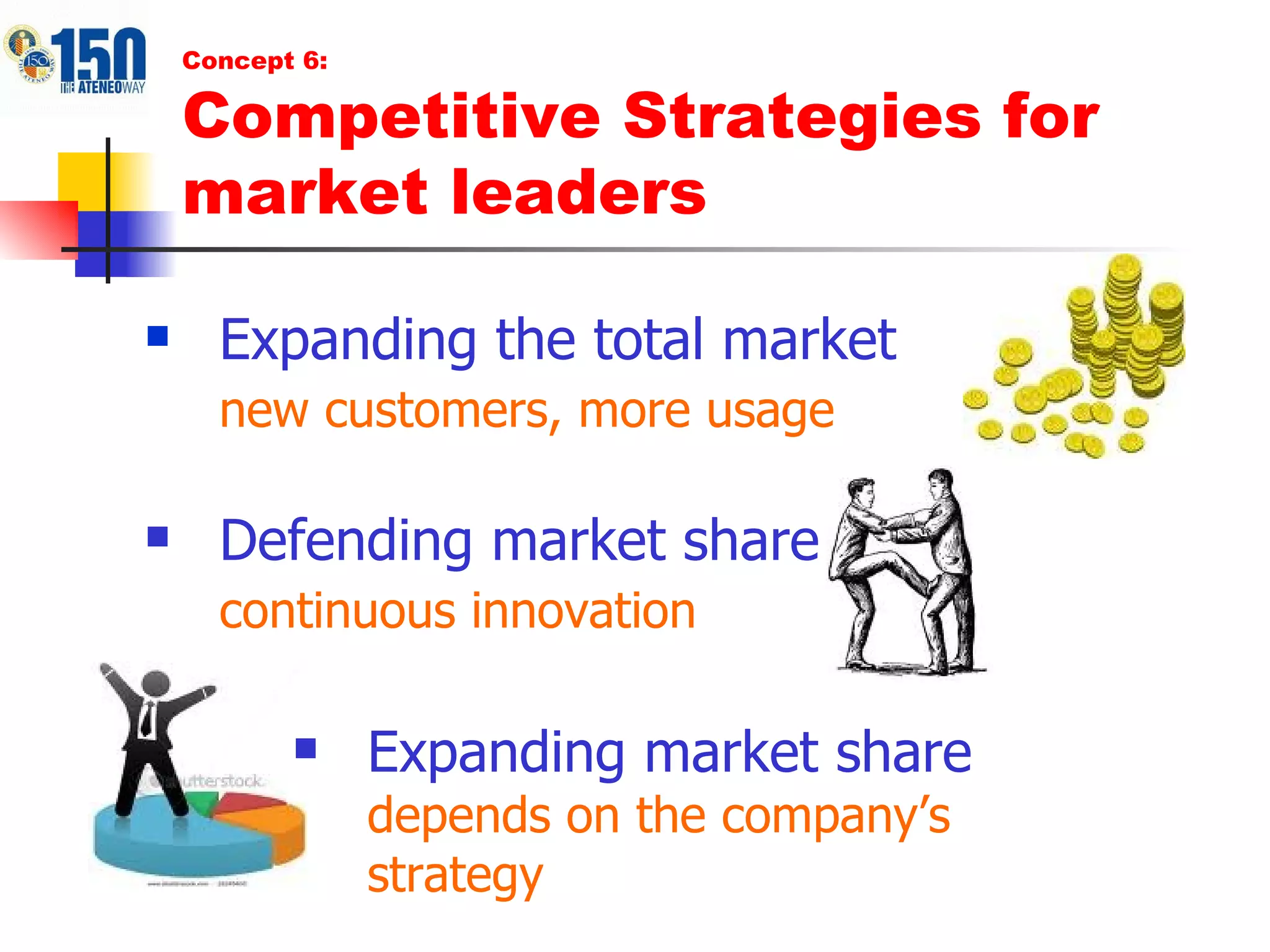
Defending market share  continuous innovation   Concept 6: Competitive Strategies for market leaders Expanding the total market  new customers, more usage   Expanding market share  depends on the company’s strategy
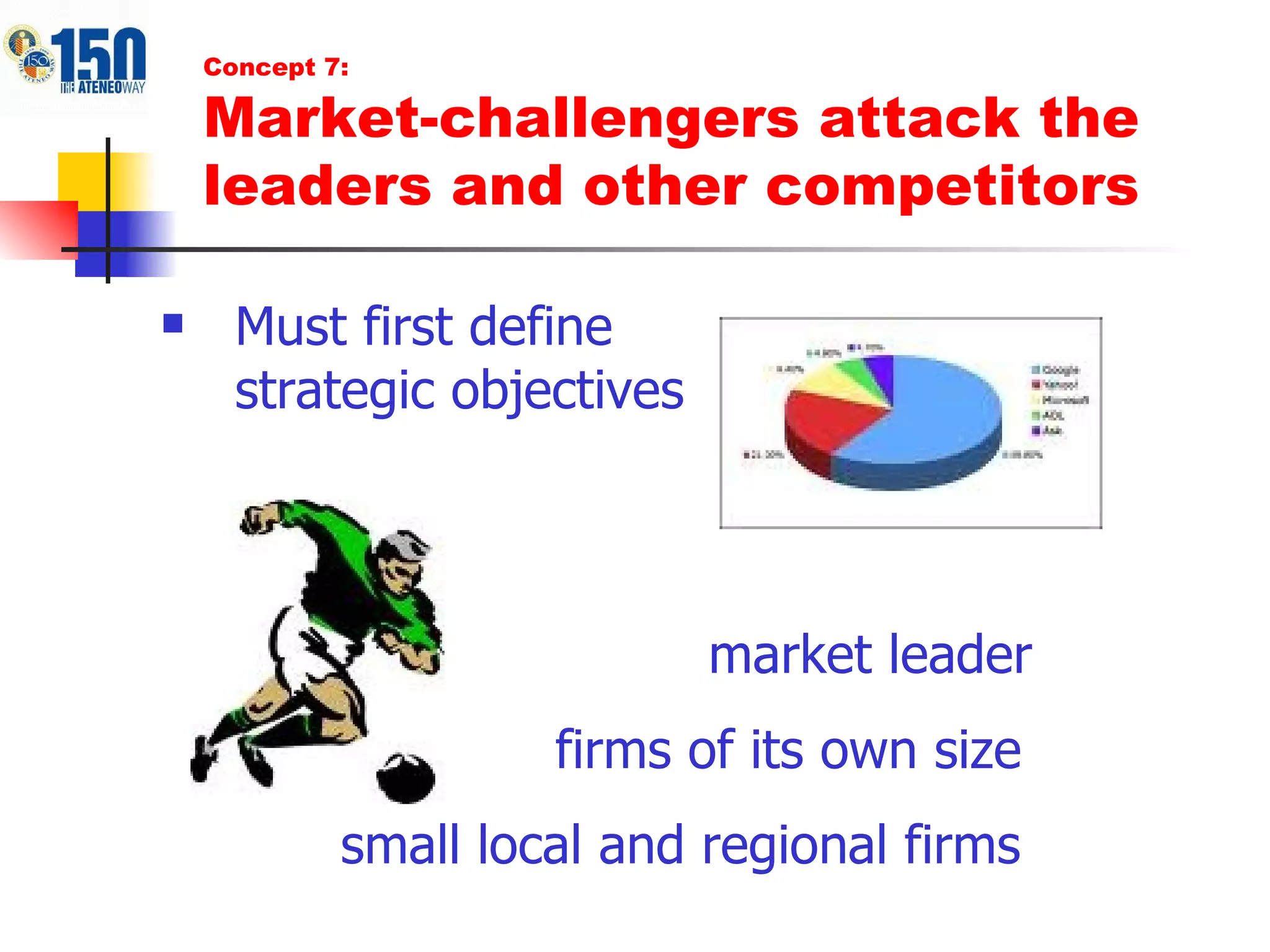
Must first define strategic objectives Concept 7: Market-challengers attack the leaders and other competitors firms of its own size small local and regional firms market leader
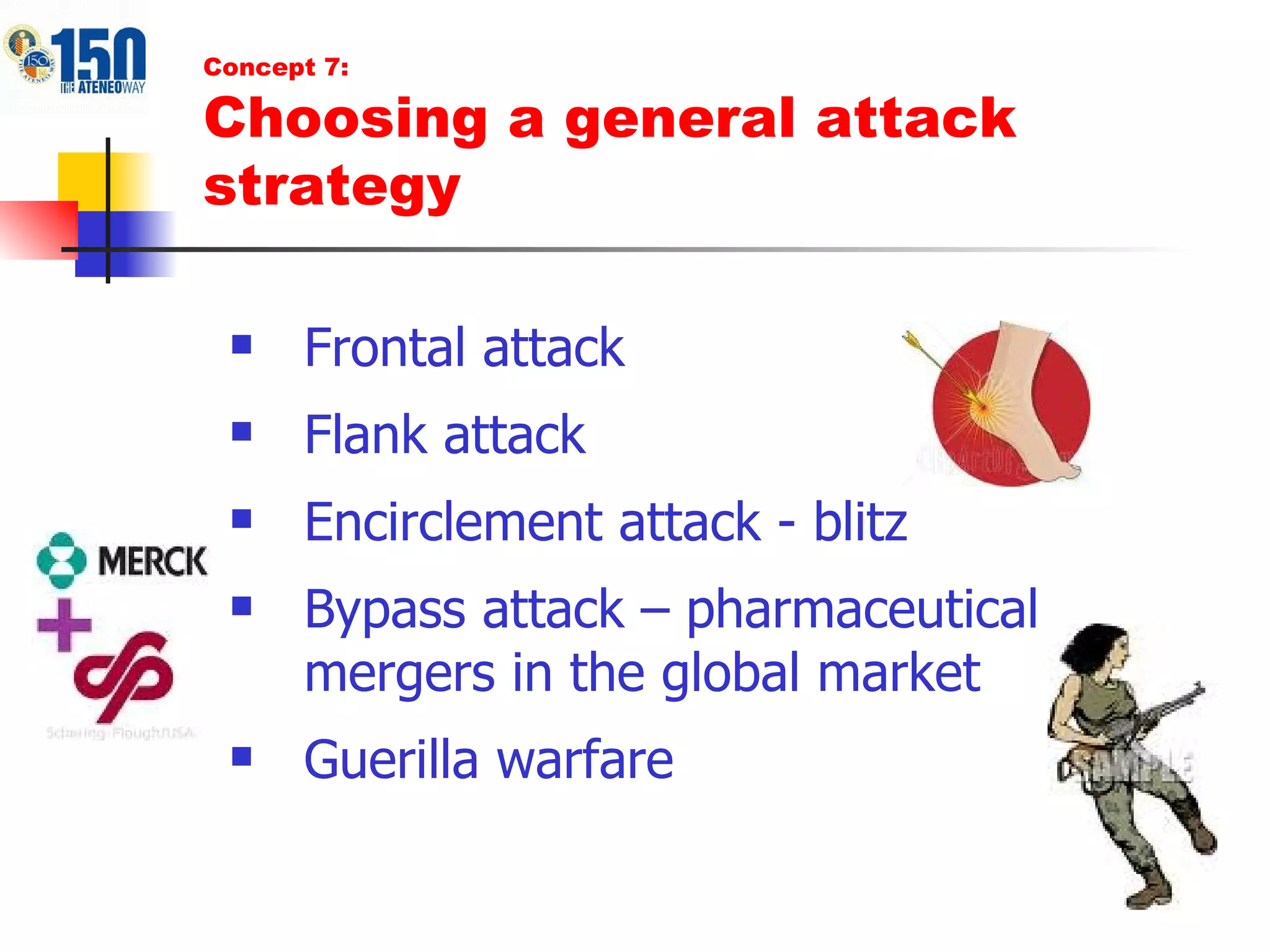
Frontal attack Flank attack Encirclement attack - blitz Bypass attack – pharmaceutical mergers in the global market Guerilla warfare Concept 7: Choosing a general attack strategy
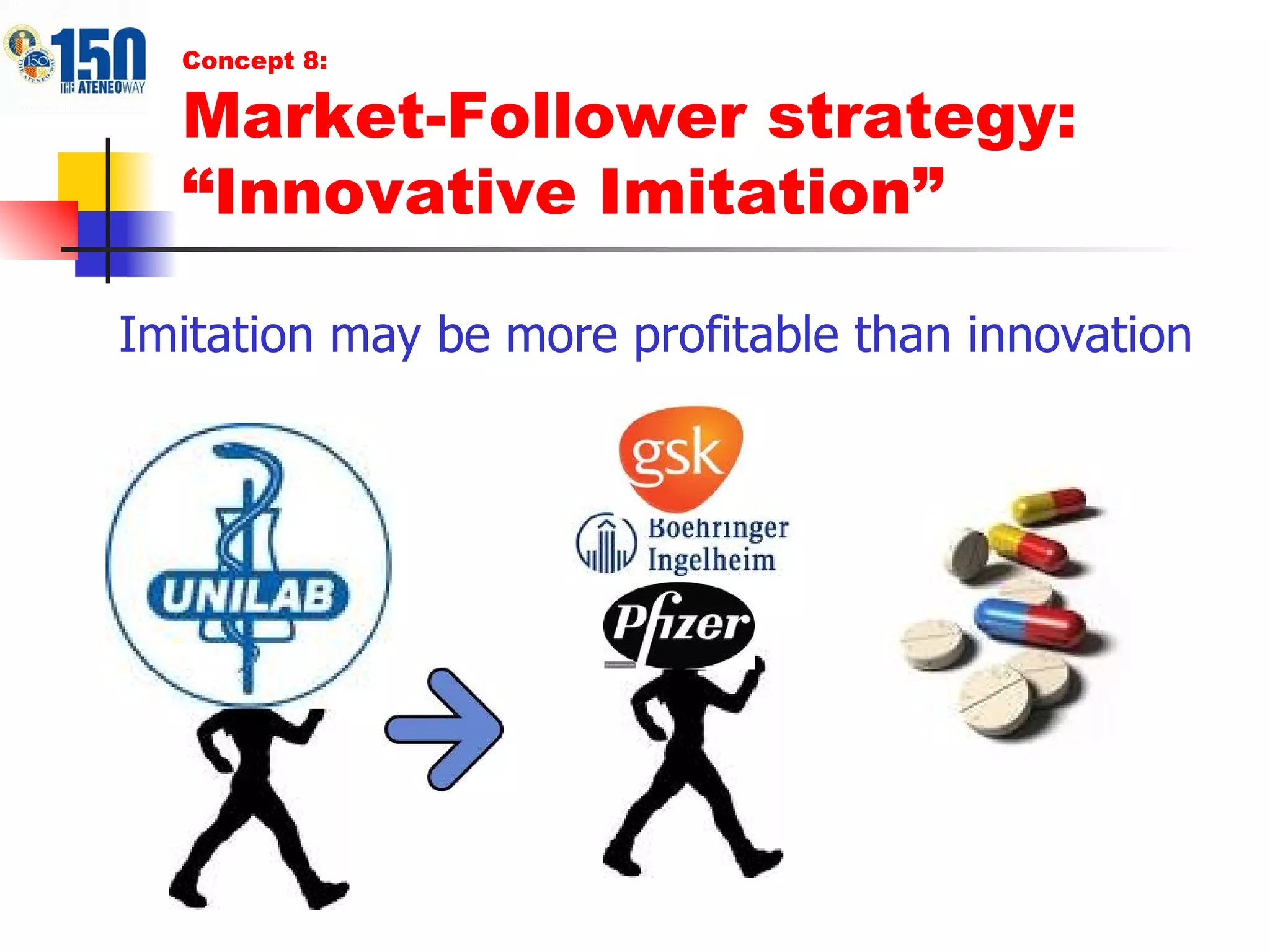
Imitation may be more profitable than innovation Concept 8: Market-Follower strategy: “Innovative Imitation”
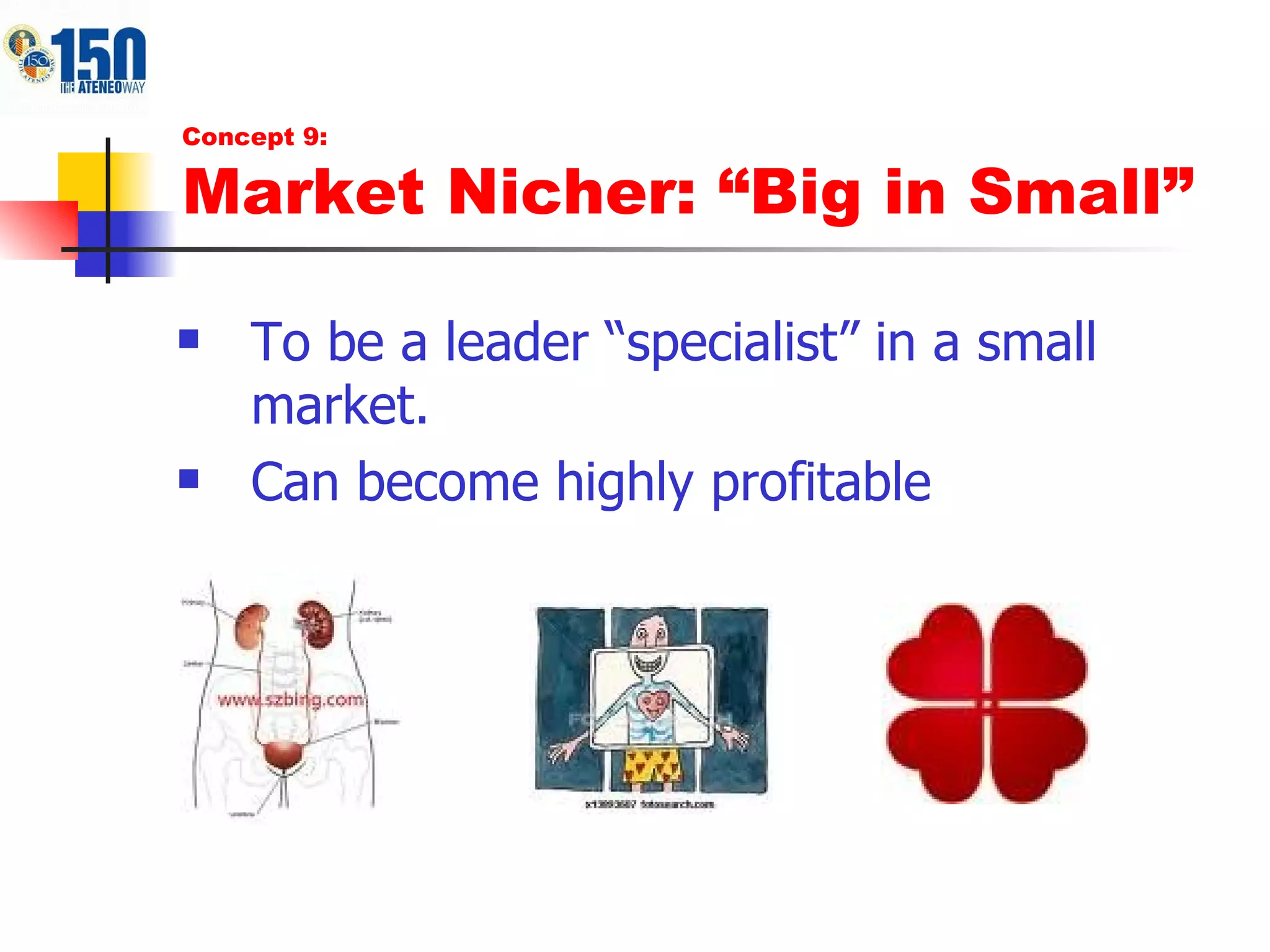
To be a leader “specialist” in a small market. Can become highly profitable Concept 9: Market Nicher: “Big in Small”
Maintain a good balance of consumer and competitor orientations  Customer-centered company is in better position to identify new opportunities  Concept 10: Customer vs Competition
Dealing with Competition… 10 Concepts: The 5 Competitive Forces  Identifying Competitors Analyzing Competitors High growth through value innovation Classify market roles
Dealing with Competition… 10 Concepts: Competitive Strategies for Market Leaders Market-Challenger Strategies Market-Follower Strategies Market-Nicher Strategies Balancing Customer and Competitor Orientations
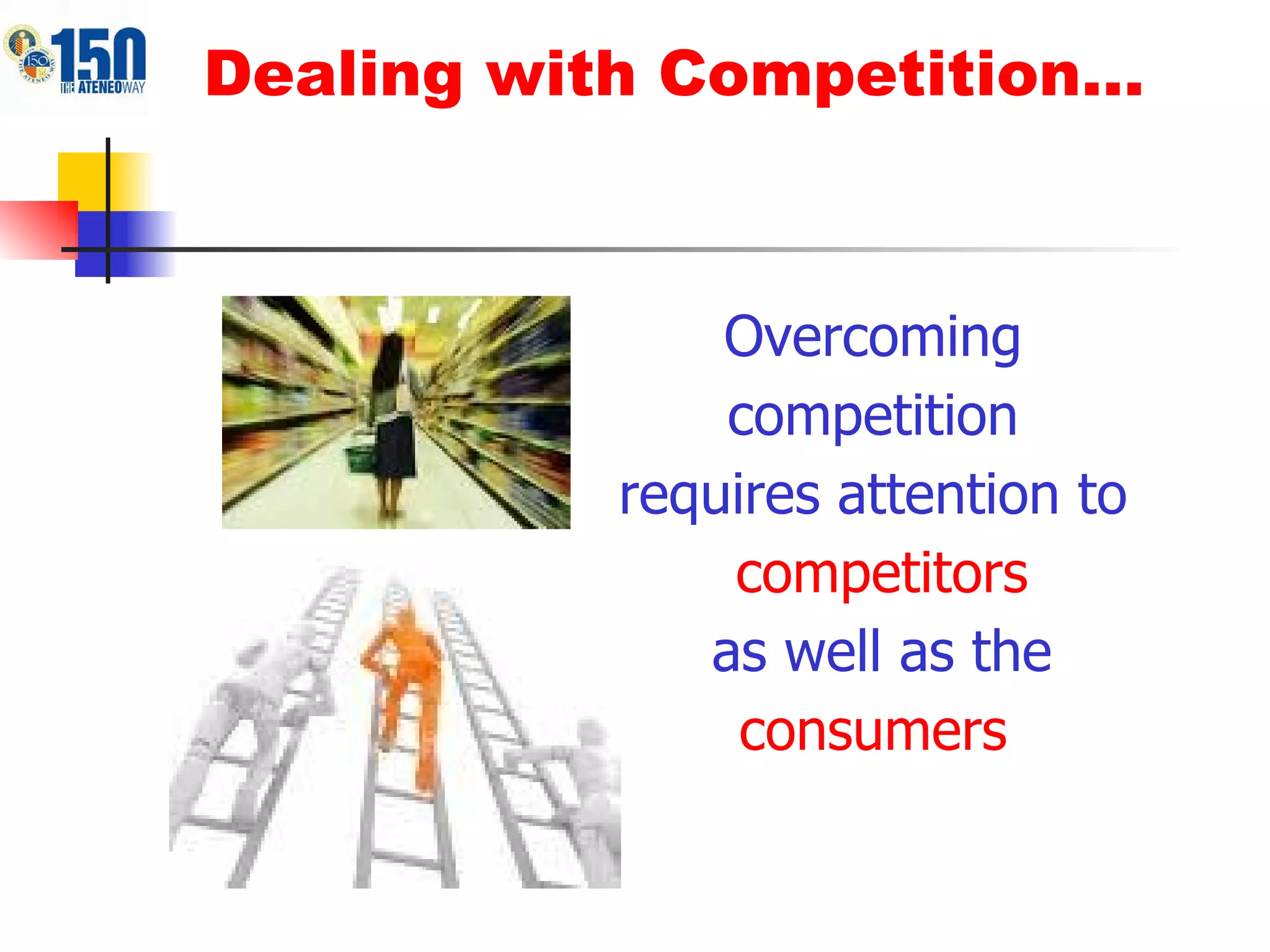
Dealing with Competition… Overcoming competition requires attention to competitors as well as the consumers
Dealing with  Competition Noel C. Cruz, M.D. Ateneo Graduate School of Business May 8, 2010 drnoelcruz.com Marketing Concepts

Kotler dealing with competition

  • 1.
    Dealing with Competition Noel C. Cruz, M.D. Ateneo Graduate School of Business May 8, 2010 drnoelcruz.com/ Marketing Concepts
  • 2.
    Dealing with Competition…10 Concepts: The 5 Competitive Forces Identifying Competitors Analyzing Competitors High growth through value innovation Classify market roles
  • 3.
    Dealing with Competition…10 Concepts: Competitive Strategies for Market Leaders Market-Challenger Strategies Market-Follower Strategies Market-Nicher Strategies Balancing Customer and Competitor Orientations
  • 4.
    Intense segment rivalryConcept 1: 5 Competitive Forces that determine the long-term attractiveness of a market….Michael Porter
  • 5.
    Intense segment rivalryNew Entrants Concept 1: 5 Competitive Forces that determine the long-term attractiveness of a market
  • 6.
    Intense segment rivalryNew Entrants Substitute products Concept 1: 5 Competitive Forces that determine the long-term attractiveness of a market
  • 7.
    Intense segment rivalryNew Entrants Substitute products Buyer’s growing bargaining power Concept 1: 5 Competitive Forces that determine the long-term attractiveness of a market
  • 8.
    Intense segment rivalryNew Entrants Substitute products Buyer’s growing bargaining power Supplier’s growing bargaining power Concept 1: 5 Competitive Forces that determine the long-term attractiveness of a market
  • 9.
    Industry and marketpoint of view Concept 2: Marketers need to identify competitors
  • 10.
    Number of sellersand degree of differentiation Presence or absence of entry, mobility and exit barriers Cost structure Degree of vertical integration Degree of globalization Concept 2: Industry concept of competition
  • 11.
    Competitors as companiesthat satisfy the same customer need Concept 2: Market concept of competition
  • 12.
    Objectives Concept 3:Marketers need to analyze competitors Strategies Strengths and Weaknesses
  • 13.
    Creating products andservices for which there are no direct competitors Kotler: Southwest airline-reliable,fun convenient service at low cost Local: Cebupacificair Medical: cosmetic procedures with hotel admission “ red-ocean thinking” – head to head battles with competitors Concept 4: “Blue-ocean thinking” - high growth through value innovation
  • 14.
    Concept 5: Classifyfirms by the roles they play in the target market
  • 15.
    Defending market share continuous innovation Concept 6: Competitive Strategies for market leaders Expanding the total market new customers, more usage Expanding market share depends on the company’s strategy
  • 16.
    Must first definestrategic objectives Concept 7: Market-challengers attack the leaders and other competitors firms of its own size small local and regional firms market leader
  • 17.
    Frontal attack Flankattack Encirclement attack - blitz Bypass attack – pharmaceutical mergers in the global market Guerilla warfare Concept 7: Choosing a general attack strategy
  • 18.
    Imitation may bemore profitable than innovation Concept 8: Market-Follower strategy: “Innovative Imitation”
  • 19.
    To be aleader “specialist” in a small market. Can become highly profitable Concept 9: Market Nicher: “Big in Small”
  • 20.
    Maintain a goodbalance of consumer and competitor orientations Customer-centered company is in better position to identify new opportunities Concept 10: Customer vs Competition
  • 21.
    Dealing with Competition…10 Concepts: The 5 Competitive Forces Identifying Competitors Analyzing Competitors High growth through value innovation Classify market roles
  • 22.
    Dealing with Competition…10 Concepts: Competitive Strategies for Market Leaders Market-Challenger Strategies Market-Follower Strategies Market-Nicher Strategies Balancing Customer and Competitor Orientations
  • 23.
    Dealing with Competition…Overcoming competition requires attention to competitors as well as the consumers
  • 24.
    Dealing with Competition Noel C. Cruz, M.D. Ateneo Graduate School of Business May 8, 2010 drnoelcruz.com Marketing Concepts

Editor's Notes

  • #2 Building strong brands requires a keen understanding of competitors and competitions grows more intense every year. New competition is coming from all directions – from global competitors eager to grow sales, from online competitors seeking cost-efficient ways to expand distribution, from private-label and store brands One good way to start to deal with competition is through creatively designed and well-executed marketing programs
  • #5 Effective marketing strategies involve studying competitors and competitive forces. A segment is unattractive if it already contains numerous, strong, or aggressive competitors
  • #6 The most attractive segment is one in which entry barriers are high and exit barriers are low. Few new firms can enter the industry and poorly performing firms can easily exit.
  • #7 A segment is unattractive when there are actual or potential substitutes for the product. Substitutes place a limit on prices and on profits.
  • #8 A segment is unattractive if buyers possess strong or growing bargaining power. Kotler: Wal-mart, local: SM hypermart/Save More
  • #9 A segment is unattractive if the company’s suppliers are able to raise prices or reduce quantity supplied. Kotler: Oil companies. Local: china products
  • #10 A company should identify competitors by using both industry and market-based analyses, It would seem a simple tack for a company to identify its competitors. Kotler: Pepsi-Coca-Cola/Citigroup vs Bank of America. However the range of a company’s actual and potential competitors can be much broader than the obvious. And a company is more likely
  • #11 An industry is a group of firms that offer a product or class of products that are close substitutes for one another
  • #12 Broader set of actual and potential competitors than competition defined in just product category terms. Kotler: Coca-cola
  • #13 Group competitors into their strategic grouping What is each competitor seeking in the marketplace A company should monitor three variable when analyzing competitions: share of market, share of mind, share of heart
  • #15 Share of the market
  • #17 Firms that occupy second, third and lower ranks in an industry are considered market challenger. These firms can attack the leader and other competitors in an aggressive bid for further market share
  • #18 In frontal attack, the attacker matches its opponents product, advertising, price and distribution. The principle of force says that the side with the greater resources will win. Flank attack to an enemy’s weak spots Encirclement to capture a wide slice of enemy’s territory, launching a grand offensive on several fronts Guerilla warfare consists of waging small, intermittent attacks to harass and demoralize the opponent and eventually secure permanent footholds
  • #19 A market follower is a runner-up firm willing to maintain its market share and not rock the boat. A follower can play the role of counterfeiter, cloner, imitator, or adapter
  • #20 A market nicher serves small market segments not being served by larger firms, The key to nichemanship is specialization. Nichers develop offerings to fully meet a certain group of customer’s need, commanding a premium price in the process.
  • #21 In today’s global market, the companies should not overdo the emphasis on competitors. They should maintain a good balance of consumer and competitor monitoring Competitor-centered companies should be based on competitor’s marketing mix strategy and benchmarking and reacts these matters with company’s strong resources Customer-centered companies should be based on customer needs and thus company will find out the target market to serve, quality-sensitive segment