



Creating
Brand Equity
Cha pte r 9
ATC “Old Boys”
Othma n Ahma d
Za za li Moha me d S ofia n
Zuhre n Md. Na s ir
9-3
9-4
9-5
9-6
What is “Brand” ?

9-7
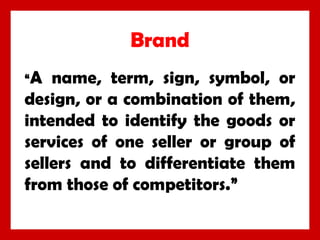
Brand
“A

name, term, sign, symbol, or
design, or a combination of them,
intended to identify the goods or
services of one seller or group of
sellers and to differentiate them
from those of competitors.”
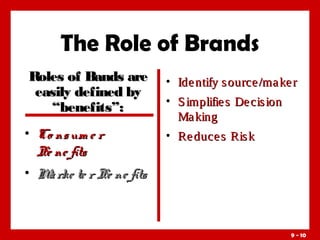
The Role of Brands
Roles of Bands are
easily defined by
“benefits”:
• Co ns um e r
Be ne fits
• M rke te r Be ne fits
a

• Ide ntify s ource /ma ke r
• S implifie s De cis ion
Ma king
• Re duce s Ris k

9 - 10
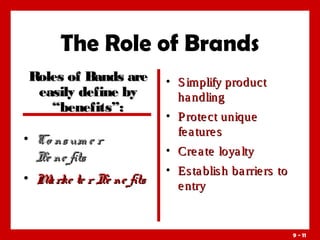
The Role of Brands
Roles of Bands are
easily define by
“benefits”:
• Co ns um e r
Be ne fits
• M rke te r Be ne fits
a

• S implify product
ha ndling
• P rote ct unique
fe a ture s
• Cre a te loya lty
• Es ta blis h ba rrie rs to
e ntry

9 - 11
Scope of Branding
 “Bra nding” is e ndowing
products a nd s e rvice s
with the powe r of a
bra nd – by giving na me s
us ing bra nd e le me nts to
he lp ide ntify it
 The ke y to “bra nding” is
tha t cons ume rs mus t
not think tha t a ll bra nds
in the ca te gory a re the
s a me

9 - 12
Brand Equity
The added value endowed on
products and services because of the
brand.
- Reflected in how consumers think, and act
with respect to the brand, as well as the prices,
market share, and profitability that the brand
commands.

9 - 13
Brand Equity
“The value of a brand. From a consumer
perspective, brand equity is based on
consumer attitudes about positive brand
attributes and favorable consequences of
brand use.” 
– American Marketing Association
9 - 14
Brand vs Product
A product is something that is made in a factory;
A brand is something that is bought by a
customer.
A product can be copied by a competitor;
A brand is unique.
A product can be quickly outdated;
A successful brand is timeless.
– Stephen King (WPP Group, London)
9 - 15
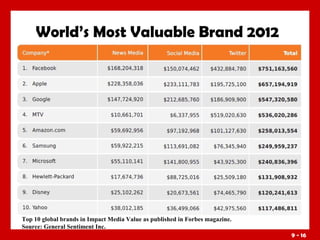
World’s Most Valuable Brand 2012

Top 10 global brands in Impact Media Value as published in Forbes magazine.
Source: General Sentiment Inc.
9 - 16
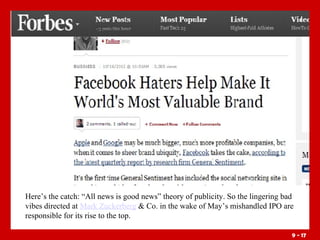
Here’s the catch: “All news is good news” theory of publicity. So the lingering bad
vibes directed at Mark Zuckerberg & Co. in the wake of May’s mishandled IPO are
responsible for its rise to the top.
9 - 17
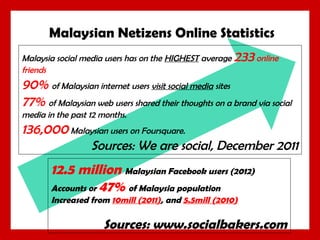
Malaysian Netizens Online Statistics
Malaysia social media users has on the HIGHEST average
friends

233 online

90% of Malaysian internet users visit social media sites
77% of Malaysian web users shared their thoughts on a brand via social
media in the past 12 months.

136,000 Malaysian users on Foursquare.
Sources: We are social, December 2011

12.5 million Malaysian Facebook users (2012)
Accounts or 47% of Malaysia population
Increased from 10mill (2011), and 5.5mill (2010)

Sources: www.socialbakers.com
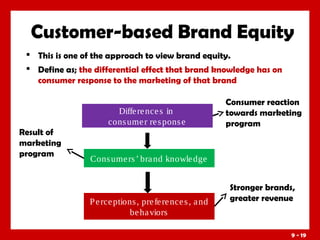
Customer-based Brand Equity
 This is one of the approach to view brand equity.
 Define as; the differential effect that brand knowledge has on
consumer response to the marketing of that brand
Diffe re nce s in
cons ume r re s pons e
Result of
marketing
program

Consumer reaction
towards marketing
program

Cons ume rs ’ bra nd knowle dge

P e rce ptions , pre fe re nce s , a nd
be ha viors

Stronger brands,
greater revenue

9 - 19
Customer-Based Brand Equity
as a “Bridge”
• Customer-based brand
equity represents the
“added value” endowed
to a product as a result
of past investments in
the marketing of a
brand.
• Customer-based brand
equity provides direction
and focus to future
marketing activities
Advantages of Strong Brands
• Improve d pe rce ptions of product pe rforma nce
• Gre a te r loya lty
• La rge r Ma rgins
• Le s s vulne ra bility to compe titive ma rke ting a ctions
• Le s s vulne ra ble to ma rke ting cris is
• Incre a s e d ma rke ting communica tions e ffe ctive ne s s
• Improve d e mploye e re cruiting a nd re te ntion
• Gre a te r fina ncia l ma rke t re turns

9 - 21
Brand Promise
 Is the ma rke te r’s vis ion
of wha t the bra nd mus t
be a nd do for
cons ume rs
 Cons ume rs will de cide
ba s e d on wha t the y
think a nd fe e l a bout the
bra nd

9 - 22
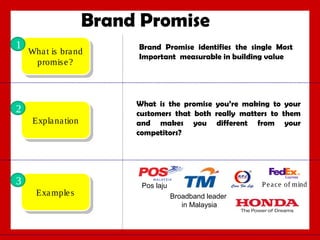
Brand Promise
1

Wha ttis bra nd
Wha is bra nd
promis ee??
promis

2
Expla na tion
Expla na tion

3
Exa mple ss
Exa mple

Brand Promise identifies the single Most
Important measurable in building value

What is the promise you’re making to your
customers that both really matters to them
and makes you different from your
competitors?

P e a ce of mind

Pos laju
Broadband leader
in Malaysia
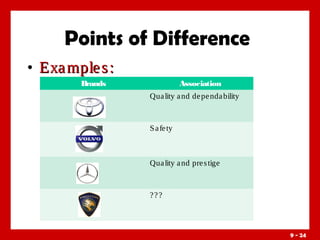
Points of Difference
• Exa mple s :
Brands

Association
Qua lity a nd de pe nda bility

S a fe ty

Qua lity a nd pre s tige

???

9 - 24
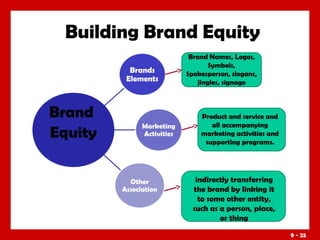
Building Brand Equity
Brands
Elements

Brand
Equity

Marketing
Activities

Other
Association

Brand Names, Logos,
Symbols,
Spokesperson, slogans,
jingles, signage

Product and service and
all accompanying
marketing activities and
supporting programs.

indirectly transferring
the brand by linking it
to some other entity,
such as a person, place,
or thing
9 - 25
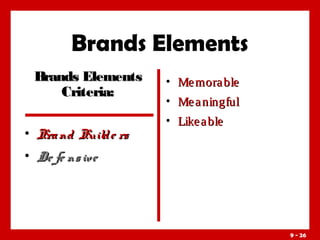
Brands Elements
Brands Elements
Criteria:
• Bra nd Build e rs
• De fe ns ive

• Me mora ble
• Me a ningful
• Like a ble

9 - 26
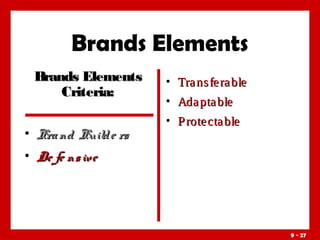
Brands Elements
Brands Elements
Criteria:
• Bra nd Build e rs
• De fe ns ive

• Tra ns fe ra ble
• Ada pta ble
• P rote cta ble

9 - 27
Brand Communities
Specialized community of consumers and
employees whose identification and activities
focus around the brand.
Three Characteristics identify brand
communities:
i) Consciousness (kesedaran),
ii) Shared ritual, stories, and traditions that
help to convey the meaning of the community
iii)Shared moral responsibility or duty to both
the community as a whole and individual
community members.
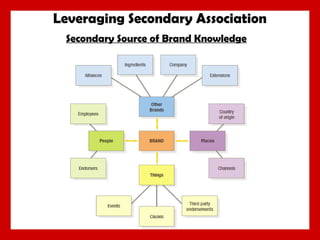
Leveraging Secondary Association
Secondary Source of Brand Knowledge
Managing Brand Equity
A COMPREHENSIVE FRAMEWORK FOR
MANAGING BRAND EQUITY
The intangible assets of brands create the basis of brand equity.
Brand equity consists of five different asset dimensions. These
assets include:
1) brand loyalty,
2) brand awareness,
3) perceived quality,
4) brand associations, and
5) other proprietary assets such as patents, trademarks and
channel relationships. If managed well, these assets add value to
the product or service and create additional customer satisfaction,
which, in turn, provide a number of benefits to the firm. (Aaker
1991, 19–21)
Brand Reinforcement
-In the market where products are related,branding
can have a large effect on the price that customer will
able to pay.
-Therefore brands add value to a basic product or
service to rule of higher price,or contribute higher
market share than an unbranded equivalent.
-Brand reinforcement is an activity associated with
getting consumer who have tried a particular brand to
become repeat purchasers and with attracting new
users.Brand reinforcement is a primary objective of the
development stage of the products’s life cycle
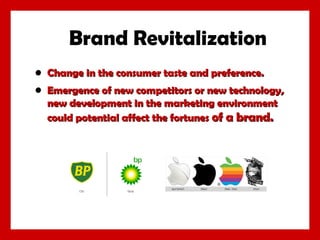
Brand Revitalization
• Change in the consumer taste and preference.
• Emergence of new competitors or new technology,
new development in the marketing environment
could potential affect the fortunes of a brand.
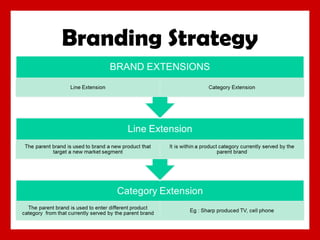
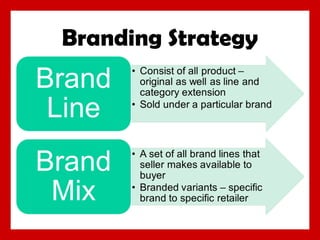
Branding Strategy
A firm’s bra nding s tra te gy –
ofte n ca lle d bra nd a rchite cture
re fle cts the numbe r a nd
na ture of common a nd
dis tinctive e le me nts a pplie d.
Branding Strategy
3 choices
• De ve lop ne w bra nd
• Apply s ome e xis ting bra nd
• Us e combina tion – ne w a nd e xis ting
Branding Strategy
Branding Strategy
Branding Strategy
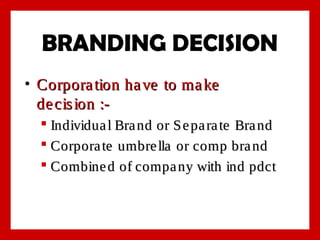
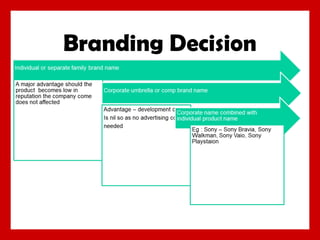
BRANDING DECISION
• Corpora tion ha ve to ma ke
de cis ion : Individua l Bra nd or S e pa ra te Bra nd
 Corpora te umbre lla or comp bra nd
 Combine d of compa ny with ind pdct
Branding Decision
Brand Portfolio
• Multiple bra nd a re ofte n ne ce s s a ry
to purs ue multiple ma rke t s e gme nt
• S ome a dva nta ge s : Incre a s ing s he lf pre s e nce a nd re ta ile r
de pe nde nce
 Attra cting cus tome r for va rie ty
 Incre a s ing inte rna l compe tition within the firm
 Economie s of s ca le in a dve rtis ing, s a le s ,
me rcha ndis ing a nd phys ica l dis tribution
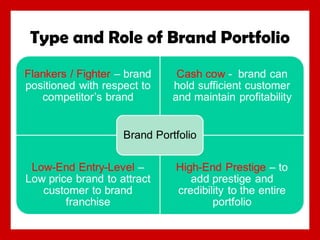
Type and Role of Brand Portfolio
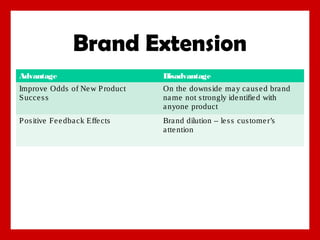
Brand Extension
Advantage

Disadvantage

Improve Odds of Ne w P roduct
S ucce s s

On the downs ide ma y ca us e d bra nd
na me not s trongly ide ntifie d with
a nyone product

P os itive Fe e dba ck Effe cts

Bra nd dilution – le s s cus tome r’s
a tte ntion
Success Characteristic
•
•
•
•

Marketers should judge and ask:Does the parent brand have strong equity?
Is there a strong basis of fit?
Will the extension have the optimal-of-parity and
point-of-different?
• How can marketing programs enhance extension
equity?
• What implications will the extension have for
parent brand equity and profitability?
• How should feedback effects best be managed?
S umma ry – Bra nd Vide o

9 - 44
Thank You.

9 - 45

Creating Brand Equity

  • 1.
  • 2.
    ATC “Old Boys” Othman Ahma d Za za li Moha me d S ofia n Zuhre n Md. Na s ir
  • 3.
  • 4.
  • 5.
  • 6.
  • 7.
  • 9.
    Brand “A name, term, sign,symbol, or design, or a combination of them, intended to identify the goods or services of one seller or group of sellers and to differentiate them from those of competitors.”
  • 10.
    The Role ofBrands Roles of Bands are easily defined by “benefits”: • Co ns um e r Be ne fits • M rke te r Be ne fits a • Ide ntify s ource /ma ke r • S implifie s De cis ion Ma king • Re duce s Ris k 9 - 10
  • 11.
    The Role ofBrands Roles of Bands are easily define by “benefits”: • Co ns um e r Be ne fits • M rke te r Be ne fits a • S implify product ha ndling • P rote ct unique fe a ture s • Cre a te loya lty • Es ta blis h ba rrie rs to e ntry 9 - 11
  • 12.
    Scope of Branding “Bra nding” is e ndowing products a nd s e rvice s with the powe r of a bra nd – by giving na me s us ing bra nd e le me nts to he lp ide ntify it  The ke y to “bra nding” is tha t cons ume rs mus t not think tha t a ll bra nds in the ca te gory a re the s a me 9 - 12
  • 13.
    Brand Equity The addedvalue endowed on products and services because of the brand. - Reflected in how consumers think, and act with respect to the brand, as well as the prices, market share, and profitability that the brand commands. 9 - 13
  • 14.
    Brand Equity “The valueof a brand. From a consumer perspective, brand equity is based on consumer attitudes about positive brand attributes and favorable consequences of brand use.”  – American Marketing Association 9 - 14
  • 15.
    Brand vs Product Aproduct is something that is made in a factory; A brand is something that is bought by a customer. A product can be copied by a competitor; A brand is unique. A product can be quickly outdated; A successful brand is timeless. – Stephen King (WPP Group, London) 9 - 15
  • 16.
    World’s Most ValuableBrand 2012 Top 10 global brands in Impact Media Value as published in Forbes magazine. Source: General Sentiment Inc. 9 - 16
  • 17.
    Here’s the catch:“All news is good news” theory of publicity. So the lingering bad vibes directed at Mark Zuckerberg & Co. in the wake of May’s mishandled IPO are responsible for its rise to the top. 9 - 17
  • 18.
    Malaysian Netizens OnlineStatistics Malaysia social media users has on the HIGHEST average friends 233 online 90% of Malaysian internet users visit social media sites 77% of Malaysian web users shared their thoughts on a brand via social media in the past 12 months. 136,000 Malaysian users on Foursquare. Sources: We are social, December 2011 12.5 million Malaysian Facebook users (2012) Accounts or 47% of Malaysia population Increased from 10mill (2011), and 5.5mill (2010) Sources: www.socialbakers.com
  • 19.
    Customer-based Brand Equity This is one of the approach to view brand equity.  Define as; the differential effect that brand knowledge has on consumer response to the marketing of that brand Diffe re nce s in cons ume r re s pons e Result of marketing program Consumer reaction towards marketing program Cons ume rs ’ bra nd knowle dge P e rce ptions , pre fe re nce s , a nd be ha viors Stronger brands, greater revenue 9 - 19
  • 20.
    Customer-Based Brand Equity asa “Bridge” • Customer-based brand equity represents the “added value” endowed to a product as a result of past investments in the marketing of a brand. • Customer-based brand equity provides direction and focus to future marketing activities
  • 21.
    Advantages of StrongBrands • Improve d pe rce ptions of product pe rforma nce • Gre a te r loya lty • La rge r Ma rgins • Le s s vulne ra bility to compe titive ma rke ting a ctions • Le s s vulne ra ble to ma rke ting cris is • Incre a s e d ma rke ting communica tions e ffe ctive ne s s • Improve d e mploye e re cruiting a nd re te ntion • Gre a te r fina ncia l ma rke t re turns 9 - 21
  • 22.
    Brand Promise  Isthe ma rke te r’s vis ion of wha t the bra nd mus t be a nd do for cons ume rs  Cons ume rs will de cide ba s e d on wha t the y think a nd fe e l a bout the bra nd 9 - 22
  • 23.
    Brand Promise 1 Wha ttisbra nd Wha is bra nd promis ee?? promis 2 Expla na tion Expla na tion 3 Exa mple ss Exa mple Brand Promise identifies the single Most Important measurable in building value What is the promise you’re making to your customers that both really matters to them and makes you different from your competitors? P e a ce of mind Pos laju Broadband leader in Malaysia
  • 24.
    Points of Difference •Exa mple s : Brands Association Qua lity a nd de pe nda bility S a fe ty Qua lity a nd pre s tige ??? 9 - 24
  • 25.
    Building Brand Equity Brands Elements Brand Equity Marketing Activities Other Association BrandNames, Logos, Symbols, Spokesperson, slogans, jingles, signage Product and service and all accompanying marketing activities and supporting programs. indirectly transferring the brand by linking it to some other entity, such as a person, place, or thing 9 - 25
  • 26.
    Brands Elements Brands Elements Criteria: •Bra nd Build e rs • De fe ns ive • Me mora ble • Me a ningful • Like a ble 9 - 26
  • 27.
    Brands Elements Brands Elements Criteria: •Bra nd Build e rs • De fe ns ive • Tra ns fe ra ble • Ada pta ble • P rote cta ble 9 - 27
  • 28.
    Brand Communities Specialized communityof consumers and employees whose identification and activities focus around the brand. Three Characteristics identify brand communities: i) Consciousness (kesedaran), ii) Shared ritual, stories, and traditions that help to convey the meaning of the community iii)Shared moral responsibility or duty to both the community as a whole and individual community members.
  • 29.
  • 30.
    Managing Brand Equity ACOMPREHENSIVE FRAMEWORK FOR MANAGING BRAND EQUITY The intangible assets of brands create the basis of brand equity. Brand equity consists of five different asset dimensions. These assets include: 1) brand loyalty, 2) brand awareness, 3) perceived quality, 4) brand associations, and 5) other proprietary assets such as patents, trademarks and channel relationships. If managed well, these assets add value to the product or service and create additional customer satisfaction, which, in turn, provide a number of benefits to the firm. (Aaker 1991, 19–21)
  • 31.
    Brand Reinforcement -In themarket where products are related,branding can have a large effect on the price that customer will able to pay. -Therefore brands add value to a basic product or service to rule of higher price,or contribute higher market share than an unbranded equivalent. -Brand reinforcement is an activity associated with getting consumer who have tried a particular brand to become repeat purchasers and with attracting new users.Brand reinforcement is a primary objective of the development stage of the products’s life cycle
  • 32.
    Brand Revitalization • Changein the consumer taste and preference. • Emergence of new competitors or new technology, new development in the marketing environment could potential affect the fortunes of a brand.
  • 33.
    Branding Strategy A firm’sbra nding s tra te gy – ofte n ca lle d bra nd a rchite cture re fle cts the numbe r a nd na ture of common a nd dis tinctive e le me nts a pplie d.
  • 34.
    Branding Strategy 3 choices •De ve lop ne w bra nd • Apply s ome e xis ting bra nd • Us e combina tion – ne w a nd e xis ting
  • 35.
  • 36.
  • 37.
  • 38.
    BRANDING DECISION • Corporation ha ve to ma ke de cis ion : Individua l Bra nd or S e pa ra te Bra nd  Corpora te umbre lla or comp bra nd  Combine d of compa ny with ind pdct
  • 39.
  • 40.
    Brand Portfolio • Multiplebra nd a re ofte n ne ce s s a ry to purs ue multiple ma rke t s e gme nt • S ome a dva nta ge s : Incre a s ing s he lf pre s e nce a nd re ta ile r de pe nde nce  Attra cting cus tome r for va rie ty  Incre a s ing inte rna l compe tition within the firm  Economie s of s ca le in a dve rtis ing, s a le s , me rcha ndis ing a nd phys ica l dis tribution
  • 41.
    Type and Roleof Brand Portfolio
  • 42.
    Brand Extension Advantage Disadvantage Improve Oddsof Ne w P roduct S ucce s s On the downs ide ma y ca us e d bra nd na me not s trongly ide ntifie d with a nyone product P os itive Fe e dba ck Effe cts Bra nd dilution – le s s cus tome r’s a tte ntion
  • 43.
    Success Characteristic • • • • Marketers shouldjudge and ask:Does the parent brand have strong equity? Is there a strong basis of fit? Will the extension have the optimal-of-parity and point-of-different? • How can marketing programs enhance extension equity? • What implications will the extension have for parent brand equity and profitability? • How should feedback effects best be managed?
  • 44.
    S umma ry– Bra nd Vide o 9 - 44
  • 45.

Editor's Notes

  • #29 A brand community is a specialized community of consumers and employees whose identification and activities focus around the brand. Three characteristics identify brand communities. Connection to the brand, company, product, or other community members. Shared rituals, stories, and traditions that help to convey the meaning of the community, Shared moral responsibility or duty to both the community and to individual community members.
  • #30 Indirect approach assesses potential sources of brand equity by identifying and tracking consumer brand knowledge structures. Direct approach assesses the actual impact of brand knowledge on consumer response to different aspects of the marketing. Marketers need to fully understand (1) the sources of brand equity and how they affect outcomes of interest, and (2) how these sources and outcomes change, if at all, over time. The Brand Value Chain in the next slide shows how to link the two approaches
  • #31 The brand value chain is a structured approach to assessing the sources and outcomes of brand equity and the way marketing activities create brand value (Figure 9.6). First, firm targets actual or potential customers by investing in a marketing program to develop the brand. Next, assume customers’ mind-sets, buying behavior, and response to price will change as a result of the marketing program; the question is how. Finally, the investment community will consider market performance, replacement cost, and purchase price in acquisitions (among other factors) to assess shareholder value in general and the value of a brand in particular. Three multipliers moderate the transfer between the marketing program and the subsequent three value stages. • The program multiplier determines the marketing program’s ability to affect the customer mind-set and is a function of the quality of the program investment. • The customer multiplier determines the extent to which value created in the minds of customers affects market performance. • The market multiplier determines the extent to which the value shown by the market performance of a brand is manifested in shareholder value.