Three Kingdoms of Korea
Preview
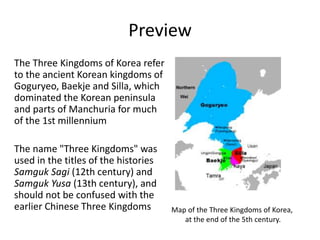
The Three Kingdoms of Korea refer
to the ancient Korean kingdoms of
Goguryeo, Baekje and Silla, which
dominated the Korean peninsula
and parts of Manchuria for much
of the 1st millennium
The name "Three Kingdoms" was
used in the titles of the histories
Samguk Sagi (12th century) and
Samguk Yusa (13th century), and
should not be confused with the
earlier Chinese Three Kingdoms Map of the Three Kingdoms of Korea,
at the end of the 5th century.
Preview
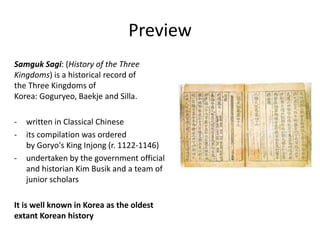
Samguk Sagi: (History of the Three
Kingdoms) is a historical record of
the Three Kingdoms of
Korea: Goguryeo, Baekje and Silla.
- written in Classical Chinese
- its compilation was ordered
by Goryo's King Injong (r. 1122-1146)
- undertaken by the government official
and historian Kim Busik and a team of
junior scholars
It is well known in Korea as the oldest
extant Korean history
Preview
Samguk Yusa or Memorabilia of the
Three Kingdoms, is a collection of
legends, folktales, and historical accounts
relating to the Three Kingdoms of Korea
- written in Classical Chinese
- It was compiled, at least in part, by
the Buddhist monk Iryeon (1206 -
1289) at the end of the 13th century, a
century after the Samguk Sagi.
- Samguk Yusa focuses on various
folktales, legends, and biographies
from early Korean history
Background
• The Three Kingdoms were founded after the
fall of Gojoseon, and gradually conquered and
absorbed various other small states and
confederacies
• The three polities made the transition from
walled-town state to full-fledged state-level
societies between 1st - 3rd century AD.
Background
• All three kingdoms shared a similar culture and
language
• Their original religions appear to have
been shamanistic,
• But they were increasingly influenced by Chinese
culture, particularly Confucianism and Taoism.
• In the 4th century, Buddhism was introduced to the
peninsula and spread rapidly, briefly becoming the
official religion of all three kingdoms.
Goguryeo (37 B.C. – A.D. 668)
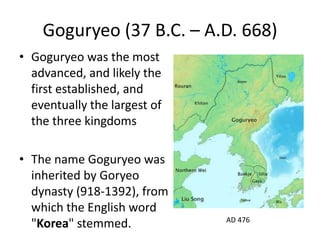
• Goguryeo was the most
advanced, and likely the
first established, and
eventually the largest of
the three kingdoms
• The name Goguryeo was
inherited by Goryeo
dynasty (918-1392), from
which the English word
"Korea" stemmed. AD 476
Goguryeo (37 B.C. – A.D. 668)
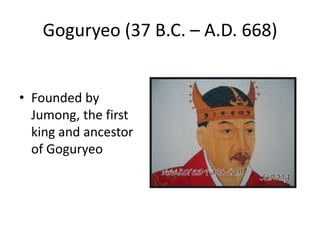
• Founded by
Jumong, the first
king and ancestor
of Goguryeo
Goguryeo (37 B.C. – A.D. 668)
• The Empire was at its zenith in the 5th
century during the rule of King
Gwanggaeto the Great and his
son King Jangsu in their campaign
against China in Manchuria and was
the dominant empire in the Korean
peninsula.
• Goguryeo controlled not only Koreans
but also Chinese and other Tungusic
tribes in Manchuria and North Korea.
• Gwanggaeto's accomplishments are
recorded on the Gwanggaeto Stele
Goguryeo (37 B.C. – A.D. 668)
• Had several capitals in
alternation: two capitals in the
upper Yalu area, and later
Nangrang which is now part of
Pyongyang
• Population: 3,500,000 (at the
time of its fall at 668 AD)
• After the establishment of
the Sui Dynasty and later
the Tang Dynasty in China, the
empire continued to suffer from
Chinese attacks until conquered
by an allied Silla–Tang forces in
668.
Goguryeo (37 B.C. – A.D. 668)
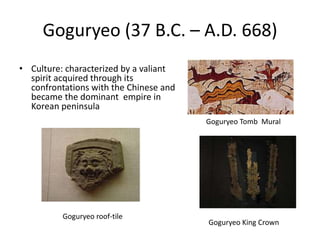
• Culture: characterized by a valiant
spirit acquired through its
confrontations with the Chinese and
became the dominant empire in
Korean peninsula
Goguryeo King Crown
Goguryeo Tomb Mural
Goguryeo roof-tile
Baekje (18 B.C. – A.D. 660)
• Located in the
southwestern region
of Korean peninsula,
situated in a fertile
plain with many rivers
and streams
• Population:
3,800,000 est.
Korea in 375, The greatest territory
expansion of Baekje.
Baekje (18 B.C. – A.D. 660)
• According to the
Samguk Sagi, Baekje
was founded in 18 BCE
by King Onjo (the third
son of Goguryeo's
founder Jumong and So
Seo-no), who led a
group of people from
Goguryeo south to the
Han River basin
Baekje (18 B.C. – A.D. 660)
• During the reign of King Goi (234–
286), Baekje became a full-fledged
kingdom as it continued
consolidating the Mahan
confederacy
• King Geunchogo (346–375)
expanded Baekje's territory to the
north through war
against Goguryeo, while annexing
the remaining Mahan societies in
the south
• the territories of Baekje included
most of the western Korean
Peninsula (except the
two Pyeongan provinces), and in
371, Baekje defeated Goguryeo
at Pyongyang
Baekje (18 B.C. – A.D. 660)
• Baekje also became a sea
power and continued
mutual goodwill
relationships with
the Japanese rulers of
the Kofun period,
transmitting continental
cultural influences to
Japan.
• Baekje played a
fundamental role in
transmitting cultural
developments, including
Chinese characters and
Buddhism, into ancient
Japan
Replica of the Seven-
pronged Sword Baekje
gave to Yamato.
Guze Kannon is a
buddhist statue made
in the image of King
Seong[19] in the
Korean style
Baekje (18 B.C. – A.D. 660)
• Culture: defined by an aristocratics, refined, and soft beauty
• Baekje Kingdom relics demonstrate the subtle beauty of that
kingdom
Gilt-bronze Incense Burner of BaekjeBangasayusang. Mireuksa
Baekje (18 B.C. – A.D. 660)
• In 660, the coalition troops of Silla
and Tang of China attacked Baekje, which was
then allied with Goguryeo. A heavily outmanned
army led by General Gyebaek was defeated in
the Battle of Hwangsanbeol near Nonsan. The
capital Sabi fell almost immediately thereafter,
resulting in the annexation of Baekje
by Silla. King Uija and his son Buyeo Yung were
sent into exile in China while at least some of
the ruling class fled to Japan.
Silla (57 B.C. – A.D. 668)
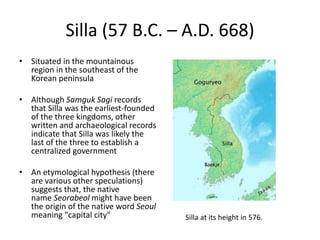
• Situated in the mountainous
region in the southeast of the
Korean peninsula
• Although Samguk Sagi records
that Silla was the earliest-founded
of the three kingdoms, other
written and archaeological records
indicate that Silla was likely the
last of the three to establish a
centralized government
• An etymological hypothesis (there
are various other speculations)
suggests that, the native
name Seorabeol might have been
the origin of the native word Seoul
meaning "capital city" Silla at its height in 576.
Silla (57 B.C. – A.D. 668)
• Founded by King Park
Hyeokgeose in 57 BC,
around present-day
Gyeongju
• He is also known to be
the originator of the
Korean family name Park
Silla (57 B.C. – A.D. 668)
• The kingdom annexed the Gaya confederacy in the first
half of the 6th Century. Goguryeo and Baekje responded
by forming an alliance.
• To cope with invasions from Goguryeo and Baekje, Silla
deepened its relations with the Tang Dynasty, with her
newly gained access to the Yellow Sea making direct
contact with the Tang possible.
• Gained strength in the 7th century and joined forces
with Dang Dynasty of China to defeat Baekje (660) and
Goguryeo Kingdom (668) unifying Three Kings
• After the conquest of Goguryeo and Baekje with her
Tang allies, the Silla kingdom drove the Tang forces out
of the peninsula and occupied the lands south of
Pyongyang
Silla (57 B.C. – A.D. 668)
• Silla focussed its
national resources
on raising valiant
men of talent
• Hwa rang do: teach
talented youth
martial arts and
moral principles  it
was an honor to
sacrifice one’s life for
the country
Silla (57 B.C. – A.D. 668)
• Many relics indicate the advanced scientific technology and artistic
prowess of Silla
A golden inner cap.
5-6th century Silla.
Gold ornament from early Silla.
A crown from late 5th
or early 6th Silla.
Silla (57 B.C. – A.D. 668)
• Many relics indicate the advanced scientific technology and artistic
prowess of Silla
Mojeon Stone Pagoda at
Bunhwangsa Temple
Cheomsongdae (the oldest astronomical
observatory in Asia)

Korean history

  • 1.
  • 2.
    Preview The Three Kingdomsof Korea refer to the ancient Korean kingdoms of Goguryeo, Baekje and Silla, which dominated the Korean peninsula and parts of Manchuria for much of the 1st millennium The name "Three Kingdoms" was used in the titles of the histories Samguk Sagi (12th century) and Samguk Yusa (13th century), and should not be confused with the earlier Chinese Three Kingdoms Map of the Three Kingdoms of Korea, at the end of the 5th century.
  • 3.
    Preview Samguk Sagi: (Historyof the Three Kingdoms) is a historical record of the Three Kingdoms of Korea: Goguryeo, Baekje and Silla. - written in Classical Chinese - its compilation was ordered by Goryo's King Injong (r. 1122-1146) - undertaken by the government official and historian Kim Busik and a team of junior scholars It is well known in Korea as the oldest extant Korean history
  • 4.
    Preview Samguk Yusa orMemorabilia of the Three Kingdoms, is a collection of legends, folktales, and historical accounts relating to the Three Kingdoms of Korea - written in Classical Chinese - It was compiled, at least in part, by the Buddhist monk Iryeon (1206 - 1289) at the end of the 13th century, a century after the Samguk Sagi. - Samguk Yusa focuses on various folktales, legends, and biographies from early Korean history
  • 5.
    Background • The ThreeKingdoms were founded after the fall of Gojoseon, and gradually conquered and absorbed various other small states and confederacies • The three polities made the transition from walled-town state to full-fledged state-level societies between 1st - 3rd century AD.
  • 6.
    Background • All threekingdoms shared a similar culture and language • Their original religions appear to have been shamanistic, • But they were increasingly influenced by Chinese culture, particularly Confucianism and Taoism. • In the 4th century, Buddhism was introduced to the peninsula and spread rapidly, briefly becoming the official religion of all three kingdoms.
  • 7.
    Goguryeo (37 B.C.– A.D. 668) • Goguryeo was the most advanced, and likely the first established, and eventually the largest of the three kingdoms • The name Goguryeo was inherited by Goryeo dynasty (918-1392), from which the English word "Korea" stemmed. AD 476
  • 8.
    Goguryeo (37 B.C.– A.D. 668) • Founded by Jumong, the first king and ancestor of Goguryeo
  • 9.
    Goguryeo (37 B.C.– A.D. 668) • The Empire was at its zenith in the 5th century during the rule of King Gwanggaeto the Great and his son King Jangsu in their campaign against China in Manchuria and was the dominant empire in the Korean peninsula. • Goguryeo controlled not only Koreans but also Chinese and other Tungusic tribes in Manchuria and North Korea. • Gwanggaeto's accomplishments are recorded on the Gwanggaeto Stele
  • 10.
    Goguryeo (37 B.C.– A.D. 668) • Had several capitals in alternation: two capitals in the upper Yalu area, and later Nangrang which is now part of Pyongyang • Population: 3,500,000 (at the time of its fall at 668 AD) • After the establishment of the Sui Dynasty and later the Tang Dynasty in China, the empire continued to suffer from Chinese attacks until conquered by an allied Silla–Tang forces in 668.
  • 11.
    Goguryeo (37 B.C.– A.D. 668) • Culture: characterized by a valiant spirit acquired through its confrontations with the Chinese and became the dominant empire in Korean peninsula Goguryeo King Crown Goguryeo Tomb Mural Goguryeo roof-tile
  • 12.
    Baekje (18 B.C.– A.D. 660) • Located in the southwestern region of Korean peninsula, situated in a fertile plain with many rivers and streams • Population: 3,800,000 est. Korea in 375, The greatest territory expansion of Baekje.
  • 13.
    Baekje (18 B.C.– A.D. 660) • According to the Samguk Sagi, Baekje was founded in 18 BCE by King Onjo (the third son of Goguryeo's founder Jumong and So Seo-no), who led a group of people from Goguryeo south to the Han River basin
  • 14.
    Baekje (18 B.C.– A.D. 660) • During the reign of King Goi (234– 286), Baekje became a full-fledged kingdom as it continued consolidating the Mahan confederacy • King Geunchogo (346–375) expanded Baekje's territory to the north through war against Goguryeo, while annexing the remaining Mahan societies in the south • the territories of Baekje included most of the western Korean Peninsula (except the two Pyeongan provinces), and in 371, Baekje defeated Goguryeo at Pyongyang
  • 15.
    Baekje (18 B.C.– A.D. 660) • Baekje also became a sea power and continued mutual goodwill relationships with the Japanese rulers of the Kofun period, transmitting continental cultural influences to Japan. • Baekje played a fundamental role in transmitting cultural developments, including Chinese characters and Buddhism, into ancient Japan Replica of the Seven- pronged Sword Baekje gave to Yamato. Guze Kannon is a buddhist statue made in the image of King Seong[19] in the Korean style
  • 16.
    Baekje (18 B.C.– A.D. 660) • Culture: defined by an aristocratics, refined, and soft beauty • Baekje Kingdom relics demonstrate the subtle beauty of that kingdom Gilt-bronze Incense Burner of BaekjeBangasayusang. Mireuksa
  • 17.
    Baekje (18 B.C.– A.D. 660) • In 660, the coalition troops of Silla and Tang of China attacked Baekje, which was then allied with Goguryeo. A heavily outmanned army led by General Gyebaek was defeated in the Battle of Hwangsanbeol near Nonsan. The capital Sabi fell almost immediately thereafter, resulting in the annexation of Baekje by Silla. King Uija and his son Buyeo Yung were sent into exile in China while at least some of the ruling class fled to Japan.
  • 18.
    Silla (57 B.C.– A.D. 668) • Situated in the mountainous region in the southeast of the Korean peninsula • Although Samguk Sagi records that Silla was the earliest-founded of the three kingdoms, other written and archaeological records indicate that Silla was likely the last of the three to establish a centralized government • An etymological hypothesis (there are various other speculations) suggests that, the native name Seorabeol might have been the origin of the native word Seoul meaning "capital city" Silla at its height in 576.
  • 19.
    Silla (57 B.C.– A.D. 668) • Founded by King Park Hyeokgeose in 57 BC, around present-day Gyeongju • He is also known to be the originator of the Korean family name Park
  • 20.
    Silla (57 B.C.– A.D. 668) • The kingdom annexed the Gaya confederacy in the first half of the 6th Century. Goguryeo and Baekje responded by forming an alliance. • To cope with invasions from Goguryeo and Baekje, Silla deepened its relations with the Tang Dynasty, with her newly gained access to the Yellow Sea making direct contact with the Tang possible. • Gained strength in the 7th century and joined forces with Dang Dynasty of China to defeat Baekje (660) and Goguryeo Kingdom (668) unifying Three Kings • After the conquest of Goguryeo and Baekje with her Tang allies, the Silla kingdom drove the Tang forces out of the peninsula and occupied the lands south of Pyongyang
  • 21.
    Silla (57 B.C.– A.D. 668) • Silla focussed its national resources on raising valiant men of talent • Hwa rang do: teach talented youth martial arts and moral principles  it was an honor to sacrifice one’s life for the country
  • 22.
    Silla (57 B.C.– A.D. 668) • Many relics indicate the advanced scientific technology and artistic prowess of Silla A golden inner cap. 5-6th century Silla. Gold ornament from early Silla. A crown from late 5th or early 6th Silla.
  • 23.
    Silla (57 B.C.– A.D. 668) • Many relics indicate the advanced scientific technology and artistic prowess of Silla Mojeon Stone Pagoda at Bunhwangsa Temple Cheomsongdae (the oldest astronomical observatory in Asia)

Editor's Notes

  • #4 In taking on the task of compiling (this term is more accurate than "writing" because much of the history is taken from earlier historical records) the Samguk Sagi Kim Busik was consciously modeling his actions on Chinese Imperial traditions, just as he modeled the history’s format after its Chinese forebears There were various motivating factors behind the compilation of the Samguk Sagi in the 12th century. These may roughly be categorized as ideological and political. The ideological factors are made manifest in the work's preface, written by Kim Busik The other motive was to produce a history that would serve to educate native Korean literati in native history, and provide them with Korean exemplars of Confucian virtues. This was especially important in mid-Goryeo as that dynasty became increasingly Confucianized.
  • #5 Unlike the more factually-oriented Samguk Sagi, the Samguk Yusa focuses on various folktales, legends, and biographies from early Korean history. Many of the founding legends of the various kingdoms in Korean history are recorded in the book. Iryeon covered legends from many Korean kingdoms, including Gojoseon, Wiman Joseon, Buyeo, Goguryeo, Baekje, Silla, and Gaya.
  • #6 After the fall of Gojoseon, the Han dynasty established four commanderies in present Liaoning, Three fell quickly to the Samhan, and the last was destroyed by Goguryeo in 313 The nascent precursors of Baekje and Silla expanded within the web of statelets during the Proto Three Kingdoms Period, andGoguryeo conquered neighboring state like Buyeo in Manchuria and chiefdoms in Okjeo, Dongye which occupied the northeastern Korean peninsula
  • #7 After the fall of Gojoseon, the Han dynasty established four commanderies in present Liaoning, Three fell quickly to the Samhan, and the last was destroyed by Goguryeo in 313 The nascent precursors of Baekje and Silla expanded within the web of statelets during the Proto Three Kingdoms Period, andGoguryeo conquered neighboring state like Buyeo in Manchuria and chiefdoms in Okjeo, Dongye which occupied the northeastern Korean peninsula Shamanistic is a practice that involves a practitioner reaching altered states of consciousness in order to encounter and interact with the spirit world.[2] A shaman is a person regarded as having access to, and influence in, the world of benevolent and malevolent spirits, who typically enters into a trance state during a ritual, and practicesdivination and healing.[3] The term "shamanism" was first applied to the ancient religion of the Turks andMongols
  • #9 Jumong's biological father was said to be a man named Hae Mosu who is described as a "strong man" and "a heavenly prince."[11] The river god chased Yuhwa away to Ubal river (우발수, 優渤水) due to pregnancy, where she met and became the concubine of King Geumwa of Dongbuyeo. Jumong was well known for his exceptional archery skills. Eventually, Geumwa's sons became jealous of him, and Jumong was forced to leave Dongbuyeo.[12] The Stele and later Korean sources disagree as to which Buyeo Jumong came from. The Stele says he came from Northern Buyeo and the Samguk Sagi and Samguk Yusa say he came from Eastern Buyeo. Jumong eventually made it to the Jolbon Buyeo confederacy, where he married So Seo-no, daughter of its ruler. He subsequently became king himself, founding Goguryeo with a small group of his followers from his native country.
  • #10 1st picture: Entrance to King Gwanggaeto's burial chamber 2nd: The Gwanggaeto Stele stands at nearly 7 meters. (Sept. 2001) The stele of Gwanggaeto the Great of Goguryeo was erected in 414 by Jangsu of Goguryeo as a memorial to his deceased father. It is one of the major primary sources extant for the history of Goguryeo, one of the Three Kingdoms of Korea, and supplies invaluable historical detail on his reign as well as insights into Goguryeo mythology.
  • #12 UNESCO added Capital Cities and Tombs of the Ancient Koguryo Kingdom in present-day China and Complex of Goguryeo Tombs in present-day North Korea to the World Heritage Sites in 2004.
  • #13 Relics: Murals. Golden crowns, and incence burner Baekje Geumdong Daehyangro (a great gold-bronze incence burner) Seosan Ma-e Samjonbul-sang (a three Budah image with a subtle and gentle smile in Seosan) And a variety of stode and wooden pagodas
  • #14 The Samguk Sagi provides a detailed account of Baekje's founding. Jumong had left his son Yuri in Buyeo when he left that kingdom to establish the new kingdom of Goguryeo. Jumong became King Dongmyeongseong, and had two more sons with So Seo-no, Onjo and Biryu. When Yuri later arrived in Goguryeo, Jumong promptly made him the crown prince. Realizing Yuri would become the next king, So Seo-no left Goguryeo, taking her two sons Biryu and Onjo south to found their own kingdoms with their people, along with ten vassals. She is remembered as a key figure in the founding of both Goguryeo and Baekje
  • #15 Relics: Murals. Golden crowns, and incence burner Baekje Geumdong Daehyangro (a great gold-bronze incence burner) Seosan Ma-e Samjonbul-sang (a three Budah image with a subtle and gentle smile in Seosan) And a variety of stode and wooden pagodas
  • #16 The statue, originally come from Baekje,[21] is kept in the Dream Hall at the Japanese temple Horyu-ji.
  • #17 Relics: Murals. Golden crowns, and incence burner Baekje Geumdong Daehyangro (a great gold-bronze incence burner) Seosan Ma-e Samjonbul-sang (a three Budah image with a subtle and gentle smile in Seosan) And a variety of stode and wooden pagodas
  • #20 Relics: Mojeon Stone Pagoda at Bunhwangsa Temple Cheomsongdae (the oldest astronomical observatory in Asia) Geumdong Mireuk Banga Sayusang (gilt bronze mediatin-g-half-seated Maitreya wearing crown)
  • #21 Relics: Mojeon Stone Pagoda at Bunhwangsa Temple Cheomsongdae (the oldest astronomical observatory in Asia) Geumdong Mireuk Banga Sayusang (gilt bronze mediatin-g-half-seated Maitreya wearing crown)
  • #23 Relics: Mojeon Stone Pagoda at Bunhwangsa Temple Cheomsongdae (the oldest astronomical observatory in Asia) Geumdong Mireuk Banga Sayusang (gilt bronze mediatin-g-half-seated Maitreya wearing crown)
  • #24 Relics: Mojeon Stone Pagoda at Bunhwangsa Temple Cheomsongdae (the oldest astronomical observatory in Asia) Geumdong Mireuk Banga Sayusang (gilt bronze mediatin-g-half-seated Maitreya wearing crown)