Macroeconomics 2
Abdul Hadi Ilman
Sumbawa University of Technology
What will we learn?
 Trying to integrate two quite different schools of thought
• New Classical vs Keynesian
• Classical  micro-foundation, and excluding market failure
• Keynesian  macro policy, and excluding micro-foundation
 The development of the “New Neoclassical Synthesis”
• a system that involved the Classical model determining full equilibrium, and a Keynesian
model of temporarily sticky prices determining the approach to that full equilibrium
 Short run issues: dynamics, expectations, and micro-foundations
 Long run issues: natural unemployment rate, old and new growth theory
What will we learn? The applications
 the Lucas critique of standard methods for
evaluating policy,
 credibility and dynamic consistency issues
in policy design,
 the sustainability of rising debt levels and
an evaluation of Europe's Stability Pact,
 the optimal inflation rate,
 the implications of alternative monetary
policies for pursuing price stability (price-
level vs inflation-rate targeting, fixed vs
flexible exchange rates),
 tax reform (trickle-down controversies
and whether second-best initial
conditions ease the trade-off between
efficiency and equity objectives),
 theories of the natural unemployment
rate and the possibility of multiple
equilibria,
 alternative low-income support
policies, and globalization (including the
alleged threat to the scope for
independent macro policy).
Keynes and the Classic
Chapter 1
Makroekonomi 2
Abdul Hadi Ilman
Introduction
 Keynesian view is that adjustment back to equilibrium simply does not take place
without policy assistance.
 (i) the economy has multiple equilibria, only one of which involves "full" employment; or
 (ii) there is only one equilibrium, and it involves "full" employment, but the economic system is
unstable without the assistance of policy, so it cannot reach the "full" employment equilibrium on
its own.
 Stability vs outright instability
 Chapter 1: Specification in the labor market, to clarify the cause of unemployment:
 Perfectly flexbile money wages (Classical)
 Completely fixed money wages (Keynesian)
Introduction
 Chapter 2, we assume that nominal rigidities are only temporary, and we consider a dynamic analysis that
has Classical properties in full equilibrium, but Keynesian features in the transitional periods on the way to
full equilibrium
 In Chapter 3, we enrich this dynamic analysis by exploring alternative ways of bringing expectations into
the analysis. we will have identified two important considerations that make macroeconomic convergence
more problematic: firms' reactions to sticky prices and sales constraints, and expectations.
 In Chapter 4, we rectify one major limitation of the analysis to that point — that formal micro-foundations
have been missing. The intertemporal optimization that is needed to overcome this limitation is explained
in Chapter 4.
 in Chapter 5, we examine the New Classical approach to business cycle analysis — the modern, more
micro-based version of the market-clearing approach to macroeconomics, in which no appeal to sticky
prices is involved.
 Finally, in Chapters 6 and 7, we examine what has been called the "New" Neoclassical Synthesis — a
business-cycle analysis that blends the microeconomic rigour of the New Classicals with the empirical
applicability that has always been the focus of the Keynesian tradition and the original Neoclassical
Synthesis.
Criteria for Model Selection
 Broad criteria for macro models
• First, models must be subjected to empirical tests, to see whether the predictions
are consistent with actual experience.
• Second, should be evaluated as to their consistency with optimizing
underpinnings. Microeconomics base
 Frustrating debate in 1970s and 1980s between these two schools of thought
 In 1990s, there were constructive dialogs to combine the best features of the
competing approaches so that now the subject is empirically applicable, has solid
micro-foundations, and it allows for market failure
Classical Economics
 Economists:
 Adam Smith( Scottish philosopher)
 Alfred Marshall(British economist)
 Arthur Cecil Pigou (British
economist)
 David Ricardo (British economist)
 JS.Mill
 Malthus
CENTRAL PRINCIPLE
 The economy is best organised as
a self-regulating system of
markets.
 Known also as: laissez faire,
liberal, supply side
Classical Economics
 Wages and prices are fully
flexible in order to clear
markets rapidly.
 Economy operates at full
employment most of the time.
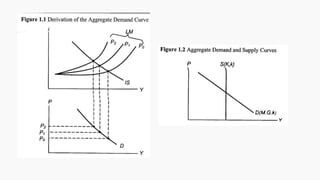
Classical aggregate curve is
vertical
 Minimal govt intervention
reflecting distrust of
government and belief in its
inefficiency.
 Unemployment in the economy
is either Voluntary or due to
some External Interference.
Keynesian Economics
 Advocates:
• Francis Ysidro Edge Worth
• Jean-Baptist Say
• Paul Samuelson
• John Maynard Keynes
CENTRAL PRINCIPLE
The economy often operates at
less than full employment;
market system does not self
adjust.
Known also as: interventionist, demand side
Key Differences
 IN THE CLASSICAL WORLD
• Free market economies are always stable
• Tending towards full employment & full production equilibrium
• Free fluctuating pricies in the three macro markets (Goods, money, labor)
 IN THE KEYNESIAN WORLD
• Free market economies are unstable
• Equilibrium but no reason for full employment/full production
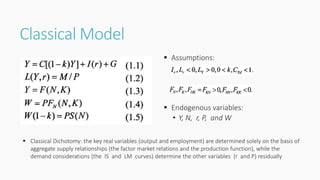
Classical Model
 Assumptions:
 Endogenous variables:
• Y, N, r, P, and W
 Classical Dichotomy: the key real variables (output and employment) are determined solely on the basis of
aggregate supply relationships (the factor market relations and the production function), while the
demand considerations (the IS and LM curves) determine the other variables (r and P) residually
Classical View on Unemployment
 The labor &the other resources are always fully employed.
 General unemployment is assumed to be impossible.
 If there is any unemployment, it is assumed to be temporary/ abnormal.
 In the long run the economy will have full employment/natural rate of
unemployment if wages & prices are flexible
Classical’s Reason for Full Employment
 Say’s law: Supply creates its own demand.
 Abstinence theory of interest: Interest rate influences people’s saving.
 Classical theorists held that wages & prices would change proportionally
Graphically the pure classical theorists would have a vertical AS curve. That shows
the same GDP associated with full employment, at each level in the economy.
Classical’s Reason for Unemployment
 Intervention by the
government/private
monopoly.
 Wrong calculation by
entrepreneurs & inaccurate
decisions
 Artificial resistance
• Classical unemployment occurs when real
wages are kept above the market clearing
wage rate, leading to a surplus of labor
supplied
• Classical unemployment sometimes known
as real wage unemployment. Because it
refers to real wages being too high.
Keynesian Economics
 Markets clear only slowly, if at al
 In a depression or recession, much
employment is involuntary.
 Economy operates less often than full
employment, since market don’t clear
 Govt intervention may be desirable to
stabilize the business cycle. (Fiscal and
monetary policies)
 Demand becomes much
bigger driving force
 Supply will adjust to
demand
 According to Keynes;
Demand creates its own
supply”
Keynesian policy Implications
 Under the classical system, government had no role in management of
the economy- “Laissez faire” do nothing.
 Under Keynes, Government must step into to correct instability of the
economy.
• If the economy faces recessionary gap, govt must increase demand by spending
more; lowering taxes;lowering interest;
• If the economy faces an inflationary gap, govt must reduce demand by spending
less; raise taxes; increase interest rate;
Keynesian’s view on Unemployment
 Keynesian theory holds that unemployment is the normal state of the economy &
significant government intervention is required if employment/output targets are to
be reached
• Central Keynesian conclusion:
• AD determines real GDP
• In short run, AD can be adjusted to achieve target GDP & unemployment levels
with prices not changing (fixed, flat price)
Conclusion
 Unemployment can exist only in the presence of some stickiness in money wage.
 Should we advocate increased wage flexibility so as to avoid at least some
unemployment?
• Micro view: private agents must have adopted the institution of temporarily rigid
wages (contracts) for a reason and that reason must be understood before one
can be confident that increasing wage flexibility is "good."
• Macro view: the microeconomic costs of increased flexibility would not be large
and, therefore, directly proceed with a macroeconomic analysis -of whether the
built-in stability of the overall economy is enhanced by wage flexibility
Tugas
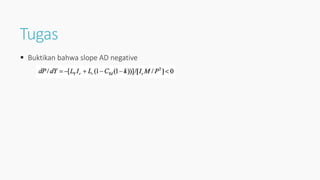
 Buktikan bahwa slope AD negative

Chapter 1 keynes and the classic (Scarth)

  • 1.
    Macroeconomics 2 Abdul HadiIlman Sumbawa University of Technology
  • 2.
    What will welearn?  Trying to integrate two quite different schools of thought • New Classical vs Keynesian • Classical  micro-foundation, and excluding market failure • Keynesian  macro policy, and excluding micro-foundation  The development of the “New Neoclassical Synthesis” • a system that involved the Classical model determining full equilibrium, and a Keynesian model of temporarily sticky prices determining the approach to that full equilibrium  Short run issues: dynamics, expectations, and micro-foundations  Long run issues: natural unemployment rate, old and new growth theory
  • 3.
    What will welearn? The applications  the Lucas critique of standard methods for evaluating policy,  credibility and dynamic consistency issues in policy design,  the sustainability of rising debt levels and an evaluation of Europe's Stability Pact,  the optimal inflation rate,  the implications of alternative monetary policies for pursuing price stability (price- level vs inflation-rate targeting, fixed vs flexible exchange rates),  tax reform (trickle-down controversies and whether second-best initial conditions ease the trade-off between efficiency and equity objectives),  theories of the natural unemployment rate and the possibility of multiple equilibria,  alternative low-income support policies, and globalization (including the alleged threat to the scope for independent macro policy).
  • 4.
    Keynes and theClassic Chapter 1 Makroekonomi 2 Abdul Hadi Ilman
  • 5.
    Introduction  Keynesian viewis that adjustment back to equilibrium simply does not take place without policy assistance.  (i) the economy has multiple equilibria, only one of which involves "full" employment; or  (ii) there is only one equilibrium, and it involves "full" employment, but the economic system is unstable without the assistance of policy, so it cannot reach the "full" employment equilibrium on its own.  Stability vs outright instability  Chapter 1: Specification in the labor market, to clarify the cause of unemployment:  Perfectly flexbile money wages (Classical)  Completely fixed money wages (Keynesian)
  • 6.
    Introduction  Chapter 2,we assume that nominal rigidities are only temporary, and we consider a dynamic analysis that has Classical properties in full equilibrium, but Keynesian features in the transitional periods on the way to full equilibrium  In Chapter 3, we enrich this dynamic analysis by exploring alternative ways of bringing expectations into the analysis. we will have identified two important considerations that make macroeconomic convergence more problematic: firms' reactions to sticky prices and sales constraints, and expectations.  In Chapter 4, we rectify one major limitation of the analysis to that point — that formal micro-foundations have been missing. The intertemporal optimization that is needed to overcome this limitation is explained in Chapter 4.  in Chapter 5, we examine the New Classical approach to business cycle analysis — the modern, more micro-based version of the market-clearing approach to macroeconomics, in which no appeal to sticky prices is involved.  Finally, in Chapters 6 and 7, we examine what has been called the "New" Neoclassical Synthesis — a business-cycle analysis that blends the microeconomic rigour of the New Classicals with the empirical applicability that has always been the focus of the Keynesian tradition and the original Neoclassical Synthesis.
  • 7.
    Criteria for ModelSelection  Broad criteria for macro models • First, models must be subjected to empirical tests, to see whether the predictions are consistent with actual experience. • Second, should be evaluated as to their consistency with optimizing underpinnings. Microeconomics base  Frustrating debate in 1970s and 1980s between these two schools of thought  In 1990s, there were constructive dialogs to combine the best features of the competing approaches so that now the subject is empirically applicable, has solid micro-foundations, and it allows for market failure
  • 8.
    Classical Economics  Economists: Adam Smith( Scottish philosopher)  Alfred Marshall(British economist)  Arthur Cecil Pigou (British economist)  David Ricardo (British economist)  JS.Mill  Malthus CENTRAL PRINCIPLE  The economy is best organised as a self-regulating system of markets.  Known also as: laissez faire, liberal, supply side
  • 9.
    Classical Economics  Wagesand prices are fully flexible in order to clear markets rapidly.  Economy operates at full employment most of the time. Classical aggregate curve is vertical  Minimal govt intervention reflecting distrust of government and belief in its inefficiency.  Unemployment in the economy is either Voluntary or due to some External Interference.
  • 10.
    Keynesian Economics  Advocates: •Francis Ysidro Edge Worth • Jean-Baptist Say • Paul Samuelson • John Maynard Keynes CENTRAL PRINCIPLE The economy often operates at less than full employment; market system does not self adjust. Known also as: interventionist, demand side
  • 11.
    Key Differences  INTHE CLASSICAL WORLD • Free market economies are always stable • Tending towards full employment & full production equilibrium • Free fluctuating pricies in the three macro markets (Goods, money, labor)  IN THE KEYNESIAN WORLD • Free market economies are unstable • Equilibrium but no reason for full employment/full production
  • 12.
    Classical Model  Assumptions: Endogenous variables: • Y, N, r, P, and W  Classical Dichotomy: the key real variables (output and employment) are determined solely on the basis of aggregate supply relationships (the factor market relations and the production function), while the demand considerations (the IS and LM curves) determine the other variables (r and P) residually
  • 14.
    Classical View onUnemployment  The labor &the other resources are always fully employed.  General unemployment is assumed to be impossible.  If there is any unemployment, it is assumed to be temporary/ abnormal.  In the long run the economy will have full employment/natural rate of unemployment if wages & prices are flexible
  • 15.
    Classical’s Reason forFull Employment  Say’s law: Supply creates its own demand.  Abstinence theory of interest: Interest rate influences people’s saving.  Classical theorists held that wages & prices would change proportionally Graphically the pure classical theorists would have a vertical AS curve. That shows the same GDP associated with full employment, at each level in the economy.
  • 16.
    Classical’s Reason forUnemployment  Intervention by the government/private monopoly.  Wrong calculation by entrepreneurs & inaccurate decisions  Artificial resistance • Classical unemployment occurs when real wages are kept above the market clearing wage rate, leading to a surplus of labor supplied • Classical unemployment sometimes known as real wage unemployment. Because it refers to real wages being too high.
  • 17.
    Keynesian Economics  Marketsclear only slowly, if at al  In a depression or recession, much employment is involuntary.  Economy operates less often than full employment, since market don’t clear  Govt intervention may be desirable to stabilize the business cycle. (Fiscal and monetary policies)  Demand becomes much bigger driving force  Supply will adjust to demand  According to Keynes; Demand creates its own supply”
  • 18.
    Keynesian policy Implications Under the classical system, government had no role in management of the economy- “Laissez faire” do nothing.  Under Keynes, Government must step into to correct instability of the economy. • If the economy faces recessionary gap, govt must increase demand by spending more; lowering taxes;lowering interest; • If the economy faces an inflationary gap, govt must reduce demand by spending less; raise taxes; increase interest rate;
  • 19.
    Keynesian’s view onUnemployment  Keynesian theory holds that unemployment is the normal state of the economy & significant government intervention is required if employment/output targets are to be reached • Central Keynesian conclusion: • AD determines real GDP • In short run, AD can be adjusted to achieve target GDP & unemployment levels with prices not changing (fixed, flat price)
  • 20.
    Conclusion  Unemployment canexist only in the presence of some stickiness in money wage.  Should we advocate increased wage flexibility so as to avoid at least some unemployment? • Micro view: private agents must have adopted the institution of temporarily rigid wages (contracts) for a reason and that reason must be understood before one can be confident that increasing wage flexibility is "good." • Macro view: the microeconomic costs of increased flexibility would not be large and, therefore, directly proceed with a macroeconomic analysis -of whether the built-in stability of the overall economy is enhanced by wage flexibility
  • 21.
    Tugas  Buktikan bahwaslope AD negative