Integrated Village
Development Plan
KONAIPALLY
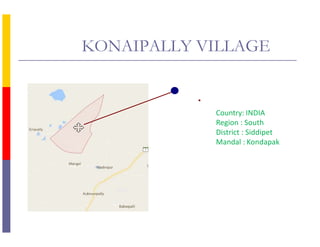
KONAIPALLY VILLAGE
Country: INDIA
Region : South
District : Siddipet
Mandal : Kondapak
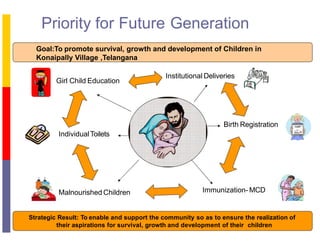
Priority for Future Generation
Institutional Deliveries
Malnourished Children
Girl Child Education
Birth Registration
IndividualToilets
Immunization- MCD
Goal:To promote survival, growth and development of Children in
Konaipally Village ,Telangana
Strategic Result: To enable and support the community so as to ensure the realization of
their aspirations for survival, growth and development of their children
Development Plan For Children
1.
2.
3.
4.
5.
6.
7.
8.
9.
Registration and certificate to all children within 21 days of birth.
All deliveries by technically trained people.
Breast feeding to infants up to 6 months.
Complete Immunization of 90%children.
ORS consumption for children suffering from Diarrhea, and preventive care on
respiratoryproblems.
All children get complete doses of vitamin A.
No child should fall under grade 3-4 of malnutrition, 30% reduction in children falling
under grade 1-2.
All children complete primary education and are linked to the process of developing
basic learningskills.
Awareness and knowledge among 15-24 years on HIV/AIDS. Practicing safe sexual
behavior.
10. 50% Reduction in children marrying before age of 18.
11. Ensuring protection of children from unsafe work and hazardous working conditions.
Continued…
1. Use of Iodine salt in everyhousehold.
2.
3.
4.
5.
6.
7.
8.
Outreach of every family to safe drinking water sources, and no water source should
remain malfunction for more than 4 days.
Safe hygiene practices to be followed by every person of the family (washing hands
before and after meals and defecation).
Outreach of all to safe hygiene and sanitation facilities.
Pre and Post natal care to all pregnant women, and PPTC (Prevention of Parentto
Child )services.
Facilities for children at ICDS center and health centers on the basis ofindividual
evaluation.
Village level micro-planning in every village.
Promoting safe behaviors through behavior change communication
9. Planned implementation of various child and mother development programs, and
evaluating them on the basis ofperformance.
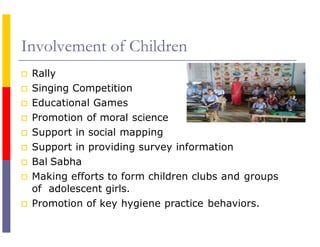
Involvement of Children
 Rally
 Singing Competition
 Educational Games
 Promotion of moral science
 Support in social mapping
 Support in providing survey information
 Bal Sabha
 Making efforts to form children clubs and groups
of adolescent girls.
 Promotion of key hygiene practice behaviors.
Personal Development
• Personal Values.
• Respect for Parents, Teachers, Women, Martyrs and Elders
• Cleanliness (Toileting, Bathing, Brushing mouth ,Washing Clothes, keeping house and
environment clean.)
• Good Hygiene
• Cultural Heritage
• Behavior Change
• Moral and Ethical Values
• Disposal of solid and Liquid wastes
• Educate the villagers for toilet use
• Inculcating habits of regular Physical Exercises
Human Development
• Hundred percent Institutional Delivery
• Hundred percent Vaccinations against various preventable diseases.
• Pre primary education through Anganwadi, and Nutritious Feeding,
• Hundred percent primary education,
• Hundred percent Secondary educations (up to 10th standard)
• All-‐round developmental education like, Physical education, Yoga, craft etc.,
Reducing child and mother mortality rate.
• Employable skill development.
• Maintenance of Schools and Hospitals for healthy developments.
• Providing good drinking water.
• Create awareness about various health programme.
Agriculture Development
• To increase the yield of the field as well as Horticultural crops
• To adopt crop specific Hi tech technologies without harming conventional agricultural
practices simultaneously.
• To attain raise the income of the farmer substantially in a sustainable manner.
• To conceive and achieve integrated and holistic productivity increasing model by
incorporating natural and Biological components.
• To increase the income of farmers by introducing suitable crops
• To diversify the prevailing cropping pattern
• To help in avoidance of mono cropping
• To bring in ecological sustainability
Soil Health Card and Fertility Mapping
• To issue Soil Health Card to all the farmers.
• To prepare Soil Fertility Mapping of the village.
• To moot the farmers to undertake need based fertilizer application.
• To promote rational use of fertilizer .
• To decrease the cost of cultivation by going to cost effective fertilizer application .
• To stop the indiscriminate use of fertilizer application .
• To prevent the soil degradation and water contamination.
Initial Preparations
 Framing survey formats- village, family
 Testing survey format
 Presentations through Videos
Need for Participatory Planning
 It is easily understood that the people of a village know better them
any outsider.
 ToAddress their problems and improve their situation.
Participatory planning is an approach and a methodology which helps
identify community problems and to Plan solutions with the active
participation of community members.
Facilitates the identification, preparation and design of community
project based on the reality and criteria of its members.
 It is a people- centric process that puts the poorest first.
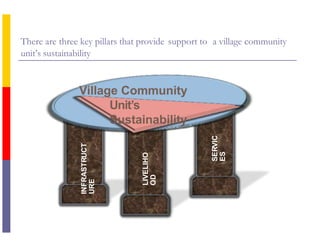
There are three key pillars that provide support to a village community
unit’s sustainability
SERVIC
ES
LIVELIHO
OD
INFRASTRUCT
UREVillage Community
Unit’s
Sustainability
Identification of Gaps
Gaps at Household level
Gaps at Village Level
Gaps in Infrastructure
Gaps in Skill
Gaps in Equipment
Gaps in Backward Linkage
Gaps in Forward Linkage
Prioritization ofgaps
Who is to be benefitted-priorityranking -Poorest/ vulnerable sections
What is to be taken up –priority ranking of families
Civic Amenities at Village Level
Cement Concrete Roads with drains
Street Light
Safe Drinking Water Supply to households/common places-De-
fluoridation/ RO
Sanitation Facilities
E-Library /Library/
Functional School Building
Functional Anganwadi Centre
Play ground / playmaterials
Cremation ground
Public Park
Building for Social purpose
Passenger shade
Civic Amenities at Household Level
Pucca House
Sanitation
Cattle-shed
Biogas
Drinking Water
Gas Connection
WasteManagement
Farm Infrastructure
Land Levelling
Irrigationwell
Green Fencing
Kisan Credit Card
Best Practices
Horticulture
Commercial Plantation
Percolation tank
Lift/Gravity flow irrigation
Ground water rechargefacilities
Facilities for Village Economic
Activities
Collection cum Distribution Centre
Milk Collection Centre with Computer
Go down, grading, packing facility Centre
Fish pond
Common workingshed
Multi facilities training Centre
E-Panchayatfacility
Ultra Small Bank Branch
Village Market
Agriculture equipment bank
Grading cum meeting platforms with shade
Village Convergence Plan
Identified components and prepare list of works
Prepare estimates for each work
Identified fundingsource for each component
Take technical and administrativeapproval
Include in village Shelf of Project
Identified user group/management committees for stake building-community
contribution/execution
Identified executionagencies
Develop to bring Public Participation through PPP
Develop mechanism for operation and maintenance
Schemes to reach the beneficiaries in thevillage
Issues Emerged
 Flies and Mosquitoes
 Clog in Drainage
 Malfunctioning PRI
 Non dependable Government Services
 Land ownership and productivity
 Lack of Proper Awareness
 Caste and class distances
 Women denied rights
 Quality of education
Community Level Issues
 Garbage
 Open Defecation
 Washing hands before meals
 Washing hands after defecation
 Personal hygiene
 Village sanitation
 Leaving waste water standing on roads and pathways
 Other feeding to infants before 6 months
 Liquor flow
 Girl child education
 Caste discrimination
 Participation of women and children in decision making
Government Level Issues
 Distribution of supplement at ICDS
 Check-up & Immunization by ANM
 ANM not staying at Sub-center
 Unemployment
 Distribution of Ration (PDS)
 Vulnerabilities
 Insufficient Leadership
 School building not adequate
 Roads
Proposals to PRI
 School Infrastructure
 Veterinary Center
 Government Schemes
 Garbage dumps
 Drain construction
 Agriculture Schemes
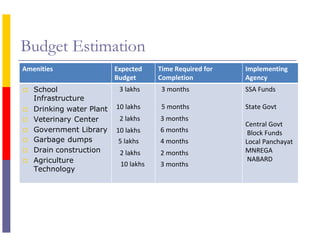
Budget Estimation
Amenities Expected
Budget
Time Required for
Completion
Implementing
Agency
 School
Infrastructure
 Drinking water Plant
 Veterinary Center
 Government Library
 Garbage dumps
 Drain construction
 Agriculture
Technology
3 lakhs 3 months
5 months
SSA Funds
State Govt
Central Govt
Block Funds
Local Panchayat
MNREGA
NABARD
10 lakhs
2 lakhs
10 lakhs
5 lakhs
2 lakhs
10 lakhs
3 months
6 months
4 months
2 months
3 months
Village Shelf Projects
 Pucca Roads
 Mini Functionary Bank
 School Infrastructure
 Cashless Village
 Insurance Coverage
 Alternative Methods for Electricity
 Kisan Help
Working with Mahila Mandal
 Mobilize in formation of more SHG Groups
 Assistance in regular immunization
 Ensuring exclusive breast feeding
YUVA Mandal
 Reaching out more youth
 Library construction in Village
Meena Manch
 Ensuring girls reach school
The Model Village ecosystem consists of four
entities with specific focus and purpose
• Providing loans to themicro-enterprises
established in villages and provide
seedcapital
for basic infrastructure development in
villages
MV
Fun
d
(MVF
) • Providing micro-enterprises the 4C
support
framework i.e. Capital, Capacity,
Channel, & Community engagement
and providing Services to villagers as
is being done currently
Plannin
g
• Small businesses set up in
villages
to provide livelihood
opportunities and stimulate
village economy
VillageMicro-
Enterprise
(MME)
• Providingbasic
infrastructure such as
health, sanitation,
potable water,etc. in
the village
Village
Infra
• Livelihood and
Infrastructure
• Livelihood,
Infrastructure
and Services
• Primarily
Livelihoo
d
• Primarily
basic
Infrastructur
e
Focus Entity
Purpose
Constraints
 Illiteracy
 Drinking water
 Cultural beliefs and myths
 Lack of sensitization among service providers
 Poverty
 Farm Practices

Konaipally idp plan nird batch 13

  • 1.
  • 2.
    KONAIPALLY VILLAGE Country: INDIA Region: South District : Siddipet Mandal : Kondapak
  • 3.
    Priority for FutureGeneration Institutional Deliveries Malnourished Children Girl Child Education Birth Registration IndividualToilets Immunization- MCD Goal:To promote survival, growth and development of Children in Konaipally Village ,Telangana Strategic Result: To enable and support the community so as to ensure the realization of their aspirations for survival, growth and development of their children
  • 4.
    Development Plan ForChildren 1. 2. 3. 4. 5. 6. 7. 8. 9. Registration and certificate to all children within 21 days of birth. All deliveries by technically trained people. Breast feeding to infants up to 6 months. Complete Immunization of 90%children. ORS consumption for children suffering from Diarrhea, and preventive care on respiratoryproblems. All children get complete doses of vitamin A. No child should fall under grade 3-4 of malnutrition, 30% reduction in children falling under grade 1-2. All children complete primary education and are linked to the process of developing basic learningskills. Awareness and knowledge among 15-24 years on HIV/AIDS. Practicing safe sexual behavior. 10. 50% Reduction in children marrying before age of 18. 11. Ensuring protection of children from unsafe work and hazardous working conditions.
  • 5.
    Continued… 1. Use ofIodine salt in everyhousehold. 2. 3. 4. 5. 6. 7. 8. Outreach of every family to safe drinking water sources, and no water source should remain malfunction for more than 4 days. Safe hygiene practices to be followed by every person of the family (washing hands before and after meals and defecation). Outreach of all to safe hygiene and sanitation facilities. Pre and Post natal care to all pregnant women, and PPTC (Prevention of Parentto Child )services. Facilities for children at ICDS center and health centers on the basis ofindividual evaluation. Village level micro-planning in every village. Promoting safe behaviors through behavior change communication 9. Planned implementation of various child and mother development programs, and evaluating them on the basis ofperformance.
  • 6.
    Involvement of Children Rally  Singing Competition  Educational Games  Promotion of moral science  Support in social mapping  Support in providing survey information  Bal Sabha  Making efforts to form children clubs and groups of adolescent girls.  Promotion of key hygiene practice behaviors.
  • 7.
    Personal Development • PersonalValues. • Respect for Parents, Teachers, Women, Martyrs and Elders • Cleanliness (Toileting, Bathing, Brushing mouth ,Washing Clothes, keeping house and environment clean.) • Good Hygiene • Cultural Heritage • Behavior Change • Moral and Ethical Values • Disposal of solid and Liquid wastes • Educate the villagers for toilet use • Inculcating habits of regular Physical Exercises
  • 8.
    Human Development • Hundredpercent Institutional Delivery • Hundred percent Vaccinations against various preventable diseases. • Pre primary education through Anganwadi, and Nutritious Feeding, • Hundred percent primary education, • Hundred percent Secondary educations (up to 10th standard) • All-‐round developmental education like, Physical education, Yoga, craft etc., Reducing child and mother mortality rate. • Employable skill development. • Maintenance of Schools and Hospitals for healthy developments. • Providing good drinking water. • Create awareness about various health programme.
  • 9.
    Agriculture Development • Toincrease the yield of the field as well as Horticultural crops • To adopt crop specific Hi tech technologies without harming conventional agricultural practices simultaneously. • To attain raise the income of the farmer substantially in a sustainable manner. • To conceive and achieve integrated and holistic productivity increasing model by incorporating natural and Biological components. • To increase the income of farmers by introducing suitable crops • To diversify the prevailing cropping pattern • To help in avoidance of mono cropping • To bring in ecological sustainability
  • 10.
    Soil Health Cardand Fertility Mapping • To issue Soil Health Card to all the farmers. • To prepare Soil Fertility Mapping of the village. • To moot the farmers to undertake need based fertilizer application. • To promote rational use of fertilizer . • To decrease the cost of cultivation by going to cost effective fertilizer application . • To stop the indiscriminate use of fertilizer application . • To prevent the soil degradation and water contamination.
  • 11.
    Initial Preparations  Framingsurvey formats- village, family  Testing survey format  Presentations through Videos
  • 12.
    Need for ParticipatoryPlanning  It is easily understood that the people of a village know better them any outsider.  ToAddress their problems and improve their situation. Participatory planning is an approach and a methodology which helps identify community problems and to Plan solutions with the active participation of community members. Facilitates the identification, preparation and design of community project based on the reality and criteria of its members.  It is a people- centric process that puts the poorest first.
  • 13.
    There are threekey pillars that provide support to a village community unit’s sustainability SERVIC ES LIVELIHO OD INFRASTRUCT UREVillage Community Unit’s Sustainability
  • 14.
    Identification of Gaps Gapsat Household level Gaps at Village Level Gaps in Infrastructure Gaps in Skill Gaps in Equipment Gaps in Backward Linkage Gaps in Forward Linkage Prioritization ofgaps Who is to be benefitted-priorityranking -Poorest/ vulnerable sections What is to be taken up –priority ranking of families
  • 15.
    Civic Amenities atVillage Level Cement Concrete Roads with drains Street Light Safe Drinking Water Supply to households/common places-De- fluoridation/ RO Sanitation Facilities E-Library /Library/ Functional School Building Functional Anganwadi Centre Play ground / playmaterials Cremation ground Public Park Building for Social purpose Passenger shade
  • 16.
    Civic Amenities atHousehold Level Pucca House Sanitation Cattle-shed Biogas Drinking Water Gas Connection WasteManagement
  • 17.
    Farm Infrastructure Land Levelling Irrigationwell GreenFencing Kisan Credit Card Best Practices Horticulture Commercial Plantation Percolation tank Lift/Gravity flow irrigation Ground water rechargefacilities
  • 18.
    Facilities for VillageEconomic Activities Collection cum Distribution Centre Milk Collection Centre with Computer Go down, grading, packing facility Centre Fish pond Common workingshed Multi facilities training Centre E-Panchayatfacility Ultra Small Bank Branch Village Market Agriculture equipment bank Grading cum meeting platforms with shade
  • 19.
    Village Convergence Plan Identifiedcomponents and prepare list of works Prepare estimates for each work Identified fundingsource for each component Take technical and administrativeapproval Include in village Shelf of Project Identified user group/management committees for stake building-community contribution/execution Identified executionagencies Develop to bring Public Participation through PPP Develop mechanism for operation and maintenance Schemes to reach the beneficiaries in thevillage
  • 20.
    Issues Emerged  Fliesand Mosquitoes  Clog in Drainage  Malfunctioning PRI  Non dependable Government Services  Land ownership and productivity  Lack of Proper Awareness  Caste and class distances  Women denied rights  Quality of education
  • 21.
    Community Level Issues Garbage  Open Defecation  Washing hands before meals  Washing hands after defecation  Personal hygiene  Village sanitation  Leaving waste water standing on roads and pathways  Other feeding to infants before 6 months  Liquor flow  Girl child education  Caste discrimination  Participation of women and children in decision making
  • 22.
    Government Level Issues Distribution of supplement at ICDS  Check-up & Immunization by ANM  ANM not staying at Sub-center  Unemployment  Distribution of Ration (PDS)  Vulnerabilities  Insufficient Leadership  School building not adequate  Roads
  • 23.
    Proposals to PRI School Infrastructure  Veterinary Center  Government Schemes  Garbage dumps  Drain construction  Agriculture Schemes
  • 24.
    Budget Estimation Amenities Expected Budget TimeRequired for Completion Implementing Agency  School Infrastructure  Drinking water Plant  Veterinary Center  Government Library  Garbage dumps  Drain construction  Agriculture Technology 3 lakhs 3 months 5 months SSA Funds State Govt Central Govt Block Funds Local Panchayat MNREGA NABARD 10 lakhs 2 lakhs 10 lakhs 5 lakhs 2 lakhs 10 lakhs 3 months 6 months 4 months 2 months 3 months
  • 25.
    Village Shelf Projects Pucca Roads  Mini Functionary Bank  School Infrastructure  Cashless Village  Insurance Coverage  Alternative Methods for Electricity  Kisan Help
  • 26.
    Working with MahilaMandal  Mobilize in formation of more SHG Groups  Assistance in regular immunization  Ensuring exclusive breast feeding YUVA Mandal  Reaching out more youth  Library construction in Village Meena Manch  Ensuring girls reach school
  • 27.
    The Model Villageecosystem consists of four entities with specific focus and purpose • Providing loans to themicro-enterprises established in villages and provide seedcapital for basic infrastructure development in villages MV Fun d (MVF ) • Providing micro-enterprises the 4C support framework i.e. Capital, Capacity, Channel, & Community engagement and providing Services to villagers as is being done currently Plannin g • Small businesses set up in villages to provide livelihood opportunities and stimulate village economy VillageMicro- Enterprise (MME) • Providingbasic infrastructure such as health, sanitation, potable water,etc. in the village Village Infra • Livelihood and Infrastructure • Livelihood, Infrastructure and Services • Primarily Livelihoo d • Primarily basic Infrastructur e Focus Entity Purpose
  • 28.
    Constraints  Illiteracy  Drinkingwater  Cultural beliefs and myths  Lack of sensitization among service providers  Poverty  Farm Practices