National Institute of Rural Development
Rajendra Nagar, Hyderabad - 500030
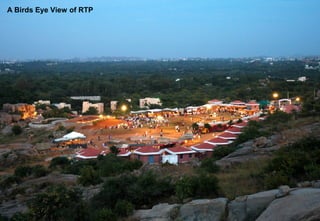
A Birds Eye View of RTP
Accelerate wide dissemination of
appropriate & affordable technologies to
the rural poor for increasing productivity
& enhancing quality of Life, thereby
enabling the community to move towards
sustainable development
 Provide functional exposure to replicable models to meet
location specific-cum-season specific-cum-social contextual
needs.
 Promote participative-cum-partnership network collaboration
between front line / forward demonstration teams, other official
and NGO institutions and uses by taking technology to users
doorstep directly.
 Lend technologies at the RTP to users to facilitate
practice/display of operational skills and produce high quality
products for sale on site;
 Link users, PRIs, NGOs, CBOs and institutions with technology
developers/suppliers; and
 Compile data bank and disseminate.
 To spread and transfer all successful technologies.
 Provide a platform for periodic exchange of ideas between CSIR and
ICAR, technology inventors, marketing agencies, financial institutions
other scientific establishments,
 To undertake technology transfer on ground, in selected villages
through action research and pilot projects.
 To provide a regular mechanism for appraisal of various technologies
To serve as a platform for demonstration of a variety of static,
simulated technology models in stalls and thematic pavilions. Taking
Successful and proven technology models to the villages, with active
involvement of primary stake holders, CBO’s, SHG’s, GP’s and
NGO’s.
 WaterWater
 Farm Technologies – Animal Husbandry, Biotech, Agro Forestry &Farm Technologies – Animal Husbandry, Biotech, Agro Forestry &
Herbal & AromaticsHerbal & Aromatics
 FisheriesFisheries
 Value Addition Food ProductsValue Addition Food Products
 LeatherLeather
 Non Farm TechnologiesNon Farm Technologies
 Housing & SanitationHousing & Sanitation
 EnergyEnergy
 Khadi & Village IndustriesKhadi & Village Industries
 Artisan Based TechnologiesArtisan Based Technologies
 Knowledge Village NetworkKnowledge Village Network
• AWARENESS
• ACCESSIBILITY
• AFFORDABILITY
• APPLICATION
• AUGUMENTATION
• AUDIT
Criteria for Selection of Technology Models
 Gandhi Hand Made Paper UnitGandhi Hand Made Paper Unit
 Dastakar Andhra (Natural Dyes)Dastakar Andhra (Natural Dyes)
 Uttam Industries (Home Based Products)Uttam Industries (Home Based Products)
 APNL-SDDPA (Bio-Tech)APNL-SDDPA (Bio-Tech)
 APNL-SAIRD (Bio-Tech)APNL-SAIRD (Bio-Tech)
 SWRC, Tilonia (Solar Energy)SWRC, Tilonia (Solar Energy)
 HABTECH (Rural Building Center)HABTECH (Rural Building Center)
 SAIRD, Gaddipalli (Herbal & Aromatics)SAIRD, Gaddipalli (Herbal & Aromatics)
 A.P Bee-Keepers AssociationA.P Bee-Keepers Association
 Coir BoardCoir Board
Technologies Promoted through Selected Partners
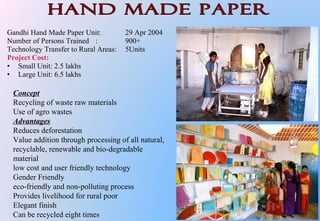
Gandhi Hand Made Paper Unit: 29 Apr 2004
Number of Persons Trained : 900+
Technology Transfer to Rural Areas: 5Units
Project Cost:
• Small Unit: 2.5 lakhs
• Large Unit: 6.5 lakhs
Concept
Recycling of waste raw materials
Use of agro wastes
Advantages
Reduces deforestation
Value addition through processing of all natural,
recyclable, renewable and bio-degradable
material
low cost and user friendly technology
Gender Friendly
eco-friendly and non-polluting process
Provides livelihood for rural poor
Elegant finish
Can be recycled eight times
Dastakar Andhra (Natural Dyes) 10 June 2004
Number of Persons Trained 500 persons
Technology Transfer to Rural Areas 3 Units
Project Cost:
• Small Unit: 2-5 lakhs
• Large Unit: > 5 lakhs
Objectives: To Produce at least six fully
standardized eco-friendly natural dyes
from potential herbal/natural resources.
Evaluation of natural colors for eco-
friendliness.
Standardization of processes for various
textile substrates. Large scale production
and development of other application to
use in cosmetics, food and
pharmaceuticals.
Home Based Enterprises:
Products Preparation: White Phenyl, Cleaning
powder Detergent Powder, Candles (Gel &
Wax), Pain-balm, Incense Sticks, Cosmetics
etc.
Advantages of the technology:
Economical
Higher returns and not seasonal
Easy to use
Cost effective
Uttam Industries (Domestic products)
25 Aug 2004
Number of Persons Trained 1500 Nos
Technology Transfer to Rural Areas - 10 Units
Project Cost:
Small Unit: 2-5 lakhs
Large Unit: > 5 lakhs
• Low-cost
• Sustainability in yields production
• More labor
• Better economics
• Safe environment
• More biodiversity
Products:
Nucleo Poly hydral Virus (NPV),
Bacillus Thuringiensis (BT),
Neam Products, Tricoderma
Cards
Biological PesticidesBiological Pesticides
BACILLUS THURINGIENSISBACILLUS THURINGIENSIS
Target specific, ecologically safe
and does not pollute environment.
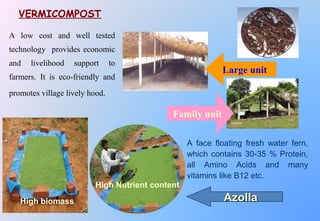
A low cost and well tested
technology provides economic
and livelihood support to
farmers. It is eco-friendly and
promotes village lively hood.
VERMICOMPOST
Large unit
Family unit
A face floating fresh water fern,
which contains 30-35 % Protein,
all Amino Acids and many
vitamins like B12 etc.
High biomass
High Nutrient content
AzollaAzolla
•Safe
•Cost effective
•Culturally acceptable
•Accessible
•Natural
COMMON NAME : DATURA
BOTANICAL NAME : DATURA METAL
PART USED : WHOLE PLANT
USED IN : SKIN DISEASES, INSECT BITE
AND RHEOMATISM.
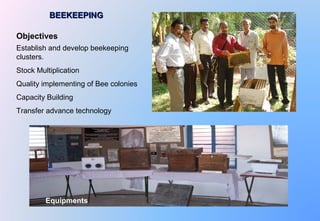
BEEKEEPINGBEEKEEPING
Equipments
Objectives
Establish and develop beekeeping
clusters.
Stock Multiplication
Quality implementing of Bee colonies
Capacity Building
Transfer advance technology
Solar Power House
The Solar Power House has
been established with 4 Bare
foot solar engineers who got
trained at SWRC, Tilonia and
are now able to train and
establish them selves. Solar House
Barefoot Approach
Training of illiterate & unskilled rural
women as master trainers and
engaged in fabrication, installation,
repair and maintenance of solar
systems.
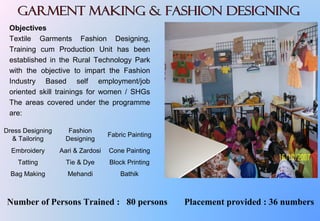
Objectives
Textile Garments Fashion Designing,
Training cum Production Unit has been
established in the Rural Technology Park
with the objective to impart the Fashion
Industry Based self employment/job
oriented skill trainings for women / SHGs
The areas covered under the programme
are:
Dress Designing
& Tailoring
Fashion
Designing
Fabric Painting
Embroidery Aari & Zardosi Cone Painting
Tatting Tie & Dye Block Printing
Bag Making Mehandi Bathik
Number of Persons Trained : 80 persons Placement provided : 36 numbers
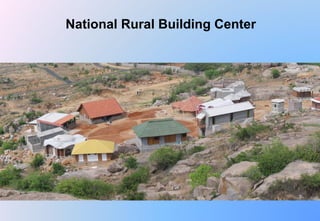
 National Rural Building Center
 
LIST OF TECHNOLOGIES
1. Mud Block Walling for inner
walls
2. Tile facing mud Blocks for
outer walls
3. Conical Tile Arch Roofing
4. Mud Plaster
5. Bamboo mat paneled Doors
and Windows
HIGHLIGHTS 
• Mud Block Walling for inner walls : Cost saving due to blocks are made by locally available mud
at site.
• Conical Tile Arch Roofing : As an alternative to RCC roof save Steel and CC
• Mud Plaster : As an alternative to cement plaster
• Bamboo mat paneled Doors and Windows : Aesthetic appearance and long durability
• Plinth Area: 1452.00 sft Cost of Construction: Rs.270 - 300/sft
Adobe Mud Block House
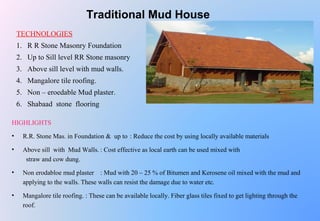
Traditional Mud House
TECHNOLOGIES
1. R R Stone Masonry Foundation
2. Up to Sill level RR Stone masonry
3. Above sill level with mud walls.
4. Mangalore tile roofing.
5. Non – eroedable Mud plaster.
6. Shabaad stone flooring
HIGHLIGHTS
• R.R. Stone Mas. in Foundation & up to : Reduce the cost by using locally available materials
• Above sill with Mud Walls. : Cost effective as local earth can be used mixed with
straw and cow dung.
• Non erodabloe mud plaster : Mud with 20 – 25 % of Bitumen and Kerosene oil mixed with the mud and
applying to the walls. These walls can resist the damage due to water etc.
• Mangalore tile roofing. : These can be available locally. Fiber glass tiles fixed to get lighting through the
roof.
 
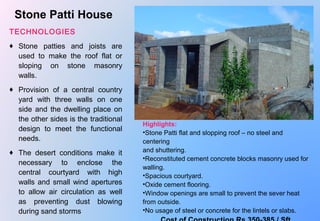
Stone Patti House
TECHNOLOGIES
♦ Stone  patties  and  joists  are 
used  to  make  the  roof  flat  or 
sloping  on  stone  masonry 
walls.
♦ Provision  of  a  central  country 
yard  with  three  walls  on  one 
side and the dwelling place on 
the other sides is the traditional 
design  to  meet  the  functional 
needs.
♦ The  desert  conditions  make  it 
necessary  to  enclose  the 
central  courtyard  with  high 
walls and small wind apertures 
to  allow  air  circulation  as  well 
as  preventing  dust  blowing 
during sand storms
Highlights: 
•Stone Patti flat and slopping roof – no steel and 
centering 
and shuttering. 
•Reconstituted cement concrete blocks masonry used for 
walling.
•Spacious courtyard.
•Oxide cement flooring.
•Window openings are small to prevent the sever heat 
from outside.
•No usage of steel or concrete for the lintels or slabs.
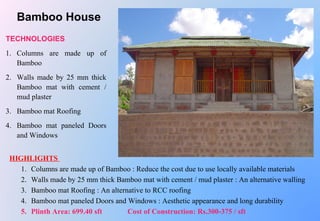
TECHNOLOGIES
1. Columns are made up of
Bamboo
2. Walls made by 25 mm thick
Bamboo mat with cement /
mud plaster
3. Bamboo mat Roofing
4. Bamboo mat paneled Doors
and Windows
HIGHLIGHTS
1. Columns are made up of Bamboo : Reduce the cost due to use locally available materials
2. Walls made by 25 mm thick Bamboo mat with cement / mud plaster : An alternative walling
3. Bamboo mat Roofing : An alternative to RCC roofing
4. Bamboo mat paneled Doors and Windows : Aesthetic appearance and long durability
5. Plinth Area: 699.40 sft Cost of Construction: Rs.300-375 / sft
Bamboo House
Stone Masonry House
TECHNOLOGIES
• Stone  masonry  is  a  traditional 
building  technology  in  the  rural 
areas  of  Uttranchal  and  Himachal 
Pradesh.
• Using  normal  un-coursed  rubble 
masonry.
• At plinth level one RCC plinth band 
has  been  provided  along  with 
vertical reinforcements to counteract 
earthquakes.
Main Features:
• RR stone masonry walling (Ground Floor).
• Cement Concrete Block walling (First Floor).
• Micro Concrete Block walling (First Floor).
• Horizontal bands at plinth, window sill, lintel and roof level and vertical bands.
• Pre-cast RCC panels over pre-cast RCC joists.
• Lime plaster finishing to the walls inside the house.
Cost of construction Rs. 320-375 /sft.
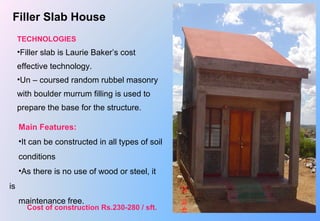
Filler Slab House
TECHNOLOGIES
•Filler slab is Laurie Baker’s cost 
effective technology.
•Un – coursed random rubbel masonry 
with boulder murrum filling is used to 
prepare the base for the structure.
Main Features:
•It can be constructed in all types of soil 
conditions
•As there is no use of wood or steel, it 
is 
maintenance free.
Cost of construction Rs.230-280 / sft.
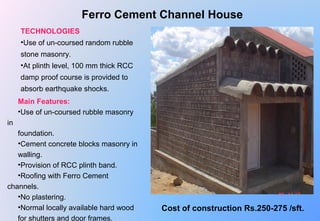
Ferro Cement Channel House
TECHNOLOGIES
•Use of un-coursed random rubble 
stone masonry.
•At plinth level, 100 mm thick RCC 
damp proof course is provided to 
absorb earthquake shocks.
Main Features:
•Use of un-coursed rubble masonry 
in 
foundation.
•Cement concrete blocks masonry in 
walling.
•Provision of RCC plinth band.
•Roofing with Ferro Cement 
channels.
•No plastering.
•Normal locally available hard wood 
for shutters and door frames.
Cost of construction Rs.250-275 /sft.
 
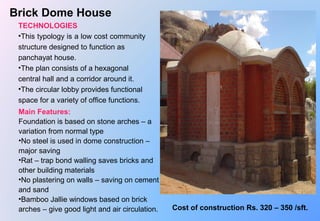
Brick Dome House
TECHNOLOGIES
•This typology is a low cost community 
structure designed to function as 
panchayat house.
•The plan consists of a hexagonal 
central hall and a corridor around it.
•The circular lobby provides functional 
space for a variety of office functions.
Main Features:
Foundation is based on stone arches – a 
variation from normal type
•No steel is used in dome construction – 
major saving 
•Rat – trap bond walling saves bricks and 
other building materials
•No plastering on walls – saving on cement 
and sand
•Bamboo Jallie windows based on brick 
arches – give good light and air circulation. Cost of construction Rs. 320 – 350 /sft.
 
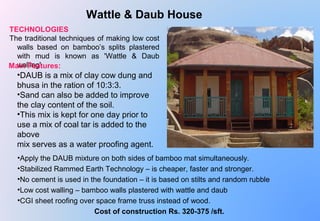
Wattle & Daub House
TECHNOLOGIES
The traditional techniques of making low cost 
walls  based  on  bamboo’s  splits  plastered 
with  mud  is  known  as  'Wattle  &  Daub 
walling'
•DAUB is a mix of clay cow dung and 
bhusa in the ration of 10:3:3.
•Sand can also be added to improve 
the clay content of the soil.
•This mix is kept for one day prior to 
use a mix of coal tar is added to the 
above 
mix serves as a water proofing agent.
•Apply the DAUB mixture on both sides of bamboo mat simultaneously. 
•Stabilized Rammed Earth Technology – is cheaper, faster and stronger.
•No cement is used in the foundation – it is based on stilts and random rubble
•Low cost walling – bamboo walls plastered with wattle and daub
•CGI sheet roofing over space frame truss instead of wood.
Cost of construction Rs. 320-375 /sft.
Main Features:
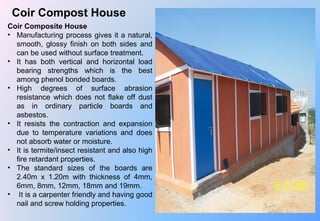
Coir Compost House
Coir Composite House
• Manufacturing process gives it a natural, 
smooth,  glossy  finish  on  both  sides  and 
can be used without surface treatment.
• It  has  both  vertical  and  horizontal  load 
bearing  strengths  which  is  the  best 
among phenol bonded boards.
• High  degrees  of  surface  abrasion 
resistance  which  does  not  flake  off  dust 
as  in  ordinary  particle  boards  and 
asbestos.
• It  resists  the  contraction  and  expansion 
due  to  temperature  variations  and  does 
not absorb water or moisture.
• It is termite/insect resistant and also high 
fire retardant properties.
• The  standard  sizes  of  the  boards  are 
2.40m  x  1.20m  with  thickness  of  4mm, 
6mm, 8mm, 12mm, 18mm and 19mm.
•  It is a carpenter friendly and having good 
nail and screw holding properties.
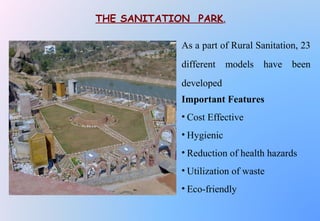
As a part of Rural Sanitation, 23
different models have been
developed
THE SANITATION PARK.
Important Features
• Cost Effective
• Hygienic
• Reduction of health hazards
• Utilization of waste
• Eco-friendly
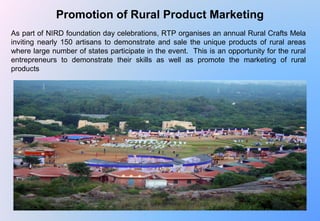
Promotion of Rural Product Marketing
As part of NIRD foundation day celebrations, RTP organises an annual Rural Crafts Mela 
inviting  nearly  150  artisans to  demonstrate  and sale  the  unique  products of rural areas 
where large number of states participate in the event.  This is an opportunity for the rural 
entrepreneurs  to  demonstrate  their  skills  as  well  as  promote  the  marketing  of  rural 
products
Water Harvesting Technologies
Food Industries 
Fashion Designing & Readymade Garments
Soap making unit.          Uttam Industries
Terracotta pottery CARVE, Kumariguda.
Leaf cup making        
Leather Artisans Welfare Association, Warangal.
Hosiery Products
Fisheries Gangaputra Sangam
Technology Demonstration Corridor – Seghel Foundation
Micro Boil Compost
Weather Forecasting Station
Projects in Pipeline
Technology Transfer Through Action Research
• Anganwadi Centre Balkampet Hyderabad- Vimala Charitrablu Trust
• Projects Under Implementation - Amarchinta Village (Mahaboo Nagar Dist)
1. Mass Rural Sanitation 
2. Artisans Center 
3. School Building
4. Farmers House 
• Projects Under Implementation – Chilver Village (Medak Dist)
1. Health Center
2. Knowledge Center
3. Technology Stalls
4. Yoga Center
5. Sanitation
• Projects Under Implementation – Nalgonda (Nalgonda Dist)
1. Technology Demonstration Center

RTP NIRDPR

  • 1.
    National Institute ofRural Development Rajendra Nagar, Hyderabad - 500030
  • 2.
    A Birds EyeView of RTP
  • 3.
    Accelerate wide disseminationof appropriate & affordable technologies to the rural poor for increasing productivity & enhancing quality of Life, thereby enabling the community to move towards sustainable development
  • 4.
     Provide functionalexposure to replicable models to meet location specific-cum-season specific-cum-social contextual needs.  Promote participative-cum-partnership network collaboration between front line / forward demonstration teams, other official and NGO institutions and uses by taking technology to users doorstep directly.  Lend technologies at the RTP to users to facilitate practice/display of operational skills and produce high quality products for sale on site;  Link users, PRIs, NGOs, CBOs and institutions with technology developers/suppliers; and  Compile data bank and disseminate.
  • 5.
     To spreadand transfer all successful technologies.  Provide a platform for periodic exchange of ideas between CSIR and ICAR, technology inventors, marketing agencies, financial institutions other scientific establishments,  To undertake technology transfer on ground, in selected villages through action research and pilot projects.  To provide a regular mechanism for appraisal of various technologies
  • 6.
    To serve asa platform for demonstration of a variety of static, simulated technology models in stalls and thematic pavilions. Taking Successful and proven technology models to the villages, with active involvement of primary stake holders, CBO’s, SHG’s, GP’s and NGO’s.
  • 7.
     WaterWater  FarmTechnologies – Animal Husbandry, Biotech, Agro Forestry &Farm Technologies – Animal Husbandry, Biotech, Agro Forestry & Herbal & AromaticsHerbal & Aromatics  FisheriesFisheries  Value Addition Food ProductsValue Addition Food Products  LeatherLeather  Non Farm TechnologiesNon Farm Technologies  Housing & SanitationHousing & Sanitation  EnergyEnergy  Khadi & Village IndustriesKhadi & Village Industries  Artisan Based TechnologiesArtisan Based Technologies  Knowledge Village NetworkKnowledge Village Network
  • 8.
    • AWARENESS • ACCESSIBILITY •AFFORDABILITY • APPLICATION • AUGUMENTATION • AUDIT Criteria for Selection of Technology Models
  • 9.
     Gandhi HandMade Paper UnitGandhi Hand Made Paper Unit  Dastakar Andhra (Natural Dyes)Dastakar Andhra (Natural Dyes)  Uttam Industries (Home Based Products)Uttam Industries (Home Based Products)  APNL-SDDPA (Bio-Tech)APNL-SDDPA (Bio-Tech)  APNL-SAIRD (Bio-Tech)APNL-SAIRD (Bio-Tech)  SWRC, Tilonia (Solar Energy)SWRC, Tilonia (Solar Energy)  HABTECH (Rural Building Center)HABTECH (Rural Building Center)  SAIRD, Gaddipalli (Herbal & Aromatics)SAIRD, Gaddipalli (Herbal & Aromatics)  A.P Bee-Keepers AssociationA.P Bee-Keepers Association  Coir BoardCoir Board Technologies Promoted through Selected Partners
  • 10.
    Gandhi Hand MadePaper Unit: 29 Apr 2004 Number of Persons Trained : 900+ Technology Transfer to Rural Areas: 5Units Project Cost: • Small Unit: 2.5 lakhs • Large Unit: 6.5 lakhs Concept Recycling of waste raw materials Use of agro wastes Advantages Reduces deforestation Value addition through processing of all natural, recyclable, renewable and bio-degradable material low cost and user friendly technology Gender Friendly eco-friendly and non-polluting process Provides livelihood for rural poor Elegant finish Can be recycled eight times
  • 11.
    Dastakar Andhra (NaturalDyes) 10 June 2004 Number of Persons Trained 500 persons Technology Transfer to Rural Areas 3 Units Project Cost: • Small Unit: 2-5 lakhs • Large Unit: > 5 lakhs Objectives: To Produce at least six fully standardized eco-friendly natural dyes from potential herbal/natural resources. Evaluation of natural colors for eco- friendliness. Standardization of processes for various textile substrates. Large scale production and development of other application to use in cosmetics, food and pharmaceuticals.
  • 12.
    Home Based Enterprises: ProductsPreparation: White Phenyl, Cleaning powder Detergent Powder, Candles (Gel & Wax), Pain-balm, Incense Sticks, Cosmetics etc. Advantages of the technology: Economical Higher returns and not seasonal Easy to use Cost effective Uttam Industries (Domestic products) 25 Aug 2004 Number of Persons Trained 1500 Nos Technology Transfer to Rural Areas - 10 Units Project Cost: Small Unit: 2-5 lakhs Large Unit: > 5 lakhs
  • 13.
    • Low-cost • Sustainabilityin yields production • More labor • Better economics • Safe environment • More biodiversity Products: Nucleo Poly hydral Virus (NPV), Bacillus Thuringiensis (BT), Neam Products, Tricoderma Cards Biological PesticidesBiological Pesticides BACILLUS THURINGIENSISBACILLUS THURINGIENSIS Target specific, ecologically safe and does not pollute environment.
  • 14.
    A low costand well tested technology provides economic and livelihood support to farmers. It is eco-friendly and promotes village lively hood. VERMICOMPOST Large unit Family unit A face floating fresh water fern, which contains 30-35 % Protein, all Amino Acids and many vitamins like B12 etc. High biomass High Nutrient content AzollaAzolla
  • 15.
    •Safe •Cost effective •Culturally acceptable •Accessible •Natural COMMONNAME : DATURA BOTANICAL NAME : DATURA METAL PART USED : WHOLE PLANT USED IN : SKIN DISEASES, INSECT BITE AND RHEOMATISM.
  • 16.
    BEEKEEPINGBEEKEEPING Equipments Objectives Establish and developbeekeeping clusters. Stock Multiplication Quality implementing of Bee colonies Capacity Building Transfer advance technology
  • 17.
    Solar Power House TheSolar Power House has been established with 4 Bare foot solar engineers who got trained at SWRC, Tilonia and are now able to train and establish them selves. Solar House Barefoot Approach Training of illiterate & unskilled rural women as master trainers and engaged in fabrication, installation, repair and maintenance of solar systems.
  • 18.
    Objectives Textile Garments FashionDesigning, Training cum Production Unit has been established in the Rural Technology Park with the objective to impart the Fashion Industry Based self employment/job oriented skill trainings for women / SHGs The areas covered under the programme are: Dress Designing & Tailoring Fashion Designing Fabric Painting Embroidery Aari & Zardosi Cone Painting Tatting Tie & Dye Block Printing Bag Making Mehandi Bathik Number of Persons Trained : 80 persons Placement provided : 36 numbers
  • 19.
  • 20.
      LIST OF TECHNOLOGIES 1.Mud Block Walling for inner walls 2. Tile facing mud Blocks for outer walls 3. Conical Tile Arch Roofing 4. Mud Plaster 5. Bamboo mat paneled Doors and Windows HIGHLIGHTS  • Mud Block Walling for inner walls : Cost saving due to blocks are made by locally available mud at site. • Conical Tile Arch Roofing : As an alternative to RCC roof save Steel and CC • Mud Plaster : As an alternative to cement plaster • Bamboo mat paneled Doors and Windows : Aesthetic appearance and long durability • Plinth Area: 1452.00 sft Cost of Construction: Rs.270 - 300/sft Adobe Mud Block House
  • 21.
    Traditional Mud House TECHNOLOGIES 1.R R Stone Masonry Foundation 2. Up to Sill level RR Stone masonry 3. Above sill level with mud walls. 4. Mangalore tile roofing. 5. Non – eroedable Mud plaster. 6. Shabaad stone flooring HIGHLIGHTS • R.R. Stone Mas. in Foundation & up to : Reduce the cost by using locally available materials • Above sill with Mud Walls. : Cost effective as local earth can be used mixed with straw and cow dung. • Non erodabloe mud plaster : Mud with 20 – 25 % of Bitumen and Kerosene oil mixed with the mud and applying to the walls. These walls can resist the damage due to water etc. • Mangalore tile roofing. : These can be available locally. Fiber glass tiles fixed to get lighting through the roof.
  • 22.
      Stone Patti House TECHNOLOGIES ♦Stone  patties  and  joists  are  used  to  make  the  roof  flat  or  sloping  on  stone  masonry  walls. ♦ Provision  of  a  central  country  yard  with  three  walls  on  one  side and the dwelling place on  the other sides is the traditional  design  to  meet  the  functional  needs. ♦ The  desert  conditions  make  it  necessary  to  enclose  the  central  courtyard  with  high  walls and small wind apertures  to  allow  air  circulation  as  well  as  preventing  dust  blowing  during sand storms Highlights:  •Stone Patti flat and slopping roof – no steel and  centering  and shuttering.  •Reconstituted cement concrete blocks masonry used for  walling. •Spacious courtyard. •Oxide cement flooring. •Window openings are small to prevent the sever heat  from outside. •No usage of steel or concrete for the lintels or slabs.
  • 23.
    TECHNOLOGIES 1. Columns aremade up of Bamboo 2. Walls made by 25 mm thick Bamboo mat with cement / mud plaster 3. Bamboo mat Roofing 4. Bamboo mat paneled Doors and Windows HIGHLIGHTS 1. Columns are made up of Bamboo : Reduce the cost due to use locally available materials 2. Walls made by 25 mm thick Bamboo mat with cement / mud plaster : An alternative walling 3. Bamboo mat Roofing : An alternative to RCC roofing 4. Bamboo mat paneled Doors and Windows : Aesthetic appearance and long durability 5. Plinth Area: 699.40 sft Cost of Construction: Rs.300-375 / sft Bamboo House
  • 24.
    Stone Masonry House TECHNOLOGIES •Stone  masonry  is  a  traditional  building  technology  in  the  rural  areas  of  Uttranchal  and  Himachal  Pradesh. • Using  normal  un-coursed  rubble  masonry. • At plinth level one RCC plinth band  has  been  provided  along  with  vertical reinforcements to counteract  earthquakes. Main Features: • RR stone masonry walling (Ground Floor). • Cement Concrete Block walling (First Floor). • Micro Concrete Block walling (First Floor). • Horizontal bands at plinth, window sill, lintel and roof level and vertical bands. • Pre-cast RCC panels over pre-cast RCC joists. • Lime plaster finishing to the walls inside the house. Cost of construction Rs. 320-375 /sft.
  • 25.
    Filler Slab House TECHNOLOGIES •Filler slab is Laurie Baker’s cost  effective technology. •Un – coursed random rubbel masonry  with boulder murrum filling is used to  prepare the base for the structure. MainFeatures: •It can be constructed in all types of soil  conditions •As there is no use of wood or steel, it  is  maintenance free. Cost of construction Rs.230-280 / sft.
  • 26.
    Ferro Cement ChannelHouse TECHNOLOGIES •Use of un-coursed random rubble  stone masonry. •At plinth level, 100 mm thick RCC  damp proof course is provided to  absorb earthquake shocks. Main Features: •Use of un-coursed rubble masonry  in  foundation. •Cement concrete blocks masonry in  walling. •Provision of RCC plinth band. •Roofing with Ferro Cement  channels. •No plastering. •Normal locally available hard wood  for shutters and door frames. Cost of construction Rs.250-275 /sft.
  • 27.
      Brick Dome House TECHNOLOGIES •This typology is a low cost community  structure designed to function as  panchayat house. •The plan consists of a hexagonal  central hall and a corridor around it. •The circular lobby provides functional  space for a variety of office functions. MainFeatures: Foundation is based on stone arches – a  variation from normal type •No steel is used in dome construction –  major saving  •Rat – trap bond walling saves bricks and  other building materials •No plastering on walls – saving on cement  and sand •Bamboo Jallie windows based on brick  arches – give good light and air circulation. Cost of construction Rs. 320 – 350 /sft.
  • 28.
      Wattle & DaubHouse TECHNOLOGIES The traditional techniques of making low cost  walls  based  on  bamboo’s  splits  plastered  with  mud  is  known  as  'Wattle  &  Daub  walling' •DAUB is a mix of clay cow dung and  bhusa in the ration of 10:3:3. •Sand can also be added to improve  the clay content of the soil. •This mix is kept for one day prior to  use a mix of coal tar is added to the  above  mix serves as a water proofing agent. •Apply the DAUB mixture on both sides of bamboo mat simultaneously.  •Stabilized Rammed Earth Technology – is cheaper, faster and stronger. •No cement is used in the foundation – it is based on stilts and random rubble •Low cost walling – bamboo walls plastered with wattle and daub •CGI sheet roofing over space frame truss instead of wood. Cost of construction Rs. 320-375 /sft. Main Features:
  • 29.
    Coir Compost House CoirComposite House • Manufacturing process gives it a natural,  smooth,  glossy  finish  on  both  sides  and  can be used without surface treatment. • It  has  both  vertical  and  horizontal  load  bearing  strengths  which  is  the  best  among phenol bonded boards. • High  degrees  of  surface  abrasion  resistance  which  does  not  flake  off  dust  as  in  ordinary  particle  boards  and  asbestos. • It  resists  the  contraction  and  expansion  due  to  temperature  variations  and  does  not absorb water or moisture. • It is termite/insect resistant and also high  fire retardant properties. • The  standard  sizes  of  the  boards  are  2.40m  x  1.20m  with  thickness  of  4mm,  6mm, 8mm, 12mm, 18mm and 19mm. •  It is a carpenter friendly and having good  nail and screw holding properties.
  • 30.
    As a partof Rural Sanitation, 23 different models have been developed THE SANITATION PARK. Important Features • Cost Effective • Hygienic • Reduction of health hazards • Utilization of waste • Eco-friendly
  • 31.
    Promotion of RuralProduct Marketing As part of NIRD foundation day celebrations, RTP organises an annual Rural Crafts Mela  inviting  nearly  150  artisans to  demonstrate  and sale  the  unique  products of rural areas  where large number of states participate in the event.  This is an opportunity for the rural  entrepreneurs  to  demonstrate  their  skills  as  well  as  promote  the  marketing  of  rural  products
  • 32.
  • 33.
    Food Industries  Fashion Designing & Readymade Garments Soap making unit.          Uttam Industries Terracotta pottery CARVE, Kumariguda. Leaf cup making         LeatherArtisans Welfare Association, Warangal. Hosiery Products Fisheries Gangaputra Sangam Technology Demonstration Corridor – Seghel Foundation Micro Boil Compost Weather Forecasting Station Projects in Pipeline
  • 34.
    Technology Transfer ThroughAction Research • Anganwadi Centre Balkampet Hyderabad- Vimala Charitrablu Trust • Projects Under Implementation - Amarchinta Village (Mahaboo Nagar Dist) 1. Mass Rural Sanitation  2. Artisans Center  3. School Building 4. Farmers House  • Projects Under Implementation – Chilver Village (Medak Dist) 1. Health Center 2. Knowledge Center 3. Technology Stalls 4. Yoga Center 5. Sanitation • Projects Under Implementation – Nalgonda (Nalgonda Dist) 1. Technology Demonstration Center