KOHLBERG'S SIX STAGES
OF MORAL DEVELOPMENT
Lawrence Kohlberg
Level 1. Preconventional Morality
• Stage 1. Obedience and Punishment
Orientation. Kohlberg's stage 1 is similar
to Piaget's first stage of moral thought.
The child assumes that powerful
authorities hand down a fixed set of rules
which he or she must unquestioningly
obey.
Stage 1. Obedience and
Punishment Orientation.
• The View is "It's against the law," or "It's
bad to steal," as if this were all there were
to it. When asked to elaborate, the child
usually responds in terms of the
consequences involved, explaining that
stealing is bad "because you'll get
punished" (Kohlberg, 1958b).
Stage 1. Obedience and
Punishment Orientation.
Stage 2. Individualism and
Exchange.
• This stage children recognize that there is
not just one right view that is handed down
by the authorities. Different individuals
have different viewpoints.
• At stage 1 punishment is tied up in the
child's mind with wrongness; punishment
"proves" that disobedience is wrong. At
stage 2, in contrast, punishment is simply
a risk that one naturally wants to avoid.
Stage 2. Individualism and
Exchange.
Level II. Conventional Morality
• Stage 3. Good Interpersonal Relationships. At
this stage children--who are by now usually
entering their teens--see morality as more than
simple deals. They believe that people should
live up to the expectations of the family and
community and behave in "good" ways. Good
behavior means having good motives and
interpersonal feelings such as love, empathy,
trust, and concern for others.
Good Interpersonal
Relationships
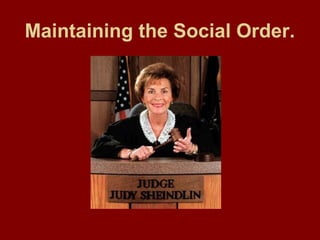
Stage 4. Maintaining the Social
Order.
• Stage 3 reasoning works best in two-person
relationships with family members or close
friends, where one can make a real effort to get
to know the other's feelings and needs and try to
help. At stage 4, in contrast, the respondent
becomes more broadly concerned with society
as a whole. Now the emphasis is on obeying
laws, respecting authority, and performing one's
duties so that the social order is maintained.
Maintaining the Social Order.
Level III. Postconventional
Morality
• Stage 5. Social Contract and Individual
Rights. At stage 5, people begin to ask, "What
makes for a good society?" They begin to think
about society in a very theoretical way, stepping
back from their own society and considering the
rights and values that a society ought to uphold.
They then evaluate existing societies in terms of
these prior considerations. They are said to take
a "prior-to-society" perspective (Colby and
Kohlberg, 1983, p. 22).
Stage 5. Social Contract and
Individual Rights.
• Stage 5 subjects,- then, talk about
"morality" and "rights" that take some
priority over particular laws. Kohlberg
insists, however, that we do not judge
people to be at stage 5 merely from their
verbal labels. We need to look at their
social perspective and mode of reasoning.
Social Contract and Individual
Rights.
Stage 6: Universal Principles.
• Kohlberg believes that there must be a higher stage--
stage 6--which defines the principles by which we
achieve justice. Kohlberg's conception of justice follows
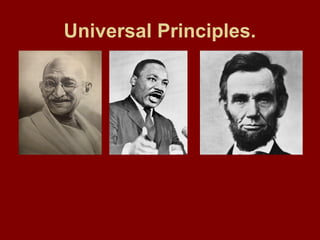
that of the philosophers Kant and Rawls, as well as great
moral leaders such as Gandhi and Martin Luther King.
According to these people, the principles of justice
require us to treat the claims of all parties in an impartial
manner, respecting the basic dignity, of all people as
individuals. The principles of justice are therefore
universal; they apply to all. Thus, for example, we would
not vote for a law that aids some people but hurts others.
The principles of justice guide us toward decisions based
on an equal respect for all.
Universal Principles.
Kohlberg: Summary
• At stage 1 children think of what is right as that
which authority says is right. Doing the right
thing is obeying authority and avoiding
punishment. At stage 2, children are no longer
so impressed by any single authority; they see
that there are different sides to any issue. Since
everything is relative, one is free to pursue one's
own interests, although it is often useful to make
deals and exchange favors with others.
Kohlberg: Summary
• At stages 3 and 4, young people think as
members of the conventional society with
its values, norms, and expectations. At
stage 3, they emphasize being a good
person, which basically means having
helpful motives toward people close to one
At stage 4, the concern shifts toward
obeying laws to maintain society as a
whole.
Kohlberg: Summary
• At stages 5 and 6 people are less
concerned with maintaining society for it
own sake, and more concerned with the
principles and values that make for a good
society. At stage 5 they emphasize basic
rights and the democratic processes that
give everyone a say, and at stage 6 they
define the principles by which agreement
will be most just.

Kohlbergs six stages_of_moral_development -

  • 1.
    KOHLBERG'S SIX STAGES OFMORAL DEVELOPMENT
  • 2.
  • 3.
    Level 1. PreconventionalMorality • Stage 1. Obedience and Punishment Orientation. Kohlberg's stage 1 is similar to Piaget's first stage of moral thought. The child assumes that powerful authorities hand down a fixed set of rules which he or she must unquestioningly obey.
  • 4.
    Stage 1. Obedienceand Punishment Orientation. • The View is "It's against the law," or "It's bad to steal," as if this were all there were to it. When asked to elaborate, the child usually responds in terms of the consequences involved, explaining that stealing is bad "because you'll get punished" (Kohlberg, 1958b).
  • 5.
    Stage 1. Obedienceand Punishment Orientation.
  • 6.
    Stage 2. Individualismand Exchange. • This stage children recognize that there is not just one right view that is handed down by the authorities. Different individuals have different viewpoints. • At stage 1 punishment is tied up in the child's mind with wrongness; punishment "proves" that disobedience is wrong. At stage 2, in contrast, punishment is simply a risk that one naturally wants to avoid.
  • 7.
  • 8.
    Level II. ConventionalMorality • Stage 3. Good Interpersonal Relationships. At this stage children--who are by now usually entering their teens--see morality as more than simple deals. They believe that people should live up to the expectations of the family and community and behave in "good" ways. Good behavior means having good motives and interpersonal feelings such as love, empathy, trust, and concern for others.
  • 9.
  • 10.
    Stage 4. Maintainingthe Social Order. • Stage 3 reasoning works best in two-person relationships with family members or close friends, where one can make a real effort to get to know the other's feelings and needs and try to help. At stage 4, in contrast, the respondent becomes more broadly concerned with society as a whole. Now the emphasis is on obeying laws, respecting authority, and performing one's duties so that the social order is maintained.
  • 11.
  • 12.
    Level III. Postconventional Morality •Stage 5. Social Contract and Individual Rights. At stage 5, people begin to ask, "What makes for a good society?" They begin to think about society in a very theoretical way, stepping back from their own society and considering the rights and values that a society ought to uphold. They then evaluate existing societies in terms of these prior considerations. They are said to take a "prior-to-society" perspective (Colby and Kohlberg, 1983, p. 22).
  • 13.
    Stage 5. SocialContract and Individual Rights. • Stage 5 subjects,- then, talk about "morality" and "rights" that take some priority over particular laws. Kohlberg insists, however, that we do not judge people to be at stage 5 merely from their verbal labels. We need to look at their social perspective and mode of reasoning.
  • 14.
    Social Contract andIndividual Rights.
  • 15.
    Stage 6: UniversalPrinciples. • Kohlberg believes that there must be a higher stage-- stage 6--which defines the principles by which we achieve justice. Kohlberg's conception of justice follows that of the philosophers Kant and Rawls, as well as great moral leaders such as Gandhi and Martin Luther King. According to these people, the principles of justice require us to treat the claims of all parties in an impartial manner, respecting the basic dignity, of all people as individuals. The principles of justice are therefore universal; they apply to all. Thus, for example, we would not vote for a law that aids some people but hurts others. The principles of justice guide us toward decisions based on an equal respect for all.
  • 16.
  • 17.
    Kohlberg: Summary • Atstage 1 children think of what is right as that which authority says is right. Doing the right thing is obeying authority and avoiding punishment. At stage 2, children are no longer so impressed by any single authority; they see that there are different sides to any issue. Since everything is relative, one is free to pursue one's own interests, although it is often useful to make deals and exchange favors with others.
  • 18.
    Kohlberg: Summary • Atstages 3 and 4, young people think as members of the conventional society with its values, norms, and expectations. At stage 3, they emphasize being a good person, which basically means having helpful motives toward people close to one At stage 4, the concern shifts toward obeying laws to maintain society as a whole.
  • 19.
    Kohlberg: Summary • Atstages 5 and 6 people are less concerned with maintaining society for it own sake, and more concerned with the principles and values that make for a good society. At stage 5 they emphasize basic rights and the democratic processes that give everyone a say, and at stage 6 they define the principles by which agreement will be most just.