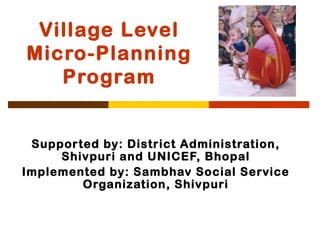
Village Level
Micro-Planning
   Program


 Supported by: District Administration,
     Shivpuri and UNICEF, Bhopal
Implemented by: Sambhav Social Service
        Organization, Shivpuri
Contents
   District Shivpuri
   Shivpuri Block
   VLMP
   Approach
   Expected Outcomes
   Benefits
   Methodology
   Phases
   Preparations
   Activities
   Involvement of Children
   Findings
   Achievements
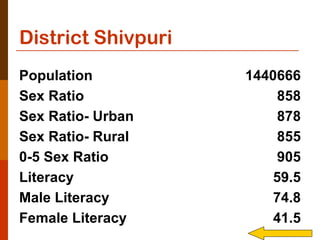
District Shivpuri
Population          1440666
Sex Ratio               858
Sex Ratio- Urban        878
Sex Ratio- Rural        855
0-5 Sex Ratio           905
Literacy                59.5
Male Literacy           74.8
Female Literacy         41.5
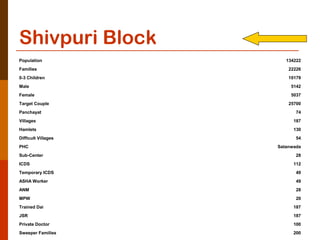
Shivpuri Block
Population              134222
Families                 22226
0-3 Children             10179
Male                      5142
Female                    5037
Target Couple            25700
Panchayat                   74
Villages                   187
Hamlets                    130
Difficult Villages          54
PHC                  Satanwada
Sub-Center                  28
ICDS                       112
Temporary ICDS              49
ASHA Worker                 49
ANM                         28
MPW                         20
Trained Dai                187
JSR                        187
Private Doctor             100
Sweeper Families           200
Village Level Micro-Planning
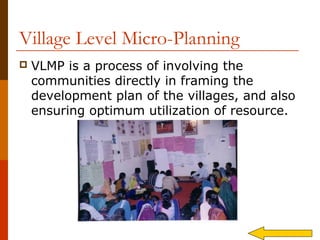
   VLMP is a process of involving the
    communities directly in framing the
    development plan of the villages, and also
    ensuring optimum utilization of resource.
Approach
 a five-day long exercise in a particular
  village in the Integrated District by a team
  of Village Planning Facilitators belonging
  to identified NGOs/CBOs, usually in groups
  of three or more depending upon the
  population size and spread of the village.
 Facilitators reside in their allotted village
  for the entire period living on what the
  villagers can offer in terms of food and
  place to stay.
Expected Outcomes
   Registration and certificate to all children within 28 days of
    birth.
   All deliveries by trained people.
   Breast feeding to infants up to 6 months.
   Complete Immunization of 90% children.
   ORS consumption for children suffering from Diarrhea, and
    preventive care on respiratory problems.
   All children get complete doses of vitamin A.
   No child should fall under grade 3-4 of malnutrition, 30%
    reduction in children falling under grade 1-2.
   All children complete primary education and are linked to the
    process of developing basic learning skills.
   Awareness and knowledge among 15-24 years on HIV/AIDS.
    Practicing safe sexual behavior.
   50% Reduction in children marrying before age of 18.
   Ensuring protection of children from unsafe work and
    hazardous working conditions.
Expected Outcomes
   Use of Iodine salt in every household.
   Outreach of every family to safe drinking water sources,
    and no water source should remain malfunction for more
    than 4 days.
   Safe hygiene practices to be followed by every person of
    the family (washing hands before and after meals and
    defecation).
   Outreach of all to safe hygiene and sanitation facilities.
   Pre and Post natal care to all pregnant women, and PPTC
    services.
   Facilities for children at ICDS center and health centers on
    the basis of individual evaluation.
   Village level micro-planning in every village.
   Promoting safe behaviors through behavior change
    communication
   Planned implementation of various child and mother
    development programs, and evaluating them on the basis
    of performance.
VLMP- Benefits
   Problem solving and decision making on the basis of
    alternatives.
   Helps find root causes of problems.
   Better understanding of communities on problem
    identification, analysis and problem solving.
   Identifying resources available at village level.
   Improved community participation in planning
   Social issues will be a part of the plans.
   Deprived classes will immediately be identified as primary
    beneficiaries.
   Communities will be able to differentiate between needed
    and available services.
   People will be the key players in planning processes.
   Increased participation of community and involvement of
    panchayats.
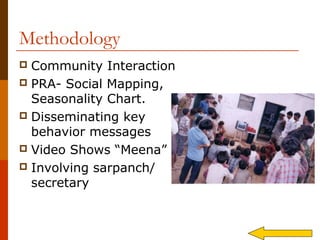
Methodology
 Community Interaction
 PRA- Social Mapping,
  Seasonality Chart.
 Disseminating key
  behavior messages
 Video Shows “Meena”
 Involving sarpanch/
  secretary
VLMP- Phases
   Analysis of every village of the district and
    problem evaluation
   Prioritization of problems by the community.
   Common opinion building and acceptance of
    problems.
   Common opinion on alternatives to problem
    solving.
   Micro-planning of every village on the basis of
    common opinion and approval by gram sabha.
Initial Preparations
 Framing survey formats- village, family
 Testing survey format
 Presentation by cultural group (Kala
  Jattha)
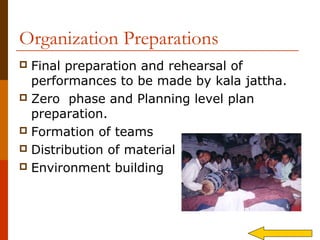
Organization Preparations
 Final preparation and rehearsal of
  performances to be made by kala jattha.
 Zero phase and Planning level plan
  preparation.
 Formation of teams
 Distribution of material
 Environment building
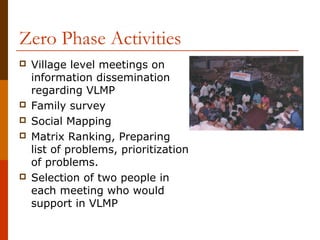
Zero Phase Activities
   Village level meetings on
    information dissemination
    regarding VLMP
   Family survey
   Social Mapping
   Matrix Ranking, Preparing
    list of problems, prioritization
    of problems.
   Selection of two people in
    each meeting who would
    support in VLMP
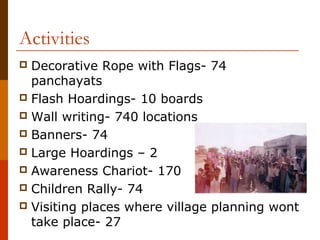
Activities
 Decorative Rope with Flags- 74
  panchayats
 Flash Hoardings- 10 boards
 Wall writing- 740 locations
 Banners- 74
 Large Hoardings – 2
 Awareness Chariot- 170
 Children Rally- 74
 Visiting places where village planning wont
  take place- 27
VLMP- Activities
   Master Trainer Training – 17 April to 31 April’2005
   Training of trainers- 13 June to 17 June’ 2005
   Cluster animator training- 20 June to 24 June’2005
   Panchayat animator training- 3 Batches
   Training of cluster animators on street theatre.
   Inauguration of VLMP program
   Commencement of VLMP on pilot basis in Suhara,
    Sirsod and Tanpur (Training phase)
   Weighing all children under Bal Sanjeevani
   Involvement in Pulse Polio Program
   Implementation of VLMP plan
   Orientation of Panchayat representatives
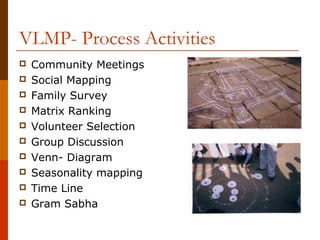
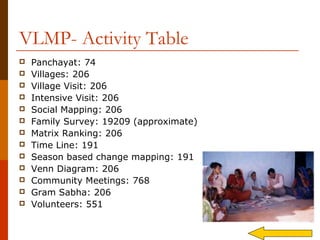
VLMP- Process Activities
   Community Meetings
   Social Mapping
   Family Survey
   Matrix Ranking
   Volunteer Selection
   Group Discussion
   Venn- Diagram
   Seasonality mapping
   Time Line
   Gram Sabha
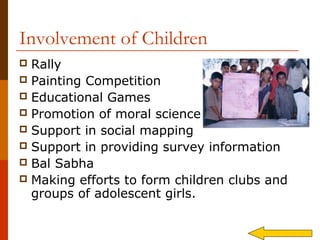
VLMP- Activity Table
   Panchayat: 74
   Villages: 206
   Village Visit: 206
   Intensive Visit: 206
   Social Mapping: 206
   Family Survey: 19209 (approximate)
   Matrix Ranking: 206
   Time Line: 191
   Season based change mapping: 191
   Venn Diagram: 206
   Community Meetings: 768
   Gram Sabha: 206
   Volunteers: 551
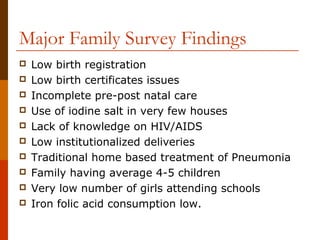
Involvement of Children
 Rally
 Painting Competition
 Educational Games
 Promotion of moral science
 Support in social mapping
 Support in providing survey information
 Bal Sabha
 Making efforts to form children clubs and
  groups of adolescent girls.
Major Family Survey Findings
   Low birth registration
   Low birth certificates issues
   Incomplete pre-post natal care
   Use of iodine salt in very few houses
   Lack of knowledge on HIV/AIDS
   Low institutionalized deliveries
   Traditional home based treatment of Pneumonia
   Family having average 4-5 children
   Very low number of girls attending schools
   Iron folic acid consumption low.
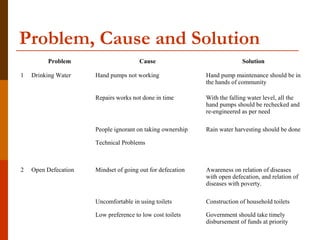
Problem, Cause and Solution
              Problem                       Cause                               Solution

    1   Drinking Water     Hand pumps not working                 Hand pump maintenance should be in 
                                                                  the hands of community

                           Repairs works not done in time         With the falling water level, all the 
                                                                  hand pumps should be rechecked and 
                                                                  re-engineered as per need

                           People ignorant on taking ownership    Rain water harvesting should be done

                           Technical Problems                      


    2   Open Defecation    Mindset of going out for defecation    Awareness on relation of diseases 
                                                                  with open defecation, and relation of 
                                                                  diseases with poverty.

                           Uncomfortable in using toilets         Construction of household toilets

                           Low preference to low cost toilets     Government should take timely 
                                                                  disbursement of funds at priority
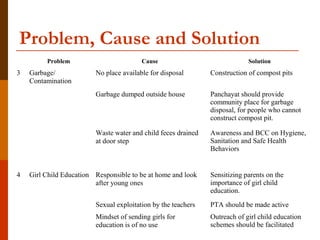
Problem, Cause and Solution
             Problem                          Cause                               Solution
    3   Garbage/              No place available for disposal        Construction of compost pits
        Contamination 
                              Garbage dumped outside house           Panchayat should provide 
                                                                     community place for garbage 
                                                                     disposal, for people who cannot 
                                                                     construct compost pit.

                              Waste water and child feces drained    Awareness and BCC on Hygiene, 
                              at door step                           Sanitation and Safe Health 
                                                                     Behaviors
                                                                      
    4   Girl Child Education  Responsible to be at home and look     Sensitizing parents on the 
                              after young ones                       importance of girl child 
                                                                     education.
                              Sexual exploitation by the teachers    PTA should be made active
                              Mindset of sending girls for           Outreach of girl child education 
                              education is of no use                 schemes should be facilitated
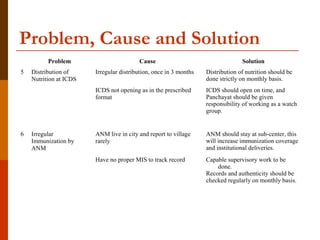
Problem, Cause and Solution
          Problem                          Cause                                   Solution
5   Distribution of      Irregular distribution, once in 3 months    Distribution of nutrition should be 
    Nutrition at ICDS                                                done strictly on monthly basis.
                         ICDS not opening as in the prescribed       ICDS should open on time, and 
                         format                                      Panchayat should be given 
                                                                     responsibility of working as a watch 
                                                                     group.

                                                                      
6   Irregular            ANM live in city and report to village      ANM should stay at sub-center, this 
    Immunization by      rarely                                      will increase immunization coverage 
    ANM                                                              and institutional deliveries.
                         Have no proper MIS to track record          Capable supervisory work to be 
                                                                         done. 
                                                                     Records and authenticity should be 
                                                                     checked regularly on monthly basis.
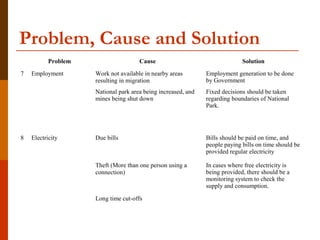
Problem, Cause and Solution
           Problem                    Cause                                   Solution
7   Employment       Work not available in nearby areas         Employment generation to be done 
                     resulting in migration                     by Government
                     National park area being increased, and    Fixed decisions should be taken 
                     mines being shut down                      regarding boundaries of National 
                                                                Park.


8   Electricity      Due bills                                  Bills should be paid on time, and 
                                                                people paying bills on time should be 
                                                                provided regular electricity

                     Theft (More than one person using a        In cases where free electricity is 
                     connection)                                being provided, there should be a 
                                                                monitoring system to check the 
                                                                supply and consumption.

                     Long time cut-offs                          
Problem, Cause and Solution
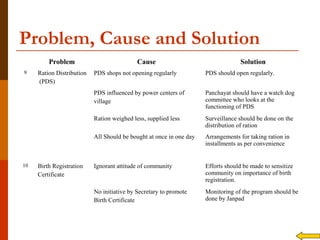
         Problem                            Cause                                  Solution
9    Ration Distribution   PDS shops not opening regularly           PDS should open regularly.
      (PDS) 
                           PDS influenced by power centers of        Panchayat should have a watch dog
                           village                                   committee who looks at the
                                                                     functioning of PDS
                           Ration weighed less, supplied less        Surveillance should be done on the 
                                                                     distribution of ration
                           All Should be bought at once in one day   Arrangements for taking ration in 
                                                                     installments as per convenience
                                                                      
10   Birth Registration    Ignorant attitude of community            Efforts should be made to sensitize 
     Certificate                                                     community on importance of birth 
                                                                     registration.
                           No initiative by Secretary to promote     Monitoring of the program should be 
                           Birth Certificate                         done by Janpad
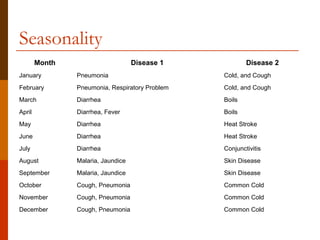
Seasonality
        Month                       Disease 1            Disease 2
January         Pneumonia                        Cold, and Cough
February        Pneumonia, Respiratory Problem   Cold, and Cough
March           Diarrhea                         Boils
April           Diarrhea, Fever                  Boils
May             Diarrhea                         Heat Stroke
June            Diarrhea                         Heat Stroke
July            Diarrhea                         Conjunctivitis
August          Malaria, Jaundice                Skin Disease
September       Malaria, Jaundice                Skin Disease
October         Cough, Pneumonia                 Common Cold
November        Cough, Pneumonia                 Common Cold
December        Cough, Pneumonia                 Common Cold
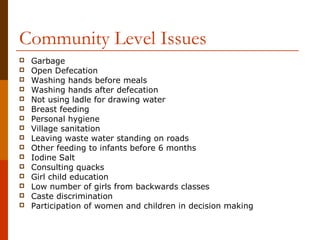
Community Level Issues
   Garbage
   Open Defecation
   Washing hands before meals
   Washing hands after defecation
   Not using ladle for drawing water
   Breast feeding
   Personal hygiene
   Village sanitation
   Leaving waste water standing on roads
   Other feeding to infants before 6 months
   Iodine Salt
   Consulting quacks
   Girl child education
   Low number of girls from backwards classes
   Caste discrimination
   Participation of women and children in decision making
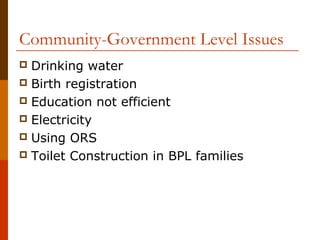
Community-Government Level Issues
 Drinking water
 Birth registration
 Education not efficient
 Electricity
 Using ORS
 Toilet Construction in BPL families
Government Level Issues
   Distribution of supplement at ICDS
   Immunization by ANM
   ANM not staying at Sub-center
   Unemployment
   Distribution of Ration (PDS)
   Distribution of Birth Registration Certificate
   No ICDS building
   No sub-center building
   School building not adequate
   Roads
Achievements
   Accredited Health Activist ASHA selection given in the
    hands of Sambhav.
   Success in establishing 42 temporary ICDS centers.
   Promotion of Nutrition Supplement to children falling in 3-4
    grade of malnutrition. 268 children have been admitted in
    district hospital till now.
   Establishment of 2 NRC centers for malnourished children,
    a result of Sambhav’s advocacy efforts.
   311 early marriages stopped
   319 child labor linked with formal schools
   Gradual improvement in institutionalized deliveries,
    especially in villages: Girmora, Mehdawali, Manakpur, Bichi,
    Arjungawan, Gatwaya
   Promoting household toilets has helped initiate construction
    of household toilets in Lalgarh, Khyawada Kalaan,
    Khorgaar, Theh, Satanwada, Patara, Sakalpur, Chaand, and
    Bara.
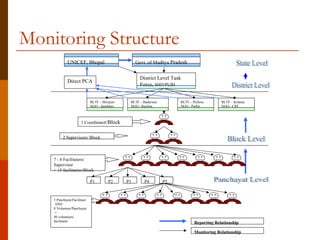
Monitoring Structure
             UNICEF, Bhopal                         Govt. of Madhya Pradesh


                                                      District Level Task 
             Direct PCA
                                                      Force, SHIVPURI


                             BLTF – Shivpuri    BLTF – Badarwas          BLTF – Pichore       BLTF – Kolaras
                             NGO - Sambhav      NGO - Rachna             NGO - Parhit         NGO - CID 


                      1 Coordinator/Block


          2 Supervisors/ Block


    7 - 8 Facilitators/ 
    Supervisor
    = 15 facilitators/Block

                             P1         P2     P3       P4        P5


    5 Panchayat/Facilitaor
     AND
    8 Volunteer/Panchayat
     =
    40 volunteers/ 
    facilitator                                                                  Reporting Relationship

                                                                                 Monitoring Relationship
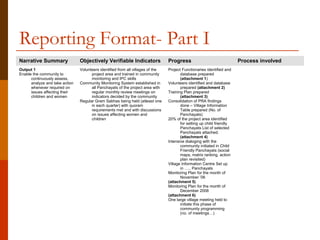
Reporting Format- Part I
Narrative Summary               Objectively Verifiable Indicators                Progress                               Process involved
Output 1                        Volunteers identified from all villages of the   Project Functionaries identified and
Enable the community to               project area and trained in community             database prepared
      continuously assess,            monitoring and IPC skills                         (attachment 1)
      analyze and take action   Community Monitoring System established in       Volunteers identified and database
      whenever required on            all Panchayats of the project area with           prepared (attachment 2)
      issues affecting their          regular monthly review meetings on         Training Plan prepared
      children and women              indicators decided by the community               (attachment 3)
                                Regular Gram Sabhas being held (atleast one      Consolidation of PRA findings
                                      in each quarter) with quoram                      done – Village Information
                                      requirements met and with discussions             Table prepared (No. of
                                      on issues affecting women and                     Panchayats)
                                      children                                   20% of the project area identified
                                                                                        for setting up child friendly
                                                                                        Panchayats List of selected
                                                                                        Panchayats attached.
                                                                                        (attachment 4)
                                                                                 Intensive dialoging with the
                                                                                        community initiated in Child
                                                                                        Friendly Panchayats (social
                                                                                        maps, matrix ranking, action
                                                                                        plan revisited)
                                                                                 Village Information Centre Set up
                                                                                        in ….. Panchayats
                                                                                 Monitoring Plan for the month of
                                                                                        November ’06
                                                                                 (attachment 5)
                                                                                 Monitoring Plan for the month of
                                                                                        December 2006
                                                                                 (attachment 6)
                                                                                 One large village meeting held to
                                                                                        initiate this phase of
                                                                                        community programming
                                                                                        (no. of meetings…)
Reporting Format- Part II
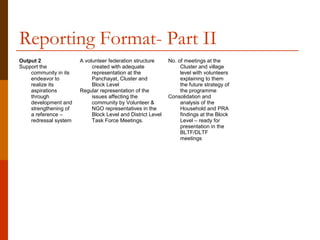
Output 2               A volunteer federation structure      No. of meetings at the
Support the                 created with adequate                 Cluster and village
    community in its        representation at the                 level with volunteers
    endeavor to             Panchayat, Cluster and                explaining to them
    realize its             Block Level                           the future strategy of
    aspirations        Regular representation of the              the programme
    through                 issues affecting the             Consolidation and
    development and         community by Volunteer &              analysis of the
    strengthening of        NGO representatives in the            Household and PRA
    a reference –           Block Level and District Level        findings at the Block
    redressal system        Task Force Meetings.                  Level – ready for
                                                                  presentation in the
                                                                  BLTF/DLTF
                                                                  meetings
Reporting Format – Part III
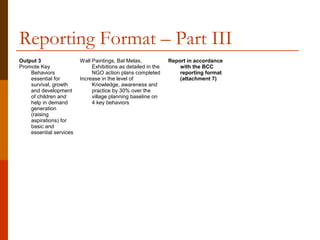
Output 3                 Wall Paintings, Bal Melas,            Report in accordance
Promote Key                   Exhibitions as detailed in the       with the BCC
    Behaviors                 NGO action plans completed           reporting format
    essential for        Increase in the level of                  (attachment 7)
    survival, growth          Knowledge, awareness and
    and development           practice by 30% over the
    of children and           village planning baseline on
    help in demand            4 key behaviors
    generation
    (raising
    aspirations) for
    basic and
    essential services
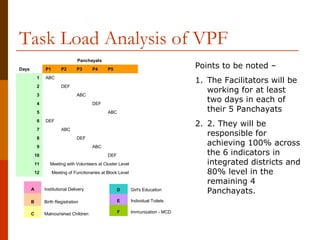
Task Load Analysis of VPF
                                  Panchayats
Days            P1       P2       P3     P4      P5
                                                                                    Points to be noted –
           1    ABC
                                                                                    1. The Facilitators will be
           2             DEF
                                                                                       working for at least
           3                      ABC
           4                             DEF
                                                                                       two days in each of
           5                                     ABC                                   their 5 Panchayats
           6    DEF
                                                                                    2. 2. They will be
           7             ABC
           8                      DEF
                                                                                       responsible for
           9                             ABC
                                                                                       achieving 100% across
           10                                    DEF                                   the 6 indicators in
           11      Meeting with Volunteers at Cluster Level                            integrated districts and
           12        Meeting of Functionaries at Block Level                           80% level in the
                                                                                       remaining 4
       A        Institutional Delivery                 D       Girl's Education        Panchayats.
       B        Birth Registration                     E       Individual Toilets

       C        Malnourished Children                  F       Immunization - MCD
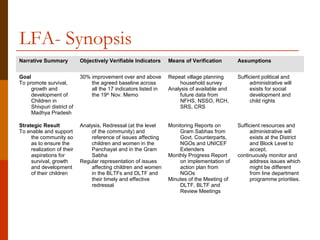
LFA- Synopsis
Narrative Summary           Objectively Verifiable Indicators     Means of Verification       Assumptions


Goal                        30% improvement over and above        Repeat village planning     Sufficient political and
To promote survival,            the agreed baseline across            household survey             administrative will
     growth and                 all the 17 indicators listed in   Analysis of available and        exists for social
     development of             the 19th Nov. Memo                    future data from             development and
     Children in                                                      NFHS, NSSO, RCH,             child rights
     Shivpuri district of                                             SRS, CRS
     Madhya Pradesh

Strategic Result            Analysis, Redressal (at the level     Monitoring Reports on       Sufficient resources and
To enable and support           of the community) and                 Gram Sabhas from             administrative will
     the community so           reference of issues affecting         Govt. Counterparts,          exists at the District
     as to ensure the           children and women in the             NGOs and UNICEF              and Block Level to
     realization of their       Panchayat and in the Gram             Extenders                    accept,
     aspirations for            Sabha                             Monthly Progress Report     continuously monitor and
     survival, growth       Regular representation of issues          on implementation of         address issues which
     and development            affecting children and women          action plan from             might be different
     of their children          in the BLTFs and DLTF and             NGOs                         from line department
                                their timely and effective        Minutes of the Meeting of        programme priorities.
                                redressal                             DLTF, BLTF and
                                                                      Review Meetings
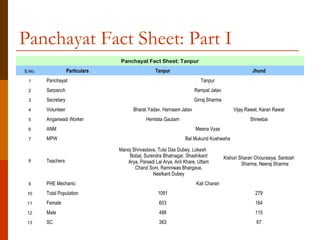
Panchayat Fact Sheet: Part I
                                  Panchayat Fact Sheet: Tanpur
S.No.               Particulars                    Tanpur                                          Jhund
 1      Panchayat                                                         Tanpur
 2      Sarpanch                                                      Rampal Jatav
 3      Secretary                                                     Girraj Sharma
 4      Volunteer                       Bharat Yadav, Harnaam Jatav                       Vijay Rawat, Karan Rawat
 5      Anganwadi Worker                       Hemlata Gautam                                     Shreebai
 6      ANM                                                            Meena Vyas
 7      MPW                                                       Bal Mukund Kushwaha

                                  Manoj Shrivastava, Tulsi Das Dubey, Lokesh
                                      Bobal, Surendra Bhatnagar, Shashikant           Kishori Sharan Chourasiya, Santosh
 8      Teachers                     Arya, Parsadi Lal Arya, Anil Khare, Uttam                 Sharma, Neeraj Sharma
                                         Chand Soni, Ramniwas Bhargava,
                                                  Neelkant Dubey
 9      PHE Mechanic                                                   Kali Charan
 10     Total Population                             1091                                            279
 11     Female                                       603                                             164
 12     Male                                         488                                             115
 13     SC                                           383                                             67
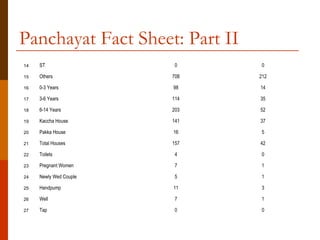
Panchayat Fact Sheet: Part II
14   ST                  0       0

15   Others             708     212

16   0-3 Years          98      14

17   3-6 Years          114     35

18   6-14 Years         203     52

19   Kaccha House       141     37

20   Pakka House        16       5

21   Total Houses       157     42

22   Toilets             4       0

23   Pregnant Women      7       1

24   Newly Wed Couple    5       1

25   Handpump           11       3

26   Well                7       1

27   Tap                 0       0
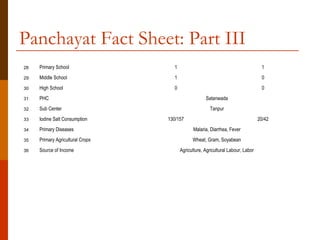
Panchayat Fact Sheet: Part III
28   Primary School                 1                                              1
29   Middle School                  1                                              0
30   High School                    0                                              0
31   PHC                                             Satanwada
32   Sub Center                                        Tanpur
33   Iodine Salt Consumption      130/157                                         20/42
34   Primary Diseases                          Malaria, Diarrhea, Fever
35   Primary Agricultural Crops               Wheat, Gram, Soyabean
36   Source of Income                   Agriculture, Agricultural Labour, Labor
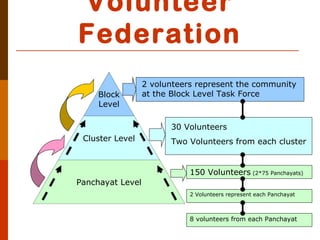
Volunteer
Federation
                  2 volunteers represent the community
     Block        at the Block Level Task Force
     Level

                        30 Volunteers
 Cluster Level          Two Volunteers from each cluster


                             150 Volunteers (2*75 Panchayats)
Panchayat Level
                             2 Volunteers represent each Panchayat


                             8 volunteers from each Panchayat
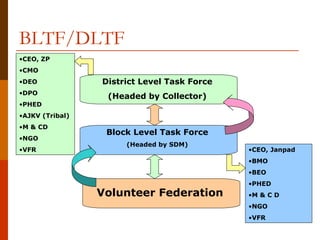
BLTF/DLTF
•CEO, ZP
•CMO
•DEO             District Level Task Force
•DPO
                  (Headed by Collector)
•PHED
•AJKV (Tribal)
•M & CD
                  Block Level Task Force
•NGO
                      (Headed by SDM)
•VFR                                         •CEO, Janpad
                                             •BMO
                                             •BEO
                                             •PHED
                 Volunteer Federation        •M & C D
                                             •NGO
                                             •VFR
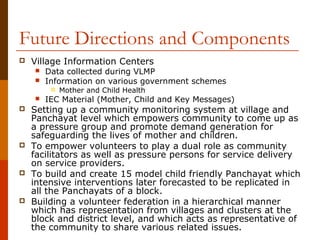
Future Directions and Components
   Village Information Centers
       Data collected during VLMP
       Information on various government schemes
            Mother and Child Health
       IEC Material (Mother, Child and Key Messages)
   Setting up a community monitoring system at village and
    Panchayat level which empowers community to come up as
    a pressure group and promote demand generation for
    safeguarding the lives of mother and children.
   To empower volunteers to play a dual role as community
    facilitators as well as pressure persons for service delivery
    on service providers.
   To build and create 15 model child friendly Panchayat which
    intensive interventions later forecasted to be replicated in
    all the Panchayats of a block.
   Building a volunteer federation in a hierarchical manner
    which has representation from villages and clusters at the
    block and district level, and which acts as representative of
    the community to share various related issues.
Next Phase Activities
   Training of volunteers
   Establishing community monitoring
   Monthly review meetings at village level
   Strengthening Gram Sabha
   Creating volunteer federation
   Promotion of 4 key behaviors
       Exclusive Breastfeeding
       Girl Child Education
       Hygiene and Sanitation Practice
       HIV/AIDS
   Training of HIV/AIDS
   Children New Agency
Village level micro planning program- exhaustive presentation- garry

Village level micro planning program- exhaustive presentation- garry

  • 1.
    Village Level Micro-Planning Program Supported by: District Administration, Shivpuri and UNICEF, Bhopal Implemented by: Sambhav Social Service Organization, Shivpuri
  • 2.
    Contents  District Shivpuri  Shivpuri Block  VLMP  Approach  Expected Outcomes  Benefits  Methodology  Phases  Preparations  Activities  Involvement of Children  Findings  Achievements
  • 3.
    District Shivpuri Population 1440666 Sex Ratio 858 Sex Ratio- Urban 878 Sex Ratio- Rural 855 0-5 Sex Ratio 905 Literacy 59.5 Male Literacy 74.8 Female Literacy 41.5
  • 4.
    Shivpuri Block Population 134222 Families 22226 0-3 Children 10179 Male 5142 Female 5037 Target Couple 25700 Panchayat 74 Villages 187 Hamlets 130 Difficult Villages 54 PHC Satanwada Sub-Center 28 ICDS 112 Temporary ICDS 49 ASHA Worker 49 ANM 28 MPW 20 Trained Dai 187 JSR 187 Private Doctor 100 Sweeper Families 200
  • 5.
    Village Level Micro-Planning  VLMP is a process of involving the communities directly in framing the development plan of the villages, and also ensuring optimum utilization of resource.
  • 6.
    Approach  a five-daylong exercise in a particular village in the Integrated District by a team of Village Planning Facilitators belonging to identified NGOs/CBOs, usually in groups of three or more depending upon the population size and spread of the village.  Facilitators reside in their allotted village for the entire period living on what the villagers can offer in terms of food and place to stay.
  • 7.
    Expected Outcomes  Registration and certificate to all children within 28 days of birth.  All deliveries by trained people.  Breast feeding to infants up to 6 months.  Complete Immunization of 90% children.  ORS consumption for children suffering from Diarrhea, and preventive care on respiratory problems.  All children get complete doses of vitamin A.  No child should fall under grade 3-4 of malnutrition, 30% reduction in children falling under grade 1-2.  All children complete primary education and are linked to the process of developing basic learning skills.  Awareness and knowledge among 15-24 years on HIV/AIDS. Practicing safe sexual behavior.  50% Reduction in children marrying before age of 18.  Ensuring protection of children from unsafe work and hazardous working conditions.
  • 8.
    Expected Outcomes  Use of Iodine salt in every household.  Outreach of every family to safe drinking water sources, and no water source should remain malfunction for more than 4 days.  Safe hygiene practices to be followed by every person of the family (washing hands before and after meals and defecation).  Outreach of all to safe hygiene and sanitation facilities.  Pre and Post natal care to all pregnant women, and PPTC services.  Facilities for children at ICDS center and health centers on the basis of individual evaluation.  Village level micro-planning in every village.  Promoting safe behaviors through behavior change communication  Planned implementation of various child and mother development programs, and evaluating them on the basis of performance.
  • 9.
    VLMP- Benefits  Problem solving and decision making on the basis of alternatives.  Helps find root causes of problems.  Better understanding of communities on problem identification, analysis and problem solving.  Identifying resources available at village level.  Improved community participation in planning  Social issues will be a part of the plans.  Deprived classes will immediately be identified as primary beneficiaries.  Communities will be able to differentiate between needed and available services.  People will be the key players in planning processes.  Increased participation of community and involvement of panchayats.
  • 10.
    Methodology  Community Interaction PRA- Social Mapping, Seasonality Chart.  Disseminating key behavior messages  Video Shows “Meena”  Involving sarpanch/ secretary
  • 11.
    VLMP- Phases  Analysis of every village of the district and problem evaluation  Prioritization of problems by the community.  Common opinion building and acceptance of problems.  Common opinion on alternatives to problem solving.  Micro-planning of every village on the basis of common opinion and approval by gram sabha.
  • 12.
    Initial Preparations  Framingsurvey formats- village, family  Testing survey format  Presentation by cultural group (Kala Jattha)
  • 13.
    Organization Preparations  Finalpreparation and rehearsal of performances to be made by kala jattha.  Zero phase and Planning level plan preparation.  Formation of teams  Distribution of material  Environment building
  • 14.
    Zero Phase Activities  Village level meetings on information dissemination regarding VLMP  Family survey  Social Mapping  Matrix Ranking, Preparing list of problems, prioritization of problems.  Selection of two people in each meeting who would support in VLMP
  • 15.
    Activities  Decorative Ropewith Flags- 74 panchayats  Flash Hoardings- 10 boards  Wall writing- 740 locations  Banners- 74  Large Hoardings – 2  Awareness Chariot- 170  Children Rally- 74  Visiting places where village planning wont take place- 27
  • 16.
    VLMP- Activities  Master Trainer Training – 17 April to 31 April’2005  Training of trainers- 13 June to 17 June’ 2005  Cluster animator training- 20 June to 24 June’2005  Panchayat animator training- 3 Batches  Training of cluster animators on street theatre.  Inauguration of VLMP program  Commencement of VLMP on pilot basis in Suhara, Sirsod and Tanpur (Training phase)  Weighing all children under Bal Sanjeevani  Involvement in Pulse Polio Program  Implementation of VLMP plan  Orientation of Panchayat representatives
  • 17.
    VLMP- Process Activities  Community Meetings  Social Mapping  Family Survey  Matrix Ranking  Volunteer Selection  Group Discussion  Venn- Diagram  Seasonality mapping  Time Line  Gram Sabha
  • 18.
    VLMP- Activity Table  Panchayat: 74  Villages: 206  Village Visit: 206  Intensive Visit: 206  Social Mapping: 206  Family Survey: 19209 (approximate)  Matrix Ranking: 206  Time Line: 191  Season based change mapping: 191  Venn Diagram: 206  Community Meetings: 768  Gram Sabha: 206  Volunteers: 551
  • 19.
    Involvement of Children Rally  Painting Competition  Educational Games  Promotion of moral science  Support in social mapping  Support in providing survey information  Bal Sabha  Making efforts to form children clubs and groups of adolescent girls.
  • 20.
    Major Family SurveyFindings  Low birth registration  Low birth certificates issues  Incomplete pre-post natal care  Use of iodine salt in very few houses  Lack of knowledge on HIV/AIDS  Low institutionalized deliveries  Traditional home based treatment of Pneumonia  Family having average 4-5 children  Very low number of girls attending schools  Iron folic acid consumption low.
  • 21.
    Problem, Cause andSolution   Problem Cause Solution 1 Drinking Water Hand pumps not working Hand pump maintenance should be in  the hands of community     Repairs works not done in time With the falling water level, all the  hand pumps should be rechecked and  re-engineered as per need     People ignorant on taking ownership Rain water harvesting should be done     Technical Problems           2 Open Defecation  Mindset of going out for defecation  Awareness on relation of diseases  with open defecation, and relation of  diseases with poverty.     Uncomfortable in using toilets  Construction of household toilets     Low preference to low cost toilets Government should take timely  disbursement of funds at priority
  • 22.
    Problem, Cause andSolution   Problem Cause Solution 3 Garbage/  No place available for disposal  Construction of compost pits Contamination      Garbage dumped outside house  Panchayat should provide  community place for garbage  disposal, for people who cannot  construct compost pit.     Waste water and child feces drained  Awareness and BCC on Hygiene,  at door step  Sanitation and Safe Health  Behaviors         4 Girl Child Education  Responsible to be at home and look  Sensitizing parents on the  after young ones  importance of girl child  education.     Sexual exploitation by the teachers  PTA should be made active     Mindset of sending girls for  Outreach of girl child education  education is of no use   schemes should be facilitated
  • 23.
    Problem, Cause andSolution   Problem Cause Solution 5 Distribution of  Irregular distribution, once in 3 months  Distribution of nutrition should be  Nutrition at ICDS  done strictly on monthly basis.     ICDS not opening as in the prescribed  ICDS should open on time, and  format  Panchayat should be given  responsibility of working as a watch  group.         6 Irregular  ANM live in city and report to village  ANM should stay at sub-center, this  Immunization by  rarely  will increase immunization coverage  ANM  and institutional deliveries.     Have no proper MIS to track record  Capable supervisory work to be  done.  Records and authenticity should be  checked regularly on monthly basis.
  • 24.
    Problem, Cause andSolution   Problem Cause Solution 7 Employment  Work not available in nearby areas  Employment generation to be done  resulting in migration  by Government     National park area being increased, and  Fixed decisions should be taken  mines being shut down regarding boundaries of National  Park.       8 Electricity  Due bills  Bills should be paid on time, and  people paying bills on time should be  provided regular electricity     Theft (More than one person using a  In cases where free electricity is  connection)  being provided, there should be a  monitoring system to check the  supply and consumption.     Long time cut-offs    
  • 25.
    Problem, Cause andSolution   Problem Cause Solution 9 Ration Distribution PDS shops not opening regularly  PDS should open regularly.  (PDS)      PDS influenced by power centers of  Panchayat should have a watch dog village  committee who looks at the functioning of PDS     Ration weighed less, supplied less Surveillance should be done on the  distribution of ration     All Should be bought at once in one day Arrangements for taking ration in  installments as per convenience         10 Birth Registration Ignorant attitude of community  Efforts should be made to sensitize  Certificate  community on importance of birth  registration.     No initiative by Secretary to promote  Monitoring of the program should be  Birth Certificate   done by Janpad
  • 26.
    Seasonality Month Disease 1 Disease 2 January Pneumonia Cold, and Cough February Pneumonia, Respiratory Problem Cold, and Cough March Diarrhea Boils April Diarrhea, Fever Boils May Diarrhea Heat Stroke June Diarrhea Heat Stroke July Diarrhea Conjunctivitis August Malaria, Jaundice Skin Disease September Malaria, Jaundice Skin Disease October Cough, Pneumonia Common Cold November Cough, Pneumonia Common Cold December Cough, Pneumonia Common Cold
  • 27.
    Community Level Issues  Garbage  Open Defecation  Washing hands before meals  Washing hands after defecation  Not using ladle for drawing water  Breast feeding  Personal hygiene  Village sanitation  Leaving waste water standing on roads  Other feeding to infants before 6 months  Iodine Salt  Consulting quacks  Girl child education  Low number of girls from backwards classes  Caste discrimination  Participation of women and children in decision making
  • 28.
    Community-Government Level Issues Drinking water  Birth registration  Education not efficient  Electricity  Using ORS  Toilet Construction in BPL families
  • 29.
    Government Level Issues  Distribution of supplement at ICDS  Immunization by ANM  ANM not staying at Sub-center  Unemployment  Distribution of Ration (PDS)  Distribution of Birth Registration Certificate  No ICDS building  No sub-center building  School building not adequate  Roads
  • 30.
    Achievements  Accredited Health Activist ASHA selection given in the hands of Sambhav.  Success in establishing 42 temporary ICDS centers.  Promotion of Nutrition Supplement to children falling in 3-4 grade of malnutrition. 268 children have been admitted in district hospital till now.  Establishment of 2 NRC centers for malnourished children, a result of Sambhav’s advocacy efforts.  311 early marriages stopped  319 child labor linked with formal schools  Gradual improvement in institutionalized deliveries, especially in villages: Girmora, Mehdawali, Manakpur, Bichi, Arjungawan, Gatwaya  Promoting household toilets has helped initiate construction of household toilets in Lalgarh, Khyawada Kalaan, Khorgaar, Theh, Satanwada, Patara, Sakalpur, Chaand, and Bara.
  • 31.
    Monitoring Structure UNICEF, Bhopal Govt. of Madhya Pradesh District Level Task  Direct PCA Force, SHIVPURI BLTF – Shivpuri BLTF – Badarwas BLTF – Pichore BLTF – Kolaras NGO - Sambhav NGO - Rachna NGO - Parhit NGO - CID  1 Coordinator/Block 2 Supervisors/ Block 7 - 8 Facilitators/  Supervisor = 15 facilitators/Block P1 P2 P3 P4 P5 5 Panchayat/Facilitaor  AND 8 Volunteer/Panchayat  = 40 volunteers/  facilitator Reporting Relationship Monitoring Relationship
  • 32.
    Reporting Format- PartI Narrative Summary Objectively Verifiable Indicators Progress Process involved Output 1 Volunteers identified from all villages of the Project Functionaries identified and Enable the community to project area and trained in community database prepared continuously assess, monitoring and IPC skills (attachment 1) analyze and take action Community Monitoring System established in Volunteers identified and database whenever required on all Panchayats of the project area with prepared (attachment 2) issues affecting their regular monthly review meetings on Training Plan prepared children and women indicators decided by the community (attachment 3) Regular Gram Sabhas being held (atleast one Consolidation of PRA findings in each quarter) with quoram done – Village Information requirements met and with discussions Table prepared (No. of on issues affecting women and Panchayats) children 20% of the project area identified for setting up child friendly Panchayats List of selected Panchayats attached. (attachment 4) Intensive dialoging with the community initiated in Child Friendly Panchayats (social maps, matrix ranking, action plan revisited) Village Information Centre Set up in ….. Panchayats Monitoring Plan for the month of November ’06 (attachment 5) Monitoring Plan for the month of December 2006 (attachment 6) One large village meeting held to initiate this phase of community programming (no. of meetings…)
  • 33.
    Reporting Format- PartII Output 2 A volunteer federation structure No. of meetings at the Support the created with adequate Cluster and village community in its representation at the level with volunteers endeavor to Panchayat, Cluster and explaining to them realize its Block Level the future strategy of aspirations Regular representation of the the programme through issues affecting the Consolidation and development and community by Volunteer & analysis of the strengthening of NGO representatives in the Household and PRA a reference – Block Level and District Level findings at the Block redressal system Task Force Meetings. Level – ready for presentation in the BLTF/DLTF meetings
  • 34.
    Reporting Format –Part III Output 3 Wall Paintings, Bal Melas, Report in accordance Promote Key Exhibitions as detailed in the with the BCC Behaviors NGO action plans completed reporting format essential for Increase in the level of (attachment 7) survival, growth Knowledge, awareness and and development practice by 30% over the of children and village planning baseline on help in demand 4 key behaviors generation (raising aspirations) for basic and essential services
  • 35.
    Task Load Analysisof VPF Panchayats Days P1 P2 P3 P4 P5 Points to be noted – 1 ABC 1. The Facilitators will be 2 DEF working for at least 3 ABC 4 DEF two days in each of 5 ABC their 5 Panchayats 6 DEF 2. 2. They will be 7 ABC 8 DEF responsible for 9 ABC achieving 100% across 10 DEF the 6 indicators in 11 Meeting with Volunteers at Cluster Level integrated districts and 12 Meeting of Functionaries at Block Level 80% level in the remaining 4 A Institutional Delivery D Girl's Education Panchayats. B Birth Registration E Individual Toilets C Malnourished Children F Immunization - MCD
  • 36.
    LFA- Synopsis Narrative Summary Objectively Verifiable Indicators Means of Verification Assumptions Goal 30% improvement over and above Repeat village planning Sufficient political and To promote survival, the agreed baseline across household survey administrative will growth and all the 17 indicators listed in Analysis of available and exists for social development of the 19th Nov. Memo future data from development and Children in NFHS, NSSO, RCH, child rights Shivpuri district of SRS, CRS Madhya Pradesh Strategic Result Analysis, Redressal (at the level Monitoring Reports on Sufficient resources and To enable and support of the community) and Gram Sabhas from administrative will the community so reference of issues affecting Govt. Counterparts, exists at the District as to ensure the children and women in the NGOs and UNICEF and Block Level to realization of their Panchayat and in the Gram Extenders accept, aspirations for Sabha Monthly Progress Report continuously monitor and survival, growth Regular representation of issues on implementation of address issues which and development affecting children and women action plan from might be different of their children in the BLTFs and DLTF and NGOs from line department their timely and effective Minutes of the Meeting of programme priorities. redressal DLTF, BLTF and Review Meetings
  • 37.
    Panchayat Fact Sheet:Part I Panchayat Fact Sheet: Tanpur S.No. Particulars Tanpur Jhund 1 Panchayat Tanpur 2 Sarpanch Rampal Jatav 3 Secretary Girraj Sharma 4 Volunteer Bharat Yadav, Harnaam Jatav Vijay Rawat, Karan Rawat 5 Anganwadi Worker Hemlata Gautam Shreebai 6 ANM Meena Vyas 7 MPW Bal Mukund Kushwaha Manoj Shrivastava, Tulsi Das Dubey, Lokesh Bobal, Surendra Bhatnagar, Shashikant Kishori Sharan Chourasiya, Santosh 8 Teachers Arya, Parsadi Lal Arya, Anil Khare, Uttam Sharma, Neeraj Sharma Chand Soni, Ramniwas Bhargava, Neelkant Dubey 9 PHE Mechanic Kali Charan 10 Total Population 1091 279 11 Female 603 164 12 Male 488 115 13 SC 383 67
  • 38.
    Panchayat Fact Sheet:Part II 14 ST 0 0 15 Others 708 212 16 0-3 Years 98 14 17 3-6 Years 114 35 18 6-14 Years 203 52 19 Kaccha House 141 37 20 Pakka House 16 5 21 Total Houses 157 42 22 Toilets 4 0 23 Pregnant Women 7 1 24 Newly Wed Couple 5 1 25 Handpump 11 3 26 Well 7 1 27 Tap 0 0
  • 39.
    Panchayat Fact Sheet:Part III 28 Primary School 1 1 29 Middle School 1 0 30 High School 0 0 31 PHC Satanwada 32 Sub Center Tanpur 33 Iodine Salt Consumption 130/157 20/42 34 Primary Diseases Malaria, Diarrhea, Fever 35 Primary Agricultural Crops Wheat, Gram, Soyabean 36 Source of Income Agriculture, Agricultural Labour, Labor
  • 40.
    Volunteer Federation 2 volunteers represent the community Block at the Block Level Task Force Level 30 Volunteers Cluster Level Two Volunteers from each cluster 150 Volunteers (2*75 Panchayats) Panchayat Level 2 Volunteers represent each Panchayat 8 volunteers from each Panchayat
  • 41.
    BLTF/DLTF •CEO, ZP •CMO •DEO District Level Task Force •DPO (Headed by Collector) •PHED •AJKV (Tribal) •M & CD Block Level Task Force •NGO (Headed by SDM) •VFR •CEO, Janpad •BMO •BEO •PHED Volunteer Federation •M & C D •NGO •VFR
  • 42.
    Future Directions andComponents  Village Information Centers  Data collected during VLMP  Information on various government schemes  Mother and Child Health  IEC Material (Mother, Child and Key Messages)  Setting up a community monitoring system at village and Panchayat level which empowers community to come up as a pressure group and promote demand generation for safeguarding the lives of mother and children.  To empower volunteers to play a dual role as community facilitators as well as pressure persons for service delivery on service providers.  To build and create 15 model child friendly Panchayat which intensive interventions later forecasted to be replicated in all the Panchayats of a block.  Building a volunteer federation in a hierarchical manner which has representation from villages and clusters at the block and district level, and which acts as representative of the community to share various related issues.
  • 43.
    Next Phase Activities  Training of volunteers  Establishing community monitoring  Monthly review meetings at village level  Strengthening Gram Sabha  Creating volunteer federation  Promotion of 4 key behaviors  Exclusive Breastfeeding  Girl Child Education  Hygiene and Sanitation Practice  HIV/AIDS  Training of HIV/AIDS  Children New Agency