BACKGROUND OF THE 
CHILD 
Matteo is a 6 years old Grade 1 student at John Dewey School for 
Children. He is very playful and sociable child. Colossal squid is his 
favorite animal and oftentimes he will suddenly claw his fingers and 
imitate its hands movements. But dinosaurs and scary things are what he 
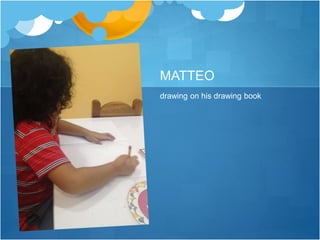
draws most of the time. Scary things for him are anything with spikes. In 
his drawing book, there is a house with spikes, a man wearing shoes with 
spikes and any possible thing that can be drawn with spikes.
BACKGROUND OF THE 
CHILD 
The teachers have not yet determined in what particular field Matteo 
excels because he still needs help in his academic performance. He is 
having a difficult time doing his schoolworks by himself. Therefore, 
every day after class, he stays at school for his tutoring session 
because if he does not, his homeworks will still be homeworks the 
next day. It has also been said that Matteo is used to always getting 
what he wants and whenever things do not go his way he tends to 
throw tantrums and act very cranky.
PHYSICAL DEVELOPMENT 
Motor skills are very essential for him right now. These test his reactions to 
his surroundings or even to a certain stimuli. His physical abilities and 
capacities widen as he continue to grow and learn new things thoroughly. He 
uses his main bodily movements in performing gross motor skills-- jumping, 
running, dancing, balancing, skipping and turning. On the other hand, he uses 
his small bodily movements in performing fine motor skills such as writing, 
drawing and tying shoe laces. Children must have adequate opportunities 
and be interested in developing these skills to become more competent.
PHYSICAL DEVELOPMENT 
Matteo sometimes shows hyperactivity in his actions, he jumps and runs from one place to 
another and shows no sign of stopping or slowing down. His energy level is stable and always full, 
enabling him to perform those motor skills and do multiple tasks at the same time. Mateo also 
loves to draw and he is surprisingly good at it. 
Matteo’s health is also a factor in his physical development. He may have some respiratory 
ailments, cough, cold or stomachaches due to his not yet fully developed lungs. But because JDSC 
has a healthy food policy, the healthy foods that are fed to the children lessen the chances for them 
to get sick. Physical development is an important factor for children like Matteo because their 
conditions and actions rely on it.
COGNITIVE DEVELOPMENT 
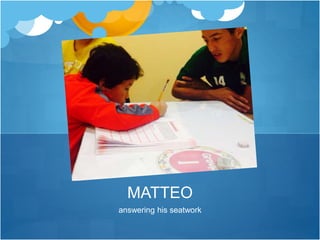
The teacher gave the children an activity on their workbooks to do, this is also 
known as a schema or cognitive frameworks or concepts that help people organize 
and interpret information. After observing Matteo during this activity, we decided to 
assist him to help him get into the follow of the lesson. At first, egocentrism was 
quite obvious in the child for he was grumpy and insisted on doing things his own 
way. After his teacher noted his mistakes, he was asked to do the activity again and 
that’s when he decided to take in our help. We guided him through his work using 
the scaffolding method.
COGNITIVE DEVELOPMENT 
Matteo showed the preoperational stage perfectly. Doing things his own way at first showed that 
he could not completely manipulate information and was unable to take in the point of view of 
others. On the other hand, his egocentrism did show the cognitive skill of reasoning, which was 
proof of his cognitive development. He also showed the cognitive skill of problem – solving when 
he then decided that take in our help, knowing his situation. Lastly, not just Matteo but the entire 
class showed that memory was present in their cognitive development when they actually 
remembered some of our names as we entered their classroom during the second school visit.
EMOTIONAL DEVELOPMENT 
Matteo is a playful and happy person. He is always jumping around or playing with his classmates. 
He is very talkative as well. Once a person starts talking to him, he will eventually be the only one 
doing the talking. Despite his parents being separated, they were still able to show him positive 
emotional skills that contributed in shaping his emotional development. Children who learn 
positive emotional skills from their parents seem to have more success making friends. Children of 
emotionally expressive mothers tend to receive high regard from their peers (Cassidy, Parke, 
Butkovsky, & Braungart, 1992). Matteo seems to be friendly with his classmates and seems to share 
a good relationship with them.
SOCIAL DEVELOPMENT 
Social development of a child refers on how he reacts and responds on his environment. 
This is the start of child's relationship development, which includes building of friendship 
or socialization in the community. Matteo is a very sociable child. He is cheerful and 
approachable so his classmates are always playing with him. When talking to him, it 
seems like he always has a lot to say that eventually he will be the only one doing the 
talking. As his teacher said, he is really good at manipulating people. He gets them 
distracted when they talk to him so he can avoid doing something he does not want to do. 
Reiner seems to be his closest friend. Although Reiner has some special needs, this did not 
stop Matteo from befriending him. Every time they are seated beside each other, which is 
most of the time, they always have something to talk to and laugh about.
SOCIAL DEVELOPMENT 
Matteo seems to be close with some of his classmates. They are often playing with 
each other and it is surprising to know that even if they are just kids they already 
have concern for each other.When Matteo only kept on eating his rice, his friend told 
him to also eat the vegetables and meat because his body needs it.
CONCLUSION 
Matteo has developed properly in terms of physical development and social development. His 
body is able to withstand his physical activities like playing, jumping and running around. He 
also has a good interpersonal relationship with his classmates and teachers although 
sometimes he can be really persistent in doing what he wants. Despite the situation of his 
parents, it is wonderful to see that he is still a jolly kid outside and that he is trying not to let 
the separation affect his social life. 
Matteo had successfully made it through Erik Erikson’s industry vs. inferiority. The 
acknowledgement and encouragement he got because of his drawings helped him through this 
stage. He felt sense of accomplishment upon knowing that he has something to prove to people. 
Matteo was able to develop competence as he successfully passes this stage.
CONCLUSION 
However, despite the positive approaches on these two aspects, he still needs to be further 
developed cognitively and emotionally. In Matteo’s case, he is having a hard time with school. It 
is normal but still needs development. It takes time for children to adapt to school activities by 
themselves. Children around his age usually have tutors who assist and guide them in doing the 
schoolworks. Also, Matteo has been showing signs that he is still egocentric. 
As for Matteo’s emotional development, he is still affected by his parents’ separation which is 
the reason why he still gets emotional upon talking about it. Children who are victims of 
broken families are often affected seriously only during the ffirst year but once the child starts 
to understand the situation, he eventually starts to adapt to it and soon the topic will not be 
something to avoid any longer.
RECOMMENDATIONS 
For future case studies, a few more visits would be greatly appreciated for it 
will give students more knowledge and information on the children they will 
be observing. This will also give them more time to gather more 
information, which may in fact produce better and more interesting case 
studies. Scheduled meetings/ a scheduled meeting with the subject’s 
(child’s) parents/parent would also be a great tool in producing better case 
studies.
RECOMMENDATIONS 
Overall, we would recommend this school, the John Dewey School for 
Children, for future case studies for it on its own is still a developing school. 
On behalf of our classmates, we would like to say thank you, Ms. Razo, for 
giving us the opportunity to visit, use, and learn from the amazing children 
of John Dewey School for Children for our case study.
MATTEO 
6 YEARS OLD
MATTEO 
drawing on his drawing book
MATTEO 
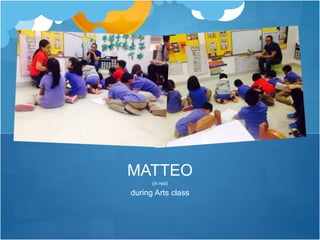
(in red) 
during Arts class
MATTEO 
answering his seatwork
MATTEO 
with his mother
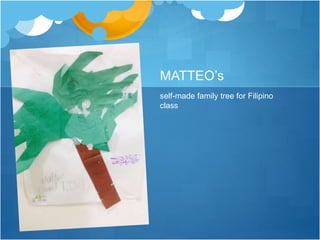
MATTEO’s 
self-made family tree for Filipino 
class
MATTEO 
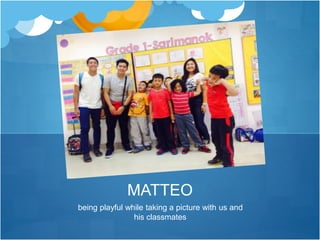
being playful while taking a picture with us and 
his classmates
MATTEO 
with the group members

A Case Study on Child Development - Matteo

  • 2.
    BACKGROUND OF THE CHILD Matteo is a 6 years old Grade 1 student at John Dewey School for Children. He is very playful and sociable child. Colossal squid is his favorite animal and oftentimes he will suddenly claw his fingers and imitate its hands movements. But dinosaurs and scary things are what he draws most of the time. Scary things for him are anything with spikes. In his drawing book, there is a house with spikes, a man wearing shoes with spikes and any possible thing that can be drawn with spikes.
  • 3.
    BACKGROUND OF THE CHILD The teachers have not yet determined in what particular field Matteo excels because he still needs help in his academic performance. He is having a difficult time doing his schoolworks by himself. Therefore, every day after class, he stays at school for his tutoring session because if he does not, his homeworks will still be homeworks the next day. It has also been said that Matteo is used to always getting what he wants and whenever things do not go his way he tends to throw tantrums and act very cranky.
  • 4.
    PHYSICAL DEVELOPMENT Motorskills are very essential for him right now. These test his reactions to his surroundings or even to a certain stimuli. His physical abilities and capacities widen as he continue to grow and learn new things thoroughly. He uses his main bodily movements in performing gross motor skills-- jumping, running, dancing, balancing, skipping and turning. On the other hand, he uses his small bodily movements in performing fine motor skills such as writing, drawing and tying shoe laces. Children must have adequate opportunities and be interested in developing these skills to become more competent.
  • 5.
    PHYSICAL DEVELOPMENT Matteosometimes shows hyperactivity in his actions, he jumps and runs from one place to another and shows no sign of stopping or slowing down. His energy level is stable and always full, enabling him to perform those motor skills and do multiple tasks at the same time. Mateo also loves to draw and he is surprisingly good at it. Matteo’s health is also a factor in his physical development. He may have some respiratory ailments, cough, cold or stomachaches due to his not yet fully developed lungs. But because JDSC has a healthy food policy, the healthy foods that are fed to the children lessen the chances for them to get sick. Physical development is an important factor for children like Matteo because their conditions and actions rely on it.
  • 6.
    COGNITIVE DEVELOPMENT Theteacher gave the children an activity on their workbooks to do, this is also known as a schema or cognitive frameworks or concepts that help people organize and interpret information. After observing Matteo during this activity, we decided to assist him to help him get into the follow of the lesson. At first, egocentrism was quite obvious in the child for he was grumpy and insisted on doing things his own way. After his teacher noted his mistakes, he was asked to do the activity again and that’s when he decided to take in our help. We guided him through his work using the scaffolding method.
  • 7.
    COGNITIVE DEVELOPMENT Matteoshowed the preoperational stage perfectly. Doing things his own way at first showed that he could not completely manipulate information and was unable to take in the point of view of others. On the other hand, his egocentrism did show the cognitive skill of reasoning, which was proof of his cognitive development. He also showed the cognitive skill of problem – solving when he then decided that take in our help, knowing his situation. Lastly, not just Matteo but the entire class showed that memory was present in their cognitive development when they actually remembered some of our names as we entered their classroom during the second school visit.
  • 8.
    EMOTIONAL DEVELOPMENT Matteois a playful and happy person. He is always jumping around or playing with his classmates. He is very talkative as well. Once a person starts talking to him, he will eventually be the only one doing the talking. Despite his parents being separated, they were still able to show him positive emotional skills that contributed in shaping his emotional development. Children who learn positive emotional skills from their parents seem to have more success making friends. Children of emotionally expressive mothers tend to receive high regard from their peers (Cassidy, Parke, Butkovsky, & Braungart, 1992). Matteo seems to be friendly with his classmates and seems to share a good relationship with them.
  • 9.
    SOCIAL DEVELOPMENT Socialdevelopment of a child refers on how he reacts and responds on his environment. This is the start of child's relationship development, which includes building of friendship or socialization in the community. Matteo is a very sociable child. He is cheerful and approachable so his classmates are always playing with him. When talking to him, it seems like he always has a lot to say that eventually he will be the only one doing the talking. As his teacher said, he is really good at manipulating people. He gets them distracted when they talk to him so he can avoid doing something he does not want to do. Reiner seems to be his closest friend. Although Reiner has some special needs, this did not stop Matteo from befriending him. Every time they are seated beside each other, which is most of the time, they always have something to talk to and laugh about.
  • 10.
    SOCIAL DEVELOPMENT Matteoseems to be close with some of his classmates. They are often playing with each other and it is surprising to know that even if they are just kids they already have concern for each other.When Matteo only kept on eating his rice, his friend told him to also eat the vegetables and meat because his body needs it.
  • 11.
    CONCLUSION Matteo hasdeveloped properly in terms of physical development and social development. His body is able to withstand his physical activities like playing, jumping and running around. He also has a good interpersonal relationship with his classmates and teachers although sometimes he can be really persistent in doing what he wants. Despite the situation of his parents, it is wonderful to see that he is still a jolly kid outside and that he is trying not to let the separation affect his social life. Matteo had successfully made it through Erik Erikson’s industry vs. inferiority. The acknowledgement and encouragement he got because of his drawings helped him through this stage. He felt sense of accomplishment upon knowing that he has something to prove to people. Matteo was able to develop competence as he successfully passes this stage.
  • 12.
    CONCLUSION However, despitethe positive approaches on these two aspects, he still needs to be further developed cognitively and emotionally. In Matteo’s case, he is having a hard time with school. It is normal but still needs development. It takes time for children to adapt to school activities by themselves. Children around his age usually have tutors who assist and guide them in doing the schoolworks. Also, Matteo has been showing signs that he is still egocentric. As for Matteo’s emotional development, he is still affected by his parents’ separation which is the reason why he still gets emotional upon talking about it. Children who are victims of broken families are often affected seriously only during the ffirst year but once the child starts to understand the situation, he eventually starts to adapt to it and soon the topic will not be something to avoid any longer.
  • 13.
    RECOMMENDATIONS For futurecase studies, a few more visits would be greatly appreciated for it will give students more knowledge and information on the children they will be observing. This will also give them more time to gather more information, which may in fact produce better and more interesting case studies. Scheduled meetings/ a scheduled meeting with the subject’s (child’s) parents/parent would also be a great tool in producing better case studies.
  • 14.
    RECOMMENDATIONS Overall, wewould recommend this school, the John Dewey School for Children, for future case studies for it on its own is still a developing school. On behalf of our classmates, we would like to say thank you, Ms. Razo, for giving us the opportunity to visit, use, and learn from the amazing children of John Dewey School for Children for our case study.
  • 15.
  • 16.
    MATTEO drawing onhis drawing book
  • 17.
    MATTEO (in red) during Arts class
  • 18.
  • 19.
  • 20.
    MATTEO’s self-made familytree for Filipino class
  • 21.
    MATTEO being playfulwhile taking a picture with us and his classmates
  • 22.
    MATTEO with thegroup members