Case Study: Christchurch September 2010/February 2011
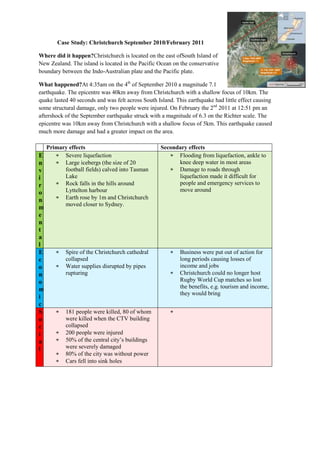
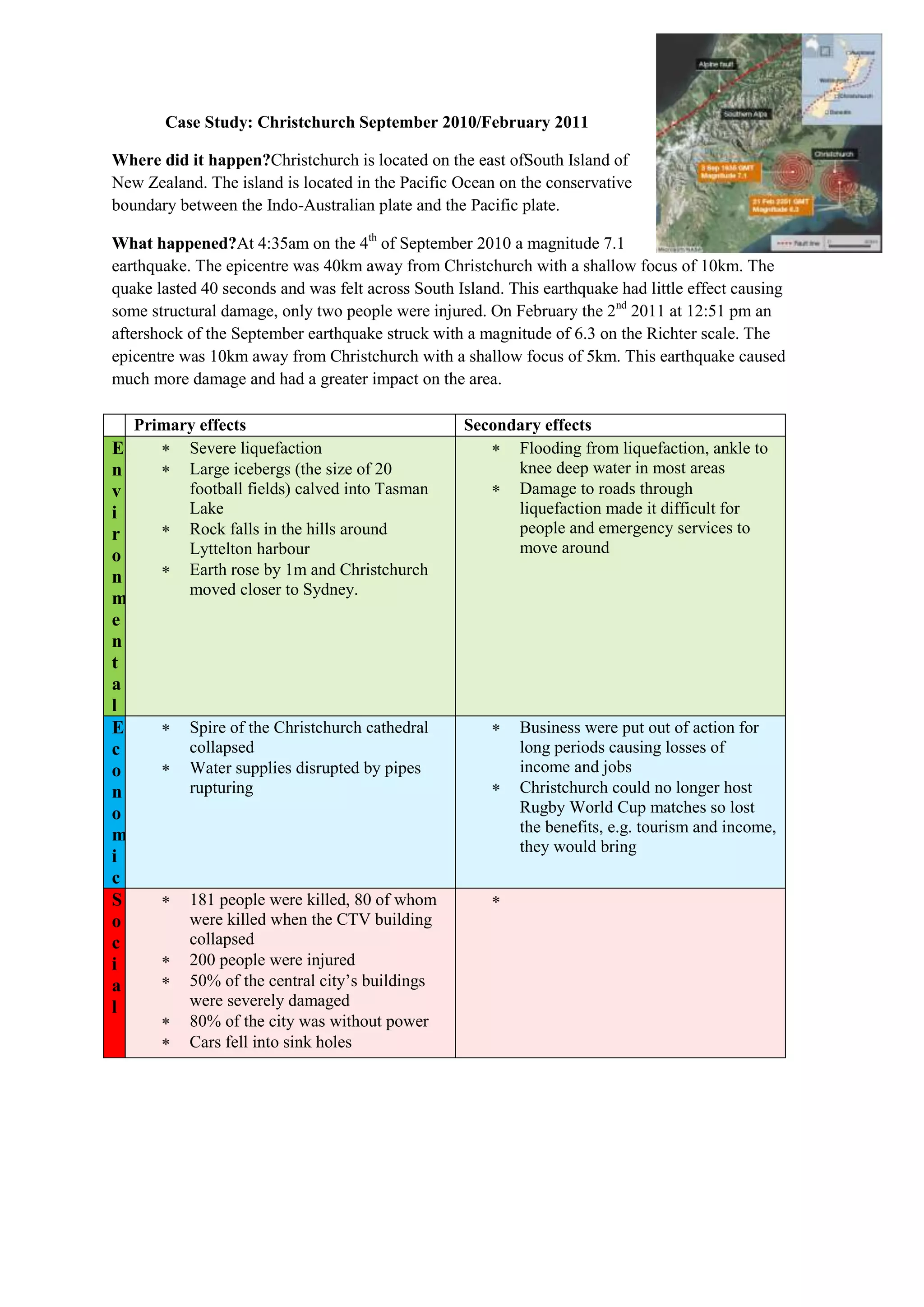
Where did it happen?Christchurch is located on the east ofSouth Island of
New Zealand. The island is located in the Pacific Ocean on the conservative
boundary between the Indo-Australian plate and the Pacific plate.
What happened?At 4:35am on the 4th of September 2010 a magnitude 7.1
earthquake. The epicentre was 40km away from Christchurch with a shallow focus of 10km. The
quake lasted 40 seconds and was felt across South Island. This earthquake had little effect causing
some structural damage, only two people were injured. On February the 2nd 2011 at 12:51 pm an
aftershock of the September earthquake struck with a magnitude of 6.3 on the Richter scale. The
epicentre was 10km away from Christchurch with a shallow focus of 5km. This earthquake caused
much more damage and had a greater impact on the area.

E
n
v
i
r
o
n
m
e
n
t
a
l
E
c
o
n
o
m
i
c
S
o
c
i
a
l

Primary effects
Severe liquefaction
Large icebergs (the size of 20
football fields) calved into Tasman
Lake
Rock falls in the hills around
Lyttelton harbour
Earth rose by 1m and Christchurch
moved closer to Sydney.

Spire of the Christchurch cathedral
collapsed
Water supplies disrupted by pipes
rupturing

181 people were killed, 80 of whom
were killed when the CTV building
collapsed
200 people were injured
50% of the central city’s buildings
were severely damaged
80% of the city was without power
Cars fell into sink holes

Secondary effects
Flooding from liquefaction, ankle to
knee deep water in most areas
Damage to roads through
liquefaction made it difficult for
people and emergency services to
move around

Business were put out of action for
long periods causing losses of
income and jobs
Christchurch could no longer host
Rugby World Cup matches so lost
the benefits, e.g. tourism and income,
they would bring
Immediate responses
Ordinary people helped to rescue those
who were trapped
Urban Search and Rescue was there
within a couple of hours of the event.
Emergency government cabinet meeting
held at 3pm
The Canterbury Art Gallery, which was
earthquake proof, was turned into an
emergency response centre.
300 Australian police were flown in
The police provided security cordons,
organised evacuations, supported search
and rescue teams, missing persons and
family liaison, and organised media
briefings and tours of the affected areas.
Chemical toilets were provided for
30,000 residents
Areas were zoned (green, orange, white,
red) to classify damage/cost of repairs
International aid was provided in the
form of money (around $6-7 million) and
aid workers
The Earthquake commission assessed all
buildings to ensure they were safe.

Long term responses
The Red Cross provided grants to
families with children under 5years of
age who were living in significantly
damaged homes caused by the September
or February earthquakes, with their
electricity bills.
The police coordinated forensic analysis
and evidence gathering of fatalities
working closely with pathologists,
forensic dentists and scientists.
Paid $898 million in building claims
Provided temporary housing and ensured
all damaged housing was kept water tight
Water and sewerage was restored for all
residents by August
Roads and houses were cleared of silt
from liquefaction by August and 80% of
roads/50% of footpaths were repaired

How was the hazard managed? In New Zealand regular earthquake drills are carried out to ensure
people know what to do. Plus all buildings are made life safe ensure that they will not collapse in case
of an earthquake. Any old buildings have been retrofitted to withstand earthquakes
Why did the main shock have so little effect but the aftershock of a smaller magnitude have a
greater effect?The earthquake in September happened in the middle of the night when nobody was
out and about which meant that there was no casualties. Plus, the buildings are earthquake proof
which meant that, although they were weakened, they did not collapse and kill people as they slept.
The earthquake in February happened in the middle of the day when everyone was at work of having
lunch. This meant that when the buildings collapsed there were lots of people around. Also, many
buildings had been weakened by the previous earthquake which meant that they were more likely to
collapse, and in many cases they did. There was some controversy over buildings that had been
declared safe after the main earthquake collapsing in February.

Christchurch earthquake case study

  • 1.
    Case Study: ChristchurchSeptember 2010/February 2011 Where did it happen?Christchurch is located on the east ofSouth Island of New Zealand. The island is located in the Pacific Ocean on the conservative boundary between the Indo-Australian plate and the Pacific plate. What happened?At 4:35am on the 4th of September 2010 a magnitude 7.1 earthquake. The epicentre was 40km away from Christchurch with a shallow focus of 10km. The quake lasted 40 seconds and was felt across South Island. This earthquake had little effect causing some structural damage, only two people were injured. On February the 2nd 2011 at 12:51 pm an aftershock of the September earthquake struck with a magnitude of 6.3 on the Richter scale. The epicentre was 10km away from Christchurch with a shallow focus of 5km. This earthquake caused much more damage and had a greater impact on the area. E n v i r o n m e n t a l E c o n o m i c S o c i a l Primary effects Severe liquefaction Large icebergs (the size of 20 football fields) calved into Tasman Lake Rock falls in the hills around Lyttelton harbour Earth rose by 1m and Christchurch moved closer to Sydney. Spire of the Christchurch cathedral collapsed Water supplies disrupted by pipes rupturing 181 people were killed, 80 of whom were killed when the CTV building collapsed 200 people were injured 50% of the central city’s buildings were severely damaged 80% of the city was without power Cars fell into sink holes Secondary effects Flooding from liquefaction, ankle to knee deep water in most areas Damage to roads through liquefaction made it difficult for people and emergency services to move around Business were put out of action for long periods causing losses of income and jobs Christchurch could no longer host Rugby World Cup matches so lost the benefits, e.g. tourism and income, they would bring
  • 2.
    Immediate responses Ordinary peoplehelped to rescue those who were trapped Urban Search and Rescue was there within a couple of hours of the event. Emergency government cabinet meeting held at 3pm The Canterbury Art Gallery, which was earthquake proof, was turned into an emergency response centre. 300 Australian police were flown in The police provided security cordons, organised evacuations, supported search and rescue teams, missing persons and family liaison, and organised media briefings and tours of the affected areas. Chemical toilets were provided for 30,000 residents Areas were zoned (green, orange, white, red) to classify damage/cost of repairs International aid was provided in the form of money (around $6-7 million) and aid workers The Earthquake commission assessed all buildings to ensure they were safe. Long term responses The Red Cross provided grants to families with children under 5years of age who were living in significantly damaged homes caused by the September or February earthquakes, with their electricity bills. The police coordinated forensic analysis and evidence gathering of fatalities working closely with pathologists, forensic dentists and scientists. Paid $898 million in building claims Provided temporary housing and ensured all damaged housing was kept water tight Water and sewerage was restored for all residents by August Roads and houses were cleared of silt from liquefaction by August and 80% of roads/50% of footpaths were repaired How was the hazard managed? In New Zealand regular earthquake drills are carried out to ensure people know what to do. Plus all buildings are made life safe ensure that they will not collapse in case of an earthquake. Any old buildings have been retrofitted to withstand earthquakes Why did the main shock have so little effect but the aftershock of a smaller magnitude have a greater effect?The earthquake in September happened in the middle of the night when nobody was out and about which meant that there was no casualties. Plus, the buildings are earthquake proof which meant that, although they were weakened, they did not collapse and kill people as they slept. The earthquake in February happened in the middle of the day when everyone was at work of having lunch. This meant that when the buildings collapsed there were lots of people around. Also, many buildings had been weakened by the previous earthquake which meant that they were more likely to collapse, and in many cases they did. There was some controversy over buildings that had been declared safe after the main earthquake collapsing in February.