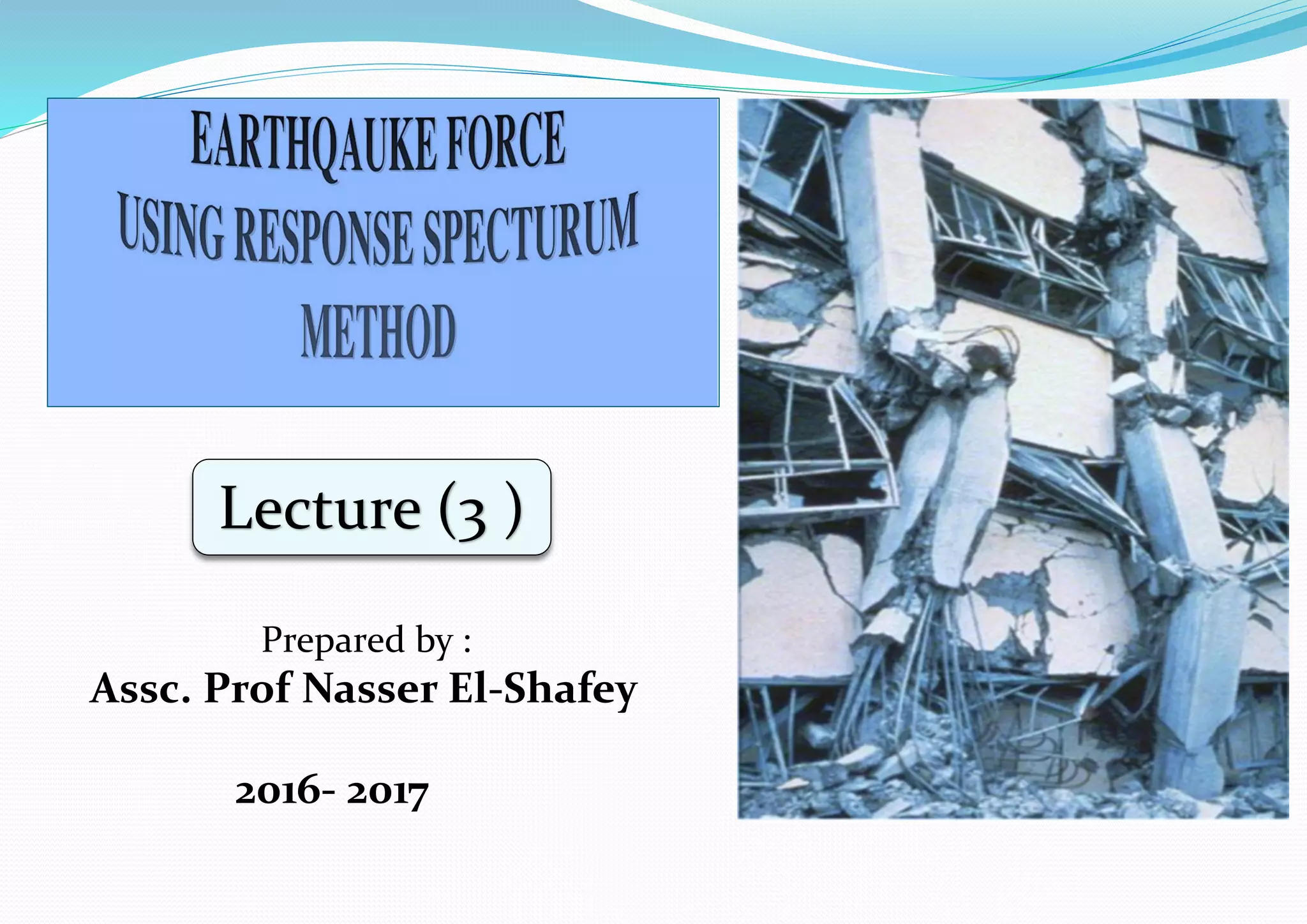
Lecture (3 )
Prepared by :
Assc. Prof Nasser El-Shafey
2016- 2017
When loose, saturated sands, silts, or gravel shaken, the
material consolidates, reducing the porosity and increasing
pore water pressure. The ground settles, often unevenly,
tilting and toppling structures that were formerly supported
by the soil
Liquefaction can cause problems as soil loses it’s ability to
resist shear and flows much like quick sand. Anything
relying on the substrata for support can shift, tilt, rupture, or
collapse.
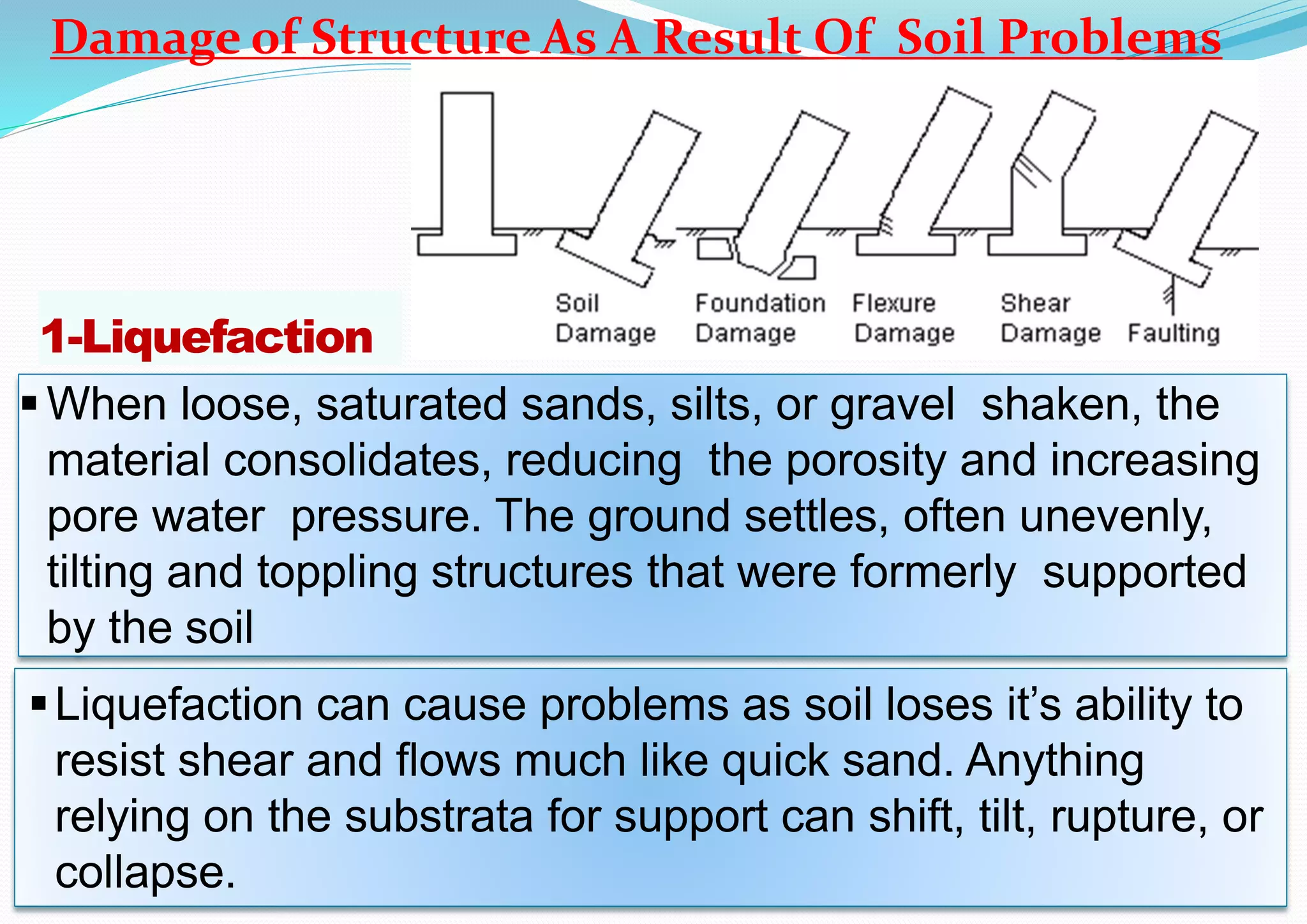
1-Liquefaction
Damage of Structure As A Result Of Soil Problems
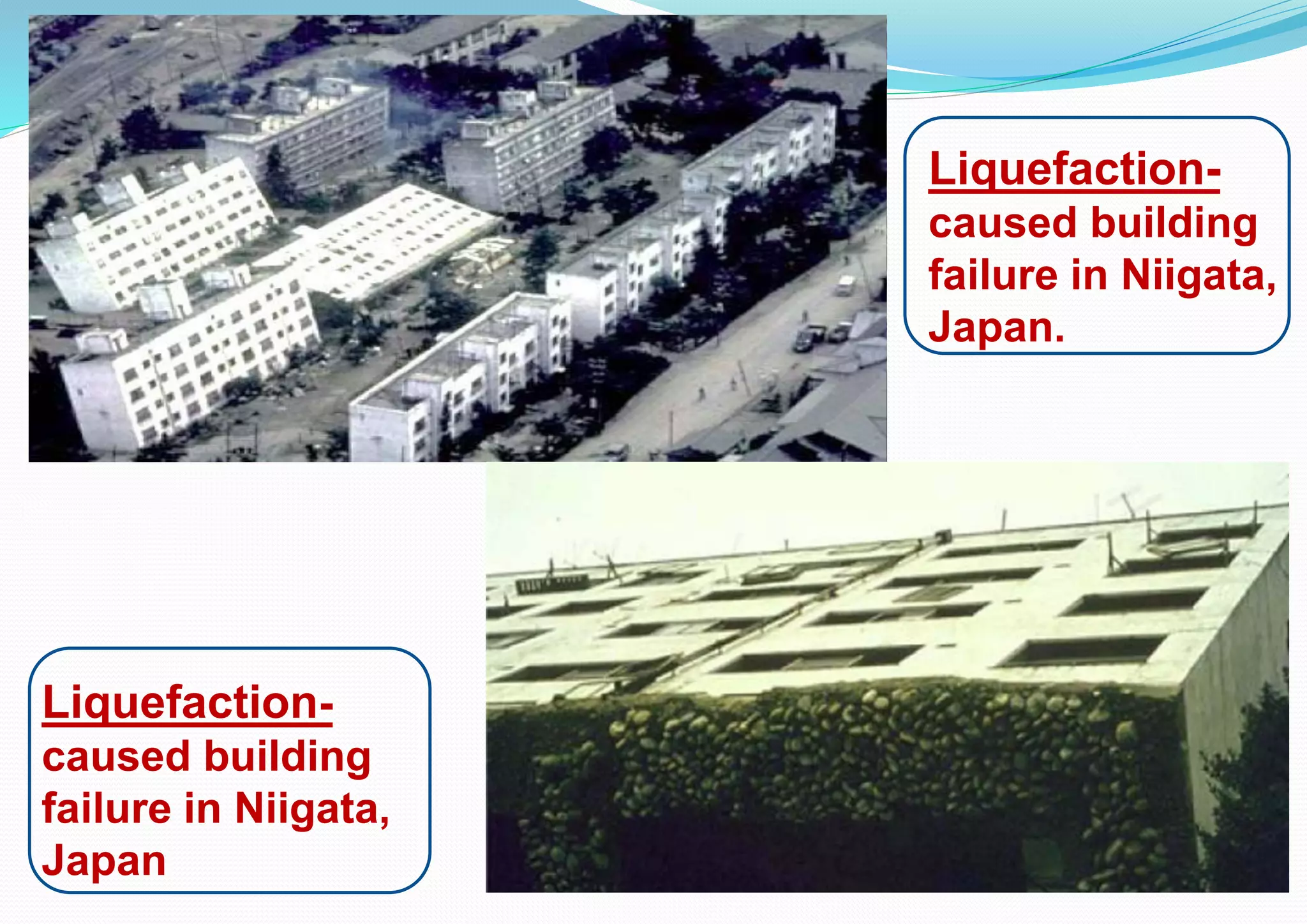
Liquefaction-
caused building
failure in Niigata,
Japan.
Liquefaction-
caused building
failure in Niigata,
Japan
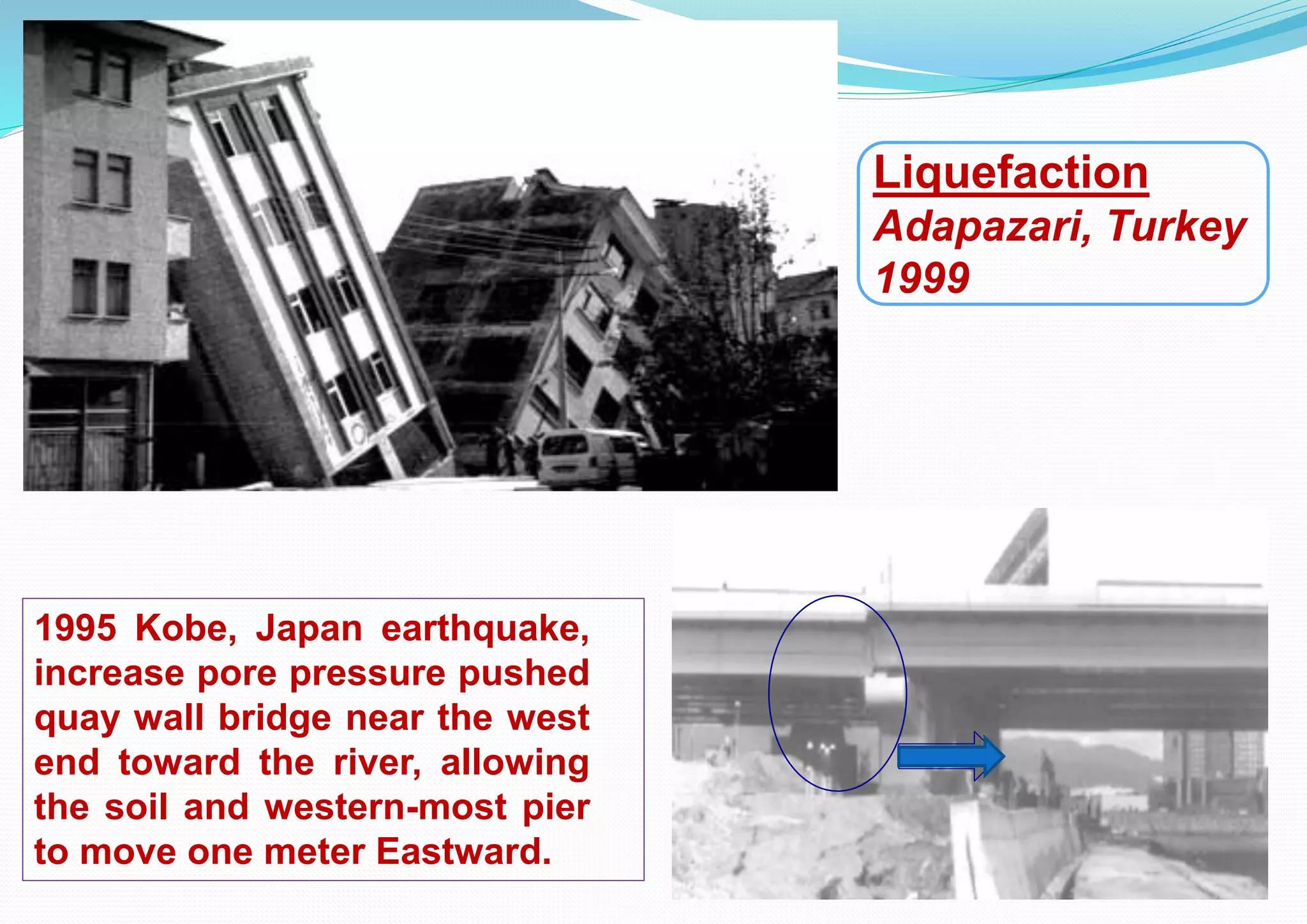
Liquefaction
Adapazari, Turkey
1999
1995 Kobe, Japan earthquake,
increase pore pressure pushed
quay wall bridge near the west
end toward the river, allowing
the soil and western-most pier
to move one meter Eastward.
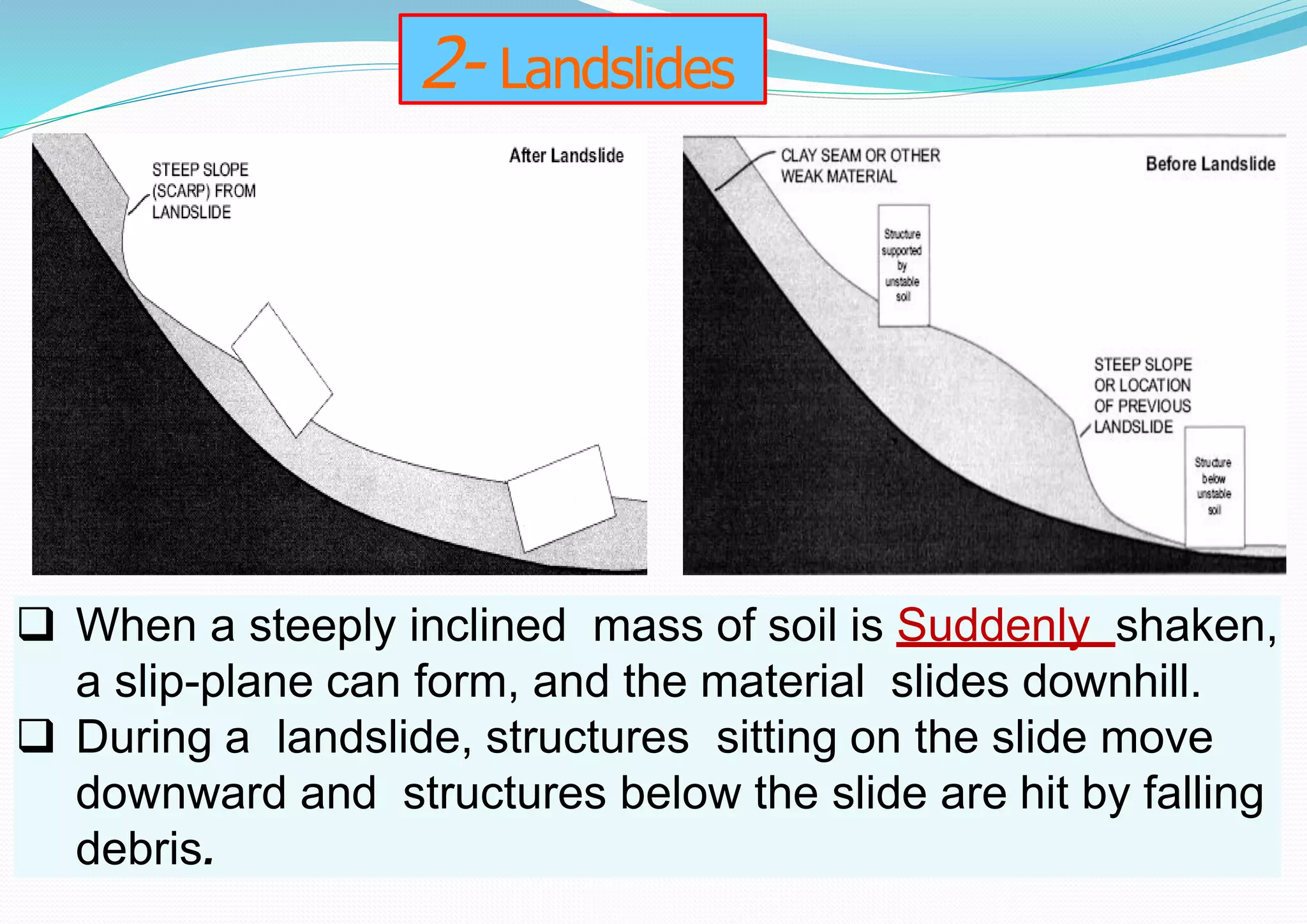
2- Landslides
 When a steeply inclined mass of soil is Suddenly shaken,
a slip-plane can form, and the material slides downhill.
 During a landslide, structures sitting on the slide move
downward and structures below the slide are hit by falling
debris.
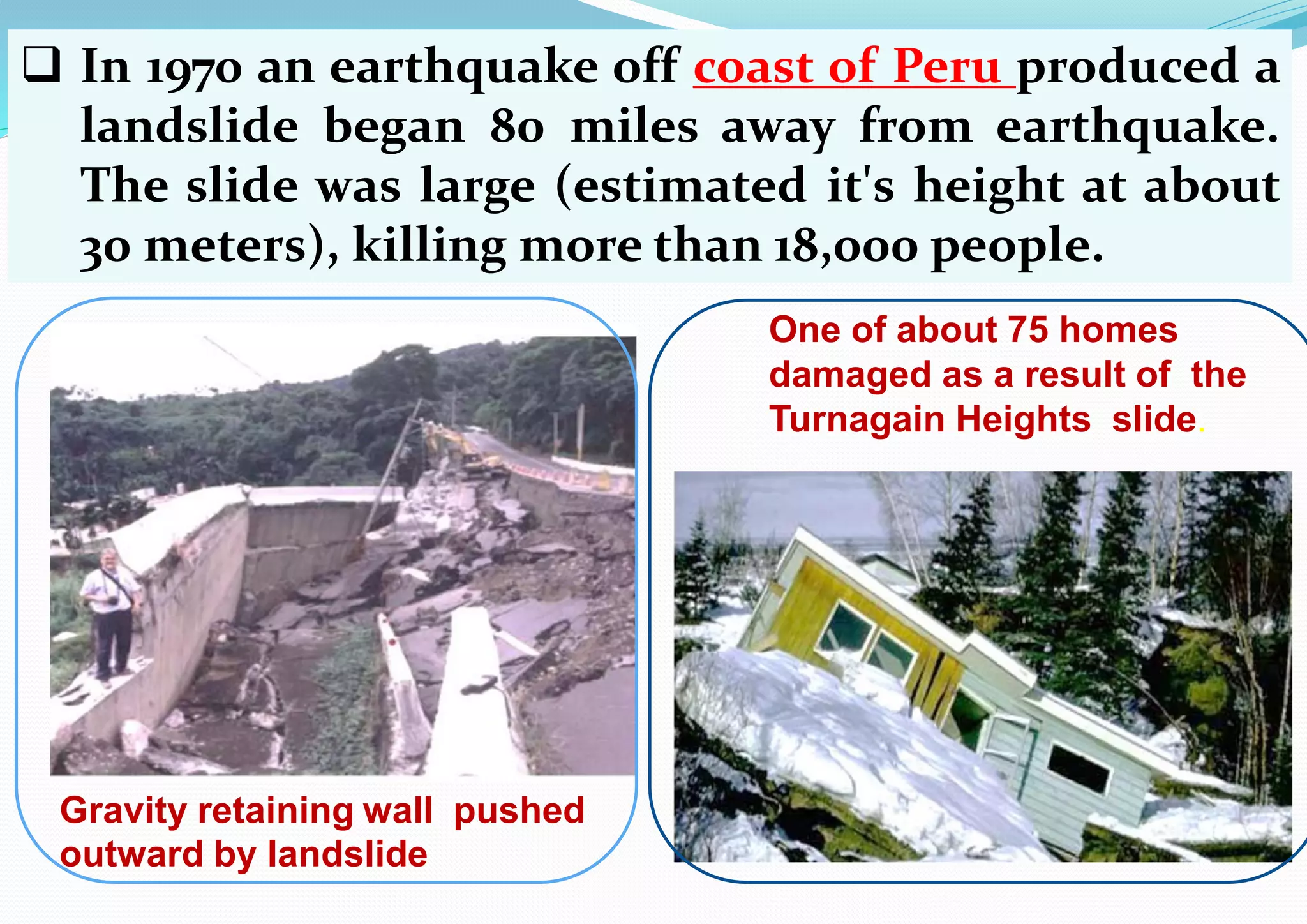
 In 1970 an earthquake off coast of Peru produced a
landslide began 80 miles away from earthquake.
The slide was large (estimated it's height at about
30 meters), killing more than 18,000 people.
Gravity retaining wall pushed
outward by landslide
One of about 75 homes
damaged as a result of the
Turnagain Heights slide.
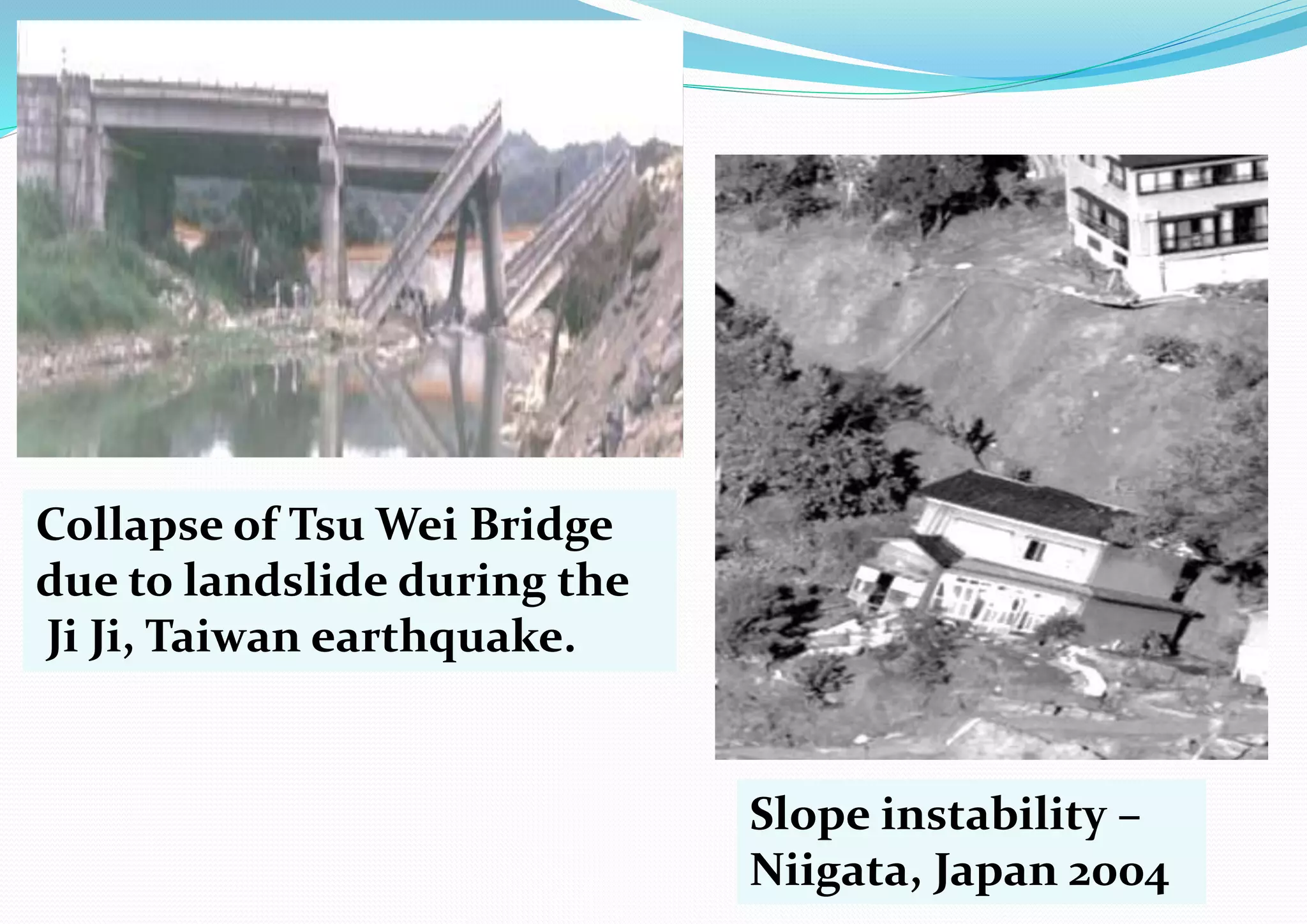
Collapse of Tsu Wei Bridge
due to landslide during the
Ji Ji, Taiwan earthquake.
Slope instability –
Niigata, Japan 2004
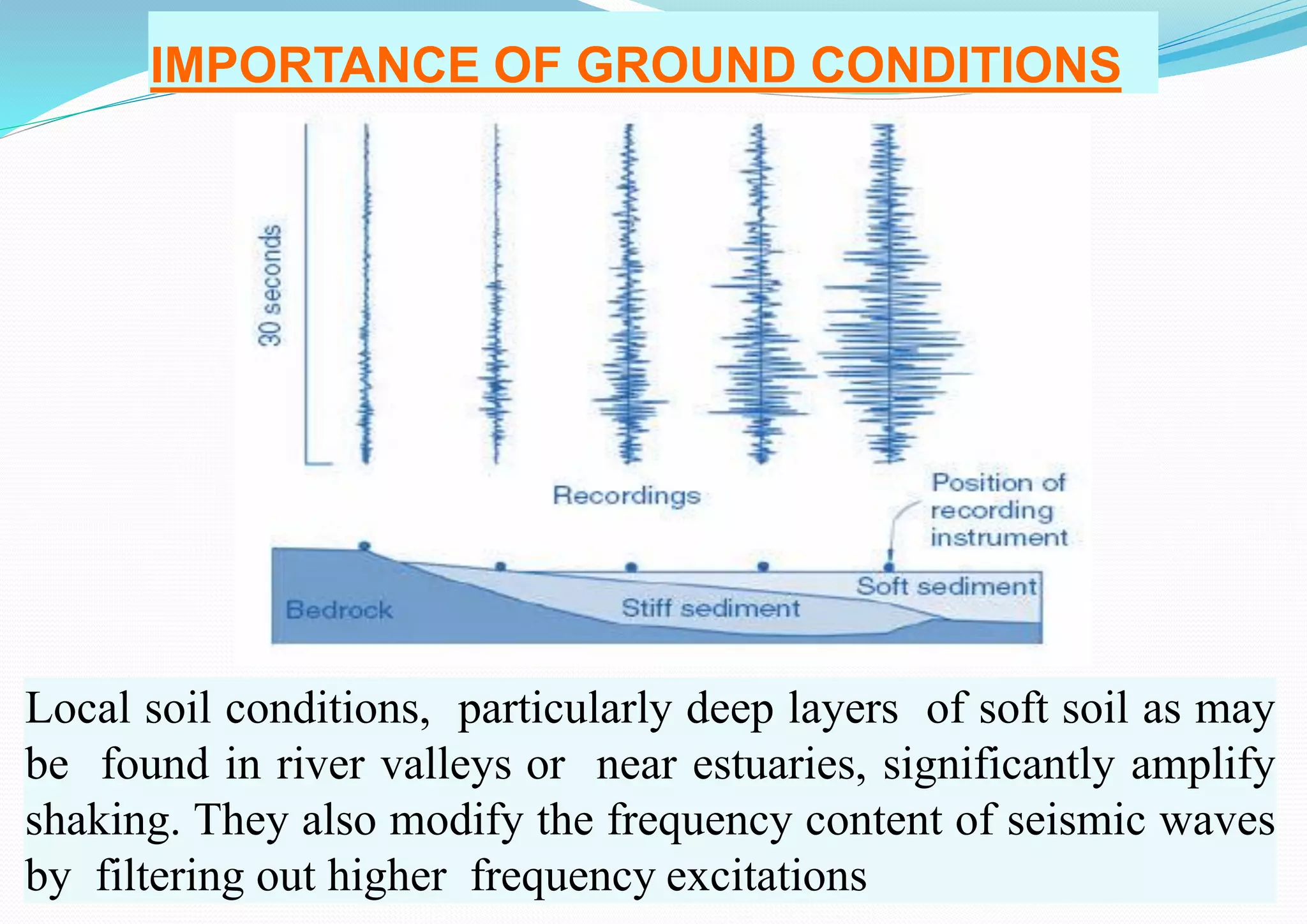
IMPORTANCE OF GROUND CONDITIONS
Local soil conditions, particularly deep layers of soft soil as may
be found in river valleys or near estuaries, significantly amplify
shaking. They also modify the frequency content of seismic waves
by filtering out higher frequency excitations
DAMAGE AS A RESULT OF STRUCTURAL PROBLEMS
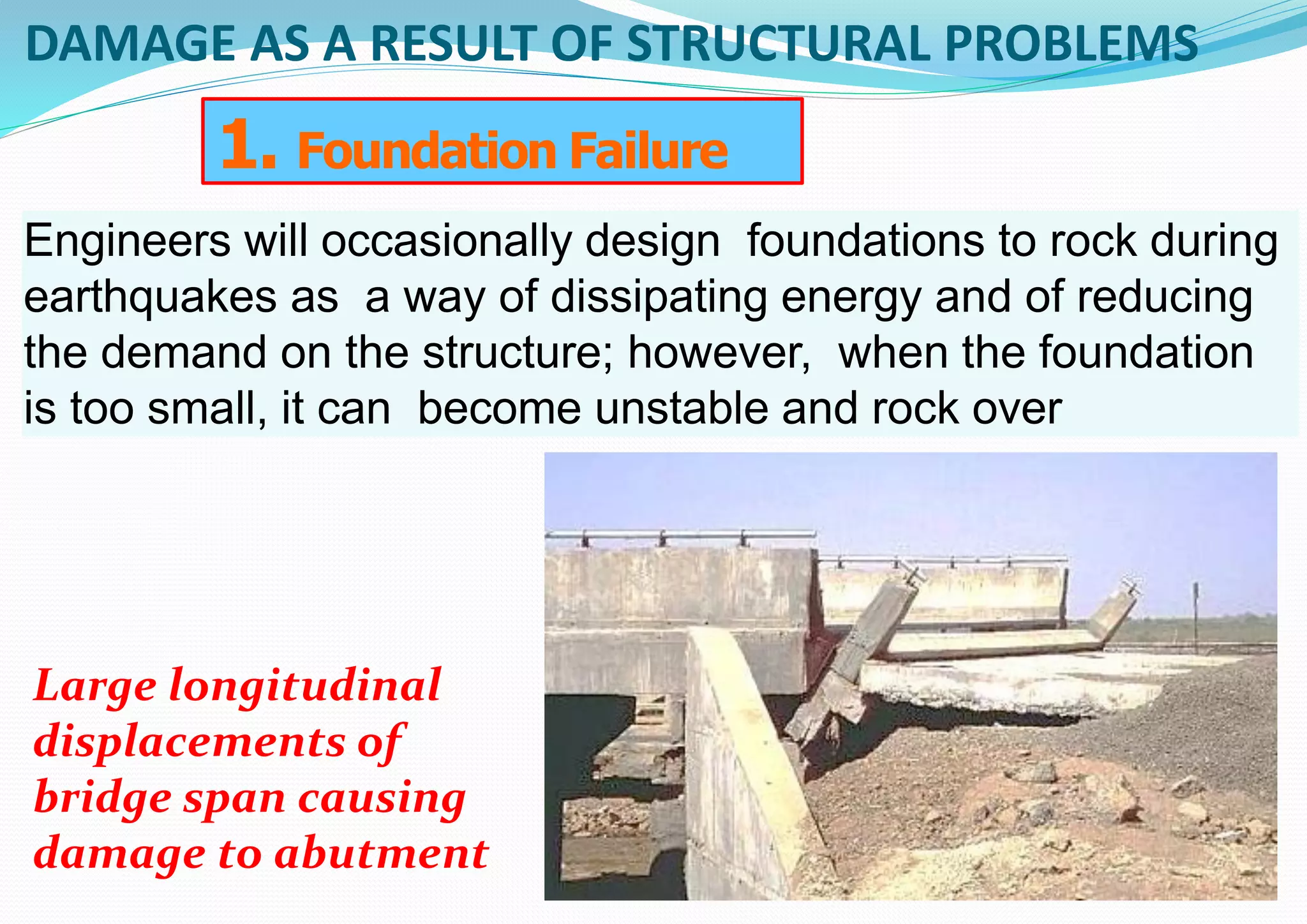
Engineers will occasionally design foundations to rock during
earthquakes as a way of dissipating energy and of reducing
the demand on the structure; however, when the foundation
is too small, it can become unstable and rock over
1. Foundation Failure
Large longitudinal
displacements of
bridge span causing
damage to abutment
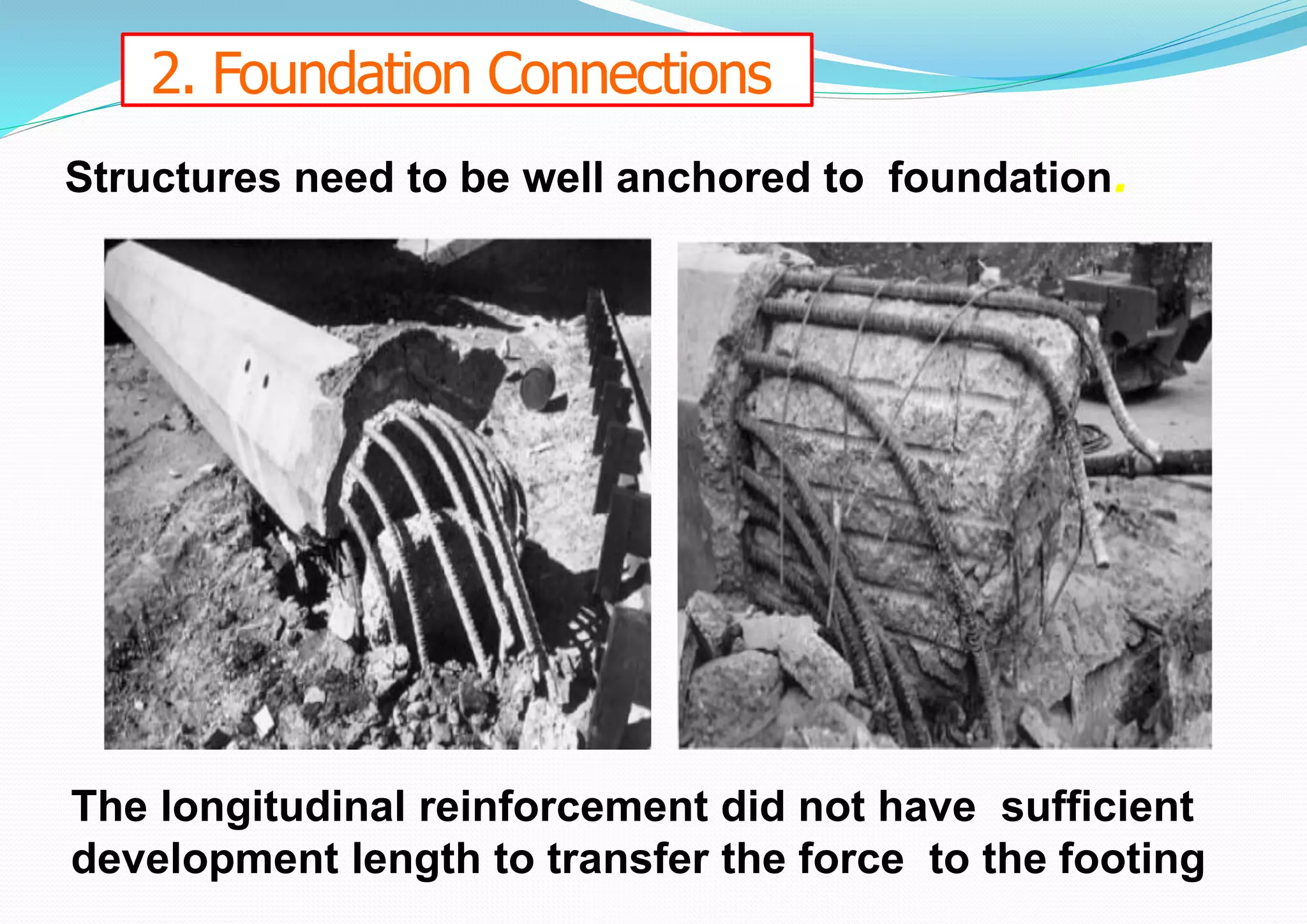
2. Foundation Connections
Structures need to be well anchored to foundation.
The longitudinal reinforcement did not have sufficient
development length to transfer the force to the footing
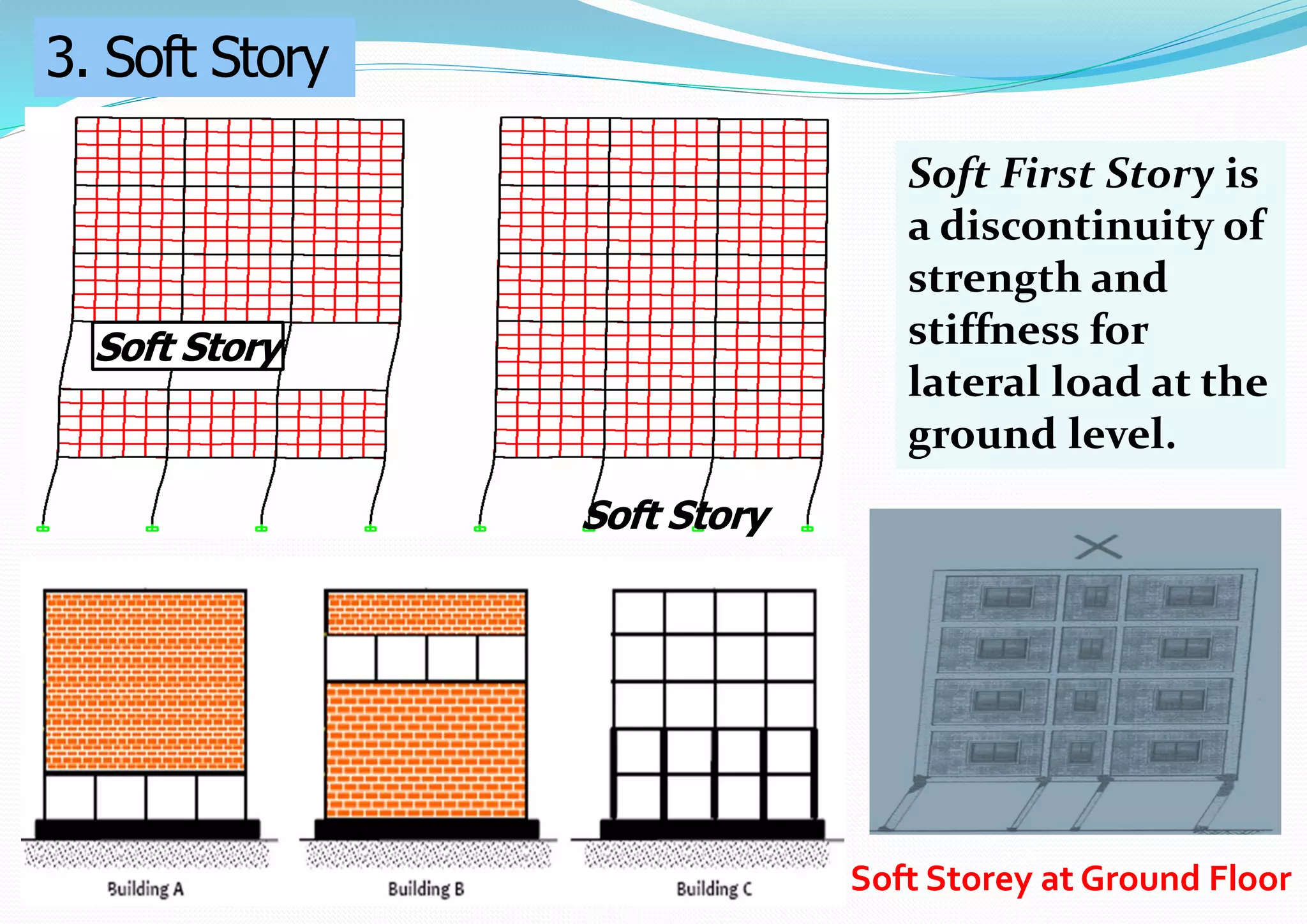
Soft Story
Soft Story
Soft First Story is
a discontinuity of
strength and
stiffness for
lateral load at the
ground level.
3. Soft Story
Soft Storey at Ground Floor
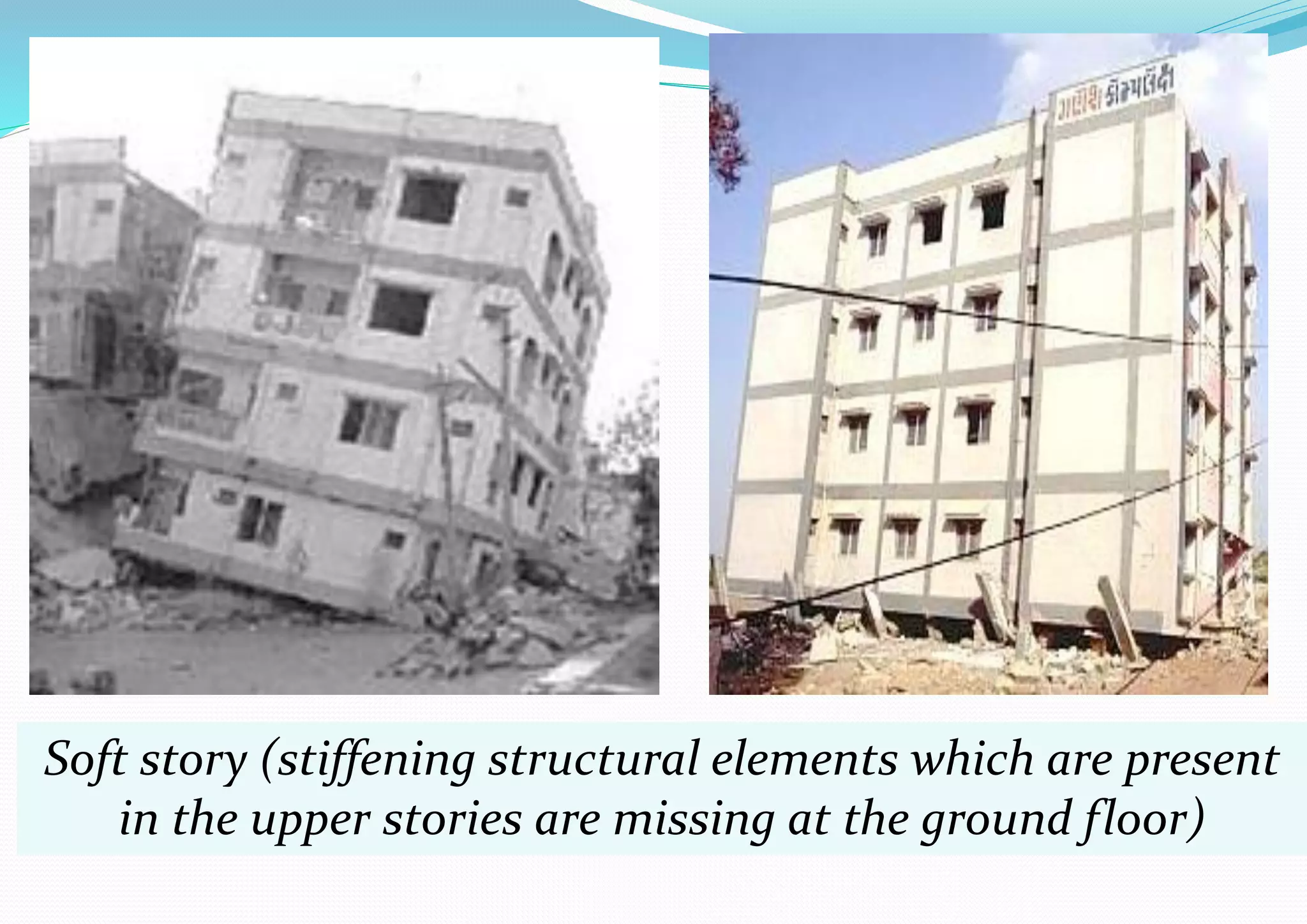
Soft story (stiffening structural elements which are present
in the upper stories are missing at the ground floor)
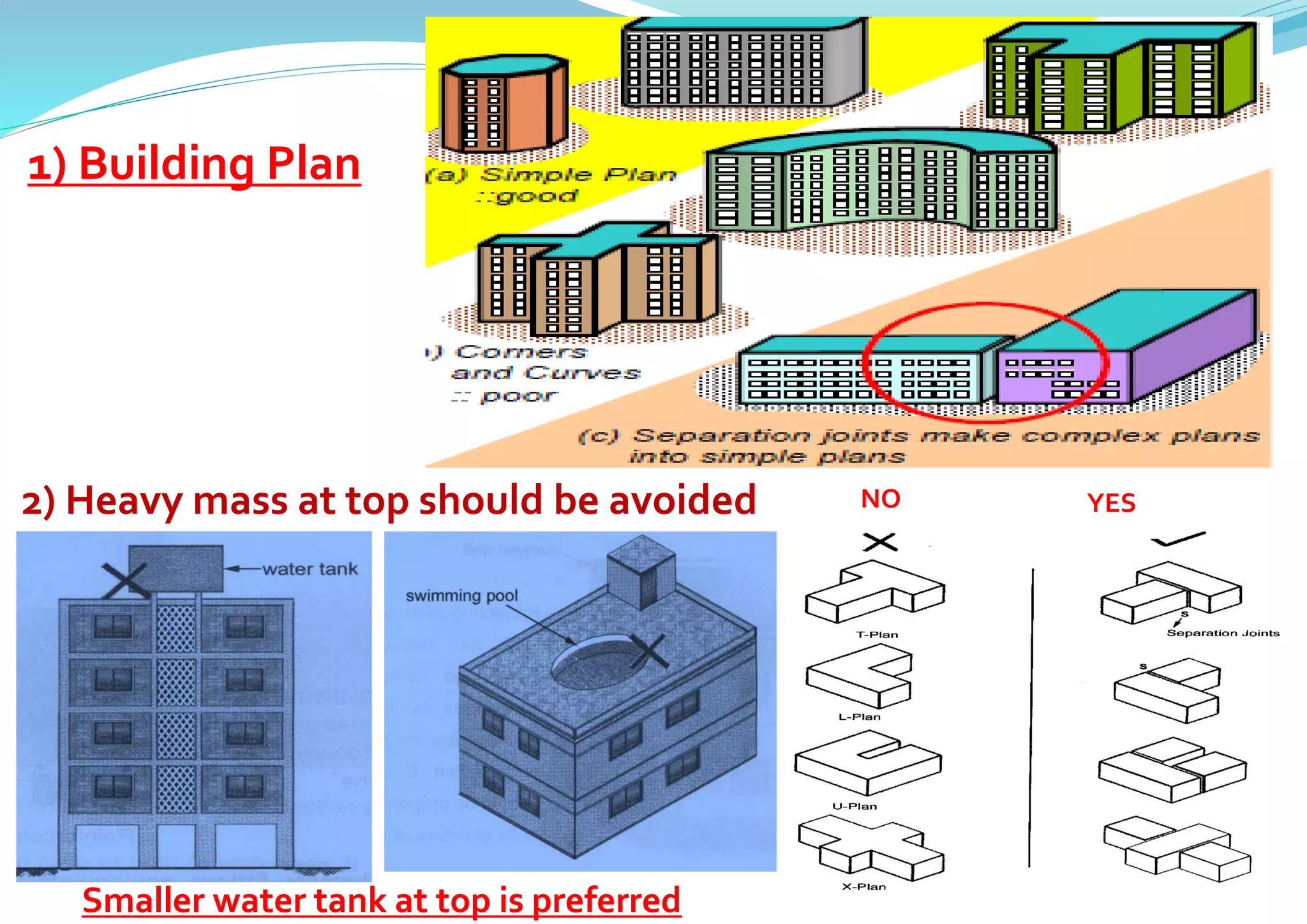
1) Building Plan
2) Heavy mass at top should be avoided
Smaller water tank at top is preferred
NO YES
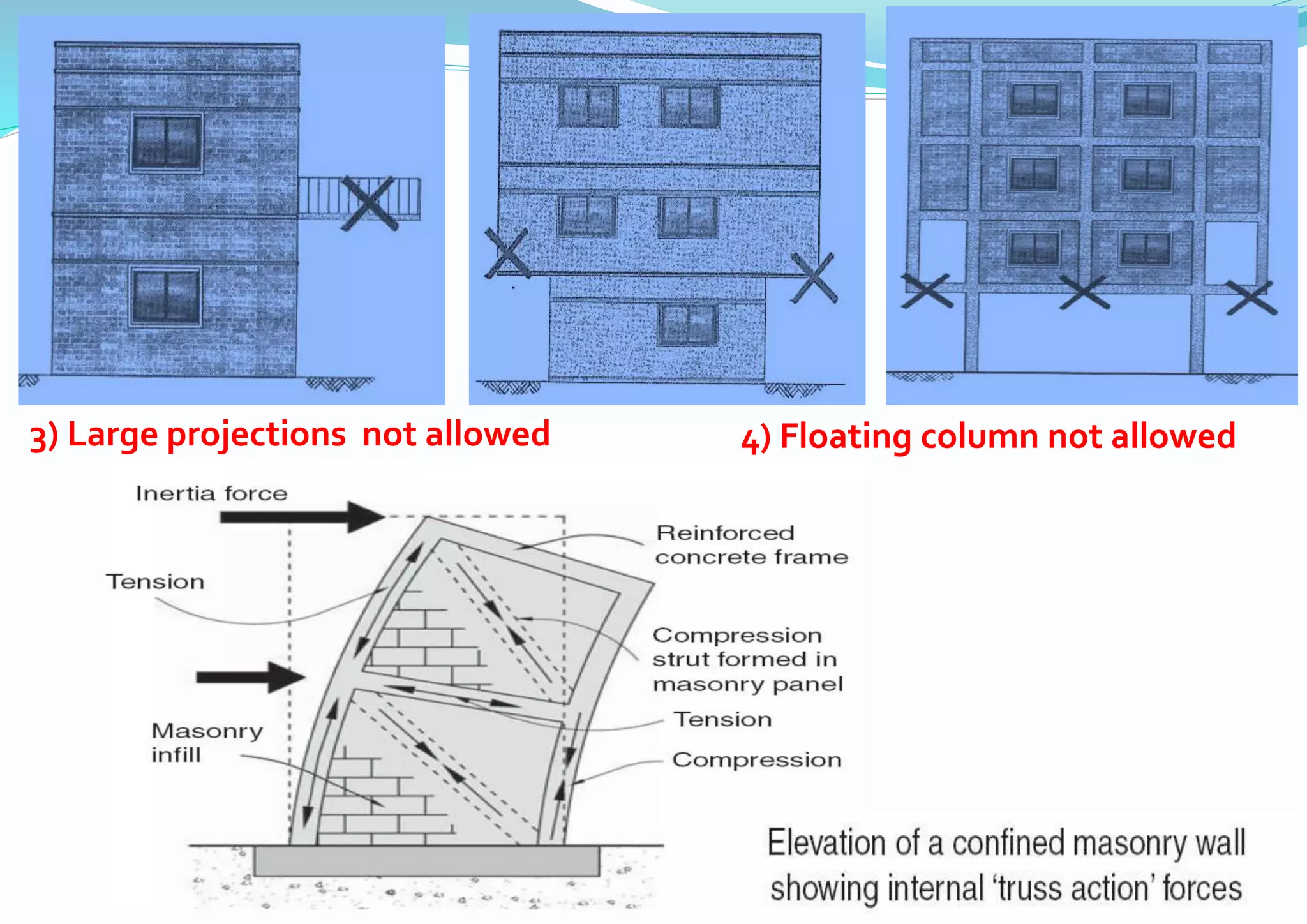
3) Large projections not allowed 4) Floating column not allowed
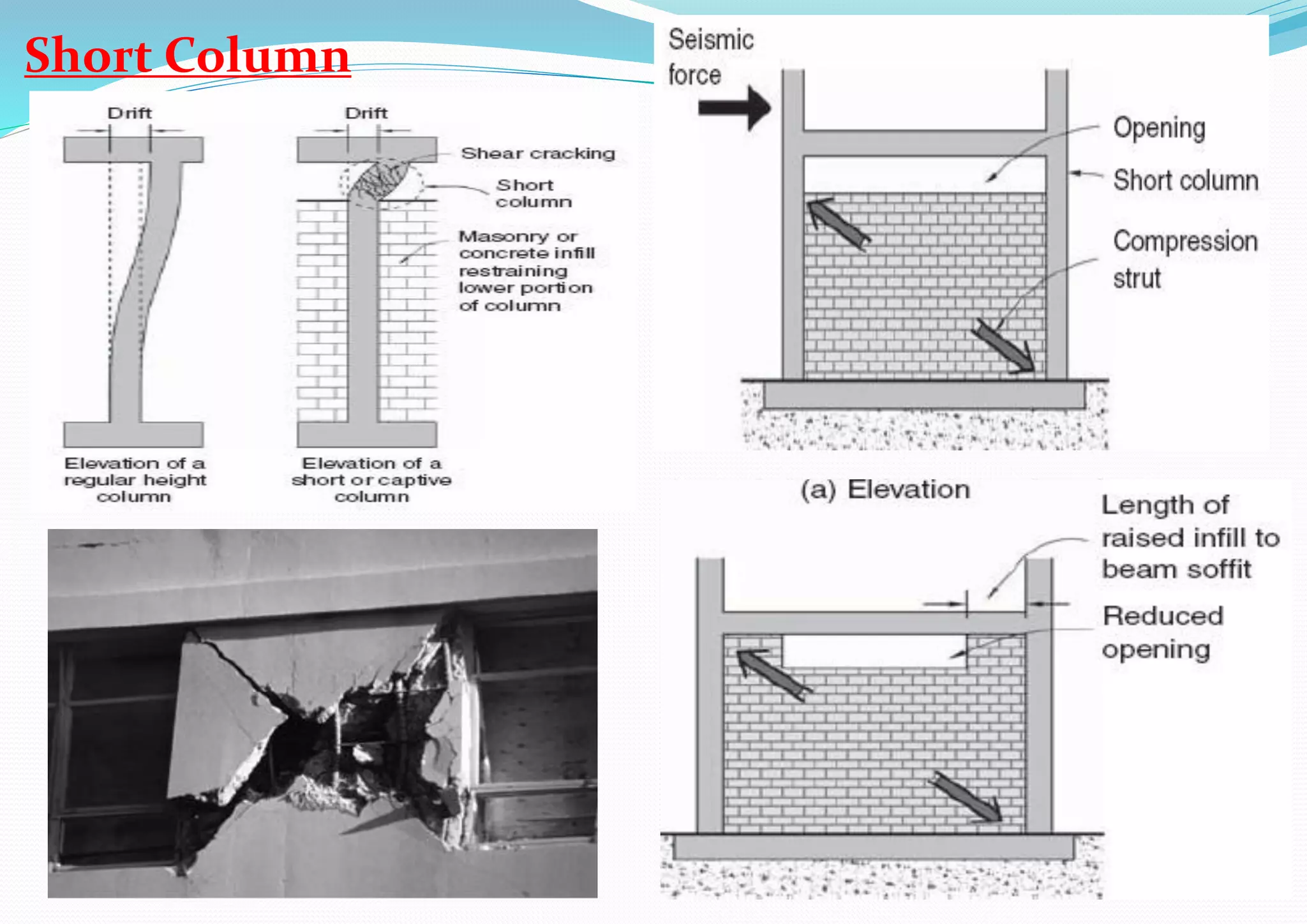
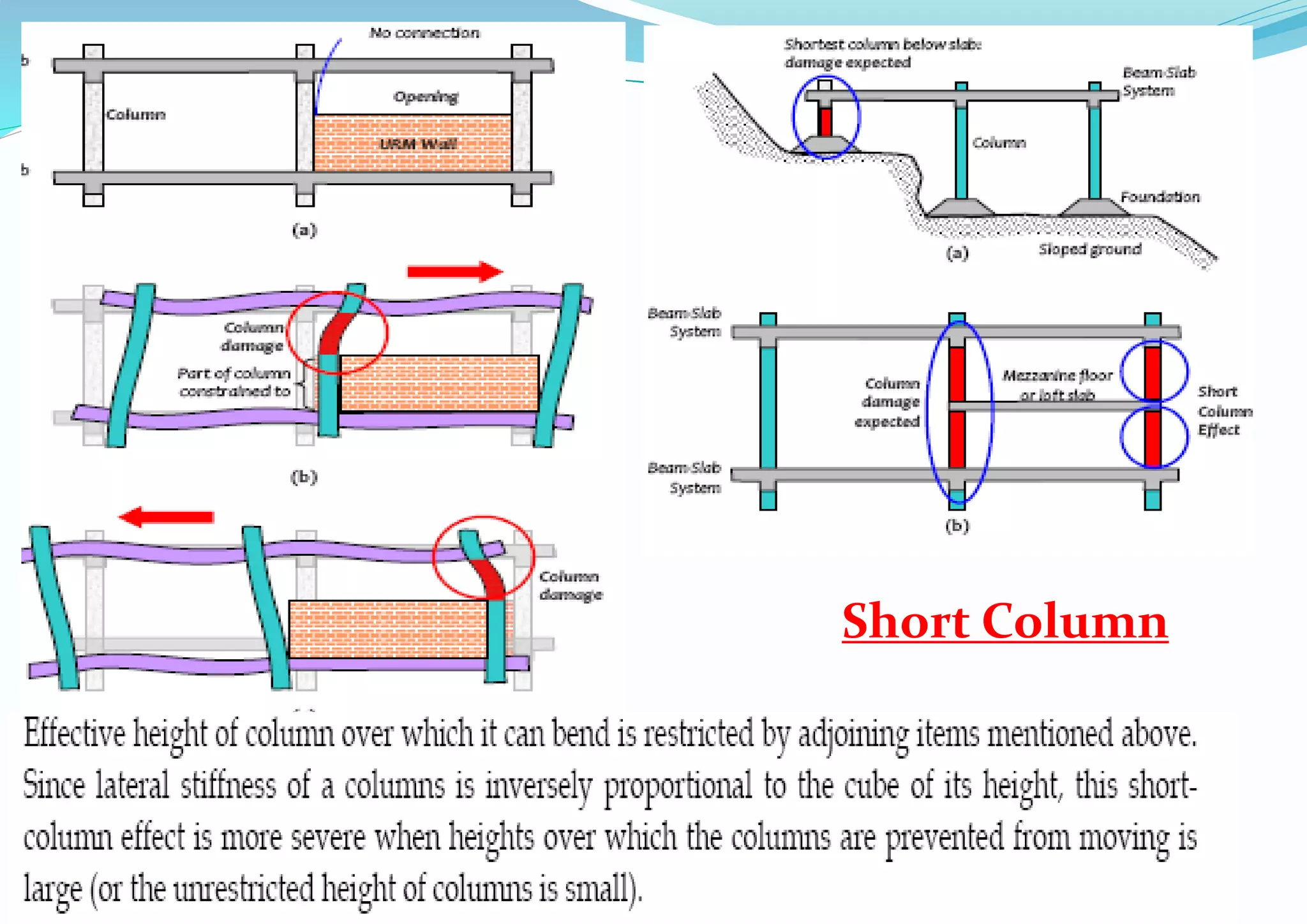
Short Column
Short Column
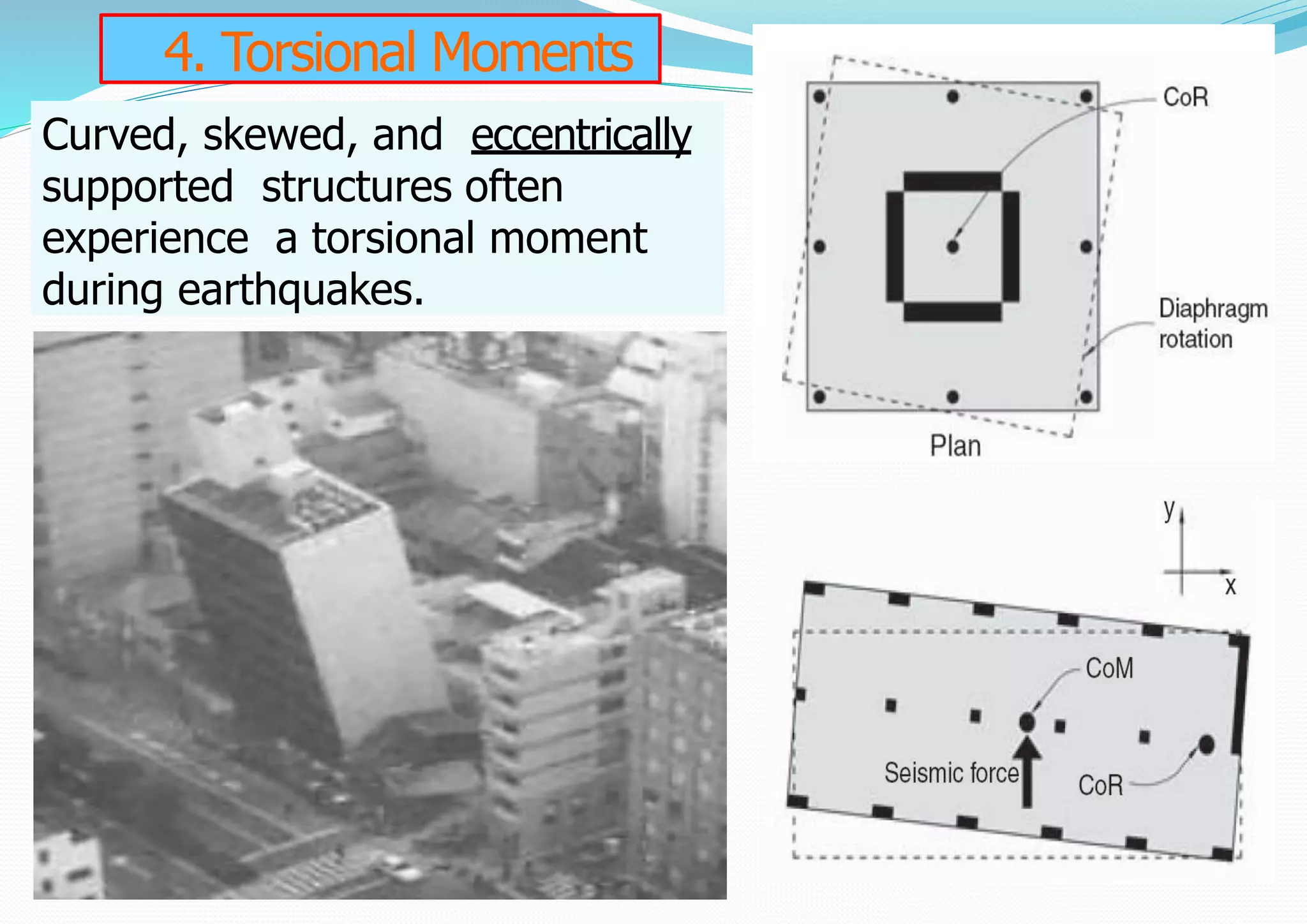
4. Torsional Moments
Curved, skewed, and eccentrically
supported structures often
experience a torsional moment
during earthquakes.
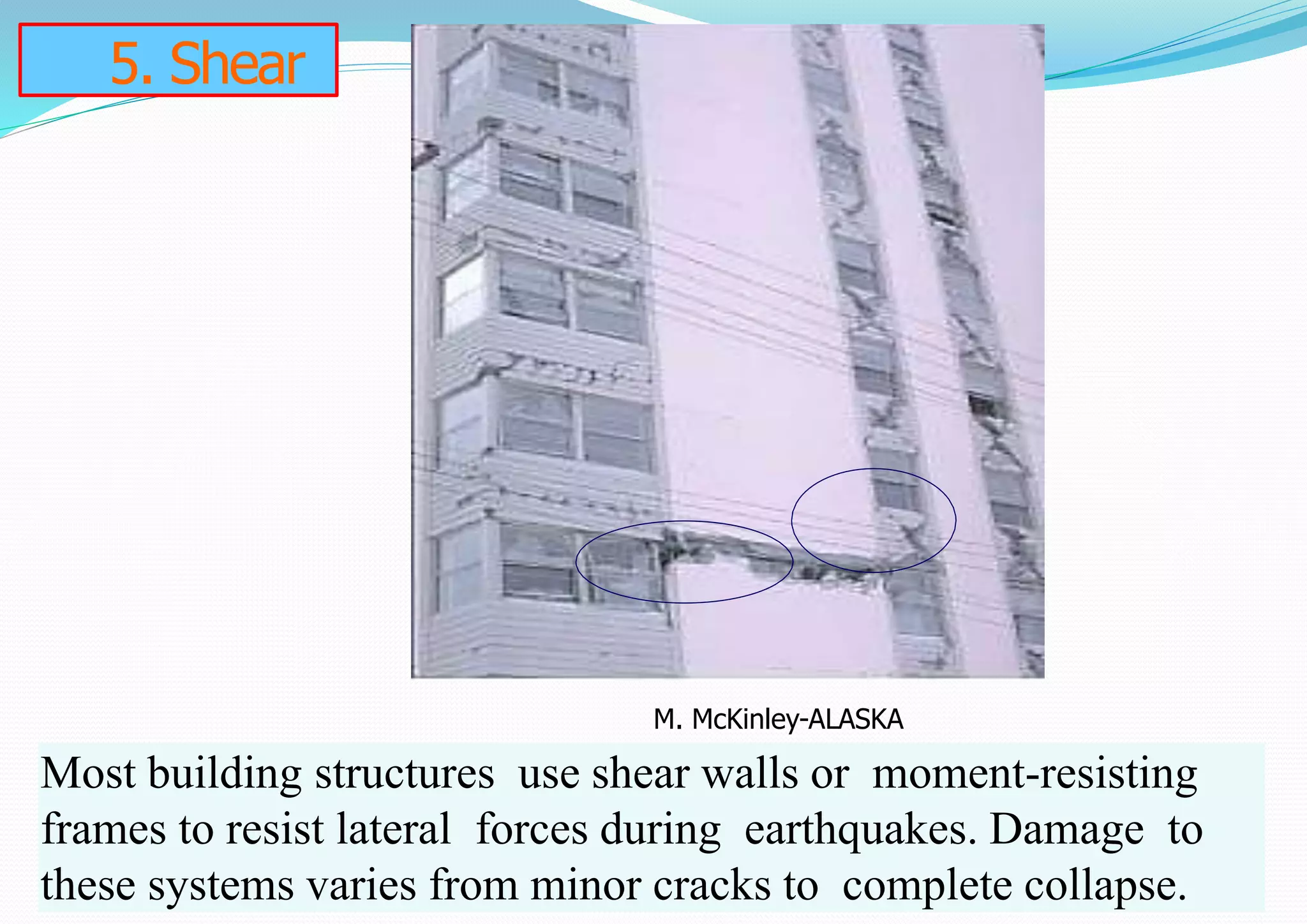
5. Shear
Most building structures use shear walls or moment-resisting
frames to resist lateral forces during earthquakes. Damage to
these systems varies from minor cracks to complete collapse.
M. McKinley-ALASKA
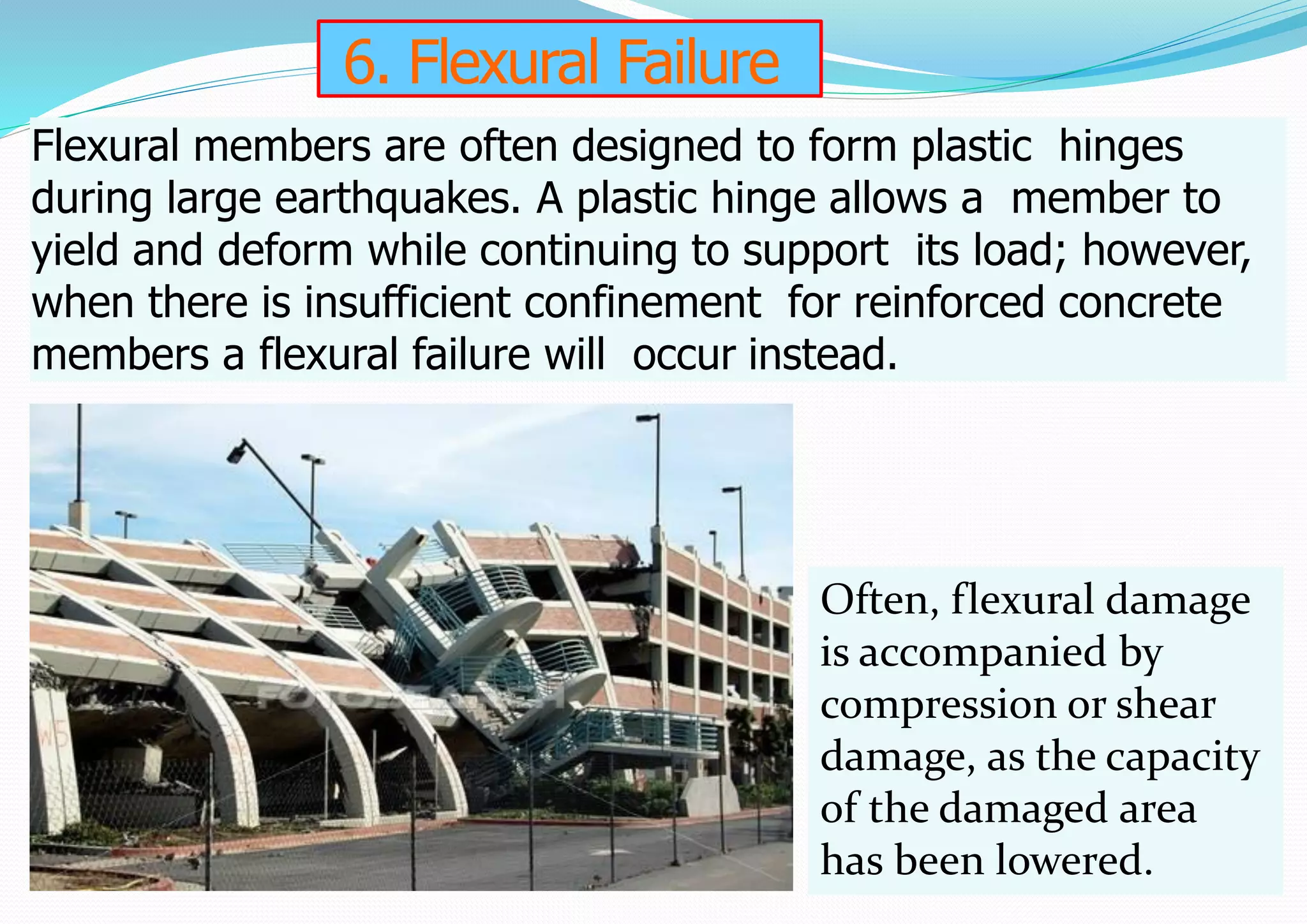
6. Flexural Failure
Flexural members are often designed to form plastic hinges
during large earthquakes. A plastic hinge allows a member to
yield and deform while continuing to support its load; however,
when there is insufficient confinement for reinforced concrete
members a flexural failure will occur instead.
Often, flexural damage
is accompanied by
compression or shear
damage, as the capacity
of the damaged area
has been lowered.
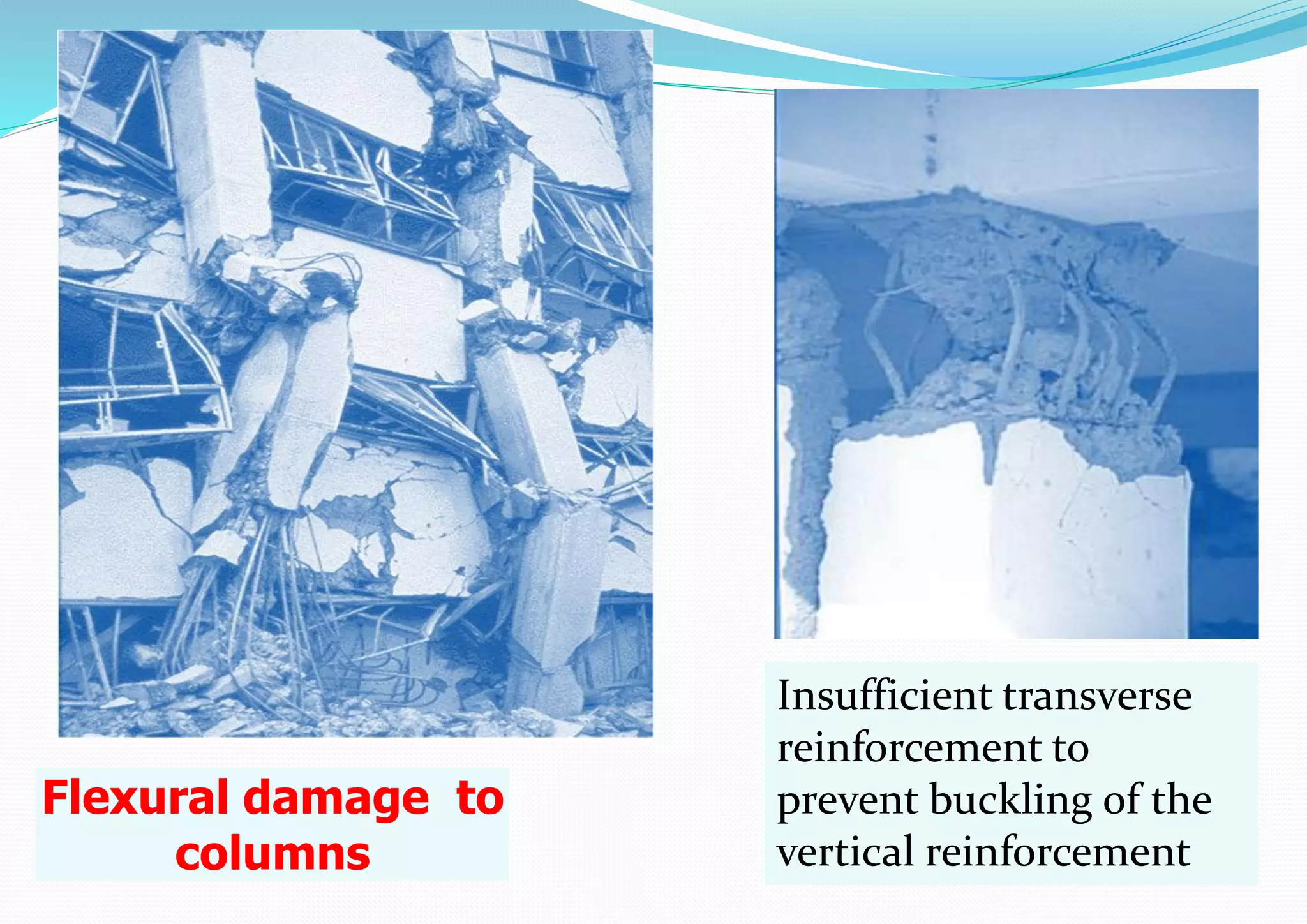
Flexural damage to
columns
Insufficient transverse
reinforcement to
prevent buckling of the
vertical reinforcement
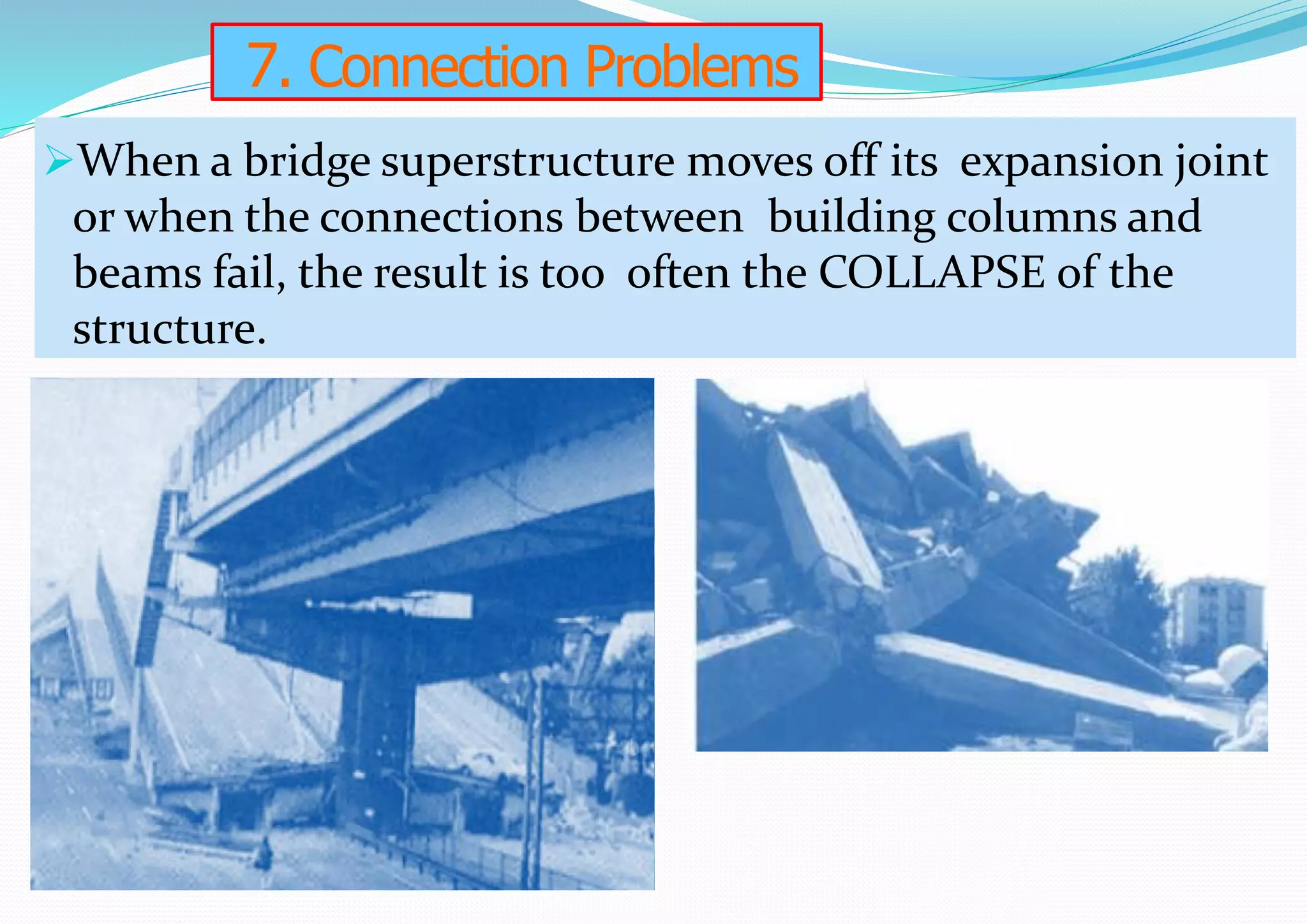
7. Connection Problems
When a bridge superstructure moves off its expansion joint
or when the connections between building columns and
beams fail, the result is too often the COLLAPSE of the
structure.
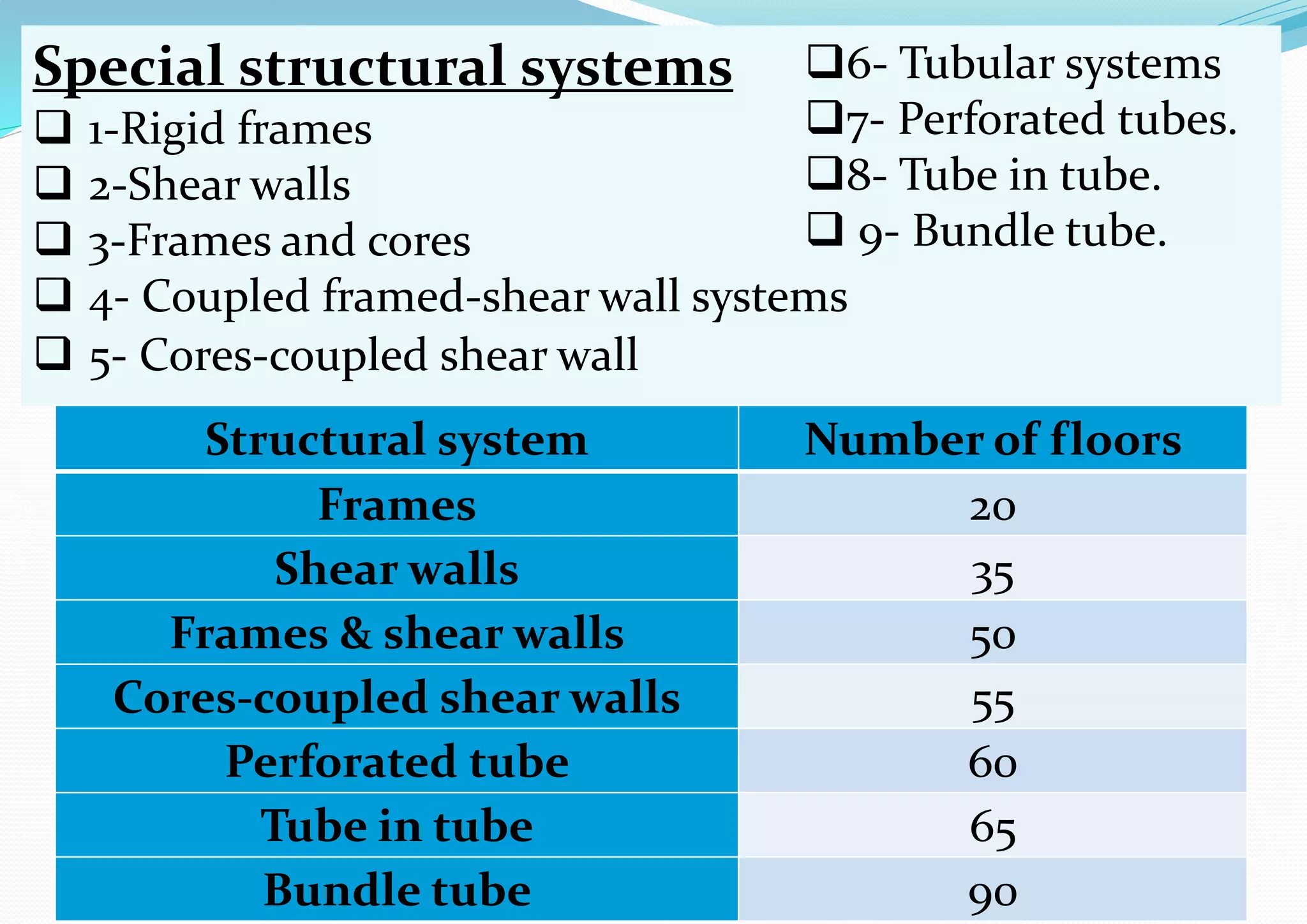
Special structural systems
 1-Rigid frames
 2-Shear walls
 3-Frames and cores
 4- Coupled framed-shear wall systems
 5- Cores-coupled shear wall
6- Tubular systems
7- Perforated tubes.
8- Tube in tube.
 9- Bundle tube.
Structural system Number of floors
Frames 20
Shear walls 35
Frames & shear walls 50
Cores-coupled shear walls 55
Perforated tube 60
Tube in tube 65
Bundle tube 90
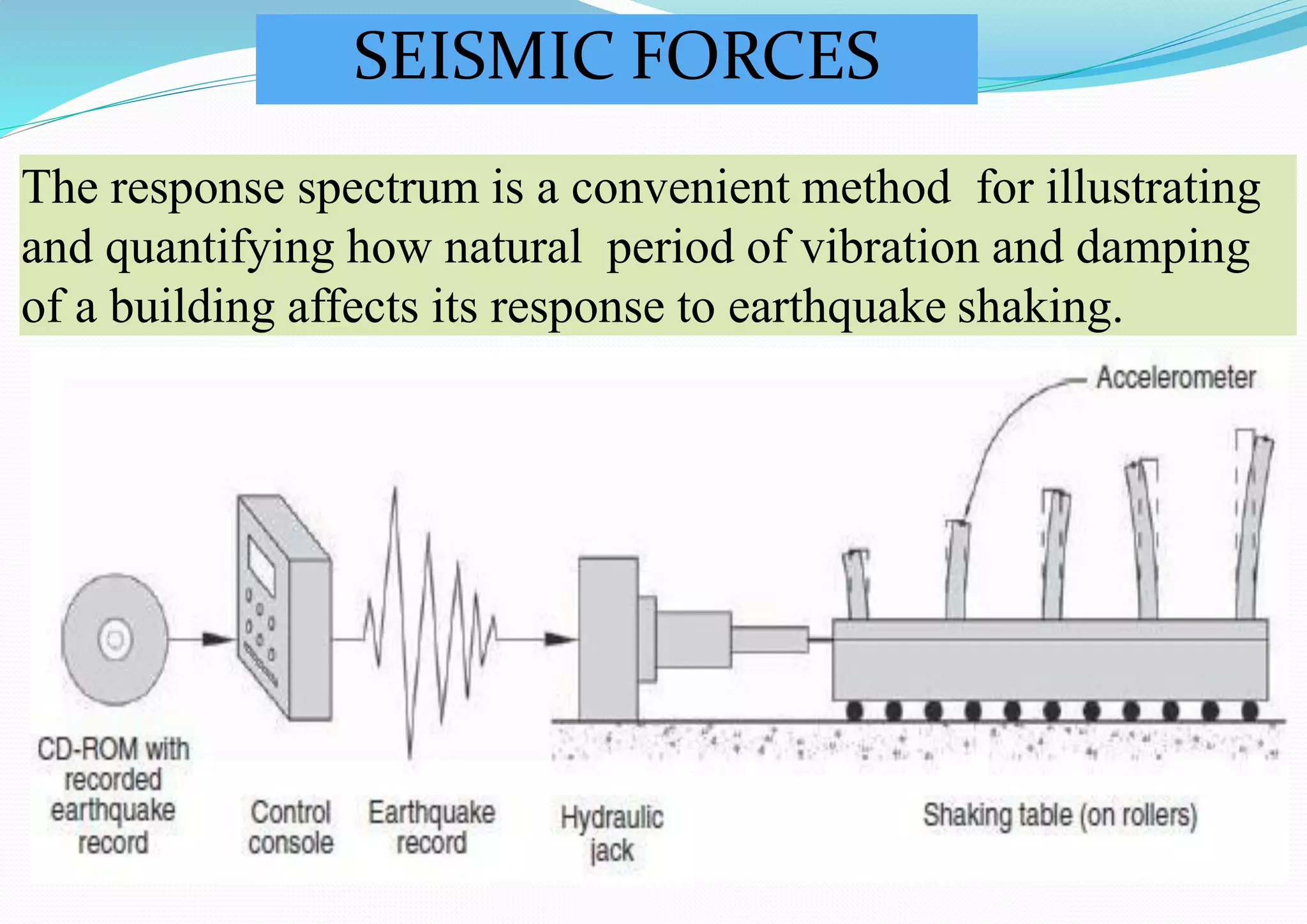
The response spectrum is a convenient method for illustrating
and quantifying how natural period of vibration and damping
of a building affects its response to earthquake shaking.
SEISMIC FORCES
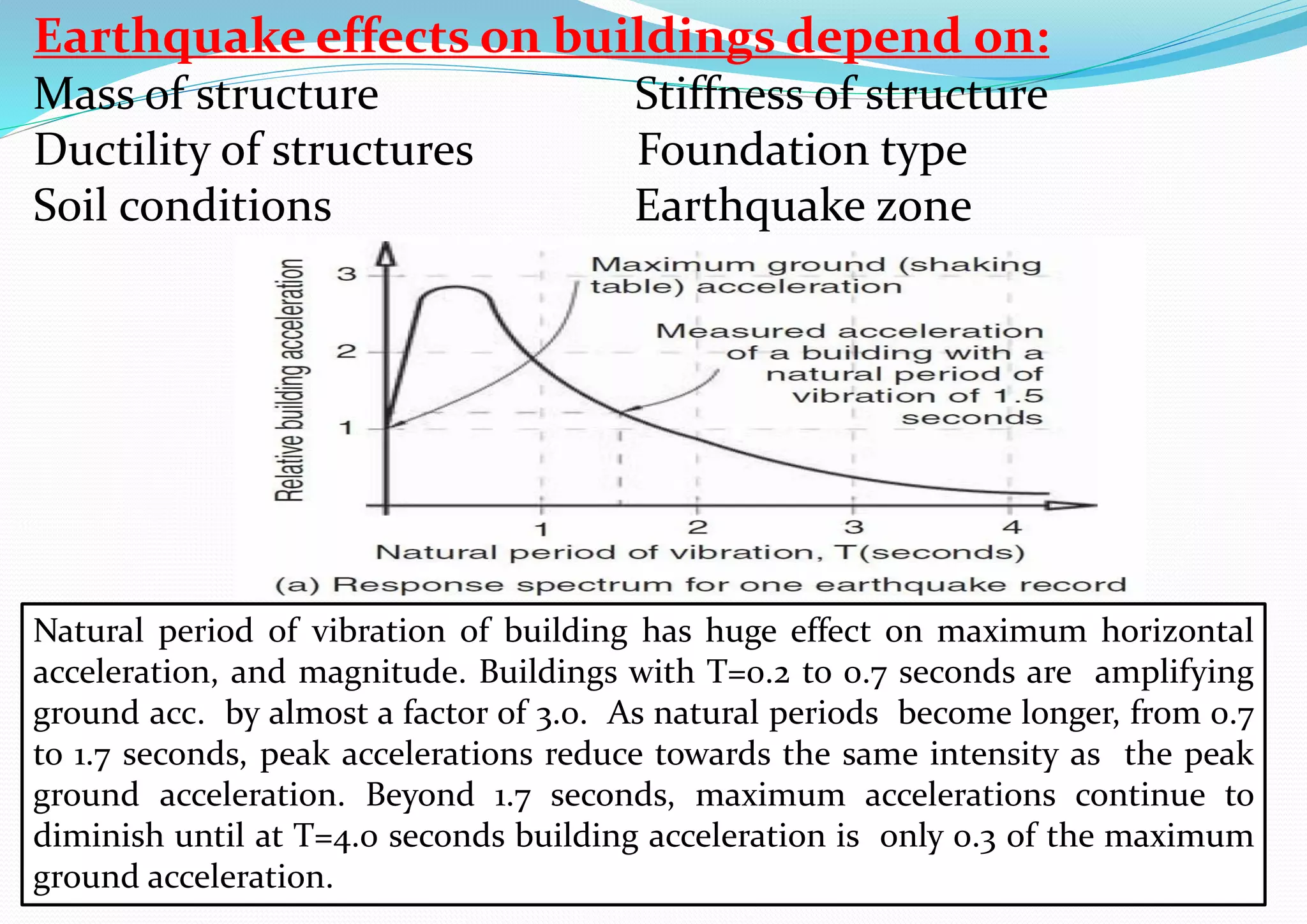
Natural period of vibration of building has huge effect on maximum horizontal
acceleration, and magnitude. Buildings with T=0.2 to 0.7 seconds are amplifying
ground acc. by almost a factor of 3.0. As natural periods become longer, from 0.7
to 1.7 seconds, peak accelerations reduce towards the same intensity as the peak
ground acceleration. Beyond 1.7 seconds, maximum accelerations continue to
diminish until at T=4.0 seconds building acceleration is only 0.3 of the maximum
ground acceleration.
Earthquake effects on buildings depend on:
Mass of structure Stiffness of structure
Ductility of structures Foundation type
Soil conditions Earthquake zone
1.Symmetry: The structure is almost symmetrical in plan along
two orthogonal directions regarding the lateral stiffness and
mass distribution.
2.Recesses: shall not exceed 5% of the floor area.
3.Aspect Ratio: Lx / Ly <4.0.
4.Torsional regularity: eccentricity between C.M. & C.R.
< 15% Li for each direction (Li=Lx &Ly for x & y directions).
Plan Regularity
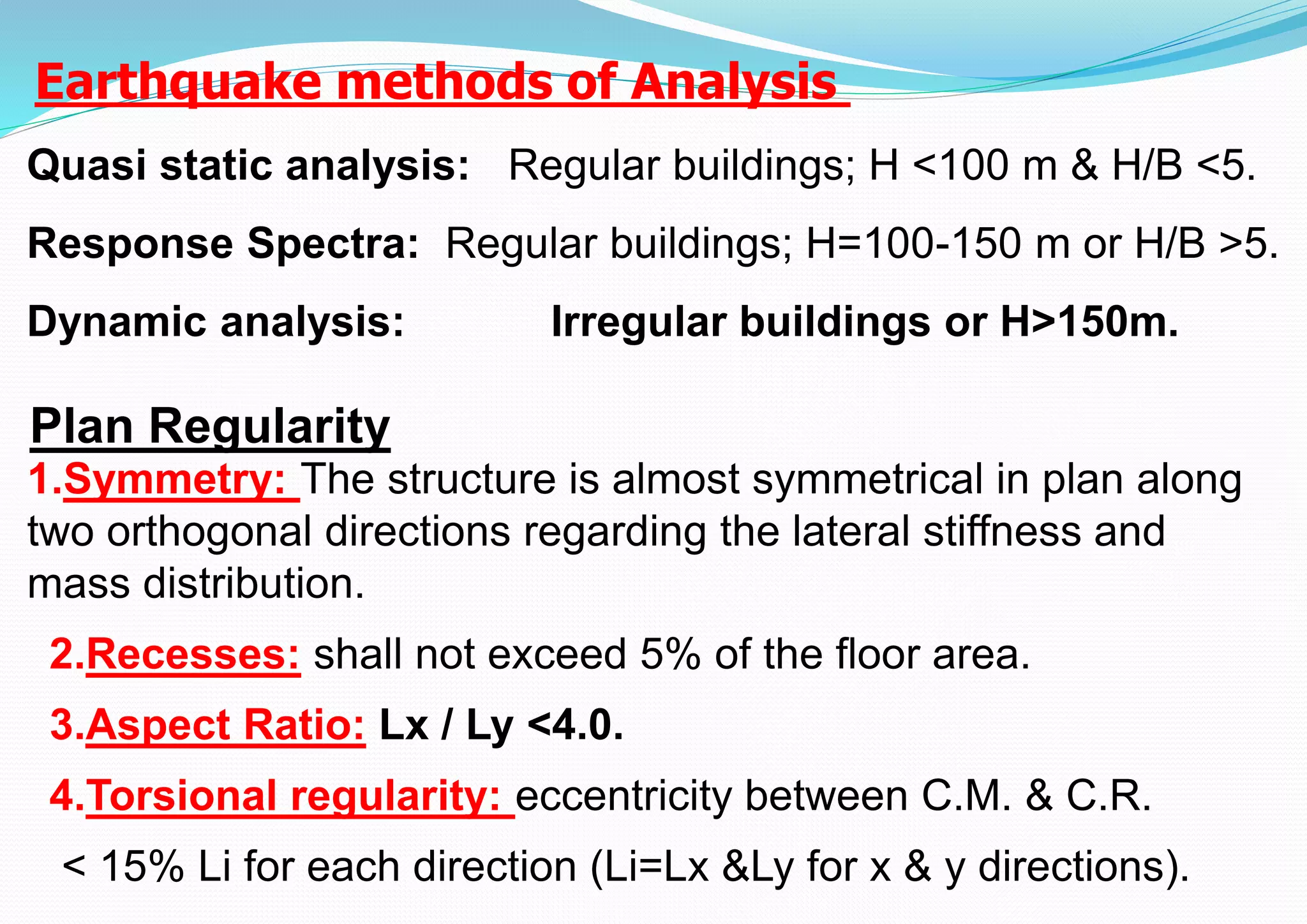
Quasi static analysis: Regular buildings; H <100 m & H/B <5.
Response Spectra: Regular buildings; H=100-150 m or H/B >5.
Dynamic analysis: Irregular buildings or H>150m.
Earthquake methods of Analysis
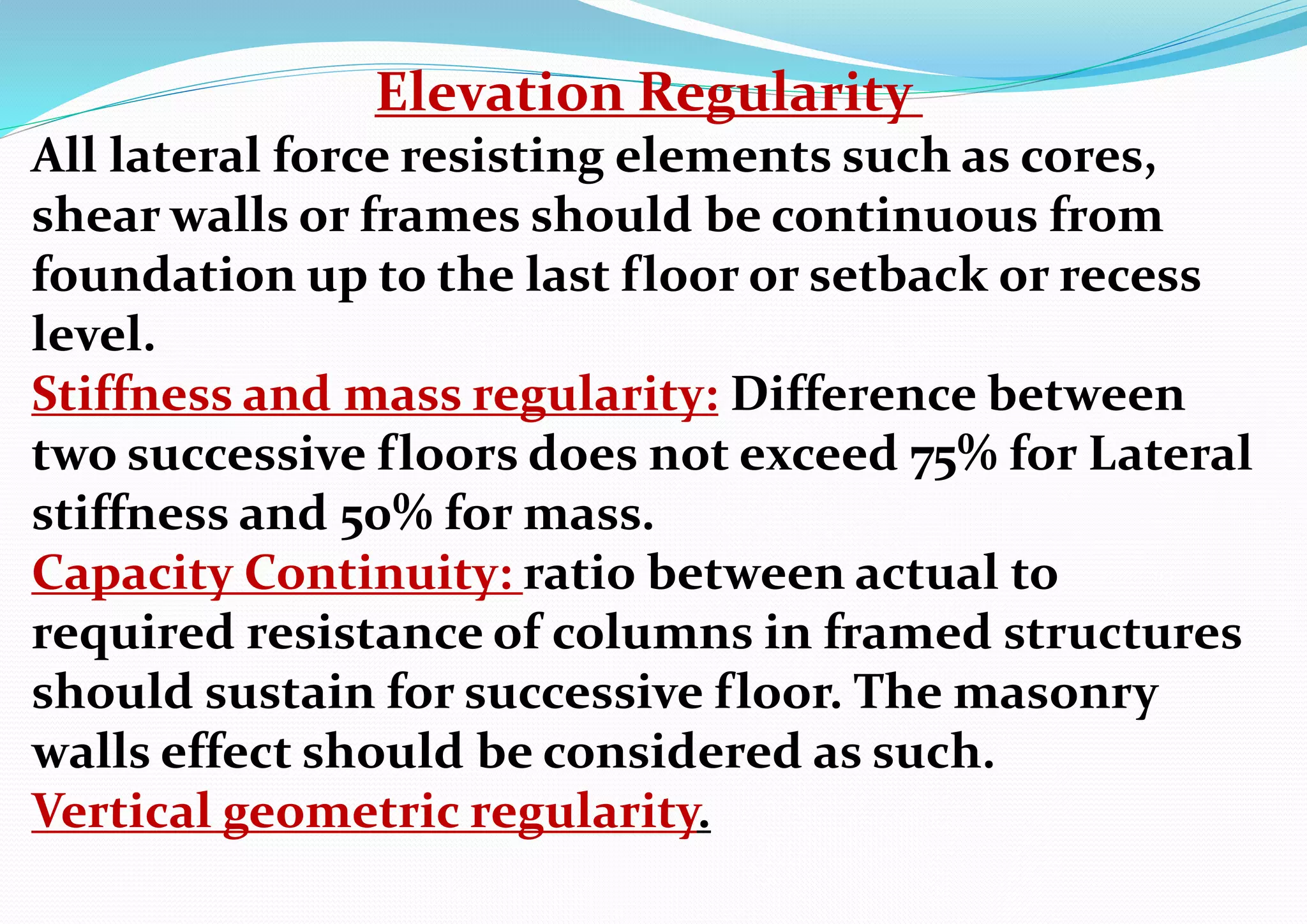
Elevation Regularity
All lateral force resisting elements such as cores,
shear walls or frames should be continuous from
foundation up to the last floor or setback or recess
level.
Stiffness and mass regularity: Difference between
two successive floors does not exceed 75% for Lateral
stiffness and 50% for mass.
Capacity Continuity: ratio between actual to
required resistance of columns in framed structures
should sustain for successive floor. The masonry
walls effect should be considered as such.
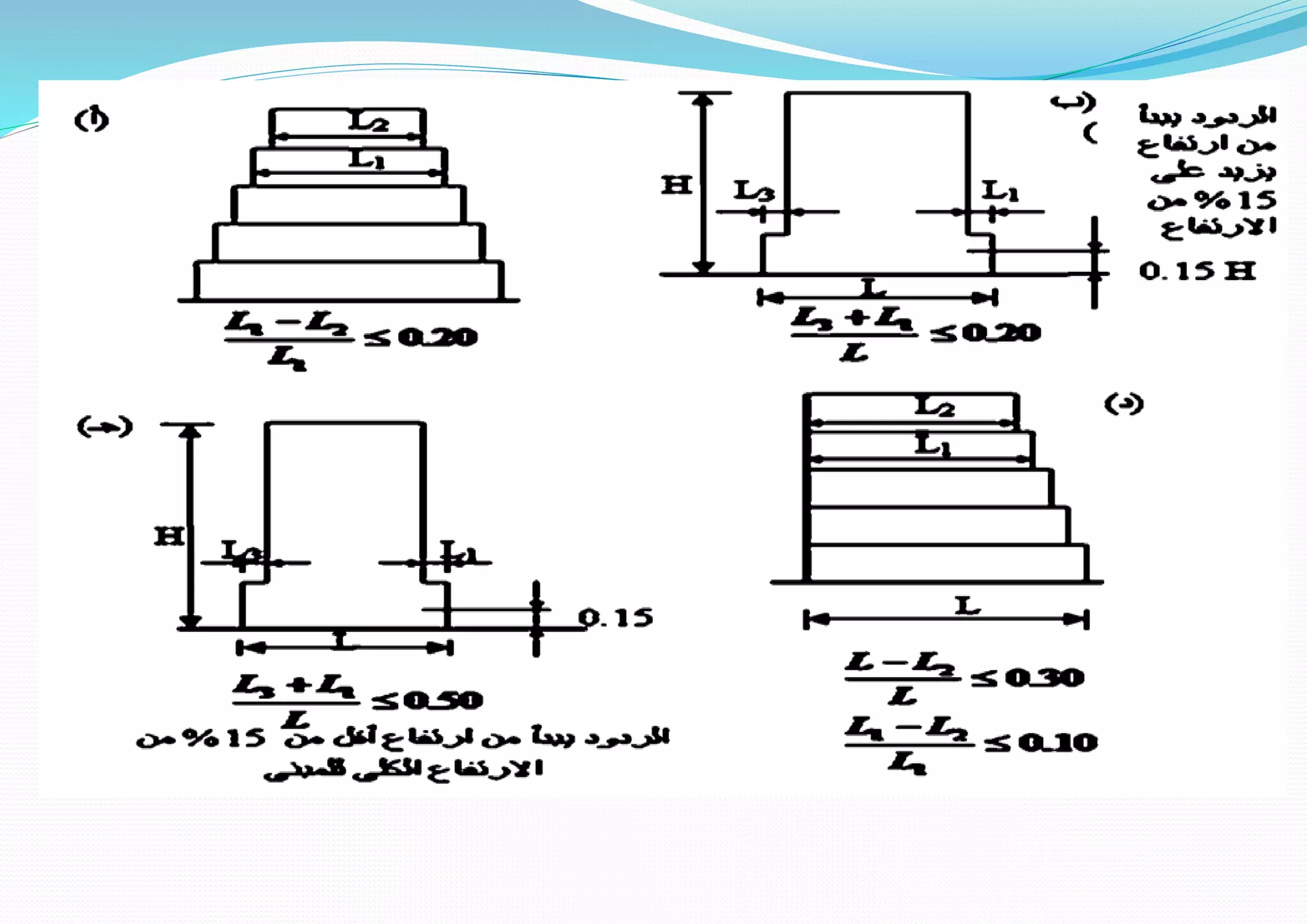
Vertical geometric regularity.
Simplified Modal Response
Spectrum Method

Lec03 Earthquake Force Using Response Specturum Method (1) (Earthquake Engineering هندسة الزلازل & Assc.Prof Nasser El-Shafey)

  • 1.
    Lecture (3 ) Preparedby : Assc. Prof Nasser El-Shafey 2016- 2017
  • 2.
    When loose, saturatedsands, silts, or gravel shaken, the material consolidates, reducing the porosity and increasing pore water pressure. The ground settles, often unevenly, tilting and toppling structures that were formerly supported by the soil Liquefaction can cause problems as soil loses it’s ability to resist shear and flows much like quick sand. Anything relying on the substrata for support can shift, tilt, rupture, or collapse. 1-Liquefaction Damage of Structure As A Result Of Soil Problems
  • 3.
    Liquefaction- caused building failure inNiigata, Japan. Liquefaction- caused building failure in Niigata, Japan
  • 4.
    Liquefaction Adapazari, Turkey 1999 1995 Kobe,Japan earthquake, increase pore pressure pushed quay wall bridge near the west end toward the river, allowing the soil and western-most pier to move one meter Eastward.
  • 5.
    2- Landslides  Whena steeply inclined mass of soil is Suddenly shaken, a slip-plane can form, and the material slides downhill.  During a landslide, structures sitting on the slide move downward and structures below the slide are hit by falling debris.
  • 6.
     In 1970an earthquake off coast of Peru produced a landslide began 80 miles away from earthquake. The slide was large (estimated it's height at about 30 meters), killing more than 18,000 people. Gravity retaining wall pushed outward by landslide One of about 75 homes damaged as a result of the Turnagain Heights slide.
  • 7.
    Collapse of TsuWei Bridge due to landslide during the Ji Ji, Taiwan earthquake. Slope instability – Niigata, Japan 2004
  • 8.
    IMPORTANCE OF GROUNDCONDITIONS Local soil conditions, particularly deep layers of soft soil as may be found in river valleys or near estuaries, significantly amplify shaking. They also modify the frequency content of seismic waves by filtering out higher frequency excitations
  • 9.
    DAMAGE AS ARESULT OF STRUCTURAL PROBLEMS Engineers will occasionally design foundations to rock during earthquakes as a way of dissipating energy and of reducing the demand on the structure; however, when the foundation is too small, it can become unstable and rock over 1. Foundation Failure Large longitudinal displacements of bridge span causing damage to abutment
  • 10.
    2. Foundation Connections Structuresneed to be well anchored to foundation. The longitudinal reinforcement did not have sufficient development length to transfer the force to the footing
  • 11.
    Soft Story Soft Story SoftFirst Story is a discontinuity of strength and stiffness for lateral load at the ground level. 3. Soft Story Soft Storey at Ground Floor
  • 12.
    Soft story (stiffeningstructural elements which are present in the upper stories are missing at the ground floor)
  • 13.
    1) Building Plan 2)Heavy mass at top should be avoided Smaller water tank at top is preferred NO YES
  • 14.
    3) Large projectionsnot allowed 4) Floating column not allowed
  • 15.
  • 16.
  • 17.
    4. Torsional Moments Curved,skewed, and eccentrically supported structures often experience a torsional moment during earthquakes.
  • 18.
    5. Shear Most buildingstructures use shear walls or moment-resisting frames to resist lateral forces during earthquakes. Damage to these systems varies from minor cracks to complete collapse. M. McKinley-ALASKA
  • 19.
    6. Flexural Failure Flexuralmembers are often designed to form plastic hinges during large earthquakes. A plastic hinge allows a member to yield and deform while continuing to support its load; however, when there is insufficient confinement for reinforced concrete members a flexural failure will occur instead. Often, flexural damage is accompanied by compression or shear damage, as the capacity of the damaged area has been lowered.
  • 20.
    Flexural damage to columns Insufficienttransverse reinforcement to prevent buckling of the vertical reinforcement
  • 21.
    7. Connection Problems Whena bridge superstructure moves off its expansion joint or when the connections between building columns and beams fail, the result is too often the COLLAPSE of the structure.
  • 22.
    Special structural systems 1-Rigid frames  2-Shear walls  3-Frames and cores  4- Coupled framed-shear wall systems  5- Cores-coupled shear wall 6- Tubular systems 7- Perforated tubes. 8- Tube in tube.  9- Bundle tube. Structural system Number of floors Frames 20 Shear walls 35 Frames & shear walls 50 Cores-coupled shear walls 55 Perforated tube 60 Tube in tube 65 Bundle tube 90
  • 23.
    The response spectrumis a convenient method for illustrating and quantifying how natural period of vibration and damping of a building affects its response to earthquake shaking. SEISMIC FORCES
  • 24.
    Natural period ofvibration of building has huge effect on maximum horizontal acceleration, and magnitude. Buildings with T=0.2 to 0.7 seconds are amplifying ground acc. by almost a factor of 3.0. As natural periods become longer, from 0.7 to 1.7 seconds, peak accelerations reduce towards the same intensity as the peak ground acceleration. Beyond 1.7 seconds, maximum accelerations continue to diminish until at T=4.0 seconds building acceleration is only 0.3 of the maximum ground acceleration. Earthquake effects on buildings depend on: Mass of structure Stiffness of structure Ductility of structures Foundation type Soil conditions Earthquake zone
  • 25.
    1.Symmetry: The structureis almost symmetrical in plan along two orthogonal directions regarding the lateral stiffness and mass distribution. 2.Recesses: shall not exceed 5% of the floor area. 3.Aspect Ratio: Lx / Ly <4.0. 4.Torsional regularity: eccentricity between C.M. & C.R. < 15% Li for each direction (Li=Lx &Ly for x & y directions). Plan Regularity Quasi static analysis: Regular buildings; H <100 m & H/B <5. Response Spectra: Regular buildings; H=100-150 m or H/B >5. Dynamic analysis: Irregular buildings or H>150m. Earthquake methods of Analysis
  • 26.
    Elevation Regularity All lateralforce resisting elements such as cores, shear walls or frames should be continuous from foundation up to the last floor or setback or recess level. Stiffness and mass regularity: Difference between two successive floors does not exceed 75% for Lateral stiffness and 50% for mass. Capacity Continuity: ratio between actual to required resistance of columns in framed structures should sustain for successive floor. The masonry walls effect should be considered as such. Vertical geometric regularity.
  • 28.