Earthquakes Aubrey Meagher Brooklyn Jerzewski Mrs.Smith  5th Hour April 8, 2011
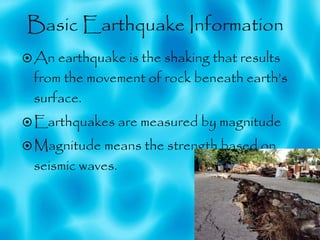
Basic Earthquake Information  An earthquake is the shaking that results from the movement of rock beneath earth’s surface. Earthquakes are measured by magnitude  Magnitude means the strength based on seismic waves.
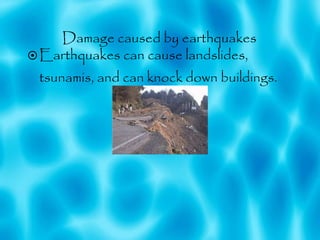
Damage caused by earthquakes Earthquakes can cause landslides, tsunamis, and can knock down buildings.
Waves Earthquake waves are called seismic waves. Two types of seismic waves are surface waves and body waves.  Two types of body waves are primary waves ( P- waves) and secondary waves( S- waves).
Body Waves  P- waves travel at about 1 to 5 miles per second depending on the material it’s traveling through. S- waves come after P- waves.  P- waves move faster than S- waves.
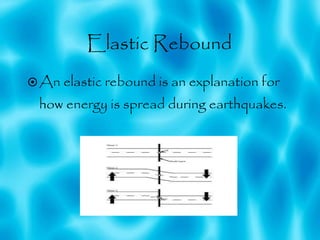
Elastic Rebound  An elastic rebound is an explanation for how energy is spread during earthquakes.
The Tohoku Earthquake The earthquake occurred Friday March 11, 2011 at 2:46 pm at epicenter time. The quake occurred at 38.322 degrees north, 142.369 degrees east. The magnitude of this quake was 9.0, near the northeast coast of Honshu, Japan.
Effects on the Environment  Tsunamis Landslides Buildings collapse The crust of the Earth can separate
Effects on the people of Japan Destroys homes Destroys work places Injures/kills people People missing
Effects on the economy of Japan Sony’s six factories in the region were affected by the earthquake No idea when Sony will re-open Assembly plants for Toyota, Honda, Nissan were closed  The Japanese economy threatens to suffer another bout of recession   Nuclear plants have problems
GPS Sensors One interesting fact about the earthquake in Japan is that it moved several GPS sensors. This will require all GPS sensors to be reset Certain things wouldn’t be there because of elastic rebound
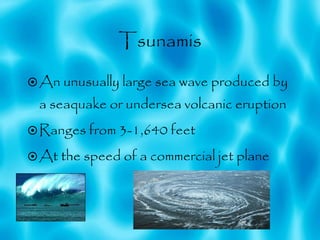
Tsunamis An unusually large sea wave produced by a seaquake or undersea volcanic eruption  Ranges from 3-1,640 feet At the speed of a commercial jet plane

Earthquake+project

  • 1.
    Earthquakes Aubrey MeagherBrooklyn Jerzewski Mrs.Smith 5th Hour April 8, 2011
  • 2.
    Basic Earthquake Information An earthquake is the shaking that results from the movement of rock beneath earth’s surface. Earthquakes are measured by magnitude Magnitude means the strength based on seismic waves.
  • 3.
    Damage caused byearthquakes Earthquakes can cause landslides, tsunamis, and can knock down buildings.
  • 4.
    Waves Earthquake wavesare called seismic waves. Two types of seismic waves are surface waves and body waves. Two types of body waves are primary waves ( P- waves) and secondary waves( S- waves).
  • 5.
    Body Waves P- waves travel at about 1 to 5 miles per second depending on the material it’s traveling through. S- waves come after P- waves. P- waves move faster than S- waves.
  • 6.
    Elastic Rebound An elastic rebound is an explanation for how energy is spread during earthquakes.
  • 7.
    The Tohoku EarthquakeThe earthquake occurred Friday March 11, 2011 at 2:46 pm at epicenter time. The quake occurred at 38.322 degrees north, 142.369 degrees east. The magnitude of this quake was 9.0, near the northeast coast of Honshu, Japan.
  • 8.
    Effects on theEnvironment Tsunamis Landslides Buildings collapse The crust of the Earth can separate
  • 9.
    Effects on thepeople of Japan Destroys homes Destroys work places Injures/kills people People missing
  • 10.
    Effects on theeconomy of Japan Sony’s six factories in the region were affected by the earthquake No idea when Sony will re-open Assembly plants for Toyota, Honda, Nissan were closed The Japanese economy threatens to suffer another bout of recession Nuclear plants have problems
  • 11.
    GPS Sensors Oneinteresting fact about the earthquake in Japan is that it moved several GPS sensors. This will require all GPS sensors to be reset Certain things wouldn’t be there because of elastic rebound
  • 12.
    Tsunamis An unusuallylarge sea wave produced by a seaquake or undersea volcanic eruption Ranges from 3-1,640 feet At the speed of a commercial jet plane