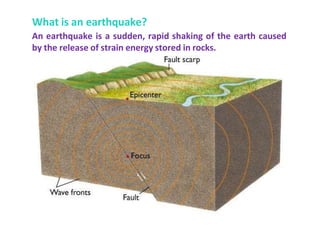
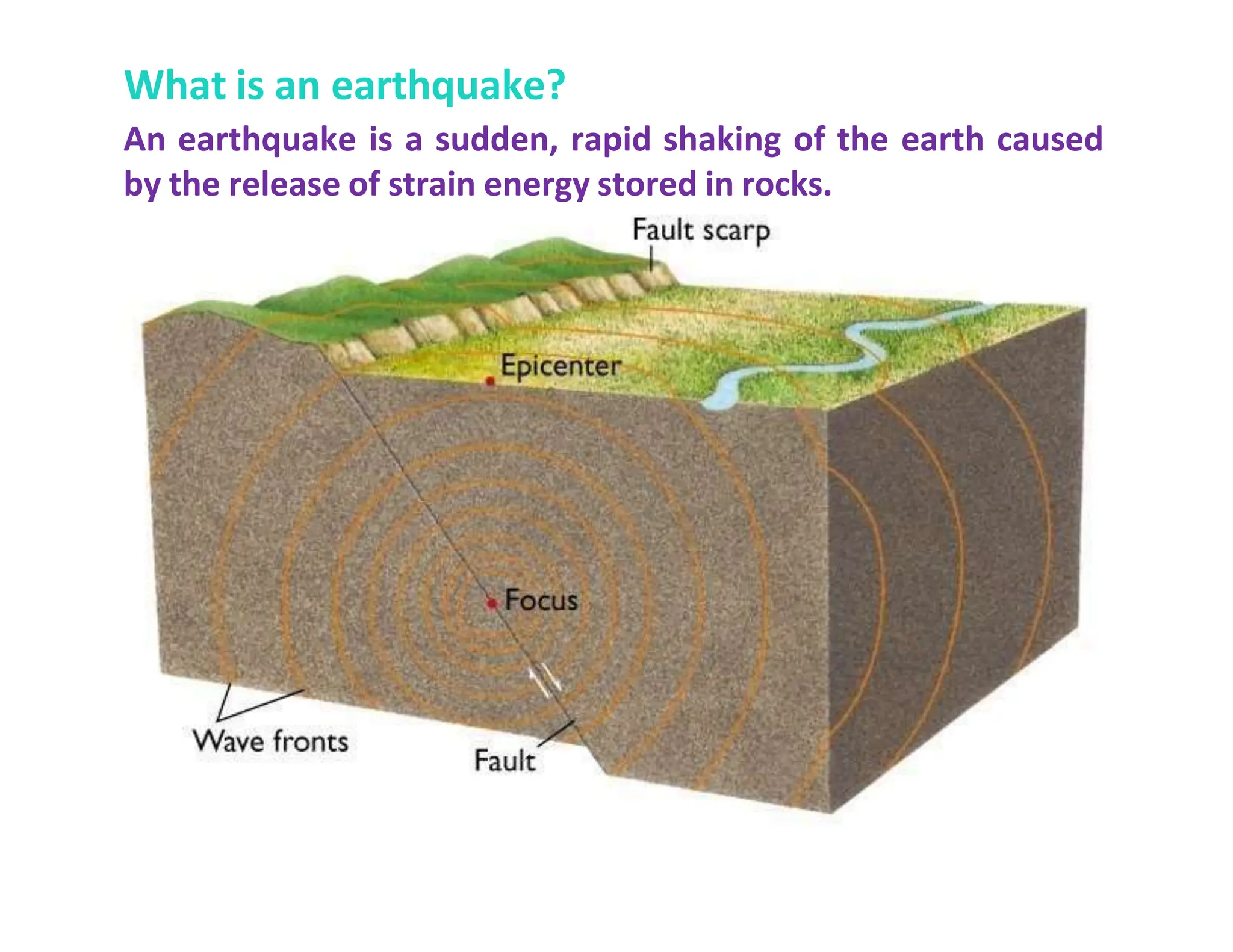
What is an earthquake?
An earthquake is a sudden, rapid shaking of the earth caused
by the release of strain energy stored in rocks.
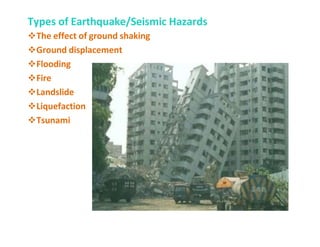
Types of Earthquake/Seismic Hazards
The effect of ground shaking
Ground displacement
Flooding
Fire
Landslide
Liquefaction
Tsunami
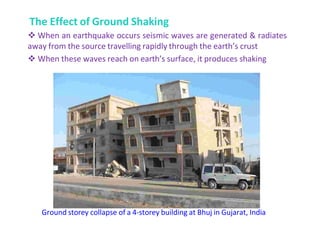
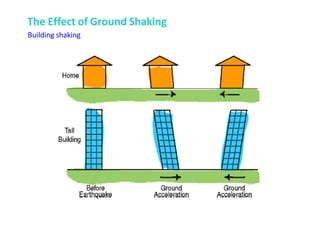
The Effect of Ground Shaking
 When an earthquake occurs seismic waves are generated & radiates
away from the source travelling rapidly through the earth’s crust
 When these waves reach on earth’s surface, it produces shaking
Ground storey collapse of a 4-storey building at Bhuj in Gujarat, India
The Effect of Ground Shaking
Building shaking
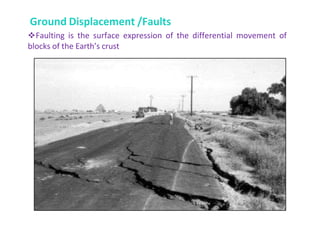
Ground Displacement /Faults
Faulting is the surface expression of the differential movement of
blocks of the Earth’s crust
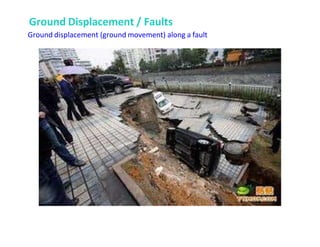
Ground Displacement / Faults
Ground displacement (ground movement) along a fault
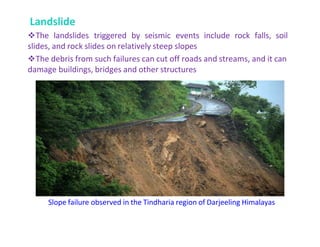
Landslide
The landslides triggered by seismic events include rock falls, soil
slides, and rock slides on relatively steep slopes
The debris from such failures can cut off roads and streams, and it can
damage buildings, bridges and other structures
Slope failure observed in the Tindharia region of Darjeeling Himalayas
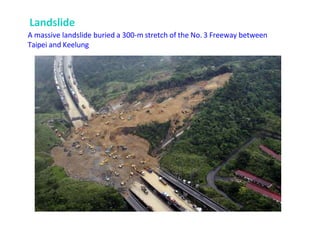
Landslide
A massive landslide buried a 300-m stretch of the No. 3 Freeway between
Taipei and Keelung
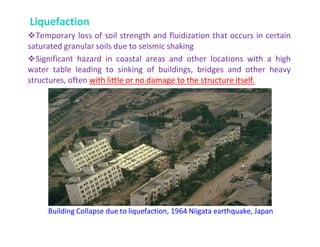
Liquefaction
Temporary loss of soil strength and fluidization that occurs in certain
saturated granular soils due to seismic shaking
Significant hazard in coastal areas and other locations with a high
water table leading to sinking of buildings, bridges and other heavy
structures, often with little or no damage to the structure itself.
Building Collapse due to liquefaction, 1964 Niigata earthquake, Japan
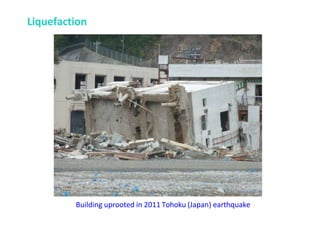
Liquefaction
Building uprooted in 2011 Tohoku (Japan) earthquake
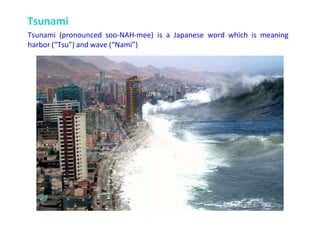
Tsunami
Tsunami (pronounced soo-NAH-mee) is a Japanese word which is meaning
harbor (“Tsu”) and wave (“Nami”)
Tsunami
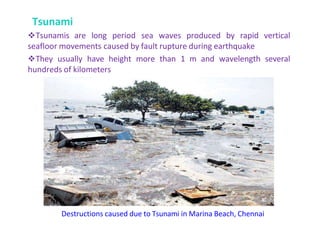
Tsunamis are long period sea waves produced by rapid vertical
seafloor movements caused by fault rupture during earthquake
They usually have height more than 1 m and wavelength several
hundreds of kilometers
Destructions caused due to Tsunami in Marina Beach, Chennai
Secondary Effects: Flooding
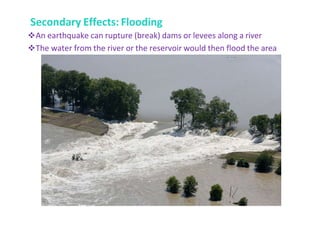
An earthquake can rupture (break) dams or levees along a river
The water from the river or the reservoir would then flood the area
Secondary Effects: Flooding
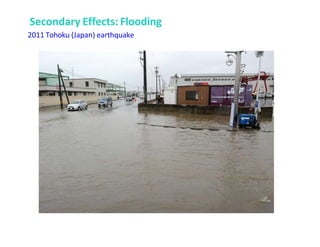
2011 Tohoku (Japan) earthquake
Secondary Effects: Fire
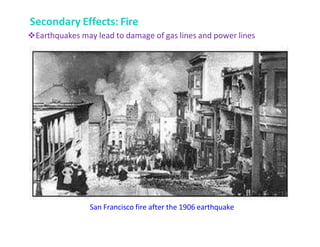
Earthquakes may lead to damage of gas lines and power lines
San Francisco fire after the 1906 earthquake
Secondary Effects: Fire
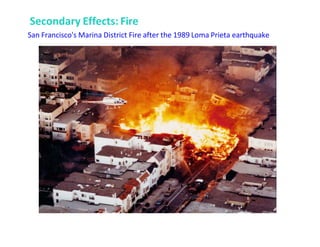
San Francisco's Marina District Fire after the 1989 Loma Prieta earthquake
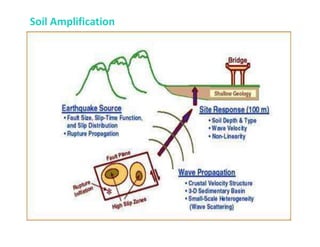
Soil Amplification

soil dynamics and earthquake geotechnical engineering's

  • 1.
    What is anearthquake? An earthquake is a sudden, rapid shaking of the earth caused by the release of strain energy stored in rocks.
  • 2.
    Types of Earthquake/SeismicHazards The effect of ground shaking Ground displacement Flooding Fire Landslide Liquefaction Tsunami
  • 3.
    The Effect ofGround Shaking  When an earthquake occurs seismic waves are generated & radiates away from the source travelling rapidly through the earth’s crust  When these waves reach on earth’s surface, it produces shaking Ground storey collapse of a 4-storey building at Bhuj in Gujarat, India
  • 4.
    The Effect ofGround Shaking Building shaking
  • 5.
    Ground Displacement /Faults Faultingis the surface expression of the differential movement of blocks of the Earth’s crust
  • 6.
    Ground Displacement /Faults Ground displacement (ground movement) along a fault
  • 7.
    Landslide The landslides triggeredby seismic events include rock falls, soil slides, and rock slides on relatively steep slopes The debris from such failures can cut off roads and streams, and it can damage buildings, bridges and other structures Slope failure observed in the Tindharia region of Darjeeling Himalayas
  • 8.
    Landslide A massive landslideburied a 300-m stretch of the No. 3 Freeway between Taipei and Keelung
  • 9.
    Liquefaction Temporary loss ofsoil strength and fluidization that occurs in certain saturated granular soils due to seismic shaking Significant hazard in coastal areas and other locations with a high water table leading to sinking of buildings, bridges and other heavy structures, often with little or no damage to the structure itself. Building Collapse due to liquefaction, 1964 Niigata earthquake, Japan
  • 10.
    Liquefaction Building uprooted in2011 Tohoku (Japan) earthquake
  • 11.
    Tsunami Tsunami (pronounced soo-NAH-mee)is a Japanese word which is meaning harbor (“Tsu”) and wave (“Nami”)
  • 12.
    Tsunami Tsunamis are longperiod sea waves produced by rapid vertical seafloor movements caused by fault rupture during earthquake They usually have height more than 1 m and wavelength several hundreds of kilometers Destructions caused due to Tsunami in Marina Beach, Chennai
  • 13.
    Secondary Effects: Flooding Anearthquake can rupture (break) dams or levees along a river The water from the river or the reservoir would then flood the area
  • 14.
    Secondary Effects: Flooding 2011Tohoku (Japan) earthquake
  • 15.
    Secondary Effects: Fire Earthquakesmay lead to damage of gas lines and power lines San Francisco fire after the 1906 earthquake
  • 16.
    Secondary Effects: Fire SanFrancisco's Marina District Fire after the 1989 Loma Prieta earthquake
  • 17.