Knowledge Management
CONTENTS
 Data, Information & Knowledge
 Knowledge Hierarchy
 Types of Knowledge
 What Is Knowledge Management
 Why KM
 What is Knowledge Management Trying to Solve
CONT…
 KM MODELS
 KM life Cycle
 Why do organizations invest in knowledge management?
 Conclusion
4
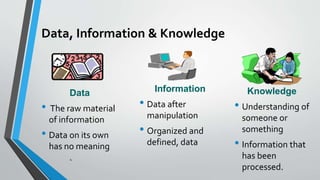
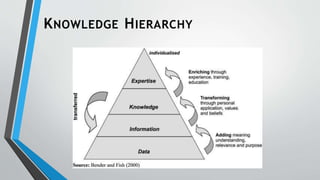
Data, Information & Knowledge
Data
• The raw material
of information
• Data on its own
has no meaning
Knowledge
• Understanding of
someone or
something
• Information that
has been
processed.
Information
• Data after
manipulation
• Organized and
defined, data
KNOWLEDGE HIERARCHY
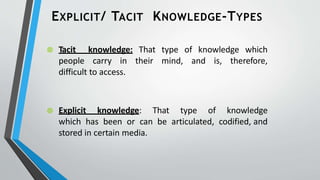
EXPLICIT/ TACIT KNOWLEDGE-TYPES
 Tacit knowledge: That type of knowledge which
people carry in their mind, and is, therefore,
difficult to access.
 Explicit knowledge: That type of knowledge
which has been or can be articulated, codified, and
stored in certain media.
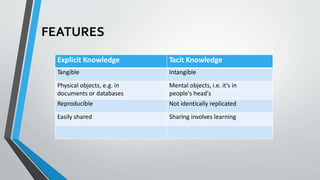
FEATURES
Explicit Knowledge Tacit Knowledge
Tangible Intangible
Physical objects, e.g. in
documents or databases
Mental objects, i.e. it's in
people's head's
Reproducible Not identically replicated
Easily shared Sharing involves learning
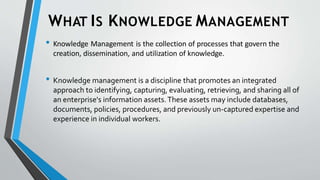
WHAT IS KNOWLEDGE MANAGEMENT
• Knowledge Management is the collection of processes that govern the
creation, dissemination, and utilization of knowledge.
• Knowledge management is a discipline that promotes an integrated
approach to identifying, capturing, evaluating, retrieving, and sharing all of
an enterprise's information assets.These assets may include databases,
documents, policies, procedures, and previously un-captured expertise and
experience in individual workers.
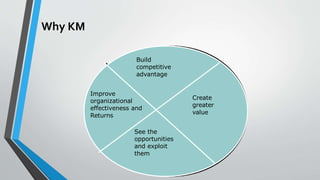
Improve
organizational
effectiveness and
Returns
Build
competitive
advantage
Create
greater
value
See the
opportunities
and exploit
them
Why KM
10
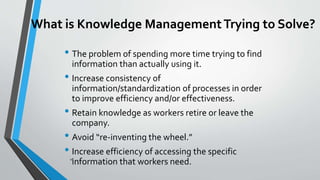
What is Knowledge ManagementTrying to Solve?
• The problem of spending more time trying to find
information than actually using it.
• Increase consistency of
information/standardization of processes in order
to improve efficiency and/or effectiveness.
• Retain knowledge as workers retire or leave the
company.
• Avoid “re-inventing the wheel.”
• Increase efficiency of accessing the specific
information that workers need.
KM MODELS
There are some KM Models:
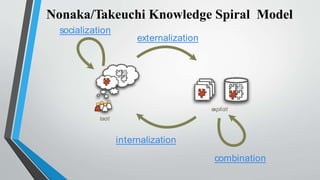
 Nonaka/Takeuchi Knowledge Spiral (1995)
 The Choo Sense-making KM Model (1998)
 WIIG KM Model
explicit
tacit
internalization
socialization
externalization
combination
Nonaka/Takeuchi Knowledge Spiral Model
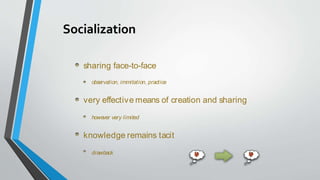
Socialization
sharing face-to-face
observation, immitation, practice
very effective means of creation and sharing
however very limited
knowledge remains tacit
drawback
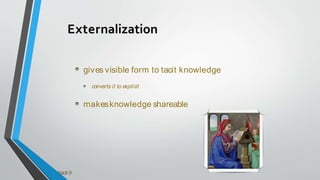
Externalization
gives visible form to tacit knowledge
converts it to explicit
makesknowledge shareable
backჵ
Combination
recombining to a new form
synthesis, trend analysis, summary, linking and cross-referencing
categorization, tagging
creating training material
backჵ
Internalization
embedding new mental models
learning by doing
employees know how to do their jobs and
tasks differently
backჵ
next knowing
cycle
Sense
Making
Decision
Making
Knowledge
Creating
streams of
experience
external
information and
knowledge
!
thismodel fouseson
ჶ book p. 59
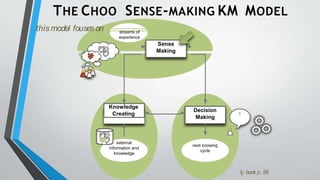
THE CHOO SENSE-MAKING KM MODEL
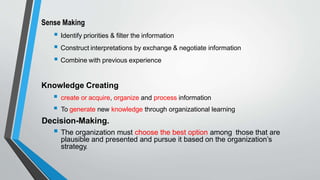
Sense Making
 Identify priorities & filter the information
 Construct interpretations by exchange & negotiate information
 Combine with previous experience
Knowledge Creating
 create or acquire, organize and process information
 To generate new knowledge through organizational learning
Decision-Making.
 The organization must choose the best option among those that are
plausible and presented and pursue it based on the organization’s
strategy.
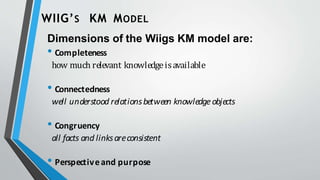
WIIG’S KM MODEL
Dimensions of the Wiigs KM model are:
• Completeness
how much relevant knowledgeisavailable
• Connectedness
well understood relationsbetween knowledgeobjects
• Congruency
all facts and linksareconsistent
• Perspectiveand purpose
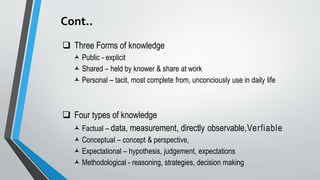
Cont..
 Three Forms of knowledge
 Public - explicit
 Shared – held by knower & share at work
 Personal – tacit, most complete from, unconciously use in daily life
 Four types of knowledge
 Factual – data, measurement, directly observable,Verfiable
 Conceptual – concept & perspective,
 Expectational – hypothesis, judgement, expectations
 Methodological - reasoning, strategies, decision making
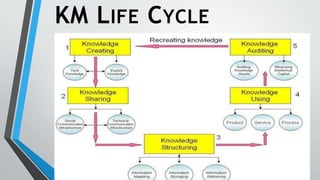
KM LIFE CYCLE
Why do organizations invest in knowledge
management?
• Enabling better and faster decision making
• Making it easy to find relevant information and resources
• Avoiding making the same mistakes twice
• Taking advantage of existing expertise and experience
• Communicating important information widely and quickly
• Promoting standard, repeatable processes and procedures
• Making the organization's best problem-solving experiences reusable
Conclusion
 KM helps us get a deeper understanding
 Several models of KM were introduced.
 A model-driven KM approach enables not only a better
description but also helps to provide a better
prescription for meeting organizational goals.
 KM Increases efficiency
 Easy to find relevant information and resources
knowledgemanagement-180601233759.pdf

knowledgemanagement-180601233759.pdf

  • 1.
  • 2.
    CONTENTS  Data, Information& Knowledge  Knowledge Hierarchy  Types of Knowledge  What Is Knowledge Management  Why KM  What is Knowledge Management Trying to Solve
  • 3.
    CONT…  KM MODELS KM life Cycle  Why do organizations invest in knowledge management?  Conclusion
  • 4.
    4 Data, Information &Knowledge Data • The raw material of information • Data on its own has no meaning Knowledge • Understanding of someone or something • Information that has been processed. Information • Data after manipulation • Organized and defined, data
  • 5.
  • 6.
    EXPLICIT/ TACIT KNOWLEDGE-TYPES Tacit knowledge: That type of knowledge which people carry in their mind, and is, therefore, difficult to access.  Explicit knowledge: That type of knowledge which has been or can be articulated, codified, and stored in certain media.
  • 7.
    FEATURES Explicit Knowledge TacitKnowledge Tangible Intangible Physical objects, e.g. in documents or databases Mental objects, i.e. it's in people's head's Reproducible Not identically replicated Easily shared Sharing involves learning
  • 8.
    WHAT IS KNOWLEDGEMANAGEMENT • Knowledge Management is the collection of processes that govern the creation, dissemination, and utilization of knowledge. • Knowledge management is a discipline that promotes an integrated approach to identifying, capturing, evaluating, retrieving, and sharing all of an enterprise's information assets.These assets may include databases, documents, policies, procedures, and previously un-captured expertise and experience in individual workers.
  • 9.
  • 10.
    10 What is KnowledgeManagementTrying to Solve? • The problem of spending more time trying to find information than actually using it. • Increase consistency of information/standardization of processes in order to improve efficiency and/or effectiveness. • Retain knowledge as workers retire or leave the company. • Avoid “re-inventing the wheel.” • Increase efficiency of accessing the specific information that workers need.
  • 11.
    KM MODELS There aresome KM Models:  Nonaka/Takeuchi Knowledge Spiral (1995)  The Choo Sense-making KM Model (1998)  WIIG KM Model
  • 12.
  • 13.
    Socialization sharing face-to-face observation, immitation,practice very effective means of creation and sharing however very limited knowledge remains tacit drawback
  • 14.
    Externalization gives visible formto tacit knowledge converts it to explicit makesknowledge shareable backჵ
  • 15.
    Combination recombining to anew form synthesis, trend analysis, summary, linking and cross-referencing categorization, tagging creating training material backჵ
  • 16.
    Internalization embedding new mentalmodels learning by doing employees know how to do their jobs and tasks differently backჵ
  • 17.
    next knowing cycle Sense Making Decision Making Knowledge Creating streams of experience external informationand knowledge ! thismodel fouseson ჶ book p. 59 THE CHOO SENSE-MAKING KM MODEL
  • 18.
    Sense Making  Identifypriorities & filter the information  Construct interpretations by exchange & negotiate information  Combine with previous experience Knowledge Creating  create or acquire, organize and process information  To generate new knowledge through organizational learning Decision-Making.  The organization must choose the best option among those that are plausible and presented and pursue it based on the organization’s strategy.
  • 19.
    WIIG’S KM MODEL Dimensionsof the Wiigs KM model are: • Completeness how much relevant knowledgeisavailable • Connectedness well understood relationsbetween knowledgeobjects • Congruency all facts and linksareconsistent • Perspectiveand purpose
  • 20.
    Cont..  Three Formsof knowledge  Public - explicit  Shared – held by knower & share at work  Personal – tacit, most complete from, unconciously use in daily life  Four types of knowledge  Factual – data, measurement, directly observable,Verfiable  Conceptual – concept & perspective,  Expectational – hypothesis, judgement, expectations  Methodological - reasoning, strategies, decision making
  • 21.
  • 22.
    Why do organizationsinvest in knowledge management? • Enabling better and faster decision making • Making it easy to find relevant information and resources • Avoiding making the same mistakes twice • Taking advantage of existing expertise and experience • Communicating important information widely and quickly • Promoting standard, repeatable processes and procedures • Making the organization's best problem-solving experiences reusable
  • 23.
    Conclusion  KM helpsus get a deeper understanding  Several models of KM were introduced.  A model-driven KM approach enables not only a better description but also helps to provide a better prescription for meeting organizational goals.  KM Increases efficiency  Easy to find relevant information and resources