By :
NIYATI MEHTA
Introduction to e-
commerce
Element of e-commerce
Feature
Why
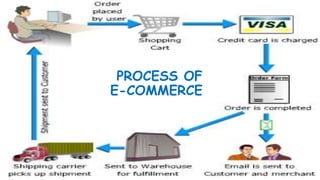
 The Process of e-
commerce
 Types of e-commerce
 Applications of e-
commerce
 Advantages
 Disadvantages
 Conclusion
• Commonly known as Electronic Marketing.
• “It consist of buying and selling goods and services over an
electronic systems Such as the internet and other computer
networks.”
• “E-commerce is the purchasing, selling and exchanging goods
and services over computer networks (internet) through which
transaction or terms of sale are performed electronically.
CUSTOMERCOMPANY
 There are certain elements required to perform
online business.
 Promote your Web site presence.
 Have an online catalog or store.
 Have the capability to receive payments.
 Be able to deliver the item.
 Provide after-the-sale support.
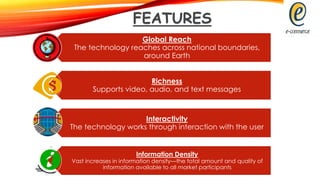
FEATURES
Global Reach
The technology reaches across national boundaries,
around Earth
Richness
Supports video, audio, and text messages
Interactivity
The technology works through interaction with the user
Information Density
Vast increases in information density—the total amount and quality of
information available to all market participants
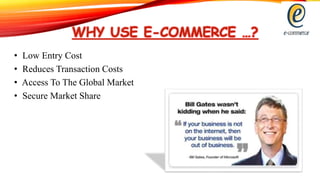
WHY USE E-COMMERCE …?
• Low Entry Cost
• Reduces Transaction Costs
• Access To The Global Market
• Secure Market Share
PROCESS OF
E-COMMERCE
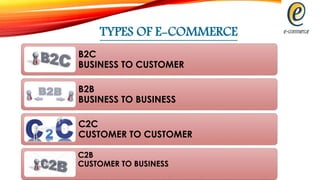
TYPES OF E-COMMERCE
B2C
BUSINESS TO CUSTOMER
B2B
BUSINESS TO BUSINESS
C2C
CUSTOMER TO CUSTOMER
C2B
CUSTOMER TO BUSINESS
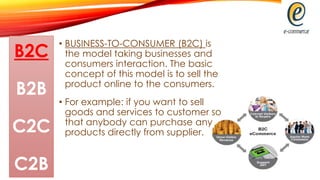
• BUSINESS-TO-CONSUMER (B2C) is
the model taking businesses and
consumers interaction. The basic
concept of this model is to sell the
product online to the consumers.
• For example: if you want to sell
goods and services to customer so
that anybody can purchase any
products directly from supplier.
B2C
B2B
C2C
C2B
B2C
B2B
C2C
C2B
BUSINESS TO BUSINESS means
business to business. It is the types
of e-commerce in which buyer
and seller, both are businesses.
In this, one business is sells its
goods or services while other
business buys these products or
services.
Example :- Alibaba.com.
Global source.com.
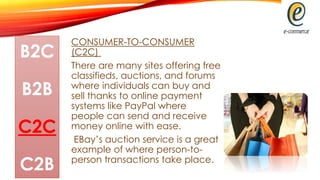
CONSUMER-TO-CONSUMER
(C2C)
There are many sites offering free
classifieds, auctions, and forums
where individuals can buy and
sell thanks to online payment
systems like PayPal where
people can send and receive
money online with ease.
EBay’s auction service is a great
example of where person-to-
person transactions take place.
B2C
B2B
C2C
C2B
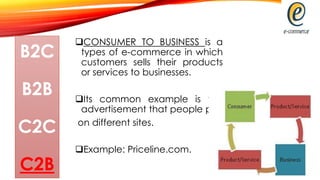
CONSUMER TO BUSINESS is a
types of e-commerce in which
customers sells their products
or services to businesses.
Its common example is the
advertisement that people put
on different sites.
Example: Priceline.com.
B2C
B2B
C2C
C2B
Pros
Reduce prices.
You can shop
anywhere in the world.
Wide selection for
consumers
Easy access 24 hours
a day
CONS
Unable to examine
products personally.
Not everyone is connected
to the Internet.
There is the possibility of
credit card number theft
On average only 1/9th of
stock is available on the net
SOME IMAGES
OF
FUTURE:
3D SHOP TO BUY
CLOTHES
3D HOME DECOR SHOP…
E-COMMERCE PORTALS
CONCLUSION
Ecommerce

Ecommerce

  • 1.
  • 2.
    Introduction to e- commerce Elementof e-commerce Feature Why  The Process of e- commerce  Types of e-commerce  Applications of e- commerce  Advantages  Disadvantages  Conclusion
  • 3.
    • Commonly knownas Electronic Marketing. • “It consist of buying and selling goods and services over an electronic systems Such as the internet and other computer networks.” • “E-commerce is the purchasing, selling and exchanging goods and services over computer networks (internet) through which transaction or terms of sale are performed electronically. CUSTOMERCOMPANY
  • 4.
     There arecertain elements required to perform online business.  Promote your Web site presence.  Have an online catalog or store.  Have the capability to receive payments.  Be able to deliver the item.  Provide after-the-sale support.
  • 5.
    FEATURES Global Reach The technologyreaches across national boundaries, around Earth Richness Supports video, audio, and text messages Interactivity The technology works through interaction with the user Information Density Vast increases in information density—the total amount and quality of information available to all market participants
  • 6.
    WHY USE E-COMMERCE…? • Low Entry Cost • Reduces Transaction Costs • Access To The Global Market • Secure Market Share
  • 7.
  • 8.
    TYPES OF E-COMMERCE B2C BUSINESSTO CUSTOMER B2B BUSINESS TO BUSINESS C2C CUSTOMER TO CUSTOMER C2B CUSTOMER TO BUSINESS
  • 9.
    • BUSINESS-TO-CONSUMER (B2C)is the model taking businesses and consumers interaction. The basic concept of this model is to sell the product online to the consumers. • For example: if you want to sell goods and services to customer so that anybody can purchase any products directly from supplier. B2C B2B C2C C2B
  • 10.
    B2C B2B C2C C2B BUSINESS TO BUSINESSmeans business to business. It is the types of e-commerce in which buyer and seller, both are businesses. In this, one business is sells its goods or services while other business buys these products or services. Example :- Alibaba.com. Global source.com.
  • 11.
    CONSUMER-TO-CONSUMER (C2C) There are manysites offering free classifieds, auctions, and forums where individuals can buy and sell thanks to online payment systems like PayPal where people can send and receive money online with ease. EBay’s auction service is a great example of where person-to- person transactions take place. B2C B2B C2C C2B
  • 12.
    CONSUMER TO BUSINESSis a types of e-commerce in which customers sells their products or services to businesses. Its common example is the advertisement that people put on different sites. Example: Priceline.com. B2C B2B C2C C2B
  • 14.
    Pros Reduce prices. You canshop anywhere in the world. Wide selection for consumers Easy access 24 hours a day
  • 15.
    CONS Unable to examine productspersonally. Not everyone is connected to the Internet. There is the possibility of credit card number theft On average only 1/9th of stock is available on the net
  • 16.
  • 17.
    3D SHOP TOBUY CLOTHES
  • 18.
  • 19.
  • 20.