Albert Simard Knowledge Manager Defence R&D Canada   Presented to  17 th  Conference on Knowledge-Based organizations  November 24-26, 2011 Becoming a  Knowledge Organization
Knowledge-Based Organizations KBOs are in the knowledge business.   C reating and using knowledge is their core activity. Knowledge is a KBOs most valuable asset.   They often spend 10 to 15 times more   to create and use knowledge than on facilities, equipment, and infrastructure. KBOs must become knowledge organizations to remain relevant.  They must create,  manage , and use  knowledge as a strategic resource.
Outline Management Levels Knowledge Flow Creation Validation Organization Authorization Management Regimes
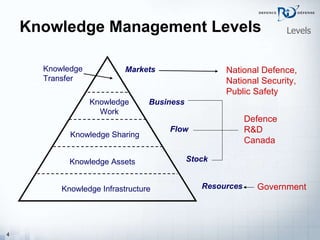
Knowledge Management Levels Levels Knowledge Assets Knowledge Sharing Knowledge Work Knowledge Transfer Knowledge Infrastructure Stock Flow Business National Defence, National Security,  Public Safety Defence R&D Canada Markets Resources Government
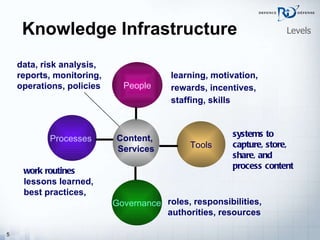
Knowledge Infrastructure Levels Processes   work routines lessons learned, best practices,   People learning, motivation, rewards, incentives, staffing, skills Governance roles, responsibilities, authorities, resources Content,  Services data, risk analysis, reports, monitoring, operations, policies Tools systems to capture, store, share, and process content
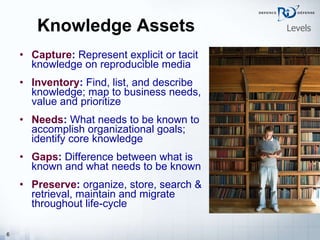
Knowledge Assets Capture :  Represent explicit or tacit knowledge on reproducible media Inventory :  Find, list, and describe knowledge; map to business needs, value and prioritize Needs :  What needs to be known to accomplish organizational goals; identify core knowledge Gaps :  Difference between what is known and what needs to be known Preserve :  organize, store, search & retrieval, maintain and migrate throughout life-cycle Levels
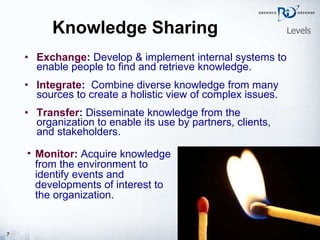
Knowledge Sharing Exchange :  Develop & implement internal systems to enable people to find and retrieve knowledge. Integrate :   Combine diverse knowledge from many sources to create a holistic view of complex issues. Transfer :  Disseminate knowledge from the organization to enable its use by partners, clients, and stakeholders. Monitor :  Acquire knowledge from the environment to identify events and developments of interest to the organization. Levels
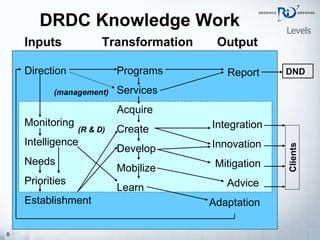
DRDC Knowledge Work   Levels Inputs Direction Monitoring Intelligence Needs Priorities Establishment Transformation Programs Services Acquire Create Develop Mobilize Learn  Output  Report Integration Innovation Mitigation Advice Adaptation Clients DND (management) (R & D)
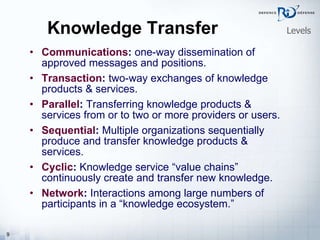
Knowledge Transfer Communications :  one-way dissemination of approved messages and positions. Transaction :  two-way exchanges of knowledge products & services. Parallel :  Transferring knowledge products & services from or to two or more providers or users. Sequential :  Multiple organizations sequentially produce and transfer knowledge products & services. Cyclic :  Knowledge service “value chains” continuously create and transfer new knowledge. Network :  Interactions among large numbers of participants in a “knowledge ecosystem.” Levels
Outline Management Levels Knowledge Flow Creation Validation Organization Authorization Management Regimes
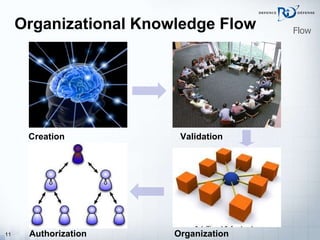
Organizational Knowledge Flow Flow Creation Validation Organization Authorization
Incentives   Compliance   (you will) Pay, job security, duty, work ethic,   penalties Military, manufacturing, law, regulation, policies Meet quotas, minimum standards, routine tasks  Motivation   (you’ll be rewarded) Ambition, challenges, bonuses, rewards, recognition Efficiency, productivity, quality Increases, improvements Engagement   (would you like to?) Meaningfulness, ownership, self-esteem, enjoyment Creativity, innovation, discovery Commitment, involvement, willingness, enjoyment Flow-Creation
Engagement Autonomy:   (agreed task, flexible schedule, select technique, choose team)   Mastery:   (is a mindset, it takes time and effort, it is asymptotic) Purpose:  (meaningful goals, words are important, policies) Daniel Pink (2009) Flow-Creation
Eliciting Methods Conversations, discussions, dialogue  (colleagues, peers) Questions & answers, problems & solutions  (novice/expert) After-action reviews, lessons learned  (event/group) Capture, document, interview, record  (expert/facilitator) Extraction, identify, codify, organize  (expert/know engineer) Advising, briefing, recommending  (subordinate/superior) Teaching, educating, training (teacher/student) Storytelling, narratives, anecdotes  (teller/listener) Explaining, demonstrating, describing  (technician/user) Presentations, lectures, speeches  (speaker/audience) Flow-Creation
Communities Create & Validate Knowledge  Knowledge exists in the minds of people.  Experience is as important as formal knowledge. Knowledge is tacit as well as explicit. Transferring tacit knowledge is more effective through human interaction. Knowledge is social as well as individual.  Today’s knowledge is the result of centuries of collective research. Knowledge is changing at an accelerating rate.  It takes a community of people to keep up with new concepts, practices, and technology. Flow-Communities
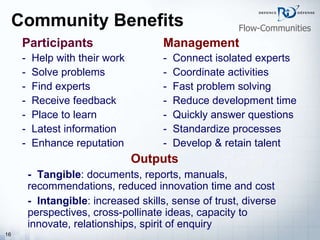
Community Benefits Participants -   Help with   their work -  Solve problems -  Find experts -  Receive feedback -  Place to learn -  Latest information -  Enhance reputation Management -  Connect isolated experts -  Coordinate activities -  Fast problem solving -  Reduce development time -  Quickly answer questions -  Standardize processes -  Develop & retain talent Outputs -  Tangible : documents, reports, manuals, recommendations, reduced innovation time and cost -  Intangible : increased skills, sense of trust, diverse perspectives, cross-pollinate ideas, capacity to innovate, relationships, spirit of enquiry Flow-Communities
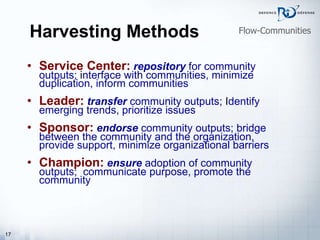
Harvesting Methods  Service Center:   repository  for community outputs;  i nterface with communities, minimize duplication, inform communities Leader:   transfer  community outputs;  I dentify emerging trends, prioritize issues Sponsor:   endorse  community outputs; bridge between the community and the organization, provide support, minimize organizational barriers  Champion:   ensure  adoption of community outputs;  communicate purpose, promote the community Flow-Communities
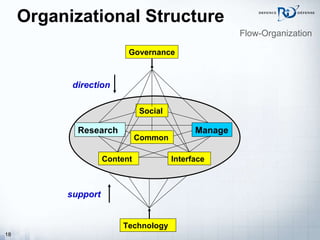
Organizational Structure Flow-Organization Technology support Manage Interface Content Research Social Common Governance direction
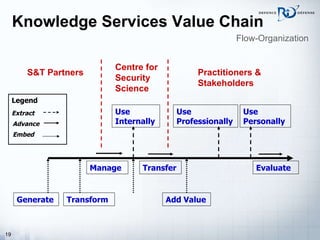
Knowledge Services Value Chain Flow-Organization Use Internally Use Professionally Use Personally Generate Transform Add Value Transfer Evaluate Manage Extract Advance Embed Legend S&T Partners Centre for Security Science Practitioners & Stakeholders
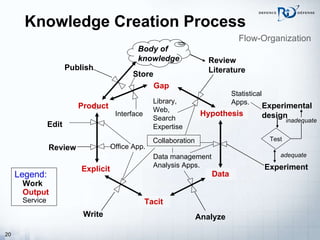
Knowledge Creation Process   Flow-Organization Statistical Apps. Store Analyze Body of knowledge Review Literature Experimental design Test Experiment inadequate adequate Write Review Publish Edit Hypothesis Data Tacit Explicit Product Gap Legend:   Work   Output   Service Library, Web, Search Expertise Office App. Data management Analysis Apps. Interface Collaboration
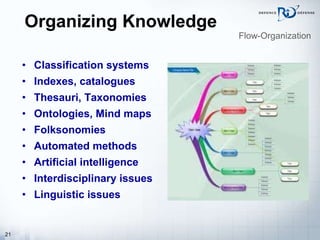
Organizing Knowledge   Classification systems Indexes, catalogues Thesauri, Taxonomies Ontologies, Mind maps Folksonomies Automated methods  Artificial intelligence Interdisciplinary issues Linguistic issues Flow-Organization
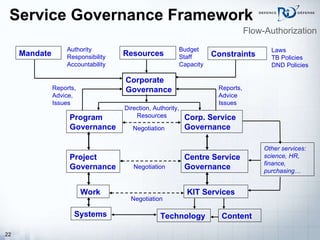
Service Governance   Framework Flow-Authorization Negotiation Negotiation Negotiation Direction, Authority, Resources Program   Governance Project Governance Work Systems Reports, Advice, Issues Corp. Service Governance Centre Service Governance KIT Services Technology Content Reports, Advice Issues Other services: science, HR, finance, purchasing… Mandate Resources Constraints Authority Responsibility Accountability Budget Staff Capacity Laws  TB Policies DND Policies Corporate Governance
Authorization Understanding   –  Keep it simple ; one message with stories and multiple analogies from different perspectives.   Experience   –  Do your homework ; pre-brief decision makers, solicit opinions, negotiate objections (to a point). Resources   –  Pick low-hanging fruit ; plan low cost, small effort, low impact activities.   Management   –  Think big, start small ; divide into small projects with measurable, high-impact deliverables.   Submission   –  Leadership is essential ; bypass unjustified objections, accept majority vote, authorize work. Flow-Authorization
Sustainability Leadership   – Outputs must be delivered within a leader’s tenure; preferably, get them institutionalized.   Governance   – Representative, federated decision making is the only sustainable governance for knowledge work. Reorganization  – Align a project/activity with the organizational business model.   Priorities   – Align the project/activity with the organization’s long-term strategy Support   – Deliver initial outputs when & as promised; be prepared to adapt to changing priorities. Culture   – Develop favorable policies, reward desired behavior, leverage work, implement helpful systems. Flow-Authorization
Outline Management Levels Knowledge Flow Individuals Communities Organization Authorization Management Regimes
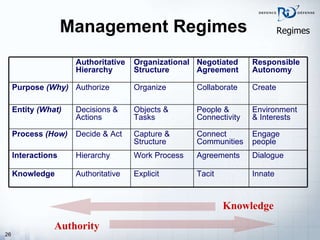
Management Regimes Regimes Dialogue Agreements Work Process Hierarchy Interactions Innate Tacit Explicit Authoritative Knowledge Create  Collaborate  Organize  Authorize Purpose  (Why) Engage people Connect Communities Capture & Structure Decide & Act  Process  (How) Environment & Interests People & Connectivity Objects & Tasks Decisions & Actions Entity  (What) Responsible Autonomy Negotiated Agreement Organizational Structure Authoritative Hierarchy Knowledge Authority
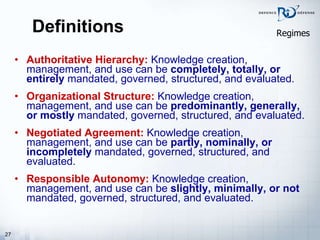
Definitions Authoritative Hierarchy:  Knowledge creation, management, and use can be  completely, totally, or entirely  mandated, governed, structured, and evaluated. Organizational Structure:  Knowledge creation, management, and use can be  predominantly, generally, or mostly  mandated, governed, structured, and evaluated. Negotiated Agreement:  Knowledge creation, management, and use can be  partly, nominally, or incompletely  mandated, governed, structured, and evaluated. Responsible Autonomy:  Knowledge creation, management, and use can be  slightly, minimally, or not  mandated, governed, structured, and evaluated. Regimes
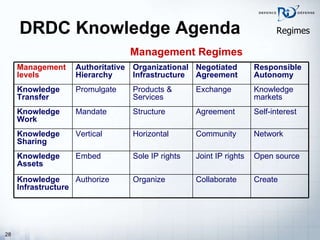
DRDC Knowledge Agenda Management Regimes Regimes Self-interest Agreement Structure Mandate Knowledge Work   Knowledge markets Exchange Products & Services Promulgate Knowledge Transfer Create Collaborate Organize Authorize Knowledge   Infrastructure Open source Joint IP rights Sole IP rights  Embed Knowledge Assets Vertical Authoritative Hierarchy Network Community Horizontal Knowledge Sharing Responsible Autonomy Negotiated Agreement Organizational Infrastructure Management levels
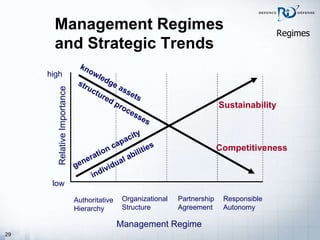
Management Regimes and Strategic Trends Regimes Authoritative Hierarchy Organizational Structure Partnership Agreement Responsible Autonomy knowledge assets generation capacity structured processes individual abilities Relative Importance high low Management Regime Competitiveness Sustainability
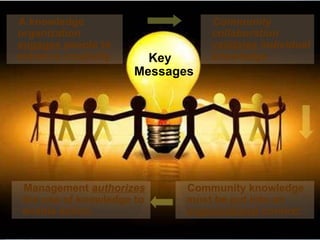
Key Messages Management  authorizes   the use of knowledge to enable action. A knowledge organization  engages  people to enhance creativity  Community collaboration  validates  individual knowledge Community knowledge must be put into an  organizational  context.

Knowledge agenda

  • 1.
    Albert Simard KnowledgeManager Defence R&D Canada Presented to 17 th Conference on Knowledge-Based organizations November 24-26, 2011 Becoming a Knowledge Organization
  • 2.
    Knowledge-Based Organizations KBOsare in the knowledge business. C reating and using knowledge is their core activity. Knowledge is a KBOs most valuable asset. They often spend 10 to 15 times more to create and use knowledge than on facilities, equipment, and infrastructure. KBOs must become knowledge organizations to remain relevant. They must create, manage , and use knowledge as a strategic resource.
  • 3.
    Outline Management LevelsKnowledge Flow Creation Validation Organization Authorization Management Regimes
  • 4.
    Knowledge Management LevelsLevels Knowledge Assets Knowledge Sharing Knowledge Work Knowledge Transfer Knowledge Infrastructure Stock Flow Business National Defence, National Security, Public Safety Defence R&D Canada Markets Resources Government
  • 5.
    Knowledge Infrastructure LevelsProcesses work routines lessons learned, best practices, People learning, motivation, rewards, incentives, staffing, skills Governance roles, responsibilities, authorities, resources Content, Services data, risk analysis, reports, monitoring, operations, policies Tools systems to capture, store, share, and process content
  • 6.
    Knowledge Assets Capture: Represent explicit or tacit knowledge on reproducible media Inventory : Find, list, and describe knowledge; map to business needs, value and prioritize Needs : What needs to be known to accomplish organizational goals; identify core knowledge Gaps : Difference between what is known and what needs to be known Preserve : organize, store, search & retrieval, maintain and migrate throughout life-cycle Levels
  • 7.
    Knowledge Sharing Exchange: Develop & implement internal systems to enable people to find and retrieve knowledge. Integrate : Combine diverse knowledge from many sources to create a holistic view of complex issues. Transfer : Disseminate knowledge from the organization to enable its use by partners, clients, and stakeholders. Monitor : Acquire knowledge from the environment to identify events and developments of interest to the organization. Levels
  • 8.
    DRDC Knowledge Work Levels Inputs Direction Monitoring Intelligence Needs Priorities Establishment Transformation Programs Services Acquire Create Develop Mobilize Learn Output Report Integration Innovation Mitigation Advice Adaptation Clients DND (management) (R & D)
  • 9.
    Knowledge Transfer Communications: one-way dissemination of approved messages and positions. Transaction : two-way exchanges of knowledge products & services. Parallel : Transferring knowledge products & services from or to two or more providers or users. Sequential : Multiple organizations sequentially produce and transfer knowledge products & services. Cyclic : Knowledge service “value chains” continuously create and transfer new knowledge. Network : Interactions among large numbers of participants in a “knowledge ecosystem.” Levels
  • 10.
    Outline Management LevelsKnowledge Flow Creation Validation Organization Authorization Management Regimes
  • 11.
    Organizational Knowledge FlowFlow Creation Validation Organization Authorization
  • 12.
    Incentives Compliance (you will) Pay, job security, duty, work ethic, penalties Military, manufacturing, law, regulation, policies Meet quotas, minimum standards, routine tasks Motivation (you’ll be rewarded) Ambition, challenges, bonuses, rewards, recognition Efficiency, productivity, quality Increases, improvements Engagement (would you like to?) Meaningfulness, ownership, self-esteem, enjoyment Creativity, innovation, discovery Commitment, involvement, willingness, enjoyment Flow-Creation
  • 13.
    Engagement Autonomy: (agreed task, flexible schedule, select technique, choose team) Mastery: (is a mindset, it takes time and effort, it is asymptotic) Purpose: (meaningful goals, words are important, policies) Daniel Pink (2009) Flow-Creation
  • 14.
    Eliciting Methods Conversations,discussions, dialogue (colleagues, peers) Questions & answers, problems & solutions (novice/expert) After-action reviews, lessons learned (event/group) Capture, document, interview, record (expert/facilitator) Extraction, identify, codify, organize (expert/know engineer) Advising, briefing, recommending (subordinate/superior) Teaching, educating, training (teacher/student) Storytelling, narratives, anecdotes (teller/listener) Explaining, demonstrating, describing (technician/user) Presentations, lectures, speeches (speaker/audience) Flow-Creation
  • 15.
    Communities Create &Validate Knowledge Knowledge exists in the minds of people. Experience is as important as formal knowledge. Knowledge is tacit as well as explicit. Transferring tacit knowledge is more effective through human interaction. Knowledge is social as well as individual. Today’s knowledge is the result of centuries of collective research. Knowledge is changing at an accelerating rate. It takes a community of people to keep up with new concepts, practices, and technology. Flow-Communities
  • 16.
    Community Benefits Participants- Help with their work - Solve problems - Find experts - Receive feedback - Place to learn - Latest information - Enhance reputation Management - Connect isolated experts - Coordinate activities - Fast problem solving - Reduce development time - Quickly answer questions - Standardize processes - Develop & retain talent Outputs - Tangible : documents, reports, manuals, recommendations, reduced innovation time and cost - Intangible : increased skills, sense of trust, diverse perspectives, cross-pollinate ideas, capacity to innovate, relationships, spirit of enquiry Flow-Communities
  • 17.
    Harvesting Methods Service Center: repository for community outputs; i nterface with communities, minimize duplication, inform communities Leader: transfer community outputs; I dentify emerging trends, prioritize issues Sponsor: endorse community outputs; bridge between the community and the organization, provide support, minimize organizational barriers Champion: ensure adoption of community outputs; communicate purpose, promote the community Flow-Communities
  • 18.
    Organizational Structure Flow-OrganizationTechnology support Manage Interface Content Research Social Common Governance direction
  • 19.
    Knowledge Services ValueChain Flow-Organization Use Internally Use Professionally Use Personally Generate Transform Add Value Transfer Evaluate Manage Extract Advance Embed Legend S&T Partners Centre for Security Science Practitioners & Stakeholders
  • 20.
    Knowledge Creation Process Flow-Organization Statistical Apps. Store Analyze Body of knowledge Review Literature Experimental design Test Experiment inadequate adequate Write Review Publish Edit Hypothesis Data Tacit Explicit Product Gap Legend: Work Output Service Library, Web, Search Expertise Office App. Data management Analysis Apps. Interface Collaboration
  • 21.
    Organizing Knowledge Classification systems Indexes, catalogues Thesauri, Taxonomies Ontologies, Mind maps Folksonomies Automated methods Artificial intelligence Interdisciplinary issues Linguistic issues Flow-Organization
  • 22.
    Service Governance Framework Flow-Authorization Negotiation Negotiation Negotiation Direction, Authority, Resources Program Governance Project Governance Work Systems Reports, Advice, Issues Corp. Service Governance Centre Service Governance KIT Services Technology Content Reports, Advice Issues Other services: science, HR, finance, purchasing… Mandate Resources Constraints Authority Responsibility Accountability Budget Staff Capacity Laws TB Policies DND Policies Corporate Governance
  • 23.
    Authorization Understanding – Keep it simple ; one message with stories and multiple analogies from different perspectives. Experience – Do your homework ; pre-brief decision makers, solicit opinions, negotiate objections (to a point). Resources – Pick low-hanging fruit ; plan low cost, small effort, low impact activities. Management – Think big, start small ; divide into small projects with measurable, high-impact deliverables. Submission – Leadership is essential ; bypass unjustified objections, accept majority vote, authorize work. Flow-Authorization
  • 24.
    Sustainability Leadership – Outputs must be delivered within a leader’s tenure; preferably, get them institutionalized. Governance – Representative, federated decision making is the only sustainable governance for knowledge work. Reorganization – Align a project/activity with the organizational business model. Priorities – Align the project/activity with the organization’s long-term strategy Support – Deliver initial outputs when & as promised; be prepared to adapt to changing priorities. Culture – Develop favorable policies, reward desired behavior, leverage work, implement helpful systems. Flow-Authorization
  • 25.
    Outline Management LevelsKnowledge Flow Individuals Communities Organization Authorization Management Regimes
  • 26.
    Management Regimes RegimesDialogue Agreements Work Process Hierarchy Interactions Innate Tacit Explicit Authoritative Knowledge Create Collaborate Organize Authorize Purpose (Why) Engage people Connect Communities Capture & Structure Decide & Act Process (How) Environment & Interests People & Connectivity Objects & Tasks Decisions & Actions Entity (What) Responsible Autonomy Negotiated Agreement Organizational Structure Authoritative Hierarchy Knowledge Authority
  • 27.
    Definitions Authoritative Hierarchy: Knowledge creation, management, and use can be completely, totally, or entirely mandated, governed, structured, and evaluated. Organizational Structure: Knowledge creation, management, and use can be predominantly, generally, or mostly mandated, governed, structured, and evaluated. Negotiated Agreement: Knowledge creation, management, and use can be partly, nominally, or incompletely mandated, governed, structured, and evaluated. Responsible Autonomy: Knowledge creation, management, and use can be slightly, minimally, or not mandated, governed, structured, and evaluated. Regimes
  • 28.
    DRDC Knowledge AgendaManagement Regimes Regimes Self-interest Agreement Structure Mandate Knowledge Work Knowledge markets Exchange Products & Services Promulgate Knowledge Transfer Create Collaborate Organize Authorize Knowledge Infrastructure Open source Joint IP rights Sole IP rights Embed Knowledge Assets Vertical Authoritative Hierarchy Network Community Horizontal Knowledge Sharing Responsible Autonomy Negotiated Agreement Organizational Infrastructure Management levels
  • 29.
    Management Regimes andStrategic Trends Regimes Authoritative Hierarchy Organizational Structure Partnership Agreement Responsible Autonomy knowledge assets generation capacity structured processes individual abilities Relative Importance high low Management Regime Competitiveness Sustainability
  • 30.
    Key Messages Management authorizes the use of knowledge to enable action. A knowledge organization engages people to enhance creativity Community collaboration validates individual knowledge Community knowledge must be put into an organizational context.

Editor's Notes

  • #4 This presentation is divided into three parts. We’ll start by describing why and how the knowledge services framework was developed. The knowledge organization will compare content management and knowledge service approaches for structuring knowledge management in an organizational context. The knowledge environment will consider how an organization interacts with its clients and, in the case of governments, with all citizens. So, let’s look at how the framework was developed.
  • #6 This is an organizational infrastructure that includes pretty much everything that is needed to run CSS. This applies to KM as well as anything else that we do. Simply put, people use tools and process within a governance structure to increase the value of content and services. It isn’t a matter of focussing on one or more parts of the infrastructure. All parts must be reflected in a task, project, or program if it is to succeed.
  • #11 This presentation is divided into three parts. We’ll start by describing why and how the knowledge services framework was developed. The knowledge organization will compare content management and knowledge service approaches for structuring knowledge management in an organizational context. The knowledge environment will consider how an organization interacts with its clients and, in the case of governments, with all citizens. So, let’s look at how the framework was developed.
  • #20 Many departments are mandated to produce content and to use it to achieve sector outcomes. Knowledge services show the flow of departmental outputs from generation through final use. We can think of the flow of services as a value chain, with several stages. Each stage involves one of three processes – embedding, advancing, and extracting value Four stages embed value; three advance it along the value chain, and three stages extract value from knowledge services. As previously, all of the organizational infrastructure and hierarchy are involved in every stage. The first five stages of the value chain are internal to a department – what can be managed. The last four stages relate to the sector and society – these can only be influenced. Content management is a key part of the management stage. The provider/user market model is represented by the vertical line between the organization and the sector. As you can see, knowledge services involve a lot more than transferring content. It also involves more than service delivery. Achieving sector outcomes and results for Canadians requires that the services be actually used to fulfill a want or need.
  • #22 There are many ways to organize knowledge, each with strengths and weaknesses. Librarians have been classifying knowledge since ancient times; departments do this through subject classification indexes. Every scientist is also familiar with discipline-specific thesauri for organizing terminology. These are, naturally, incompatible with departmental subject-based classification systems. Computers brought on automated keyword systems. Except that terms used by an author often don’t match those used by someone else. More recently, artificial intelligence has been used to developed “concept maps” of ideas rather than words. With Web 2.0 we are seeing “folksonomies,” where knowledge is organized by participants in social networks, based on popularity of usage. These are the bane of librarians and records managers. All of these methods are faced with interdisciplinary issues. For example, terms such as risk analysis have very specific meanings in the CFIA which differ from their meanings in other disciplines. And then there are familiar linguistic issues where terms don’t really have a counterpart in another language. The only solution is to provide multiple criteria for organizing and searching, so that regardless of a user’s perspective, they will find what they are looking for quickly and efficiently. Ultimately, if it isn’t easy, simple, and fast for people to organize their knowledge, the way they work , they won’t do it.
  • #24 Managers won’t fund what they don’t understand. Managers won’t abandon what worked (or didn’t) before. Managers will oppose loss of resources. Managers want short-term-low-risk deliverables.
  • #26 This presentation is divided into three parts. We’ll start by describing why and how the knowledge services framework was developed. The knowledge organization will compare content management and knowledge service approaches for structuring knowledge management in an organizational context. The knowledge environment will consider how an organization interacts with its clients and, in the case of governments, with all citizens. So, let’s look at how the framework was developed.