UNIT III.
Mother Tongue-Based Multilingual Education
Mother Tongue-Based Multilingual Education (MTB-MLE) is an education
that begins in the language that the learner speaks most fluently, and then
gradually introduces other languages. In the MTB-MLE system, a child’s first
language or mother tongue (often denoted as L1) is used to teach basic
reading, writing and academic material.
ESSENTIAL QUESTIONS
To understand better the lesson, use the following questions as
guide to process the bits of information in the following section.
1. What is MTB-MLE?
2. What is MTB-MLE provides?
3. How is the acquisition of learning languages ?
4. How we ended up adopting MTB-MLE?
5. What are the Lingua Franca?
6. What are the promises of MTB-MLE to the learners?
7. What are the theories in teaching MTB-MLE?
8. What is Culture?
EXPECTED OUTCOMES
At the end of the lesson, students are expected to:
1. Identify the different theories in teaching MTB-MLE
2. Justify the reason why there is a need for MTB-MLE to be established
3. Create a concept map focusing on the importance, theories and culture
we can get in teaching MTB-MLE
4. Learn the importance of using MTB-MLE
9. What are the elements of culture?
10. What are the national and international policies about mother tongue as
MOI?
11. What are the five knowledge of language?
EXPLORING CONTENT
To fully understand the content of the lesson, read fully the
explanation.
What is MTB-MLE?
 The Mother Tongue Based-Multilingual Education (MTB-MLE) is the
government’s banner program for education as a salient part of the
implementation of the K to 12 Basic Education Program. It was embodied
in the Department Order Number 74, series of 2009, an order
“Institutionalizing Mother Tongue-Based Multilingual Education
(MTB-MLE). Its significance is articulated in Republic Act 10532,
otherwise known as the “Enhanced Basic Education Act of 2013.”
 MTB-MLE is a formal or non-formal medium of communication, in which
the learner’s mother tongue and additional languages are used in the
classroom.
 The MTB-MLE is a program where the medium of instruction is the
mother tongue or the first language (L1) of the learners. In the
teaching-learning process, both the teacher and the learners use the
mother tongue in explaining the lesson.
 Mother Tongue instruction allows teachers and students to interact
naturally and negotiate meanings together, creating participatory learning
environments that are conducive to cognitive as well as linguistic
development.
MTB-MLE provides:
1. Literacy. We only learn to read once. Learning to read in the L1 develops
skills that transfer to reading any other languages. Comprehension in reading
other languages only focus after oral proficiency has developed such that
vocabulary of the written L2 text is already part of the learners' spoken
vocabulary.
2. Prior knowledge. Engaging learners in a discussion of what is already
familiar to them using the home language and culture enables better learning
of the curriculum tough integration and application of that knowledge into
current knowledge schemes.
3. Cognitive development and higher order thinking skills
(HOTS), Using the learners' mother tongue provides a strong foundation by
developing cognitive skills and comprehension of the academic content from
day one. MTB-MLE cultivates critical thinking through talking about ideas in
the familiar language.
4. Strong Bridge. MTB-MLE provides a good bridge to listening, speaking,
reading, and writing the L2s (L2, L3) of the classroom using sound
educational principles for building fluency and confidence in using the other
languages for lifelong learning.
Why MTB-MLE?
Acquisition
-The process of learning skills or getting knowledge
 Language learning is conscious or intentional process which may
involve studying the language, paying attention to grammar.
 Language acquisition is a natural process and involves ‘picking up’
language in a nonconscious way through exposure to language, not
by studying it.
 Children acquire their first language and get to know its rules
through exposure and by being exposed to examples of language and
by using it.
this part of the theory of “first language acquisition”.
 Second language acquisition is the process and study of the process,
by which people learn a language that is not their native language.
 Teachers and theorists believe that we do learn a second language by
“acquiring” or “picking up” a language, but there are some important
considerations for second language learners.
 second language learners acquire language through exposure to
many different examples of the language, by riding it, and by hearing
it.
 we listen and read and develop an understanding of language over a
period before we eventually use it ourselves.
 the periods, when learners are taking in language, processing it and
perhaps silently practicing it, is known as the “silent period” and is
thought to be an important state in language acquisition.
 once we use the language, it is important that there is an
opportunity for interaction, so we can use the language to
experiment, to make the language work in communication.
How we ended up adopting the MTB -MLE
- It all began with the Lingua Franca Education Project (LFEP)
 DECS embarked on a pilot study called Lingua Franca
Education Project in SY 1999-2000
 LFEP aimed to define and implement a national bridging
program from the vernacular to Filipino to English to develop
initial literacy for use in public schools.
 through the bridging program, an alternative curriculum will
be used in acquiring basic literacy and numeracy with the
local lingua franca as the language instruction.
 The pilot study involved two grade 1 classes from each of the
14 regions. One was the experimental class and the other the
control class.
Two grade 1 teachers from each of the experimental schools, together with the
principal, underwent training before the pilot study. One teacher handled the
grade 1 experimental class while the other taught that alternate class.
The Lingua Franca used in the pilot study were as follows:
- regions I, II, CAR – Ilocano
- Regions III, IV, V, VII, XII, NCR- Tagalog
- Regions VII, VIII, IX, X, XI, CARAGA- Cebuano
Since the LFEP, DECS Memo No. 144 s. 1999, Mother Tongue-Based
Multilingual Education Program is the most vital reform for the country ‘s
basic education and school system.
As researchers shows, ( Dutcher,1994: Tucker, 1998; Klaus, 2001;
Thomas, 2002: Dekker and Young, 2007; Durnnian, 2007; UNESCO 2007 b;
Dekker, Duquiang, 2008; Noorlander & Van, 2008)
- Quality education occurs most effectively when the mother tongue,
the learner’s home language, is used for initial learning;
 the first Language is the language of learning. It is by far the
easiest way for children to interact with the world. And when
the language of learning and language of instruction do not
much, learning difficulties are bound to follow (world bank,
2006, page 4)
MTB-MLE promises to the Learners;
- MTB MLE is a theoretically based and well-planned educational
program that provides a strong foundation for literacy using the
learners developing cognitive skills and comprehension of academic
content:
 Literacy
 prior knowledge
 cognitive development and higher order thinking skills
 Strong bridge
 Scaffolding
 teaching for meaning and accuracy.
confidence building and proficiency development for 2 or more language along
the macro skill and Communication.
Constructivitst Theory in Teaching MTB-MLE
What is Constructivism?
Constructivism is an important learning theory that educators use to help
their learners learn. Constructivism is based on the idea that people actively
construct or make their own knowledge, and that reality is determined by
your experiences as a learner.
Constructivism in Language Learning
It is an innovative approach in which students construct their knowledge
themselves through interaction with each-other on the basis of previous
experiences. It is student-centered rather than teacher-centered in which
teacher acts as a facilitator (Sharma and Poonam,2016).
Pillars of the Constructivist Learning Theory
Jean Piaget and Lev Vygotsky
Jean Piaget was born August 9, 1896, Neuchâtel, Switzerland—died
September 16, 1980, Geneva. Swiss psychologist who was the first to make a
systematic study of the acquisition of understanding in children. He is
thought by many to have been the major figure in 20th-century developmental
psychology.
Lev Vygotsky was born November 17, 1896, in Orsha, a city in the western
Russian Empire. In 1917, he earned a law degree at Moscow State University,
where he studied a range of topics including sociology, linguistics, psychology,
and philosophy.
Jean Piaget and Lev Vygotsky are two most recognized pillars of constructivist
learning theory. They puts high emphasis on how children acquire and
construct meaning. However, unlike the behaviorists, they do not view
children as empty vessels waiting to be filled by an expert and learned adult.
Constructivists argue that children are preformed to learn and acquire
language as they go through different developmental stages.
Jean Piaget’s Constructivist Theory
•Humans create knowledge through the interaction between their experiences
and ideas.
•Children are active learners who construct meaning from their environment.
COGNITIVE DEVELOPMENTAL THEORY
1. Sensorimotor stage (birth to 2 years old)
-The earliest stage of cognitive development. In this stage infant and toddlers
acquire knowledge through sensory experiences and manipulating objects.
-Object Permanence- the understanding that objects continue to exist even
when they cannot be seen.
A child who understands object permanence willl:
 Know their caregiver is still there when playing games such as Peek-A-Boo
 Know a toy still exists even if it is hidden under a blanket
 Understand they or their surroundings are still there even if they cover
their eyes
2.Preoperational Stage (2 to 7 years old)
-Kids learn to pretend play yet continue to think concretely about the world
around them.
-One of the hallmarks of this stage is emergence of language.
-Children still struggle with logic and taking the point of view of other people.
Some exaples a child is at the preoperational stage include:
 Imitating the way someone talks or moves even when they are not in the
room
 Drawing people and objects from their own life but understanding they are
only representations
 Pretending a stick is a sword or that a broom is a horse during play
 Imagining that they are a superhero or someone they admire
 Inventing an imaginary friend
3.Concrete Operational Stage (7 to 11 years old)
-While the children are still very concrete and literal in their thinking at this
point, they become much more adept at using logic.
-Thinking, however, can still be rigid and kids tend to struggle with abstract
and hypothetical concepts.
Examples
 Knowing that water has the same properties (e.g. wetness) even when it is
in different vessels or has a different color
 Understanding that water can freeze and then melt again but that other
canges are permanent
 Being able to organize crayons into groups based on their color
 Being able to sort their toys into order, based on their size or importance
4.Formal Operational Stage (12 years old and up)
-The final stage of Piaget’s theory involves an increase in logic, the ability to
use deductive reasoning, and an understanding of abstract ideas. At this
point, people become capable of seeing multiple potential solutions to
problems and think more scientifically about the world around them.
A child at the formal operational stage can think numerouz ways of solving a
single problem, the choose the best option based on how logical or
successful it is likely to be.
For example, if a child has to create a model of the solar system using
materials they have at home, there are a number of ways they could use them.
Thinking of several possibilities and then using the one that is most logical or
effective shows that they have hypothetical-deductive reasoning skills.
Children at this stage can also examine and evaluate their own thoughts and
actions. For example, if they argue with a friend, they can cnsider how their
opinions or behavior might have contributed. They can then decide how to
approach the situation.
Lev Vygotsky’s social constructivism
• Lev Vygotsky, conceive that individuals are active participants in the
creation of their own knowledge. Vygotsky believed that learning takes place
primarily in social and cultural settings, rather than solely within the
individual (Schreiber & Valle, 2013).
• Social constructivism suggest that successful teaching and learning is
heavily dependent on interpersonal interaction and discussion, with the
primary focus on the students understanding of the discussion (Prawat,
1992).
Zone of Proximal Development
 With the help of the instructor, students are able to understand and
master knowledge and skills that they would not be able to on their own
(Schreiber & Valle, 2013).
 Once the students master a particular skill they are able to complete it
independently.
Social constructivism
 Private speech, an act where children talk to themselves, is a good way
to turn shared knowledge into personal knowledge.
 Children should be taught to incorporate the speech of others and then
use that speech to help themselves solve problems.
 Cognitive development and the ability to use thought to control one’s
own action require first a mastery of cultural communication systems
to regulate one’s own thought processes.
Piaget’s view vs. Vygotsky view
If Piaget’s view of learning and language acquisition is centered on the,
children’s changes of logical thinking through stages based on maturation
and experience.
Vygotsky’s view is centered on the role of culture and social interactions of
children with other children and adults in the environment. Vygotsky even
argued that children’s speech is a major tool in their development of thinking.
Implications to teaching and learning MTB-MLE
• Teachers should first understand learning in the real world, organize it in
the most rational way possible and present it to the learners.
• Provide learners with activities, with hands-on learning, with opportunities
to experiment and manipulate objects of the world.
• Consider the learners as wonderful, individual living beings- each of whom
creates his/her own model to explain nature.
Guidelines for the Constructivist teacher
1. Learning is a process of learning by doing wherein the active
engagement of the learner in the process makes it an effective one.
2. Learning is a web process, as a learner is engaged in learning, the
learner also learns other concepts or procedures related to what is
being learned explicitly.
3. Learning is a mental process that involves actual doing and reflective
action.
UNDERSTANDING THE LOCAL CULTURE
What is CULTURE?
Culture is composed of may elements. Some of these are values,
language (Salvatore, 2012), symbols, objects (Watts, 1981), groups, and
norms (Hebdige, 2012). These elements may be classified into three: (1)
Sense-making, (2) Artifacts, and (3) Groups.
DEFINITIONS OF CULTURALLY-RESPONSIVE EDUCATION
 To use the experiences and frames of reference based on the diverse
culture of the students (Gay, 2010).
 An approach to education where the teacher integrates elements of the
students’ lifestyle and daily experiences in the instruction and the
curriculum (Taylor & Sobel, 2011).
 A type of pedagogy where teachers are competent in cross-cultural and
multicultural setting (Diller & Moule, 2005).
 Recognizes the uniqueness of the majority and the minority in the body
of the students (Cartledge, Gardner, & Ford, 2009… as cited in Taylor &
Sobel, 2011).
ELEMENTS OF CULTURE
 Sense-making
- It is the multiple representation of meaning of a given object, person, or
event. Different people provide different meanings to a certain object.
this may depend on their values and their language (Salvatore, 2012).
 Artifacts
- Is defined as anything belonging to a group of people that provides
information about the said group’s culture. It may include symbols,
traditional objects found in archeological sites, or more modern objects
like cellphones, televisions, laptops, etc. (Watts, 1981).
 Groups
- different cultures usually have sub-groups inside which are called
subcultures. These are groups that have their own norms and values
that sometimes retain a few of the parent culture’s general principles
(Hebdige, 2012).
KNOWING THE MOTHER TONGUE
International and National Policies About the Mother Tongue as Medium
of Instruction
1. United Nations Declaration on the Rights of Indigenous Peoples
(UNDRIP) Article 13 Section 1-2 and Article 14 Section 1
Article 13 Section 1
Indigenous Peoples have the right to revitalize use develop and transmit to
future generations their histories, language and oral traditions, philosophies
writing systems and literatures and to designate and retain their own names
for communities, places, and person.
Article 13 Section 2
States that take effective measure to ensure that this right is protected,
and that indigenous people can be understand and be understood in political
legal and administrative proceedings where necessary through the provision
of interpretation or by appropriate means.
Article 14 Section 1
Indigenous people have the right to establish and control their educational
system and institution providing them their own languages in a manner
appropriate to their cultural methods of teaching and learning.
2. The Declaration of the Rights of Persons Belonging to National or
Ethnic, Religions, and Linguistics Minorities of 1992
Reaffirming that one of the basic aims of the United Nations, as proclaimed
in the charter is to promote and encourage human rights for fundamental
freedom for all without distinction as to race , sex, language or religion .
Article 2 Section 1
Persons belonging to the Nation and Ethnic, Religious, and Linguistic
Minorities have the right to enjoy their own culture to profess and practice
their own religion and to use their own language in private and in public, freely
and without interference or any of discrimination.
3. RA 10157: The Kindergarten Education: Act of 2011
Section 5
• Adopt the Mother Tongue Based- Multilingual Education (MTB-MLE)
• The Mother Tongue is the primary medium of instruction for Teaching
and Learning in the Kindergarten.
4. RA 10533: Enhanced Basic Education: Act of 2013
Section 4
Composition Entrant Age
Kindergarten = 1year Prepatory Education = 5
years old
Elementary = 6 years Elementary = 6 years
old
Junior High School = 4 years Junior High School = 12 years
old
Senior Highschool = 2 years Senior High School = 16 years
old
Prepatory Education = 5 years old
K- Grade 3 = Regional or Native Language in instruction , teaching
materials and assessment
Section 5
Standards and Principles in Developing the Enhanced Basic Education
Curriculum.
To achieve an effective enhanced basic education curriculum, the DepED
shall undertake consultations with other national government agencies and
other stakeholders including, but not limited to, the Department of Labor and
Employment (DOLE), the Professional Regulation Commission (PRC), the
private and public schools associations, the national student organizations,
the national teacher organizations, the parents-teachers associations and the
chambers of commerce on matters affecting the concerned stakeholders.
The DepED shall adhere to the following standards and principles in
developing the enhanced basic education curriculum:
(a) The curriculum shall be learner-centered, inclusive and developmentally
appropriate;
(b) The curriculum shall be relevant, responsive and research-based;
(c) The curriculum shall be culture-sensitive;
(d) The curriculum shall be contextualized and global;
(e) The curriculum shall use pedagogical approaches that are constructivist,
inquiry-based, reflective, collaborative and integrative;
(f) The curriculum shall adhere to the principles and framework of Mother
Tongue-Based Multilingual Education (MTB-MLE) which starts from where
the learners are and from what they already knew proceeding from the known
to the unknown; instructional materials and capable teachers to implement
the MTB-MLE curriculum shall be available;
(g) The curriculum shall use the spiral progression approach to ensure
mastery of knowledge and skills after each level; and
(h) The curriculum shall be flexible enough to enable and allow schools to
localize, indigenize and enhance the same based on their respective
educational and social contexts. The production and development of locally
produced teaching materials shall be encouraged and approval of these
materials shall devolve to the regional and division education units.
WHAT IS MOTHER TONGUE?
Nelson Mandela
A highly influential South Africa political leader was once quoted saying “if
you talk to a man in a language he understands, that goes in his heads. If you
talk to him in his language, that goes to his heart “(BBC NEWS)
The mother tongue or any language, may be studied and understood through
different aspects. It may be examined using the five knowledge of the language
which are:
Phonology
Morphology
Syntax
Semantics
Pragmatics
1. PHONOLOGY - defined as the study of patterns in speech sound and. It
consists of knowing about the sounds of a language of describing the said
sound (Brentani, Fenlon, and Comier 2018)
a. Phonemes – Distinctive units of sound within a language. Example: N =
Nanang
b. Allophones – The different ways to pronounce a single phoneme. For
instance, in the word “top’’, the “t” is usually pronounced as a “ th” .
2. MORPHOLOGY - is defined as the rules of language that govern word
formation
a. Morpheme – the smallest unit of word that has information about the
word’s meaning and purpose. For example the word “farmer”, there are 2
morphemes which are “Farm” (Former) and “er” ( latter) .
Mannalon – ‘’Mann” (letter) and ‘’alon ‘’ (Former) from the rootwrod of
“Taltalon ‘’.
b. Rootword – a term that form the basis of another word. These are usually
nouns, verbs, adjectives, or adverbs.
Examples: Agpagna, Mother –in – law, Socialization,
b. Affixes – morphemes placed either at the beginning, middle, or ent of the
root word
Types of Affixes
Prefix (Panneket Sango) = “ Ag”( prefix) and “ pagna”(root word)
Infix ( Pannekt Tinga)= “Mother” “law” ( rootword) and “ –in- “ ( infix)
Suffix ( Panneket likod) = “ Social “ ( rootword) and “ ization “ ( suffix)
c. Compound word – a combination of two root words to form a new meaning
( O’Grady , Archibald, 2016)
Example : Mother-in-law ‘’ Mother “ and “law “ ( root words)
3. Syntax- Is defined as the set of statutes and principles that govern
sentence structure and a word order in a language ( Chomsky , and
Lightfoot , 20020)
a. Common Order - Subject comes before the predicate. Example, Ni Mario
ket nagaget nga ubing.
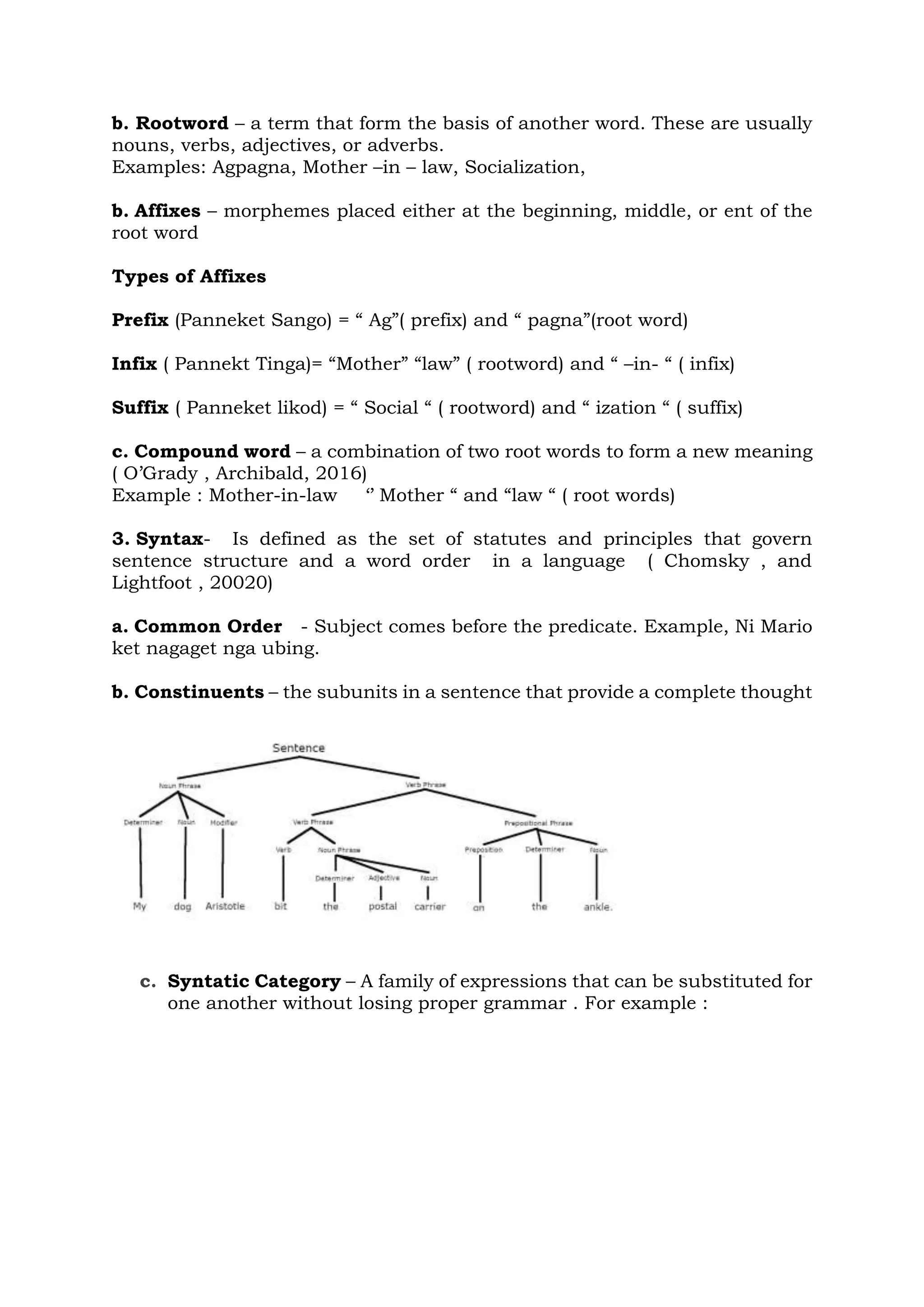
b. Constinuents – the subunits in a sentence that provide a complete thought
c. Syntatic Category – A family of expressions that can be substituted for
one another without losing proper grammar . For example :
4. SEMANTICS - defined as a study of linguistic meaning .
a. Anomaly – a situation when specific words or phrases cannot be combined
to make sense.
For example, “Colorless green “ does not make sense . Another “ Iti yelo ket
napudot. “
b. Metaphor – a figure of speech where one object or idea is used to refer to
another object or idea for rhetorical purposes (Meriam –webster Dictionary)
For example: Ti Sarita a nangegak ket kasla musika iti lapayagko.
c. Idioms – expressions established by societal norms to have meaning aside
from what is literally indicates (Tom, 1992)
For example: In Ilocano , we do not say “ Go home Early” but we say
“Aggian ka ditan ! Uray dita ka agnanayunen! “
5. PRAGMATICS- defined as the study of unseen or hidden meanings in
different languages apart from its content . This meaning is provided by the
context and a pre-existing knowledge of the perceiver about the utterance.
Physical Context – an actual location ,apart of the utterance, that provides
the context . For example :
Linguistic Context – the context provided by the utterance itself
Deixis – words that cannot be identified without the context
Example: here , there, him , her, yesterday , and tomorrow.
References– the act of which the speaker specifies an orientation or a
position for the deixis .
Inference - the perceiver’s use of additional information not provided in the
utterance in order to understand the message .
f. Anaphora – Another term , for instance a pronoun , used to identify an
object that is being referred to for the second time
EXPANDING SKILLS
Enhancement activity for understanding.
ENRICHING SKILLS
To have a further understanding about the lesson, do the
following:
TRUE OR FALSE
Direction: Read the statements carefully and tell whether the statement
is TRUE or FALSE.
1. Mtb- mle is a formal medium of communication, in which the learner’s
mother tongue and additional languages are used in the classroom. F
2. Mother Tongue instruction allows teachers and students to interact
naturally and negotiate meanings together. T
3. Mtb provides higher order thinking skills and cognitive development. T
4. Vygostsky view of learning and language acquisition is centered on the,
children’s changes of logical thinking through stages based on maturation
and experience. F
5. Piaget’s even argued that children’s speech is a major tool in their
development of thinking. F
6. There are three elements of culture.T
7. United Nations Declaration on the Rights of Indigenous Peoples Article 11
Section 1-2 and Article 12 Section 1. F
8. Article 13 Section 1 Peoples have the right to revitalize use develop and
transmit to future generations their histories, language and oral traditions. T
Create a concept map focusing on the importance, theories and culture
we can get in teaching MTB-MLE
9. RA 10157 is the Education Act of 2011 Section 5. F
10. The curriculum shall be learner-centered, inclusive and developmentally
appropriate. T
11. The curriculum shall adhere to the principles and framework of Mother
Tongue-Based Multilingual Education (MTB-MLE). T
12. Phonology defined as the study of patterns in speech sound and. It
consists of knowing about the sounds of a language of describing the said
sound. T
13. Constinuents the subunits in a sentence that provide a complete thought.
T
14. There are two types of affixes. F
15. Pragmatic is defined as a study of linguistic meaning . F
REFERENCES
https://youtu.be/b7574gwR7_l?feature=shared
https://www.studocu.com/ph/document/palawan-state-university/educati
on/mother-tongue-cg-curriculum-guide/46092482
https://www.slideshare.net/menchiellagas/mother-tongue-miltilingual-edu
cation-mtbmle

MTB-MLE Unit 3 (Group 3 Knowing L1).docx

  • 1.
    UNIT III. Mother Tongue-BasedMultilingual Education Mother Tongue-Based Multilingual Education (MTB-MLE) is an education that begins in the language that the learner speaks most fluently, and then gradually introduces other languages. In the MTB-MLE system, a child’s first language or mother tongue (often denoted as L1) is used to teach basic reading, writing and academic material. ESSENTIAL QUESTIONS To understand better the lesson, use the following questions as guide to process the bits of information in the following section. 1. What is MTB-MLE? 2. What is MTB-MLE provides? 3. How is the acquisition of learning languages ? 4. How we ended up adopting MTB-MLE? 5. What are the Lingua Franca? 6. What are the promises of MTB-MLE to the learners? 7. What are the theories in teaching MTB-MLE? 8. What is Culture? EXPECTED OUTCOMES At the end of the lesson, students are expected to: 1. Identify the different theories in teaching MTB-MLE 2. Justify the reason why there is a need for MTB-MLE to be established 3. Create a concept map focusing on the importance, theories and culture we can get in teaching MTB-MLE 4. Learn the importance of using MTB-MLE
  • 2.
    9. What arethe elements of culture? 10. What are the national and international policies about mother tongue as MOI? 11. What are the five knowledge of language? EXPLORING CONTENT To fully understand the content of the lesson, read fully the explanation. What is MTB-MLE?  The Mother Tongue Based-Multilingual Education (MTB-MLE) is the government’s banner program for education as a salient part of the implementation of the K to 12 Basic Education Program. It was embodied in the Department Order Number 74, series of 2009, an order “Institutionalizing Mother Tongue-Based Multilingual Education (MTB-MLE). Its significance is articulated in Republic Act 10532, otherwise known as the “Enhanced Basic Education Act of 2013.”  MTB-MLE is a formal or non-formal medium of communication, in which the learner’s mother tongue and additional languages are used in the classroom.  The MTB-MLE is a program where the medium of instruction is the mother tongue or the first language (L1) of the learners. In the teaching-learning process, both the teacher and the learners use the mother tongue in explaining the lesson.  Mother Tongue instruction allows teachers and students to interact naturally and negotiate meanings together, creating participatory learning environments that are conducive to cognitive as well as linguistic development. MTB-MLE provides: 1. Literacy. We only learn to read once. Learning to read in the L1 develops skills that transfer to reading any other languages. Comprehension in reading other languages only focus after oral proficiency has developed such that vocabulary of the written L2 text is already part of the learners' spoken vocabulary.
  • 3.
    2. Prior knowledge.Engaging learners in a discussion of what is already familiar to them using the home language and culture enables better learning of the curriculum tough integration and application of that knowledge into current knowledge schemes. 3. Cognitive development and higher order thinking skills (HOTS), Using the learners' mother tongue provides a strong foundation by developing cognitive skills and comprehension of the academic content from day one. MTB-MLE cultivates critical thinking through talking about ideas in the familiar language. 4. Strong Bridge. MTB-MLE provides a good bridge to listening, speaking, reading, and writing the L2s (L2, L3) of the classroom using sound educational principles for building fluency and confidence in using the other languages for lifelong learning. Why MTB-MLE? Acquisition -The process of learning skills or getting knowledge  Language learning is conscious or intentional process which may involve studying the language, paying attention to grammar.  Language acquisition is a natural process and involves ‘picking up’ language in a nonconscious way through exposure to language, not by studying it.  Children acquire their first language and get to know its rules through exposure and by being exposed to examples of language and by using it. this part of the theory of “first language acquisition”.  Second language acquisition is the process and study of the process, by which people learn a language that is not their native language.  Teachers and theorists believe that we do learn a second language by “acquiring” or “picking up” a language, but there are some important considerations for second language learners.  second language learners acquire language through exposure to many different examples of the language, by riding it, and by hearing it.  we listen and read and develop an understanding of language over a period before we eventually use it ourselves.  the periods, when learners are taking in language, processing it and perhaps silently practicing it, is known as the “silent period” and is thought to be an important state in language acquisition.
  • 4.
     once weuse the language, it is important that there is an opportunity for interaction, so we can use the language to experiment, to make the language work in communication. How we ended up adopting the MTB -MLE - It all began with the Lingua Franca Education Project (LFEP)  DECS embarked on a pilot study called Lingua Franca Education Project in SY 1999-2000  LFEP aimed to define and implement a national bridging program from the vernacular to Filipino to English to develop initial literacy for use in public schools.  through the bridging program, an alternative curriculum will be used in acquiring basic literacy and numeracy with the local lingua franca as the language instruction.  The pilot study involved two grade 1 classes from each of the 14 regions. One was the experimental class and the other the control class. Two grade 1 teachers from each of the experimental schools, together with the principal, underwent training before the pilot study. One teacher handled the grade 1 experimental class while the other taught that alternate class. The Lingua Franca used in the pilot study were as follows: - regions I, II, CAR – Ilocano - Regions III, IV, V, VII, XII, NCR- Tagalog - Regions VII, VIII, IX, X, XI, CARAGA- Cebuano Since the LFEP, DECS Memo No. 144 s. 1999, Mother Tongue-Based Multilingual Education Program is the most vital reform for the country ‘s basic education and school system. As researchers shows, ( Dutcher,1994: Tucker, 1998; Klaus, 2001; Thomas, 2002: Dekker and Young, 2007; Durnnian, 2007; UNESCO 2007 b; Dekker, Duquiang, 2008; Noorlander & Van, 2008) - Quality education occurs most effectively when the mother tongue, the learner’s home language, is used for initial learning;
  • 5.
     the firstLanguage is the language of learning. It is by far the easiest way for children to interact with the world. And when the language of learning and language of instruction do not much, learning difficulties are bound to follow (world bank, 2006, page 4) MTB-MLE promises to the Learners; - MTB MLE is a theoretically based and well-planned educational program that provides a strong foundation for literacy using the learners developing cognitive skills and comprehension of academic content:  Literacy  prior knowledge  cognitive development and higher order thinking skills  Strong bridge  Scaffolding  teaching for meaning and accuracy. confidence building and proficiency development for 2 or more language along the macro skill and Communication. Constructivitst Theory in Teaching MTB-MLE What is Constructivism? Constructivism is an important learning theory that educators use to help their learners learn. Constructivism is based on the idea that people actively construct or make their own knowledge, and that reality is determined by your experiences as a learner. Constructivism in Language Learning It is an innovative approach in which students construct their knowledge themselves through interaction with each-other on the basis of previous experiences. It is student-centered rather than teacher-centered in which teacher acts as a facilitator (Sharma and Poonam,2016). Pillars of the Constructivist Learning Theory Jean Piaget and Lev Vygotsky Jean Piaget was born August 9, 1896, Neuchâtel, Switzerland—died September 16, 1980, Geneva. Swiss psychologist who was the first to make a systematic study of the acquisition of understanding in children. He is thought by many to have been the major figure in 20th-century developmental psychology.
  • 6.
    Lev Vygotsky wasborn November 17, 1896, in Orsha, a city in the western Russian Empire. In 1917, he earned a law degree at Moscow State University, where he studied a range of topics including sociology, linguistics, psychology, and philosophy. Jean Piaget and Lev Vygotsky are two most recognized pillars of constructivist learning theory. They puts high emphasis on how children acquire and construct meaning. However, unlike the behaviorists, they do not view children as empty vessels waiting to be filled by an expert and learned adult. Constructivists argue that children are preformed to learn and acquire language as they go through different developmental stages. Jean Piaget’s Constructivist Theory •Humans create knowledge through the interaction between their experiences and ideas. •Children are active learners who construct meaning from their environment. COGNITIVE DEVELOPMENTAL THEORY 1. Sensorimotor stage (birth to 2 years old) -The earliest stage of cognitive development. In this stage infant and toddlers acquire knowledge through sensory experiences and manipulating objects. -Object Permanence- the understanding that objects continue to exist even when they cannot be seen. A child who understands object permanence willl:  Know their caregiver is still there when playing games such as Peek-A-Boo  Know a toy still exists even if it is hidden under a blanket  Understand they or their surroundings are still there even if they cover their eyes 2.Preoperational Stage (2 to 7 years old) -Kids learn to pretend play yet continue to think concretely about the world around them. -One of the hallmarks of this stage is emergence of language. -Children still struggle with logic and taking the point of view of other people. Some exaples a child is at the preoperational stage include:  Imitating the way someone talks or moves even when they are not in the room
  • 7.
     Drawing peopleand objects from their own life but understanding they are only representations  Pretending a stick is a sword or that a broom is a horse during play  Imagining that they are a superhero or someone they admire  Inventing an imaginary friend 3.Concrete Operational Stage (7 to 11 years old) -While the children are still very concrete and literal in their thinking at this point, they become much more adept at using logic. -Thinking, however, can still be rigid and kids tend to struggle with abstract and hypothetical concepts. Examples  Knowing that water has the same properties (e.g. wetness) even when it is in different vessels or has a different color  Understanding that water can freeze and then melt again but that other canges are permanent  Being able to organize crayons into groups based on their color  Being able to sort their toys into order, based on their size or importance 4.Formal Operational Stage (12 years old and up) -The final stage of Piaget’s theory involves an increase in logic, the ability to use deductive reasoning, and an understanding of abstract ideas. At this point, people become capable of seeing multiple potential solutions to problems and think more scientifically about the world around them. A child at the formal operational stage can think numerouz ways of solving a single problem, the choose the best option based on how logical or successful it is likely to be. For example, if a child has to create a model of the solar system using materials they have at home, there are a number of ways they could use them. Thinking of several possibilities and then using the one that is most logical or effective shows that they have hypothetical-deductive reasoning skills. Children at this stage can also examine and evaluate their own thoughts and actions. For example, if they argue with a friend, they can cnsider how their opinions or behavior might have contributed. They can then decide how to approach the situation. Lev Vygotsky’s social constructivism • Lev Vygotsky, conceive that individuals are active participants in the creation of their own knowledge. Vygotsky believed that learning takes place
  • 8.
    primarily in socialand cultural settings, rather than solely within the individual (Schreiber & Valle, 2013). • Social constructivism suggest that successful teaching and learning is heavily dependent on interpersonal interaction and discussion, with the primary focus on the students understanding of the discussion (Prawat, 1992). Zone of Proximal Development  With the help of the instructor, students are able to understand and master knowledge and skills that they would not be able to on their own (Schreiber & Valle, 2013).  Once the students master a particular skill they are able to complete it independently. Social constructivism  Private speech, an act where children talk to themselves, is a good way to turn shared knowledge into personal knowledge.  Children should be taught to incorporate the speech of others and then use that speech to help themselves solve problems.  Cognitive development and the ability to use thought to control one’s own action require first a mastery of cultural communication systems to regulate one’s own thought processes. Piaget’s view vs. Vygotsky view If Piaget’s view of learning and language acquisition is centered on the, children’s changes of logical thinking through stages based on maturation and experience. Vygotsky’s view is centered on the role of culture and social interactions of children with other children and adults in the environment. Vygotsky even argued that children’s speech is a major tool in their development of thinking. Implications to teaching and learning MTB-MLE • Teachers should first understand learning in the real world, organize it in the most rational way possible and present it to the learners. • Provide learners with activities, with hands-on learning, with opportunities to experiment and manipulate objects of the world. • Consider the learners as wonderful, individual living beings- each of whom creates his/her own model to explain nature.
  • 9.
    Guidelines for theConstructivist teacher 1. Learning is a process of learning by doing wherein the active engagement of the learner in the process makes it an effective one. 2. Learning is a web process, as a learner is engaged in learning, the learner also learns other concepts or procedures related to what is being learned explicitly. 3. Learning is a mental process that involves actual doing and reflective action. UNDERSTANDING THE LOCAL CULTURE What is CULTURE? Culture is composed of may elements. Some of these are values, language (Salvatore, 2012), symbols, objects (Watts, 1981), groups, and norms (Hebdige, 2012). These elements may be classified into three: (1) Sense-making, (2) Artifacts, and (3) Groups. DEFINITIONS OF CULTURALLY-RESPONSIVE EDUCATION  To use the experiences and frames of reference based on the diverse culture of the students (Gay, 2010).  An approach to education where the teacher integrates elements of the students’ lifestyle and daily experiences in the instruction and the curriculum (Taylor & Sobel, 2011).  A type of pedagogy where teachers are competent in cross-cultural and multicultural setting (Diller & Moule, 2005).  Recognizes the uniqueness of the majority and the minority in the body of the students (Cartledge, Gardner, & Ford, 2009… as cited in Taylor & Sobel, 2011). ELEMENTS OF CULTURE  Sense-making - It is the multiple representation of meaning of a given object, person, or event. Different people provide different meanings to a certain object. this may depend on their values and their language (Salvatore, 2012).  Artifacts - Is defined as anything belonging to a group of people that provides information about the said group’s culture. It may include symbols, traditional objects found in archeological sites, or more modern objects like cellphones, televisions, laptops, etc. (Watts, 1981).  Groups
  • 10.
    - different culturesusually have sub-groups inside which are called subcultures. These are groups that have their own norms and values that sometimes retain a few of the parent culture’s general principles (Hebdige, 2012). KNOWING THE MOTHER TONGUE International and National Policies About the Mother Tongue as Medium of Instruction 1. United Nations Declaration on the Rights of Indigenous Peoples (UNDRIP) Article 13 Section 1-2 and Article 14 Section 1 Article 13 Section 1 Indigenous Peoples have the right to revitalize use develop and transmit to future generations their histories, language and oral traditions, philosophies writing systems and literatures and to designate and retain their own names for communities, places, and person. Article 13 Section 2 States that take effective measure to ensure that this right is protected, and that indigenous people can be understand and be understood in political legal and administrative proceedings where necessary through the provision of interpretation or by appropriate means. Article 14 Section 1 Indigenous people have the right to establish and control their educational system and institution providing them their own languages in a manner appropriate to their cultural methods of teaching and learning. 2. The Declaration of the Rights of Persons Belonging to National or Ethnic, Religions, and Linguistics Minorities of 1992 Reaffirming that one of the basic aims of the United Nations, as proclaimed in the charter is to promote and encourage human rights for fundamental freedom for all without distinction as to race , sex, language or religion . Article 2 Section 1 Persons belonging to the Nation and Ethnic, Religious, and Linguistic Minorities have the right to enjoy their own culture to profess and practice their own religion and to use their own language in private and in public, freely and without interference or any of discrimination. 3. RA 10157: The Kindergarten Education: Act of 2011 Section 5 • Adopt the Mother Tongue Based- Multilingual Education (MTB-MLE) • The Mother Tongue is the primary medium of instruction for Teaching and Learning in the Kindergarten.
  • 11.
    4. RA 10533:Enhanced Basic Education: Act of 2013 Section 4 Composition Entrant Age Kindergarten = 1year Prepatory Education = 5 years old Elementary = 6 years Elementary = 6 years old Junior High School = 4 years Junior High School = 12 years old Senior Highschool = 2 years Senior High School = 16 years old Prepatory Education = 5 years old K- Grade 3 = Regional or Native Language in instruction , teaching materials and assessment Section 5 Standards and Principles in Developing the Enhanced Basic Education Curriculum. To achieve an effective enhanced basic education curriculum, the DepED shall undertake consultations with other national government agencies and other stakeholders including, but not limited to, the Department of Labor and Employment (DOLE), the Professional Regulation Commission (PRC), the private and public schools associations, the national student organizations, the national teacher organizations, the parents-teachers associations and the chambers of commerce on matters affecting the concerned stakeholders. The DepED shall adhere to the following standards and principles in developing the enhanced basic education curriculum: (a) The curriculum shall be learner-centered, inclusive and developmentally appropriate; (b) The curriculum shall be relevant, responsive and research-based; (c) The curriculum shall be culture-sensitive; (d) The curriculum shall be contextualized and global; (e) The curriculum shall use pedagogical approaches that are constructivist, inquiry-based, reflective, collaborative and integrative; (f) The curriculum shall adhere to the principles and framework of Mother Tongue-Based Multilingual Education (MTB-MLE) which starts from where the learners are and from what they already knew proceeding from the known to the unknown; instructional materials and capable teachers to implement the MTB-MLE curriculum shall be available;
  • 12.
    (g) The curriculumshall use the spiral progression approach to ensure mastery of knowledge and skills after each level; and (h) The curriculum shall be flexible enough to enable and allow schools to localize, indigenize and enhance the same based on their respective educational and social contexts. The production and development of locally produced teaching materials shall be encouraged and approval of these materials shall devolve to the regional and division education units. WHAT IS MOTHER TONGUE? Nelson Mandela A highly influential South Africa political leader was once quoted saying “if you talk to a man in a language he understands, that goes in his heads. If you talk to him in his language, that goes to his heart “(BBC NEWS) The mother tongue or any language, may be studied and understood through different aspects. It may be examined using the five knowledge of the language which are: Phonology Morphology Syntax Semantics Pragmatics 1. PHONOLOGY - defined as the study of patterns in speech sound and. It consists of knowing about the sounds of a language of describing the said sound (Brentani, Fenlon, and Comier 2018) a. Phonemes – Distinctive units of sound within a language. Example: N = Nanang b. Allophones – The different ways to pronounce a single phoneme. For instance, in the word “top’’, the “t” is usually pronounced as a “ th” . 2. MORPHOLOGY - is defined as the rules of language that govern word formation a. Morpheme – the smallest unit of word that has information about the word’s meaning and purpose. For example the word “farmer”, there are 2 morphemes which are “Farm” (Former) and “er” ( latter) . Mannalon – ‘’Mann” (letter) and ‘’alon ‘’ (Former) from the rootwrod of “Taltalon ‘’.
  • 13.
    b. Rootword –a term that form the basis of another word. These are usually nouns, verbs, adjectives, or adverbs. Examples: Agpagna, Mother –in – law, Socialization, b. Affixes – morphemes placed either at the beginning, middle, or ent of the root word Types of Affixes Prefix (Panneket Sango) = “ Ag”( prefix) and “ pagna”(root word) Infix ( Pannekt Tinga)= “Mother” “law” ( rootword) and “ –in- “ ( infix) Suffix ( Panneket likod) = “ Social “ ( rootword) and “ ization “ ( suffix) c. Compound word – a combination of two root words to form a new meaning ( O’Grady , Archibald, 2016) Example : Mother-in-law ‘’ Mother “ and “law “ ( root words) 3. Syntax- Is defined as the set of statutes and principles that govern sentence structure and a word order in a language ( Chomsky , and Lightfoot , 20020) a. Common Order - Subject comes before the predicate. Example, Ni Mario ket nagaget nga ubing. b. Constinuents – the subunits in a sentence that provide a complete thought c. Syntatic Category – A family of expressions that can be substituted for one another without losing proper grammar . For example :
  • 14.
    4. SEMANTICS -defined as a study of linguistic meaning . a. Anomaly – a situation when specific words or phrases cannot be combined to make sense. For example, “Colorless green “ does not make sense . Another “ Iti yelo ket napudot. “ b. Metaphor – a figure of speech where one object or idea is used to refer to another object or idea for rhetorical purposes (Meriam –webster Dictionary) For example: Ti Sarita a nangegak ket kasla musika iti lapayagko. c. Idioms – expressions established by societal norms to have meaning aside from what is literally indicates (Tom, 1992) For example: In Ilocano , we do not say “ Go home Early” but we say “Aggian ka ditan ! Uray dita ka agnanayunen! “ 5. PRAGMATICS- defined as the study of unseen or hidden meanings in different languages apart from its content . This meaning is provided by the context and a pre-existing knowledge of the perceiver about the utterance. Physical Context – an actual location ,apart of the utterance, that provides the context . For example : Linguistic Context – the context provided by the utterance itself Deixis – words that cannot be identified without the context Example: here , there, him , her, yesterday , and tomorrow. References– the act of which the speaker specifies an orientation or a position for the deixis . Inference - the perceiver’s use of additional information not provided in the utterance in order to understand the message . f. Anaphora – Another term , for instance a pronoun , used to identify an object that is being referred to for the second time
  • 15.
    EXPANDING SKILLS Enhancement activityfor understanding. ENRICHING SKILLS To have a further understanding about the lesson, do the following: TRUE OR FALSE Direction: Read the statements carefully and tell whether the statement is TRUE or FALSE. 1. Mtb- mle is a formal medium of communication, in which the learner’s mother tongue and additional languages are used in the classroom. F 2. Mother Tongue instruction allows teachers and students to interact naturally and negotiate meanings together. T 3. Mtb provides higher order thinking skills and cognitive development. T 4. Vygostsky view of learning and language acquisition is centered on the, children’s changes of logical thinking through stages based on maturation and experience. F 5. Piaget’s even argued that children’s speech is a major tool in their development of thinking. F 6. There are three elements of culture.T 7. United Nations Declaration on the Rights of Indigenous Peoples Article 11 Section 1-2 and Article 12 Section 1. F 8. Article 13 Section 1 Peoples have the right to revitalize use develop and transmit to future generations their histories, language and oral traditions. T Create a concept map focusing on the importance, theories and culture we can get in teaching MTB-MLE
  • 16.
    9. RA 10157is the Education Act of 2011 Section 5. F 10. The curriculum shall be learner-centered, inclusive and developmentally appropriate. T 11. The curriculum shall adhere to the principles and framework of Mother Tongue-Based Multilingual Education (MTB-MLE). T 12. Phonology defined as the study of patterns in speech sound and. It consists of knowing about the sounds of a language of describing the said sound. T 13. Constinuents the subunits in a sentence that provide a complete thought. T 14. There are two types of affixes. F 15. Pragmatic is defined as a study of linguistic meaning . F REFERENCES https://youtu.be/b7574gwR7_l?feature=shared https://www.studocu.com/ph/document/palawan-state-university/educati on/mother-tongue-cg-curriculum-guide/46092482 https://www.slideshare.net/menchiellagas/mother-tongue-miltilingual-edu cation-mtbmle