Jyruss Regalado
Information Technology in
Knowledge Management
What is knowledge management?
• Knowledge management (KM) is the process of organizing, creating, using, and sharing collective
knowledge within an organization.
• Successful knowledge management includes maintaining information in a place where it is easy to
access, like a wiki or employee intranet.
Types of knowledge
management
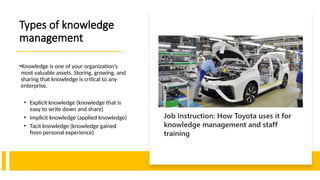
•Knowledge is one of your organization’s
most valuable assets. Storing, growing, and
sharing that knowledge is critical to any
enterprise.
• Explicit knowledge (knowledge that is
easy to write down and share)
• ‍
Implicit knowledge (applied knowledge)
• Tacit knowledge (knowledge gained
from personal experience)
Today, Toyota has hundreds of JI documents in use to
make a single car.
• A JI document must contain 3 elements:
• Important steps – the sequential order of steps to complete
a task
• Key points – any extra information regarding how to save
time, or avoid mistakes
• Reasons – the line of reasoning behind the key points, such
as what the result of errors would be
Knowledge
management
process
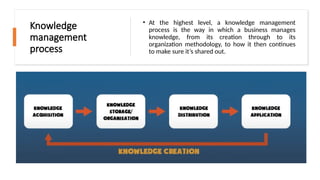
• At the highest level, a knowledge management
process is the way in which a business manages
knowledge, from its creation through to its
organization methodology, to how it then continues
to make sure it’s shared out.
How a knowledge management system helps
organizations
• When an organization is able to easily access, share, and update
business knowledge, it can become more productive and cost-
efficient.
• The ability to access the right knowledge at the right time, via a
robust knowledge management system, informs accurate decision-
making and stimulates collaboration and innovation.
Benefits of a knowledge management system
• Faster decision-making
• Efficient access to knowledge and information
• Increased collaboration and idea generation
• Enhanced communication throughout your organization
• Improved quality of information and data
• More security for intellectual property
• Optimized training
Why is knowledge management important?
• Increases efficiency and productivity
• Enables informed decision-making
• Reduces duplicate or outdated information
• Prevents company silos
What kind of information is captured in
knowledge management?
• Documents
• Company handbooks
• Benefits breakdown
• Product FAQs
• Holiday calendars
• Release notes
• Team Data
• Strategy
• Competitor briefs
• Product development timelines
• Presentation tactics
• Works in progress
• Best practices
• Organizational Data
• Org charts
• Procurement flows
• Individual contract information
• Office location and contact information
• Brand information
• Organizational News
• Company media mentions
• Information technology (IT) updates
• All-hands updates
• Upcoming promotions
• NPS scores and insights
• Promotion updates
Why knowledge management fails
• Holding onto knowledge. Some employees may want to hoard
knowledge to maintain a particular position or level of importance
within a company, while others may just not have time, interest, or
a place to share it.
• Searching is time-consuming. When companies lack a single source
of truth, information can be spread across too many different apps.
• Information is outdated.
Knowledge
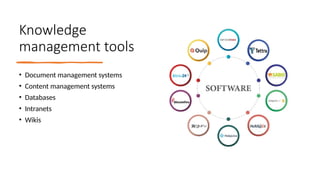
management tools
• Document management systems
• Content management systems
• Databases
• Intranets
• Wikis
Enterprise-wide knowledge management
systems
• It involve efforts across the organization to collect, store, and use
disseminated Knowledge in streamlined workflows.
• Structured knowledge systems
• Semi-structured knowledge systems
• knowledge network systems
Typical examples of Knowledge
management systems
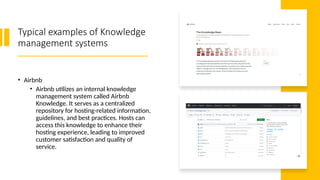
• Airbnb
• Airbnb utilizes an internal knowledge
management system called Airbnb
Knowledge. It serves as a centralized
repository for hosting-related information,
guidelines, and best practices. Hosts can
access this knowledge to enhance their
hosting experience, leading to improved
customer satisfaction and quality of
service.
Typical examples of Knowledge
management systems
• Amazon Web Services
• Amazon employs an advanced knowledge
management system known as Repost to
provide critical answers for Amazon Web
Service customers. There is training
materials, documentation, and best
practices across various departments and
functions.
Conclusion
• Information technology in knowledge management is a powerful
tool that enables organizations to capture, store, and share valuable
information effectively. By leveraging IT, companies can enhance
decision-making, foster innovation, and improve efficiency. However,
successful implementation requires a clear strategy, investment in
training, and a culture that values knowledge sharing.
• As technology continues to evolve, the role of information
technology in knowledge management will only grow in importance.
Organizations that embrace these advancements and integrate
them into their KM strategies will be better positioned to thrive in an
increasingly competitive business environment. By staying ahead of
the curve and leveraging the latest IT tools, companies can unlock
the full potential of their knowledge and achieve long-term success.

IT in Knowledge Managementttttttttt.pptx

  • 1.
  • 2.
    What is knowledgemanagement? • Knowledge management (KM) is the process of organizing, creating, using, and sharing collective knowledge within an organization. • Successful knowledge management includes maintaining information in a place where it is easy to access, like a wiki or employee intranet.
  • 3.
    Types of knowledge management •Knowledgeis one of your organization’s most valuable assets. Storing, growing, and sharing that knowledge is critical to any enterprise. • Explicit knowledge (knowledge that is easy to write down and share) • ‍ Implicit knowledge (applied knowledge) • Tacit knowledge (knowledge gained from personal experience)
  • 4.
    Today, Toyota hashundreds of JI documents in use to make a single car. • A JI document must contain 3 elements: • Important steps – the sequential order of steps to complete a task • Key points – any extra information regarding how to save time, or avoid mistakes • Reasons – the line of reasoning behind the key points, such as what the result of errors would be
  • 5.
    Knowledge management process • At thehighest level, a knowledge management process is the way in which a business manages knowledge, from its creation through to its organization methodology, to how it then continues to make sure it’s shared out.
  • 6.
    How a knowledgemanagement system helps organizations • When an organization is able to easily access, share, and update business knowledge, it can become more productive and cost- efficient. • The ability to access the right knowledge at the right time, via a robust knowledge management system, informs accurate decision- making and stimulates collaboration and innovation.
  • 7.
    Benefits of aknowledge management system • Faster decision-making • Efficient access to knowledge and information • Increased collaboration and idea generation • Enhanced communication throughout your organization • Improved quality of information and data • More security for intellectual property • Optimized training
  • 8.
    Why is knowledgemanagement important? • Increases efficiency and productivity • Enables informed decision-making • Reduces duplicate or outdated information • Prevents company silos
  • 9.
    What kind ofinformation is captured in knowledge management? • Documents • Company handbooks • Benefits breakdown • Product FAQs • Holiday calendars • Release notes • Team Data • Strategy • Competitor briefs • Product development timelines • Presentation tactics • Works in progress • Best practices • Organizational Data • Org charts • Procurement flows • Individual contract information • Office location and contact information • Brand information • Organizational News • Company media mentions • Information technology (IT) updates • All-hands updates • Upcoming promotions • NPS scores and insights • Promotion updates
  • 10.
    Why knowledge managementfails • Holding onto knowledge. Some employees may want to hoard knowledge to maintain a particular position or level of importance within a company, while others may just not have time, interest, or a place to share it. • Searching is time-consuming. When companies lack a single source of truth, information can be spread across too many different apps. • Information is outdated.
  • 11.
    Knowledge management tools • Documentmanagement systems • Content management systems • Databases • Intranets • Wikis
  • 12.
    Enterprise-wide knowledge management systems •It involve efforts across the organization to collect, store, and use disseminated Knowledge in streamlined workflows. • Structured knowledge systems • Semi-structured knowledge systems • knowledge network systems
  • 13.
    Typical examples ofKnowledge management systems • Airbnb • Airbnb utilizes an internal knowledge management system called Airbnb Knowledge. It serves as a centralized repository for hosting-related information, guidelines, and best practices. Hosts can access this knowledge to enhance their hosting experience, leading to improved customer satisfaction and quality of service.
  • 14.
    Typical examples ofKnowledge management systems • Amazon Web Services • Amazon employs an advanced knowledge management system known as Repost to provide critical answers for Amazon Web Service customers. There is training materials, documentation, and best practices across various departments and functions.
  • 15.
    Conclusion • Information technologyin knowledge management is a powerful tool that enables organizations to capture, store, and share valuable information effectively. By leveraging IT, companies can enhance decision-making, foster innovation, and improve efficiency. However, successful implementation requires a clear strategy, investment in training, and a culture that values knowledge sharing. • As technology continues to evolve, the role of information technology in knowledge management will only grow in importance. Organizations that embrace these advancements and integrate them into their KM strategies will be better positioned to thrive in an increasingly competitive business environment. By staying ahead of the curve and leveraging the latest IT tools, companies can unlock the full potential of their knowledge and achieve long-term success.

Editor's Notes

  • #3  When looking at it from this perspective, knowledge management's meaning includes the process that helps you acquire, organize, and share: Toyota distinguishes between explicit and tacit knowledge: explicit knowledge is data, instructions, and procedures that can be captured in words and numbers. Tacit knowledge is gained by experience, resides in the minds of experts, and is harder to transmit to others. To share tacit knowledge internally, Toyota came up with the JI Document to standardize production, improve safety, and ensure quality.
  • #5 Knowledge creation. Knowledge creation starts with knowledge acquisition. This knowledge may come from many sources, including employees within an organization or outside individuals that are brought in for knowledge or expertise on a specific subject. As knowledge is acquired, the next step is to understand what knowledge will be used for, how it will be applied and where it’s applicable. Knowledge organization. The knowledge must then be structured in a knowledge management system for future use. This knowledge must not only be organized, but it also needs to include security features so that knowledge can be accessed by authorized personnel when needed. This knowledge organization process is an important part of knowledge management because without it, knowledge becomes disorganized and has no structure, making it difficult or impossible to find in the future when knowledge is needed. Knowledge sharing. The knowledge organization process is completed by knowledge sharing. This knowledge sharing includes everything from knowledge training to knowledge exchange, where knowledge can be acquired or enhanced through knowledge discussions with other employees in an organization.
  • #7 The more effectively and efficiently a company shares its information with its employees, the better the business will perform. The benefits of knowledge management include:
  • #8 Done well, knowledge management streamlines company knowledge, making it accessible and actionable for everyone in the organization. Think about all the hours wasted searching through multiple systems trying to find the information you need. Was it in chat, a document, or email? When you do find that information, how do you know it's correct when company knowledge is scattered across all these systems? And when do people who are constantly interrupted actually get key work done?   A company that has knowledge transparency across the entire organization ensures that everyone is working with the same information and toward the same goals. It unites all employees, making sure they have all the information they need to make the best decisions possible.  After you’ve spent time searching for information and finally found it, how can you tell that it's the most reliable and recent information? When company information lives across multiple systems, you run the risk of making decisions or referencing information that isn’t accurate. A single source of truth like Guru creates a space for reliable information to live so you can adapt faster and keep resilient without the risk of using outdated information. Good knowledge management removes the risk of information silos and encourages a culture of transparency and communication. An information silo is when information is only known to one person or team, potentially preventing other departments from knowing the information they need to collaborate effectively. 
  • #10 In a 2015 piece for the Wall Street Journal, Thomas H. Davenport, a business analytics expert, explained that there are many reasons why KM has historically failed, but the main reasons are threefold: In all of these cases, information doesn't get documented, which means it can't be widely disseminated. If an employee doesn't know where to look or has to look in too many places for an answer, they may simply stop looking, and start relying on colleagues to get them answers quickly. If knowledge management processes are primarily used for document storage instead of knowledge application, old information proliferates making looking for the right answer exceedingly difficult. In this case, again, employees simply stop relying on the knowledge base.
  • #11 These systems act as centralized digital filing cabinets for company documents. They make retrieving documents easy, support regulatory compliance, and enhance workflow. In addition, when a document management system is enhanced with passwords and backup procedures, document security is enhanced, but not thoroughly protected from outside access.  Content management systems are similar to document management systems, but store audio, video, and other media types in addition to documents. A database is a computer application that allows people to capture, store, analyze, and interact with data. Data stored in databases can be very secure because the system prohibits manipulation. However, they can be volatile and are often costly to design and set up. They also require a high level of skill to use and maintain. These private computer networks built on searchable platforms can provide an easily accessible resource for information that enhances collaboration and social networking within your enterprise. These web pages are easy-to-use collaborative tools that allow anyone to publish and store information in a central location. They can be good places to maintain business documents or product catalogues. However, because they can be openly edited, wikis can often include wrong information. In addition, they aren’t optimized to show what information within them is being viewed or used or where knowledge gaps exist.
  • #12 Typically, there are three types of enterprise-wide knowledge management systems: structured knowledge systems, semi-structured knowledge systems, and knowledge network systems. Structured knowledge systems provide employees with access to tools and databases no matter where they are. This knowledge system serves as the central hub of communication within the organization, where everyone across various departments can view information on employees, case studies, best practices, procedural guidelines, and more. Semi-structured knowledge systems store and track semi-structured knowledge such as videos, images, and emails that cannot be integrated into formal documents. Some companies use solutions like Squarespace, Wix, or WordPress for managing semi-structured content. Finally, knowledge network systems are exclusive to certain members within an organization. This network system transforms undocumented and unstructured information into one that can be stored in a central database. This is similar to a database that maintains answers from experts on several problems.