WORKING CAPITAL MANAGEMENT ANALYSIS
(March 2012 – March 2016)
Thakur Institute of Management Studies and
Research
(Sunday , 9 October, 2016)
Presented by
Mr. Manish Tripathi ( I – 15-18-19)
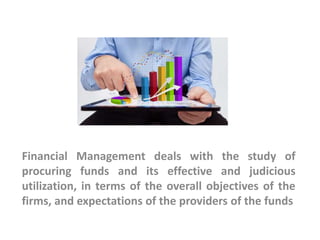
Financial Management deals with the study of
procuring funds and its effective and judicious
utilization, in terms of the overall objectives of the
firms, and expectations of the providers of the funds
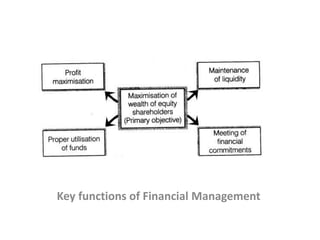
Key functions of Financial Management
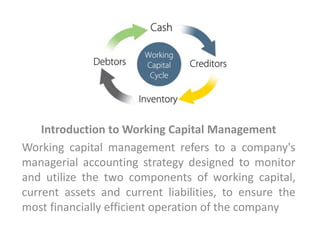
Introduction to Working Capital Management
Working capital management refers to a company's
managerial accounting strategy designed to monitor
and utilize the two components of working capital,
current assets and current liabilities, to ensure the
most financially efficient operation of the company
Ratios used in Working Capital Management
Current ratio / working capital ratio
This ratio is an indication of the firm’s commitment to
meet its short term commitment to meet its short
term liabilities. To gauge this ability, the current ratio
considers the current total assets of a company (both
liquid and illiquid) relative to that company’s current
total liabilities
Current Ratio = Currents Assets / Current Liabilities
Quick ratio/ Liquid ratio / acid test ratio
It is a ratio of absolute liquid assets to current liabilities.
In the computation of this ratio only the absolute liquid
assets are compared with the liquid liabilities. Quick
assets are current assets that can be converted to cash
within 90 days or in the short-term.
Quick Ratio = quick Assets / quick liabilities
Quick assets= current assets- stock – pre-paid expenses
quick liabilities= current liabilities – bank over draft
Cash ratio
The cash ratio or cash coverage ratio is a liquidity ratio
that measures a firm's ability to pay off its current
liabilities with only cash and cash equivalents. A cash ratio
of 0.2 would mean that for every rupee the company
owes creditors in the next 12 months it has 0.2 in cash.
Cash Ratio = (Cash + Cash equivalent) / Current Liabilities
Tata Consultancy Services (TCS) is a global
leader in IT services, digital and business
solutions that partners with its clients to
simplify, strengthen and transform their
businesses.
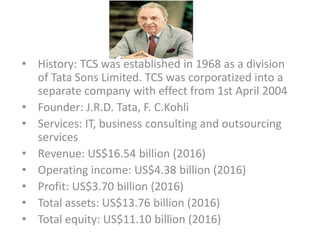
• History: TCS was established in 1968 as a division
of Tata Sons Limited. TCS was corporatized into a
separate company with effect from 1st April 2004
• Founder: J.R.D. Tata, F. C.Kohli
• Services: IT, business consulting and outsourcing
services
• Revenue: US$16.54 billion (2016)
• Operating income: US$4.38 billion (2016)
• Profit: US$3.70 billion (2016)
• Total assets: US$13.76 billion (2016)
• Total equity: US$11.10 billion (2016)
• Number of employees: 362,079 (Aug 2016)
• Number of women employees: 1,15,000+ (Aug 2016)
• Number of employees nationalities: 125+
• Leadership Team
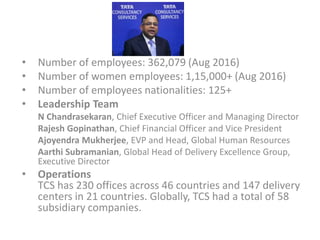
N Chandrasekaran, Chief Executive Officer and Managing Director
Rajesh Gopinathan, Chief Financial Officer and Vice President
Ajoyendra Mukherjee, EVP and Head, Global Human Resources
Aarthi Subramanian, Global Head of Delivery Excellence Group,
Executive Director
• Operations
TCS has 230 offices across 46 countries and 147 delivery
centers in 21 countries. Globally, TCS had a total of 58
subsidiary companies.
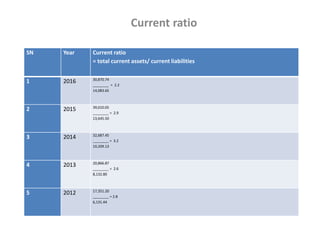
Current ratio
SN Year Current ratio
= total current assets/ current liabilities
1 2016 30,870.74
________ = 2.2
14,083.65
2 2015 39,010.05
________ = 2.9
13,645.50
3 2014 32,687.45
________ = 3.2
10,209.13
4 2013 20,866.87
________ = 2.6
8,132.80
5 2012 17,351.20
________ = 2.8
6,131.44
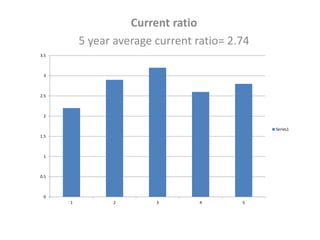
Current ratio
5 year average current ratio= 2.74
0
0.5
1
1.5
2
2.5
3
3.5
1 2 3 4 5
Series1
Current ratio
Observations and comments:
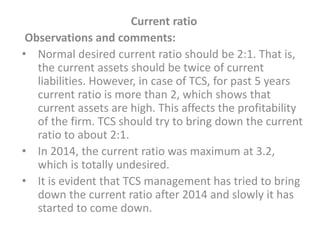
• Normal desired current ratio should be 2:1. That is,
the current assets should be twice of current
liabilities. However, in case of TCS, for past 5 years
current ratio is more than 2, which shows that
current assets are high. This affects the profitability
of the firm. TCS should try to bring down the current
ratio to about 2:1.
• In 2014, the current ratio was maximum at 3.2,
which is totally undesired.
• It is evident that TCS management has tried to bring
down the current ratio after 2014 and slowly it has
started to come down.
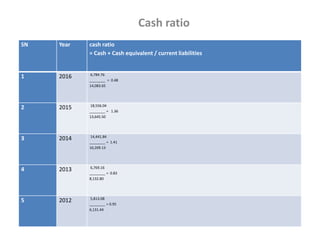
Cash ratio
SN Year cash ratio
= Cash + Cash equivalent / current liabilities
1 2016 6,784.76
________ = 0.48
14,083.65
2 2015 18,556.04
________ = 1.36
13,645.50
3 2014 14,441.84
________ = 1.41
10,209.13
4 2013 6,769.16
________ = 0.83
8,132.80
5 2012 5,813.08
________ = 0.95
6,131.44
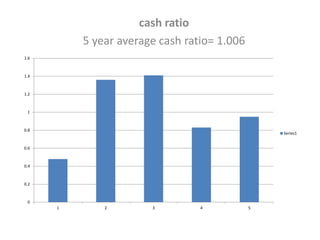
cash ratio
5 year average cash ratio= 1.006
0
0.2
0.4
0.6
0.8
1
1.2
1.4
1.6
1 2 3 4 5
Series1
Cash ratio
Observations and comments:
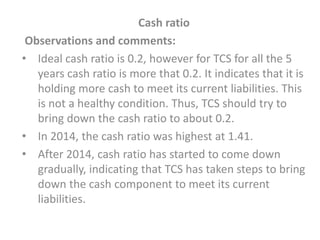
• Ideal cash ratio is 0.2, however for TCS for all the 5
years cash ratio is more that 0.2. It indicates that it is
holding more cash to meet its current liabilities. This
is not a healthy condition. Thus, TCS should try to
bring down the cash ratio to about 0.2.
• In 2014, the cash ratio was highest at 1.41.
• After 2014, cash ratio has started to come down
gradually, indicating that TCS has taken steps to bring
down the cash component to meet its current
liabilities.
Quick ratio
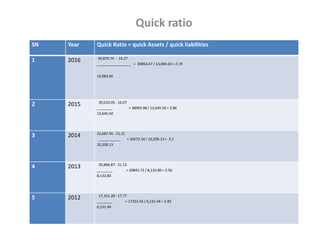
SN Year Quick Ratio = quick Assets / quick liabilities
1 2016 30,870.74 - 16.27
_________________ = 30854.47 / 14,083.65 = 2.19
14,083.65
2 2015 39,010.05 - 16.07
________ = 38993.98 / 13,645.50 = 2.86
13,645.50
3 2014 32,687.45 - 15.21
___________ = 32672.24 / 10,209.13 = 3.2
10,209.13
4 2013 20,866.87 - 21.15
________ = 20845.72 / 8,132.80 = 2.56
8,132.80
5 2012 17,351.20 - 17.77
________ = 17333.43 / 6,131.44 = 2.83
6,131.44
Quick ratio
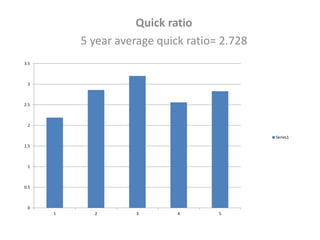
5 year average quick ratio= 2.728
0
0.5
1
1.5
2
2.5
3
3.5
1 2 3 4 5
Series1
Quick ratio
Observations and comments:
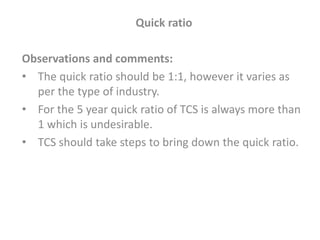
• The quick ratio should be 1:1, however it varies as
per the type of industry.
• For the 5 year quick ratio of TCS is always more than
1 which is undesirable.
• TCS should take steps to bring down the quick ratio.
Conclusion
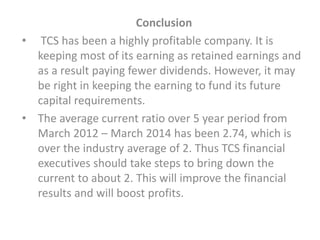
• TCS has been a highly profitable company. It is
keeping most of its earning as retained earnings and
as a result paying fewer dividends. However, it may
be right in keeping the earning to fund its future
capital requirements.
• The average current ratio over 5 year period from
March 2012 – March 2014 has been 2.74, which is
over the industry average of 2. Thus TCS financial
executives should take steps to bring down the
current to about 2. This will improve the financial
results and will boost profits.
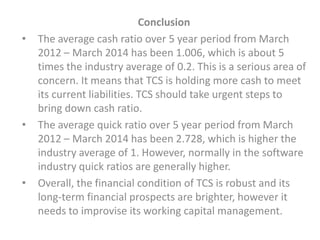
Conclusion
• The average cash ratio over 5 year period from March
2012 – March 2014 has been 1.006, which is about 5
times the industry average of 0.2. This is a serious area of
concern. It means that TCS is holding more cash to meet
its current liabilities. TCS should take urgent steps to
bring down cash ratio.
• The average quick ratio over 5 year period from March
2012 – March 2014 has been 2.728, which is higher the
industry average of 1. However, normally in the software
industry quick ratios are generally higher.
• Overall, the financial condition of TCS is robust and its
long-term financial prospects are brighter, however it
needs to improvise its working capital management.
Manish tripathi-tcs-financial-management-9 october2016

Manish tripathi-tcs-financial-management-9 october2016

  • 1.
    WORKING CAPITAL MANAGEMENTANALYSIS (March 2012 – March 2016) Thakur Institute of Management Studies and Research (Sunday , 9 October, 2016) Presented by Mr. Manish Tripathi ( I – 15-18-19)
  • 2.
    Financial Management dealswith the study of procuring funds and its effective and judicious utilization, in terms of the overall objectives of the firms, and expectations of the providers of the funds
  • 3.
    Key functions ofFinancial Management
  • 4.
    Introduction to WorkingCapital Management Working capital management refers to a company's managerial accounting strategy designed to monitor and utilize the two components of working capital, current assets and current liabilities, to ensure the most financially efficient operation of the company
  • 5.
    Ratios used inWorking Capital Management
  • 6.
    Current ratio /working capital ratio This ratio is an indication of the firm’s commitment to meet its short term commitment to meet its short term liabilities. To gauge this ability, the current ratio considers the current total assets of a company (both liquid and illiquid) relative to that company’s current total liabilities Current Ratio = Currents Assets / Current Liabilities
  • 7.
    Quick ratio/ Liquidratio / acid test ratio It is a ratio of absolute liquid assets to current liabilities. In the computation of this ratio only the absolute liquid assets are compared with the liquid liabilities. Quick assets are current assets that can be converted to cash within 90 days or in the short-term. Quick Ratio = quick Assets / quick liabilities Quick assets= current assets- stock – pre-paid expenses quick liabilities= current liabilities – bank over draft
  • 8.
    Cash ratio The cashratio or cash coverage ratio is a liquidity ratio that measures a firm's ability to pay off its current liabilities with only cash and cash equivalents. A cash ratio of 0.2 would mean that for every rupee the company owes creditors in the next 12 months it has 0.2 in cash. Cash Ratio = (Cash + Cash equivalent) / Current Liabilities
  • 9.
    Tata Consultancy Services(TCS) is a global leader in IT services, digital and business solutions that partners with its clients to simplify, strengthen and transform their businesses.
  • 10.
    • History: TCSwas established in 1968 as a division of Tata Sons Limited. TCS was corporatized into a separate company with effect from 1st April 2004 • Founder: J.R.D. Tata, F. C.Kohli • Services: IT, business consulting and outsourcing services • Revenue: US$16.54 billion (2016) • Operating income: US$4.38 billion (2016) • Profit: US$3.70 billion (2016) • Total assets: US$13.76 billion (2016) • Total equity: US$11.10 billion (2016)
  • 11.
    • Number ofemployees: 362,079 (Aug 2016) • Number of women employees: 1,15,000+ (Aug 2016) • Number of employees nationalities: 125+ • Leadership Team N Chandrasekaran, Chief Executive Officer and Managing Director Rajesh Gopinathan, Chief Financial Officer and Vice President Ajoyendra Mukherjee, EVP and Head, Global Human Resources Aarthi Subramanian, Global Head of Delivery Excellence Group, Executive Director • Operations TCS has 230 offices across 46 countries and 147 delivery centers in 21 countries. Globally, TCS had a total of 58 subsidiary companies.
  • 12.
    Current ratio SN YearCurrent ratio = total current assets/ current liabilities 1 2016 30,870.74 ________ = 2.2 14,083.65 2 2015 39,010.05 ________ = 2.9 13,645.50 3 2014 32,687.45 ________ = 3.2 10,209.13 4 2013 20,866.87 ________ = 2.6 8,132.80 5 2012 17,351.20 ________ = 2.8 6,131.44
  • 13.
    Current ratio 5 yearaverage current ratio= 2.74 0 0.5 1 1.5 2 2.5 3 3.5 1 2 3 4 5 Series1
  • 14.
    Current ratio Observations andcomments: • Normal desired current ratio should be 2:1. That is, the current assets should be twice of current liabilities. However, in case of TCS, for past 5 years current ratio is more than 2, which shows that current assets are high. This affects the profitability of the firm. TCS should try to bring down the current ratio to about 2:1. • In 2014, the current ratio was maximum at 3.2, which is totally undesired. • It is evident that TCS management has tried to bring down the current ratio after 2014 and slowly it has started to come down.
  • 15.
    Cash ratio SN Yearcash ratio = Cash + Cash equivalent / current liabilities 1 2016 6,784.76 ________ = 0.48 14,083.65 2 2015 18,556.04 ________ = 1.36 13,645.50 3 2014 14,441.84 ________ = 1.41 10,209.13 4 2013 6,769.16 ________ = 0.83 8,132.80 5 2012 5,813.08 ________ = 0.95 6,131.44
  • 16.
    cash ratio 5 yearaverage cash ratio= 1.006 0 0.2 0.4 0.6 0.8 1 1.2 1.4 1.6 1 2 3 4 5 Series1
  • 17.
    Cash ratio Observations andcomments: • Ideal cash ratio is 0.2, however for TCS for all the 5 years cash ratio is more that 0.2. It indicates that it is holding more cash to meet its current liabilities. This is not a healthy condition. Thus, TCS should try to bring down the cash ratio to about 0.2. • In 2014, the cash ratio was highest at 1.41. • After 2014, cash ratio has started to come down gradually, indicating that TCS has taken steps to bring down the cash component to meet its current liabilities.
  • 18.
    Quick ratio SN YearQuick Ratio = quick Assets / quick liabilities 1 2016 30,870.74 - 16.27 _________________ = 30854.47 / 14,083.65 = 2.19 14,083.65 2 2015 39,010.05 - 16.07 ________ = 38993.98 / 13,645.50 = 2.86 13,645.50 3 2014 32,687.45 - 15.21 ___________ = 32672.24 / 10,209.13 = 3.2 10,209.13 4 2013 20,866.87 - 21.15 ________ = 20845.72 / 8,132.80 = 2.56 8,132.80 5 2012 17,351.20 - 17.77 ________ = 17333.43 / 6,131.44 = 2.83 6,131.44
  • 19.
    Quick ratio 5 yearaverage quick ratio= 2.728 0 0.5 1 1.5 2 2.5 3 3.5 1 2 3 4 5 Series1
  • 20.
    Quick ratio Observations andcomments: • The quick ratio should be 1:1, however it varies as per the type of industry. • For the 5 year quick ratio of TCS is always more than 1 which is undesirable. • TCS should take steps to bring down the quick ratio.
  • 21.
    Conclusion • TCS hasbeen a highly profitable company. It is keeping most of its earning as retained earnings and as a result paying fewer dividends. However, it may be right in keeping the earning to fund its future capital requirements. • The average current ratio over 5 year period from March 2012 – March 2014 has been 2.74, which is over the industry average of 2. Thus TCS financial executives should take steps to bring down the current to about 2. This will improve the financial results and will boost profits.
  • 22.
    Conclusion • The averagecash ratio over 5 year period from March 2012 – March 2014 has been 1.006, which is about 5 times the industry average of 0.2. This is a serious area of concern. It means that TCS is holding more cash to meet its current liabilities. TCS should take urgent steps to bring down cash ratio. • The average quick ratio over 5 year period from March 2012 – March 2014 has been 2.728, which is higher the industry average of 1. However, normally in the software industry quick ratios are generally higher. • Overall, the financial condition of TCS is robust and its long-term financial prospects are brighter, however it needs to improvise its working capital management.