Using social media to harness knowledge within an organisation:  Addressing the challenges Keith De La Rue AcKnowledge Consulting Friday, 15 August 2008
Outline Understanding the social media revolution Where are we, and where are we going? Understanding the tools in a business context Fundamentals The power of social networking, people & trust Harnessing Web 2.0 for results Challenges, benefits and risks The IT challenge Gaining the benefits
How will we do this? Cover a mixture of theory and practice Multiple sources We all have something to offer Please all feel free to participate Talk about your own experiences Talk about what you have learnt here We need to share our knowledge! Stop and ask questions if anything is unclear Tell me if we need to move on
My turn first… Keith De La Rue AcKnowledge Consulting, Melbourne Primary focus on sales force efficiency Knowledge Management role Knowledge transfer on changing business initiatives Comms, document management, training Previous roles Consultancy, Project Mgt, IT Conferences & workshops Change Management, Internal Comms, KM, EDRM
Your turn… Your objectives for this morning What is most important: Why social media? Basic understanding of the tools Understanding the principles Facing the challenges Gaining the benefits
Quick poll How many of you read blogs? … write a blog? Personal, Intranet, Corporate web How many use Wikipedia? Contribute … write a wiki? Intranet, Corporate web How many on Facebook or LinkedIn? Other sites/tools?
Understanding the social media revolution Where are we, and where are we going?
Be afraid, be very afraid… “… with the advent of …social software, suddenly highly savvy networks of people are springing up in their millions. They’re talking to each other.  With or without your permission ” Hugh McLeod –  http://www.gapingvoid.com/
Discontinuous change Many technology improvements have been gradual There have also been times of dramatic change The transistor Integrated circuits Internet WWW Social media… How much change?
A change in perspective Is the future just an extension of the past? How much are we like Holland? Do you remember South Wales? No longer part of the “old country” A new territory
What is a PC? Number Processor = “Calculator” Word Processor = “Typewriter” Media Processor = “TV” => A modelling machine Access to the world Access to people
What is an Intranet? Originally – a terminal network for system access Now – PCs, Internet tools inside the organisation News and information services Policies and procedures Directories and organisational structure Document repository Online learning Portals Now?
What is corporate communication? Many traditional tools are one-way “Push” – eg, newsletters “Pull” – eg, document libraries Intranets make richer media available Some still one-way Newer technologies provide richer interaction * Andrew Mitchell
What is the economy? An economy of scarcity IP must be protected at all costs Win-lose An economy of abundance Knowledge must be shared at all costs Win-win
Who controls the Intranet? IT Information Services Internal Comms Learning Centralised/decentralised An important consideration…
Discontinuous change Your view of all this determines how you see today’s world and Intranet 2.0… “Did you know?” http://thefischbowl.blogspot.com/2007/06/did-you-know-20.html
Social computing “ Social computing requires a mind-shift from previous ways of doing business and requires high levels of trust and confidence from those engaging in it. How you communicate your intentions and encourage take up is crucial” Euan Semple,  http://www.euansemple.com/
Social Media Understanding the tools in a business context
http://en.wikipedia.org/wiki/Web_2.0
Web 2.0 Move from 1:many to many:many Definitive products: Web 1.0 – Netscape, system-dependent Web 2.0 – Google, ubiquitous Move from hierarchies to networks Move from online brochures to interaction The rise of prosumers Intranet 2.0 – Enterprise 2.0 “SMIF” – Social Media Inside the Firewall (Andrew Mitchell) Tim O’Reilly -   http://tim.oreilly.com/
The new world Blogs, wikis, RSS and more… Push and pull boundaries blurred Opens up the organisation Complex media for a complex environment Requires a new way of thinking Most software low-cost or free But challenging for corporate IT!
Your challenge Which of these would be useful in your organisation? What would the benefit be? Who would see the benefit? If you are already using them, how can they be improved? Make notes as we go through…
Every blog has its day We b log   = a diary on steroids Can include text, images, multimedia Originally a single author, personal diary Can be shared authorship; dialogue through comments  Chronological organisation; more permanent Edited anywhere, online Cheap – open source or commercial WordPress, Movable Type, Typepad “Blogs are useless drivel”? Might as well say “Paper is useless”
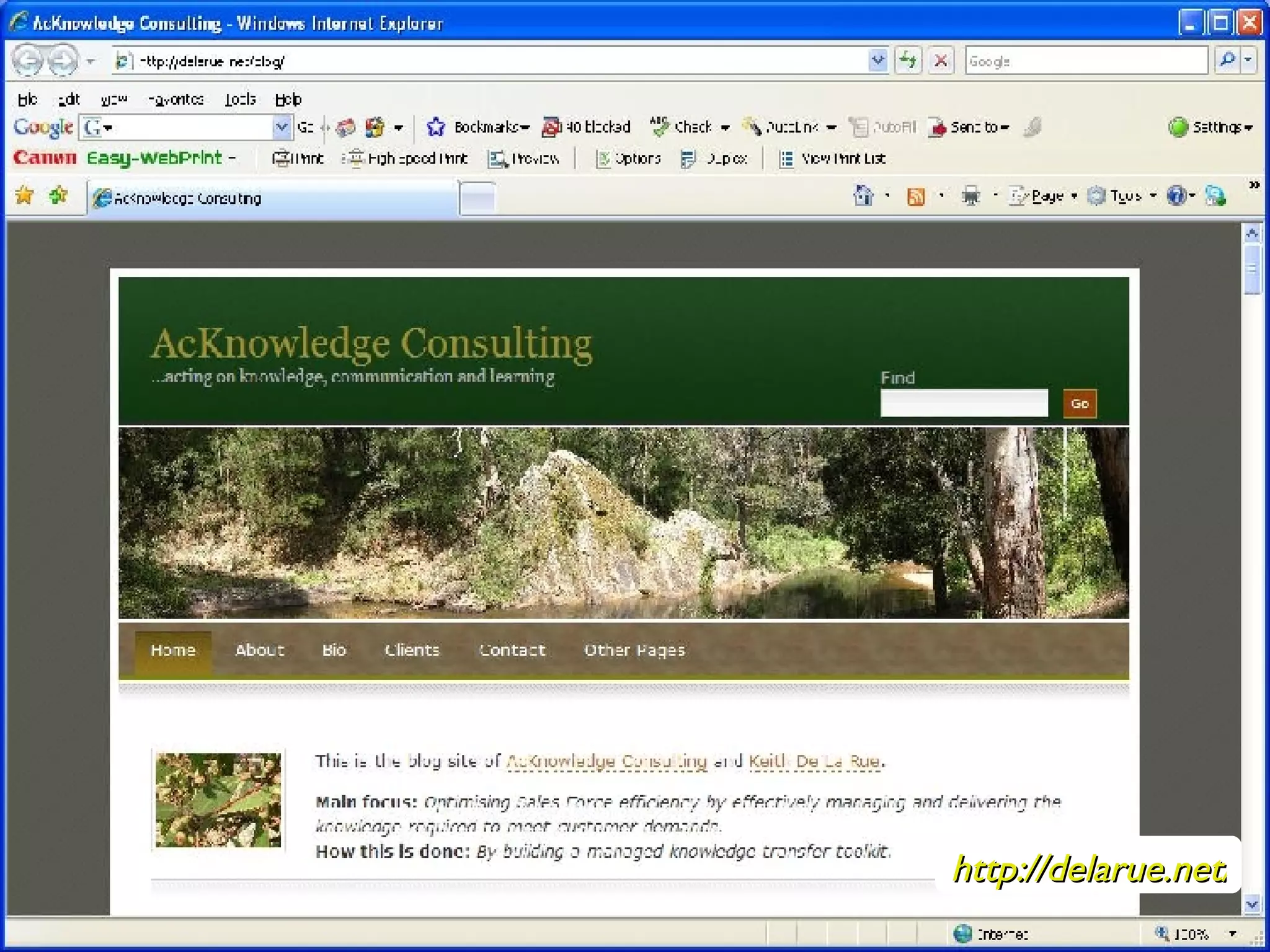
http://delarue.net/
http://www.melbournekmlf.org/
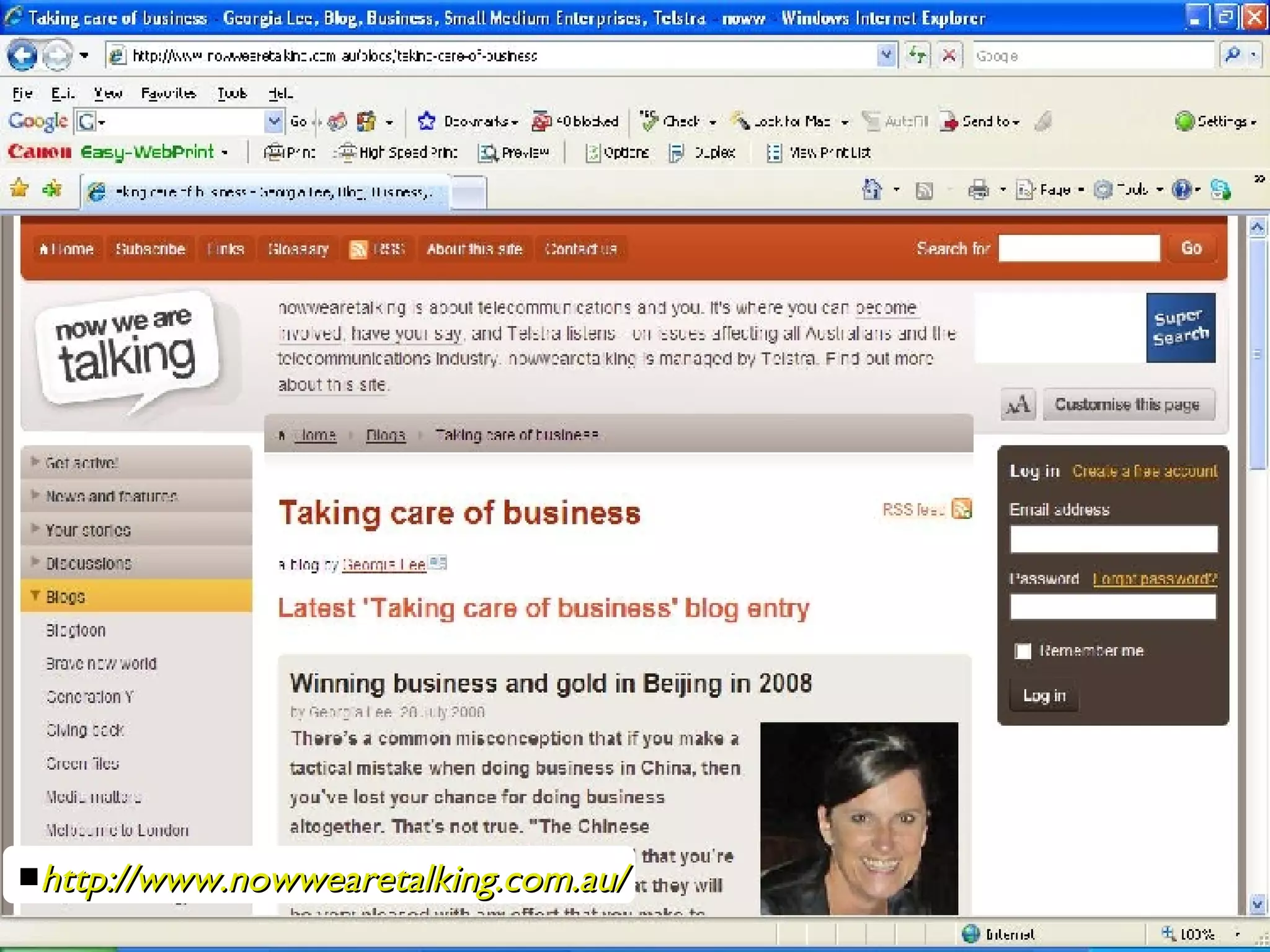
http://www.nowwearetalking.com.au/
The corporate blog? http://www.dilbert.com/
Blogs in internal comms Use to build a community or dialogue Is blogging the new water cooler? Knowledge sharing - and opinions! Need something to say, time to update Needs trust, not control CEO “chat” Disney cable – “Shiftlog” Global technical operators US University library News, event management, facility use End of the “typing pool” paradigm?
Tags Simple categories or key words User-defined - “Folksonomy” Each item can have multiple tags Commonly used in blogs Introduced to email by Gmail Used by Flickr to tag images Can use to generate a “tag cloud” Del.icio.us – social book-marking
Tags and taxonomy A taxonomy is like a concrete footpath Not frequently changed Tags are more like tracks in the grass More worn the more they are used What is the best way to make use of grass tracks?
RSS – ‘Real Simple Syndication’ Web feed of blog or other content News feeds User-defined subscription Can reduce email network load Users establish their own priorities! Needs a “feed-reader” or aggregator Built in to IE 7, Firefox, Office 2007 Tools available to convert to email No user software installation
http://http://www.google.com/ig/
Podcasting A pre-recorded audio program or message Allows portability, time-shifting Caters to different learning styles So what’s new? Simple software and devices Anyone can produce RSS feeds “Knowledge Bites”
Videocasting YouTube and the “home video” revolution http://www.youtube.com/user/plambe
Online forums Allows all users to post articles Content pushed by email or browsed All users are equal (But some are more equal than others!) May be moderated Otherwise, may get out of control – flames, storms Excellent medium for sharing Serves a Community of Practice Broader range of input and views than blogs
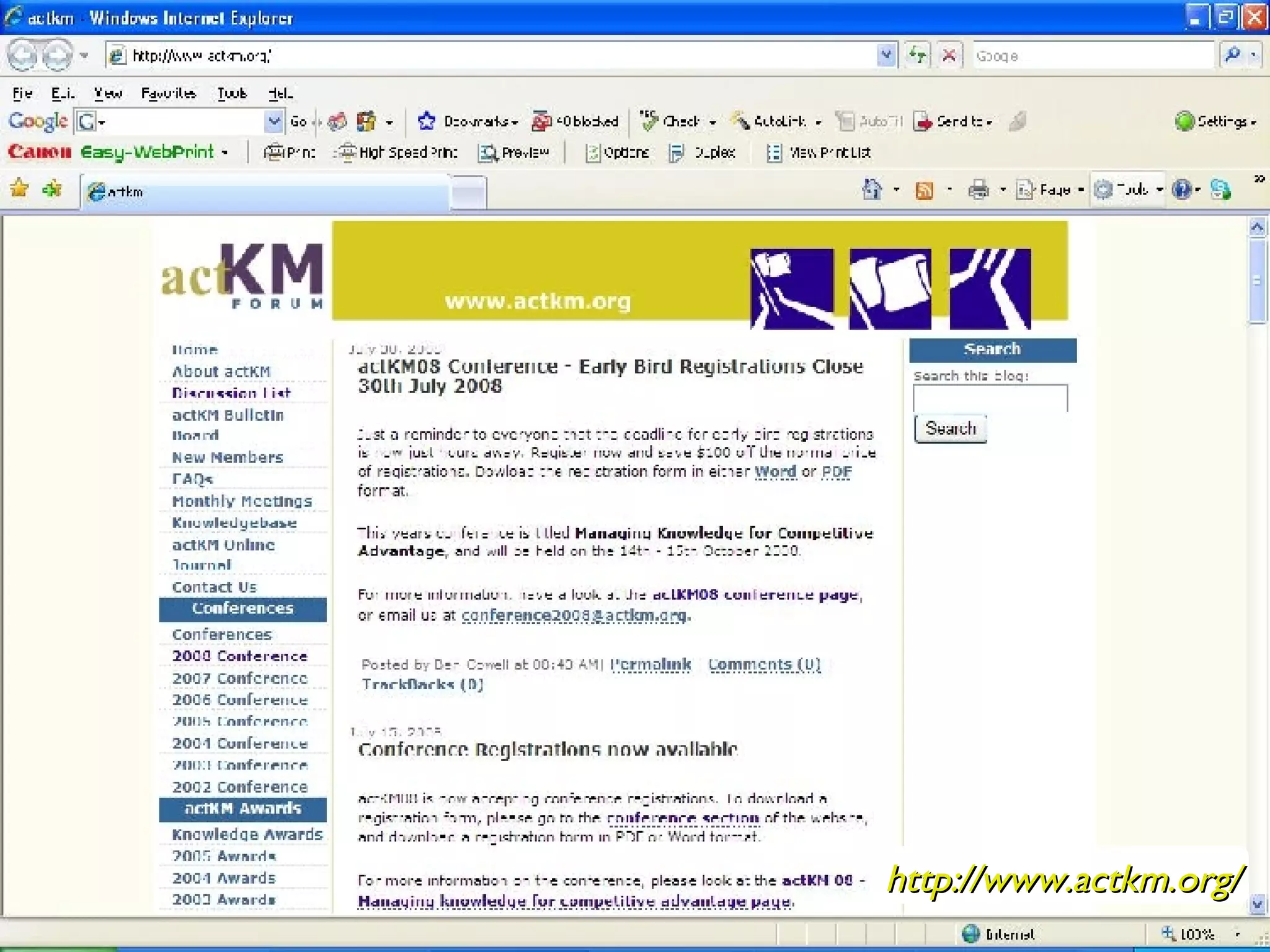
http://www.actkm.org/
Wikis An online reference source, edited by users "Wiki-wiki" = "hurry quick" (Hawaiian) Quick to set-up, and supports rapid development Easy online editing Includes author comments and discussion Lowers barriers to participation Readily-available software Vulnerability? “iStore” experience Reliability? Wikipedia…
Wikipedia Encyclopaedia Britannica vs Wikipedia December 2005 Nature magazine’s nature.com comparison “Can multiple, unpaid editors match paid professionals for accuracy?” 50 parallel reviews of articles from each Eight serious errors, four from each Other errors: Wikipedia 162, Britannica 123 Disputed by Britannica; defended by Nature
Wikis in organisations Good for experts to build a body of knowledge Needs encouragement for input Or critical mass? Jimmy Wales – “5 to 10 dedicated people” NAB – Training group collaboration On an  external   site… US Government Enterprise Architecture Conference management - end-to-end Telstra – Project Management for Online team Email replacement – “Socialtext”
 
Our Intranet, the Wiki Janssen-Cilag 300 employees, Australia & NZ Launch budget $11,000 Uses  Confluence  by Atlassian Directory integration, attachments Started with pilot on office relocation After 12 months, 184 contributors Content ownership key! Nathan Wallace -   http://www.e-gineer.com/v2/blog/2007/08/our-intranet-wiki-case-study-of-wiki.htm
Connecting people Expertise location Social Network Analysis Use “connectors” Lend Lease “iKonnect” model Add-on to directories Add expertise, networks IBM “Blue Pages” Arup People…
People directories - Arup
Adding expertise
Adding connections
Instant Messaging Managing “presence” across geographically-separated teams Collaboration Group messages Faster than a speeding email? Mobility applications SMS
http://twitter.com/kdelarue
Twitter 140-character messages “Microblogging” “Group proprioception” “The ability to sense the position, location, orientation and movement of the body and its parts” “ If only most companies realised the treasure trove of expertise and information that their employees would be able to access if they encouraged the use of such services” Shane Goldberg, Telstra
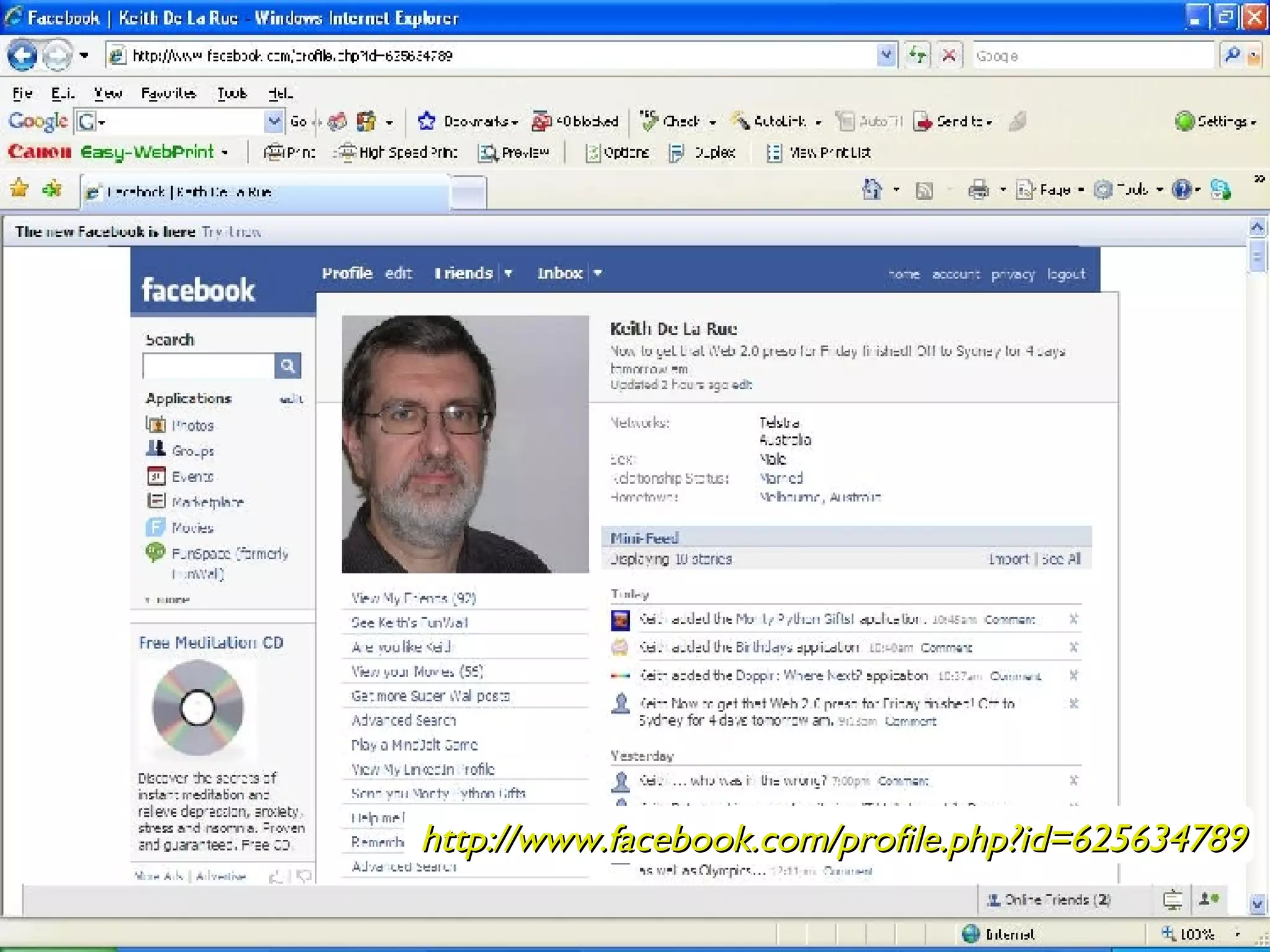
http://www.facebook.com/profile.php?id=625634789
Online communities Value MySpace; $580 million LinkedIn: $1 billion Facebook: $15 billion Some organisations were  blocking   Facebook Some organisations are  using   Facebook Deloitte has over 17,000 members Directory, expertise location Promoting events Use to build or share apps
http://secondlife.com/
Virtual Worlds 3D representations of real or imagined landscapes Members use “avatars” Second Life Public spaces and private spaces available ABC and BigPond use externally Supports use for organisational training IBM Tertiary institutions Mixed results
http://www.telstraenterprise.com/
Leveraging the community Using viral marketing techniques Build it and they will come? … so long as it is fun or interesting Let your market spread the word “Big Beer” ad Danish traffic authority “Speed control bikini bandits” http://delarue.net/blog/2007/06/get-used-to-21c/ Can you use this inside the organisation? Why not?
Discuss Which  of these would be useful in your organisation? What  would the benefit be? Who  would see the benefit? If you are already using them, how  can they be improved?
The fundamentals The power of social networking, people & trust
What’s missing from this picture? It’s all about people!
Trust - the critical factor Organisations must be prepared to trust staff Management must be open Security and confidentiality must not  be used as an smokescreen… Outcomes may not be direct or  obvious in advance Recognition that management do not have a monopoly on ideas…
Why social media? Enhances face-to-face networks Increases personal connections between staff RSS allows consumers to establish own priorities Push and Pull concepts less clear Supports rapid changes in priorities Relevant info is distributed more quickly Creates an information base over time May take time Not for everyone?
http://www.dilbert.com/
What’s so funny? Gag Lovers – cleverness: 20% Visual People – look, art: 20% Relevance – how does it relate to me: 60% Dilbert started with focus on gags – < 100 papers Most popular strips showed Dilbert at work Moved focus to office – now over 2,000 papers  Scott Adams -   http://dilbert.com/blog/
Know your audience Identify and understand target audiences Know the culture Natural tendency to share Role and functions Geographical diversity Access to technology Affinity for technology Know how to cater to needs of each audience Build tools to meet the needs
Building a social community Must be a reason to share “Community of practice” It’s the  practice   that’s important “I am a…” Provide rewards and recognition But must be carefully targeted Regular, focussed communication Build in help and training Mentoring more important than direction
Who drives change? “The primary driver of employee engagement is  opening up decision making ” John Smythe –  Engage for Change Power sharing – leader a guide, not a god Command & control does not fit knowledge age McKinsey research, many case studies Architect engagement interventions
Creativity “ Individual creativity is a critical element of productivity, efficiency and work quality in today’s complex work in organisations” Teresa Amabile, Harvard Business School  “ The challenges that arise in developing a new idea… provide the workforce with high levels of mental stimulation, problem-solving, employee-engagement and, thus, personal growth” Edmund Phelps, Wall Street Journal http://delarue.net/blog/2007/02/making-people-creative/
Wikinomics – harnessing prosumers More than “customisation” Too limited; need early engagement in design Losing control Let customers make own innovations, or they leave Better than ceding the game completely Become a peer Don’t make products, innovate ecosystems Share the fruits Customers want a share of the ownership Eg – Second Life Don Tapscott & Anthony D Williams
Principles for social media Trust   - you don’t need to control everything Understand your communities Anticipate needs not yet fully articulated by your audience Don’t let the security police put you off Don’t get stuck with the conventional wisdom Experiment!
Harnessing Web 2.0 Getting the results
Social Media “ Social media has enabled me to feel ahead, not behind as I return to work after 2nd baby” Serena Joyner (on Twitter)
So who does it?  Intranet Dashboard survey, May 07 50% of Australian companies interested in social networking, but not yet using 26% had begun a trial or using Forester, June 08 “Social Networks will Augment HR Strategies” Recruiting, alumni programs, mentoring, learning, collaboration, and connecting people “Professional networks are the backbone of business” http://blog.connectbeam.com/blog/2008/06/forrester-repor.html
Royal Bank of Canada Intranet 70,000 staff - only 1% reading printed comms Largest share of costs 91% preferred online Developed INsite – online newsletter Driven by regular feedback from staff Debates, suggestions, content rating, polls Virtual editorial board of 300 staff Saved over A$340k pa in 18 months Increased staff engagement significantly http://www.melcrum.com/
Social Media Manager, BT Decentralised Intranet, 100% accessible “ Encouraging every employee to believe they can make a difference” Social networks included in Business Drivers BTpedia, blogging, collaboration, podcasting Social networking – do, create, innovate, change Focus on value, not risk Start early, start small, build slowly Richard Dennison http://www.slideshare.net/InsideOut/international-employee-communications-summit-2008
Twitter for news and info “NASA confirms there is water on Mars” Via Twitter News out much faster than conventional media Searchable content “… actually becoming an essential part of my information-sourcing activities, which are critical to my role” Shane Goldberg, Telstra http://search.twitter.com/search?q=water+mars
Twitter for collaboration “Twebinar” Web-based seminar = “Webinar” Add Twitter for participant collaboration Presentation + collaboration  Removes geographical boundaries Can also be used within a room Ask questions Gains peer-to-peer sharing benefit Conversations before, during and after http://www.twebinar.com/
The inductee How do connected Gen Y round pegs fit into the organisational square hole? … they probably feel that their arms and legs are being cut off! Imagine if you were not “allowed” to use email! “ People want to use their favourite technologies at work. They're satisfying themselves and not waiting for IT” Dennis Moore, SAP Yahoo! News – 19 June 2007
 
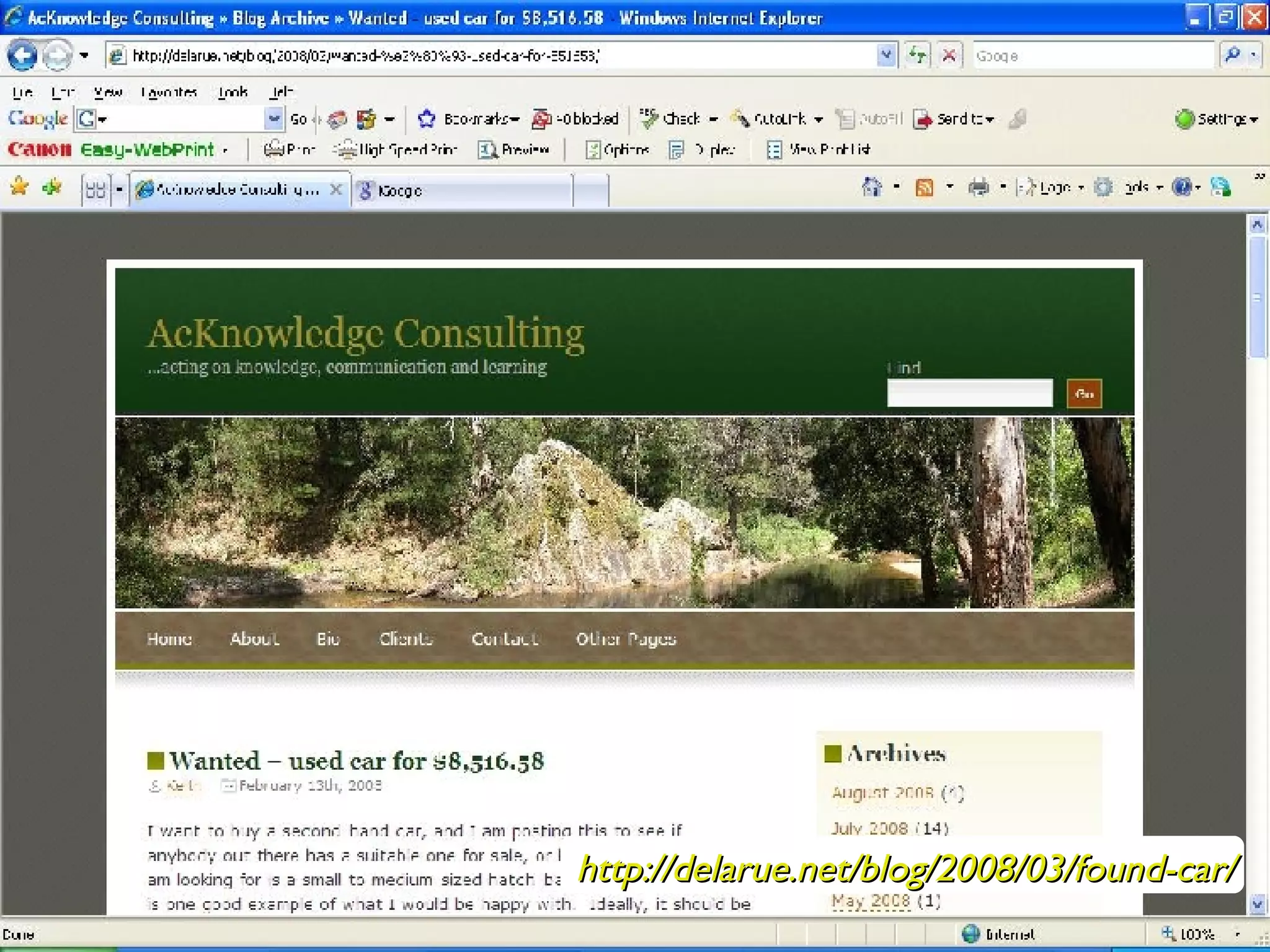
http://delarue.net/blog/2008/03/found-car/
 
Which ones fit? Combine Producer/Consumer boundaries blurred Set the agenda with blog articles Improve engagement through online discussion Use podcasts for key announcements Leverage expertise sharing with wikis Encourage sharing and connection Break down the walls of the Ivory Tower It’s up to you…
Challenges, benefits and risks Gaining the benefits
Implementation and availability Software readily available Free or low-cost “Failure” not a financial loss Hosted or DIY sites readily available May be IT issues Compatibility with existing systems Firewall issues “Skunkworks” Content can be edited anywhere, with no software install
Expect questions Don’t we have collaboration tools already? Will these tools lead to collaboration? Aren’t these just fads? What about security? Can we trust our people? How do they fit in with our architecture? Won’t these tools confuse people? How will we manage all this content? Matt Moore -   http://engineerswithoutfears.blogspot.com/
The home-baked approach IBM building in-house versions Blue Twit – twitter Beehive - Facebook Dogear - Del.icio.us (favourite sharing) Beehive has 30,000 users (May 2008) Including top executives Assist with geographically dispersed teams Strengthen staff ties Aid with knowledge sharing and innovation http://www.businessweek.com/magazine/content/08_22/b4086056643442.htm
Stepping outside… Training group collaborating on an external wiki Facebook as a corporate expertise directory Private network – for free Brian Lehrer, WNYC, 27 Aug 07 What is the cost of people working in isolation?
Measurement & ROI What do you measure? Traditional measures of usage, views and participation The 100/10/1 rule  (1 to set up, 10 involved, 100 consume) Applications of social network analysis How do we show value? The “I” should be low Productivity gains & reduced email load Impact on the bottom line? Matt Moore -   http://engineerswithoutfears.blogspot.com/
The security issue Security  can   be a real issue Security can also be a smokescreen Hiding knowledge hoarding The “Ivory Tower” syndrome “You can’t trust a sales person to understand…” “There is no secret knowledge!”
The risk of information leakage? Can lead to a “clamp-down” on info sharing This can lead to disengaged, disempowered staff “Rebellion” can follow This can lead to a risk of information leakage… The importance of  trust http://shugg.wordpress.com/2008/06/15/communication-scary/
The benefits of social media Engaged staff - people feel “heard” Better, quicker staff access to needed information More benefits from knowledge sharing Organisational access to staff knowledge and ideas Easier to find right people quickly Innovation much more rapid Personal ties lead to staff retention Improve connections across geography
Questions? Have we met your objectives? Anything we didn’t cover?
Thank You! [email_address] 0418 51 7676 Blog:  http://acknowledgeconsulting.com/

Workshop A, Keith De La Rue, E2.0

  • 1.
    Using social mediato harness knowledge within an organisation: Addressing the challenges Keith De La Rue AcKnowledge Consulting Friday, 15 August 2008
  • 2.
    Outline Understanding thesocial media revolution Where are we, and where are we going? Understanding the tools in a business context Fundamentals The power of social networking, people & trust Harnessing Web 2.0 for results Challenges, benefits and risks The IT challenge Gaining the benefits
  • 3.
    How will wedo this? Cover a mixture of theory and practice Multiple sources We all have something to offer Please all feel free to participate Talk about your own experiences Talk about what you have learnt here We need to share our knowledge! Stop and ask questions if anything is unclear Tell me if we need to move on
  • 4.
    My turn first…Keith De La Rue AcKnowledge Consulting, Melbourne Primary focus on sales force efficiency Knowledge Management role Knowledge transfer on changing business initiatives Comms, document management, training Previous roles Consultancy, Project Mgt, IT Conferences & workshops Change Management, Internal Comms, KM, EDRM
  • 5.
    Your turn… Yourobjectives for this morning What is most important: Why social media? Basic understanding of the tools Understanding the principles Facing the challenges Gaining the benefits
  • 6.
    Quick poll Howmany of you read blogs? … write a blog? Personal, Intranet, Corporate web How many use Wikipedia? Contribute … write a wiki? Intranet, Corporate web How many on Facebook or LinkedIn? Other sites/tools?
  • 7.
    Understanding the socialmedia revolution Where are we, and where are we going?
  • 8.
    Be afraid, bevery afraid… “… with the advent of …social software, suddenly highly savvy networks of people are springing up in their millions. They’re talking to each other. With or without your permission ” Hugh McLeod – http://www.gapingvoid.com/
  • 9.
    Discontinuous change Manytechnology improvements have been gradual There have also been times of dramatic change The transistor Integrated circuits Internet WWW Social media… How much change?
  • 10.
    A change inperspective Is the future just an extension of the past? How much are we like Holland? Do you remember South Wales? No longer part of the “old country” A new territory
  • 11.
    What is aPC? Number Processor = “Calculator” Word Processor = “Typewriter” Media Processor = “TV” => A modelling machine Access to the world Access to people
  • 12.
    What is anIntranet? Originally – a terminal network for system access Now – PCs, Internet tools inside the organisation News and information services Policies and procedures Directories and organisational structure Document repository Online learning Portals Now?
  • 13.
    What is corporatecommunication? Many traditional tools are one-way “Push” – eg, newsletters “Pull” – eg, document libraries Intranets make richer media available Some still one-way Newer technologies provide richer interaction * Andrew Mitchell
  • 14.
    What is theeconomy? An economy of scarcity IP must be protected at all costs Win-lose An economy of abundance Knowledge must be shared at all costs Win-win
  • 15.
    Who controls theIntranet? IT Information Services Internal Comms Learning Centralised/decentralised An important consideration…
  • 16.
    Discontinuous change Yourview of all this determines how you see today’s world and Intranet 2.0… “Did you know?” http://thefischbowl.blogspot.com/2007/06/did-you-know-20.html
  • 17.
    Social computing “Social computing requires a mind-shift from previous ways of doing business and requires high levels of trust and confidence from those engaging in it. How you communicate your intentions and encourage take up is crucial” Euan Semple, http://www.euansemple.com/
  • 18.
    Social Media Understandingthe tools in a business context
  • 19.
  • 20.
    Web 2.0 Movefrom 1:many to many:many Definitive products: Web 1.0 – Netscape, system-dependent Web 2.0 – Google, ubiquitous Move from hierarchies to networks Move from online brochures to interaction The rise of prosumers Intranet 2.0 – Enterprise 2.0 “SMIF” – Social Media Inside the Firewall (Andrew Mitchell) Tim O’Reilly - http://tim.oreilly.com/
  • 21.
    The new worldBlogs, wikis, RSS and more… Push and pull boundaries blurred Opens up the organisation Complex media for a complex environment Requires a new way of thinking Most software low-cost or free But challenging for corporate IT!
  • 22.
    Your challenge Whichof these would be useful in your organisation? What would the benefit be? Who would see the benefit? If you are already using them, how can they be improved? Make notes as we go through…
  • 23.
    Every blog hasits day We b log = a diary on steroids Can include text, images, multimedia Originally a single author, personal diary Can be shared authorship; dialogue through comments Chronological organisation; more permanent Edited anywhere, online Cheap – open source or commercial WordPress, Movable Type, Typepad “Blogs are useless drivel”? Might as well say “Paper is useless”
  • 24.
  • 25.
  • 26.
  • 27.
    The corporate blog?http://www.dilbert.com/
  • 28.
    Blogs in internalcomms Use to build a community or dialogue Is blogging the new water cooler? Knowledge sharing - and opinions! Need something to say, time to update Needs trust, not control CEO “chat” Disney cable – “Shiftlog” Global technical operators US University library News, event management, facility use End of the “typing pool” paradigm?
  • 29.
    Tags Simple categoriesor key words User-defined - “Folksonomy” Each item can have multiple tags Commonly used in blogs Introduced to email by Gmail Used by Flickr to tag images Can use to generate a “tag cloud” Del.icio.us – social book-marking
  • 30.
    Tags and taxonomyA taxonomy is like a concrete footpath Not frequently changed Tags are more like tracks in the grass More worn the more they are used What is the best way to make use of grass tracks?
  • 31.
    RSS – ‘RealSimple Syndication’ Web feed of blog or other content News feeds User-defined subscription Can reduce email network load Users establish their own priorities! Needs a “feed-reader” or aggregator Built in to IE 7, Firefox, Office 2007 Tools available to convert to email No user software installation
  • 32.
  • 33.
    Podcasting A pre-recordedaudio program or message Allows portability, time-shifting Caters to different learning styles So what’s new? Simple software and devices Anyone can produce RSS feeds “Knowledge Bites”
  • 34.
    Videocasting YouTube andthe “home video” revolution http://www.youtube.com/user/plambe
  • 35.
    Online forums Allowsall users to post articles Content pushed by email or browsed All users are equal (But some are more equal than others!) May be moderated Otherwise, may get out of control – flames, storms Excellent medium for sharing Serves a Community of Practice Broader range of input and views than blogs
  • 36.
  • 37.
    Wikis An onlinereference source, edited by users &quot;Wiki-wiki&quot; = &quot;hurry quick&quot; (Hawaiian) Quick to set-up, and supports rapid development Easy online editing Includes author comments and discussion Lowers barriers to participation Readily-available software Vulnerability? “iStore” experience Reliability? Wikipedia…
  • 38.
    Wikipedia Encyclopaedia Britannicavs Wikipedia December 2005 Nature magazine’s nature.com comparison “Can multiple, unpaid editors match paid professionals for accuracy?” 50 parallel reviews of articles from each Eight serious errors, four from each Other errors: Wikipedia 162, Britannica 123 Disputed by Britannica; defended by Nature
  • 39.
    Wikis in organisationsGood for experts to build a body of knowledge Needs encouragement for input Or critical mass? Jimmy Wales – “5 to 10 dedicated people” NAB – Training group collaboration On an external site… US Government Enterprise Architecture Conference management - end-to-end Telstra – Project Management for Online team Email replacement – “Socialtext”
  • 40.
  • 41.
    Our Intranet, theWiki Janssen-Cilag 300 employees, Australia & NZ Launch budget $11,000 Uses Confluence by Atlassian Directory integration, attachments Started with pilot on office relocation After 12 months, 184 contributors Content ownership key! Nathan Wallace - http://www.e-gineer.com/v2/blog/2007/08/our-intranet-wiki-case-study-of-wiki.htm
  • 42.
    Connecting people Expertiselocation Social Network Analysis Use “connectors” Lend Lease “iKonnect” model Add-on to directories Add expertise, networks IBM “Blue Pages” Arup People…
  • 43.
  • 44.
  • 45.
  • 46.
    Instant Messaging Managing“presence” across geographically-separated teams Collaboration Group messages Faster than a speeding email? Mobility applications SMS
  • 47.
  • 48.
    Twitter 140-character messages“Microblogging” “Group proprioception” “The ability to sense the position, location, orientation and movement of the body and its parts” “ If only most companies realised the treasure trove of expertise and information that their employees would be able to access if they encouraged the use of such services” Shane Goldberg, Telstra
  • 49.
  • 50.
    Online communities ValueMySpace; $580 million LinkedIn: $1 billion Facebook: $15 billion Some organisations were blocking Facebook Some organisations are using Facebook Deloitte has over 17,000 members Directory, expertise location Promoting events Use to build or share apps
  • 51.
  • 52.
    Virtual Worlds 3Drepresentations of real or imagined landscapes Members use “avatars” Second Life Public spaces and private spaces available ABC and BigPond use externally Supports use for organisational training IBM Tertiary institutions Mixed results
  • 53.
  • 54.
    Leveraging the communityUsing viral marketing techniques Build it and they will come? … so long as it is fun or interesting Let your market spread the word “Big Beer” ad Danish traffic authority “Speed control bikini bandits” http://delarue.net/blog/2007/06/get-used-to-21c/ Can you use this inside the organisation? Why not?
  • 55.
    Discuss Which of these would be useful in your organisation? What would the benefit be? Who would see the benefit? If you are already using them, how can they be improved?
  • 56.
    The fundamentals Thepower of social networking, people & trust
  • 57.
    What’s missing fromthis picture? It’s all about people!
  • 58.
    Trust - thecritical factor Organisations must be prepared to trust staff Management must be open Security and confidentiality must not be used as an smokescreen… Outcomes may not be direct or obvious in advance Recognition that management do not have a monopoly on ideas…
  • 59.
    Why social media?Enhances face-to-face networks Increases personal connections between staff RSS allows consumers to establish own priorities Push and Pull concepts less clear Supports rapid changes in priorities Relevant info is distributed more quickly Creates an information base over time May take time Not for everyone?
  • 60.
  • 61.
    What’s so funny?Gag Lovers – cleverness: 20% Visual People – look, art: 20% Relevance – how does it relate to me: 60% Dilbert started with focus on gags – < 100 papers Most popular strips showed Dilbert at work Moved focus to office – now over 2,000 papers Scott Adams - http://dilbert.com/blog/
  • 62.
    Know your audienceIdentify and understand target audiences Know the culture Natural tendency to share Role and functions Geographical diversity Access to technology Affinity for technology Know how to cater to needs of each audience Build tools to meet the needs
  • 63.
    Building a socialcommunity Must be a reason to share “Community of practice” It’s the practice that’s important “I am a…” Provide rewards and recognition But must be carefully targeted Regular, focussed communication Build in help and training Mentoring more important than direction
  • 64.
    Who drives change?“The primary driver of employee engagement is opening up decision making ” John Smythe – Engage for Change Power sharing – leader a guide, not a god Command & control does not fit knowledge age McKinsey research, many case studies Architect engagement interventions
  • 65.
    Creativity “ Individualcreativity is a critical element of productivity, efficiency and work quality in today’s complex work in organisations” Teresa Amabile, Harvard Business School “ The challenges that arise in developing a new idea… provide the workforce with high levels of mental stimulation, problem-solving, employee-engagement and, thus, personal growth” Edmund Phelps, Wall Street Journal http://delarue.net/blog/2007/02/making-people-creative/
  • 66.
    Wikinomics – harnessingprosumers More than “customisation” Too limited; need early engagement in design Losing control Let customers make own innovations, or they leave Better than ceding the game completely Become a peer Don’t make products, innovate ecosystems Share the fruits Customers want a share of the ownership Eg – Second Life Don Tapscott & Anthony D Williams
  • 67.
    Principles for socialmedia Trust - you don’t need to control everything Understand your communities Anticipate needs not yet fully articulated by your audience Don’t let the security police put you off Don’t get stuck with the conventional wisdom Experiment!
  • 68.
    Harnessing Web 2.0Getting the results
  • 69.
    Social Media “Social media has enabled me to feel ahead, not behind as I return to work after 2nd baby” Serena Joyner (on Twitter)
  • 70.
    So who doesit? Intranet Dashboard survey, May 07 50% of Australian companies interested in social networking, but not yet using 26% had begun a trial or using Forester, June 08 “Social Networks will Augment HR Strategies” Recruiting, alumni programs, mentoring, learning, collaboration, and connecting people “Professional networks are the backbone of business” http://blog.connectbeam.com/blog/2008/06/forrester-repor.html
  • 71.
    Royal Bank ofCanada Intranet 70,000 staff - only 1% reading printed comms Largest share of costs 91% preferred online Developed INsite – online newsletter Driven by regular feedback from staff Debates, suggestions, content rating, polls Virtual editorial board of 300 staff Saved over A$340k pa in 18 months Increased staff engagement significantly http://www.melcrum.com/
  • 72.
    Social Media Manager,BT Decentralised Intranet, 100% accessible “ Encouraging every employee to believe they can make a difference” Social networks included in Business Drivers BTpedia, blogging, collaboration, podcasting Social networking – do, create, innovate, change Focus on value, not risk Start early, start small, build slowly Richard Dennison http://www.slideshare.net/InsideOut/international-employee-communications-summit-2008
  • 73.
    Twitter for newsand info “NASA confirms there is water on Mars” Via Twitter News out much faster than conventional media Searchable content “… actually becoming an essential part of my information-sourcing activities, which are critical to my role” Shane Goldberg, Telstra http://search.twitter.com/search?q=water+mars
  • 74.
    Twitter for collaboration“Twebinar” Web-based seminar = “Webinar” Add Twitter for participant collaboration Presentation + collaboration Removes geographical boundaries Can also be used within a room Ask questions Gains peer-to-peer sharing benefit Conversations before, during and after http://www.twebinar.com/
  • 75.
    The inductee Howdo connected Gen Y round pegs fit into the organisational square hole? … they probably feel that their arms and legs are being cut off! Imagine if you were not “allowed” to use email! “ People want to use their favourite technologies at work. They're satisfying themselves and not waiting for IT” Dennis Moore, SAP Yahoo! News – 19 June 2007
  • 76.
  • 77.
  • 78.
  • 79.
    Which ones fit?Combine Producer/Consumer boundaries blurred Set the agenda with blog articles Improve engagement through online discussion Use podcasts for key announcements Leverage expertise sharing with wikis Encourage sharing and connection Break down the walls of the Ivory Tower It’s up to you…
  • 80.
    Challenges, benefits andrisks Gaining the benefits
  • 81.
    Implementation and availabilitySoftware readily available Free or low-cost “Failure” not a financial loss Hosted or DIY sites readily available May be IT issues Compatibility with existing systems Firewall issues “Skunkworks” Content can be edited anywhere, with no software install
  • 82.
    Expect questions Don’twe have collaboration tools already? Will these tools lead to collaboration? Aren’t these just fads? What about security? Can we trust our people? How do they fit in with our architecture? Won’t these tools confuse people? How will we manage all this content? Matt Moore - http://engineerswithoutfears.blogspot.com/
  • 83.
    The home-baked approachIBM building in-house versions Blue Twit – twitter Beehive - Facebook Dogear - Del.icio.us (favourite sharing) Beehive has 30,000 users (May 2008) Including top executives Assist with geographically dispersed teams Strengthen staff ties Aid with knowledge sharing and innovation http://www.businessweek.com/magazine/content/08_22/b4086056643442.htm
  • 84.
    Stepping outside… Traininggroup collaborating on an external wiki Facebook as a corporate expertise directory Private network – for free Brian Lehrer, WNYC, 27 Aug 07 What is the cost of people working in isolation?
  • 85.
    Measurement & ROIWhat do you measure? Traditional measures of usage, views and participation The 100/10/1 rule (1 to set up, 10 involved, 100 consume) Applications of social network analysis How do we show value? The “I” should be low Productivity gains & reduced email load Impact on the bottom line? Matt Moore - http://engineerswithoutfears.blogspot.com/
  • 86.
    The security issueSecurity can be a real issue Security can also be a smokescreen Hiding knowledge hoarding The “Ivory Tower” syndrome “You can’t trust a sales person to understand…” “There is no secret knowledge!”
  • 87.
    The risk ofinformation leakage? Can lead to a “clamp-down” on info sharing This can lead to disengaged, disempowered staff “Rebellion” can follow This can lead to a risk of information leakage… The importance of trust http://shugg.wordpress.com/2008/06/15/communication-scary/
  • 88.
    The benefits ofsocial media Engaged staff - people feel “heard” Better, quicker staff access to needed information More benefits from knowledge sharing Organisational access to staff knowledge and ideas Easier to find right people quickly Innovation much more rapid Personal ties lead to staff retention Improve connections across geography
  • 89.
    Questions? Have wemet your objectives? Anything we didn’t cover?
  • 90.
    Thank You! [email_address]0418 51 7676 Blog: http://acknowledgeconsulting.com/