Let’s look at what it means for
NASPA to be a Virtual-Networked
          Organization…
From my standpoint, NASPA has traditionally
  been a Learning Organization, mastering the
        five disciplines is various ways(1):

          Engaging in Systems Thinking
                   Through it’s interconnected nature
            Fostering Personal Mastery
   Many opportunities for personal growth, learning, feeding the soul
            Challenging Mental Models
          By creating a space for reflection, dialogue and action
               Building Shared Visions
        By listening to personal visions, “NASPA is it’s members”
             Embodying Team Learning
Through commonality of purpose. The whole exceeds the sum of it’s parts.
But, as we have seen in the video, online
   networks are allowing for an even
greater Collective Intelligence within the
              organization
I did some crowd sourcing to find out how
 Student Affairs professionals describe the
benefits of tweeting within the profession,
  in hopes that this would help shape my
                  theory…
              It started with:
www.twitterfall.com
In sum, the benefits of tweeting within Student Affairs:

•   Connection
•   Networking
•   Conversation
•   Dialogue
•   Support
•   Personal & Professional Development
•   Keeping Current with Relevant News
•   Knowledge Sharing
•   Community Building
•   Job Searching
•   Celebration
•   Twitter Connections > IRL Connections
•   Connection with our students on a new level!
Building a theory...
Morgan’s brief discussion of Virtual and Networked
Organizations:
     Temporary, ad hoc committees
     Project-oriented
     Answer to geographic challenges(2)

Morgan’s description of “Networked Intelligence”:
     “Information systems that…create a potential for
      individuals throughout an enterprise…to become
      full participants in an evolving system of
      organizational memory and intelligence”
     “…create a capacity for the evolution of a
      shared “organizational mind””
The Virtual-Networked Organization
            or Theory-#

  Peak Virtual-Networked
       Organization
Independently Functioning

       Engaging Space

         Bulletin-Board

              Big 3

              URL
URL
• Organization has a website
  – Resource for information, events
  – Website may have many visitors, but users do not
    have a way of further engaging with the
    organization online
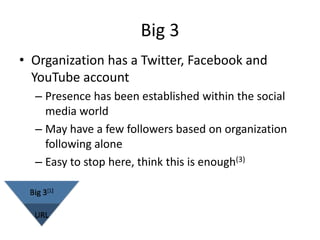
Big 3
• Organization has a Twitter, Facebook and
  YouTube account
  – Presence has been established within the social
    media world
  – May have a few followers based on organization
    following alone
  – Easy to stop here, think this is enough(3)
Bulletin Board
• Organization uses their social media presence
  to share information, advertise upcoming
  events, and to relay important dates (3)
  – One-way flow of information
  – Slightly more followers
Engaging Space
• Organization engages their social media
  community
  – Shared information adds value to follower’s lives (3)
  – Followers engage with website moderators and other
    followers around topics
  – Connections, Conversations, Networking, Knowledge
    Sharing, and Sharing of Relevant News takes place
  – Tipping point with regard to followership
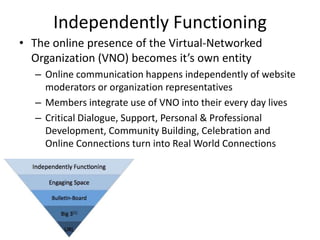
Independently Functioning
• The online presence of the Virtual-Networked
  Organization (VNO) becomes it’s own entity
   – Online communication happens independently of website
     moderators or organization representatives
   – Members integrate use of VNO into their every day lives
   – Critical Dialogue, Support, Personal & Professional
     Development, Community Building, Celebration and
     Online Connections turn into Real World Connections
Peak Virtual-Networked Organization
• What happens online becomes transcendent
  –   Members bring the conversation into real life
  –   Real world changes occur as a result
  –   A shared, evolving “organizational mind” exists
  –   Online aspects of the VNO get tied into the more
      traditional aspects of the organization
        – i.e. becoming standard aspect of conferences or
          being tied into Student Affairs graduate programs (4)


                               + perhaps, we don’t even know
                                 what else can flow from a fully
                                 functioning Virtual-Networked
                                 Organization…
#thankyou
References:

[1]: Senge, P. (2006). The Fifth Discipline: The Art and Practice of the
  Learning Organization- Revised. New York: Doubleday.

[2]: Morgan, G. (2006). Images of Organizations. Thousand Oaks, CA:
  Sage.

[3] Stoller, Eric. (2011). Closing speaker session. NASPA Western
  Regional Conference.

[4] Cabellon, Ed. (2010). The New Student Affairs Conference. The
  Student Affairs Collaborative.

Theory# Slideshow for OrgTheory

  • 2.
    Let’s look atwhat it means for NASPA to be a Virtual-Networked Organization…
  • 3.
    From my standpoint,NASPA has traditionally been a Learning Organization, mastering the five disciplines is various ways(1): Engaging in Systems Thinking Through it’s interconnected nature Fostering Personal Mastery Many opportunities for personal growth, learning, feeding the soul Challenging Mental Models By creating a space for reflection, dialogue and action Building Shared Visions By listening to personal visions, “NASPA is it’s members” Embodying Team Learning Through commonality of purpose. The whole exceeds the sum of it’s parts.
  • 4.
    But, as wehave seen in the video, online networks are allowing for an even greater Collective Intelligence within the organization
  • 5.
    I did somecrowd sourcing to find out how Student Affairs professionals describe the benefits of tweeting within the profession, in hopes that this would help shape my theory… It started with:
  • 6.
  • 7.
    In sum, thebenefits of tweeting within Student Affairs: • Connection • Networking • Conversation • Dialogue • Support • Personal & Professional Development • Keeping Current with Relevant News • Knowledge Sharing • Community Building • Job Searching • Celebration • Twitter Connections > IRL Connections • Connection with our students on a new level!
  • 8.
    Building a theory... Morgan’sbrief discussion of Virtual and Networked Organizations:  Temporary, ad hoc committees  Project-oriented  Answer to geographic challenges(2) Morgan’s description of “Networked Intelligence”:  “Information systems that…create a potential for individuals throughout an enterprise…to become full participants in an evolving system of organizational memory and intelligence”  “…create a capacity for the evolution of a shared “organizational mind””
  • 9.
    The Virtual-Networked Organization or Theory-# Peak Virtual-Networked Organization Independently Functioning Engaging Space Bulletin-Board Big 3 URL
  • 10.
    URL • Organization hasa website – Resource for information, events – Website may have many visitors, but users do not have a way of further engaging with the organization online
  • 11.
    Big 3 • Organizationhas a Twitter, Facebook and YouTube account – Presence has been established within the social media world – May have a few followers based on organization following alone – Easy to stop here, think this is enough(3)
  • 12.
    Bulletin Board • Organizationuses their social media presence to share information, advertise upcoming events, and to relay important dates (3) – One-way flow of information – Slightly more followers
  • 13.
    Engaging Space • Organizationengages their social media community – Shared information adds value to follower’s lives (3) – Followers engage with website moderators and other followers around topics – Connections, Conversations, Networking, Knowledge Sharing, and Sharing of Relevant News takes place – Tipping point with regard to followership
  • 14.
    Independently Functioning • Theonline presence of the Virtual-Networked Organization (VNO) becomes it’s own entity – Online communication happens independently of website moderators or organization representatives – Members integrate use of VNO into their every day lives – Critical Dialogue, Support, Personal & Professional Development, Community Building, Celebration and Online Connections turn into Real World Connections
  • 16.
    Peak Virtual-Networked Organization •What happens online becomes transcendent – Members bring the conversation into real life – Real world changes occur as a result – A shared, evolving “organizational mind” exists – Online aspects of the VNO get tied into the more traditional aspects of the organization – i.e. becoming standard aspect of conferences or being tied into Student Affairs graduate programs (4) + perhaps, we don’t even know what else can flow from a fully functioning Virtual-Networked Organization…
  • 17.
    #thankyou References: [1]: Senge, P.(2006). The Fifth Discipline: The Art and Practice of the Learning Organization- Revised. New York: Doubleday. [2]: Morgan, G. (2006). Images of Organizations. Thousand Oaks, CA: Sage. [3] Stoller, Eric. (2011). Closing speaker session. NASPA Western Regional Conference. [4] Cabellon, Ed. (2010). The New Student Affairs Conference. The Student Affairs Collaborative.