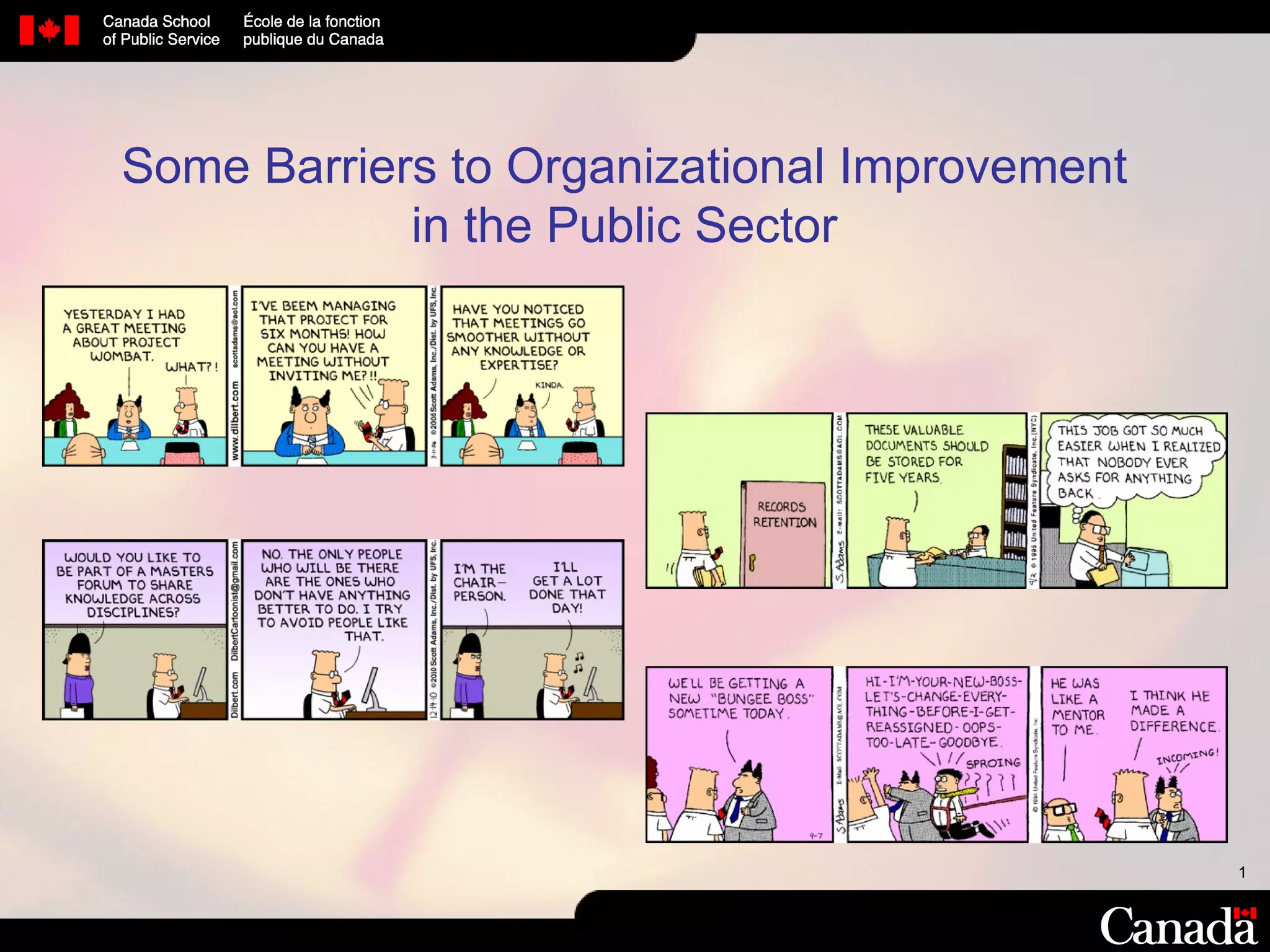
Some Barriers to Organizational Improvement in the Public Sector
Knowledge Management in the Public Sector 15 years of lessons learned… and other painful experiences January 2011 Paul McDowall Knowledge Management  Advisor Canada School of Public Service
Key Questions What is KM and how might it apply to me, and to my group? How/where could/should I start?  How will I have to change? How will our work need to change? How can we sustain this change? What about the organizational culture? How will we know that we are getting better?
What is Knowledge Management? How does Knowledge Management apply to the Canadian public sector? How has Knowledge Management been applied across the Canadian public sector? Lessons Learned in applying KM Agenda “ The purpose of management is the productivity of knowledge.”   Peter Drucker
Knowledge Exists in Two Forms  (M. Polanyi) Explicit knowledge:  knowledge that is  articulated in formal language and which can be easily transmitted among individuals.  It can be expressed in scientific formulae, codified procedures or a variety of other forms.  It includes codified information, data, facts, records and documents, text, etc and is held in many different types of media.  Tacit knowledge:  knowledge that is embedded in individual experience such as perspective and inferential knowledge.  Tacit knowledge includes insights, hunches, intuitions, and skills that are highly personal and hard to formalize, making them difficult to communicate or share with others.  It can be ‘learned’ from someone often only by close association with them for a period of time.  It represents the cognitive abilities of people.
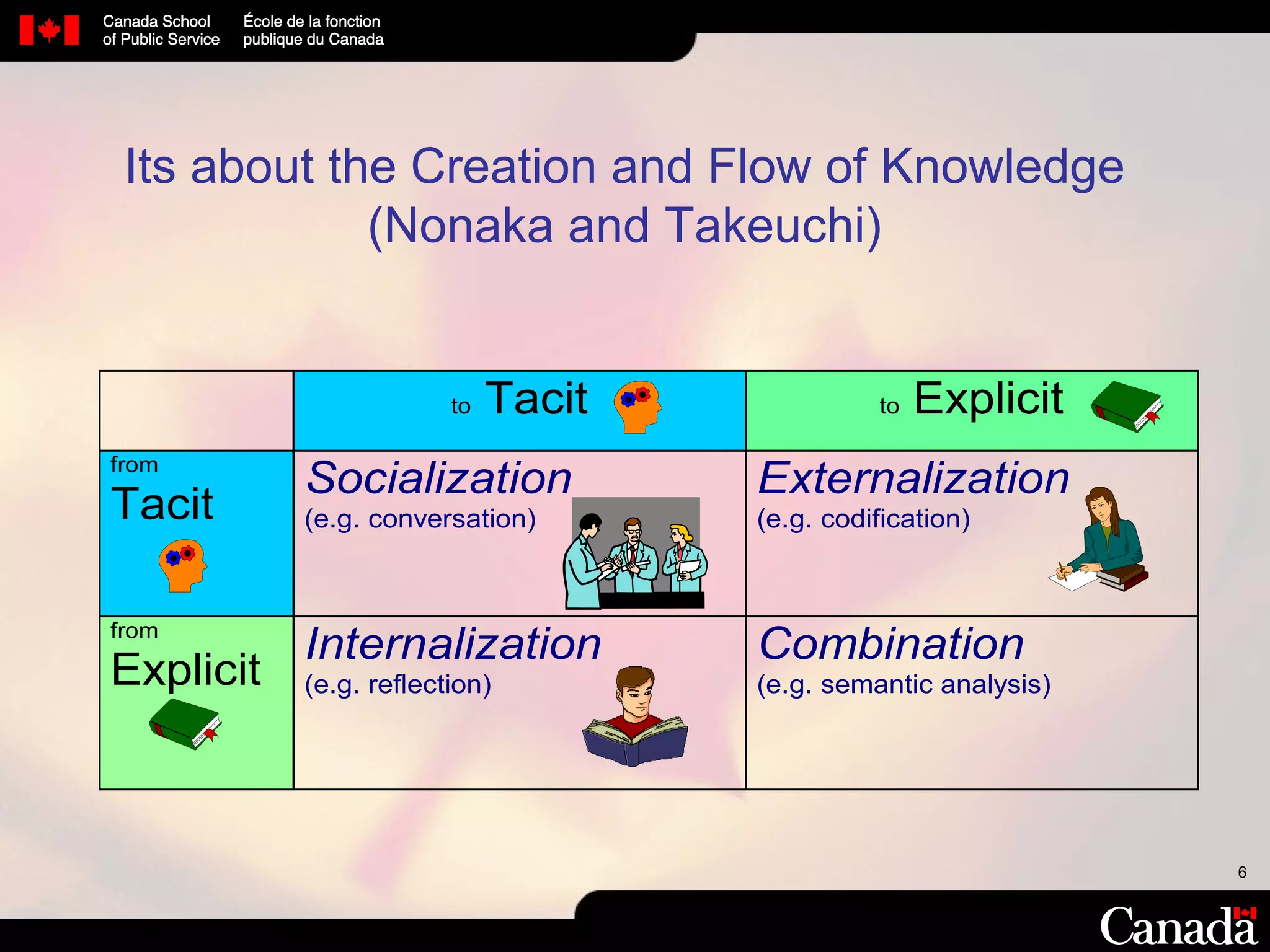
Its about the Creation and Flow of Knowledge (Nonaka and Takeuchi)
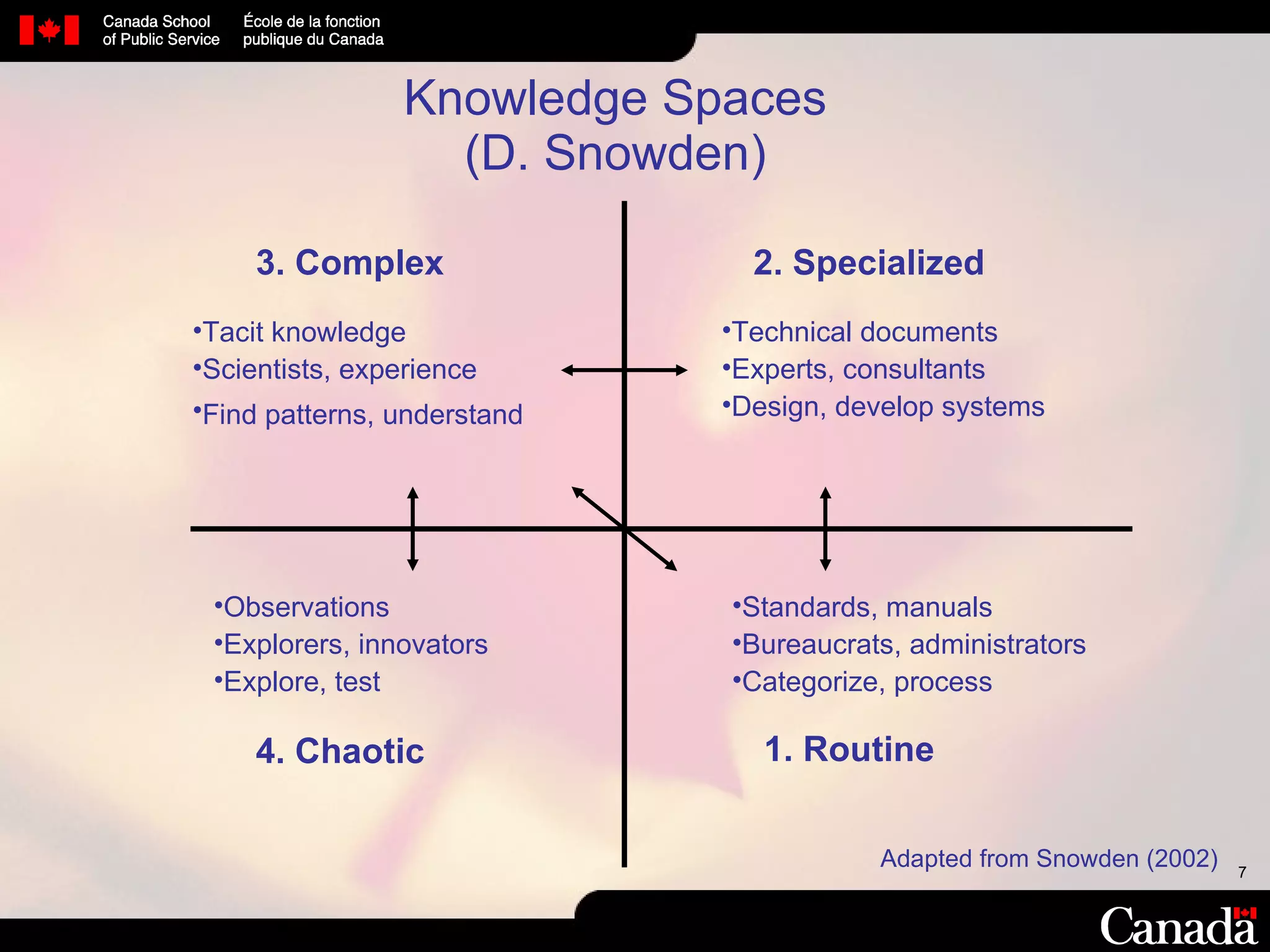
Knowledge Spaces (D. Snowden) 1. Routine Standards, manuals Bureaucrats, administrators Categorize, process 2. Specialized Technical documents Experts, consultants Design, develop systems 3. Complex Tacit knowledge Scientists, experience Find patterns, understand   4. Chaotic Observations Explorers, innovators Explore, test Adapted from Snowden (2002)
Knowledge Management Principles   Davenport/Prusak: Knowledge originates and resides in people's minds Knowledge sharing requires trust Knowledge sharing must be encouraged and rewarded Management support and resources are essential Knowledge is creative and should be encouraged to develop in unexpected ways Technology enables new knowledge behaviours Snowden: Knowledge can only be volunteered, it cannot be conscripted We only know what we know when we need to know it In the context of real need few people will withhold their knowledge Everything is fragmented Tolerated failure imprints learning better than success The way we know things is not the way we report we know things We always know more than we can say, and we always say more than we can write down
Knowledge Management, or  the management of an environment to facilitate the creation and use of knowledge for increased innovation and value ,  is a multi-disciplinary field that draws from theories in economics, sociology, philosophy, and psychology.  It also engages the applied fields of information technology, information and library science, and business.  This matrix gives KM dimensions that other management approaches lack and thus can provide comprehensive and practical management solutions. S. McIntyre and I. Moen, Vanguard, Issue 4, 2002 Defence Research and Development Canada What Does KM Look Like?
What Does KM Look Like? Knowledge   management refers to  the processes of creating, capturing, transferring and using knowledge to enhance organizational performance . Knowledge management is most frequently associated with two particular types of activities: - those activities that attempt to  document and appropriate knowledge  that individuals have (sometimes called the codification of knowledge) and activities to disseminate that knowledge throughout the organization, and - those activities that  facilitate human exchanges  in which knowledge that is not codified (tacit knowledge) can be shared.   Public Service Commission of Canada, 1998
What Does KM Look Like? Knowledge Management is a  multi-disciplinary approach to using  and managing organizational knowledge  that is based on sound  Information management  practices, focussed on  organizational learning , recognizing the contribution and  value of employees , and is enabled by  technolog y.  It is primarily concerned with the content  of knowledge within the organization and how that knowledge can improve organizational performance.   Interdepartmental Knowledge Management Forum, 1999
What is Knowledge Management? How does Knowledge Management apply to the Canadian public sector? How has Knowledge Management been applied across the Canadian public sector? Lessons Learned in applying KM Agenda
A Knowledge-based Public Sector A Changing Service Agenda - program effectiveness – results! -  collaborative arrangements - efficiency and innovation – strategic review - accountability - risk sensitivity A Changing Policy Agenda - policy re-focussing and rationalization A Changing Workforce – changing demographics A Changing Workforce Management Agenda - public service renewal  - core learning and professional development  - recruitment and staffing - Talent Management - retention and workplace well-being
“ Employee development is the responsibility of both the individual and the institution, but it serves a single purpose: to improve effectiveness and productivity in current and future jobs. This requires going beyond coursework and classroom learning.   The task is to consciously create learning environments where knowledge management is done well   and where employees have ready access to the information they need to do their jobs … To renew the workplace, we must put greater emphasis on collaboration, technology, innovation, back office systems and   knowledge management .  We must also improve our ability to make choices and set priorities as we carry out our work.”    Clerk of the Privy Council’s Seventeenth Annual Report, 2010 A Knowledge-based Public Sector
“ In addition to embedding renewal across their organizations, deputy heads will also advance renewal in four specific areas to support  Renewing the Workplace :  … 2. Knowledge Management Our knowledge and information are important government assets that should be systematically captured and shared among individuals and across organizations. Deputy heads will assess and improve their approaches to managing knowledge and information as corporate assets. Deputy heads will build knowledge transfer considerations into their talent management and succession planning strategies for executives and other critical positions.” 2010-11 Public Service Renewal Action Plan A Knowledge-based Public Sector
“ Loss of vital knowledge and experience is taking its toll on Canada’s cherished institutions – the Public Service of Canada in particular. Veteran employees are retiring in unprecedented numbers. Continual change and organizational churn are now the norm.  New technologies allow us to store vast amounts of information, but also to misplace vast amounts of information.  We, as an institution, are forgetting important lessons from the past… Preserving knowledge is a core responsibility of every manager… There are no longer any excuses for doing nothing. ” François Guimont, Chair, CSPS Action-Research  Roundtable on Organizational Memory (from  Lost & Found A Smart-Practice Guide to  Managing Organizational Memory , April, 2007) The Challenge for the Public Sector
What is Knowledge Management? How does Knowledge Management apply to the Canadian public sector? How has Knowledge Management been applied across the Canadian public sector? Lessons Learned in applying KM Agenda
Interdepartmental Knowledge Management Forum Our Raison d’être:   The Interdepartmental Knowledge Management Forum (IKMF) creates an exploratory environment that stimulates Knowledge Management (KM) practice in the public sector.  As a community of practice, the IKMF creates a safe environment for reflection, discovery, dialogue and innovation through the sharing of experiences, practices and insights between practitioners and those interested in KM.  The objectives of the Forum are: to encourage dialogue and collaboration between colleagues from knowledge-intensive communities to focus on and share experiences in the implementation of knowledge management in the public sector to be a centre of excellence and expertise in the development and use of knowledge management in the public sector
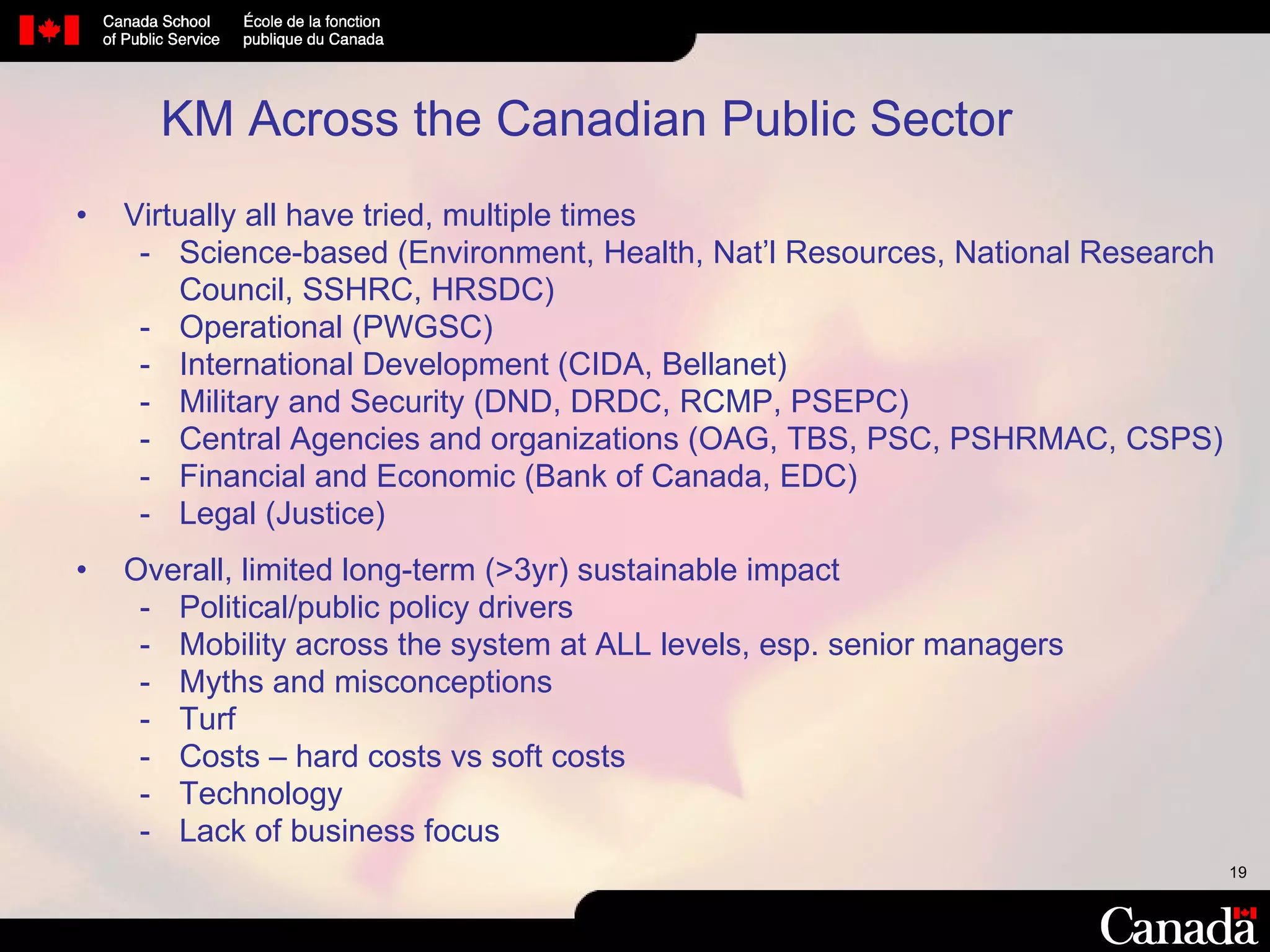
KM Across the Canadian Public Sector  Virtually all have tried, multiple times  Science-based (Environment, Health, Nat’l Resources, National Research Council, SSHRC, HRSDC) Operational (PWGSC) International Development (CIDA, Bellanet) Military and Security (DND, DRDC, RCMP, PSEPC) Central Agencies and organizations (OAG, TBS, PSC, PSHRMAC, CSPS) Financial and Economic (Bank of Canada, EDC) Legal (Justice) Overall, limited long-term (>3yr) sustainable impact Political/public policy drivers Mobility across the system at ALL levels, esp. senior managers Myths and misconceptions Turf Costs – hard costs vs soft costs Technology Lack of business focus
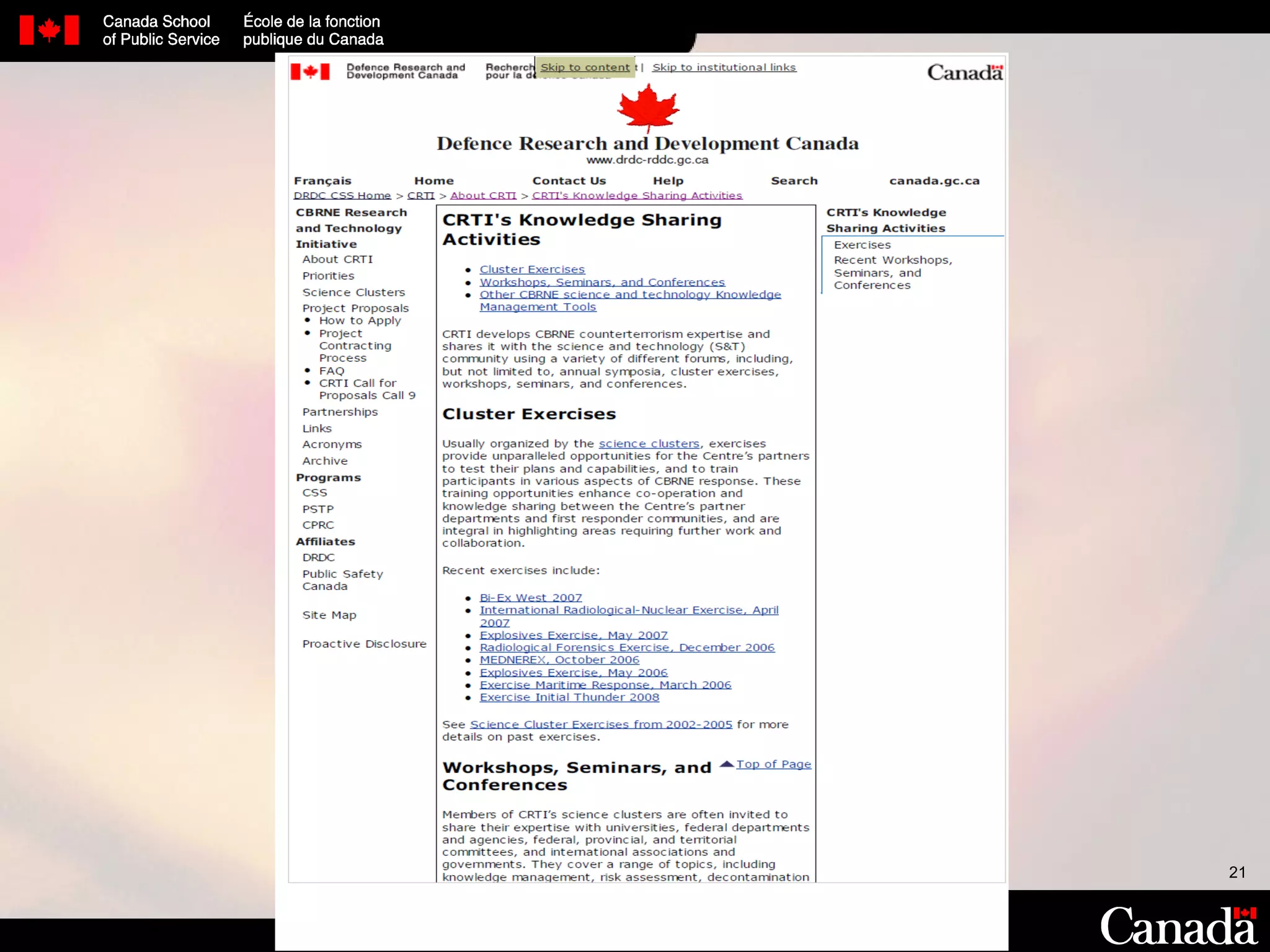
KM Approach* Defence Research and Development CRTI Tacit Explicit Tacit Explicit Socialization Combination : Externalization Internalization : *Nonaka, I. and H. Takeuchi.  The Knowledge Creating Company. New York: Oxford, 1995 . Tacit Exercises Clusters First  Responder Workshops After action reviews  Symposia Workshops Tech Demos Competency Map Lessons learned New Protocols Documents/Reports Communications Portal Databases Info Management Exercises Shared  Experience Training
 
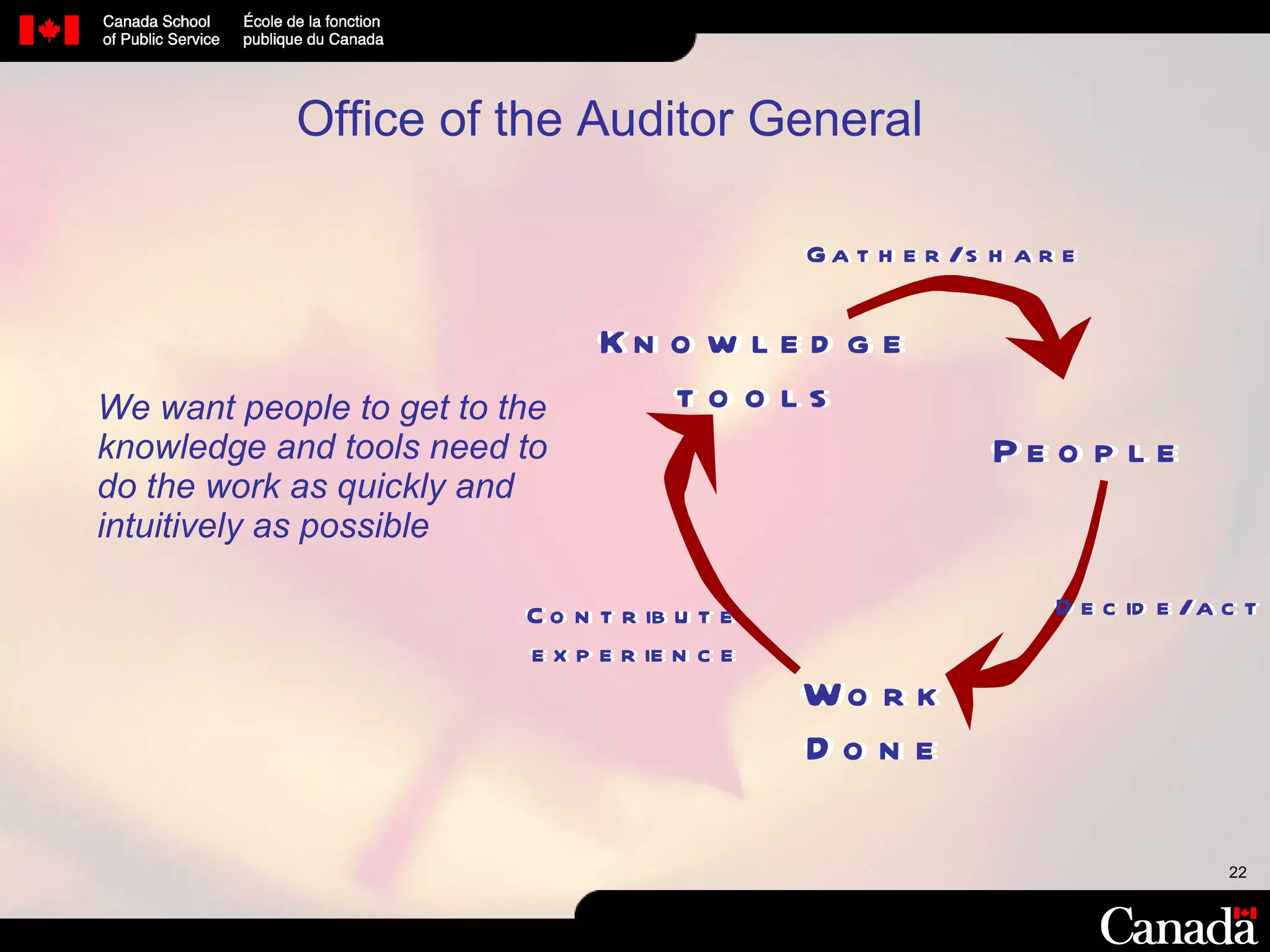
Office of the Auditor General We want people to get to the knowledge and tools need to do the work as quickly and intuitively as possible People Work Done Knowledge  tools Gather/share Decide/act Contribute  experience People Work Done Knowledge   tools Gather/share Decide/act Contribute   experience
 
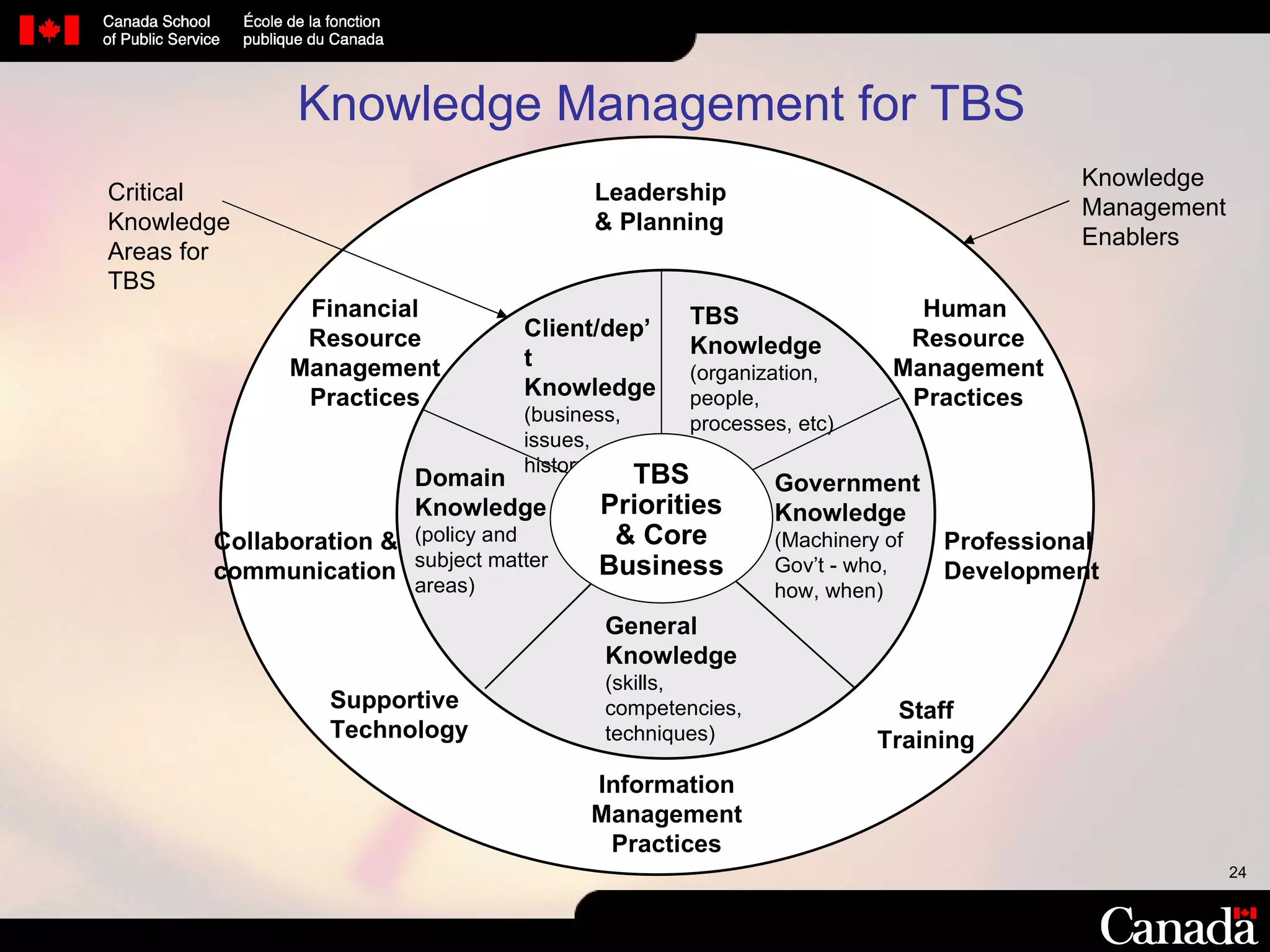
Client/dep’t Knowledge (business, issues, history, etc) Government Knowledge (Machinery of Gov’t - who, how, when) General Knowledge  (skills, competencies, techniques) Human  Resource Management Practices Staff Training Information Management Practices Leadership & Planning Supportive Technology Professional Development Knowledge Management Enablers Critical Knowledge Areas for  TBS TBS Knowledge (organization, people, processes, etc) Domain Knowledge (policy and subject matter areas) Collaboration & communication TBS Priorities & Core Business Knowledge Management for TBS Financial Resource Management Practices
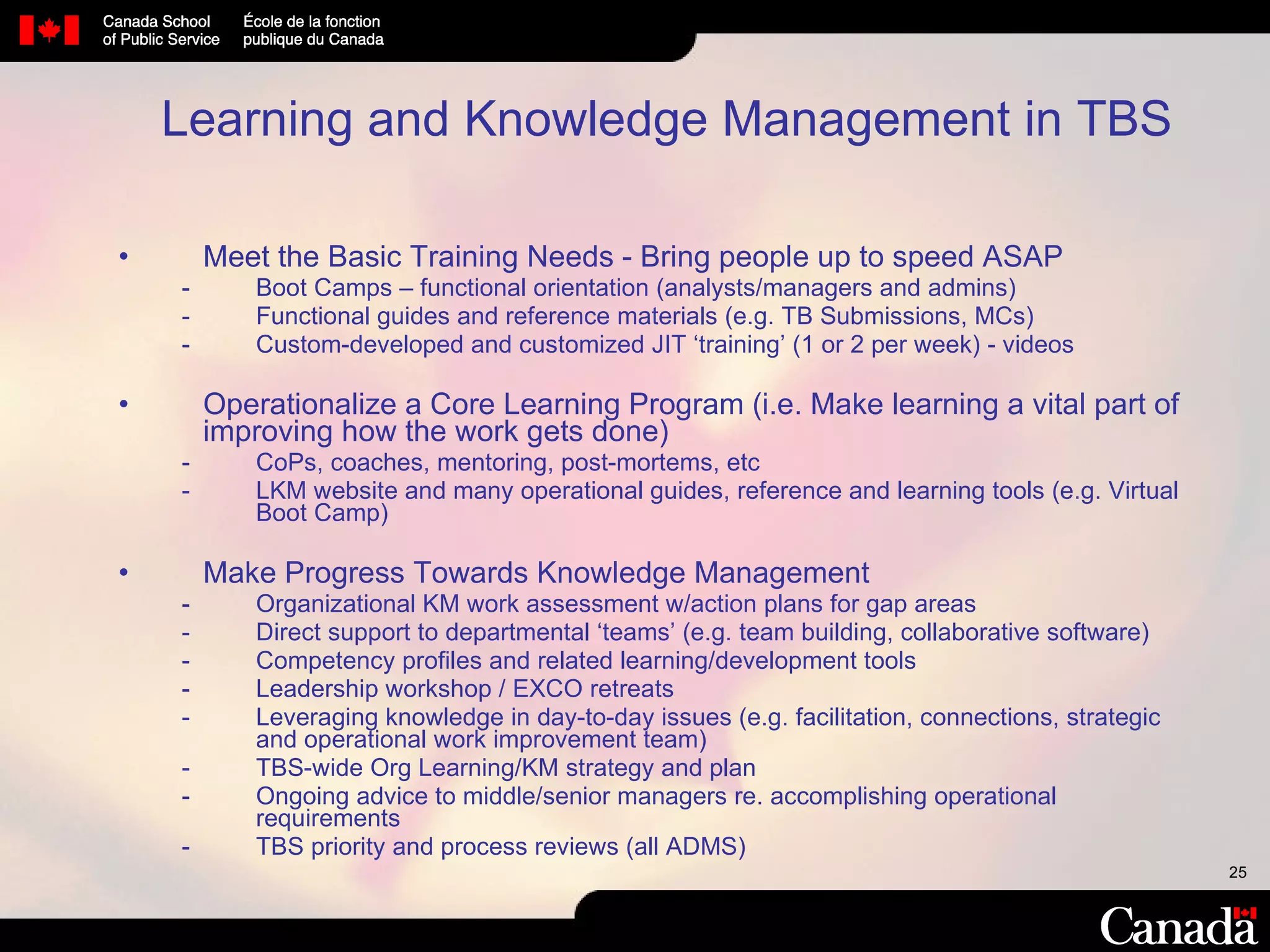
Learning and Knowledge Management in TBS Meet the Basic Training Needs - Bring people up to speed ASAP Boot Camps – functional orientation (analysts/managers and admins) Functional guides and reference materials (e.g. TB Submissions, MCs) Custom-developed and customized JIT ‘training’ (1 or 2 per week) - videos Operationalize a Core Learning Program (i.e. Make learning a vital part of improving how the work gets done) CoPs, coaches, mentoring, post-mortems, etc  LKM website and many operational guides, reference and learning tools (e.g. Virtual Boot Camp) Make Progress Towards Knowledge Management  Organizational KM work assessment w/action plans for gap areas  Direct support to departmental ‘teams’ (e.g. team building, collaborative software) Competency profiles and related learning/development tools Leadership workshop / EXCO retreats Leveraging knowledge in day-to-day issues (e.g. facilitation, connections, strategic and operational work improvement team) TBS-wide Org Learning/KM strategy and plan Ongoing advice to middle/senior managers re. accomplishing operational requirements TBS priority and process reviews (all ADMS)
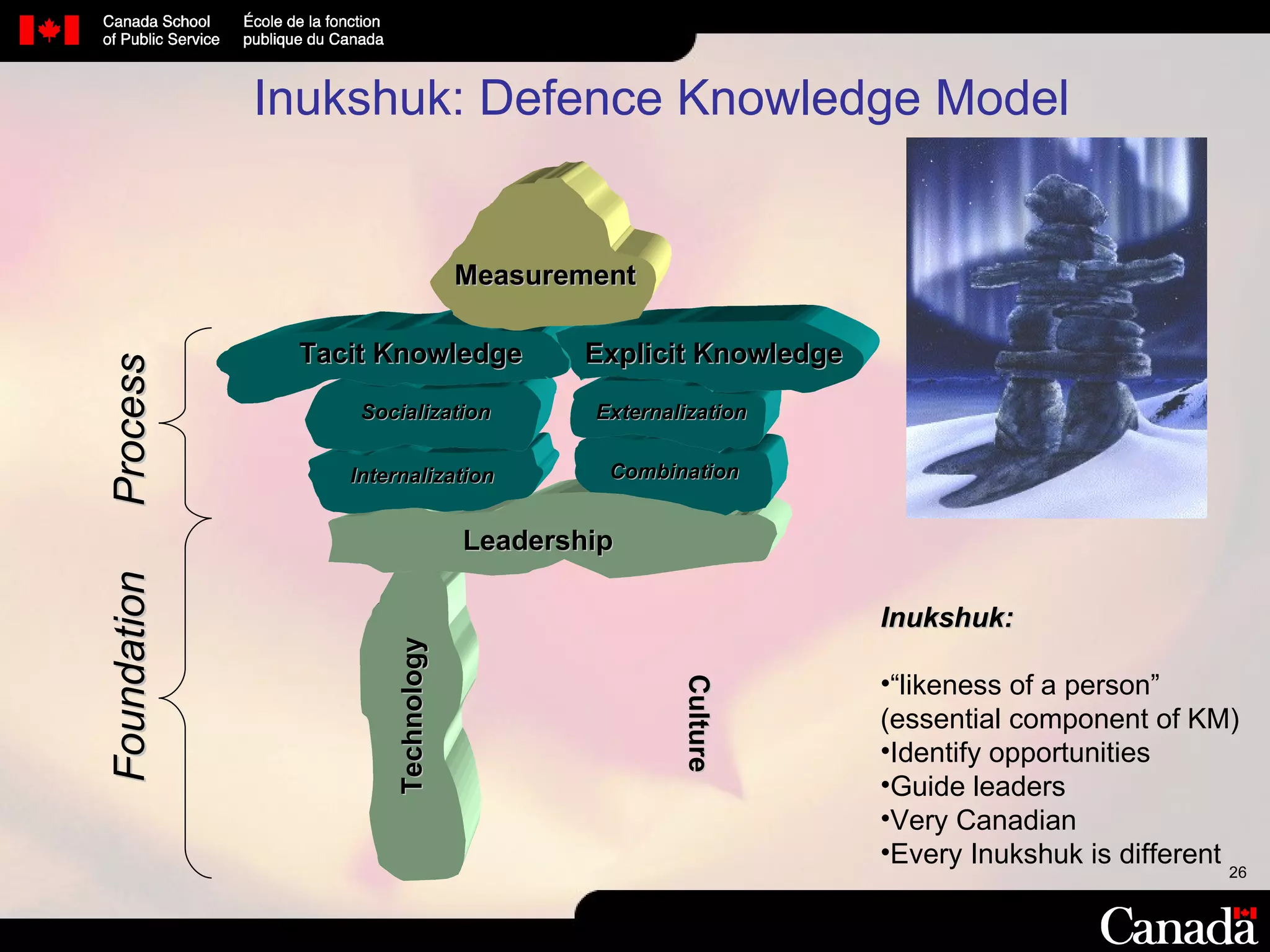
Inukshuk: Defence Knowledge Model Inukshuk: “ likeness of a person”  (essential component of KM)  Identify opportunities Guide leaders Very Canadian Every Inukshuk is different Foundation Leadership Technology Culture Internalization Socialization Externalization  Combination Process Tacit Knowledge  Explicit Knowledge  Measurement
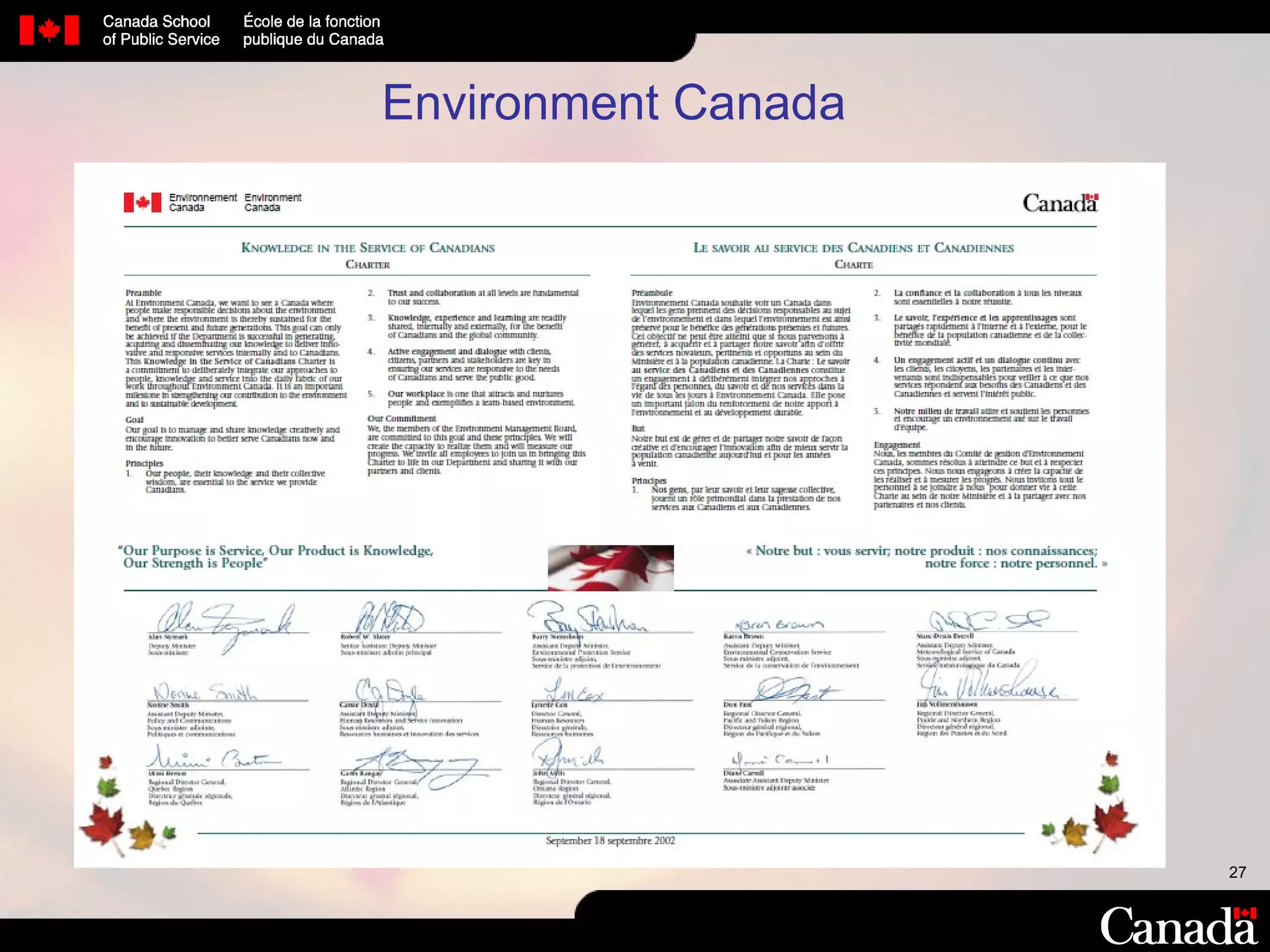
Environment Canada
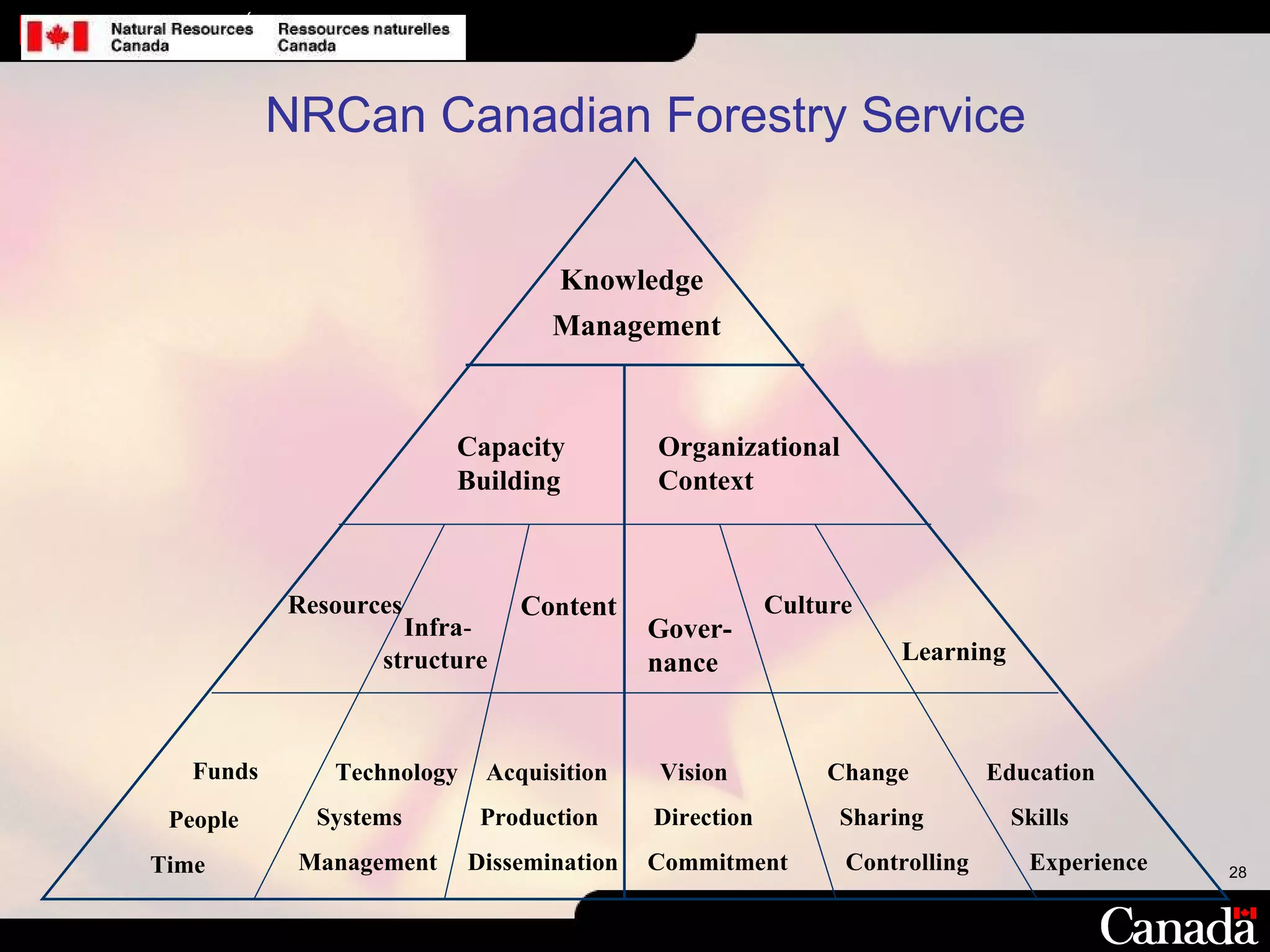
Knowledge Management NRCan Canadian Forestry Service Capacity Building Organizational Context Resources Infra - structure Co n tent Gover-nance Culture Learning Funds People Time Technology Systems Management Acquisition Production Dissemination Vision Direction Commitment Change Sharing Controlling Education Skills Experience
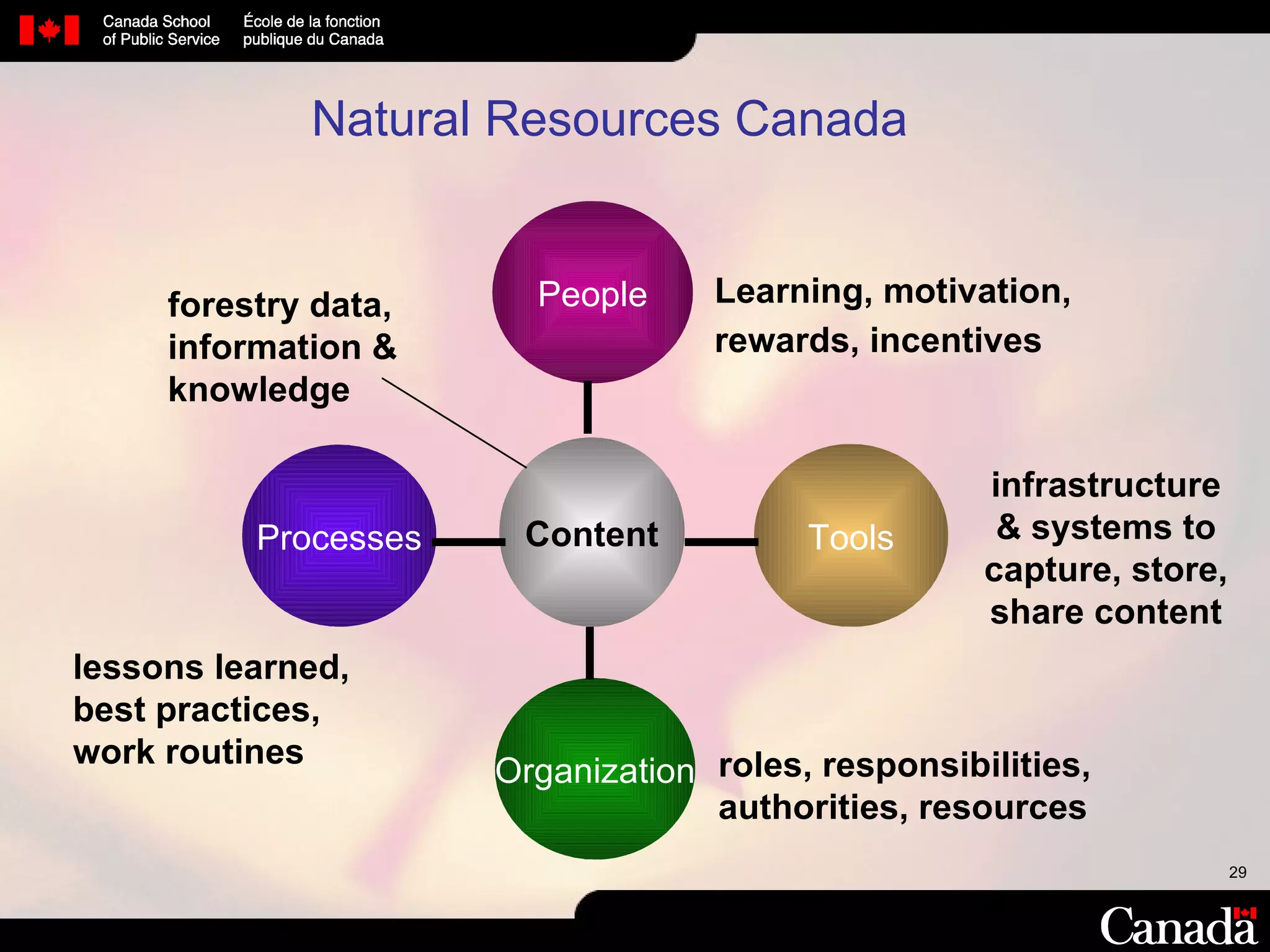
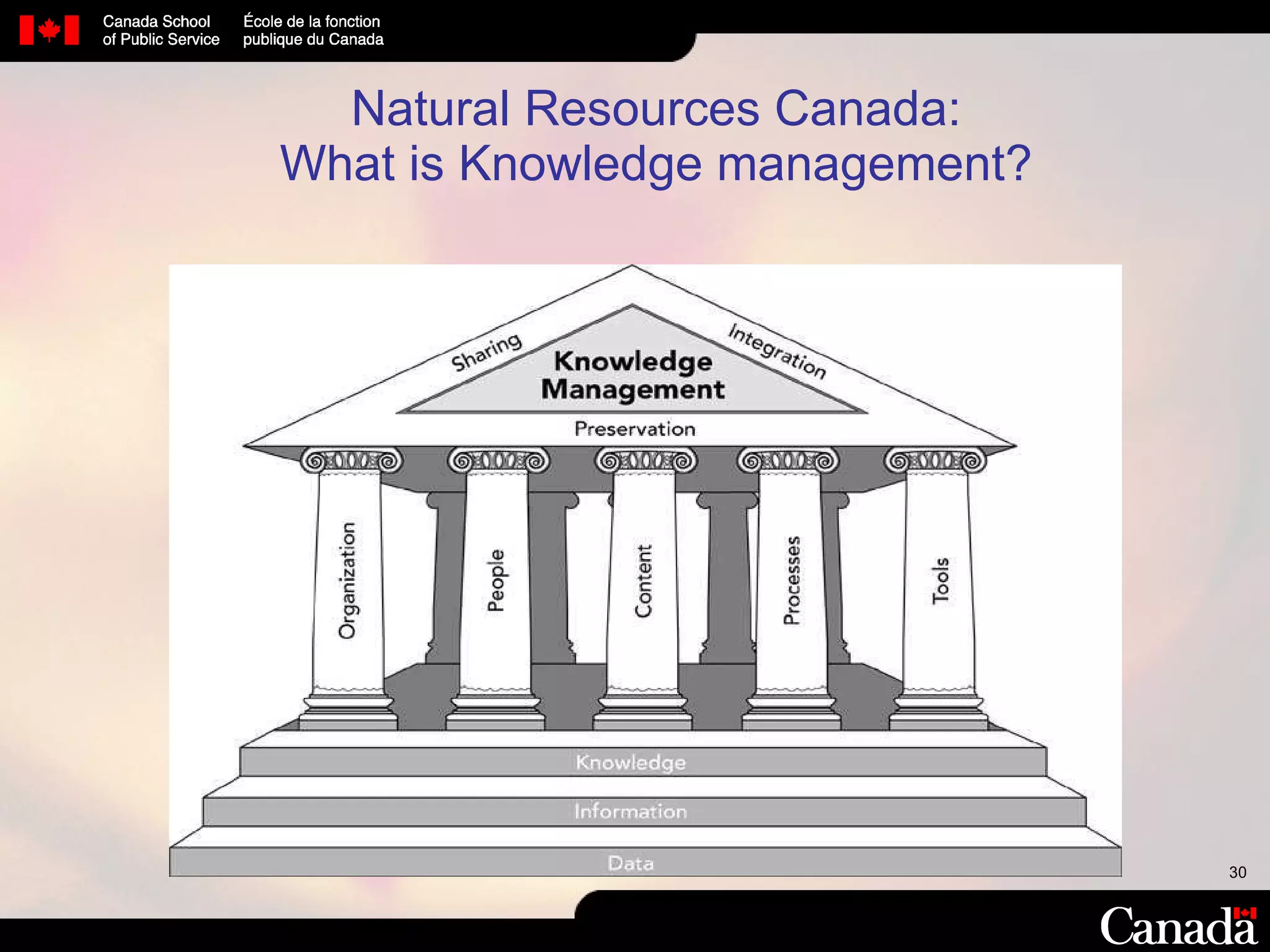
Natural Resources Canada infrastructure & systems to capture, store, share content Content Tools Organization People Learning, motivation, rewards, incentives Processes roles, responsibilities, authorities, resources lessons learned, best practices, work routines forestry data, information & knowledge
Natural Resources Canada: What is Knowledge management?
NRCan KM Video
 
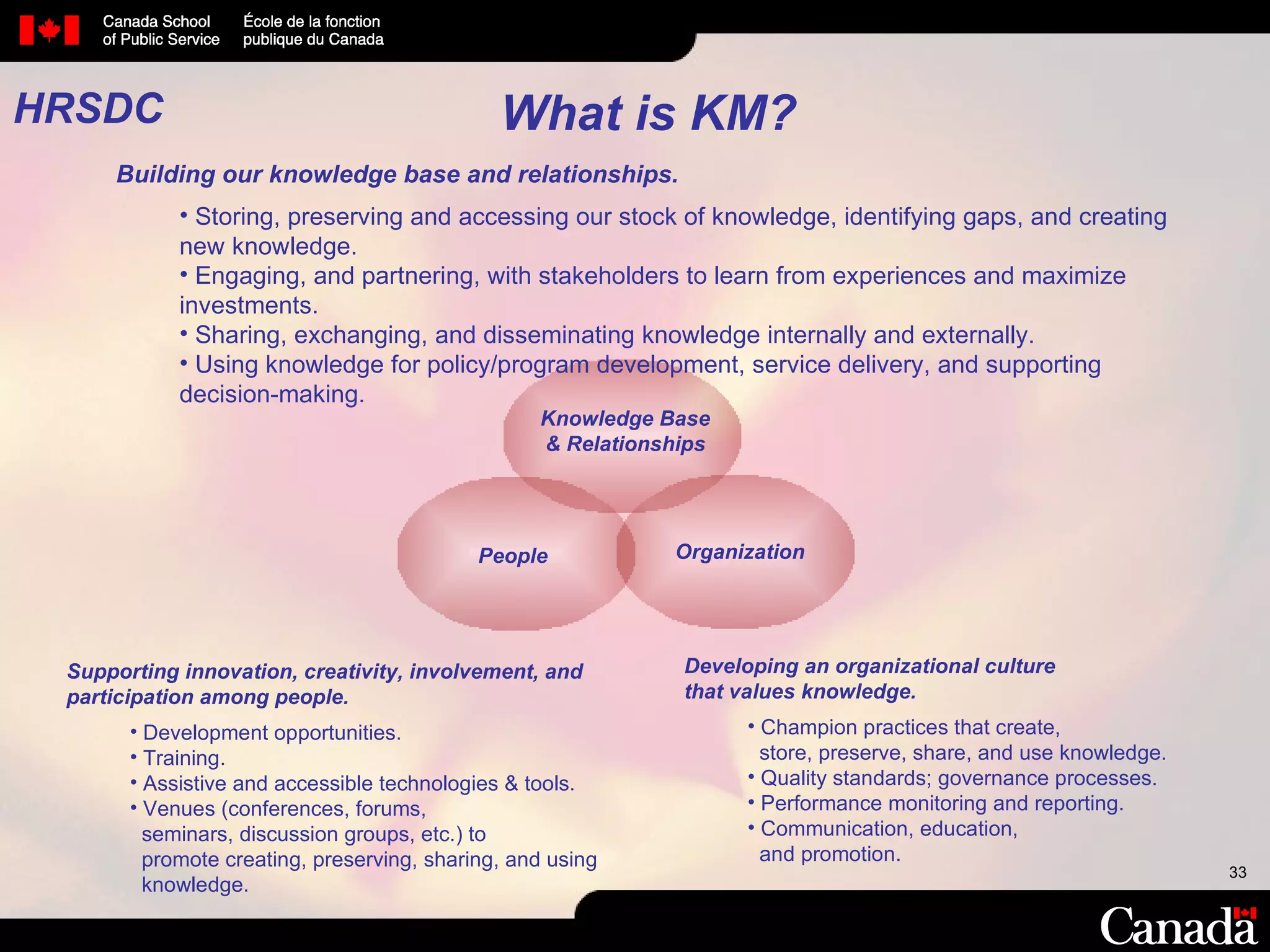
What is KM? Knowledge Base & Relationships People Organization Supporting innovation, creativity, involvement, and participation among people. Development opportunities. Training. Assistive and accessible technologies & tools. Venues (conferences, forums, seminars, discussion groups, etc.) to promote creating, preserving, sharing, and using knowledge. Developing an organizational culture  that values knowledge. Champion practices that create, store, preserve, share, and use knowledge. Quality standards; governance processes. Performance monitoring and reporting. Communication, education, and promotion. Building our knowledge base and relationships.   Storing, preserving and accessing our stock of knowledge, identifying gaps, and creating new knowledge. Engaging, and partnering, with stakeholders to learn from experiences and maximize investments. Sharing, exchanging, and disseminating knowledge internally and externally. Using knowledge for policy/program development, service delivery, and supporting decision-making. HRSDC
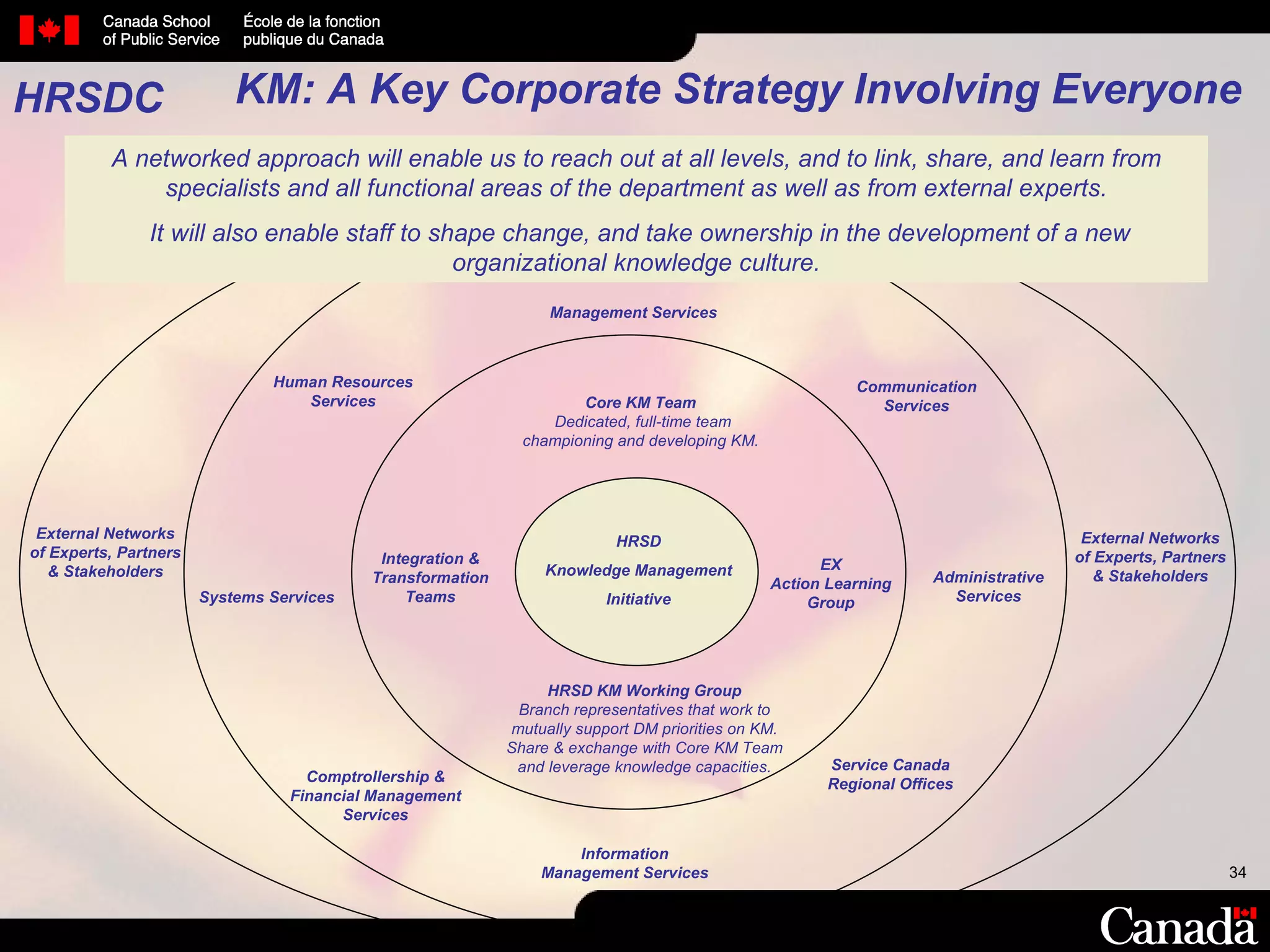
KM: A Key Corporate Strategy Involving Everyone HRSD Knowledge Management Initiative Core KM Team Dedicated, full-time team championing and developing KM. HRSD KM Working Group Branch representatives that work to mutually support DM priorities on KM. Share & exchange with Core KM Team and leverage knowledge capacities.  Systems Services Information Management Services Administrative Services Human Resources Services EX Action Learning Group Comptrollership & Financial Management Services Service Canada Regional Offices Communication Services Management Services Integration & Transformation Teams External Networks of Experts, Partners & Stakeholders External Networks of Experts, Partners & Stakeholders A networked approach will enable us to reach out at all levels, and to link, share, and learn from specialists and all functional areas of the department as well as from external experts. It will also enable staff to shape change, and take ownership in the development of a new organizational knowledge culture. HRSDC
 
 
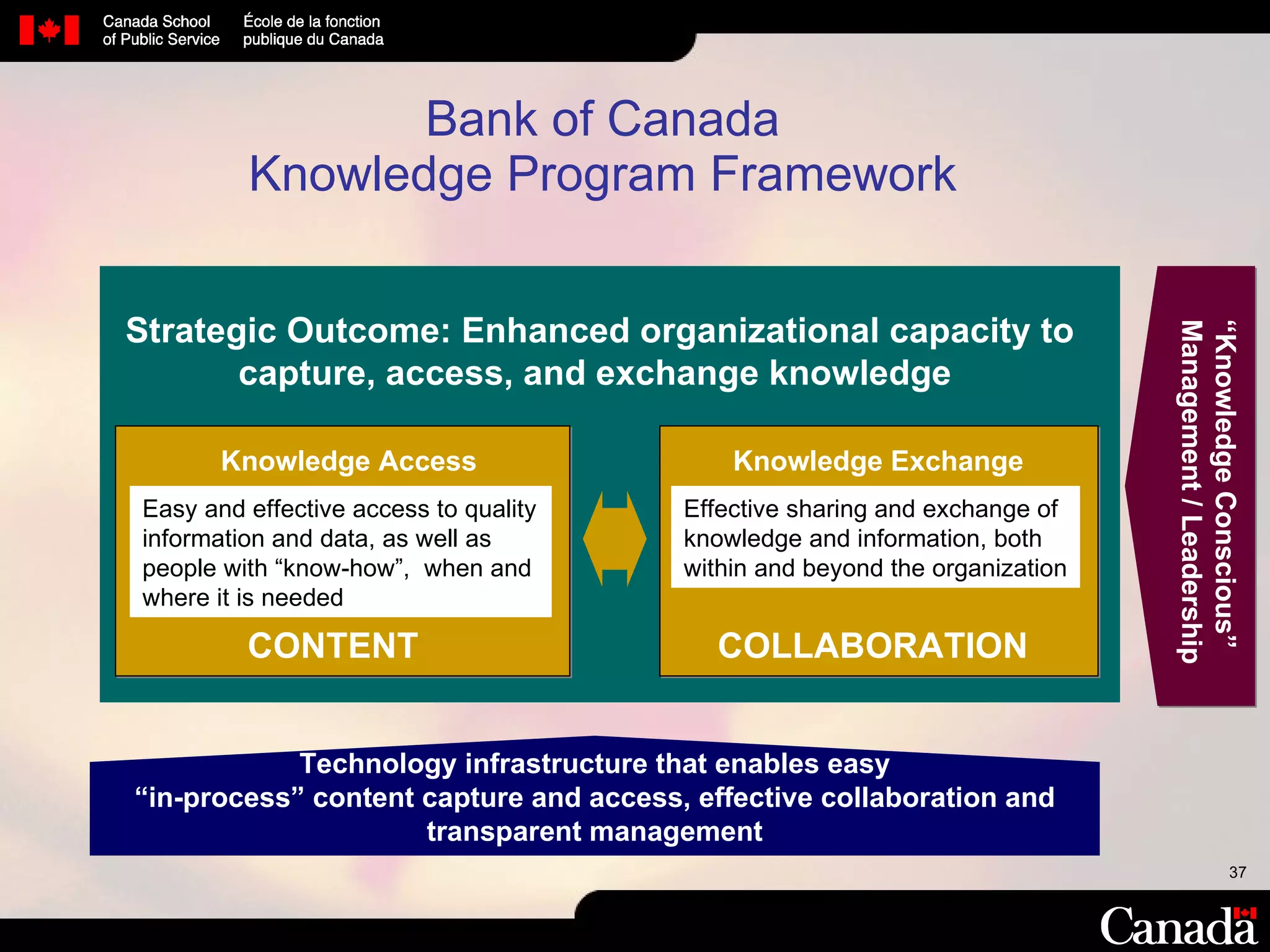
Bank of Canada  Knowledge Program Framework  Technology infrastructure that enables easy “in-process” content capture and access, effective collaboration and transparent management Effective sharing and exchange of  knowledge and information, both within and beyond the organization  Knowledge Exchange Knowledge Access  Easy and effective access to quality information and data, as well as people with “know-how”,  when and where it is needed  Strategic Outcome: Enhanced organizational capacity to capture, access, and exchange knowledge  “ Knowledge Conscious”  Management / Leadership CONTENT COLLABORATION
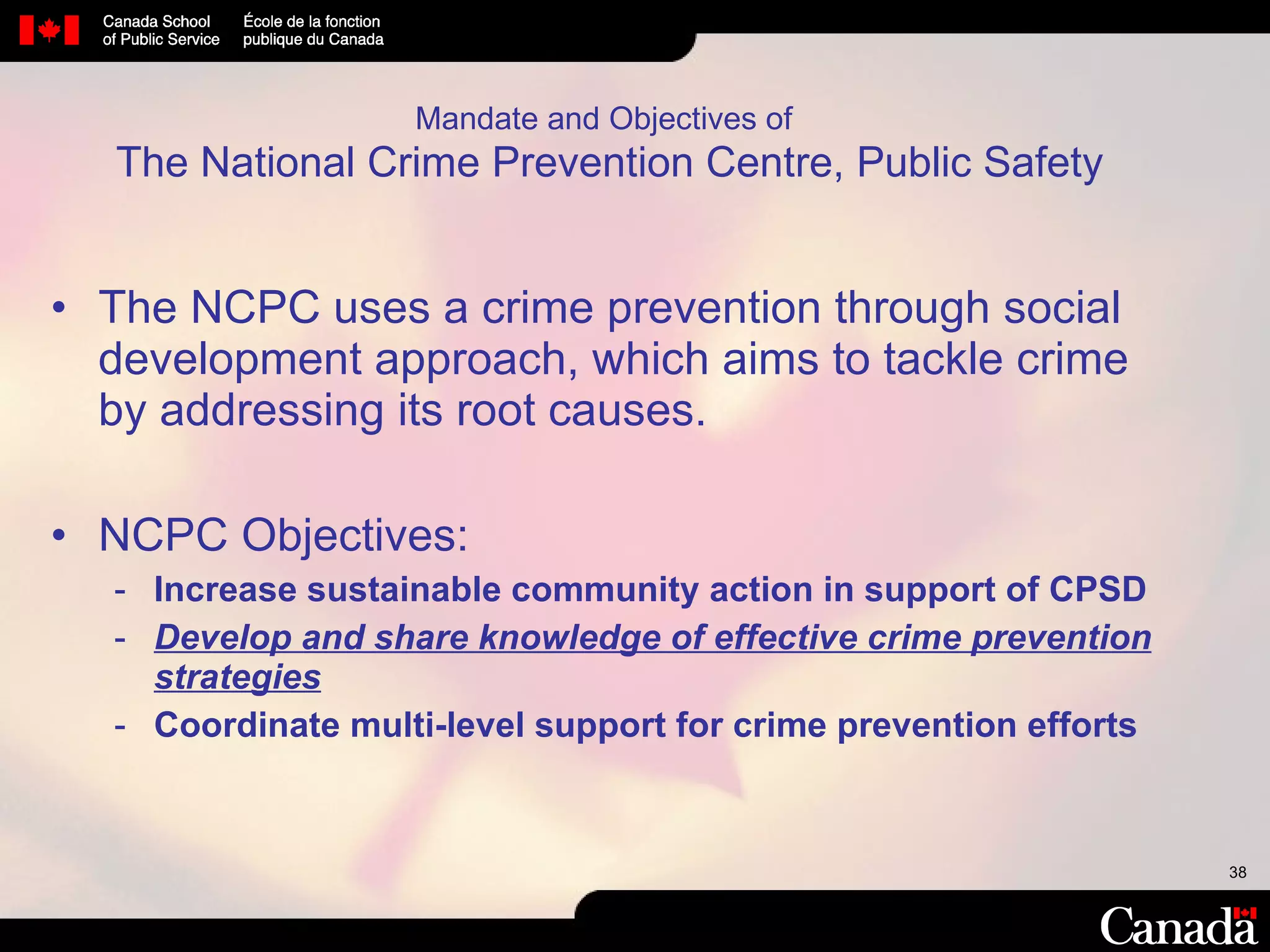
Mandate and Objectives of   The National Crime Prevention Centre, Public Safety The NCPC uses a crime prevention through social development approach, which aims to tackle crime by addressing its root causes.  NCPC Objectives: Increase sustainable community action in support of CPSD Develop and share knowledge of effective crime prevention strategies Coordinate multi-level support for crime prevention efforts
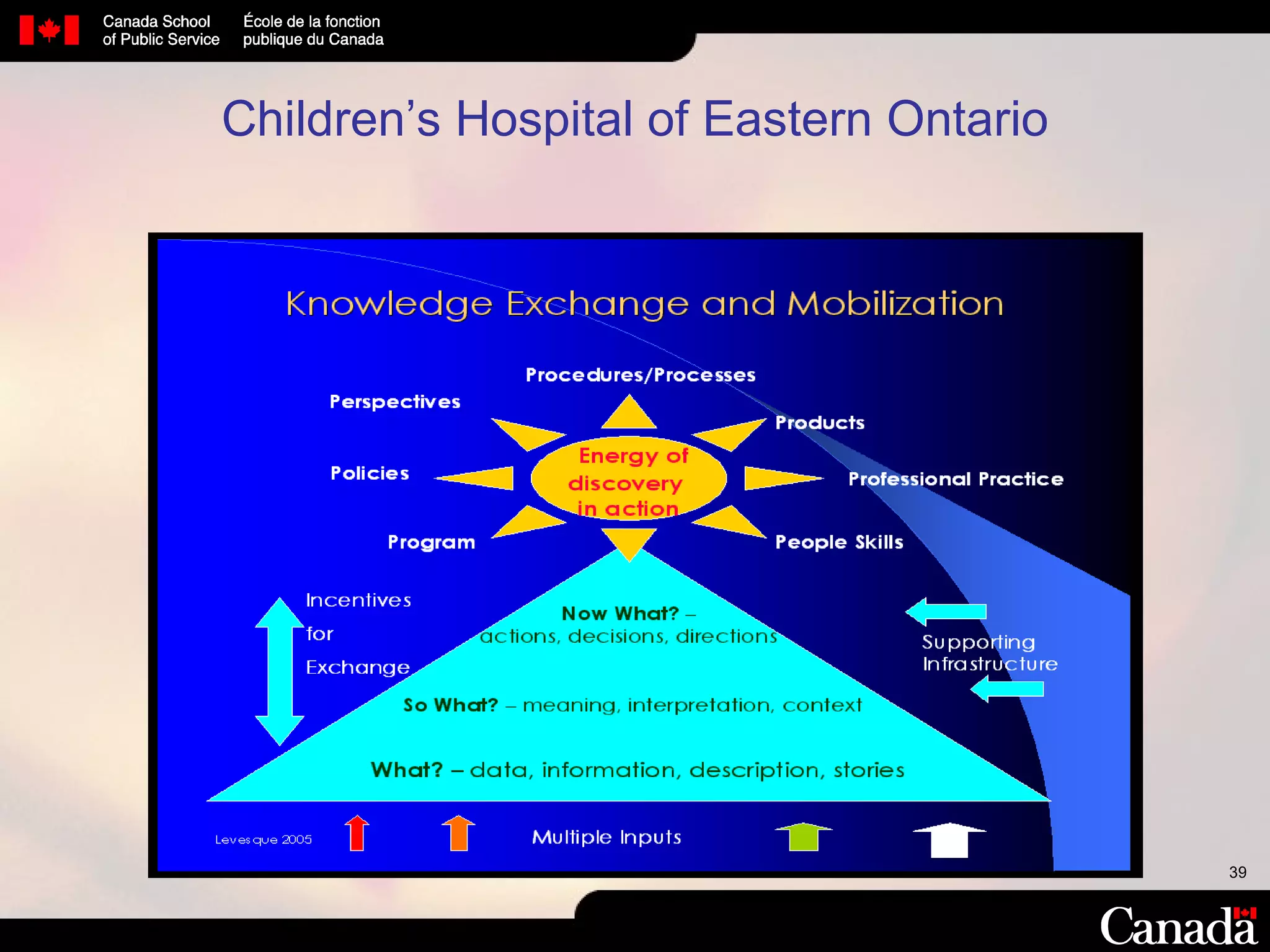
Children’s Hospital of Eastern Ontario
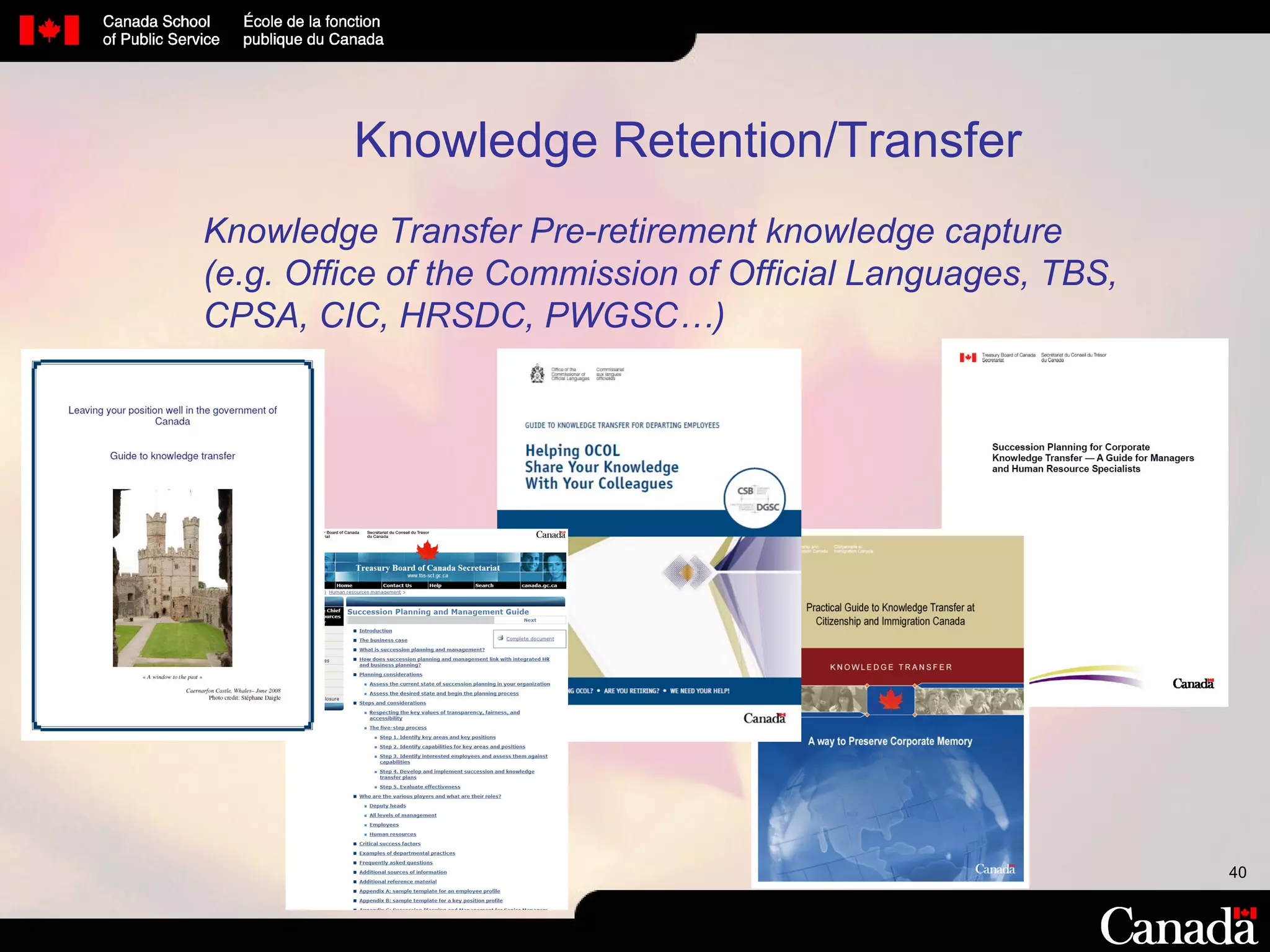
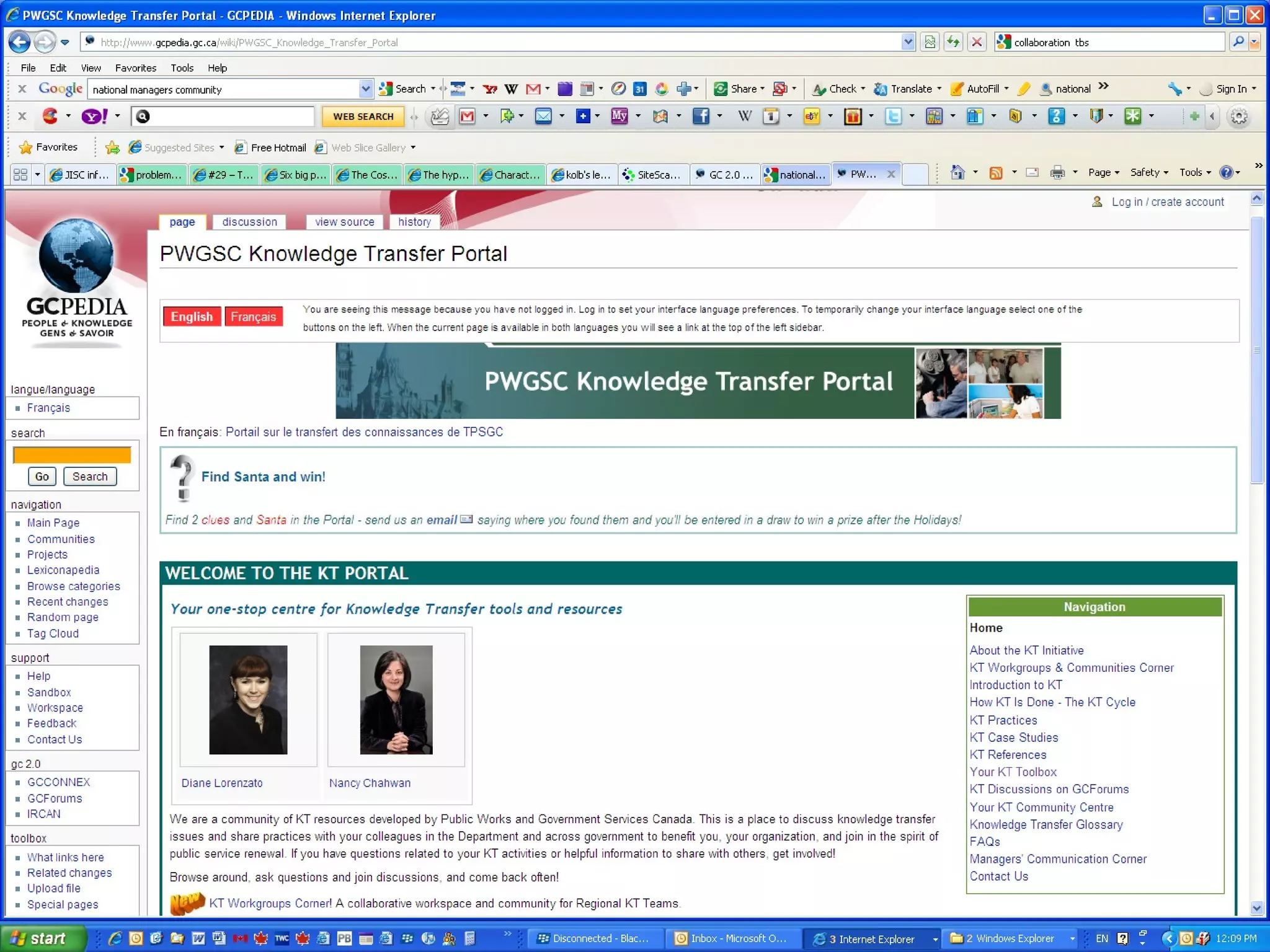
Knowledge Retention/Transfer Knowledge Transfer Pre-retirement knowledge capture (e.g. Office of the Commission of Official Languages, TBS, CPSA, CIC, HRSDC, PWGSC…)
 
What is Knowledge Management? How does Knowledge Management apply to the Canadian public sector? How has Knowledge Management been applied across the Canadian public sector? Lessons Learned in applying KM Agenda
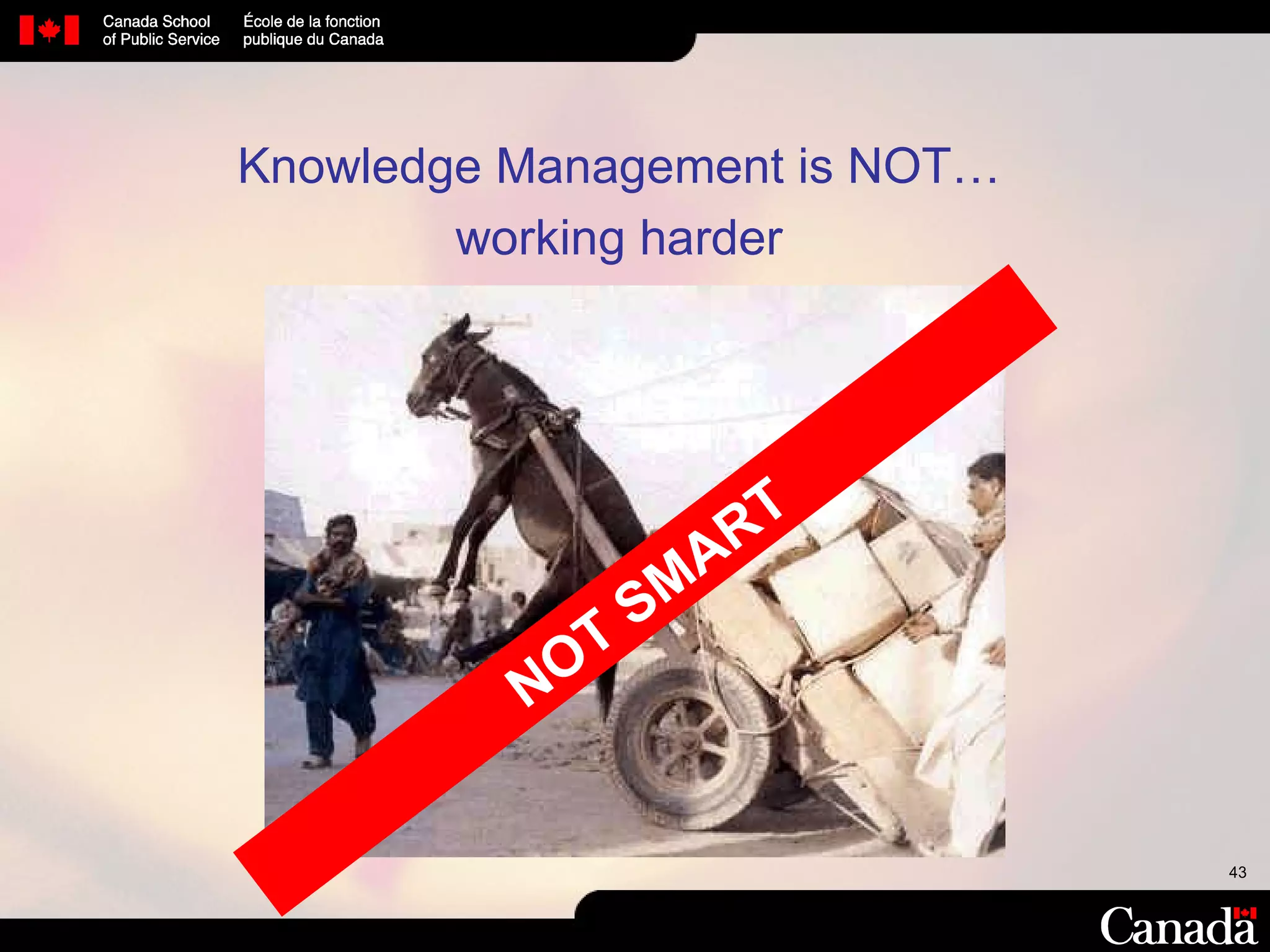
Knowledge Management is NOT… working harder NOT SMART
Knowledge Management is NOT… bullying NOT SMART
Knowledge Management is NOT…. about Technology
Who is involved in the KM Value Chain? Leaders Managers Staff/employees Support groups Clients/customers/citizens Suppliers Stakeholders KM Value Chain
KM Approaches – the Good, the Bad, … Strategic and/or tactical business-KM  communities of practice, learning networks, functional communities, collaborative arrangements organizational learning & knowledge sharing (Lessons learned, debriefs, AARs, coaching, organizational learning events)  organizational analysis (knowledge mapping/auditing, Social Network Analysis) knowledge creation/innovation – knowledge capture, knowledge transfer team-based management process improvement  HR/workplace and workforce initiatives (succession planning, Workplace Well-being) IT (intranets, group/collaborative software, portals, yellow pages, expert locators, virtual teams, conferencing, search tools) Training & Dev (individual, team) dM/IM/RM/DM (data, information, records and document management)
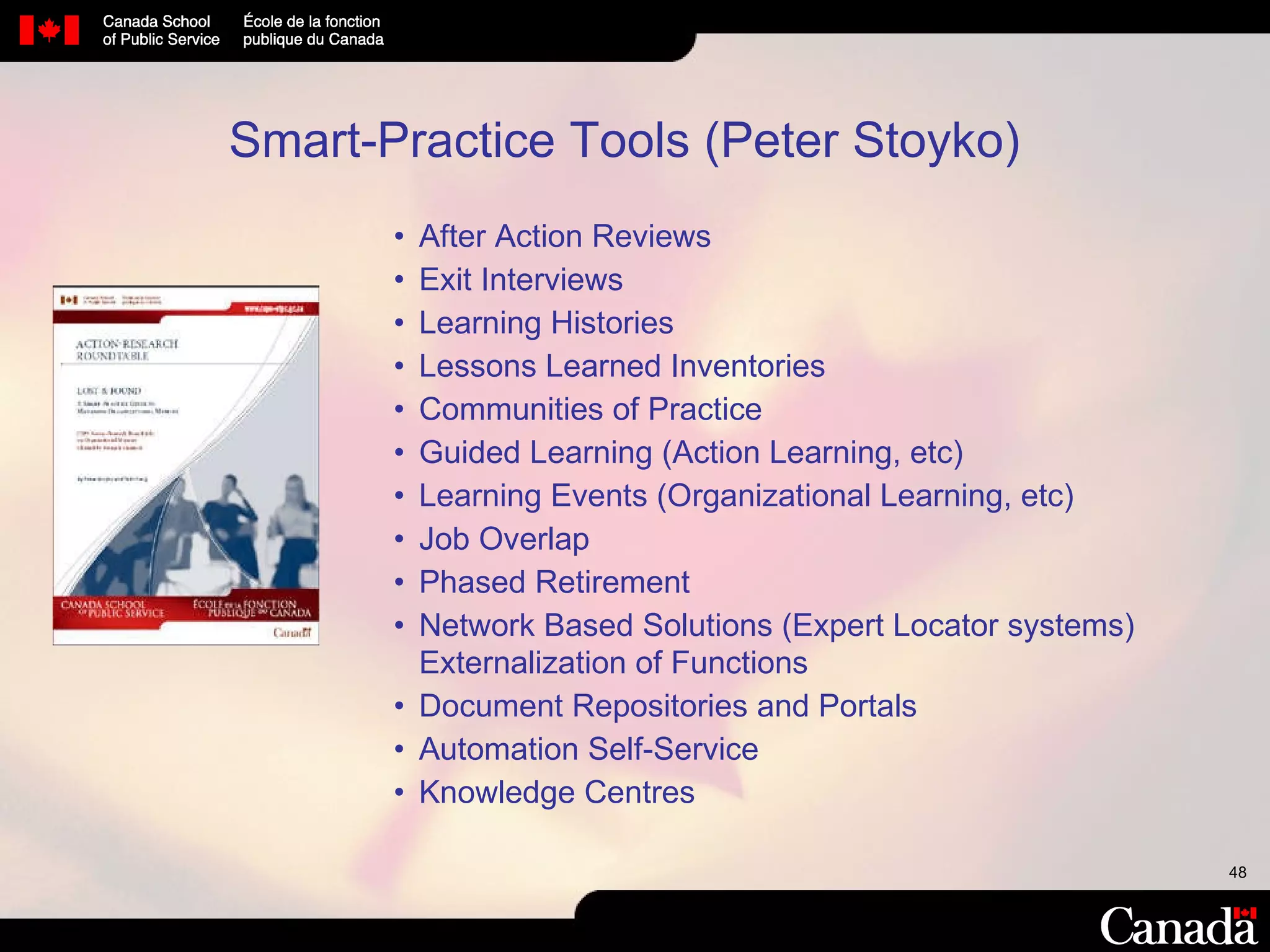
After Action Reviews Exit Interviews Learning Histories Lessons Learned Inventories Communities of Practice Guided Learning (Action Learning, etc) Learning Events (Organizational Learning, etc) Job Overlap Phased Retirement Network Based Solutions (Expert Locator systems) Externalization of Functions Document Repositories and Portals Automation Self-Service Knowledge Centres Smart-Practice Tools (Peter Stoyko)
Some Other Practices/Tools Visualization Storytelling Social Network Analysis Succession Planning/mentoring/coaching K-risk assessment, knowledge audits KM Maturity Assessment and benchmarking Concept Mapping Mindmapping Business Process A/R/M Simulation techniques Knowledge Retention Learning Labs Expert location/’Ask the Expert” Data mining/email analysis… …
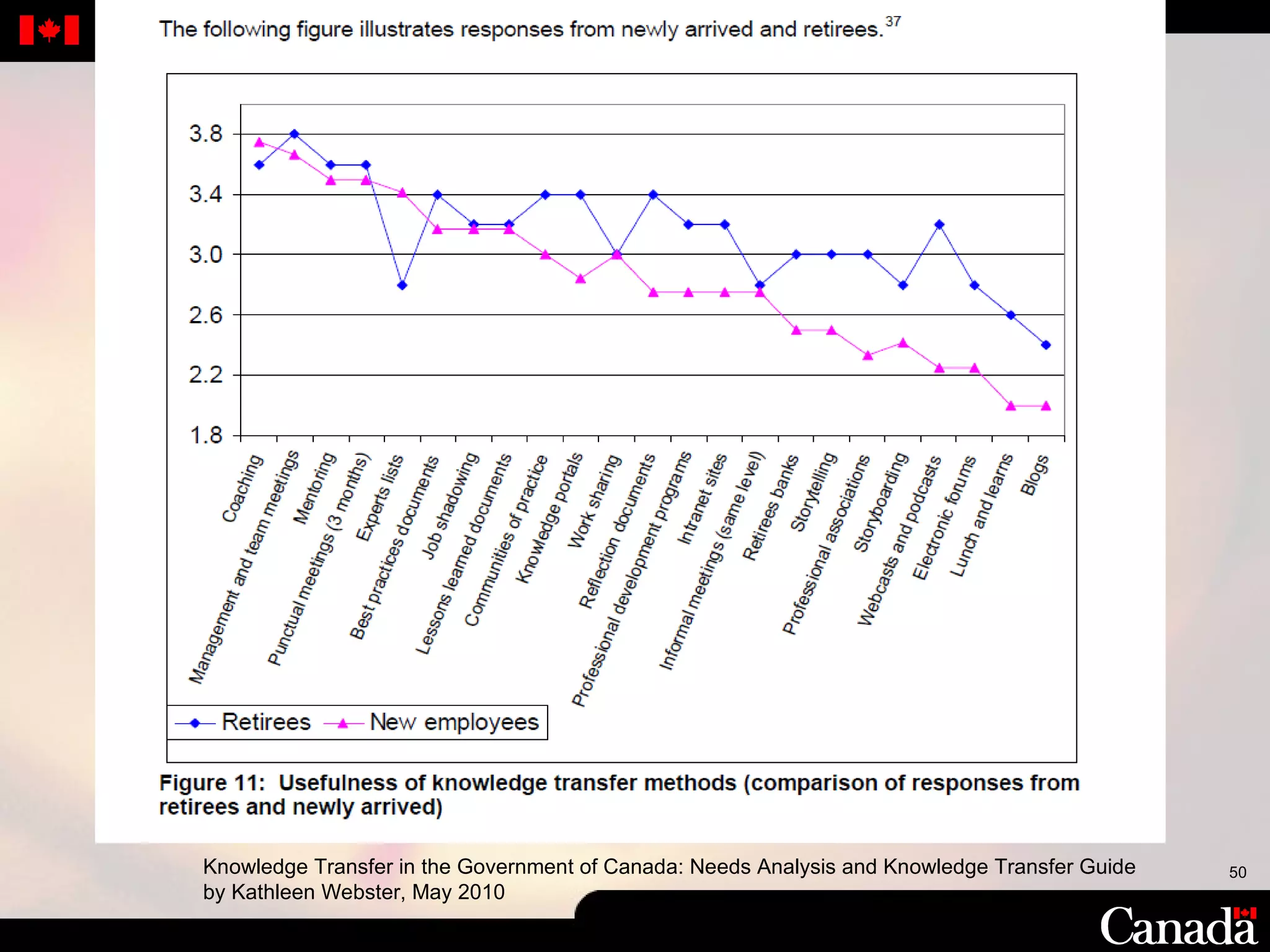
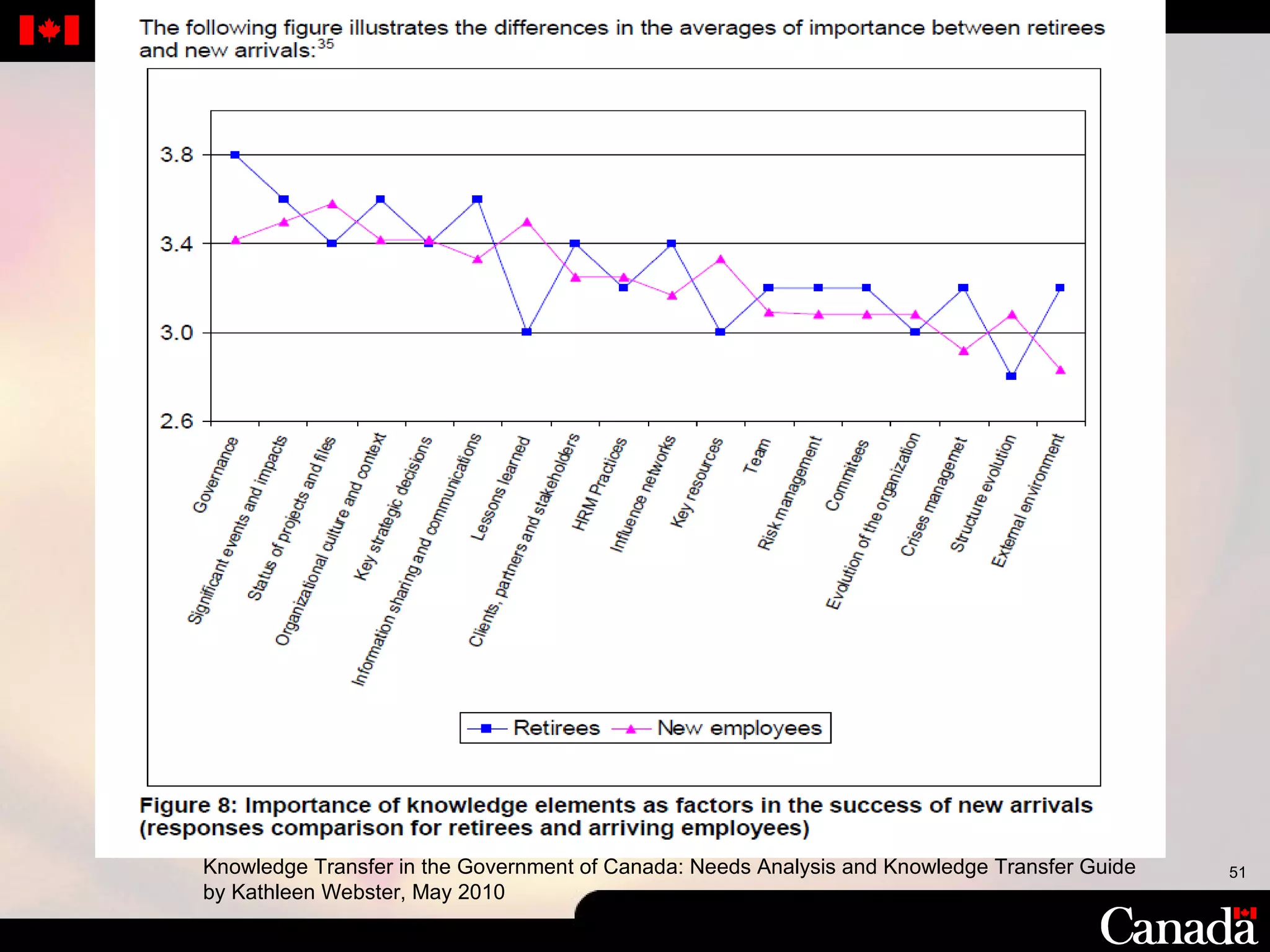
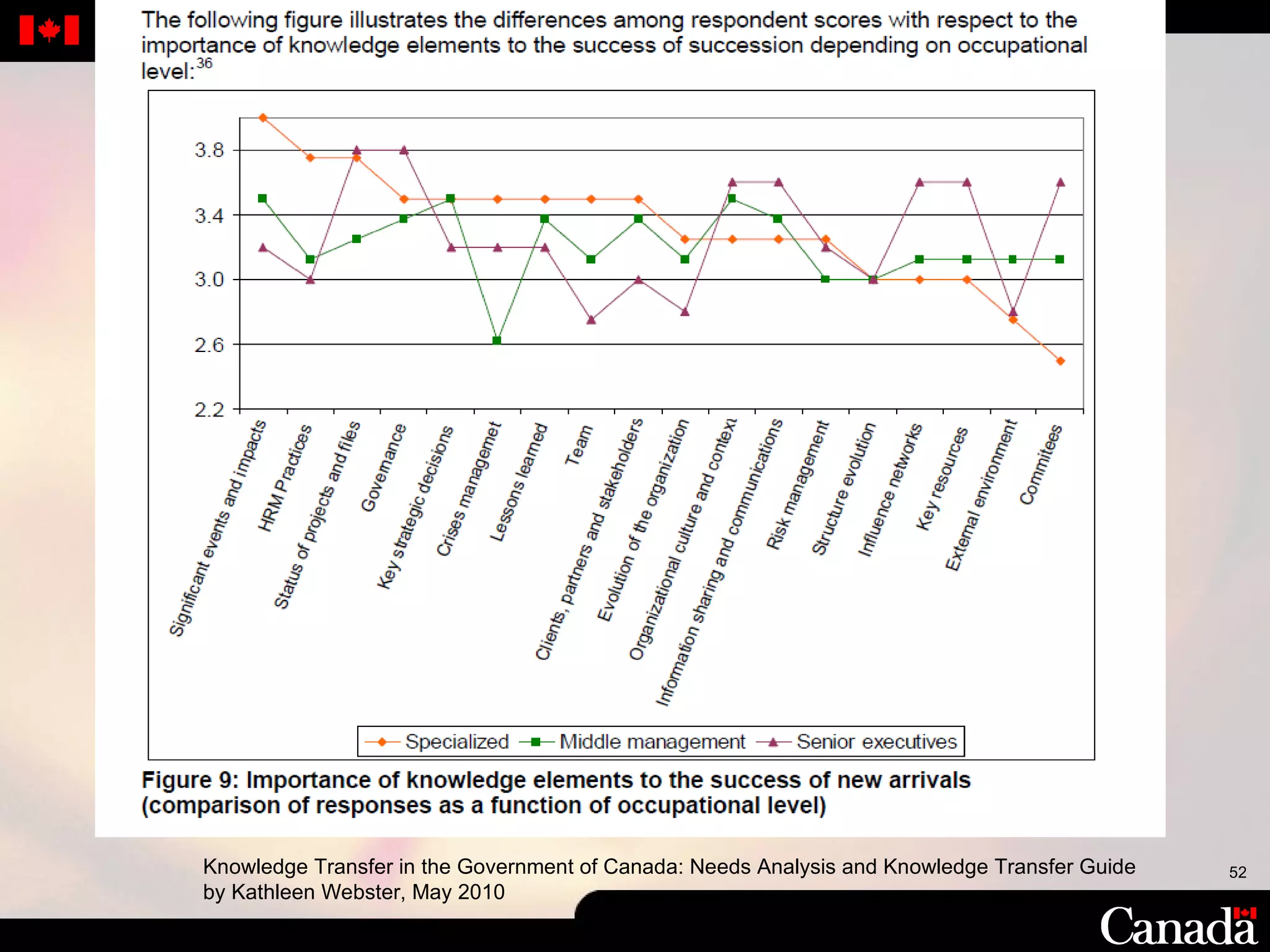
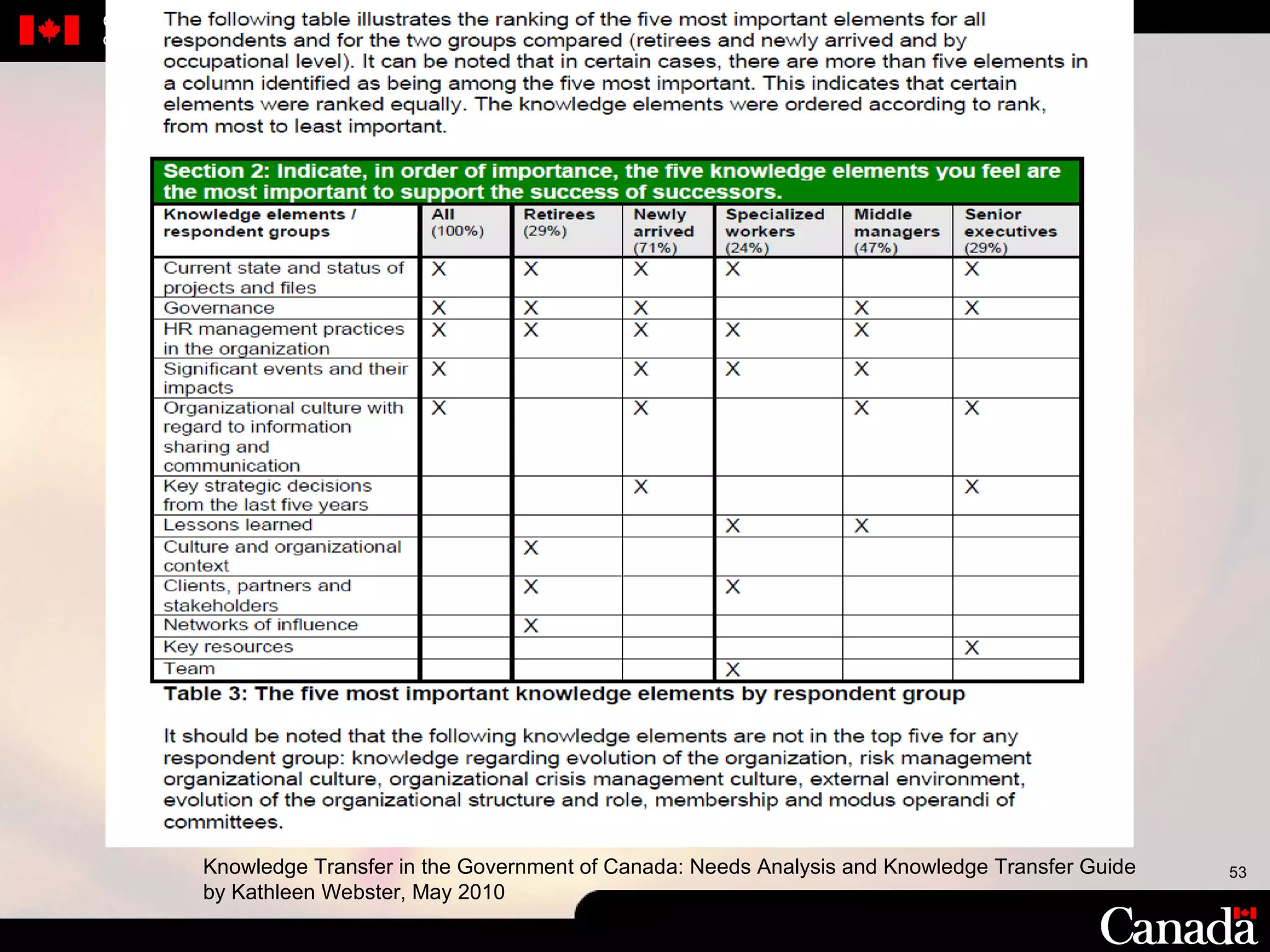
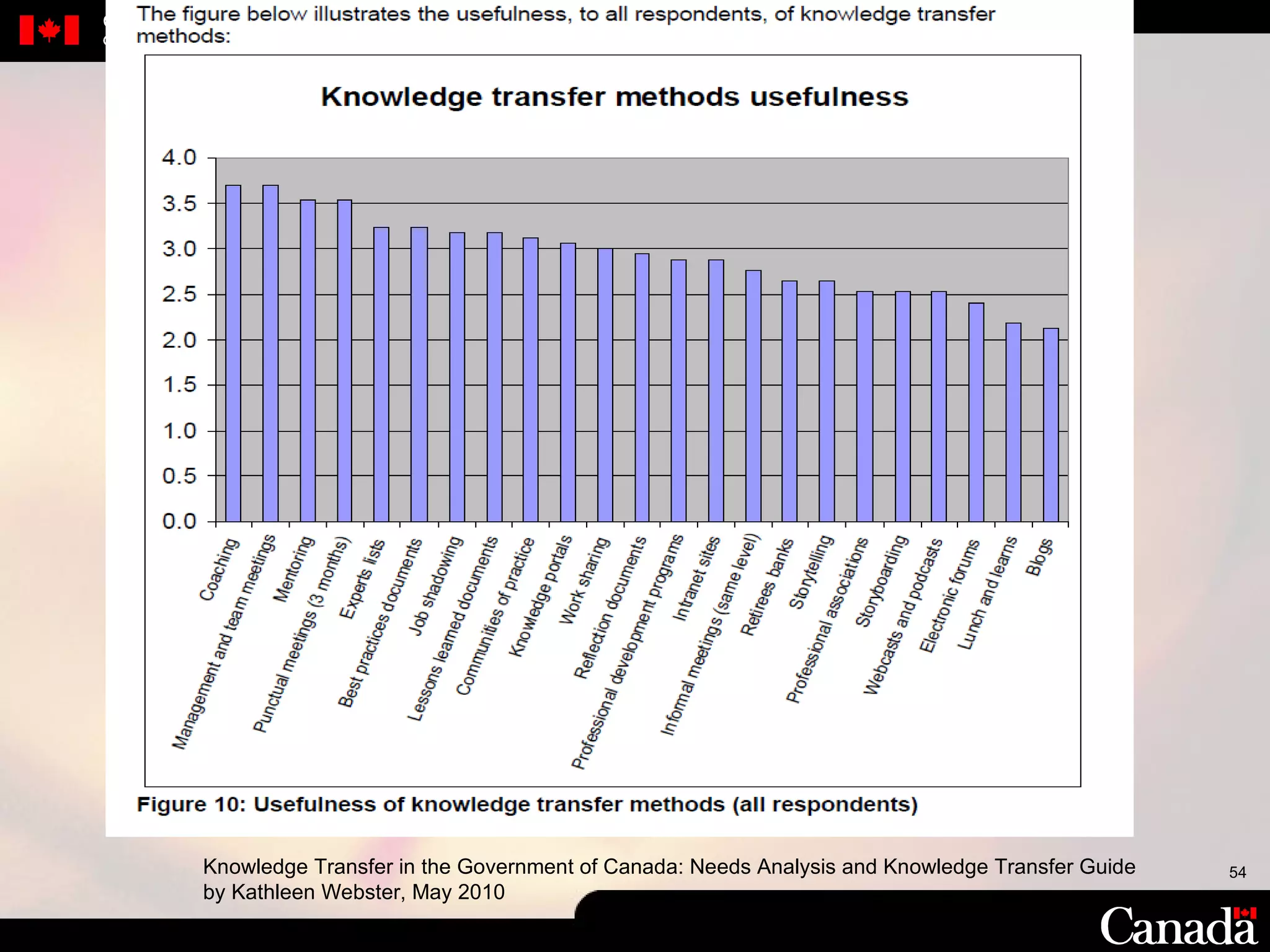
Knowledge Transfer in the Government of Canada: Needs Analysis and Knowledge Transfer Guide by Kathleen Webster, May 2010
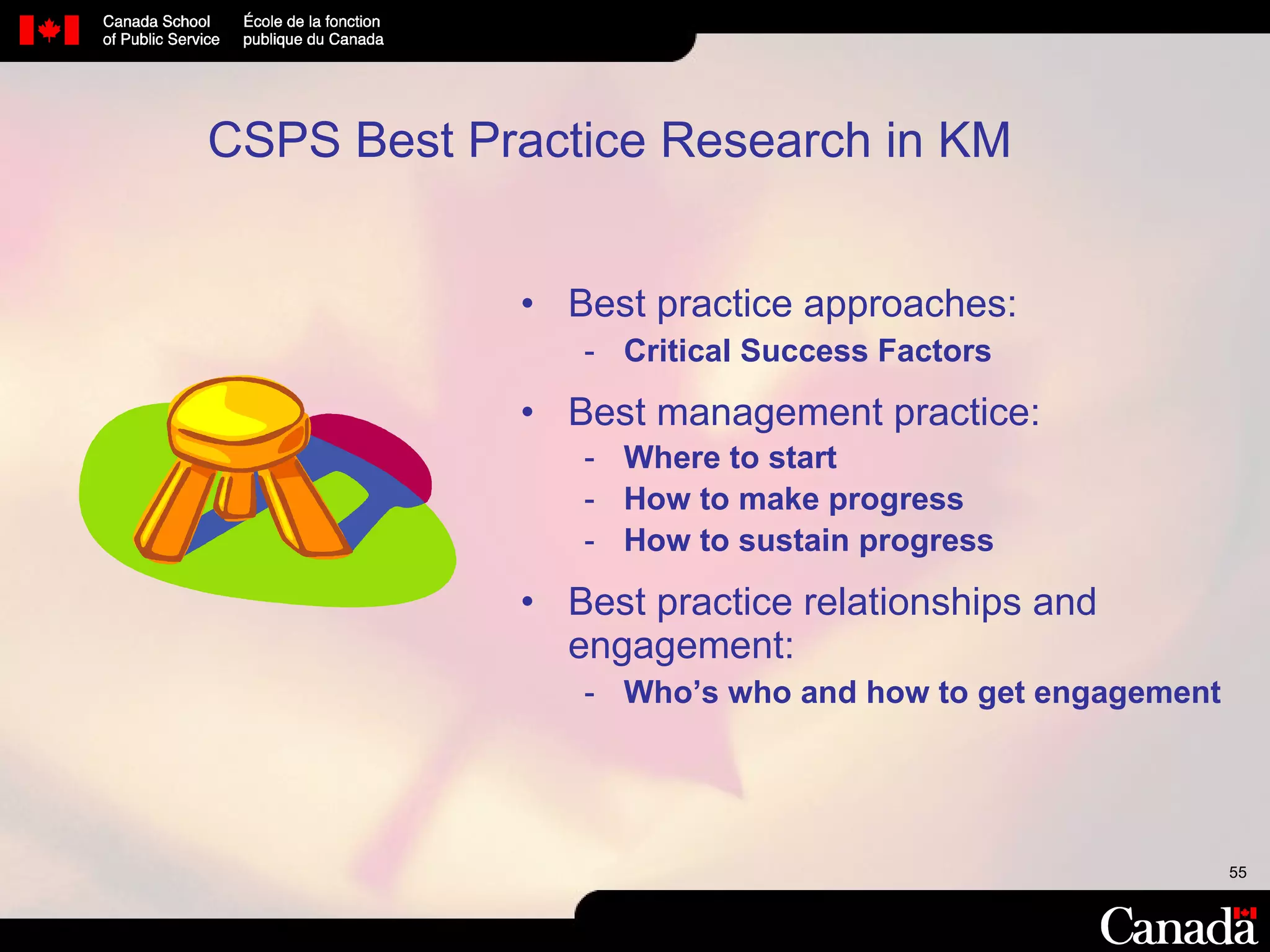
CSPS Best Practice Research in KM Best practice approaches:  Critical Success Factors  Best management practice:  Where to start How to make progress How to sustain progress Best practice relationships and engagement: Who’s who and how to get engagement
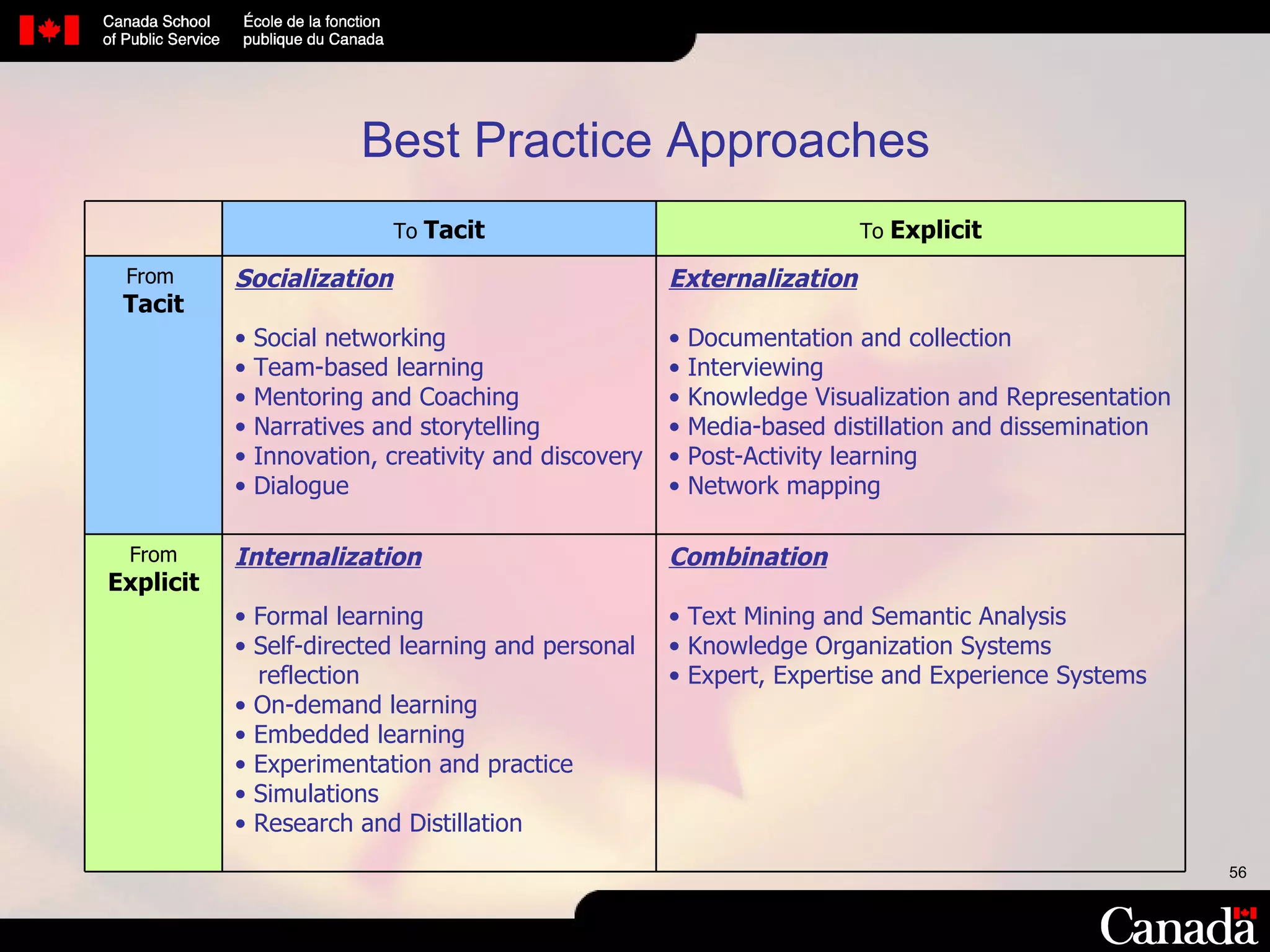
Best Practice Approaches Combination Text Mining and Semantic Analysis Knowledge Organization Systems  Expert, Expertise and Experience Systems Internalization Formal learning Self-directed learning and personal  reflection  On-demand learning Embedded learning Experimentation and practice Simulations  Research and Distillation From  Explicit Externalization Documentation and collection Interviewing Knowledge Visualization and Representation Media-based distillation and dissemination Post-Activity learning  Network mapping Socialization Social networking Team-based learning Mentoring and Coaching Narratives and storytelling Innovation, creativity and discovery Dialogue From  Tacit To  Explicit To  Tacit
Key Lessons Learned Focus KM on strategic and tactical business needs Senior leadership needs to own it, drive it and lead by example Develop strong relationships with allies (Business managers, OD, HR, IM, IT,…) Develop an integrated approach/strategy tied directly to the business strategy – leave your own agenda at the door Fix/reduce known problems – start at the point of pain  Build on what is working well - Keep building on success Engage all levels in the change – ideas and empowerment Be willing to take some risks – learn from failures Make better use of tools, both existing tools and new ones Remember the KM principles  Demonstrate servant leadership Plan and manage for change
What are the CSFs?  Business needs and drivers as the focus  Leadership Engagement – clear and motivating vision, ownership, and driving it at all levels (NOT ‘buy-in’) Employee Engagement – intellectual, emotional and social Behavioural change – influencing corporate culture Sustainable improvement – transformative organizational change, ‘stable’ organization, building on success Vision and insight  “ That’s just the way we do things around here”
The Leadership  Be-attitudes : Be strategic : Identify your organization’s greatest needs; Identify a holistic vision that captures people’s imagination and engagement  Be practical : Recommend straight-forward solutions to real problems; Build on previous work; Manage the scope of effort and expectations; Deliver what you promise, when you promise it  Be inclusive : Develop and build on personal relationships - yours and others; Build and use the support of natural allies, both internally and externally; Be helpful and flexible Be a champion : Demonstrate servant-leadership, Keep moving forward; Be constructive; Carpe diem! Lessons in Leadership   P. McDowall
“ Don’ts” for Knowledge Management Don’t treat KM as a project, an IT “solution”, or a pilot  it’s part of the management discipline!  Don’t focus on KM; focus on the business needs and use KM practices as useful means to help you be more effective (only if its needed!) Don’t underestimate the scope, timeframes and effort, depending upon your needs  this is  organizational change  towards maturity as a knowledge-intensive organization and for most organizations that’s a huge challenge
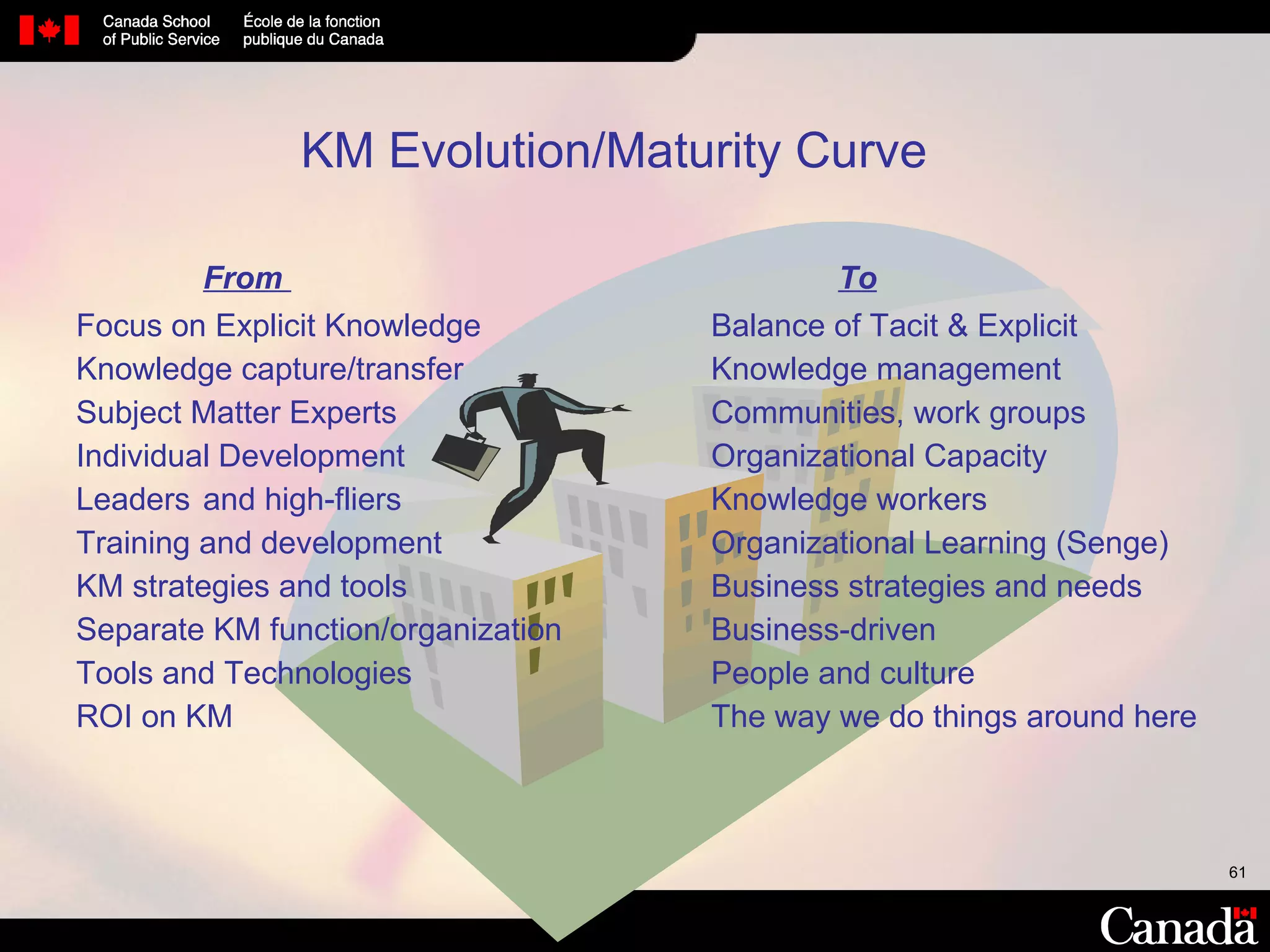
KM Evolution/Maturity Curve From  To Focus on Explicit Knowledge  Balance of Tacit & Explicit  Knowledge capture/transfer  Knowledge management Subject Matter Experts  Communities, work groups Individual Development  Organizational Capacity Leaders and high-fliers Knowledge workers Training and development  Organizational Learning (Senge) KM strategies and tools  Business strategies and needs Separate KM function/organization Business-driven Tools and Technologies  People and culture ROI on KM The way we do things around here
Key Questions What is KM and how might it apply to me, and to my group? How/where could/should I start?  How will I have to change? How will our work need to change? How can we sustain this change? What about the organizational culture? How will we know that we are getting better?
“ In the future, we won’t call it   ‘Knowledge Management’   … we’ll call it   ’Management’ ” Gartner Group
Paul McDowall Knowledge Management Advisor Canada School of Public Service 373 Sussex Drive,  Ottawa, Ontario,  K1N 6Z2, Canada 613-995-3705 [email_address] Interdepartmental Knowledge Management Forum: www. groups.yahoo.com/group/ikmf_figs

Km jan 2011 paul mc dowall

  • 1.
    Some Barriers toOrganizational Improvement in the Public Sector
  • 2.
    Knowledge Management inthe Public Sector 15 years of lessons learned… and other painful experiences January 2011 Paul McDowall Knowledge Management Advisor Canada School of Public Service
  • 3.
    Key Questions Whatis KM and how might it apply to me, and to my group? How/where could/should I start? How will I have to change? How will our work need to change? How can we sustain this change? What about the organizational culture? How will we know that we are getting better?
  • 4.
    What is KnowledgeManagement? How does Knowledge Management apply to the Canadian public sector? How has Knowledge Management been applied across the Canadian public sector? Lessons Learned in applying KM Agenda “ The purpose of management is the productivity of knowledge.” Peter Drucker
  • 5.
    Knowledge Exists inTwo Forms (M. Polanyi) Explicit knowledge: knowledge that is articulated in formal language and which can be easily transmitted among individuals. It can be expressed in scientific formulae, codified procedures or a variety of other forms. It includes codified information, data, facts, records and documents, text, etc and is held in many different types of media. Tacit knowledge: knowledge that is embedded in individual experience such as perspective and inferential knowledge. Tacit knowledge includes insights, hunches, intuitions, and skills that are highly personal and hard to formalize, making them difficult to communicate or share with others. It can be ‘learned’ from someone often only by close association with them for a period of time. It represents the cognitive abilities of people.
  • 6.
    Its about theCreation and Flow of Knowledge (Nonaka and Takeuchi)
  • 7.
    Knowledge Spaces (D.Snowden) 1. Routine Standards, manuals Bureaucrats, administrators Categorize, process 2. Specialized Technical documents Experts, consultants Design, develop systems 3. Complex Tacit knowledge Scientists, experience Find patterns, understand 4. Chaotic Observations Explorers, innovators Explore, test Adapted from Snowden (2002)
  • 8.
    Knowledge Management Principles Davenport/Prusak: Knowledge originates and resides in people's minds Knowledge sharing requires trust Knowledge sharing must be encouraged and rewarded Management support and resources are essential Knowledge is creative and should be encouraged to develop in unexpected ways Technology enables new knowledge behaviours Snowden: Knowledge can only be volunteered, it cannot be conscripted We only know what we know when we need to know it In the context of real need few people will withhold their knowledge Everything is fragmented Tolerated failure imprints learning better than success The way we know things is not the way we report we know things We always know more than we can say, and we always say more than we can write down
  • 9.
    Knowledge Management, or the management of an environment to facilitate the creation and use of knowledge for increased innovation and value , is a multi-disciplinary field that draws from theories in economics, sociology, philosophy, and psychology. It also engages the applied fields of information technology, information and library science, and business. This matrix gives KM dimensions that other management approaches lack and thus can provide comprehensive and practical management solutions. S. McIntyre and I. Moen, Vanguard, Issue 4, 2002 Defence Research and Development Canada What Does KM Look Like?
  • 10.
    What Does KMLook Like? Knowledge management refers to the processes of creating, capturing, transferring and using knowledge to enhance organizational performance . Knowledge management is most frequently associated with two particular types of activities: - those activities that attempt to document and appropriate knowledge that individuals have (sometimes called the codification of knowledge) and activities to disseminate that knowledge throughout the organization, and - those activities that facilitate human exchanges in which knowledge that is not codified (tacit knowledge) can be shared. Public Service Commission of Canada, 1998
  • 11.
    What Does KMLook Like? Knowledge Management is a multi-disciplinary approach to using and managing organizational knowledge that is based on sound Information management practices, focussed on organizational learning , recognizing the contribution and value of employees , and is enabled by technolog y. It is primarily concerned with the content of knowledge within the organization and how that knowledge can improve organizational performance. Interdepartmental Knowledge Management Forum, 1999
  • 12.
    What is KnowledgeManagement? How does Knowledge Management apply to the Canadian public sector? How has Knowledge Management been applied across the Canadian public sector? Lessons Learned in applying KM Agenda
  • 13.
    A Knowledge-based PublicSector A Changing Service Agenda - program effectiveness – results! - collaborative arrangements - efficiency and innovation – strategic review - accountability - risk sensitivity A Changing Policy Agenda - policy re-focussing and rationalization A Changing Workforce – changing demographics A Changing Workforce Management Agenda - public service renewal - core learning and professional development - recruitment and staffing - Talent Management - retention and workplace well-being
  • 14.
    “ Employee developmentis the responsibility of both the individual and the institution, but it serves a single purpose: to improve effectiveness and productivity in current and future jobs. This requires going beyond coursework and classroom learning. The task is to consciously create learning environments where knowledge management is done well and where employees have ready access to the information they need to do their jobs … To renew the workplace, we must put greater emphasis on collaboration, technology, innovation, back office systems and knowledge management . We must also improve our ability to make choices and set priorities as we carry out our work.” Clerk of the Privy Council’s Seventeenth Annual Report, 2010 A Knowledge-based Public Sector
  • 15.
    “ In additionto embedding renewal across their organizations, deputy heads will also advance renewal in four specific areas to support Renewing the Workplace : … 2. Knowledge Management Our knowledge and information are important government assets that should be systematically captured and shared among individuals and across organizations. Deputy heads will assess and improve their approaches to managing knowledge and information as corporate assets. Deputy heads will build knowledge transfer considerations into their talent management and succession planning strategies for executives and other critical positions.” 2010-11 Public Service Renewal Action Plan A Knowledge-based Public Sector
  • 16.
    “ Loss ofvital knowledge and experience is taking its toll on Canada’s cherished institutions – the Public Service of Canada in particular. Veteran employees are retiring in unprecedented numbers. Continual change and organizational churn are now the norm. New technologies allow us to store vast amounts of information, but also to misplace vast amounts of information. We, as an institution, are forgetting important lessons from the past… Preserving knowledge is a core responsibility of every manager… There are no longer any excuses for doing nothing. ” François Guimont, Chair, CSPS Action-Research Roundtable on Organizational Memory (from Lost & Found A Smart-Practice Guide to Managing Organizational Memory , April, 2007) The Challenge for the Public Sector
  • 17.
    What is KnowledgeManagement? How does Knowledge Management apply to the Canadian public sector? How has Knowledge Management been applied across the Canadian public sector? Lessons Learned in applying KM Agenda
  • 18.
    Interdepartmental Knowledge ManagementForum Our Raison d’être: The Interdepartmental Knowledge Management Forum (IKMF) creates an exploratory environment that stimulates Knowledge Management (KM) practice in the public sector.  As a community of practice, the IKMF creates a safe environment for reflection, discovery, dialogue and innovation through the sharing of experiences, practices and insights between practitioners and those interested in KM.  The objectives of the Forum are: to encourage dialogue and collaboration between colleagues from knowledge-intensive communities to focus on and share experiences in the implementation of knowledge management in the public sector to be a centre of excellence and expertise in the development and use of knowledge management in the public sector
  • 19.
    KM Across theCanadian Public Sector Virtually all have tried, multiple times Science-based (Environment, Health, Nat’l Resources, National Research Council, SSHRC, HRSDC) Operational (PWGSC) International Development (CIDA, Bellanet) Military and Security (DND, DRDC, RCMP, PSEPC) Central Agencies and organizations (OAG, TBS, PSC, PSHRMAC, CSPS) Financial and Economic (Bank of Canada, EDC) Legal (Justice) Overall, limited long-term (>3yr) sustainable impact Political/public policy drivers Mobility across the system at ALL levels, esp. senior managers Myths and misconceptions Turf Costs – hard costs vs soft costs Technology Lack of business focus
  • 20.
    KM Approach* DefenceResearch and Development CRTI Tacit Explicit Tacit Explicit Socialization Combination : Externalization Internalization : *Nonaka, I. and H. Takeuchi. The Knowledge Creating Company. New York: Oxford, 1995 . Tacit Exercises Clusters First Responder Workshops After action reviews Symposia Workshops Tech Demos Competency Map Lessons learned New Protocols Documents/Reports Communications Portal Databases Info Management Exercises Shared Experience Training
  • 21.
  • 22.
    Office of theAuditor General We want people to get to the knowledge and tools need to do the work as quickly and intuitively as possible People Work Done Knowledge tools Gather/share Decide/act Contribute experience People Work Done Knowledge tools Gather/share Decide/act Contribute experience
  • 23.
  • 24.
    Client/dep’t Knowledge (business,issues, history, etc) Government Knowledge (Machinery of Gov’t - who, how, when) General Knowledge (skills, competencies, techniques) Human Resource Management Practices Staff Training Information Management Practices Leadership & Planning Supportive Technology Professional Development Knowledge Management Enablers Critical Knowledge Areas for TBS TBS Knowledge (organization, people, processes, etc) Domain Knowledge (policy and subject matter areas) Collaboration & communication TBS Priorities & Core Business Knowledge Management for TBS Financial Resource Management Practices
  • 25.
    Learning and KnowledgeManagement in TBS Meet the Basic Training Needs - Bring people up to speed ASAP Boot Camps – functional orientation (analysts/managers and admins) Functional guides and reference materials (e.g. TB Submissions, MCs) Custom-developed and customized JIT ‘training’ (1 or 2 per week) - videos Operationalize a Core Learning Program (i.e. Make learning a vital part of improving how the work gets done) CoPs, coaches, mentoring, post-mortems, etc LKM website and many operational guides, reference and learning tools (e.g. Virtual Boot Camp) Make Progress Towards Knowledge Management Organizational KM work assessment w/action plans for gap areas Direct support to departmental ‘teams’ (e.g. team building, collaborative software) Competency profiles and related learning/development tools Leadership workshop / EXCO retreats Leveraging knowledge in day-to-day issues (e.g. facilitation, connections, strategic and operational work improvement team) TBS-wide Org Learning/KM strategy and plan Ongoing advice to middle/senior managers re. accomplishing operational requirements TBS priority and process reviews (all ADMS)
  • 26.
    Inukshuk: Defence KnowledgeModel Inukshuk: “ likeness of a person” (essential component of KM) Identify opportunities Guide leaders Very Canadian Every Inukshuk is different Foundation Leadership Technology Culture Internalization Socialization Externalization Combination Process Tacit Knowledge Explicit Knowledge Measurement
  • 27.
  • 28.
    Knowledge Management NRCanCanadian Forestry Service Capacity Building Organizational Context Resources Infra - structure Co n tent Gover-nance Culture Learning Funds People Time Technology Systems Management Acquisition Production Dissemination Vision Direction Commitment Change Sharing Controlling Education Skills Experience
  • 29.
    Natural Resources Canadainfrastructure & systems to capture, store, share content Content Tools Organization People Learning, motivation, rewards, incentives Processes roles, responsibilities, authorities, resources lessons learned, best practices, work routines forestry data, information & knowledge
  • 30.
    Natural Resources Canada:What is Knowledge management?
  • 31.
  • 32.
  • 33.
    What is KM?Knowledge Base & Relationships People Organization Supporting innovation, creativity, involvement, and participation among people. Development opportunities. Training. Assistive and accessible technologies & tools. Venues (conferences, forums, seminars, discussion groups, etc.) to promote creating, preserving, sharing, and using knowledge. Developing an organizational culture that values knowledge. Champion practices that create, store, preserve, share, and use knowledge. Quality standards; governance processes. Performance monitoring and reporting. Communication, education, and promotion. Building our knowledge base and relationships. Storing, preserving and accessing our stock of knowledge, identifying gaps, and creating new knowledge. Engaging, and partnering, with stakeholders to learn from experiences and maximize investments. Sharing, exchanging, and disseminating knowledge internally and externally. Using knowledge for policy/program development, service delivery, and supporting decision-making. HRSDC
  • 34.
    KM: A KeyCorporate Strategy Involving Everyone HRSD Knowledge Management Initiative Core KM Team Dedicated, full-time team championing and developing KM. HRSD KM Working Group Branch representatives that work to mutually support DM priorities on KM. Share & exchange with Core KM Team and leverage knowledge capacities. Systems Services Information Management Services Administrative Services Human Resources Services EX Action Learning Group Comptrollership & Financial Management Services Service Canada Regional Offices Communication Services Management Services Integration & Transformation Teams External Networks of Experts, Partners & Stakeholders External Networks of Experts, Partners & Stakeholders A networked approach will enable us to reach out at all levels, and to link, share, and learn from specialists and all functional areas of the department as well as from external experts. It will also enable staff to shape change, and take ownership in the development of a new organizational knowledge culture. HRSDC
  • 35.
  • 36.
  • 37.
    Bank of Canada Knowledge Program Framework Technology infrastructure that enables easy “in-process” content capture and access, effective collaboration and transparent management Effective sharing and exchange of knowledge and information, both within and beyond the organization Knowledge Exchange Knowledge Access Easy and effective access to quality information and data, as well as people with “know-how”, when and where it is needed Strategic Outcome: Enhanced organizational capacity to capture, access, and exchange knowledge “ Knowledge Conscious” Management / Leadership CONTENT COLLABORATION
  • 38.
    Mandate and Objectivesof The National Crime Prevention Centre, Public Safety The NCPC uses a crime prevention through social development approach, which aims to tackle crime by addressing its root causes. NCPC Objectives: Increase sustainable community action in support of CPSD Develop and share knowledge of effective crime prevention strategies Coordinate multi-level support for crime prevention efforts
  • 39.
    Children’s Hospital ofEastern Ontario
  • 40.
    Knowledge Retention/Transfer KnowledgeTransfer Pre-retirement knowledge capture (e.g. Office of the Commission of Official Languages, TBS, CPSA, CIC, HRSDC, PWGSC…)
  • 41.
  • 42.
    What is KnowledgeManagement? How does Knowledge Management apply to the Canadian public sector? How has Knowledge Management been applied across the Canadian public sector? Lessons Learned in applying KM Agenda
  • 43.
    Knowledge Management isNOT… working harder NOT SMART
  • 44.
    Knowledge Management isNOT… bullying NOT SMART
  • 45.
    Knowledge Management isNOT…. about Technology
  • 46.
    Who is involvedin the KM Value Chain? Leaders Managers Staff/employees Support groups Clients/customers/citizens Suppliers Stakeholders KM Value Chain
  • 47.
    KM Approaches –the Good, the Bad, … Strategic and/or tactical business-KM communities of practice, learning networks, functional communities, collaborative arrangements organizational learning & knowledge sharing (Lessons learned, debriefs, AARs, coaching, organizational learning events) organizational analysis (knowledge mapping/auditing, Social Network Analysis) knowledge creation/innovation – knowledge capture, knowledge transfer team-based management process improvement HR/workplace and workforce initiatives (succession planning, Workplace Well-being) IT (intranets, group/collaborative software, portals, yellow pages, expert locators, virtual teams, conferencing, search tools) Training & Dev (individual, team) dM/IM/RM/DM (data, information, records and document management)
  • 48.
    After Action ReviewsExit Interviews Learning Histories Lessons Learned Inventories Communities of Practice Guided Learning (Action Learning, etc) Learning Events (Organizational Learning, etc) Job Overlap Phased Retirement Network Based Solutions (Expert Locator systems) Externalization of Functions Document Repositories and Portals Automation Self-Service Knowledge Centres Smart-Practice Tools (Peter Stoyko)
  • 49.
    Some Other Practices/ToolsVisualization Storytelling Social Network Analysis Succession Planning/mentoring/coaching K-risk assessment, knowledge audits KM Maturity Assessment and benchmarking Concept Mapping Mindmapping Business Process A/R/M Simulation techniques Knowledge Retention Learning Labs Expert location/’Ask the Expert” Data mining/email analysis… …
  • 50.
    Knowledge Transfer inthe Government of Canada: Needs Analysis and Knowledge Transfer Guide by Kathleen Webster, May 2010
  • 51.
    Knowledge Transfer inthe Government of Canada: Needs Analysis and Knowledge Transfer Guide by Kathleen Webster, May 2010
  • 52.
    Knowledge Transfer inthe Government of Canada: Needs Analysis and Knowledge Transfer Guide by Kathleen Webster, May 2010
  • 53.
    Knowledge Transfer inthe Government of Canada: Needs Analysis and Knowledge Transfer Guide by Kathleen Webster, May 2010
  • 54.
    Knowledge Transfer inthe Government of Canada: Needs Analysis and Knowledge Transfer Guide by Kathleen Webster, May 2010
  • 55.
    CSPS Best PracticeResearch in KM Best practice approaches: Critical Success Factors Best management practice: Where to start How to make progress How to sustain progress Best practice relationships and engagement: Who’s who and how to get engagement
  • 56.
    Best Practice ApproachesCombination Text Mining and Semantic Analysis Knowledge Organization Systems Expert, Expertise and Experience Systems Internalization Formal learning Self-directed learning and personal reflection On-demand learning Embedded learning Experimentation and practice Simulations Research and Distillation From Explicit Externalization Documentation and collection Interviewing Knowledge Visualization and Representation Media-based distillation and dissemination Post-Activity learning Network mapping Socialization Social networking Team-based learning Mentoring and Coaching Narratives and storytelling Innovation, creativity and discovery Dialogue From Tacit To Explicit To Tacit
  • 57.
    Key Lessons LearnedFocus KM on strategic and tactical business needs Senior leadership needs to own it, drive it and lead by example Develop strong relationships with allies (Business managers, OD, HR, IM, IT,…) Develop an integrated approach/strategy tied directly to the business strategy – leave your own agenda at the door Fix/reduce known problems – start at the point of pain Build on what is working well - Keep building on success Engage all levels in the change – ideas and empowerment Be willing to take some risks – learn from failures Make better use of tools, both existing tools and new ones Remember the KM principles Demonstrate servant leadership Plan and manage for change
  • 58.
    What are theCSFs? Business needs and drivers as the focus Leadership Engagement – clear and motivating vision, ownership, and driving it at all levels (NOT ‘buy-in’) Employee Engagement – intellectual, emotional and social Behavioural change – influencing corporate culture Sustainable improvement – transformative organizational change, ‘stable’ organization, building on success Vision and insight “ That’s just the way we do things around here”
  • 59.
    The Leadership Be-attitudes : Be strategic : Identify your organization’s greatest needs; Identify a holistic vision that captures people’s imagination and engagement Be practical : Recommend straight-forward solutions to real problems; Build on previous work; Manage the scope of effort and expectations; Deliver what you promise, when you promise it Be inclusive : Develop and build on personal relationships - yours and others; Build and use the support of natural allies, both internally and externally; Be helpful and flexible Be a champion : Demonstrate servant-leadership, Keep moving forward; Be constructive; Carpe diem! Lessons in Leadership P. McDowall
  • 60.
    “ Don’ts” forKnowledge Management Don’t treat KM as a project, an IT “solution”, or a pilot it’s part of the management discipline! Don’t focus on KM; focus on the business needs and use KM practices as useful means to help you be more effective (only if its needed!) Don’t underestimate the scope, timeframes and effort, depending upon your needs this is organizational change towards maturity as a knowledge-intensive organization and for most organizations that’s a huge challenge
  • 61.
    KM Evolution/Maturity CurveFrom To Focus on Explicit Knowledge Balance of Tacit & Explicit Knowledge capture/transfer Knowledge management Subject Matter Experts Communities, work groups Individual Development Organizational Capacity Leaders and high-fliers Knowledge workers Training and development Organizational Learning (Senge) KM strategies and tools Business strategies and needs Separate KM function/organization Business-driven Tools and Technologies People and culture ROI on KM The way we do things around here
  • 62.
    Key Questions Whatis KM and how might it apply to me, and to my group? How/where could/should I start? How will I have to change? How will our work need to change? How can we sustain this change? What about the organizational culture? How will we know that we are getting better?
  • 63.
    “ In thefuture, we won’t call it ‘Knowledge Management’ … we’ll call it ’Management’ ” Gartner Group
  • 64.
    Paul McDowall KnowledgeManagement Advisor Canada School of Public Service 373 Sussex Drive, Ottawa, Ontario, K1N 6Z2, Canada 613-995-3705 [email_address] Interdepartmental Knowledge Management Forum: www. groups.yahoo.com/group/ikmf_figs

Editor's Notes

  • #29 In this diagram, two of the KM dimensions have been divided into progressively smaller units - sufficient to please any bureaucrat. Each dimension is divided into three goals and then into nine program-level components. A more detailed framework has been published that includes 45 project-scale activities. As you can see, knowledge management is about a lot more than Government On-Line (dissemination). To do that one highly visible activity, one needs most of the framework shown here.
  • #39 The National Crime Prevention Strategy is built on the common sense principle that the surest way to reduce crime is to focus on the factors that put individuals at risk -- factors such as family violence, school problems and drug abuse. Its goal is to develop community-based responses to crime, with a particular emphasis on children and youth, Aboriginal people and women. The National Crime Prevention Strategy provides communities with the tools, knowledge and support they need to deal with the causes of crime. Crime Prevention Through Social Development Crime prevention through social development (also referred to as CPSD) is a long-term, proactive approach. It is directed at removing those personal, social and economic factors that lead some individuals to engage in criminal acts or to become victims of crime. This approach aims at strengthening the quality of life for individuals, families and communities. CPSD is intended to increase positive attitudes or behaviours in individuals by influencing their experiences in areas such as family, life, education, employment, housing and/or recreation. While recognizing that societal influences such as poverty, gender inequality, media violence, racism, and discrimination are part of the crime prevention context, CPSD tends to concentrate on secondary prevention measures. This involves focusing on the many risk factors that contribute to involvement with crime. Some key examples include: inadequate living conditions, such as poor housing and unstable situations; family factors, such as poor or inadequate parenting, parental criminality, and parental substance abuse; individual personality and behavioural factors, such as “cognitive deficits” including a lack of problem-solving skills, self-control, critical reasoning, judgement and failure to consider the consequences of behaviour, hyperactivity, as well as the early onset of aggressive behaviour; peer association, such as relationships with friends who follow a delinquent or criminal lifestyle; school-related factors, such as poor educational achievement and truancy, as well as deficient school environments, and exclusionary policies; Crime prevention through social development seeks to foster “protective factors” such as positive family support that may mitigate situations of risk or disadvantage which contribute to crime and victimization. These protective factors also tend to reduce the risk of harm. CPSD makes connections beyond the traditional criminal justice sphere by recognizing the important role that policies, programs, and services such as social housing, education, health, income security, and social services play in preventing crime. Consequently, CPSD involves a wide range of players from various sectors working together to prevent crime problems. Because CPSD focuses on the social development end of the crime prevention equation, it can take time for the crime prevention benefits to accrue. For example, children and youth are the focus of many CPSD strategies. Some of the best known CPSD programs involve early intervention with children at risk and their parents. Programs such as the Perry Pre-School Project in Michigan and a new generation of “Headstart” programs in Canada (such as Moncton Headstart and Aboriginal Headstart) create supportive environments for children who are at potential risk of later life criminality. These programs demonstrate the ways in which supportive strategies can significantly improve child development, educational achievement and social adjustment, and reduce the likelihood of later involvement in crime. Develop community-based responses and support direct action by communities, especially those most affected. Focus on new and enhanced partnerships with stakeholders, such as local government, law enforcement agencies, the private and academic sectors, to broaden impact and learning Commit to synthesize relevant knowledge and experiences from Canadian communities, and information exchanges between these communities. The renewed NCPC will collaborate with partners at various levels to help mobilize and educate Canadians through: Developing and supporting research and evaluation, policy, and knowledge development on NCPC’s priority groups, including: children and youth, Aboriginal Peoples, and women; and Funding community-based projects through NCPC’s three funding programs, specifically, the Crime Prevention Action Fund (CPAF), the Research and Knowledge Development Fund (RKDF), and the Police, Corrections and Communities Fund (PCCF).