*
Photo by crol373 - Creative Commons Attribution-NonCommercial License https://www.flickr.com/photos/13541271@N00 Created with Haiku Deck
*
TinyURL.com/
KlingDesign
*
*
*
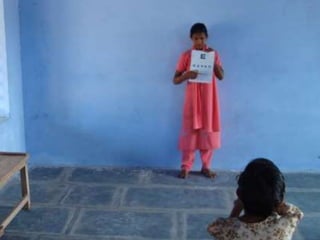
How do the case studies in
the Harvard Business Review
article connect to your work
as school leaders?
• Kaiser Permanente
• Shimano
• Aravind Eye Care System
*
*
*
*
*
*
Photo by EaglebrookSchool - Creative Commons Attribution License https://www.flickr.com/photos/45532942@N08 Created with Haiku Deck
*
What are your human-
centered design problems?
*
*
The mindsets and habits of
designers [esp. when applied
to problems that aren’t
traditional “design problems.”]
*
Focus on Human Needs
Bias Toward Action
Radical Collaboration
*
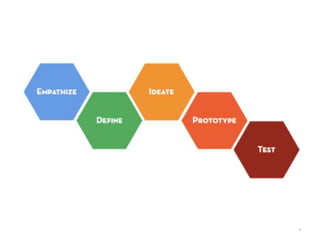
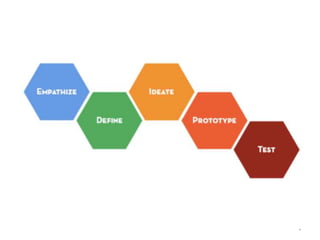
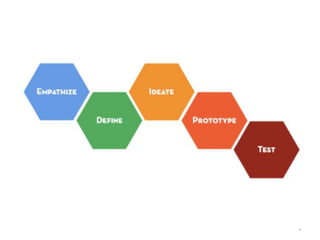
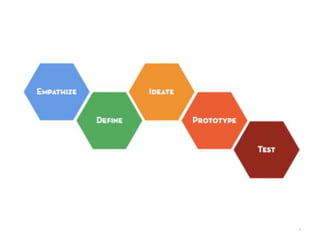
“Design Thinking”
1.Empathize
•Define
•Ideate
•Prototype
•Test
*
Photo by Mike Disharoon - Creative Commons Attribution-ShareAlike License https://www.flickr.com/photos/76975572@N00 Created with Haiku Deck
*
How might we improve
the faculty meeting?
*
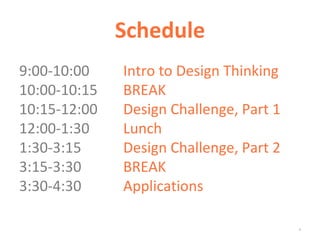
9:00-10:00
10:00-10:15
10:15-12:00
12:00-1:30
1:30-3:15
3:15-3:30
3:30-4:30
Schedule
Intro to Design Thinking
BREAK
Design Challenge, Part 1
Lunch
Design Challenge, Part 2
BREAK
Applications
*
*
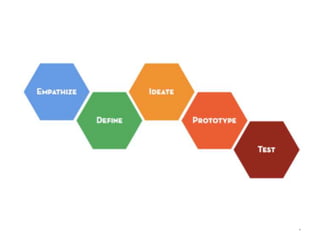
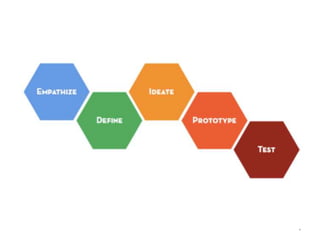
“Design Thinking”
1.Empathize
•Define
•Ideate
•Prototype
•Test
*
Empathize
*
*
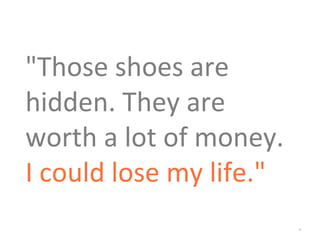
"Those shoes are
hidden. They are
worth a lot of money.
I could lose my life."
*
*
*
*
*
*
“Design Thinking”
1.Empathize
•Define
•Ideate
•Prototype
•Test
*
Define
*
*
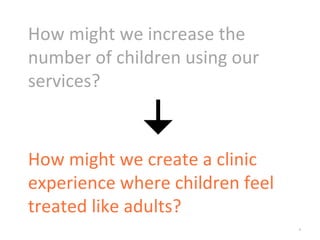
How might we increase the
number of children using our
services?
How might we create a clinic
experience where children feel
treated like adults?
*
If you want to create
better solutions,
find better problems.
*
*
List the human needs
you identified in your
research.
*
*
Imagine you were granted a
magic wish, and could
completely satisfy one of the
needs you identified.
Which need would you satisfy to
make the biggest impact?
*
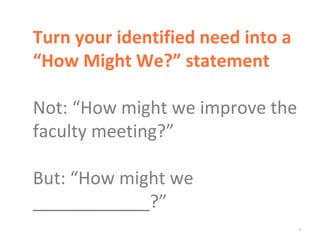
Turn your identified need into a
“How Might We?” statement
Not: “How might we improve the
faculty meeting?”
But: “How might we
____________?”
*
So far…
How does design thinking
compare with the typical decision
making process at your school?
*
“Design Thinking”
1.Empathize
•Define
•Ideate
•Prototype
•Test
*
Ideate
*
*
“Design Thinking”
1.Empathize
•Define
•Ideate
•Prototype
•Test
*
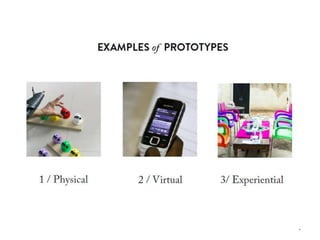
Prototype
**
**
*
**
**
**
**
*
**
**
**
**
*
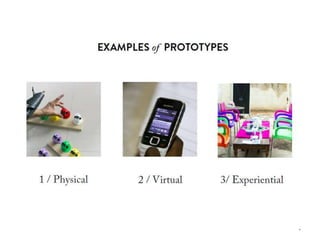
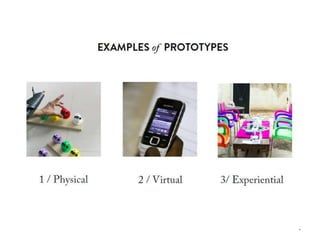
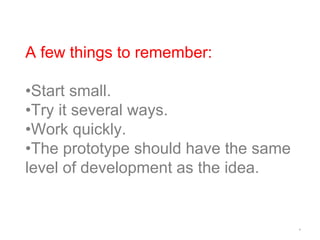
A few things to remember:
•Start small.
•Try it several ways.
•Work quickly.
•The prototype should have the same
level of development as the idea.
*
*
“Design Thinking”
1.Empathize
•Define
•Ideate
•Prototype
•Test
*
Test
*
Photo by Nanagyei - Creative Commons Attribution License https://www.flickr.com/photos/32876353@N04 Created with Haiku Deck
*
*
Write for 10 minutes, considering:
• What was hard or frustrating about
design thinking? What felt natural or
fluid
• How (or where) could you bring this to
your work as a leader?
• What habit or mindset do you need to
work on to lead as a design thinker?
*
Discuss as a design team.
*
Photo by WarzauWynn - Creative Commons Attribution-NonCommercial License https://www.flickr.com/photos/94246031@N00 Created with Haiku Deck
*
*6
8
*6
9
*
*
Photo by bourgeoisbee - Creative Commons Attribution-NonCommercial License https://www.flickr.com/photos/19627189@N06 Created with Haiku Deck
*
*
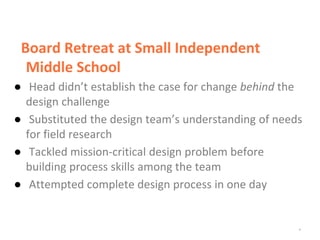
Board Retreat at Small Independent
Middle School
● Head didn’t establish the case for change behind the
design challenge
● Substituted the design team’s understanding of needs
for field research
● Tackled mission-critical design problem before
building process skills among the team
● Attempted complete design process in one day
*
*
“How might we use our
professional development
time to foster a collaborative
learning culture?”
*
Photo of teacher interviews
*
Clips from Professional Learning Time – how we “seeded” the ideation
*
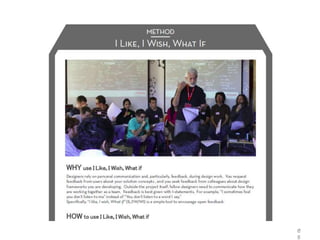
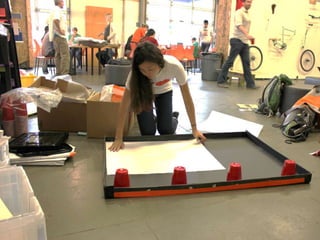
Photos of teachers giving feedback – I like, I wish, what if
*
*
“It’s the last day of the school
year, but I feel the way I usually
feel when I return to school in
August.”
*
*
*
*
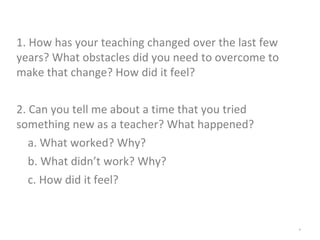
1. How has your teaching changed over the last few
years? What obstacles did you need to overcome to
make that change? How did it feel?
2. Can you tell me about a time that you tried
something new as a teacher? What happened?
a. What worked? Why?
b. What didn’t work? Why?
c. How did it feel?
*
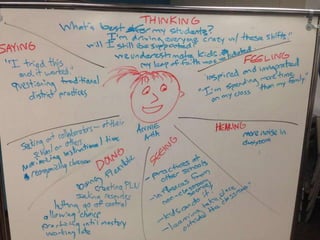
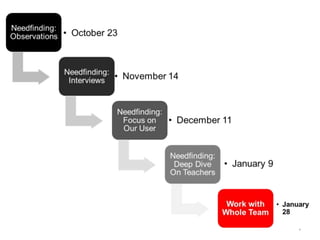
How can you observe
unarticulated needs?
Example: LASD Design Team and
learnings about professional
development
*
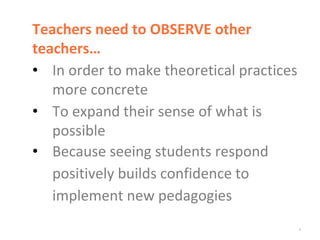
Teachers need to OBSERVE other
teachers…
• In order to make theoretical practices
more concrete
• To expand their sense of what is
possible
• Because seeing students respond
positively builds confidence to
implement new pedagogies
*
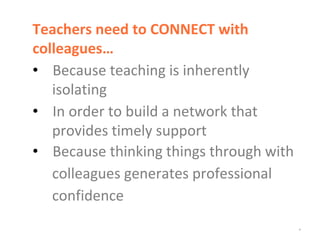
Teachers need to CONNECT with
colleagues…
• Because teaching is inherently
isolating
• In order to build a network that
provides timely support
• Because thinking things through with
colleagues generates professional
confidence
*
*
Photo by Leo Reynolds - Creative Commons Attribution-NonCommercial-ShareAlike License https://www.flickr.com/photos/49968232@N00 Created with Haiku Deck
*
Thank You!
Greg Bamford
twitter: @gregbamford
greg@watershedschool.org

Klingensteindesignworkshop 140713180714-phpapp02