1
Lecture (1)
Dr. Mawahib Gafar Abdalrahman Ahmed
Introduction to
Biomechanics
Anatomy and Physiology of Human
Movement
Aim of the course
 To study Basic Biomechanical Factors
and Concepts
 To study the movement in the human
body
3
After studying this, the students will
be able to:
 Define mechanics, biomechanics, and kinesiology,
and differentiate among their uses in the analysis of
human movement.
 Define and provide examples of linear and angular
motion.
 Define the static and dynamic
 Define kinematics and kinetics.
 Provide examples of human movements that occur
in each plane.
Biomechanics – What is it?
 The term biomechanics combines the prefix
bio, meaning “life,” “living” with the field of
mechanics, which is the study of the actions
of forces and effects.
 The international community of scientists
adopted the term biomechanics during the
early 1970s to describe the science involving
the study of the mechanical aspects of living
organisms.
 Biomechanics application of mechanical
principles in the study of living organisms
Biomechanics – What is it? (cont.)
 The mechanical bases of biological
systems.
 The application of mechanical
laws to living structures.
Biomechanics – What is it? (cont.)
 The study of the structure and
function of biological systems by
means of the methods of mechanics.
 The science concerned with the
internal and external forces acting
on the human body and the effects
produced by these forces.
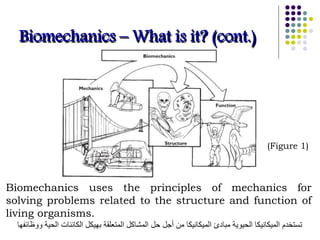
Biomechanics uses the principles of mechanics for
solving problems related to the structure and function of
living organisms.
‫ووظائفها‬ ‫الحية‬ ‫الكائنات‬ ‫بهيكل‬ ‫المتعلقة‬ ‫المشاكل‬ ‫حل‬ ‫أجل‬ ‫من‬ ‫الميكانيكا‬ ‫مبادئ‬ ‫الحيوية‬ ‫الميكانيكا‬ ‫تستخدم‬
(Figure 1)
Biomechanics – What is it? (cont.)
 Biomechanics use the tools of
mechanics, the branch of physics
involving analysis of the actions of
forces, to study the anatomical and
functional aspects of living
organisms (Figure 1).
 Statics and dynamics are two
major sub-branches of mechanics.
Biomechanics – statics
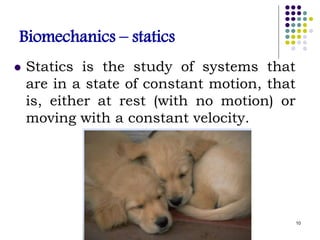
 Statics is the study of systems that
are in a state of constant motion, that
is, either at rest (with no motion) or
moving with a constant velocity.
10
Biomechanics – Dynamics
 Dynamics is the
study of systems in
which acceleration
is present.
 Dynamics-moving
systems
11
Kinesiology – Is it the same as
biomechanics?
 Kinesis (motion) + -logy (science,
study of)
 Applied anatomy and mechanics
 Rasch & Burke (1978). Kinesiology
= anatomy (science of structure)
+ physiology (science of body function)
+ mechanics (science of movement)
= science of movement of the human
body.
Kinesiology (cont.)
 Old (pre-1980) usage
 Title of a functional (applied) anatomy
+ biomechanics course (“Kinesiology”).
 Continue to see that use
 many programs now put extra
descriptors in the title for clarification
(e.g., “Anatomical Kinesiology”,
“Functional Anatomy and
Kinesiology”).
Kinesiology (cont.)
 Current (post-1980) usage
 One of several terms used to
characterize the discipline or field
(e.g., “Department of Kinesiology”).
 Other terms include “Exercise
Science and Physical Education”,
“Exercise and Sport Sciences”,
“Human Movement Studies”, or
“Movement Science”.
Kinesiology (cont.)
 Potentially an umbrella term for any
form of anatomical, physiological,
sychological, or mechanical analysis
of human movement.
15
Biomechanics:
Does it exist in more than one field?
 Exercise and sport biomechanics
 Orthopedic biomechanics
 Occupational biomechanics
 Biomechanics of other biological
systems
Biomechanics –
Does it exist in more than one field?
(cont.)
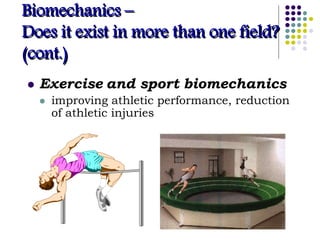
 Exercise and sport biomechanics
 improving athletic performance, reduction
of athletic injuries
Biomechanics –
Does it exist in more than one field?
(cont.)
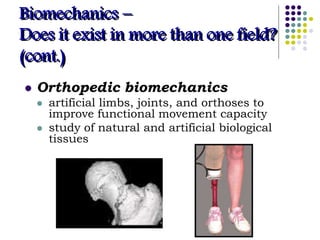
 Orthopedic biomechanics
 artificial limbs, joints, and orthoses to
improve functional movement capacity
 study of natural and artificial biological
tissues
 Occupational Biomechanics
 Ergonomics and Human Factors
 reduction of workplace injuries
Biomechanics –
Does it exist in more than one field?
(cont.)
 Biomechanics of other biological
systems
 Comparative biomechanics (e.g.,
swimming in fish)
 Equine (horse) and canine (dog) racing
performance
Biomechanics –
Does it exist in more than one field?
(cont.)
What do we have
in common?
 Application of fundamental mechanical
principles to the study of structure and
function of living systems.
 Common measurement and analysis
tools.
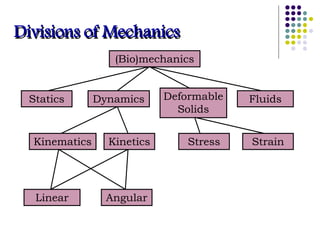
Divisions of Mechanics
Statics Dynamics Fluids
Kinematics Kinetics
Linear Angular
Deformable
Solids
Stress Strain
(Bio)mechanics
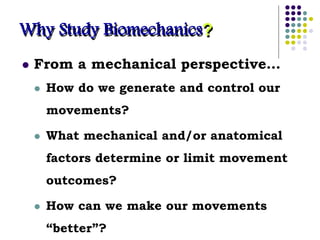
Why Study Biomechanics?
 From a mechanical perspective…
 How do we generate and control our
movements?
 What mechanical and/or anatomical
factors determine or limit movement
outcomes?
 How can we make our movements
“better”?
Terminology- Don’t forget
When the human body is in
anatomical reference position, all
body segments are considered to
be positioned at zero degrees.
Rotation of a body segment away
from anatomical position is named
according to the direction of
motion and is measured as the
angle between the body segment’s
position and anatomical position
Terminology- Don’t forget
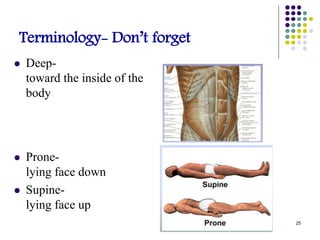
 Deep-
toward the inside of the
body
 Prone-
lying face down
 Supine-
lying face up
25
26
To be continue …….
27

Biomechanics introduction

  • 1.
    1 Lecture (1) Dr. MawahibGafar Abdalrahman Ahmed
  • 2.
    Introduction to Biomechanics Anatomy andPhysiology of Human Movement
  • 3.
    Aim of thecourse  To study Basic Biomechanical Factors and Concepts  To study the movement in the human body 3
  • 4.
    After studying this,the students will be able to:  Define mechanics, biomechanics, and kinesiology, and differentiate among their uses in the analysis of human movement.  Define and provide examples of linear and angular motion.  Define the static and dynamic  Define kinematics and kinetics.  Provide examples of human movements that occur in each plane.
  • 5.
    Biomechanics – Whatis it?  The term biomechanics combines the prefix bio, meaning “life,” “living” with the field of mechanics, which is the study of the actions of forces and effects.  The international community of scientists adopted the term biomechanics during the early 1970s to describe the science involving the study of the mechanical aspects of living organisms.  Biomechanics application of mechanical principles in the study of living organisms
  • 6.
    Biomechanics – Whatis it? (cont.)  The mechanical bases of biological systems.  The application of mechanical laws to living structures.
  • 7.
    Biomechanics – Whatis it? (cont.)  The study of the structure and function of biological systems by means of the methods of mechanics.  The science concerned with the internal and external forces acting on the human body and the effects produced by these forces.
  • 8.
    Biomechanics uses theprinciples of mechanics for solving problems related to the structure and function of living organisms. ‫ووظائفها‬ ‫الحية‬ ‫الكائنات‬ ‫بهيكل‬ ‫المتعلقة‬ ‫المشاكل‬ ‫حل‬ ‫أجل‬ ‫من‬ ‫الميكانيكا‬ ‫مبادئ‬ ‫الحيوية‬ ‫الميكانيكا‬ ‫تستخدم‬ (Figure 1) Biomechanics – What is it? (cont.)
  • 9.
    Biomechanics – Whatis it? (cont.)  Biomechanics use the tools of mechanics, the branch of physics involving analysis of the actions of forces, to study the anatomical and functional aspects of living organisms (Figure 1).  Statics and dynamics are two major sub-branches of mechanics.
  • 10.
    Biomechanics – statics Statics is the study of systems that are in a state of constant motion, that is, either at rest (with no motion) or moving with a constant velocity. 10
  • 11.
    Biomechanics – Dynamics Dynamics is the study of systems in which acceleration is present.  Dynamics-moving systems 11
  • 12.
    Kinesiology – Isit the same as biomechanics?  Kinesis (motion) + -logy (science, study of)  Applied anatomy and mechanics  Rasch & Burke (1978). Kinesiology = anatomy (science of structure) + physiology (science of body function) + mechanics (science of movement) = science of movement of the human body.
  • 13.
    Kinesiology (cont.)  Old(pre-1980) usage  Title of a functional (applied) anatomy + biomechanics course (“Kinesiology”).  Continue to see that use  many programs now put extra descriptors in the title for clarification (e.g., “Anatomical Kinesiology”, “Functional Anatomy and Kinesiology”).
  • 14.
    Kinesiology (cont.)  Current(post-1980) usage  One of several terms used to characterize the discipline or field (e.g., “Department of Kinesiology”).  Other terms include “Exercise Science and Physical Education”, “Exercise and Sport Sciences”, “Human Movement Studies”, or “Movement Science”.
  • 15.
    Kinesiology (cont.)  Potentiallyan umbrella term for any form of anatomical, physiological, sychological, or mechanical analysis of human movement. 15
  • 16.
    Biomechanics: Does it existin more than one field?  Exercise and sport biomechanics  Orthopedic biomechanics  Occupational biomechanics  Biomechanics of other biological systems
  • 17.
    Biomechanics – Does itexist in more than one field? (cont.)  Exercise and sport biomechanics  improving athletic performance, reduction of athletic injuries
  • 18.
    Biomechanics – Does itexist in more than one field? (cont.)  Orthopedic biomechanics  artificial limbs, joints, and orthoses to improve functional movement capacity  study of natural and artificial biological tissues
  • 19.
     Occupational Biomechanics Ergonomics and Human Factors  reduction of workplace injuries Biomechanics – Does it exist in more than one field? (cont.)
  • 20.
     Biomechanics ofother biological systems  Comparative biomechanics (e.g., swimming in fish)  Equine (horse) and canine (dog) racing performance Biomechanics – Does it exist in more than one field? (cont.)
  • 21.
    What do wehave in common?  Application of fundamental mechanical principles to the study of structure and function of living systems.  Common measurement and analysis tools.
  • 22.
    Divisions of Mechanics StaticsDynamics Fluids Kinematics Kinetics Linear Angular Deformable Solids Stress Strain (Bio)mechanics
  • 23.
    Why Study Biomechanics? From a mechanical perspective…  How do we generate and control our movements?  What mechanical and/or anatomical factors determine or limit movement outcomes?  How can we make our movements “better”?
  • 24.
    Terminology- Don’t forget Whenthe human body is in anatomical reference position, all body segments are considered to be positioned at zero degrees. Rotation of a body segment away from anatomical position is named according to the direction of motion and is measured as the angle between the body segment’s position and anatomical position
  • 25.
    Terminology- Don’t forget Deep- toward the inside of the body  Prone- lying face down  Supine- lying face up 25
  • 26.
  • 27.