
KINEMATICS
Venkat Ramana
UNIT 2
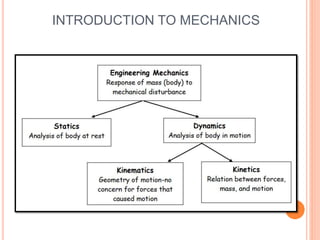
INTRODUCTION TO MECHANICS
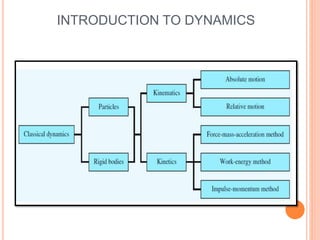
INTRODUCTION TO DYNAMICS
BASIC CONCEPTS
 A particle is a body of negligible dimensions
 Rigid Body is that body whose changes in shape are negligible compared
with its overall dimensions or with the changes in position of the body as
a whole, such as rigid link, rigid disc., etc.
 Absolute motion: The motion of body in relative to another body which is
at rest or to a fixed point located on this body.
 Relative motion: The motion of body in relative to another moved body.
 Scalar quantities are those quantities which have magnitude only e.g.
mass, time, volume, density., etc.
 Vector quantities are those quantities which have magnitude as well as
direction
e.g. velocity, acceleration, force., etc.
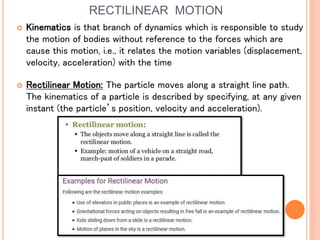
RECTILINEAR MOTION
 Kinematics is that branch of dynamics which is responsible to study
the motion of bodies without reference to the forces which are
cause this motion, i.e., it relates the motion variables (displacement,
velocity, acceleration) with the time
 Rectilinear Motion: The particle moves along a straight line path.
The kinematics of a particle is described by specifying, at any given
instant (the particle’s position, velocity and acceleration).
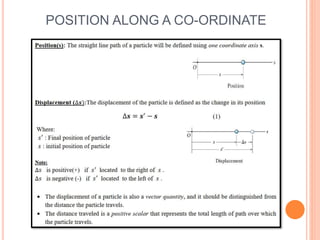
POSITION ALONG A CO-ORDINATE
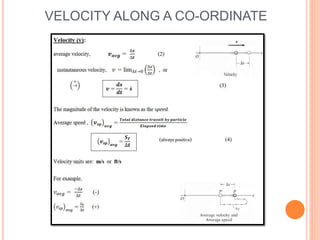
VELOCITY ALONG A CO-ORDINATE
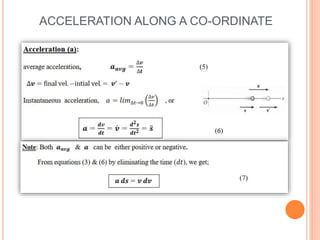
ACCELERATION ALONG A CO-ORDINATE
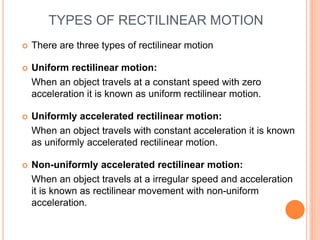
TYPES OF RECTILINEAR MOTION
 There are three types of rectilinear motion
 Uniform rectilinear motion:
When an object travels at a constant speed with zero
acceleration it is known as uniform rectilinear motion.
 Uniformly accelerated rectilinear motion:
When an object travels with constant acceleration it is known
as uniformly accelerated rectilinear motion.
 Non-uniformly accelerated rectilinear motion:
When an object travels at a irregular speed and acceleration
it is known as rectilinear movement with non-uniform
acceleration.
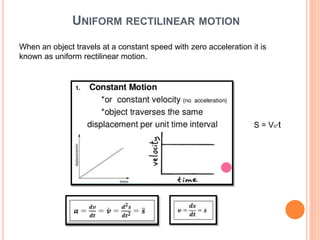
UNIFORM RECTILINEAR MOTION
When an object travels at a constant speed with zero acceleration it is
known as uniform rectilinear motion.
S = Vo*t
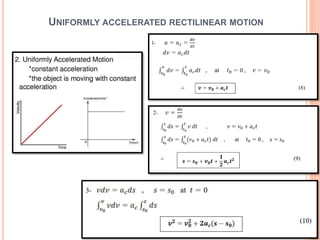
UNIFORMLY ACCELERATED RECTILINEAR MOTION
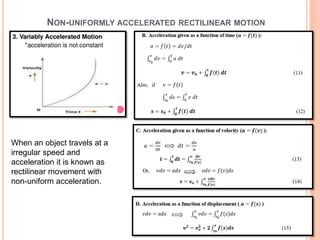
NON-UNIFORMLY ACCELERATED RECTILINEAR MOTION
When an object travels at a
irregular speed and
acceleration it is known as
rectilinear movement with
non-uniform acceleration.
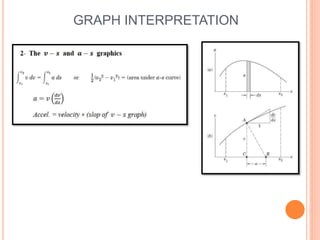
GRAPH INTERPRETATION
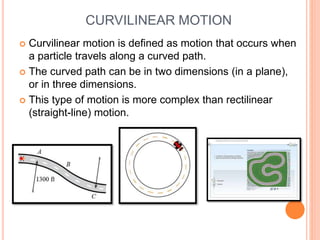
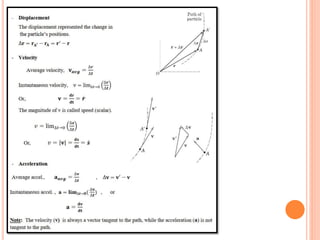
CURVILINEAR MOTION
 Curvilinear motion is defined as motion that occurs when
a particle travels along a curved path.
 The curved path can be in two dimensions (in a plane),
or in three dimensions.
 This type of motion is more complex than rectilinear
(straight-line) motion.
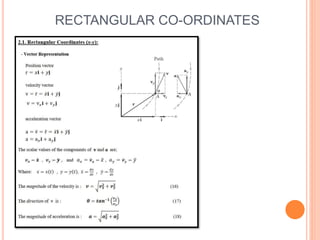
RECTANGULAR CO-ORDINATES
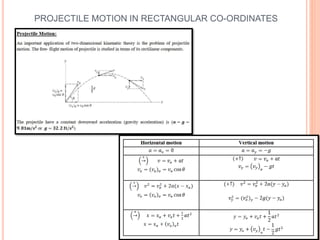
PROJECTILE MOTION IN RECTANGULAR CO-ORDINATES
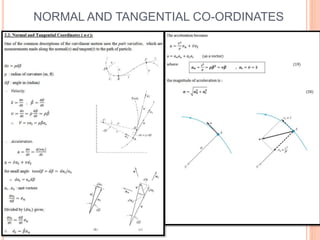
NORMAL AND TANGENTIAL CO-ORDINATES
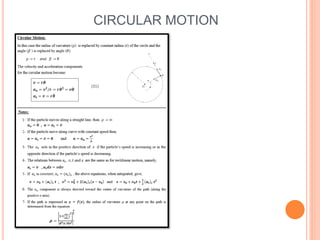
CIRCULAR MOTION
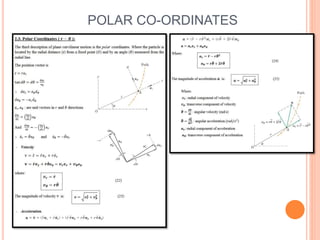
POLAR CO-ORDINATES
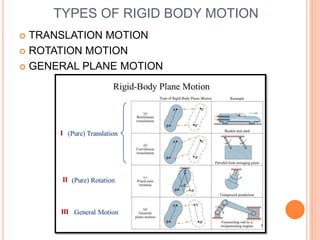
TYPES OF RIGID BODY MOTION
 TRANSLATION MOTION
 ROTATION MOTION
 GENERAL PLANE MOTION
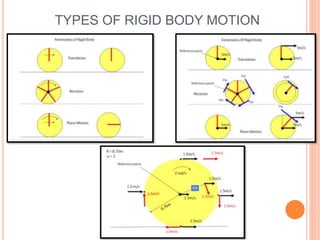
TYPES OF RIGID BODY MOTION
THANK YOU

Kinematics in Engineering Mechanics

  • 1.
  • 2.
  • 3.
  • 4.
    BASIC CONCEPTS  Aparticle is a body of negligible dimensions  Rigid Body is that body whose changes in shape are negligible compared with its overall dimensions or with the changes in position of the body as a whole, such as rigid link, rigid disc., etc.  Absolute motion: The motion of body in relative to another body which is at rest or to a fixed point located on this body.  Relative motion: The motion of body in relative to another moved body.  Scalar quantities are those quantities which have magnitude only e.g. mass, time, volume, density., etc.  Vector quantities are those quantities which have magnitude as well as direction e.g. velocity, acceleration, force., etc.
  • 5.
    RECTILINEAR MOTION  Kinematicsis that branch of dynamics which is responsible to study the motion of bodies without reference to the forces which are cause this motion, i.e., it relates the motion variables (displacement, velocity, acceleration) with the time  Rectilinear Motion: The particle moves along a straight line path. The kinematics of a particle is described by specifying, at any given instant (the particle’s position, velocity and acceleration).
  • 6.
    POSITION ALONG ACO-ORDINATE
  • 7.
    VELOCITY ALONG ACO-ORDINATE
  • 8.
  • 9.
    TYPES OF RECTILINEARMOTION  There are three types of rectilinear motion  Uniform rectilinear motion: When an object travels at a constant speed with zero acceleration it is known as uniform rectilinear motion.  Uniformly accelerated rectilinear motion: When an object travels with constant acceleration it is known as uniformly accelerated rectilinear motion.  Non-uniformly accelerated rectilinear motion: When an object travels at a irregular speed and acceleration it is known as rectilinear movement with non-uniform acceleration.
  • 10.
    UNIFORM RECTILINEAR MOTION Whenan object travels at a constant speed with zero acceleration it is known as uniform rectilinear motion. S = Vo*t
  • 11.
  • 12.
    NON-UNIFORMLY ACCELERATED RECTILINEARMOTION When an object travels at a irregular speed and acceleration it is known as rectilinear movement with non-uniform acceleration.
  • 14.
  • 15.
    CURVILINEAR MOTION  Curvilinearmotion is defined as motion that occurs when a particle travels along a curved path.  The curved path can be in two dimensions (in a plane), or in three dimensions.  This type of motion is more complex than rectilinear (straight-line) motion.
  • 17.
  • 18.
    PROJECTILE MOTION INRECTANGULAR CO-ORDINATES
  • 19.
  • 20.
  • 21.
  • 22.
    TYPES OF RIGIDBODY MOTION  TRANSLATION MOTION  ROTATION MOTION  GENERAL PLANE MOTION
  • 23.
    TYPES OF RIGIDBODY MOTION
  • 24.