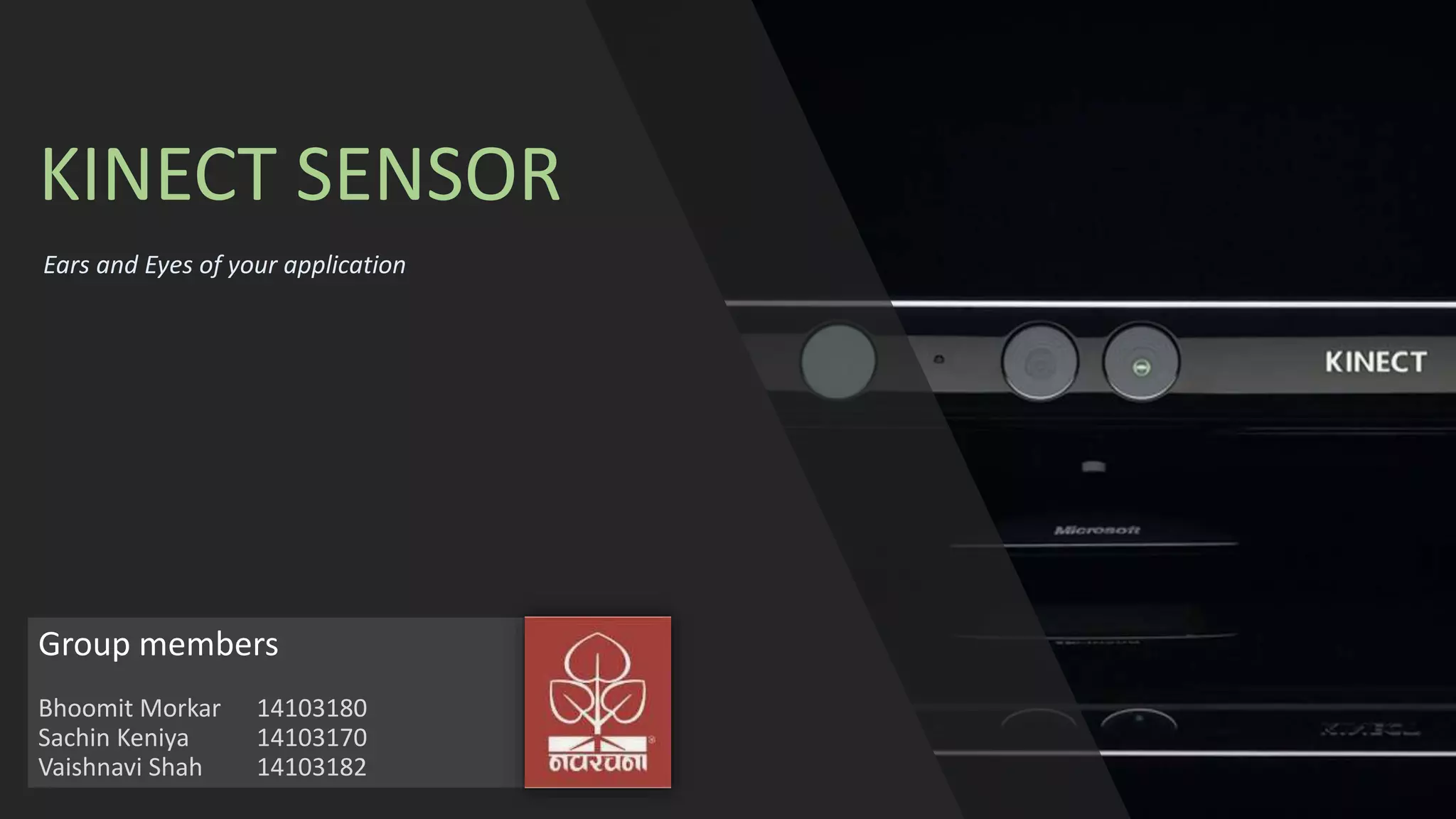
KINECT SENSOR
Group members
Bhoomit Morkar 14103180
Sachin Keniya 14103170
Vaishnavi Shah 14103182
Ears and Eyes of your application
Content
 Introduction
• Basic Construction
• Basic Specifications
• Kinect’s Potential and applications
 Working of Kinect
• Classification of Depth Measurement Techniques
 Triangulation
 Principles of TOF Imaging
 Principle of structured light
• Skeletal Tracking
 Applications
 References
Introduction
• It was Designed by Microsoft for the Xbox 360 video game console and windows PC’s.
• While making the Kinect sensor , Microsoft’s aim was to enable interactions between
users and a game without the need to touch a controller.
• Kinect is an RGB-D sensor providing synchronized color and depth images.
• It’s greatest differentials is depth sensing technology that could be extended far beyond
gaming and at a much lower cost than traditional 3-D cameras.
Why Kinect is revolutionary ?
• Kinect has proven to be an incredible piece of technology.
• It is the first practical natural user interface for machines communicating with people.
• It is combining acoustical and visual sense.
• It is recognizing full body movements, even complicated ones.
• It finds application not only in games but also in the field of medical sciences and
robotics.
• After selling a total of 8 million units in its first 60 days, the Kinect holds the Guinness
World Record of being the "fastest selling consumer electronics device".
Basic Construction
Power
Comes
from the
Sum
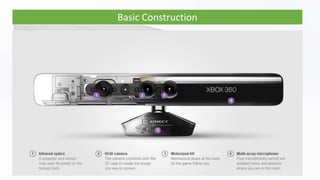
• The Kinect Sensor is the outcome of several devices(or sensors)
working together.
• It is comprised of a color camera (also known as RGB), a depth sensor,
a 4-microphone array, and a motorized tilt.
• The depth sensor, in itself, consists of an infrared (IR) projector and an
IR camera.
• Due to that Kinect being a motion sensing input device, able to
capture, track, and interpret full-body movements(3D), and recognize
gestures and voices.
• The depth sensor is a monochrome complementary metaloxide semiconductor (CMOS)
sensor.
• One of Kinect’s greatest differentials is its relatively low cost depth sensor.
• The depth-sensing technology is licensed from the Israeli company PrimeSense. Although
the exact technology is not disclosed, it is based on the structured light principle.
• The IR projector is an IR laser that passes through a diffraction grating and turns into a set
of IR dots.
• The sensor has an RGB (red-green-blue) camera for color video.
• It has four microphones that enable your application to respond to verbal input, in
addition to responding to movement.
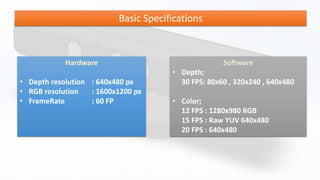
Basic Specifications
Hardware
• Depth resolution : 640x480 px
• RGB resolution : 1600x1200 px
• FrameRate : 60 FP
Software
• Depth;
30 FPS: 80x60 , 320x240 , 640x480
• Color;
12 FPS : 1280x980 RGB
15 FPS : Raw YUV 640x480
20 FPS : 640x480
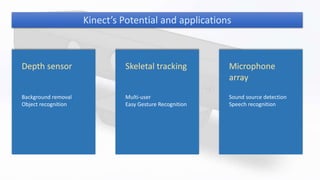
Kinect’s Potential and applications
Depth sensor Skeletal tracking Microphone
array
Background removal
Object recognition
Multi-user
Easy Gesture Recognition
Sound source detection
Speech recognition
How it works
?
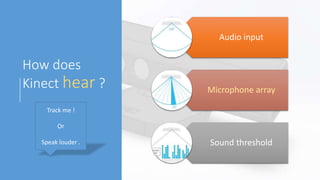
Audio input
Microphone array
Sound threshold
How does
Kinect hear ?
Track me !
Or
Speak louder .
what does it
see ?
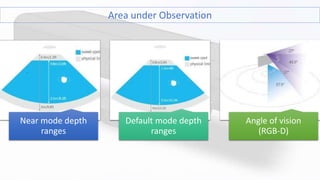
Near mode depth
ranges
Default mode depth
ranges
Angle of vision
(RGB-D)
Area under Observation
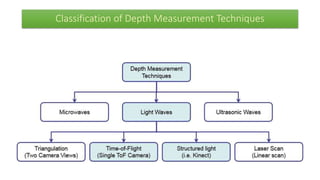
Classification of Depth Measurement Techniques
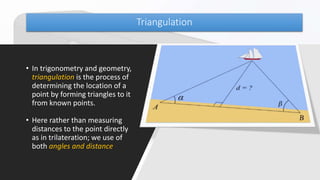
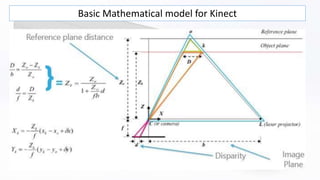
Triangulation
• In trigonometry and geometry,
triangulation is the process of
determining the location of a
point by forming triangles to it
from known points.
• Here rather than measuring
distances to the point directly
as in trilateration; we use of
both angles and distance
Basic Mathematical model for Kinect
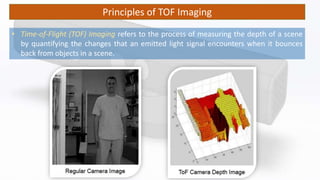
Principles of TOF Imaging
• Time-of-Flight (TOF) Imaging refers to the process of measuring the depth of a scene
by quantifying the changes that an emitted light signal encounters when it bounces
back from objects in a scene.
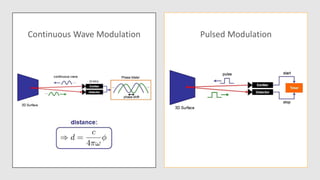
Pulsed ModulationContinuous Wave Modulation
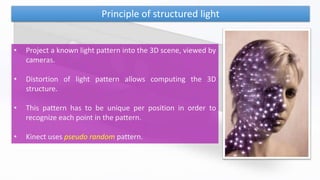
Principle of structured light
• Project a known light pattern into the 3D scene, viewed by
cameras.
• Distortion of light pattern allows computing the 3D
structure.
• This pattern has to be unique per position in order to
recognize each point in the pattern.
• Kinect uses pseudo random pattern.
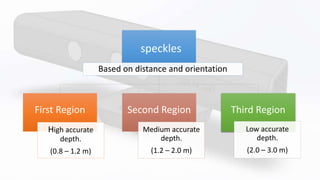
speckles
Based on distance and orientation
First Region
High accurate
depth.
(0.8 – 1.2 m)
Second Region
Medium accurate
depth.
(1.2 – 2.0 m)
Third Region
Low accurate
depth.
(2.0 – 3.0 m)
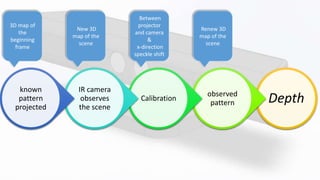
Depthobserved
pattern
Calibration
IR camera
observes
the scene
known
pattern
projected
3D map of
the
beginning
frame
New 3D
map of the
scene
Renew 3D
map of the
scene
Between
projector
and camera
&
x-direction
speckle shift
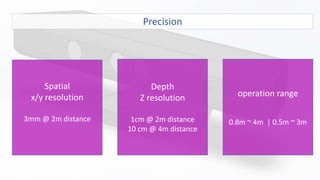
Precision
Spatial
x/y resolution
3mm @ 2m distance
Depth
Z resolution
1cm @ 2m distance
10 cm @ 4m distance
operation range
0.8m ~ 4m | 0.5m ~ 3m
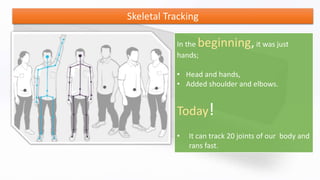
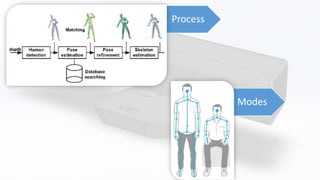
Skeletal Tracking
In the beginning,it was just
hands;
• Head and hands,
• Added shoulder and elbows.
Today!
• It can track 20 joints of our body and
rans fast.
Process
Modes
Applications
• The Kinect fusion project allows a user to use an off-the-shelf Kinect camera as a 3D
scanner for producing high-quality 3D scans of small or large objects.
• Researchers in China, in collaboration with Microsoft Research, developed the Kinect
Sign Language Translator, a system that can translate sign language into spoken and
written language in near real time.
• The Holoflector is an augmented reality mirror. Behind the mirror is a large LCD
monitor and right above the mirror is the Kinect.
• Combining a Kinect, a few hacking tools and a 3D environment, Kinectasploit allows a
user to break into a computer’s security system using body gestures. The system works
almost like a video game. In one demo, a hacker ‘shoots’ at Wi-Fi targets to break into
them.
• UBI Interactive developed their software UBI which combines your Windows 8
computer to Kinect and projector to create an interactive touchscreen off any surface.
• In another case of copying from the movies, many users have hacked their Kinect to
allow users to control robots via body movement.
• We can pick out cloths and try them all out virtually with the help of Fitnect, an
interactive dressing room.
References
 http://mms.ecs.soton.ac.uk/2014/papers/2.pdf
 http://lshao.staff.shef.ac.uk/pub/KinectReview_TC2013.pdf
 https://www.microsoft.com/en-us/research/wp-
content/uploads/2016/02/Microsoft20Kinect20Sensor20and20Its20Effect20-20IEEE20MM202012.pdf
 http://mms.ecs.soton.ac.uk/2014/papers/2.pdf
 http://campar.in.tum.de/twiki/pub/Chair/TeachingSs11Kinect/2011-DSensors_LabCourse_Kinect.pdf
 http://www.slideshare.net/MatteoValoriani/introduction-to-kinect-update-v-18?qid=e70a04cc-282d-4c11-a0d0-
cff7f58c2435&v=&b=&from_search=9
 http://www.slideshare.net/rojizofrio/xbox-one-kinect?qid=e70a04cc-282d-4c11-a0d0-
cff7f58c2435&v=&b=&from_search=15
Videos
 https://youtu.be/uq9SEJxZiUg
 http://youtu.be/bRgEdqDiOuQ?t=10m16s
 http://www.google.com/patents/US20090
 http://campar.in.tum.de/twiki/pub/Cha... (p. 33)
 http://en.wikipedia.org/wiki/Range_im... (Stereo triangulation)
 https://www.youtube.com/watch?v=-RELJD0LBg8&spfreload=5
 https://youtu.be/uq9SEJxZiUg
 http://www.hongkiat.com/blog/innovative-uses-kinect/

Kinect sensor

  • 1.
    KINECT SENSOR Group members BhoomitMorkar 14103180 Sachin Keniya 14103170 Vaishnavi Shah 14103182 Ears and Eyes of your application
  • 2.
    Content  Introduction • BasicConstruction • Basic Specifications • Kinect’s Potential and applications  Working of Kinect • Classification of Depth Measurement Techniques  Triangulation  Principles of TOF Imaging  Principle of structured light • Skeletal Tracking  Applications  References
  • 3.
    Introduction • It wasDesigned by Microsoft for the Xbox 360 video game console and windows PC’s. • While making the Kinect sensor , Microsoft’s aim was to enable interactions between users and a game without the need to touch a controller. • Kinect is an RGB-D sensor providing synchronized color and depth images. • It’s greatest differentials is depth sensing technology that could be extended far beyond gaming and at a much lower cost than traditional 3-D cameras.
  • 4.
    Why Kinect isrevolutionary ? • Kinect has proven to be an incredible piece of technology. • It is the first practical natural user interface for machines communicating with people. • It is combining acoustical and visual sense. • It is recognizing full body movements, even complicated ones. • It finds application not only in games but also in the field of medical sciences and robotics. • After selling a total of 8 million units in its first 60 days, the Kinect holds the Guinness World Record of being the "fastest selling consumer electronics device".
  • 5.
  • 6.
    Power Comes from the Sum • TheKinect Sensor is the outcome of several devices(or sensors) working together. • It is comprised of a color camera (also known as RGB), a depth sensor, a 4-microphone array, and a motorized tilt. • The depth sensor, in itself, consists of an infrared (IR) projector and an IR camera. • Due to that Kinect being a motion sensing input device, able to capture, track, and interpret full-body movements(3D), and recognize gestures and voices.
  • 7.
    • The depthsensor is a monochrome complementary metaloxide semiconductor (CMOS) sensor. • One of Kinect’s greatest differentials is its relatively low cost depth sensor. • The depth-sensing technology is licensed from the Israeli company PrimeSense. Although the exact technology is not disclosed, it is based on the structured light principle. • The IR projector is an IR laser that passes through a diffraction grating and turns into a set of IR dots. • The sensor has an RGB (red-green-blue) camera for color video. • It has four microphones that enable your application to respond to verbal input, in addition to responding to movement.
  • 8.
    Basic Specifications Hardware • Depthresolution : 640x480 px • RGB resolution : 1600x1200 px • FrameRate : 60 FP Software • Depth; 30 FPS: 80x60 , 320x240 , 640x480 • Color; 12 FPS : 1280x980 RGB 15 FPS : Raw YUV 640x480 20 FPS : 640x480
  • 9.
    Kinect’s Potential andapplications Depth sensor Skeletal tracking Microphone array Background removal Object recognition Multi-user Easy Gesture Recognition Sound source detection Speech recognition
  • 10.
  • 11.
    Audio input Microphone array Soundthreshold How does Kinect hear ? Track me ! Or Speak louder .
  • 12.
  • 13.
    Near mode depth ranges Defaultmode depth ranges Angle of vision (RGB-D) Area under Observation
  • 14.
    Classification of DepthMeasurement Techniques
  • 15.
    Triangulation • In trigonometryand geometry, triangulation is the process of determining the location of a point by forming triangles to it from known points. • Here rather than measuring distances to the point directly as in trilateration; we use of both angles and distance
  • 16.
  • 17.
    Principles of TOFImaging • Time-of-Flight (TOF) Imaging refers to the process of measuring the depth of a scene by quantifying the changes that an emitted light signal encounters when it bounces back from objects in a scene.
  • 18.
  • 19.
    Principle of structuredlight • Project a known light pattern into the 3D scene, viewed by cameras. • Distortion of light pattern allows computing the 3D structure. • This pattern has to be unique per position in order to recognize each point in the pattern. • Kinect uses pseudo random pattern.
  • 20.
    speckles Based on distanceand orientation First Region High accurate depth. (0.8 – 1.2 m) Second Region Medium accurate depth. (1.2 – 2.0 m) Third Region Low accurate depth. (2.0 – 3.0 m)
  • 21.
    Depthobserved pattern Calibration IR camera observes the scene known pattern projected 3Dmap of the beginning frame New 3D map of the scene Renew 3D map of the scene Between projector and camera & x-direction speckle shift
  • 22.
    Precision Spatial x/y resolution 3mm @2m distance Depth Z resolution 1cm @ 2m distance 10 cm @ 4m distance operation range 0.8m ~ 4m | 0.5m ~ 3m
  • 23.
    Skeletal Tracking In thebeginning,it was just hands; • Head and hands, • Added shoulder and elbows. Today! • It can track 20 joints of our body and rans fast.
  • 24.
  • 25.
    Applications • The Kinectfusion project allows a user to use an off-the-shelf Kinect camera as a 3D scanner for producing high-quality 3D scans of small or large objects. • Researchers in China, in collaboration with Microsoft Research, developed the Kinect Sign Language Translator, a system that can translate sign language into spoken and written language in near real time. • The Holoflector is an augmented reality mirror. Behind the mirror is a large LCD monitor and right above the mirror is the Kinect. • Combining a Kinect, a few hacking tools and a 3D environment, Kinectasploit allows a user to break into a computer’s security system using body gestures. The system works almost like a video game. In one demo, a hacker ‘shoots’ at Wi-Fi targets to break into them.
  • 26.
    • UBI Interactivedeveloped their software UBI which combines your Windows 8 computer to Kinect and projector to create an interactive touchscreen off any surface. • In another case of copying from the movies, many users have hacked their Kinect to allow users to control robots via body movement. • We can pick out cloths and try them all out virtually with the help of Fitnect, an interactive dressing room.
  • 27.
    References  http://mms.ecs.soton.ac.uk/2014/papers/2.pdf  http://lshao.staff.shef.ac.uk/pub/KinectReview_TC2013.pdf https://www.microsoft.com/en-us/research/wp- content/uploads/2016/02/Microsoft20Kinect20Sensor20and20Its20Effect20-20IEEE20MM202012.pdf  http://mms.ecs.soton.ac.uk/2014/papers/2.pdf  http://campar.in.tum.de/twiki/pub/Chair/TeachingSs11Kinect/2011-DSensors_LabCourse_Kinect.pdf  http://www.slideshare.net/MatteoValoriani/introduction-to-kinect-update-v-18?qid=e70a04cc-282d-4c11-a0d0- cff7f58c2435&v=&b=&from_search=9  http://www.slideshare.net/rojizofrio/xbox-one-kinect?qid=e70a04cc-282d-4c11-a0d0- cff7f58c2435&v=&b=&from_search=15
  • 28.
    Videos  https://youtu.be/uq9SEJxZiUg  http://youtu.be/bRgEdqDiOuQ?t=10m16s http://www.google.com/patents/US20090  http://campar.in.tum.de/twiki/pub/Cha... (p. 33)  http://en.wikipedia.org/wiki/Range_im... (Stereo triangulation)  https://www.youtube.com/watch?v=-RELJD0LBg8&spfreload=5  https://youtu.be/uq9SEJxZiUg  http://www.hongkiat.com/blog/innovative-uses-kinect/