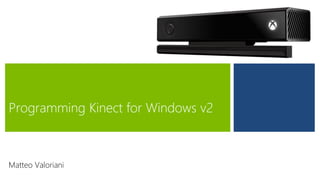
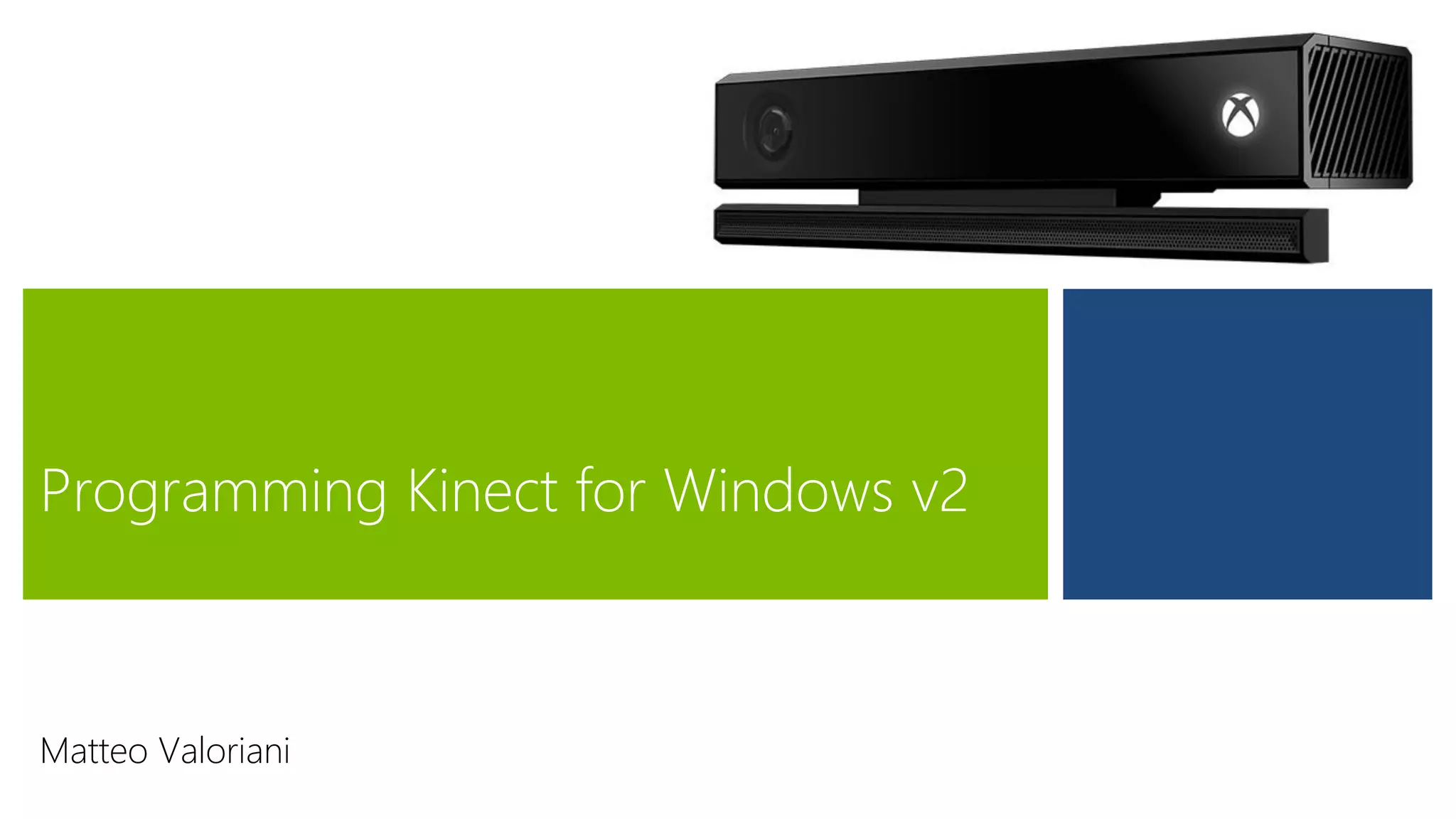
Matteo Valoriani
Nice to Meet You
Matteo Valoriani
PhD at Politecnico of Milano
CEO of Fifth Element
Speaker and Consultant
Microsoft MVP for Kinect
Intel Software Innovator: RealSense
email: mvaloriani@gmail.com
twitter: @MatteoValoriani
linkedin: https://it.linkedin.com/in/matteovaloriani
2
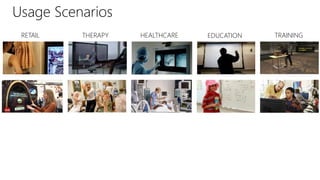
Usage Scenarios
TRAININGRETAIL HEALTHCARETHERAPY EDUCATION
You have to be a
magician…
… or at least a
good illusionist
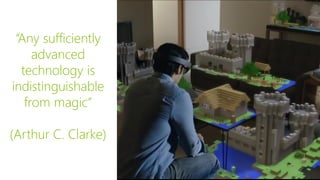
“Any sufficiently
advanced
technology is
indistinguishable
from magic”
(Arthur C. Clarke)
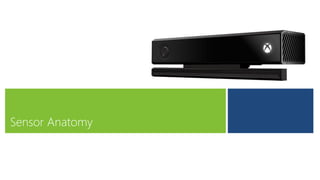
Sensor Anatomy
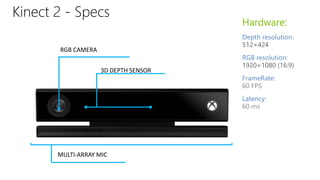
Kinect 2 - Specs
3D DEPTH SENSOR
RGB CAMERA
MULTI-ARRAY MIC
Hardware:
Depth resolution:
512×424
RGB resolution:
1920×1080 (16:9)
FrameRate:
60 FPS
Latency:
60 ms
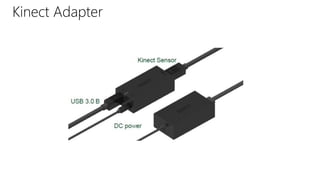
Kinect Adapter
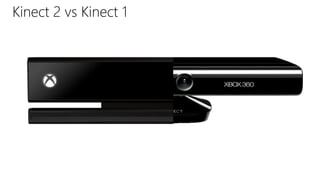
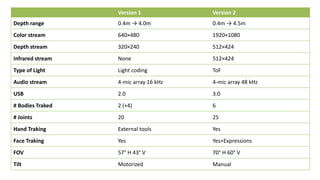
Kinect 2 vs Kinect 1
Version 1 Version 2
Depth range 0.4m → 4.0m 0.4m → 4.5m
Color stream 640×480 1920×1080
Depth stream 320×240 512×424
Infrared stream None 512×424
Type of Light Light coding ToF
Audio stream 4-mic array 16 kHz 4-mic array 48 kHz
USB 2.0 3.0
# Bodies Traked 2 (+4) 6
# Joints 20 25
Hand Traking External tools Yes
Face Traking Yes Yes+Expressions
FOV 57° H 43° V 70° H 60° V
Tilt Motorized Manual
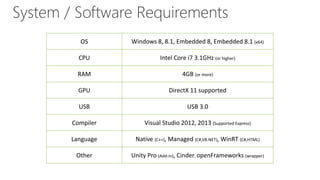
System / Software Requirements
OS Windows 8, 8.1, Embedded 8, Embedded 8.1 (x64)
CPU Intel Core i7 3.1GHz (or higher)
RAM 4GB (or more)
GPU DirectX 11 supported
USB USB 3.0
Compiler Visual Studio 2012, 2013 (Supported Express)
Language Native (C++), Managed (C#,VB.NET), WinRT (C#,HTML)
Other Unity Pro (Add-in), Cinder, openFrameworks (wrapper)
DEMO
Kinect Evolution
Accessing Kinect Data Sources
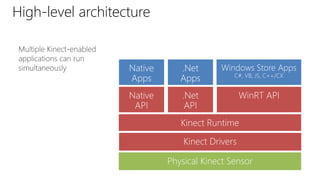
High-level architecture
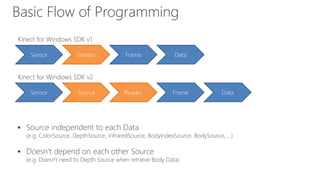
Basic Flow of Programming
Sensor Stream Frame Data
Sensor Source Reader Frame Data
Kinect for Windows SDK v1
Kinect for Windows SDK v2
 Source independent to each Data
(e.g. ColorSource, DepthSource, InfraredSource, BodyIndexSource, BodySource, …)
 Doesn’t depend on each other Source
(e.g. Doesn't need to Depth Source when retrieve Body Data)
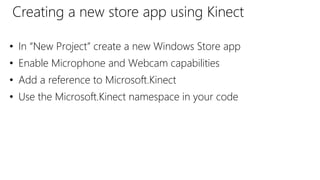
• In “New Project” create a new Windows Store app
• Enable Microphone and Webcam capabilities
• Add a reference to Microsoft.Kinect
• Use the Microsoft.Kinect namespace in your code
Creating a new store app using Kinect
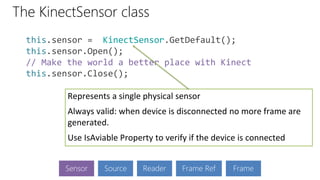
Represents a single physical sensor
Always valid: when device is disconnected no more frame are
generated.
Use IsAviable Property to verify if the device is connected
The KinectSensor class
this KinectSensor
this
// Make the world a better place with Kinect
this
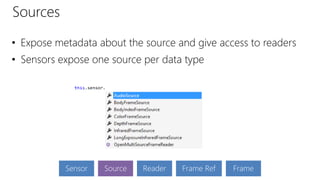
Sources
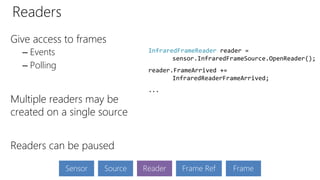
Give access to frames
– Events
– Polling
Multiple readers may be
created on a single source
Readers can be paused
Readers
InfraredFrameReader reader =
sensor.InfraredFrameSource.OpenReader();
reader.FrameArrived +=
InfraredReaderFrameArrived;
...
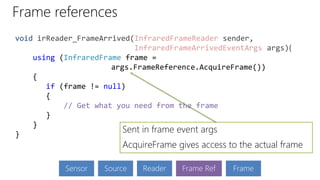
Frame references
void InfraredFrameReader
InfraredFrameArrivedEventArgs
using (InfraredFrame frame =
args.FrameReference.AcquireFrame())
{
if (frame != null)
{
// Get what you need from the frame
}
}
}
Sent in frame event args
AcquireFrame gives access to the actual frame
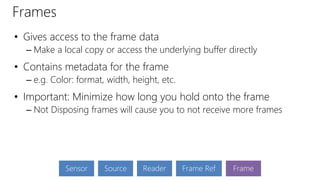
• Gives access to the frame data
– Make a local copy or access the underlying buffer directly
• Contains metadata for the frame
– e.g. Color: format, width, height, etc.
• Important: Minimize how long you hold onto the frame
– Not Disposing frames will cause you to not receive more frames
Frames
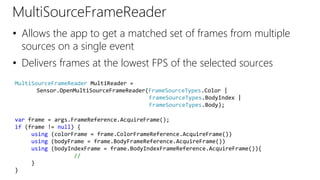
• Allows the app to get a matched set of frames from multiple
sources on a single event
• Delivers frames at the lowest FPS of the selected sources
MultiSourceFrameReader
MultiSourceFrameReader MultiReader =
Sensor.OpenMultiSourceFrameReader(FrameSourceTypes.Color |
FrameSourceTypes.BodyIndex |
FrameSourceTypes.Body);
var frame = args.FrameReference.AcquireFrame();
if (frame != null) {
using (colorFrame = frame.ColorFrameReference.AcquireFrame())
using (bodyFrame = frame.BodyFrameReference.AcquireFrame())
using (bodyIndexFrame = frame.BodyIndexFrameReference.AcquireFrame()){
//
}
}
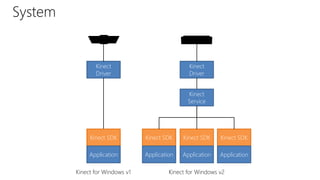
System
Kinect
Driver
Kinect SDK
Application
Kinect
Driver
Kinect SDK
Application
Kinect
Service
Kinect SDK
Application
Kinect SDK
Application
Kinect for Windows v1 Kinect for Windows v2
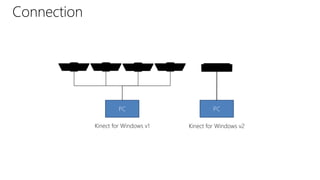
Connection
Kinect for Windows v1 Kinect for Windows v2
PCPC
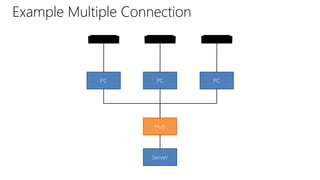
Example Multiple Connection
PCPC PC
Hub
Server
DEMO
Display frame in a Windows Store App
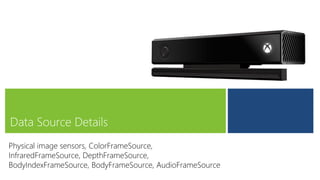
Data Source Details
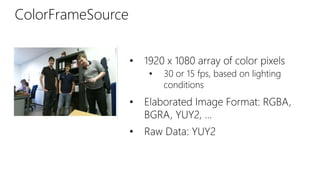
Physical image sensors, ColorFrameSource,
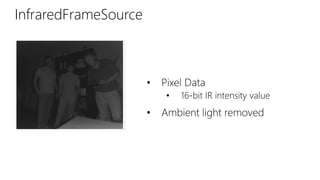
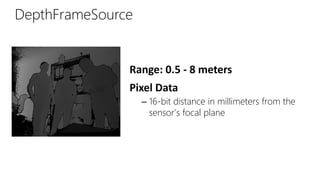
InfraredFrameSource, DepthFrameSource,
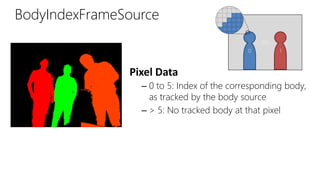
BodyIndexFrameSource, BodyFrameSource, AudioFrameSource
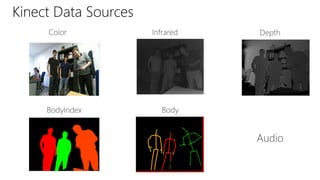
Kinect Data Sources
• 30 or 15 fps, based on lighting
conditions
ColorFrameSource
InfraredFrameSource
– 16-bit distance in millimeters from the
sensor’s focal plane
DepthFrameSource
– 0 to 5: Index of the corresponding body,
as tracked by the body source
– > 5: No tracked body at that pixel
BodyIndexFrameSource
255
0 1
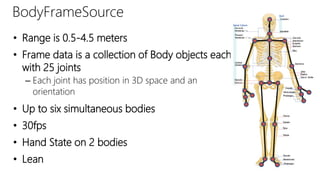
• Range is 0.5-4.5 meters
• Frame data is a collection of Body objects each
with 25 joints
– Each joint has position in 3D space and an
orientation
• Up to six simultaneous bodies
• 30fps
• Hand State on 2 bodies
• Lean
BodyFrameSource
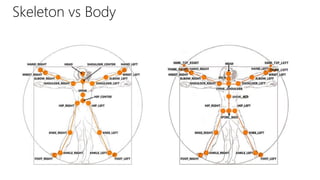
Skeleton vs Body
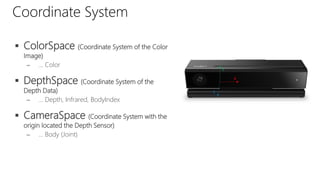
Coordinate System
 ColorSpace (Coordinate System of the Color
Image)
– … Color
 DepthSpace (Coordinate System of the
Depth Data)
– … Depth, Infrared, BodyIndex
 CameraSpace (Coordinate System with the
origin located the Depth Sensor)
– … Body (Joint)
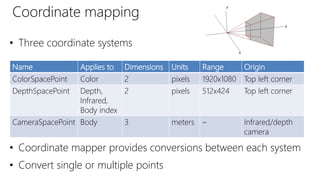
• Three coordinate systems
• Coordinate mapper provides conversions between each system
• Convert single or multiple points
Coordinate mapping
Name Applies to Dimensions Units Range Origin
ColorSpacePoint Color 2 pixels 1920x1080 Top left corner
DepthSpacePoint Depth,
Infrared,
Body index
2 pixels 512x424 Top left corner
CameraSpacePoint Body 3 meters – Infrared/depth
camera
DEMO
Handle body frames and coordinate mapping
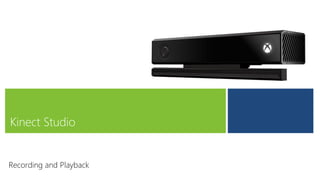
Kinect Studio
Recording and Playback
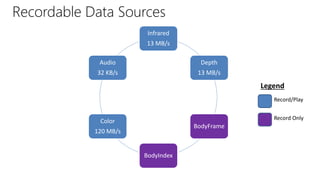
Recordable Data Sources
Infrared
13 MB/s
Depth
13 MB/s
BodyFrame
BodyIndex
Color
120 MB/s
Audio
32 KB/s
Legend
Record/Play
Record Only
DEMO
Kinect Studio 2.0
Recording | Playback
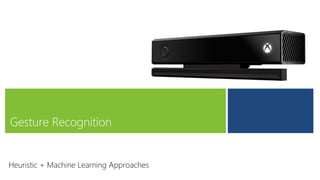
Gesture Recognition
Heuristic + Machine Learning Approaches
DEMO
Programmatic detection of a gesture/pose
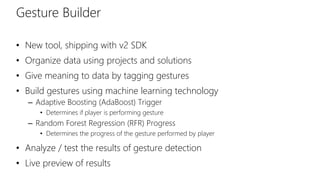
Gesture Builder
• New tool, shipping with v2 SDK
• Organize data using projects and solutions
• Give meaning to data by tagging gestures
• Build gestures using machine learning technology
– Adaptive Boosting (AdaBoost) Trigger
• Determines if player is performing gesture
– Random Forest Regression (RFR) Progress
• Determines the progress of the gesture performed by player
• Analyze / test the results of gesture detection
• Live preview of results
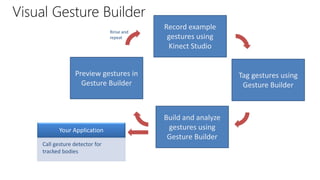
Visual Gesture Builder
Your Application
DEMO
Machine Learning Demo
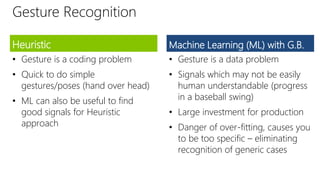
Heuristic
• Gesture is a coding problem
• Quick to do simple
gestures/poses (hand over head)
• ML can also be useful to find
good signals for Heuristic
approach
Machine Learning (ML) with G.B.
• Gesture is a data problem
• Signals which may not be easily
human understandable (progress
in a baseball swing)
• Large investment for production
• Danger of over-fitting, causes you
to be too specific – eliminating
recognition of generic cases
Gesture Recognition
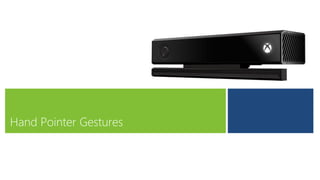
Hand Pointer Gestures
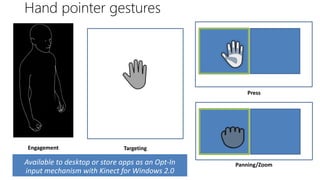
Hand pointer gestures
Engagement Targeting
Press
Panning/Zoom
DEMO
Controls Basics – XAML
UserViewer | Engagement | Targeting | Press
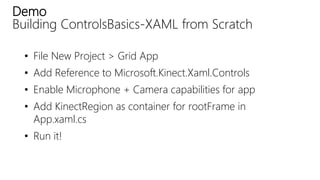
Demo
Building ControlsBasics-XAML from Scratch
• File New Project > Grid App
• Add Reference to Microsoft.Kinect.Xaml.Controls
• Enable Microphone + Camera capabilities for app
• Add KinectRegion as container for rootFrame in
App.xaml.cs
• Run it!
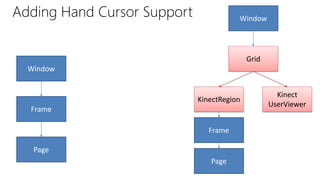
Window
Frame
Page
Window
Frame
Page
Grid
KinectRegion
Kinect
UserViewer
Adding Hand Cursor Support
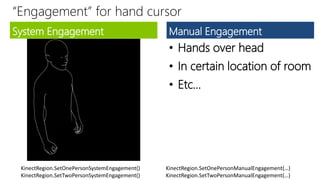
System Engagement Manual Engagement
• Hands over head
• In certain location of room
• Etc…
“Engagement” for hand cursor
KinectRegion.SetOnePersonSystemEngagement()
KinectRegion.SetTwoPersonSystemEngagement()
KinectRegion.SetOnePersonManualEngagement(…)
KinectRegion.SetTwoPersonManualEngagement(…)
DEMO
PHiZ (Physical Interaction Zone) & KinectPointerPoint
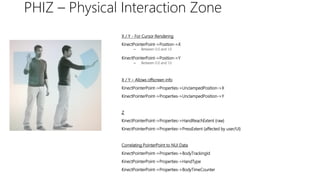
PHIZ – Physical Interaction Zone
X / Y - For Cursor Rendering
KinectPointerPoint->Position->X
– Between 0.0 and 1.0
KinectPointerPoint->Position->Y
– Between 0.0 and 1.0
X / Y – Allows offscreen info
KinectPointerPoint->Properties->UnclampedPosition->X
KinectPointerPoint->Properties->UnclampedPosition->Y
Z
KinectPointerPoint->Properties->HandReachExtent (raw)
KinectPointerPoint->Properties->PressExtent (affected by user/UI)
Correlating PointerPoint to NUI Data
KinectPointerPoint->Properties->BodyTrackingId
KinectPointerPoint->Properties->HandType
KinectPointerPoint->Properties->BodyTimeCounter
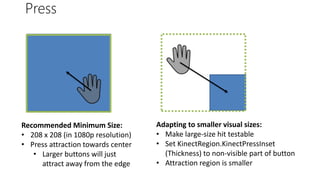
Press
Recommended Minimum Size:
• 208 x 208 (in 1080p resolution)
• Press attraction towards center
• Larger buttons will just
attract away from the edge
Adapting to smaller visual sizes:
• Make large-size hit testable
• Set KinectRegion.KinectPressInset
(Thickness) to non-visible part of button
• Attraction region is smaller
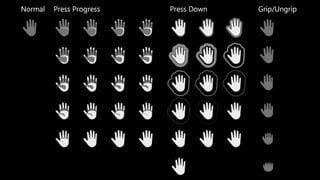
Cursors
Demo
Controls Basics – XAML
Scroll
Zoom
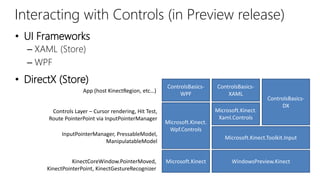
Interacting with Controls (in Preview release)
• UI Frameworks
– XAML (Store)
– WPF
• DirectX (Store)
ControlsBasics-
XAML
Microsoft.Kinect.
Xaml.Controls
Microsoft.Kinect.Toolkit.Input
WindowsPreview.Kinect
ControlsBasics-
WPF
Microsoft.Kinect.
Wpf.Controls
Microsoft.Kinect
ControlsBasics-
DX
KinectCoreWindow.PointerMoved,
KinectPointerPoint, KinectGestureRecognizer
InputPointerManager, PressableModel,
ManipulatableModel
Controls Layer – Cursor rendering, Hit Test,
Route PointerPoint via InputPointerManager
App (host KinectRegion, etc…)
Interacting with Content
• Navigating a camera through a 3d space
• Rotating a 3d object
• “Scrubbing” a video
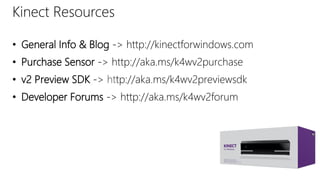
Kinect Resources
• General Info & Blog -> http://kinectforwindows.com
• Purchase Sensor -> http://aka.ms/k4wv2purchase
• v2 Preview SDK -> http://aka.ms/k4wv2previewsdk
• Developer Forums -> http://aka.ms/k4wv2forum
Q&A
Tutto il nateriale di questa sessione sul sito
http://www.dotnetcampus.it
@MatteoValoriani
©2013 Microsoft Corporation. All rights reserved. Microsoft, Windows, Office, Azure, System Center, Dynamics and other product names are or may be registered trademarks and/or trademarks in the
U.S. and/or other countries. The information herein is for informational purposes only and represents the current view of Microsoft Corporation as of the date of this presentation. Because Microsoft
must respond to changing market conditions, it should not be interpreted to be a commitment on the part of Microsoft, and Microsoft cannot guarantee the accuracy of any information provided after
the date of this presentation. MICROSOFT MAKES NO WARRANTIES, EXPRESS, IMPLIED OR STATUTORY, AS TO THE INFORMATION IN THIS PRESENTATION.

Programming with kinect v2

  • 1.
  • 2.
    Nice to MeetYou Matteo Valoriani PhD at Politecnico of Milano CEO of Fifth Element Speaker and Consultant Microsoft MVP for Kinect Intel Software Innovator: RealSense email: mvaloriani@gmail.com twitter: @MatteoValoriani linkedin: https://it.linkedin.com/in/matteovaloriani 2
  • 3.
  • 4.
    You have tobe a magician… … or at least a good illusionist
  • 5.
  • 6.
  • 7.
    Kinect 2 -Specs 3D DEPTH SENSOR RGB CAMERA MULTI-ARRAY MIC Hardware: Depth resolution: 512×424 RGB resolution: 1920×1080 (16:9) FrameRate: 60 FPS Latency: 60 ms
  • 8.
  • 9.
    Kinect 2 vsKinect 1
  • 10.
    Version 1 Version2 Depth range 0.4m → 4.0m 0.4m → 4.5m Color stream 640×480 1920×1080 Depth stream 320×240 512×424 Infrared stream None 512×424 Type of Light Light coding ToF Audio stream 4-mic array 16 kHz 4-mic array 48 kHz USB 2.0 3.0 # Bodies Traked 2 (+4) 6 # Joints 20 25 Hand Traking External tools Yes Face Traking Yes Yes+Expressions FOV 57° H 43° V 70° H 60° V Tilt Motorized Manual
  • 11.
    System / SoftwareRequirements OS Windows 8, 8.1, Embedded 8, Embedded 8.1 (x64) CPU Intel Core i7 3.1GHz (or higher) RAM 4GB (or more) GPU DirectX 11 supported USB USB 3.0 Compiler Visual Studio 2012, 2013 (Supported Express) Language Native (C++), Managed (C#,VB.NET), WinRT (C#,HTML) Other Unity Pro (Add-in), Cinder, openFrameworks (wrapper)
  • 12.
  • 13.
  • 14.
  • 15.
    Basic Flow ofProgramming Sensor Stream Frame Data Sensor Source Reader Frame Data Kinect for Windows SDK v1 Kinect for Windows SDK v2  Source independent to each Data (e.g. ColorSource, DepthSource, InfraredSource, BodyIndexSource, BodySource, …)  Doesn’t depend on each other Source (e.g. Doesn't need to Depth Source when retrieve Body Data)
  • 16.
    • In “NewProject” create a new Windows Store app • Enable Microphone and Webcam capabilities • Add a reference to Microsoft.Kinect • Use the Microsoft.Kinect namespace in your code Creating a new store app using Kinect
  • 17.
    Represents a singlephysical sensor Always valid: when device is disconnected no more frame are generated. Use IsAviable Property to verify if the device is connected The KinectSensor class this KinectSensor this // Make the world a better place with Kinect this
  • 18.
  • 19.
    Give access toframes – Events – Polling Multiple readers may be created on a single source Readers can be paused Readers InfraredFrameReader reader = sensor.InfraredFrameSource.OpenReader(); reader.FrameArrived += InfraredReaderFrameArrived; ...
  • 20.
    Frame references void InfraredFrameReader InfraredFrameArrivedEventArgs using(InfraredFrame frame = args.FrameReference.AcquireFrame()) { if (frame != null) { // Get what you need from the frame } } } Sent in frame event args AcquireFrame gives access to the actual frame
  • 21.
    • Gives accessto the frame data – Make a local copy or access the underlying buffer directly • Contains metadata for the frame – e.g. Color: format, width, height, etc. • Important: Minimize how long you hold onto the frame – Not Disposing frames will cause you to not receive more frames Frames
  • 22.
    • Allows theapp to get a matched set of frames from multiple sources on a single event • Delivers frames at the lowest FPS of the selected sources MultiSourceFrameReader MultiSourceFrameReader MultiReader = Sensor.OpenMultiSourceFrameReader(FrameSourceTypes.Color | FrameSourceTypes.BodyIndex | FrameSourceTypes.Body); var frame = args.FrameReference.AcquireFrame(); if (frame != null) { using (colorFrame = frame.ColorFrameReference.AcquireFrame()) using (bodyFrame = frame.BodyFrameReference.AcquireFrame()) using (bodyIndexFrame = frame.BodyIndexFrameReference.AcquireFrame()){ // } }
  • 23.
    System Kinect Driver Kinect SDK Application Kinect Driver Kinect SDK Application Kinect Service KinectSDK Application Kinect SDK Application Kinect for Windows v1 Kinect for Windows v2
  • 24.
    Connection Kinect for Windowsv1 Kinect for Windows v2 PCPC
  • 25.
  • 26.
    DEMO Display frame ina Windows Store App
  • 27.
    Data Source Details Physicalimage sensors, ColorFrameSource, InfraredFrameSource, DepthFrameSource, BodyIndexFrameSource, BodyFrameSource, AudioFrameSource
  • 28.
  • 29.
    • 30 or15 fps, based on lighting conditions ColorFrameSource
  • 30.
  • 31.
    – 16-bit distancein millimeters from the sensor’s focal plane DepthFrameSource
  • 32.
    – 0 to5: Index of the corresponding body, as tracked by the body source – > 5: No tracked body at that pixel BodyIndexFrameSource 255 0 1
  • 33.
    • Range is0.5-4.5 meters • Frame data is a collection of Body objects each with 25 joints – Each joint has position in 3D space and an orientation • Up to six simultaneous bodies • 30fps • Hand State on 2 bodies • Lean BodyFrameSource
  • 34.
  • 35.
    Coordinate System  ColorSpace(Coordinate System of the Color Image) – … Color  DepthSpace (Coordinate System of the Depth Data) – … Depth, Infrared, BodyIndex  CameraSpace (Coordinate System with the origin located the Depth Sensor) – … Body (Joint)
  • 36.
    • Three coordinatesystems • Coordinate mapper provides conversions between each system • Convert single or multiple points Coordinate mapping Name Applies to Dimensions Units Range Origin ColorSpacePoint Color 2 pixels 1920x1080 Top left corner DepthSpacePoint Depth, Infrared, Body index 2 pixels 512x424 Top left corner CameraSpacePoint Body 3 meters – Infrared/depth camera
  • 37.
    DEMO Handle body framesand coordinate mapping
  • 38.
  • 39.
    Recordable Data Sources Infrared 13MB/s Depth 13 MB/s BodyFrame BodyIndex Color 120 MB/s Audio 32 KB/s Legend Record/Play Record Only
  • 40.
  • 41.
    Gesture Recognition Heuristic +Machine Learning Approaches
  • 42.
  • 43.
    Gesture Builder • Newtool, shipping with v2 SDK • Organize data using projects and solutions • Give meaning to data by tagging gestures • Build gestures using machine learning technology – Adaptive Boosting (AdaBoost) Trigger • Determines if player is performing gesture – Random Forest Regression (RFR) Progress • Determines the progress of the gesture performed by player • Analyze / test the results of gesture detection • Live preview of results
  • 44.
  • 45.
  • 46.
    Heuristic • Gesture isa coding problem • Quick to do simple gestures/poses (hand over head) • ML can also be useful to find good signals for Heuristic approach Machine Learning (ML) with G.B. • Gesture is a data problem • Signals which may not be easily human understandable (progress in a baseball swing) • Large investment for production • Danger of over-fitting, causes you to be too specific – eliminating recognition of generic cases Gesture Recognition
  • 47.
  • 48.
    Hand pointer gestures EngagementTargeting Press Panning/Zoom
  • 49.
    DEMO Controls Basics –XAML UserViewer | Engagement | Targeting | Press
  • 50.
    Demo Building ControlsBasics-XAML fromScratch • File New Project > Grid App • Add Reference to Microsoft.Kinect.Xaml.Controls • Enable Microphone + Camera capabilities for app • Add KinectRegion as container for rootFrame in App.xaml.cs • Run it!
  • 51.
  • 52.
    System Engagement ManualEngagement • Hands over head • In certain location of room • Etc… “Engagement” for hand cursor KinectRegion.SetOnePersonSystemEngagement() KinectRegion.SetTwoPersonSystemEngagement() KinectRegion.SetOnePersonManualEngagement(…) KinectRegion.SetTwoPersonManualEngagement(…)
  • 53.
    DEMO PHiZ (Physical InteractionZone) & KinectPointerPoint
  • 54.
    PHIZ – PhysicalInteraction Zone X / Y - For Cursor Rendering KinectPointerPoint->Position->X – Between 0.0 and 1.0 KinectPointerPoint->Position->Y – Between 0.0 and 1.0 X / Y – Allows offscreen info KinectPointerPoint->Properties->UnclampedPosition->X KinectPointerPoint->Properties->UnclampedPosition->Y Z KinectPointerPoint->Properties->HandReachExtent (raw) KinectPointerPoint->Properties->PressExtent (affected by user/UI) Correlating PointerPoint to NUI Data KinectPointerPoint->Properties->BodyTrackingId KinectPointerPoint->Properties->HandType KinectPointerPoint->Properties->BodyTimeCounter
  • 55.
    Press Recommended Minimum Size: •208 x 208 (in 1080p resolution) • Press attraction towards center • Larger buttons will just attract away from the edge Adapting to smaller visual sizes: • Make large-size hit testable • Set KinectRegion.KinectPressInset (Thickness) to non-visible part of button • Attraction region is smaller
  • 56.
  • 57.
    Demo Controls Basics –XAML Scroll Zoom
  • 58.
    Interacting with Controls(in Preview release) • UI Frameworks – XAML (Store) – WPF • DirectX (Store) ControlsBasics- XAML Microsoft.Kinect. Xaml.Controls Microsoft.Kinect.Toolkit.Input WindowsPreview.Kinect ControlsBasics- WPF Microsoft.Kinect. Wpf.Controls Microsoft.Kinect ControlsBasics- DX KinectCoreWindow.PointerMoved, KinectPointerPoint, KinectGestureRecognizer InputPointerManager, PressableModel, ManipulatableModel Controls Layer – Cursor rendering, Hit Test, Route PointerPoint via InputPointerManager App (host KinectRegion, etc…)
  • 59.
    Interacting with Content •Navigating a camera through a 3d space • Rotating a 3d object • “Scrubbing” a video
  • 60.
    Kinect Resources • GeneralInfo & Blog -> http://kinectforwindows.com • Purchase Sensor -> http://aka.ms/k4wv2purchase • v2 Preview SDK -> http://aka.ms/k4wv2previewsdk • Developer Forums -> http://aka.ms/k4wv2forum
  • 61.
    Q&A Tutto il naterialedi questa sessione sul sito http://www.dotnetcampus.it @MatteoValoriani
  • 62.
    ©2013 Microsoft Corporation.All rights reserved. Microsoft, Windows, Office, Azure, System Center, Dynamics and other product names are or may be registered trademarks and/or trademarks in the U.S. and/or other countries. The information herein is for informational purposes only and represents the current view of Microsoft Corporation as of the date of this presentation. Because Microsoft must respond to changing market conditions, it should not be interpreted to be a commitment on the part of Microsoft, and Microsoft cannot guarantee the accuracy of any information provided after the date of this presentation. MICROSOFT MAKES NO WARRANTIES, EXPRESS, IMPLIED OR STATUTORY, AS TO THE INFORMATION IN THIS PRESENTATION.