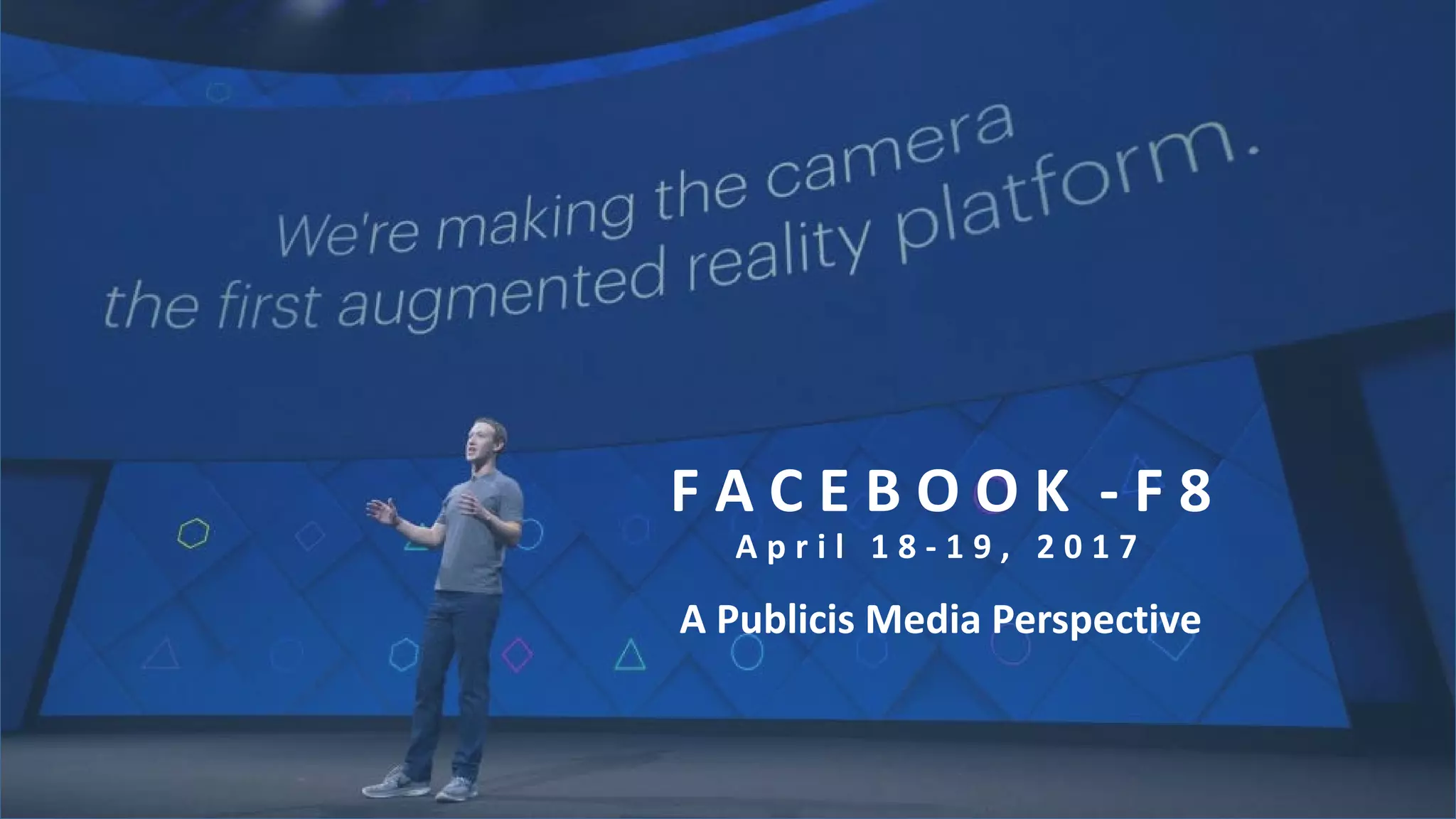
F A C E B O O K - F 8
A p r i l 1 8 - 1 9 , 2 0 1 7
A Publicis Media Perspective
Background &
Overview
• F8 is Facebook’s Annual Developer’s
conference - two days of interactive demos,
announcements, and best practices that will
keep you looking ahead.
• It’s a chance to see Mark Zuckerburg’s
vision for the company’s future and allow
developer’s from all over the world to start
building towards it.
Key Themes
• While there were several product announcements, Facebook
reinforced the 10 year mission they announced at F8 last year:
Connect The World
• Regardless of how simple or complex the announcement, everything
Facebook shared, ladders up to this ambitious goal.
• Facebook is looking across multiple platforms, aiming to remove
obstacles like lack of internet access, physical distance, language
barriers and accessibility issues for sight and hearing impaired users,
allowing people to connect to each other
• To this end, they focused on making complex and expensive
technology like AR and VR more accessible to everyone
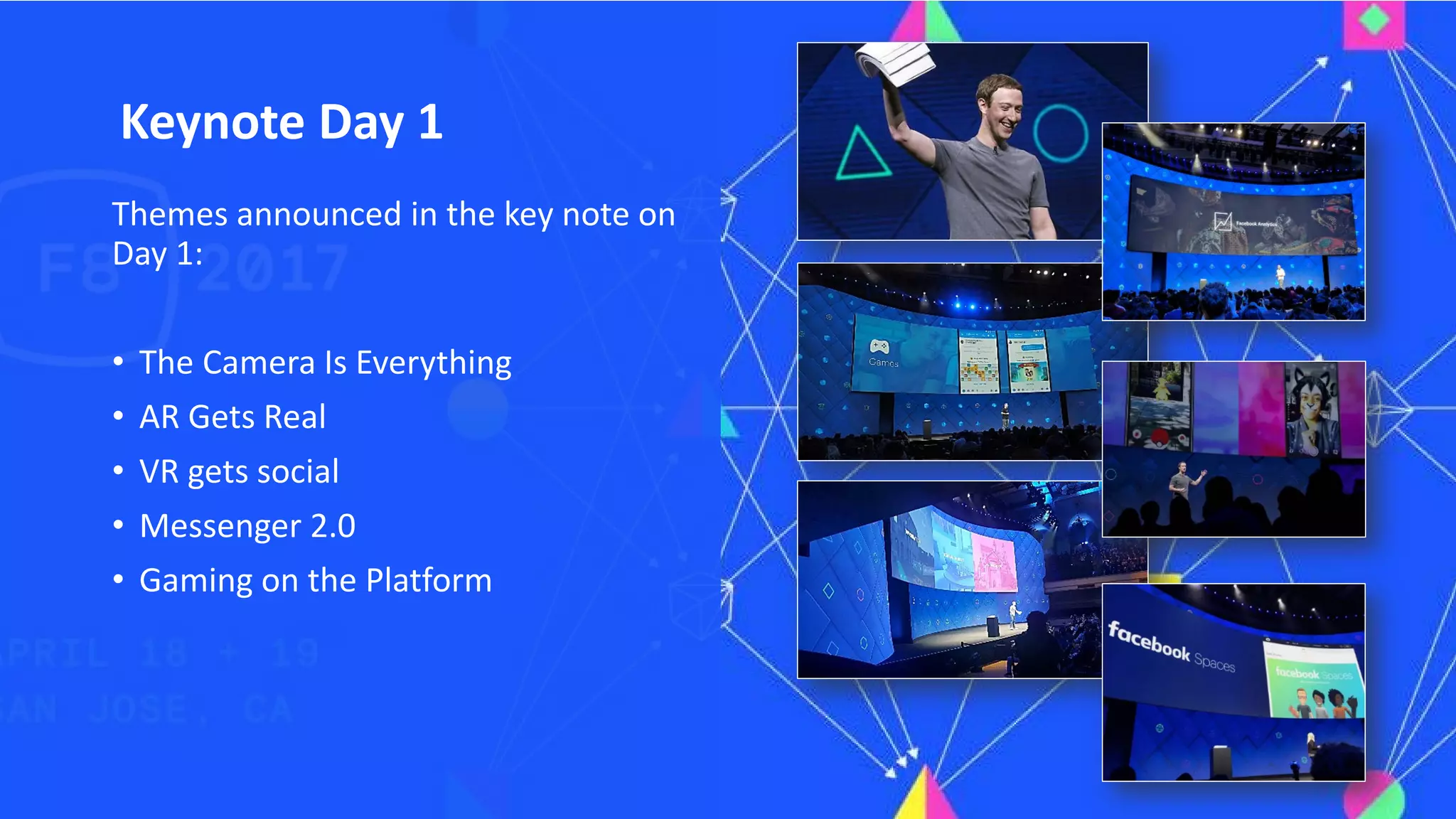
Keynote Day 1
Themes announced in the key note on
Day 1:
• The Camera Is Everything
• AR Gets Real
• VR gets social
• Messenger 2.0
• Gaming on the Platform
Key Theme: The Camera Is Everything
• From the very start of the event, Mark Zuckerberg positioned the
camera as the “channel” to unlock a variety of enhancements,
and it will be a focal point in Facebook’s progression.
• While the smartphone device allows consumers to remain
connected throughout the day, the camera will become the main
facilitator for enhanced interactive and AR experiences.
• Facebooks goal is to transform the camera into the first AR and
VR platform by allowing developers to build their own elements,
including selfie masks or overlaying information onto real-world
objects and adding virtual objects to any environment.
• Launching in beta at the event, the new open-source "Camera
Effects Platform" allows developers to build and contribute new
features and interactive experiences into Facebook's built-in
Camera feature.
• As an example the camera will detect objects, judge the depth of
2D images converting them into 3D.
What this means for brands/businesses:
Just like we have seen across other platforms (e.g. Snap),
opportunities to use camera driven overlays, frames, enhanced real-
time experiences, will become accessible for brands and business’s
going forward.
Key Theme: AR Gets Real
• Zuckerberg anticipates a day when Augmented Reality based apps
will seamlessly add personalized effects to everyday experiences.
• He outlined three main uses for AR
• to display information such as arrows on streets for
directions,
• to overlay digital objects to the real world (like Pokemon Go),
• and to enhance existing objects such as one's face or home
• Zuckerberg showed off a number of features that could be created
through the platform from tabletop games with 3D characters,
leaving digital notes, filling a room full of Skittles or placing art in
real-world places, for people to view through AR.
• Zuckerberg said developers can use simultaneous localization and
mapping (SLAM), object recognition and depth detection to create
some of these effects and experiences.
"Think about how many things in
our life don't have to be physical,
but can be digital. And think
about how much more affordable
and accessible they will be.“
Mark Zuckerberg
What this means for brands/businesses:
Augmented reality opportunities for brands and business’ will allow
consumers to interact with messaging within their current realities
(including a physical store or location), in a unique and custom way.
Key Theme: VR Gets Social
• Facebook launched the beta of Spaces, its social Virtual Reality
platform, an immersive experience accessed through VR Headsets
• Available through Oculus and investing in Samsung Gear VR to
provide inexpensive opportunities to grow scale
• Facebook Spaces creates an avatar of the user, based on their most
recent photos, and allows up to three friends to have a virtual
presence and hang out in a variety of settings
• Friends can hang out in a virtual room where they can chat, draw,
watch 360 videos, make Messenger video calls, and take VR selfies
• Facebook wants access to the long engagement time people might
spend hanging out with friends and family scattered around the
world
• It’s also further evidence that it’s time to embrace users as both
creators and consumers, now in a VR world
• As VR content and capabilities continue to grow, many panelists
discussed the need for a new role: a creative technologist, who can
help connect holistic storytelling and tech in tandem
What this means for brands/businesses:
There are future possibilities to incorporate branded experiences,
messaging and products within the VR Sphere, going forward, engaging
with consumers in a unique and social space. Brands should think about
ways to tell compelling stories with this new technology – a creative
technologist may replace the traditional director.
Key Theme: Messenger Matures
• With 65 million businesses now using Facebook, 100,000 bots and
over 2 billion messages sent between bots and people, Facebook
wants to enhance how businesses connect with their consumers
• Facebook unveiled a new version of it’s messaging app, Messenger
2.0
• New additions to the platform include:
• Increased Messenger Bot capabilities thanks to advanced AI
technology, will provide integrated smart replies – Automated
messages for common questions
• Group ChatBots were launched, enabling groups to have their
own digital assistant
• Discovery bot function that will enable users to search for and
interact with brands, and others around them.
• Chat extensions will be built in: Music (e.g. Spotify), Games,
app integrations in Messenger
• This opens up the option for Facebook to promote sponsored
placements for businesses willing to pay
• Down the road: M suggestions – Will make recommendations based
on user data. E.g. food order suggestions through delivery.com
integration
What this means for brands/businesses:
Bot capabilities via advanced AI technology will continue to shape the
way users seek out relevant information and how they problem solve.
As technology is improving in this space, AI communications
planning should be on the radar for any brand or organization, looking
to have a meaningful one-to-one dialogue with their customers.
Key Theme: Games
• Facebook released new updates for Instant Games on Messenger,
and the beta launch of the new Gameroom Platform SDK
• These products will help drive Facebook’s gaming mission to be
the world’s community for engaged gamers to play, watch and
share games
• Facebook is allowing developers to customize start and end
screens for their games, and new APIs are aimed at increasing
group play –
• E.g. a new Words with Friends launch will encourage gamers
to share their best and worst moments on the main app.
• The social network was keen to highlight this growing area,
flagging that 800 million monthly active users either play games
within Facebook or when logged in.
What this means for brands/businesses:
The Facebook gaming offering is one that needs further advancement,
for true brand messaging to be effectively incorporated. With mobile
gaming being a substantial, scaled platform, and growing exponentially,
Facebook Instant Games has significant future potential.
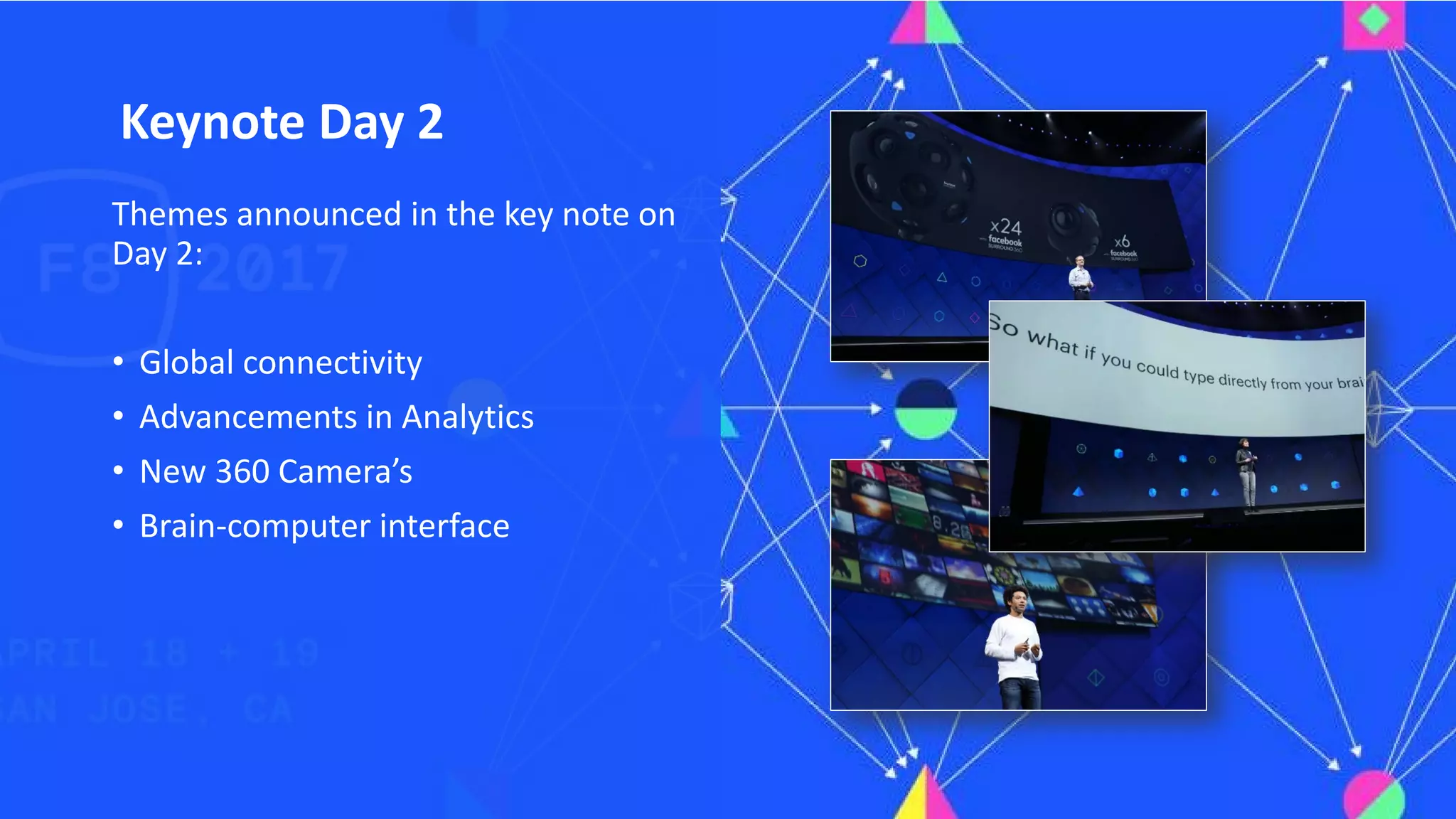
Keynote Day 2
Themes announced in the key note on
Day 2:
• Global connectivity
• Advancements in Analytics
• New 360 Camera’s
• Brain-computer interface
Key Theme: Globalizing the Internet
• Facebook is moving from connecting family and friends to building
communities.
• To truly connect the entire world, Facebook is investing in ways to
bring internet access to all:
• Terragraph – Facebooks wireless connectivity backbone – a
multi-node wireless system focused on bringing high-speed
connectivity to dense urban areas. Leveraging the cloud for
intensive data processing, the Terragraph system is optimized
for high-volume, low-cost production.
• MM-Wave – Facebook’s millimeter-wave (MMW) radio
technology can be used for drone-to-ground communications
or more traditional terrestrial applications. Facebook
announced that its MMW technology has now hit 80 Gbps.
• Aquila – Facebook’s solar powered internet providing drone,
that will beam internet access to remote parts of the world.
Described as a ‘high altitude, long endurance’ vehicle in the sky
for providing connectivity in the upper atmosphere.
What this means for brands/businesses:
These initiatives are still very much in development and have a
ways to go before they become effectively and commercially
viable, however they are on track with Facebooks 10 year
vision.
Key Theme: Analytics Gets Intelligent
• Facebook released the 2.0 version of their analytics platform,
shifting from URL/cookie based tracking to event based analytics
• The feature is a free product for accessing audience
demographics, and measuring customer behavior across channels
• Facebook announced new capabilities designed to help
developers understand and optimize their complete customer
journey across the channels they use, to interact with customers
• Amit Finkelstein, Engineering Manager at Facebook Analytics,
noted that Facebook is often surprised by the amount of time
businesses spend in analytics tools — hunting for insights,
anomalies or clues that will inform their next experiment and
drive their next wave of growth. To facilitate this better, Facebook
announced the launch of Automated Insights.
• The new Automated Insights feature will identify trends and
sudden changes in data to help brands identify moments of
friction or delight
What this means for brands/businesses:
Deeper insights and analytics on the platform will allow
marketers and developers alike, greater understanding of how
audiences engage and behave with messaging and interaction.
Key Theme: New 360 Camera’s
• Facebook will license its new 360 cameras, that capture in six
degrees of freedom
• On day two of Facebook’s F8 conference, Facebook’s CTO Mike
Schroepfer showed off designs for the two new 360 cameras
• The x24, with 24 cameras, and its little brother the x6, with six
cameras, can each capture in six degrees of freedom for more
immersive 360 content.
• Facebook plans to license the designs of the two cameras to
select commercial partners, to get each to market later this year.
What this means for brands/businesses:
With these new camera’s there is potential to create deeper
enriching experiences, and unique visual effects, which brands
can take advantage of.
Key Theme: Brain-computer interface
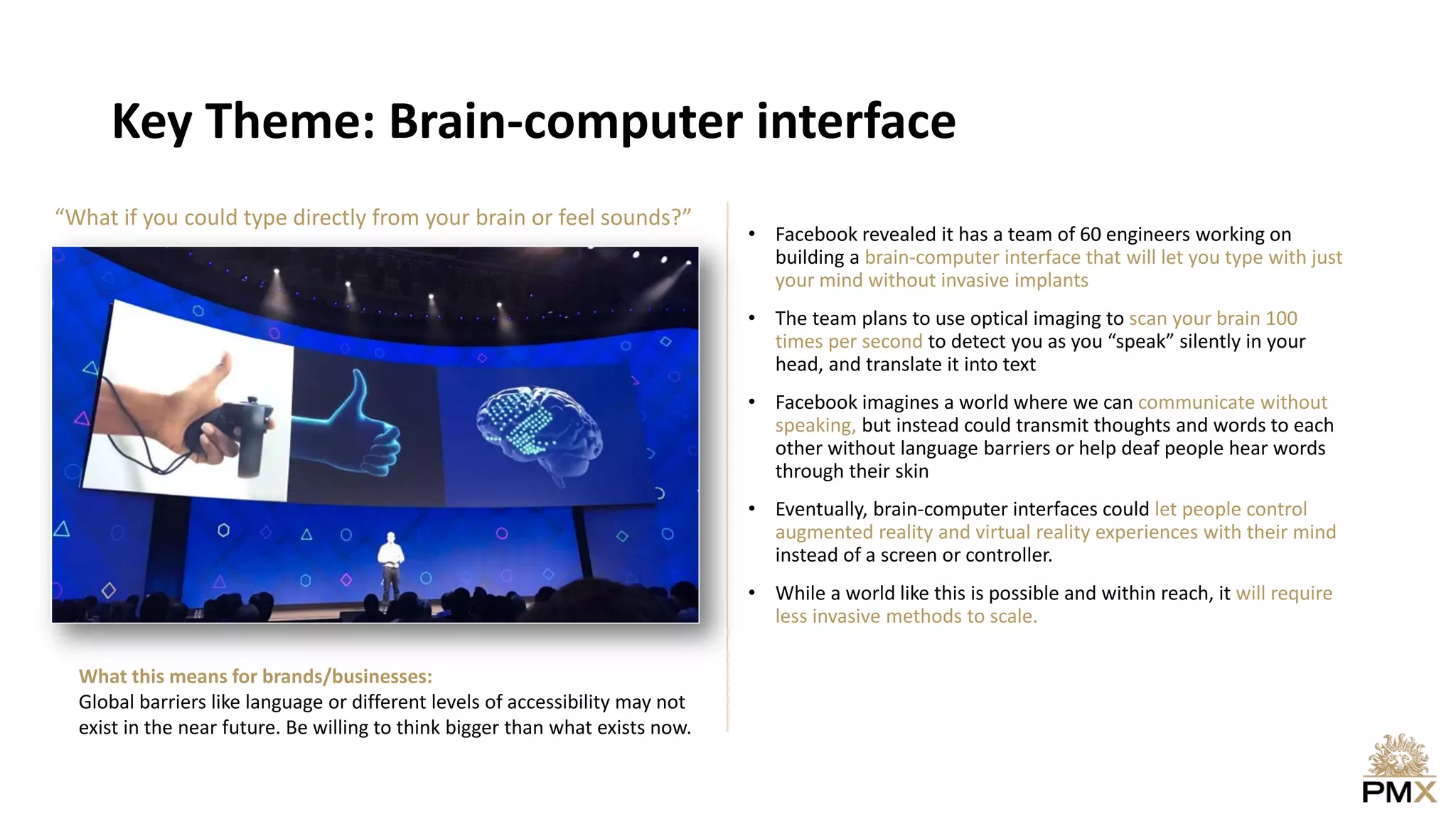
• Facebook revealed it has a team of 60 engineers working on
building a brain-computer interface that will let you type with just
your mind without invasive implants
• The team plans to use optical imaging to scan your brain 100
times per second to detect you as you “speak” silently in your
head, and translate it into text
• Facebook imagines a world where we can communicate without
speaking, but instead could transmit thoughts and words to each
other without language barriers or help deaf people hear words
through their skin
• Eventually, brain-computer interfaces could let people control
augmented reality and virtual reality experiences with their mind
instead of a screen or controller.
• While a world like this is possible and within reach, it will require
less invasive methods to scale.
What this means for brands/businesses:
Global barriers like language or different levels of accessibility may not
exist in the near future. Be willing to think bigger than what exists now.
“What if you could type directly from your brain or feel sounds?”

Facebook F8

  • 1.
    F A CE B O O K - F 8 A p r i l 1 8 - 1 9 , 2 0 1 7 A Publicis Media Perspective
  • 2.
    Background & Overview • F8is Facebook’s Annual Developer’s conference - two days of interactive demos, announcements, and best practices that will keep you looking ahead. • It’s a chance to see Mark Zuckerburg’s vision for the company’s future and allow developer’s from all over the world to start building towards it.
  • 3.
    Key Themes • Whilethere were several product announcements, Facebook reinforced the 10 year mission they announced at F8 last year: Connect The World • Regardless of how simple or complex the announcement, everything Facebook shared, ladders up to this ambitious goal. • Facebook is looking across multiple platforms, aiming to remove obstacles like lack of internet access, physical distance, language barriers and accessibility issues for sight and hearing impaired users, allowing people to connect to each other • To this end, they focused on making complex and expensive technology like AR and VR more accessible to everyone
  • 4.
    Keynote Day 1 Themesannounced in the key note on Day 1: • The Camera Is Everything • AR Gets Real • VR gets social • Messenger 2.0 • Gaming on the Platform
  • 5.
    Key Theme: TheCamera Is Everything • From the very start of the event, Mark Zuckerberg positioned the camera as the “channel” to unlock a variety of enhancements, and it will be a focal point in Facebook’s progression. • While the smartphone device allows consumers to remain connected throughout the day, the camera will become the main facilitator for enhanced interactive and AR experiences. • Facebooks goal is to transform the camera into the first AR and VR platform by allowing developers to build their own elements, including selfie masks or overlaying information onto real-world objects and adding virtual objects to any environment. • Launching in beta at the event, the new open-source "Camera Effects Platform" allows developers to build and contribute new features and interactive experiences into Facebook's built-in Camera feature. • As an example the camera will detect objects, judge the depth of 2D images converting them into 3D. What this means for brands/businesses: Just like we have seen across other platforms (e.g. Snap), opportunities to use camera driven overlays, frames, enhanced real- time experiences, will become accessible for brands and business’s going forward.
  • 6.
    Key Theme: ARGets Real • Zuckerberg anticipates a day when Augmented Reality based apps will seamlessly add personalized effects to everyday experiences. • He outlined three main uses for AR • to display information such as arrows on streets for directions, • to overlay digital objects to the real world (like Pokemon Go), • and to enhance existing objects such as one's face or home • Zuckerberg showed off a number of features that could be created through the platform from tabletop games with 3D characters, leaving digital notes, filling a room full of Skittles or placing art in real-world places, for people to view through AR. • Zuckerberg said developers can use simultaneous localization and mapping (SLAM), object recognition and depth detection to create some of these effects and experiences. "Think about how many things in our life don't have to be physical, but can be digital. And think about how much more affordable and accessible they will be.“ Mark Zuckerberg What this means for brands/businesses: Augmented reality opportunities for brands and business’ will allow consumers to interact with messaging within their current realities (including a physical store or location), in a unique and custom way.
  • 7.
    Key Theme: VRGets Social • Facebook launched the beta of Spaces, its social Virtual Reality platform, an immersive experience accessed through VR Headsets • Available through Oculus and investing in Samsung Gear VR to provide inexpensive opportunities to grow scale • Facebook Spaces creates an avatar of the user, based on their most recent photos, and allows up to three friends to have a virtual presence and hang out in a variety of settings • Friends can hang out in a virtual room where they can chat, draw, watch 360 videos, make Messenger video calls, and take VR selfies • Facebook wants access to the long engagement time people might spend hanging out with friends and family scattered around the world • It’s also further evidence that it’s time to embrace users as both creators and consumers, now in a VR world • As VR content and capabilities continue to grow, many panelists discussed the need for a new role: a creative technologist, who can help connect holistic storytelling and tech in tandem What this means for brands/businesses: There are future possibilities to incorporate branded experiences, messaging and products within the VR Sphere, going forward, engaging with consumers in a unique and social space. Brands should think about ways to tell compelling stories with this new technology – a creative technologist may replace the traditional director.
  • 8.
    Key Theme: MessengerMatures • With 65 million businesses now using Facebook, 100,000 bots and over 2 billion messages sent between bots and people, Facebook wants to enhance how businesses connect with their consumers • Facebook unveiled a new version of it’s messaging app, Messenger 2.0 • New additions to the platform include: • Increased Messenger Bot capabilities thanks to advanced AI technology, will provide integrated smart replies – Automated messages for common questions • Group ChatBots were launched, enabling groups to have their own digital assistant • Discovery bot function that will enable users to search for and interact with brands, and others around them. • Chat extensions will be built in: Music (e.g. Spotify), Games, app integrations in Messenger • This opens up the option for Facebook to promote sponsored placements for businesses willing to pay • Down the road: M suggestions – Will make recommendations based on user data. E.g. food order suggestions through delivery.com integration What this means for brands/businesses: Bot capabilities via advanced AI technology will continue to shape the way users seek out relevant information and how they problem solve. As technology is improving in this space, AI communications planning should be on the radar for any brand or organization, looking to have a meaningful one-to-one dialogue with their customers.
  • 9.
    Key Theme: Games •Facebook released new updates for Instant Games on Messenger, and the beta launch of the new Gameroom Platform SDK • These products will help drive Facebook’s gaming mission to be the world’s community for engaged gamers to play, watch and share games • Facebook is allowing developers to customize start and end screens for their games, and new APIs are aimed at increasing group play – • E.g. a new Words with Friends launch will encourage gamers to share their best and worst moments on the main app. • The social network was keen to highlight this growing area, flagging that 800 million monthly active users either play games within Facebook or when logged in. What this means for brands/businesses: The Facebook gaming offering is one that needs further advancement, for true brand messaging to be effectively incorporated. With mobile gaming being a substantial, scaled platform, and growing exponentially, Facebook Instant Games has significant future potential.
  • 10.
    Keynote Day 2 Themesannounced in the key note on Day 2: • Global connectivity • Advancements in Analytics • New 360 Camera’s • Brain-computer interface
  • 11.
    Key Theme: Globalizingthe Internet • Facebook is moving from connecting family and friends to building communities. • To truly connect the entire world, Facebook is investing in ways to bring internet access to all: • Terragraph – Facebooks wireless connectivity backbone – a multi-node wireless system focused on bringing high-speed connectivity to dense urban areas. Leveraging the cloud for intensive data processing, the Terragraph system is optimized for high-volume, low-cost production. • MM-Wave – Facebook’s millimeter-wave (MMW) radio technology can be used for drone-to-ground communications or more traditional terrestrial applications. Facebook announced that its MMW technology has now hit 80 Gbps. • Aquila – Facebook’s solar powered internet providing drone, that will beam internet access to remote parts of the world. Described as a ‘high altitude, long endurance’ vehicle in the sky for providing connectivity in the upper atmosphere. What this means for brands/businesses: These initiatives are still very much in development and have a ways to go before they become effectively and commercially viable, however they are on track with Facebooks 10 year vision.
  • 12.
    Key Theme: AnalyticsGets Intelligent • Facebook released the 2.0 version of their analytics platform, shifting from URL/cookie based tracking to event based analytics • The feature is a free product for accessing audience demographics, and measuring customer behavior across channels • Facebook announced new capabilities designed to help developers understand and optimize their complete customer journey across the channels they use, to interact with customers • Amit Finkelstein, Engineering Manager at Facebook Analytics, noted that Facebook is often surprised by the amount of time businesses spend in analytics tools — hunting for insights, anomalies or clues that will inform their next experiment and drive their next wave of growth. To facilitate this better, Facebook announced the launch of Automated Insights. • The new Automated Insights feature will identify trends and sudden changes in data to help brands identify moments of friction or delight What this means for brands/businesses: Deeper insights and analytics on the platform will allow marketers and developers alike, greater understanding of how audiences engage and behave with messaging and interaction.
  • 13.
    Key Theme: New360 Camera’s • Facebook will license its new 360 cameras, that capture in six degrees of freedom • On day two of Facebook’s F8 conference, Facebook’s CTO Mike Schroepfer showed off designs for the two new 360 cameras • The x24, with 24 cameras, and its little brother the x6, with six cameras, can each capture in six degrees of freedom for more immersive 360 content. • Facebook plans to license the designs of the two cameras to select commercial partners, to get each to market later this year. What this means for brands/businesses: With these new camera’s there is potential to create deeper enriching experiences, and unique visual effects, which brands can take advantage of.
  • 14.
    Key Theme: Brain-computerinterface • Facebook revealed it has a team of 60 engineers working on building a brain-computer interface that will let you type with just your mind without invasive implants • The team plans to use optical imaging to scan your brain 100 times per second to detect you as you “speak” silently in your head, and translate it into text • Facebook imagines a world where we can communicate without speaking, but instead could transmit thoughts and words to each other without language barriers or help deaf people hear words through their skin • Eventually, brain-computer interfaces could let people control augmented reality and virtual reality experiences with their mind instead of a screen or controller. • While a world like this is possible and within reach, it will require less invasive methods to scale. What this means for brands/businesses: Global barriers like language or different levels of accessibility may not exist in the near future. Be willing to think bigger than what exists now. “What if you could type directly from your brain or feel sounds?”