GENDER BASED
COMMUNICATION
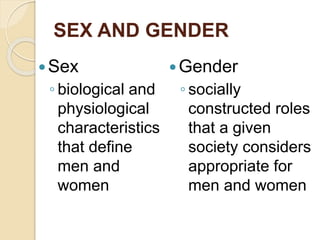
SEX AND GENDER
Sex
◦ biological and
physiological
characteristics
that define
men and
women
Gender
◦ socially
constructed roles
that a given
society considers
appropriate for
men and women
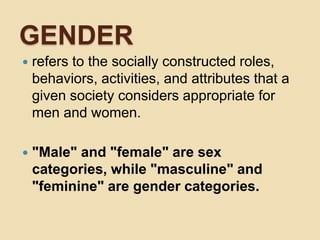
GENDER
 refers to the socially constructed roles,
behaviors, activities, and attributes that a
given society considers appropriate for
men and women.
 "Male" and "female" are sex
categories, while "masculine" and
"feminine" are gender categories.
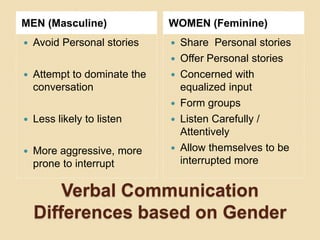
Verbal Communication
Differences based on Gender
MEN (Masculine) WOMEN (Feminine)
 Avoid Personal stories
 Attempt to dominate the
conversation
 Less likely to listen
 More aggressive, more
prone to interrupt
 Share Personal stories
 Offer Personal stories
 Concerned with
equalized input
 Form groups
 Listen Carefully /
Attentively
 Allow themselves to be
interrupted more
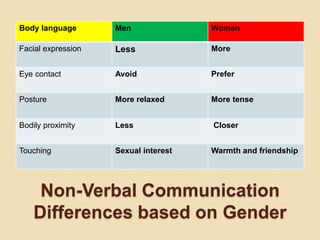
Non-Verbal Communication
Differences based on Gender
Body language Men Women
Facial expression Less More
Eye contact Avoid Prefer
Posture More relaxed More tense
Bodily proximity Less Closer
Touching Sexual interest Warmth and friendship
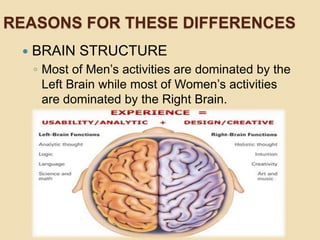
REASONS FOR THESE DIFFERENCES
 BRAIN STRUCTURE
◦ Most of Men’s activities are dominated by the
Left Brain while most of Women’s activities
are dominated by the Right Brain.
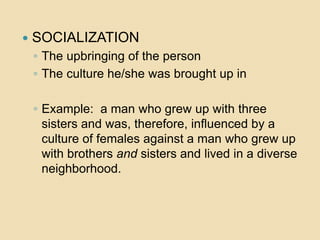
 SOCIALIZATION
◦ The upbringing of the person
◦ The culture he/she was brought up in
◦ Example: a man who grew up with three
sisters and was, therefore, influenced by a
culture of females against a man who grew up
with brothers and sisters and lived in a diverse
neighborhood.
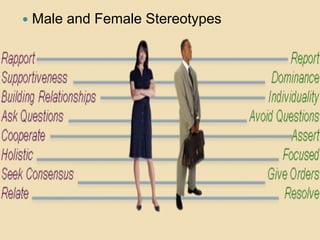
 Male and Female Stereotypes
General Stereotypes
Men
 Logic
 Power
 Winning
 Independent
 Competitive
Women
 Feeling
 Sharing
 Closeness
 Intimate
 Relational
UNDERSTANDING GENDER DIFFERENCES
A BALANCED APPROACH TO EFFECTIVE COMMUNICATION
 Understand the motivation behind the
behavior
 Recognize your own communication style
and bias
 Be respectful and open to the other
person’s communication style and values
 Work on compromise to bring out the
strengths of the communication style
 “The real issue [in workplace conflict] is
lack of gender intelligence. We need to
appreciate and respect the differences
between men and women; to anticipate
them and respond appropriately to them.”
- John Gray
Author, Men are from Mars, Women are from Venus
MANAGING COMMUNICATION CONFLICT
REFERENCES
 www.huffingtonpost.com
◦ The Mystery of Sensitive Men and Spock-Logic
Women | Charles R. Martin, Ph.D.
◦ Male and Female Communication
 www.fastcompany.com
◦ Are We Speaking A Different Language? Men And
Women's Communication Blind Spots | Fast
Company | Business + Innovation
 www.discovery.com
◦ 10 Ways Men and Women Communicate
Differently | Curiosity | Discovery
◦ Non-Verbal Communication
◦ Body Orientation
REFERENCES
 psychcentral.com
◦ 6 Ways Men & Women Communicate
Differently | World of Psychology
 science.howstuffworks.com
◦ Male and Female Brain Structure
 blog.workhealthlife.com
◦ Communication styles: Understanding gender
differences
 scholarworks.umass.edu
◦ "Popular belief in gender -based
communication differences and relation" by Ann
Michelle Johnson
REFERENCES
 www.who.int
◦ WHO | What do we mean by "sex" and
"gender"?
 www.cam.ac.uk
◦ Males and females differ in specific brain
structures | University of Cambridge
 www.webmd.com
◦ How Male and Female Brains Differ
 www.psychologyhelp.com
◦ LEFT BRAIN – RIGHT BRAIN

Gender-based communication

  • 1.
  • 2.
    SEX AND GENDER Sex ◦biological and physiological characteristics that define men and women Gender ◦ socially constructed roles that a given society considers appropriate for men and women
  • 3.
    GENDER  refers tothe socially constructed roles, behaviors, activities, and attributes that a given society considers appropriate for men and women.  "Male" and "female" are sex categories, while "masculine" and "feminine" are gender categories.
  • 4.
    Verbal Communication Differences basedon Gender MEN (Masculine) WOMEN (Feminine)  Avoid Personal stories  Attempt to dominate the conversation  Less likely to listen  More aggressive, more prone to interrupt  Share Personal stories  Offer Personal stories  Concerned with equalized input  Form groups  Listen Carefully / Attentively  Allow themselves to be interrupted more
  • 5.
    Non-Verbal Communication Differences basedon Gender Body language Men Women Facial expression Less More Eye contact Avoid Prefer Posture More relaxed More tense Bodily proximity Less Closer Touching Sexual interest Warmth and friendship
  • 6.
    REASONS FOR THESEDIFFERENCES  BRAIN STRUCTURE ◦ Most of Men’s activities are dominated by the Left Brain while most of Women’s activities are dominated by the Right Brain.
  • 8.
     SOCIALIZATION ◦ Theupbringing of the person ◦ The culture he/she was brought up in ◦ Example: a man who grew up with three sisters and was, therefore, influenced by a culture of females against a man who grew up with brothers and sisters and lived in a diverse neighborhood.
  • 9.
     Male andFemale Stereotypes
  • 10.
    General Stereotypes Men  Logic Power  Winning  Independent  Competitive Women  Feeling  Sharing  Closeness  Intimate  Relational
  • 11.
    UNDERSTANDING GENDER DIFFERENCES ABALANCED APPROACH TO EFFECTIVE COMMUNICATION  Understand the motivation behind the behavior  Recognize your own communication style and bias  Be respectful and open to the other person’s communication style and values  Work on compromise to bring out the strengths of the communication style
  • 12.
     “The realissue [in workplace conflict] is lack of gender intelligence. We need to appreciate and respect the differences between men and women; to anticipate them and respond appropriately to them.” - John Gray Author, Men are from Mars, Women are from Venus MANAGING COMMUNICATION CONFLICT
  • 13.
    REFERENCES  www.huffingtonpost.com ◦ TheMystery of Sensitive Men and Spock-Logic Women | Charles R. Martin, Ph.D. ◦ Male and Female Communication  www.fastcompany.com ◦ Are We Speaking A Different Language? Men And Women's Communication Blind Spots | Fast Company | Business + Innovation  www.discovery.com ◦ 10 Ways Men and Women Communicate Differently | Curiosity | Discovery ◦ Non-Verbal Communication ◦ Body Orientation
  • 14.
    REFERENCES  psychcentral.com ◦ 6Ways Men & Women Communicate Differently | World of Psychology  science.howstuffworks.com ◦ Male and Female Brain Structure  blog.workhealthlife.com ◦ Communication styles: Understanding gender differences  scholarworks.umass.edu ◦ "Popular belief in gender -based communication differences and relation" by Ann Michelle Johnson
  • 15.
    REFERENCES  www.who.int ◦ WHO| What do we mean by "sex" and "gender"?  www.cam.ac.uk ◦ Males and females differ in specific brain structures | University of Cambridge  www.webmd.com ◦ How Male and Female Brains Differ  www.psychologyhelp.com ◦ LEFT BRAIN – RIGHT BRAIN