Professional Etiquette


     Kimber Walters
          ATI
How Does Etiquette Benefit You?
• Differentiates you from others in a competitive
  job market
• Enables you to be confident in a variety of
  settings with a variety of people
• Honors commitment to excellence and quality
• Modifies distracting behaviors and develops
  admired conduct
“Be one step ahead, practice the social skills necessary to
  help you make a great first impression and stand out in a
                competitive job market”.
What is Etiquette??


Webster’s II New College Dictionary defines
                Etiquette as:
  The forms and practices prescribed by
     social convention or by authority.
Critical Etiquette Topics
             to Consider

•   Etiquette Basics
•   Professional Appearance
•   Office Etiquette
•   Dining and Table Manners
•   Networking
Etiquette Basics
          Creating a positive image
• Behavior:
  • Exhibit a positive attitude and pleasant demeanor
  • Use a firm handshake
  • Maintain good eye contact
  • Appropriate introductions – introduce someone by
    their title and last name (Ms. Mrs. Mr. Dr. Smith),
    unless otherwise specified
  • Rise when you are introducing someone or you are
    being introduced
  • Nonverbal communication is important
  • Show common respect and consideration for others
Professional Appearance
• Grooming is fundamental

  • Hair clean and styled appropriately
  • Clean nails, skin and teeth
  • Many professionals wear make-up
    (depends on field)
  • Check fragrance and clothing care
Professional Appearance
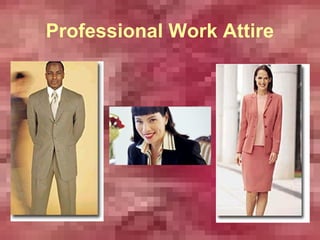
• Wardrobe
  – Professional Business Wardrobe
    -For women: skirted/pant suit, blouse or dress shirt,
    clean well maintained dress shoes (generally closed-
    toe shoe)
    -For men: suit, dress shirt, tie (well maintained dress
    shoes)

  – Outerwear
   -Appropriate for women/men: Trench coat, umbrella
Professional Work Attire
Professional Appearance
• Business Casual Wardrobe
  – For women: dress pants, shirt, blouse, well
    maintained dress or casual shoe (no tennis
    shoes, flip flops, etc.)
  – For men: slacks/khaki pants, polo shirt, or other
    collared dress shirt, well maintained dress or
    casual shoes (no tennis shoes, flip flops, etc.)

               **NOTHING SLOPPY**
Casual Work Attire
Office Etiquette
• Telephone –
  – Use appropriate tone of voice
  – Maintain a positive attitude
  – Remove slang terms and use good listening
    skills
  – Take complete phone messages (name, date,
    time, reason for calling, where they can be
    reached)
  – Cell phone – TURN IT OFF
Office Etiquette
• Email –
  – Make subject line specific
  – Address emails
  – Reply to a question- copy question into your email
    and then provide your response
  – Follow standard writing guidelines - business letter
    format as a professional courtesy
  – Keep it short and concise
  – Include your name and contact information
  – REMEMBER – NOTHING is confidential when sent
    electronically
Office Etiquette
• Cubical –
  – Keep in mind that others work around you
  – Professional business calls only
  – Use your “inside voice” when on the phone or
    speaking with a co-worker
  – Remember cubical conversations and calls
    can be heard by others (use discretion and
    good judgment as there is no “free air space”)
Office Etiquette
• Attending a meeting –
  – Listen carefully

  – Come prepared

  – Be concise and articulate when speaking

  – Show respect
Office Etiquette
• Get to know the work culture –
  – Unique sets of norms (breaks, lunch,
    meetings, workplace politics, etc.)
  – Find out what the organization values,
    philosophy of conducting business, work
    ethic, etc.
  – How and when do effective people
    communicate in the organization?
Office Etiquette
• What is expected of you?
• Don’t talk too often about “College Days” –the
  faster you shed your student identity, the
  more easily you will begin to work in the new
  setting.
• Find out about the “informal” chain of
  command
Office Etiquette
• Making a positive impression –
  – Recognize that what you do early on will be
    magnified
  – Remember your manners
  – Be ready to learn, adapt and change
  – Exercise professional maturity by showing
    good judgment and build good relationships
Office Etiquette
• Show a healthy respect for colleagues
  experience and expertise
• Exhibit a positive attitude and know what your
  role will be on the team – How can I best
  assist?
• Leave your personal life at the front door
• Inquire about the proper way to respond to
  co-workers, supervisors, clients ( Business
  letter head, phone call etc.)
The Importance of Dining
      Appropriately

 “Shirley Wiley, owner of Etiquette and
Company, California, reports that roughly
   80% of second interviews involve a
             business meal”.

*Texas Health Resources, “Placement Manuals” August 2004
Professional Dining Basics
• American Style Dining
  • Arrive on time
  • Wait to sit until host/hostess indicated the
    seating arrangement
  • Put napkin in lap before drinking or eating
  • Order easy to eat food
  • Don’t order the most expensive items on the
    menu
Professional Dining Basics
• Wait until everyone has been served before
  you begin to eat
• Bring food to your mouth – NOT your head to
  your plate
  •   Salt/Pepper pass together
  •   Generally pass food to the right
  •   Rest utensils on plate while talking
  •   Do not talk with your mouth full
  •   Do not chew with your mouth open
Individual Place Setting
Professional Dining Basics
• Proper posture is important
• Table manners please!!
  – (No gum, no elbows on the table)
• “Please and Thank You”
• Turn your cell phone off
• Be responsible for keeping up and positively
  contributing to the conversation
• Small Talk is appropriate – topics such as :
  – Books, sports, food, theater, travel, current events etc.
  – Follow employer’s lead
What is Not Appropriate?
• No swearing
• No loud or obnoxious behavior
• No crude comments or topics

• Subjects to avoid: health, gossip, love life,
  politics, religion, race and inappropriate stories
  or jokes
Networking
• BREAK OUT OF YOUR COMFORT ZONE
• Mingle – Mingle – Mingle – Mingle – Mingle
  – Don’t travel with your friends
  – Make direct eye contact, smile and speak
  – Contribute positively to the conversation with your
    thoughts and open ended questions
  – Don’t monopolize someone’s time –
     • (This is not a time to gain free advice.)
  – If appropriate, collect business card(s)
  – Politely excuse yourself and move on to another
    individual

Kimber2012 professional etiquette

  • 1.
    Professional Etiquette Kimber Walters ATI
  • 2.
    How Does EtiquetteBenefit You? • Differentiates you from others in a competitive job market • Enables you to be confident in a variety of settings with a variety of people • Honors commitment to excellence and quality • Modifies distracting behaviors and develops admired conduct “Be one step ahead, practice the social skills necessary to help you make a great first impression and stand out in a competitive job market”.
  • 3.
    What is Etiquette?? Webster’sII New College Dictionary defines Etiquette as: The forms and practices prescribed by social convention or by authority.
  • 4.
    Critical Etiquette Topics to Consider • Etiquette Basics • Professional Appearance • Office Etiquette • Dining and Table Manners • Networking
  • 5.
    Etiquette Basics Creating a positive image • Behavior: • Exhibit a positive attitude and pleasant demeanor • Use a firm handshake • Maintain good eye contact • Appropriate introductions – introduce someone by their title and last name (Ms. Mrs. Mr. Dr. Smith), unless otherwise specified • Rise when you are introducing someone or you are being introduced • Nonverbal communication is important • Show common respect and consideration for others
  • 6.
    Professional Appearance • Groomingis fundamental • Hair clean and styled appropriately • Clean nails, skin and teeth • Many professionals wear make-up (depends on field) • Check fragrance and clothing care
  • 7.
    Professional Appearance • Wardrobe – Professional Business Wardrobe -For women: skirted/pant suit, blouse or dress shirt, clean well maintained dress shoes (generally closed- toe shoe) -For men: suit, dress shirt, tie (well maintained dress shoes) – Outerwear -Appropriate for women/men: Trench coat, umbrella
  • 8.
  • 9.
    Professional Appearance • BusinessCasual Wardrobe – For women: dress pants, shirt, blouse, well maintained dress or casual shoe (no tennis shoes, flip flops, etc.) – For men: slacks/khaki pants, polo shirt, or other collared dress shirt, well maintained dress or casual shoes (no tennis shoes, flip flops, etc.) **NOTHING SLOPPY**
  • 10.
  • 11.
    Office Etiquette • Telephone– – Use appropriate tone of voice – Maintain a positive attitude – Remove slang terms and use good listening skills – Take complete phone messages (name, date, time, reason for calling, where they can be reached) – Cell phone – TURN IT OFF
  • 12.
    Office Etiquette • Email– – Make subject line specific – Address emails – Reply to a question- copy question into your email and then provide your response – Follow standard writing guidelines - business letter format as a professional courtesy – Keep it short and concise – Include your name and contact information – REMEMBER – NOTHING is confidential when sent electronically
  • 13.
    Office Etiquette • Cubical– – Keep in mind that others work around you – Professional business calls only – Use your “inside voice” when on the phone or speaking with a co-worker – Remember cubical conversations and calls can be heard by others (use discretion and good judgment as there is no “free air space”)
  • 14.
    Office Etiquette • Attendinga meeting – – Listen carefully – Come prepared – Be concise and articulate when speaking – Show respect
  • 15.
    Office Etiquette • Getto know the work culture – – Unique sets of norms (breaks, lunch, meetings, workplace politics, etc.) – Find out what the organization values, philosophy of conducting business, work ethic, etc. – How and when do effective people communicate in the organization?
  • 16.
    Office Etiquette • Whatis expected of you? • Don’t talk too often about “College Days” –the faster you shed your student identity, the more easily you will begin to work in the new setting. • Find out about the “informal” chain of command
  • 17.
    Office Etiquette • Makinga positive impression – – Recognize that what you do early on will be magnified – Remember your manners – Be ready to learn, adapt and change – Exercise professional maturity by showing good judgment and build good relationships
  • 18.
    Office Etiquette • Showa healthy respect for colleagues experience and expertise • Exhibit a positive attitude and know what your role will be on the team – How can I best assist? • Leave your personal life at the front door • Inquire about the proper way to respond to co-workers, supervisors, clients ( Business letter head, phone call etc.)
  • 19.
    The Importance ofDining Appropriately “Shirley Wiley, owner of Etiquette and Company, California, reports that roughly 80% of second interviews involve a business meal”. *Texas Health Resources, “Placement Manuals” August 2004
  • 20.
    Professional Dining Basics •American Style Dining • Arrive on time • Wait to sit until host/hostess indicated the seating arrangement • Put napkin in lap before drinking or eating • Order easy to eat food • Don’t order the most expensive items on the menu
  • 21.
    Professional Dining Basics •Wait until everyone has been served before you begin to eat • Bring food to your mouth – NOT your head to your plate • Salt/Pepper pass together • Generally pass food to the right • Rest utensils on plate while talking • Do not talk with your mouth full • Do not chew with your mouth open
  • 22.
  • 23.
    Professional Dining Basics •Proper posture is important • Table manners please!! – (No gum, no elbows on the table) • “Please and Thank You” • Turn your cell phone off • Be responsible for keeping up and positively contributing to the conversation • Small Talk is appropriate – topics such as : – Books, sports, food, theater, travel, current events etc. – Follow employer’s lead
  • 24.
    What is NotAppropriate? • No swearing • No loud or obnoxious behavior • No crude comments or topics • Subjects to avoid: health, gossip, love life, politics, religion, race and inappropriate stories or jokes
  • 25.
    Networking • BREAK OUTOF YOUR COMFORT ZONE • Mingle – Mingle – Mingle – Mingle – Mingle – Don’t travel with your friends – Make direct eye contact, smile and speak – Contribute positively to the conversation with your thoughts and open ended questions – Don’t monopolize someone’s time – • (This is not a time to gain free advice.) – If appropriate, collect business card(s) – Politely excuse yourself and move on to another individual