STRUCTURE AND FUNCTIONS OF JUXTA GLOMERULAR
APPARATUS AND ROLE OF RENIN-ANGIOTENSIN SYSTEM
JUXTAGLOMERULAR APPARATUS
• The juxtaglomerular apparatus is the site of blood pressure
regulation via the renin-angioensin-aldosterone system.
• They are located at the vascular pole of Bowman’s capsule and
are formed by the conjunction of cells of
(1)Macula densa of the thick ascending limb of LOH
(2) Juxtaglomerular cells (the modified muscle cells mainly of
afferent arteriole)
(3) Lacis cells (Extra glomerular mesangial cells)
JUXTAGLOMERULAR APPARATUS…..
• The macula densa is a portion of terminal distal straight tubule
adjacent to the renal corpuscle.
• These cells monitor the NaCl levels in the afferent arteriole and
regulate the juxtaglomerular cells within that vessel.
• The juxtaglomerular cells are specialized smooth muscle cells of the
afferent arteriole which synthesize and secrete renin.
• These cells also called as polkissen cells.
• Lacis cells are the extra glomerular mesangial cells.
• These cells secrete some quantity of renin & erythropoietin.
HOW DOES THE JUXTAGLOMERULAR APPARATUS WORK
• The macula densa cells monitor NaCl levels in the fluid of the
afferent arteriole.
• Renin secretion of the juxtaglomerular cells is stimulated by
paracrine activity from the macula densa.
• Renin is a protease that cleaves plasma angiotensinogen into
angiotensin I.
• Angiotensin I is converted to angiotensin II in the lung (by an
enzyme in the capillaries).
HOW DOES THE JUXTAGLOMERULAR
APPARATUS WORK……..
• Angiotensin II promotes vascular smooth muscle contraction and
release of aldosterone from the suprarenal cortex.
• Aldosterone stimulates absorption of NaCl and water in the distal
convoluted tubule thus increasing blood volume resulting in an
increase in blood pressure
RENIN-ANGIOTENSIN-ALDOSTERONE
SYSTEM
• Juxtaglomerular apparatus secretes renin.
• Renin acts on angiotensinogen (gamma globulin from the liver) giving
angiotensin I
• Angiotensin converting enzyme (ACE) acts on angiotensin I giving
angiotensin II
RENIN-ANGIOTENSIN-ALDOSTERONE
SYSTEM
• Renin:
1. It is secreted by the juxtaglomerular cells in Kidney
2. Changes in secretion is in response to changes in renal
arterial pressure, sympathetic nervous system signals and
some hormones
3. Its substrate is angiotensinogen
RENIN-ANGIOTENSIN-ALDOSTERONE
SYSTEM
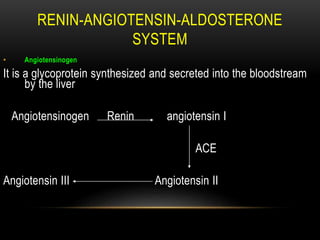
• Angiotensinogen
It is a glycoprotein synthesized and secreted into the bloodstream
by the liver
Angiotensinogen Renin angiotensin I
ACE
Angiotensin III Angiotensin II
RENIN-ANGIOTENSIN-ALDOSTERONE SYSTEM
• Angiotensin converting enzyme (ACE) is also known as kinanase II.
• It converts angiotensin I to II (vasoconstrictor) and inactivates bradykinin
(vasodilator)’
• The principal site of its action is vascular epithelium.
• It is inhibited by synthetically produced Captopril drug.
RENIN-ANGIOTENSIN-ALDOSTERONE SYSTEM
• Angiotensin II
1. Stimulates aldosterone production
2. Stimulates ADH secretion from pituitary
3. Highly potent vasoconstrictor
4. Stimulates thirst
5. Stimulates release of catecholamines by adrenal medulla
• Angiotensin III
Stimulates aldosterone production without vasoconstriction
ROLE OF ANGIOTENSIN II HYPERTENSIVE
• Angiotensin ll is a powerful vasoconstrictor. It constricts the blood vessels
and raises the peripheral resistance, thereby acting to restore blood
pressure.
• Angiotensin ll also increases the secretion of aldosterone leading to Na+
reabsorption.
EFFECTS OF ANGIOTENSIN II
REGULATION OF ALDOSTERONE
• Angiotensin II and III stimulate aldosterone release
• Changes in volume ( long Negative feedback loop)
• Inhibition of renin secretion by angiotensin II (short negative
feedback loop)
• Endothelin and vasopressin stimulate aldosterone secretion
• ANP is a potent inhibitor, dopamine also inhibits it.
Aldosterone
Angiotensin II
Angiotensin III
Endothelin
ADH
Kidney
Renin
JGA
Distal
Tubules
Blood Volume
Na
&
H2O
ANP
Osmolarity
Q1. Function/s of kidney is/are:
a) Glycogenolysis
b) Secretion of erythropoietin
c) Acid-base balance
d) Both (b) and (c)
Q2. Average number of nephrons in both kidneys
are:
a) 1 million
b) 2 million
c) 4 million
d) none
Q3. Glomerular capillary membrane is formed of:
a) Endothelium of the capillary
b) Basement membrane of the capillary
c) Podocytes
d) All of the above
Q4. True about juxtamedullary nephrons is:
a) 70-80%
b) Short loop of Henle
c) Vasa recta
d) All of the above
Q5. Albumin is not filtered because of:
a) Large size/diameter
b) Negative charge on basement membrane
c) Both (a) and (b)
d) None
Q6. Juxtaglomerular apparatus is formed of:
a) Lacis cells
b) Juxtaglomerular cells
c) Macula densa
d) All of the above
Q7. Renin is secreted by:
a) Juxtaglomerular cells
b) Interstitial cells around peritubular capillaries
c) Macula densa
d) Lacis cells
THANK YOU

JG apparatus.pptx

  • 1.
    STRUCTURE AND FUNCTIONSOF JUXTA GLOMERULAR APPARATUS AND ROLE OF RENIN-ANGIOTENSIN SYSTEM
  • 2.
    JUXTAGLOMERULAR APPARATUS • Thejuxtaglomerular apparatus is the site of blood pressure regulation via the renin-angioensin-aldosterone system. • They are located at the vascular pole of Bowman’s capsule and are formed by the conjunction of cells of (1)Macula densa of the thick ascending limb of LOH (2) Juxtaglomerular cells (the modified muscle cells mainly of afferent arteriole) (3) Lacis cells (Extra glomerular mesangial cells)
  • 3.
    JUXTAGLOMERULAR APPARATUS….. • Themacula densa is a portion of terminal distal straight tubule adjacent to the renal corpuscle. • These cells monitor the NaCl levels in the afferent arteriole and regulate the juxtaglomerular cells within that vessel. • The juxtaglomerular cells are specialized smooth muscle cells of the afferent arteriole which synthesize and secrete renin. • These cells also called as polkissen cells. • Lacis cells are the extra glomerular mesangial cells. • These cells secrete some quantity of renin & erythropoietin.
  • 6.
    HOW DOES THEJUXTAGLOMERULAR APPARATUS WORK • The macula densa cells monitor NaCl levels in the fluid of the afferent arteriole. • Renin secretion of the juxtaglomerular cells is stimulated by paracrine activity from the macula densa. • Renin is a protease that cleaves plasma angiotensinogen into angiotensin I. • Angiotensin I is converted to angiotensin II in the lung (by an enzyme in the capillaries).
  • 7.
    HOW DOES THEJUXTAGLOMERULAR APPARATUS WORK…….. • Angiotensin II promotes vascular smooth muscle contraction and release of aldosterone from the suprarenal cortex. • Aldosterone stimulates absorption of NaCl and water in the distal convoluted tubule thus increasing blood volume resulting in an increase in blood pressure
  • 8.
    RENIN-ANGIOTENSIN-ALDOSTERONE SYSTEM • Juxtaglomerular apparatussecretes renin. • Renin acts on angiotensinogen (gamma globulin from the liver) giving angiotensin I • Angiotensin converting enzyme (ACE) acts on angiotensin I giving angiotensin II
  • 9.
    RENIN-ANGIOTENSIN-ALDOSTERONE SYSTEM • Renin: 1. Itis secreted by the juxtaglomerular cells in Kidney 2. Changes in secretion is in response to changes in renal arterial pressure, sympathetic nervous system signals and some hormones 3. Its substrate is angiotensinogen
  • 10.
    RENIN-ANGIOTENSIN-ALDOSTERONE SYSTEM • Angiotensinogen It isa glycoprotein synthesized and secreted into the bloodstream by the liver Angiotensinogen Renin angiotensin I ACE Angiotensin III Angiotensin II
  • 11.
    RENIN-ANGIOTENSIN-ALDOSTERONE SYSTEM • Angiotensinconverting enzyme (ACE) is also known as kinanase II. • It converts angiotensin I to II (vasoconstrictor) and inactivates bradykinin (vasodilator)’ • The principal site of its action is vascular epithelium. • It is inhibited by synthetically produced Captopril drug.
  • 12.
    RENIN-ANGIOTENSIN-ALDOSTERONE SYSTEM • AngiotensinII 1. Stimulates aldosterone production 2. Stimulates ADH secretion from pituitary 3. Highly potent vasoconstrictor 4. Stimulates thirst 5. Stimulates release of catecholamines by adrenal medulla • Angiotensin III Stimulates aldosterone production without vasoconstriction
  • 13.
    ROLE OF ANGIOTENSINII HYPERTENSIVE • Angiotensin ll is a powerful vasoconstrictor. It constricts the blood vessels and raises the peripheral resistance, thereby acting to restore blood pressure. • Angiotensin ll also increases the secretion of aldosterone leading to Na+ reabsorption.
  • 14.
  • 15.
    REGULATION OF ALDOSTERONE •Angiotensin II and III stimulate aldosterone release • Changes in volume ( long Negative feedback loop) • Inhibition of renin secretion by angiotensin II (short negative feedback loop) • Endothelin and vasopressin stimulate aldosterone secretion • ANP is a potent inhibitor, dopamine also inhibits it.
  • 16.
  • 19.
    Q1. Function/s ofkidney is/are: a) Glycogenolysis b) Secretion of erythropoietin c) Acid-base balance d) Both (b) and (c)
  • 20.
    Q2. Average numberof nephrons in both kidneys are: a) 1 million b) 2 million c) 4 million d) none
  • 21.
    Q3. Glomerular capillarymembrane is formed of: a) Endothelium of the capillary b) Basement membrane of the capillary c) Podocytes d) All of the above
  • 22.
    Q4. True aboutjuxtamedullary nephrons is: a) 70-80% b) Short loop of Henle c) Vasa recta d) All of the above
  • 23.
    Q5. Albumin isnot filtered because of: a) Large size/diameter b) Negative charge on basement membrane c) Both (a) and (b) d) None
  • 24.
    Q6. Juxtaglomerular apparatusis formed of: a) Lacis cells b) Juxtaglomerular cells c) Macula densa d) All of the above
  • 25.
    Q7. Renin issecreted by: a) Juxtaglomerular cells b) Interstitial cells around peritubular capillaries c) Macula densa d) Lacis cells
  • 26.