P R E S E N T E D
B Y
K H A I R U R R A H M I
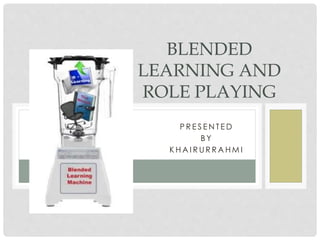
BLENDED
LEARNING AND
ROLE PLAYING
WHAT IS BLENDED LEARNING?
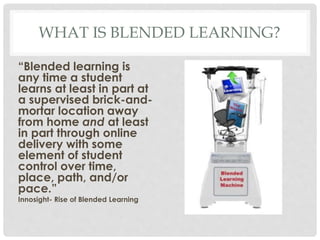
“Blended learning is
any time a student
learns at least in part at
a supervised brick-and-
mortar location away
from home and at least
in part through online
delivery with some
element of student
control over time,
place, path, and/or
pace.”
Innosight- Rise of Blended Learning
BLENDED LEARNING CAN BE….
• Email
Communication
• Videos/Simulations
• Web 2.0 Resources
• Google Docs,
Google Chat, E-
portfolios
• Podcasts/Screencasts
• Discussion Boards,
Class Wiki’s
• Any use of
technology
Depends on your needs in and out of
the classroom…
**Using a Learning Management System (LMS) to store and manipulate
content may help
ADVANTAGES OF BLENDED LEARNING
• Individualized
Learning
• Personalized Learning
Support
• Independent and
Collaborative
Learning
• Increase in Student
Engagement
• Accommodates
Several Learning
Styles
Adapted from Debra Marsh- Cambridge
University
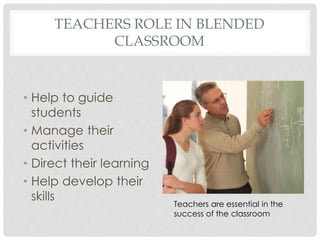
TEACHERS ROLE IN BLENDED
CLASSROOM
• Help to guide
students
• Manage their
activities
• Direct their learning
• Help develop their
skills
Teachers are essential in the
success of the classroom
WHAT IS ROLE PLAY?
“a method in which key ideas and skills are
illustrated or practiced by learners assuming
roles and contexts in which the ideas and skills
would typically be applied”
(Reigeluth and Keller, 2009, p.37)
KEY FEATURES
• students participate in a hypothetical
situation, take on a different role and look at a
situation from different perspectives
• tasks can include:
- practicing a dialogue
- performing a skit
- being given a position to defend in a debate
LEARNING GOALS
• learners are:
- actively participating in their learning
experience
- making meaningful connections to real world
situations
- practicing real-life scenarios in a safe
environment
- building confidence through peer feedback
and improving themselves before applying
their learning to the real world
- learning to appreciate one another’s differences
through asking questions and taking on a role
other than theirs to understand a concept or
situation and looking at it through a different
perspective
THE PROCEDURE
1. The learning outcome of the role playing activity
must be made clear.
2. The roles and responsibilities of the learners must
also be outlined clearly.
3. The rules and expectations of the class must be
reviewed to prevent any possible conflicts.
4. Immediate feedback must be given to students so
that they can correct any behaviours or
techniques.
5. A debriefing session must be held after the activity
to consolidate ideas on what was learned.
CRITERIA FOR SUCCESSFUL
IMPLEMENTATION
• The expectations and instructions must be made
clear to avoid confusion.
• There must be an open and comfortable learning
community so students do not feel embarrassed
and uncomfortable in front of one another.
• Constructive feedback must be encouraged and
given respectfully.
SITUATIONAL CONSTRAINTS
• Some students may not feel comfortable
engaging in the activity
• Role play will not be effective in large groups as
it might be challenging for the facilitator to
thoroughly monitor and provide feedback to
everyone
• The activities can take a long time to set up and
practice
• There might not be enough time to thoroughly
practice and learn from the activity
• The instructions might be too lengthy, making the
activity complex and difficult to adapt to
RELEVANCE TO
ADULT LEARNING CONTEXT
• Role playing:
- provides the learner an opportunity to simulate
a real life scenario in the classroom
- encourages empathy among the learners and
helps them look at situations from different
perspectives
- allows students to discuss personal experiences
and learn from one another
THANK YOU

Khairurrahmi method

  • 1.
    P R ES E N T E D B Y K H A I R U R R A H M I BLENDED LEARNING AND ROLE PLAYING
  • 2.
    WHAT IS BLENDEDLEARNING? “Blended learning is any time a student learns at least in part at a supervised brick-and- mortar location away from home and at least in part through online delivery with some element of student control over time, place, path, and/or pace.” Innosight- Rise of Blended Learning
  • 3.
    BLENDED LEARNING CANBE…. • Email Communication • Videos/Simulations • Web 2.0 Resources • Google Docs, Google Chat, E- portfolios • Podcasts/Screencasts • Discussion Boards, Class Wiki’s • Any use of technology Depends on your needs in and out of the classroom… **Using a Learning Management System (LMS) to store and manipulate content may help
  • 4.
    ADVANTAGES OF BLENDEDLEARNING • Individualized Learning • Personalized Learning Support • Independent and Collaborative Learning • Increase in Student Engagement • Accommodates Several Learning Styles Adapted from Debra Marsh- Cambridge University
  • 5.
    TEACHERS ROLE INBLENDED CLASSROOM • Help to guide students • Manage their activities • Direct their learning • Help develop their skills Teachers are essential in the success of the classroom
  • 6.
    WHAT IS ROLEPLAY? “a method in which key ideas and skills are illustrated or practiced by learners assuming roles and contexts in which the ideas and skills would typically be applied” (Reigeluth and Keller, 2009, p.37)
  • 7.
    KEY FEATURES • studentsparticipate in a hypothetical situation, take on a different role and look at a situation from different perspectives • tasks can include: - practicing a dialogue - performing a skit - being given a position to defend in a debate
  • 8.
    LEARNING GOALS • learnersare: - actively participating in their learning experience - making meaningful connections to real world situations - practicing real-life scenarios in a safe environment - building confidence through peer feedback and improving themselves before applying their learning to the real world - learning to appreciate one another’s differences through asking questions and taking on a role other than theirs to understand a concept or situation and looking at it through a different perspective
  • 9.
    THE PROCEDURE 1. Thelearning outcome of the role playing activity must be made clear. 2. The roles and responsibilities of the learners must also be outlined clearly. 3. The rules and expectations of the class must be reviewed to prevent any possible conflicts. 4. Immediate feedback must be given to students so that they can correct any behaviours or techniques. 5. A debriefing session must be held after the activity to consolidate ideas on what was learned.
  • 10.
    CRITERIA FOR SUCCESSFUL IMPLEMENTATION •The expectations and instructions must be made clear to avoid confusion. • There must be an open and comfortable learning community so students do not feel embarrassed and uncomfortable in front of one another. • Constructive feedback must be encouraged and given respectfully.
  • 11.
    SITUATIONAL CONSTRAINTS • Somestudents may not feel comfortable engaging in the activity • Role play will not be effective in large groups as it might be challenging for the facilitator to thoroughly monitor and provide feedback to everyone • The activities can take a long time to set up and practice • There might not be enough time to thoroughly practice and learn from the activity • The instructions might be too lengthy, making the activity complex and difficult to adapt to
  • 12.
    RELEVANCE TO ADULT LEARNINGCONTEXT • Role playing: - provides the learner an opportunity to simulate a real life scenario in the classroom - encourages empathy among the learners and helps them look at situations from different perspectives - allows students to discuss personal experiences and learn from one another
  • 13.