RJM


       DIFFERENTIATING
      INSTRUCTION USING
        INSTRUCTIONAL
         TECHNOLOGY
RJM


      HTTP://WWW.YOUTUBE.COM/WATCH?
      V=OS9GMUFF2UA&FEATURE=RELATED
RJM


      WHY DIFFERENTIATE
        INSTRUCTION?
RJM
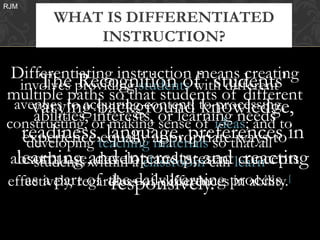
       WHAT IS DIFFERENTIATED
           INSTRUCTION?

 Differentiating instruction means creating
       The Recognition of students'
   involves providing students with different
multiple paths so that students of different
      varying interests, or learning needs
                  background knowledge,
  avenues to acquiring content; to processing,
      abilities, or making sense of ideas; and to
constructing,
   readiness,teaching appropriatethat allto in
                   language, preferences
    experience equally materials so ways
     developing
 absorb, use,and interests; and learn
  learning within a classroom can concepts
      students develop and present reacting
effectively, regardless of differencesprocess. [
    as a part of the daily learning in ability.
                    responsively.
RJM


                                        HJHJ


      the process of “ensuring that what a student learns, how he/she learns
        it, and how the student demonstrates what he/she has learned is a
       match for that student’s readiness level, interests, and preferred mode
                       of learning”. ~Carol Ann Tomlinson


         The perfect model of differentiated instruction rests upon an active,
        student centered, meaning-making approach to teaching and learning.
      The theoretical and philosophical influences embedded in differentiated
       instruction support the three key elements of differentiated instruction
      itself: readiness, interest, and learning profile (Allan & Tomlinson, 2000).
RJM


                   PHILOSOPHIES THAT SUPPORT DI


      organize the standards as concept umbrellas, if you can help kids discover
       patterns, answer essential questions, and organize their thinking, then it's
      more likely that the standards will be useful instead of defeating.“ ~Carol
                                    Ann Tomlinson
RJM


    Research indicates that many of the
      “

   emotional or social difficulties gifted
   students experience disappear when
  their educational climates are adapted
    to their level and pace of learning."
RJM


         Differentiation in education can also include how a
      student shows that they have mastery of a concept. This
       could be through a research paper, role play, podcast,
      diagram, poster, etc. The key to differentiation is finding
       how your students learn and displays their learning that
                      meets their specific needs.
RJM


        WHY UTILIZE
      INSTRUCTIONAL
       TECHNOLOGY?
Due to the ARE TODAY’Shasof technology, this ETHNICITY AND
    Diversity in learning styles
   NOT ONLY advancement
                                   always existed, however “the arrival and rapid
                                 LEARNERS DIVERSE IN generation of
learners increased distinguishable differences indecades of the havecentury” they
   dissemination of digital technology in the last
  further will face challenges in the DIVERSE IN styles 20th theSTYLES
 SOCIO CULTURAL STATUS; THEY ARE workplace that
                                                   learning
                                                            LEARNING
                                                                and    never has
                                                                         ways
                AND ABILITIES AS WELL (KUZMESKUS, 1996).
                 been faced before (Prensky, 2006).
                     must be accommodated (Prensky 2001, p.1).

   Benjamin Franklin was even quoted as saying “"Tell me and I
  forget, show me and I may remember, involve me and I learn."
RJM


            EDUCATIONAL
       PHILOSOPHIES/LEARNING
             THEORIES


         Philosophies
      Learning Theories
               (Constructivism)
              (Experiential Learning)
                (Constructionism)
RJM


      IF A STUDENT IS ABLE TO PERFORM IN A PROBLEM
      SOLVING SITUATION, A MEANINGFUL LEARNING
      SHOULD    THEN    OCCUR    BECAUSE  HE   HAS
      CONSTRUCTED AN INTERPRETATION OF HOW
      THINGS WORK USING PREEXISTING STRUCTURES.
      THIS IS THE THEORY BEHIND CONSTRUCTIVISM. BY
      CREATING A PERSONAL INTERPRETATION OF
      EXTERNAL       IDEAS     AND     EXPERIENCES,
      CONSTRUCTIVISM ALLOWS STUDENTS THE ABILITY
      TO UNDERSTAND HOW IDEAS CAN RELATE TO EACH
      OTHER AND PREEXISTING KNOWLEDGE (JANET
      DRAPIKOWSKI,PERSONALCOMMUNICATION).
RJM

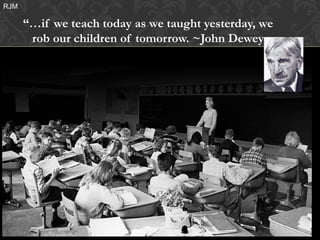
      “…if we teach today as we taught yesterday, we
       rob our children of tomorrow. ~John Dewey


                              RJM
RJM


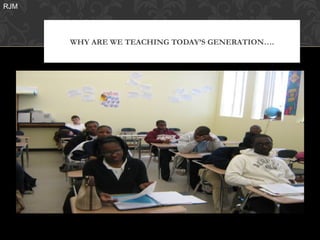
      WHY ARE WE TEACHING TODAY’S GENERATION….
RJM


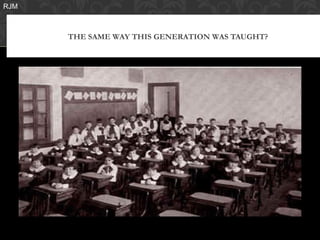
      THE SAME WAY THIS GENERATION WAS TAUGHT?
RJM


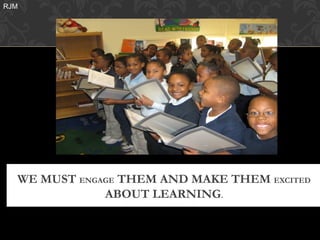
  WE MUST ENGAGE THEM AND MAKE THEM EXCITED
              ABOUT LEARNING.
Now we know why……..

Let’s talk about who we are
teaching.
RJM


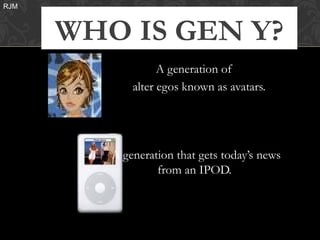
      WHO IS GEN Y?
                   A generation of
             alter egos known as avatars.


         A generation that gets today’s news
                  from an IPOD.
RJM


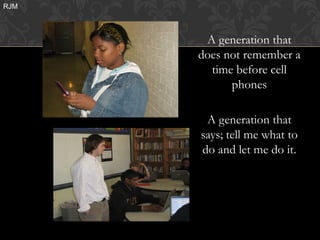
       A generation that
      does not remember a
        time before cell
            phones

       A generation that
      says; tell me what to
      do and let me do it.
RJM


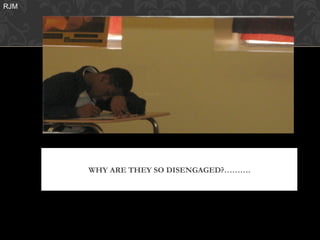
      WHY ARE THEY SO DISENGAGED?……….
RJM


      TECHNOLOGY HAS BEEN A PART OF OUR STUDENTS LIVES SINCE
                             BIRTH,

      AS A RESULT THEY PROCESS INFORMATION DIFFERENTLY. ……
RJM


 They relate differently…..

  Communicating = IM’s and text messaging
  Sharing= Blogs, MySpace
  Buying & Selling= E-Bay, Craigslist
 Learning= Wikipedia, You Tube,
 Meeting= Second Life
 Playing= Rock Band, Halo, RPG games
 Exercise= Dance Dance Revolution
RJM


                          STATISTICS SHOW……..


      The average teen is engaged willingly in 44 1/2 hours of media a week.

                  Teens download 2 billion ring tones per year.

         They also send over 250,000 emails and text messages per year.
RJM


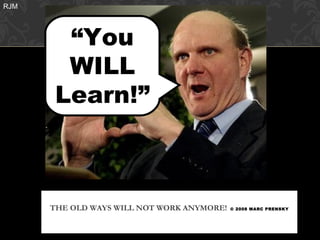
        “You
        WILL
       Learn!”


      THE OLD WAYS WILL NOT WORK ANYMORE!   © 2008 MARC PRENSKY
RJM


      They Have to
        WANT
       To Learn
RJM


      HOW???????
RJM


      WE USE TOOLS THEY CAN RELATE TO AND WE MUST ACCEPT…….


            We are no longer the “givers of knowledge”

            We are now the facilitators of their learning.

           They are not students, but researchers, we are
                       research developers.
RJM


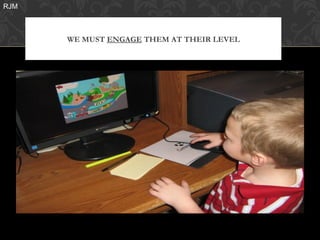
      WE MUST ENGAGE THEM AT THEIR LEVEL
RJM


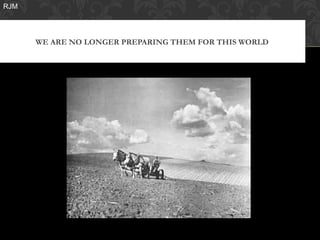
      WE ARE NO LONGER PREPARING THEM FOR THIS WORLD
RJM
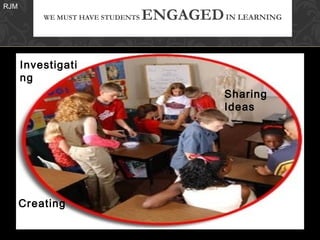
          WE MUST HAVE STUDENTS   ENGAGED IN LEARNING


      Investigati
      ng
                                             Sharing
                                             Ideas


      Creating
RJM


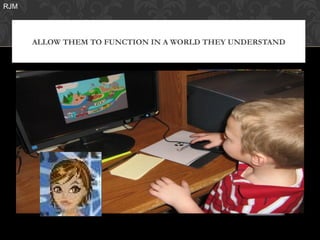
      ALLOW THEM TO FUNCTION IN A WORLD THEY UNDERSTAND
RJM
          ATTENTION DEFICIT OR
            DISENGAGEMENT


     Students today suffer from
   They say Nationally, 1.6 to 2 million
   people have been diagnosed with ADD
     E.D.D. (Educational
   and ADHD. that students today do not
      Disengagement Disorder)~ Rachel
  I feel strongly
               http://www.dailyprincetonian.com/2004/10/20/11159/


  suffer from A.D.D. (Attention Deficit
    Mercer

  Disorder)……… as
            As much
RJM


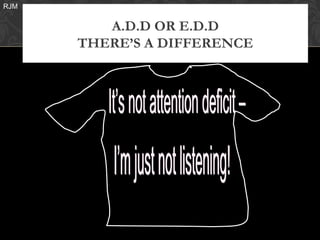
         A.D.D OR E.D.D
      THERE’S A DIFFERENCE
RJM


             HOW TO DIFFERENTIATE INSTRUCTION


  Tiering Lessons- based on
  predetermined ability:
  •(ex.) ask lower performing students to
  prepare an article, while more advanced
  students prepare a debate to present in
  front of the class.
RJM
                      DIFFERENTIATION OF
                    INSTRUCTION OCCURS IN:


                                     Content
                                     Process
                                     Product
      Throughout this process be sure you are speaking to them in the same language
                               they will be tested in. (LB)
RJM


              FIRST STEP- DETERMINE READINESS


      Readiness: explores the basic
      knowledge, understanding, and
      skill a student has~(Tomlinson &
      McTighe, 2006).
RJM


                              HOW DO WE DETERMINE READINESS


                             The obvious answer is evaluation.

                      WHAT IS A GOOD EVALUATION?
                        ActiVote/Expression (or other learner response system)


 Begin each unit with a discussion posted on Haiku (or website, or other learning management
               system). Set the question 5 – 7 days prior to discussion. (Sample)

      Socratic Questioning Session/Strategic Questioning Session based on a predetermined
                                      discussion question.
                                                               Samples
RJM


      ONCE YOU HAVE DETERMINED READINESS/ABILITY LEVELS


                            Plan Lessons Accordingly


                        Sample of Proficient   Sample of Advanced
      SAMPLE OF BASIC      Assignment             Assignment
        ASSIGNMENT


                          Haiku- Sample
RJM


      IDEAS:
RJM

                                 TOOLS TO USE


                         ActiVotes/Expressions
      Online articles that require comments from student (Haiku)
                           WebQuests (Sample)
                          Tiered Presentations:
                Power Point (Basic Sample) ,(Prof. Sample)
                             iMovie Projects
                          Movie Maker Projects
                             Screen Casting
                                  Voki
                                 Muvizu
RJM


             SUGGESTED USES OF TECHNOLOGY


      ActivExpressions-leveled self paced assessments.
            Haiku-Leveled Haiku assessments


           Use for both pre and post assessments
RJM


                  SUGGESTED USES OF TOOLS


                       WebQuests:
                         Wikis
                       Blogging
                       PodCasts
                      Leveled Tasks-
      http://www.edtechmagazine.com/k12/lessonplans
RJM


          WHAT IS OUR DIRECTION?


               To Create Classrooms that are:

      3          Student Centered
      3          Project Based
      3          Teacher Facilitated
      3          Student-Directed
RJM
                WHAT WILL THIS DO FOR
                    OUR SCHOOL?


 Create classes that students are excited about
  going to
 Teach students how to be lifelong learners
 Teach students to work collaboratively
RJM


      First we must recognize…
RJM


       OUR STUDENTS COME TO US
      FUNCTIONING AT DIFFERENT
        READINESS LEVELS WITH
          VARYING INTERESTS!
RJM


      We Must Remember Why We
          Chose Education
RJM


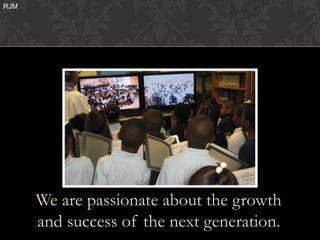
      We are passionate about the growth
      and success of the next generation.
RJM


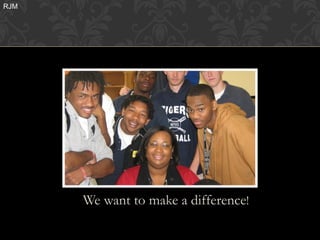
      We want to make a difference!
RJM


      WE MUST LISTEN TO WHAT
      OUR STUDENTS ARE SAYING!
RJM


  ENGAGE ME OR ENRAGE ME~
  Dr. Kip Leland LAUSD LAVA
RJM
      SAMPLES OF INSTRUCTIONAL
        TECHNOLOGY STUDENT
         CENTERED PROJECTS


         •       Student Created Tutorials
                    •    1 2 3


             •    Student Created Projects
                     •    1 2 3

Differentiating instruction through technology

  • 1.
    RJM DIFFERENTIATING INSTRUCTION USING INSTRUCTIONAL TECHNOLOGY
  • 2.
    RJM HTTP://WWW.YOUTUBE.COM/WATCH? V=OS9GMUFF2UA&FEATURE=RELATED
  • 3.
    RJM WHY DIFFERENTIATE INSTRUCTION?
  • 4.
    RJM WHAT IS DIFFERENTIATED INSTRUCTION? Differentiating instruction means creating The Recognition of students' involves providing students with different multiple paths so that students of different varying interests, or learning needs background knowledge, avenues to acquiring content; to processing, abilities, or making sense of ideas; and to constructing, readiness,teaching appropriatethat allto in language, preferences experience equally materials so ways developing absorb, use,and interests; and learn learning within a classroom can concepts students develop and present reacting effectively, regardless of differencesprocess. [ as a part of the daily learning in ability. responsively.
  • 5.
    RJM HJHJ the process of “ensuring that what a student learns, how he/she learns it, and how the student demonstrates what he/she has learned is a match for that student’s readiness level, interests, and preferred mode of learning”. ~Carol Ann Tomlinson The perfect model of differentiated instruction rests upon an active, student centered, meaning-making approach to teaching and learning. The theoretical and philosophical influences embedded in differentiated instruction support the three key elements of differentiated instruction itself: readiness, interest, and learning profile (Allan & Tomlinson, 2000).
  • 6.
    RJM PHILOSOPHIES THAT SUPPORT DI organize the standards as concept umbrellas, if you can help kids discover patterns, answer essential questions, and organize their thinking, then it's more likely that the standards will be useful instead of defeating.“ ~Carol Ann Tomlinson
  • 7.
    RJM Research indicates that many of the “ emotional or social difficulties gifted students experience disappear when their educational climates are adapted to their level and pace of learning."
  • 8.
    RJM Differentiation in education can also include how a student shows that they have mastery of a concept. This could be through a research paper, role play, podcast, diagram, poster, etc. The key to differentiation is finding how your students learn and displays their learning that meets their specific needs.
  • 9.
    RJM WHY UTILIZE INSTRUCTIONAL TECHNOLOGY?
  • 10.
    Due to theARE TODAY’Shasof technology, this ETHNICITY AND Diversity in learning styles NOT ONLY advancement always existed, however “the arrival and rapid LEARNERS DIVERSE IN generation of learners increased distinguishable differences indecades of the havecentury” they dissemination of digital technology in the last further will face challenges in the DIVERSE IN styles 20th theSTYLES SOCIO CULTURAL STATUS; THEY ARE workplace that learning LEARNING and never has ways AND ABILITIES AS WELL (KUZMESKUS, 1996). been faced before (Prensky, 2006). must be accommodated (Prensky 2001, p.1). Benjamin Franklin was even quoted as saying “"Tell me and I forget, show me and I may remember, involve me and I learn."
  • 11.
    RJM EDUCATIONAL PHILOSOPHIES/LEARNING THEORIES Philosophies Learning Theories (Constructivism) (Experiential Learning) (Constructionism)
  • 12.
    RJM IF A STUDENT IS ABLE TO PERFORM IN A PROBLEM SOLVING SITUATION, A MEANINGFUL LEARNING SHOULD THEN OCCUR BECAUSE HE HAS CONSTRUCTED AN INTERPRETATION OF HOW THINGS WORK USING PREEXISTING STRUCTURES. THIS IS THE THEORY BEHIND CONSTRUCTIVISM. BY CREATING A PERSONAL INTERPRETATION OF EXTERNAL IDEAS AND EXPERIENCES, CONSTRUCTIVISM ALLOWS STUDENTS THE ABILITY TO UNDERSTAND HOW IDEAS CAN RELATE TO EACH OTHER AND PREEXISTING KNOWLEDGE (JANET DRAPIKOWSKI,PERSONALCOMMUNICATION).
  • 13.
    RJM “…if we teach today as we taught yesterday, we rob our children of tomorrow. ~John Dewey RJM
  • 14.
    RJM WHY ARE WE TEACHING TODAY’S GENERATION….
  • 15.
    RJM THE SAME WAY THIS GENERATION WAS TAUGHT?
  • 16.
    RJM WEMUST ENGAGE THEM AND MAKE THEM EXCITED ABOUT LEARNING.
  • 17.
    Now we knowwhy…….. Let’s talk about who we are teaching.
  • 18.
    RJM WHO IS GEN Y? A generation of alter egos known as avatars. A generation that gets today’s news from an IPOD.
  • 19.
    RJM A generation that does not remember a time before cell phones A generation that says; tell me what to do and let me do it.
  • 20.
    RJM WHY ARE THEY SO DISENGAGED?……….
  • 21.
    RJM TECHNOLOGY HAS BEEN A PART OF OUR STUDENTS LIVES SINCE BIRTH, AS A RESULT THEY PROCESS INFORMATION DIFFERENTLY. ……
  • 22.
    RJM They relatedifferently….. Communicating = IM’s and text messaging Sharing= Blogs, MySpace Buying & Selling= E-Bay, Craigslist Learning= Wikipedia, You Tube, Meeting= Second Life Playing= Rock Band, Halo, RPG games Exercise= Dance Dance Revolution
  • 23.
    RJM STATISTICS SHOW…….. The average teen is engaged willingly in 44 1/2 hours of media a week. Teens download 2 billion ring tones per year. They also send over 250,000 emails and text messages per year.
  • 24.
    RJM “You WILL Learn!” THE OLD WAYS WILL NOT WORK ANYMORE! © 2008 MARC PRENSKY
  • 25.
    RJM They Have to WANT To Learn
  • 26.
    RJM HOW???????
  • 27.
    RJM WE USE TOOLS THEY CAN RELATE TO AND WE MUST ACCEPT……. We are no longer the “givers of knowledge” We are now the facilitators of their learning. They are not students, but researchers, we are research developers.
  • 28.
    RJM WE MUST ENGAGE THEM AT THEIR LEVEL
  • 29.
    RJM WE ARE NO LONGER PREPARING THEM FOR THIS WORLD
  • 30.
    RJM WE MUST HAVE STUDENTS ENGAGED IN LEARNING Investigati ng Sharing Ideas Creating
  • 31.
    RJM ALLOW THEM TO FUNCTION IN A WORLD THEY UNDERSTAND
  • 32.
    RJM ATTENTION DEFICIT OR DISENGAGEMENT Students today suffer from They say Nationally, 1.6 to 2 million people have been diagnosed with ADD E.D.D. (Educational and ADHD. that students today do not Disengagement Disorder)~ Rachel I feel strongly http://www.dailyprincetonian.com/2004/10/20/11159/ suffer from A.D.D. (Attention Deficit Mercer Disorder)……… as As much
  • 33.
    RJM A.D.D OR E.D.D THERE’S A DIFFERENCE
  • 34.
    RJM HOW TO DIFFERENTIATE INSTRUCTION Tiering Lessons- based on predetermined ability: •(ex.) ask lower performing students to prepare an article, while more advanced students prepare a debate to present in front of the class.
  • 35.
    RJM DIFFERENTIATION OF INSTRUCTION OCCURS IN: Content Process Product Throughout this process be sure you are speaking to them in the same language they will be tested in. (LB)
  • 36.
    RJM FIRST STEP- DETERMINE READINESS Readiness: explores the basic knowledge, understanding, and skill a student has~(Tomlinson & McTighe, 2006).
  • 37.
    RJM HOW DO WE DETERMINE READINESS The obvious answer is evaluation. WHAT IS A GOOD EVALUATION? ActiVote/Expression (or other learner response system) Begin each unit with a discussion posted on Haiku (or website, or other learning management system). Set the question 5 – 7 days prior to discussion. (Sample) Socratic Questioning Session/Strategic Questioning Session based on a predetermined discussion question. Samples
  • 38.
    RJM ONCE YOU HAVE DETERMINED READINESS/ABILITY LEVELS Plan Lessons Accordingly Sample of Proficient Sample of Advanced SAMPLE OF BASIC Assignment Assignment ASSIGNMENT Haiku- Sample
  • 39.
    RJM IDEAS:
  • 40.
    RJM TOOLS TO USE ActiVotes/Expressions Online articles that require comments from student (Haiku) WebQuests (Sample) Tiered Presentations: Power Point (Basic Sample) ,(Prof. Sample) iMovie Projects Movie Maker Projects Screen Casting Voki Muvizu
  • 41.
    RJM SUGGESTED USES OF TECHNOLOGY ActivExpressions-leveled self paced assessments. Haiku-Leveled Haiku assessments Use for both pre and post assessments
  • 42.
    RJM SUGGESTED USES OF TOOLS WebQuests: Wikis Blogging PodCasts Leveled Tasks- http://www.edtechmagazine.com/k12/lessonplans
  • 43.
    RJM WHAT IS OUR DIRECTION? To Create Classrooms that are: 3 Student Centered 3 Project Based 3 Teacher Facilitated 3 Student-Directed
  • 44.
    RJM WHAT WILL THIS DO FOR OUR SCHOOL?  Create classes that students are excited about going to  Teach students how to be lifelong learners  Teach students to work collaboratively
  • 45.
    RJM First we must recognize…
  • 46.
    RJM OUR STUDENTS COME TO US FUNCTIONING AT DIFFERENT READINESS LEVELS WITH VARYING INTERESTS!
  • 47.
    RJM We Must Remember Why We Chose Education
  • 48.
    RJM We are passionate about the growth and success of the next generation.
  • 49.
    RJM We want to make a difference!
  • 50.
    RJM WE MUST LISTEN TO WHAT OUR STUDENTS ARE SAYING!
  • 51.
    RJM ENGAGEME OR ENRAGE ME~ Dr. Kip Leland LAUSD LAVA
  • 52.
    RJM SAMPLES OF INSTRUCTIONAL TECHNOLOGY STUDENT CENTERED PROJECTS • Student Created Tutorials • 1 2 3 • Student Created Projects • 1 2 3