Downloaded 75 times

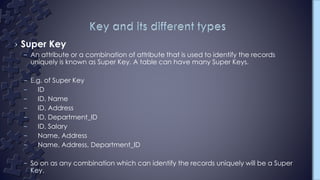
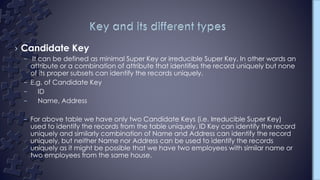
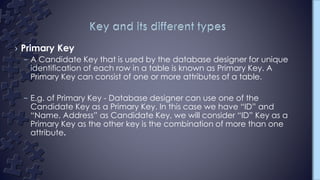

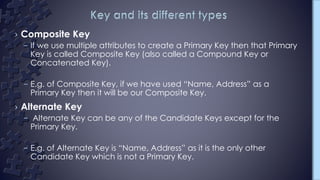

This document defines and provides examples of different types of keys in a database table: 1) A super key is an attribute or combination of attributes that can identify records, but it may contain redundant data. A candidate key is a minimal super key that uniquely identifies each record. 2) The primary key is the candidate key chosen by the database designer to uniquely identify each record. It can consist of one or more attributes. 3) A foreign key is an attribute in one table that references the primary key of another table, enforcing referential integrity between the tables. 4) If the primary key contains multiple attributes, it is called a composite or compound key.


![Lect 1 Number systems and base conversions. [Autosaved].pptx](https://cdn.slidesharecdn.com/ss_thumbnails/lect1numbersystemsandbaseconversions-260111134109-67c2d865-thumbnail.jpg?width=640&height=640&fit=bounds)


