Definition
A functional dependency is defined as a
constraint between two sets of attributes
in a relation from a database.
Given a relation R, a set of attributes X in R
is said to functionally determine another
attribute Y, also in R, (written X → Y) if
and only if each X value is associated
with at most one Y value.
In other words….
X is the determinant set and Y is the
dependent attribute. Thus, given a
tuple and the values of the attributes in
X, one can determine the
corresponding value of the Y attribute.
Example
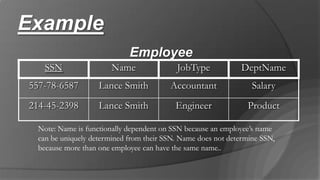
Employee
SSN Name JobType DeptName
557-78-6587 Lance Smith Accountant Salary
214-45-2398 Lance Smith Engineer Product
Note: Name is functionally dependent on SSN because an employee’s name
can be uniquely determined from their SSN. Name does not determine SSN,
because more than one employee can have the same name..
Keys
Whereas a key is a set of attributes that uniquely
identifies an entire tuple, a functional
dependency allows us to express constraints
that uniquely identify the values of certain
attributes.
However, a candidate key is always a
determinant, but a determinant doesn’t need
to be a key.
Closure
Let a relation R have some functional dependencies F
specified. The closure of F (usually written as F+) is
the set of all functional dependencies that may be
logically derived from F. Often F is the set of most
obvious and important functional dependencies and
F+, the closure, is the set of all the functional
dependencies including F and those that can be
deduced from F. The closure is important and may,
for example, be needed in finding one or more
candidate keys of the relation.
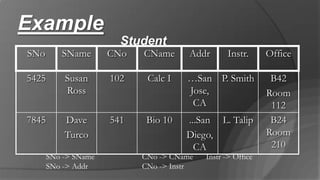
Example
Student
SNo SName CNo CName Addr Instr. Office
5425 Susan
Ross
102 Calc I …San
Jose,
CA
P. Smith B42
Room
112
7845 Dave
Turco
541 Bio 10 ...San
Diego,
CA
L. Talip B24
Room
210
SNo -> SName CNo -> CName Instr -> Office
SNo -> Addr CNo -> Instr
Axioms
Before we can determine the closure of
the relation, Student, we need a set of
rules.
Developed by Armstrong in 1974, there
are six rules (axioms) that all possible
functional dependencies may be
derived from them.
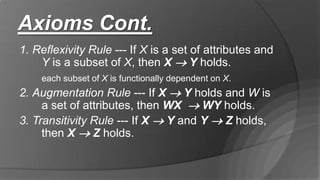
Axioms Cont.
1. Reflexivity Rule --- If X is a set of attributes and
Y is a subset of X, then X  Y holds.
each subset of X is functionally dependent on X.
2. Augmentation Rule --- If X  Y holds and W is
a set of attributes, then WX  WY holds.
3. Transitivity Rule --- If X  Y and Y  Z holds,
then X  Z holds.
Derived Theorems from
Axioms
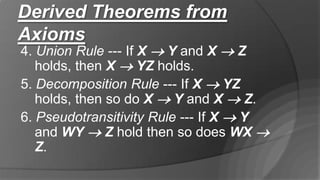
4. Union Rule --- If X  Y and X  Z
holds, then X  YZ holds.
5. Decomposition Rule --- If X  YZ
holds, then so do X  Y and X  Z.
6. Pseudotransitivity Rule --- If X  Y
and WY  Z hold then so does WX 
Z.
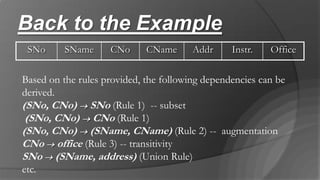
Back to the Example
SNo SName CNo CName Addr Instr. Office
Based on the rules provided, the following dependencies can be
derived.
(SNo, CNo)  SNo (Rule 1) -- subset
(SNo, CNo)  CNo (Rule 1)
(SNo, CNo)  (SName, CName) (Rule 2) -- augmentation
CNo  office (Rule 3) -- transitivity
SNo  (SName, address) (Union Rule)
etc.
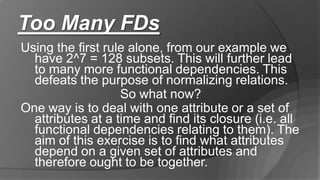
Too Many FDs
Using the first rule alone, from our example we
have 2^7 = 128 subsets. This will further lead
to many more functional dependencies. This
defeats the purpose of normalizing relations.
So what now?
One way is to deal with one attribute or a set of
attributes at a time and find its closure (i.e. all
functional dependencies relating to them). The
aim of this exercise is to find what attributes
depend on a given set of attributes and
therefore ought to be together.
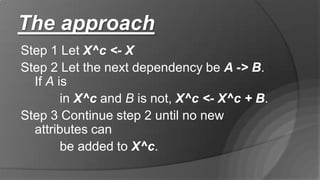
The approach
Step 1 Let X^c <- X
Step 2 Let the next dependency be A -> B.
If A is
in X^c and B is not, X^c <- X^c + B.
Step 3 Continue step 2 until no new
attributes can
be added to X^c.
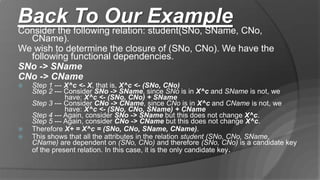
Back To Our Example
Consider the following relation: student(SNo, SName, CNo,
CName).
We wish to determine the closure of (SNo, CNo). We have the
following functional dependencies.
SNo -> SName
CNo -> CName
 Step 1 --- X^c <- X, that is, X^c <- (SNo, CNo)
Step 2 --- Consider SNo -> SName, since SNo is in X^c and SName is not, we
have: X^c <- (SNo, CNo) + SName
Step 3 --- Consider CNo -> CName, since CNo is in X^c and CName is not, we
have: X^c <- (SNo, CNo, SName) + CName
Step 4 --- Again, consider SNo -> SName but this does not change X^c.
Step 5 --- Again, consider CNo -> CName but this does not change X^c.
 Therefore X+ = X^c = (SNo, CNo, SName, CName).
 This shows that all the attributes in the relation student (SNo, CNo, SName,
CName) are dependent on (SNo, CNo) and therefore (SNo, CNo) is a candidate key
of the present relation. In this case, it is the only candidate key.
Normal Form
 Initially Codd (1972) presented three normal
forms (1NF, 2NF and 3NF) all based on
functional dependencies among the attributes
of a relation. Later Boyce and Codd proposed
another normal form called the Boyce-Codd
normal form (BCNF). The fourth and fifth
normal forms are based on multi-value and
join dependencies and were proposed later.
 The primary objective of normalization is to
avoid anomalies.
Functional dependency

Functional dependency

  • 2.
    Definition A functional dependencyis defined as a constraint between two sets of attributes in a relation from a database. Given a relation R, a set of attributes X in R is said to functionally determine another attribute Y, also in R, (written X → Y) if and only if each X value is associated with at most one Y value.
  • 3.
    In other words…. Xis the determinant set and Y is the dependent attribute. Thus, given a tuple and the values of the attributes in X, one can determine the corresponding value of the Y attribute.
  • 4.
    Example Employee SSN Name JobTypeDeptName 557-78-6587 Lance Smith Accountant Salary 214-45-2398 Lance Smith Engineer Product Note: Name is functionally dependent on SSN because an employee’s name can be uniquely determined from their SSN. Name does not determine SSN, because more than one employee can have the same name..
  • 5.
    Keys Whereas a keyis a set of attributes that uniquely identifies an entire tuple, a functional dependency allows us to express constraints that uniquely identify the values of certain attributes. However, a candidate key is always a determinant, but a determinant doesn’t need to be a key.
  • 6.
    Closure Let a relationR have some functional dependencies F specified. The closure of F (usually written as F+) is the set of all functional dependencies that may be logically derived from F. Often F is the set of most obvious and important functional dependencies and F+, the closure, is the set of all the functional dependencies including F and those that can be deduced from F. The closure is important and may, for example, be needed in finding one or more candidate keys of the relation.
  • 7.
    Example Student SNo SName CNoCName Addr Instr. Office 5425 Susan Ross 102 Calc I …San Jose, CA P. Smith B42 Room 112 7845 Dave Turco 541 Bio 10 ...San Diego, CA L. Talip B24 Room 210 SNo -> SName CNo -> CName Instr -> Office SNo -> Addr CNo -> Instr
  • 8.
    Axioms Before we candetermine the closure of the relation, Student, we need a set of rules. Developed by Armstrong in 1974, there are six rules (axioms) that all possible functional dependencies may be derived from them.
  • 9.
    Axioms Cont. 1. ReflexivityRule --- If X is a set of attributes and Y is a subset of X, then X  Y holds. each subset of X is functionally dependent on X. 2. Augmentation Rule --- If X  Y holds and W is a set of attributes, then WX  WY holds. 3. Transitivity Rule --- If X  Y and Y  Z holds, then X  Z holds.
  • 10.
    Derived Theorems from Axioms 4.Union Rule --- If X  Y and X  Z holds, then X  YZ holds. 5. Decomposition Rule --- If X  YZ holds, then so do X  Y and X  Z. 6. Pseudotransitivity Rule --- If X  Y and WY  Z hold then so does WX  Z.
  • 11.
    Back to theExample SNo SName CNo CName Addr Instr. Office Based on the rules provided, the following dependencies can be derived. (SNo, CNo)  SNo (Rule 1) -- subset (SNo, CNo)  CNo (Rule 1) (SNo, CNo)  (SName, CName) (Rule 2) -- augmentation CNo  office (Rule 3) -- transitivity SNo  (SName, address) (Union Rule) etc.
  • 12.
    Too Many FDs Usingthe first rule alone, from our example we have 2^7 = 128 subsets. This will further lead to many more functional dependencies. This defeats the purpose of normalizing relations. So what now? One way is to deal with one attribute or a set of attributes at a time and find its closure (i.e. all functional dependencies relating to them). The aim of this exercise is to find what attributes depend on a given set of attributes and therefore ought to be together.
  • 13.
    The approach Step 1Let X^c <- X Step 2 Let the next dependency be A -> B. If A is in X^c and B is not, X^c <- X^c + B. Step 3 Continue step 2 until no new attributes can be added to X^c.
  • 14.
    Back To OurExample Consider the following relation: student(SNo, SName, CNo, CName). We wish to determine the closure of (SNo, CNo). We have the following functional dependencies. SNo -> SName CNo -> CName  Step 1 --- X^c <- X, that is, X^c <- (SNo, CNo) Step 2 --- Consider SNo -> SName, since SNo is in X^c and SName is not, we have: X^c <- (SNo, CNo) + SName Step 3 --- Consider CNo -> CName, since CNo is in X^c and CName is not, we have: X^c <- (SNo, CNo, SName) + CName Step 4 --- Again, consider SNo -> SName but this does not change X^c. Step 5 --- Again, consider CNo -> CName but this does not change X^c.  Therefore X+ = X^c = (SNo, CNo, SName, CName).  This shows that all the attributes in the relation student (SNo, CNo, SName, CName) are dependent on (SNo, CNo) and therefore (SNo, CNo) is a candidate key of the present relation. In this case, it is the only candidate key.
  • 15.
    Normal Form  InitiallyCodd (1972) presented three normal forms (1NF, 2NF and 3NF) all based on functional dependencies among the attributes of a relation. Later Boyce and Codd proposed another normal form called the Boyce-Codd normal form (BCNF). The fourth and fifth normal forms are based on multi-value and join dependencies and were proposed later.  The primary objective of normalization is to avoid anomalies.