Experiment:
Convert Weston-type Galvanometer into ammeter.


Apparatus:
Galvanometer, high resistance box, voltmeter, battery, resistance box, rheostat, plug key,
ammeter, screw gauge, meter rod, sand paper and connecting wires.


Procedure:
Half deflection method:
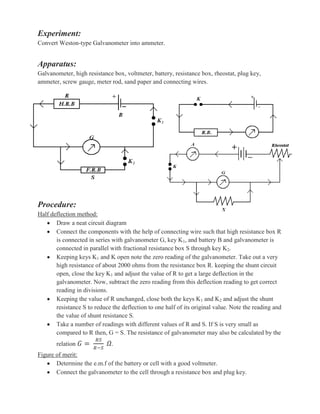
       Draw a neat circuit diagram
       Connect the components with the help of connecting wire such that high resistance box R
       is connected in series with galvanometer G, key K1, and battery B and galvanometer is
       connected in parallel with fractional resistance box S through key K2.
       Keeping keys K1 and K open note the zero reading of the galvanometer. Take out a very
       high resistance of about 2000 ohms from the resistance box R. keeping the shunt circuit
       open, close the key K1 and adjust the value of R to get a large deflection in the
       galvanometer. Now, subtract the zero reading from this deflection reading to get correct
       reading in divisions.
       Keeping the value of R unchanged, close both the keys K1 and K2 and adjust the shunt
       resistance S to reduce the deflection to one half of its original value. Note the reading and
       the value of shunt resistance S.
       Take a number of readings with different values of R and S. If S is very small as
       compared to R then, G = S. The resistance of galvanometer may also be calculated by the
       relation               .
Figure of merit:
       Determine the e.m.f of the battery or cell with a good voltmeter.
       Connect the galvanometer to the cell through a resistance box and plug key.
Adjust the resistance from resistance box to get a large deflection in the galvanometer.
         Note the deflection θ and resistance R.
         Disconnect the shunt resistance S from the apparatus and find the value of Ig by using the
         formula                      . Where, E is the e.m.f of the battery, 30 is the total number of
       divisions on galvanometer, R is the resistance selected, θ is the defection on that
       resistance and G is the resistance of the galvanometer.
Calculation of shunt:
       Calculate the full scale current Ig = nk (where, n is the number of divisions on the
       galvanometer scale between the middle point and one extreme end).
       Knowing the range of conversion calculate the value of shunt resistance by the relation
                        in ohms.

         Take a wire and measure its diameter at about ten different places and calculate its mean
         radius.
         Now calculate the length l of wire whose resistance is equal to the shunt resistance X by
         the relation               where, ρ is the specific resistance of the wire material.
Verification:
       Cut the length of the given wire 2cms more than the calculated length to account for the
       portion of length that is wrapped around the terminals.
       Connect the wire across the galvanometer terminals and complete the circuit.
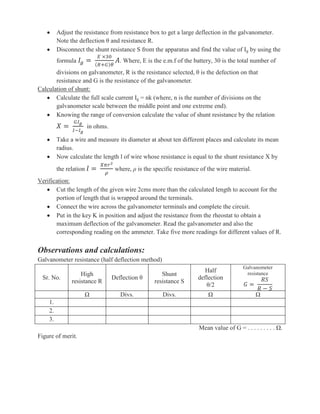
       Put in the key K in position and adjust the resistance from the rheostat to obtain a
       maximum deflection of the galvanometer. Read the galvanometer and also the
       corresponding reading on the ammeter. Take five more readings for different values of R.

Observations and calculations:
Galvanometer resistance (half deflection method)
                                                                                           Galvanometer
                                                                         Half               resistance
                   High                                Shunt
 Sr. No.                           Deflection θ                       deflection
               resistance R                         resistance S
                                                                         θ/2
                    Ω                 Divs.             Divs.              Ω                    Ω
    1.
    2.
    3.
                                                                       Mean value of G = . . . . . . . . . Ω.
Figure of merit.

G to a

  • 1.
    Experiment: Convert Weston-type Galvanometerinto ammeter. Apparatus: Galvanometer, high resistance box, voltmeter, battery, resistance box, rheostat, plug key, ammeter, screw gauge, meter rod, sand paper and connecting wires. Procedure: Half deflection method: Draw a neat circuit diagram Connect the components with the help of connecting wire such that high resistance box R is connected in series with galvanometer G, key K1, and battery B and galvanometer is connected in parallel with fractional resistance box S through key K2. Keeping keys K1 and K open note the zero reading of the galvanometer. Take out a very high resistance of about 2000 ohms from the resistance box R. keeping the shunt circuit open, close the key K1 and adjust the value of R to get a large deflection in the galvanometer. Now, subtract the zero reading from this deflection reading to get correct reading in divisions. Keeping the value of R unchanged, close both the keys K1 and K2 and adjust the shunt resistance S to reduce the deflection to one half of its original value. Note the reading and the value of shunt resistance S. Take a number of readings with different values of R and S. If S is very small as compared to R then, G = S. The resistance of galvanometer may also be calculated by the relation . Figure of merit: Determine the e.m.f of the battery or cell with a good voltmeter. Connect the galvanometer to the cell through a resistance box and plug key.
  • 2.
    Adjust the resistancefrom resistance box to get a large deflection in the galvanometer. Note the deflection θ and resistance R. Disconnect the shunt resistance S from the apparatus and find the value of Ig by using the formula . Where, E is the e.m.f of the battery, 30 is the total number of divisions on galvanometer, R is the resistance selected, θ is the defection on that resistance and G is the resistance of the galvanometer. Calculation of shunt: Calculate the full scale current Ig = nk (where, n is the number of divisions on the galvanometer scale between the middle point and one extreme end). Knowing the range of conversion calculate the value of shunt resistance by the relation in ohms. Take a wire and measure its diameter at about ten different places and calculate its mean radius. Now calculate the length l of wire whose resistance is equal to the shunt resistance X by the relation where, ρ is the specific resistance of the wire material. Verification: Cut the length of the given wire 2cms more than the calculated length to account for the portion of length that is wrapped around the terminals. Connect the wire across the galvanometer terminals and complete the circuit. Put in the key K in position and adjust the resistance from the rheostat to obtain a maximum deflection of the galvanometer. Read the galvanometer and also the corresponding reading on the ammeter. Take five more readings for different values of R. Observations and calculations: Galvanometer resistance (half deflection method) Galvanometer Half resistance High Shunt Sr. No. Deflection θ deflection resistance R resistance S θ/2 Ω Divs. Divs. Ω Ω 1. 2. 3. Mean value of G = . . . . . . . . . Ω. Figure of merit.