Types of Keys in
Database Management System
SoS in Computer Science and Application
PGDCA 203 : DBMS
Presented By
Shruti Dubey
Why we have Keys in DB?
• A Key is an attribute or a set of attributes in a relation that identifies a tuple
(record) in a relation.
• The keys are defined in a table to access or sequence the stored data quickly
and smoothly.
• They are also used to create relationship between different tables.
Types of Keys in Database
1. Primary Key
2. Candidate Key
3. Alternate Key
4. Super Key
5. Composite Key
6. Foreign Key
7. Unique Key
Primary Key
• Which is Unique &Can’t be have NULL Value
• Is the column you choose to maintain uniqueness in a table at
row level.
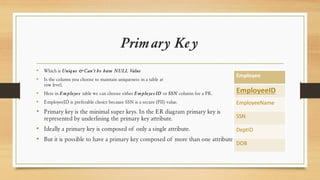
• Here in Employee table we can choose either EmployeeID or SSN column for a PK.
• EmployeeID is preferable choice because SSN is a secure (PII) value.
• Primary key is the minimal super keys. In the ER diagram primary key is
represented by underlining the primary key attribute.
• Ideally a primary key is composed of only a single attribute.
• But it is possible to have a primary key composed of more than one attribute.
To define a field as primary key,
following conditions had to be met :
• No two rows can have the same primary key value.
• Every row must have a primary key value.
• The primary key field cannot be null.
• Value in a primary key column can never be modified or updated, if any
foreign key refers to that primary key
Candidate Key
• Are individual columns in a table that qualifies for
uniqueness of each row/tuple.
• Here in Employee table EmployeeID & SSN are eligible
for a Primary Key and thus are Candidate keys.
• Candidate Keys are super keys for which no proper subset
is a super key. In other words candidate keys are
minimal super keys.
Alternate Key
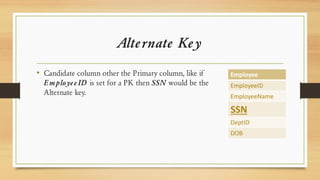
• Candidate column other the Primary column, like if
EmployeeID is set for a PK then SSN would be the
Alternate key.
Super Key
• If you add any other Column /Attribute to a Primary Key
then it become a Super Key, like EmployeeID
+ EmployeeName is a Super Key.
• Super key stands for superset of a key.
• A Super Key is a set of one or more attributes that are
taken collectively and can identify all other attributes
uniquely.
Composite Key
• If a table do have a single column that qualifies for a Candidate
key, then you have to select 2 or more columns to make a row
unique.
• Like if there is no EmployeeID or SSN columns, then you can
make EmployeeName + DateOfBirth (DOB) as Composite
Primary Key. But still therecanbe a narrow chance of duplicate rows.
Foreign Key
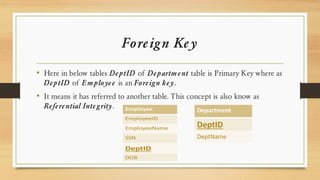
• Here in below tables DeptID of Department table is Primary Key where as
DeptID of Employee is an Foreign key.
• It means it has referred to another table. This concept is also know as
Referential Integrity.
Unique Key
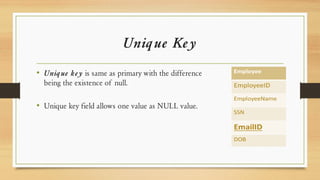
• Unique key is same as primary with the difference
being the existence of null.
• Unique key field allows one value as NULL value.

DBMS_Keys.pdf

  • 1.
    Types of Keysin Database Management System SoS in Computer Science and Application PGDCA 203 : DBMS Presented By Shruti Dubey
  • 2.
    Why we haveKeys in DB? • A Key is an attribute or a set of attributes in a relation that identifies a tuple (record) in a relation. • The keys are defined in a table to access or sequence the stored data quickly and smoothly. • They are also used to create relationship between different tables.
  • 3.
    Types of Keysin Database 1. Primary Key 2. Candidate Key 3. Alternate Key 4. Super Key 5. Composite Key 6. Foreign Key 7. Unique Key
  • 4.
    Primary Key • Whichis Unique &Can’t be have NULL Value • Is the column you choose to maintain uniqueness in a table at row level. • Here in Employee table we can choose either EmployeeID or SSN column for a PK. • EmployeeID is preferable choice because SSN is a secure (PII) value. • Primary key is the minimal super keys. In the ER diagram primary key is represented by underlining the primary key attribute. • Ideally a primary key is composed of only a single attribute. • But it is possible to have a primary key composed of more than one attribute.
  • 5.
    To define afield as primary key, following conditions had to be met : • No two rows can have the same primary key value. • Every row must have a primary key value. • The primary key field cannot be null. • Value in a primary key column can never be modified or updated, if any foreign key refers to that primary key
  • 6.
    Candidate Key • Areindividual columns in a table that qualifies for uniqueness of each row/tuple. • Here in Employee table EmployeeID & SSN are eligible for a Primary Key and thus are Candidate keys. • Candidate Keys are super keys for which no proper subset is a super key. In other words candidate keys are minimal super keys.
  • 7.
    Alternate Key • Candidatecolumn other the Primary column, like if EmployeeID is set for a PK then SSN would be the Alternate key.
  • 8.
    Super Key • Ifyou add any other Column /Attribute to a Primary Key then it become a Super Key, like EmployeeID + EmployeeName is a Super Key. • Super key stands for superset of a key. • A Super Key is a set of one or more attributes that are taken collectively and can identify all other attributes uniquely.
  • 9.
    Composite Key • Ifa table do have a single column that qualifies for a Candidate key, then you have to select 2 or more columns to make a row unique. • Like if there is no EmployeeID or SSN columns, then you can make EmployeeName + DateOfBirth (DOB) as Composite Primary Key. But still therecanbe a narrow chance of duplicate rows.
  • 10.
    Foreign Key • Herein below tables DeptID of Department table is Primary Key where as DeptID of Employee is an Foreign key. • It means it has referred to another table. This concept is also know as Referential Integrity.
  • 11.
    Unique Key • Uniquekey is same as primary with the difference being the existence of null. • Unique key field allows one value as NULL value.