The Serial Device Bus
Johan Hovold
Hovold Consulting AB
johan@hovoldconsulting.com
johan@kernel.org
September 29, 2017
Introduction
• UARTs and RS-232 have been around since 1960s
• USB, PCIe, Firewire, Thunderbolt
• Common interface for Bluetooth, NFC, FM Radio and GPS
• TTY-layer abstracts serial connection
• Character-device interface (e.g. /dev/ttyS1)
• But no (good) way to model associated resources (PM)
• GPIOs and interrupts
• Regulators
• Clocks
• Audio interface
• Kernel support limited to line-discipline ”drivers”
• Requires user-space to configure and initialise
Outline
• TTY Layer
• Problems with line-discipline drivers
• Serdev implementation
• Serdev interfaces
• Serdev limitations
• Future work
TTY Layer
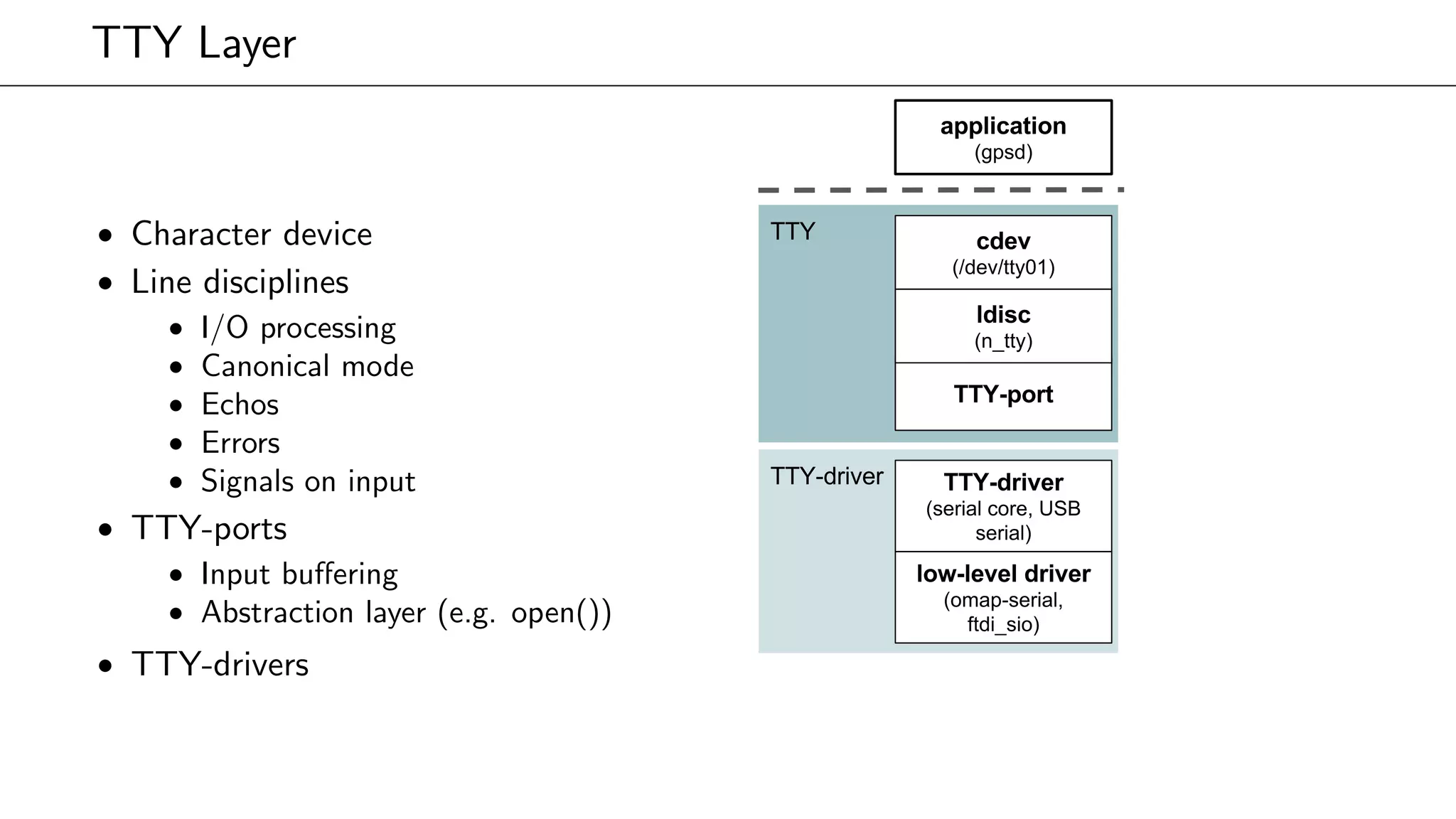
• Character device
• Line disciplines
• I/O processing
• Canonical mode
• Echos
• Errors
• Signals on input
• TTY-ports
• Input buffering
• Abstraction layer (e.g. open())
• TTY-drivers
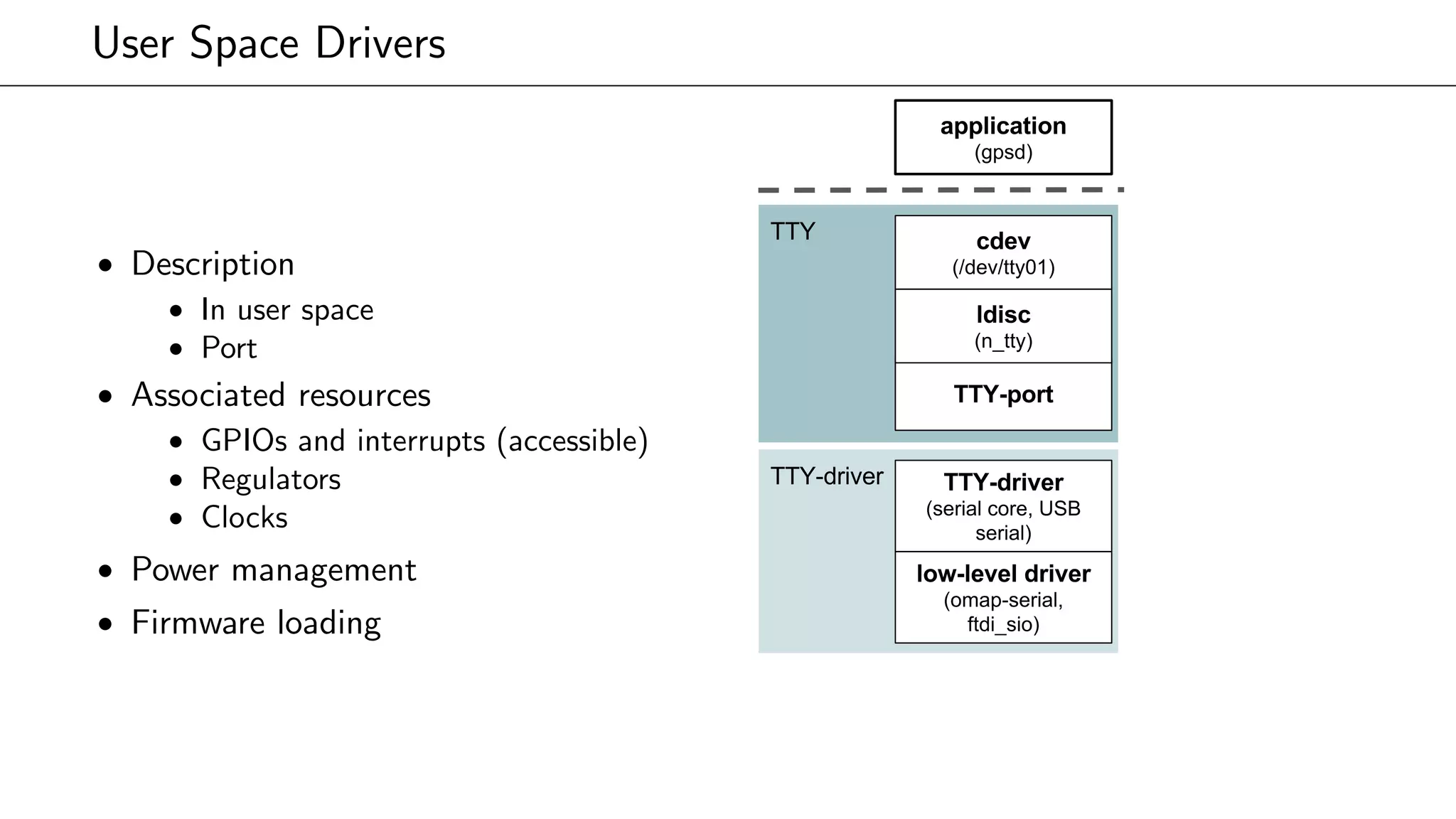
User Space Drivers
• Description
• In user space
• Port
• Associated resources
• GPIOs and interrupts (accessible)
• Regulators
• Clocks
• Power management
• Firmware loading
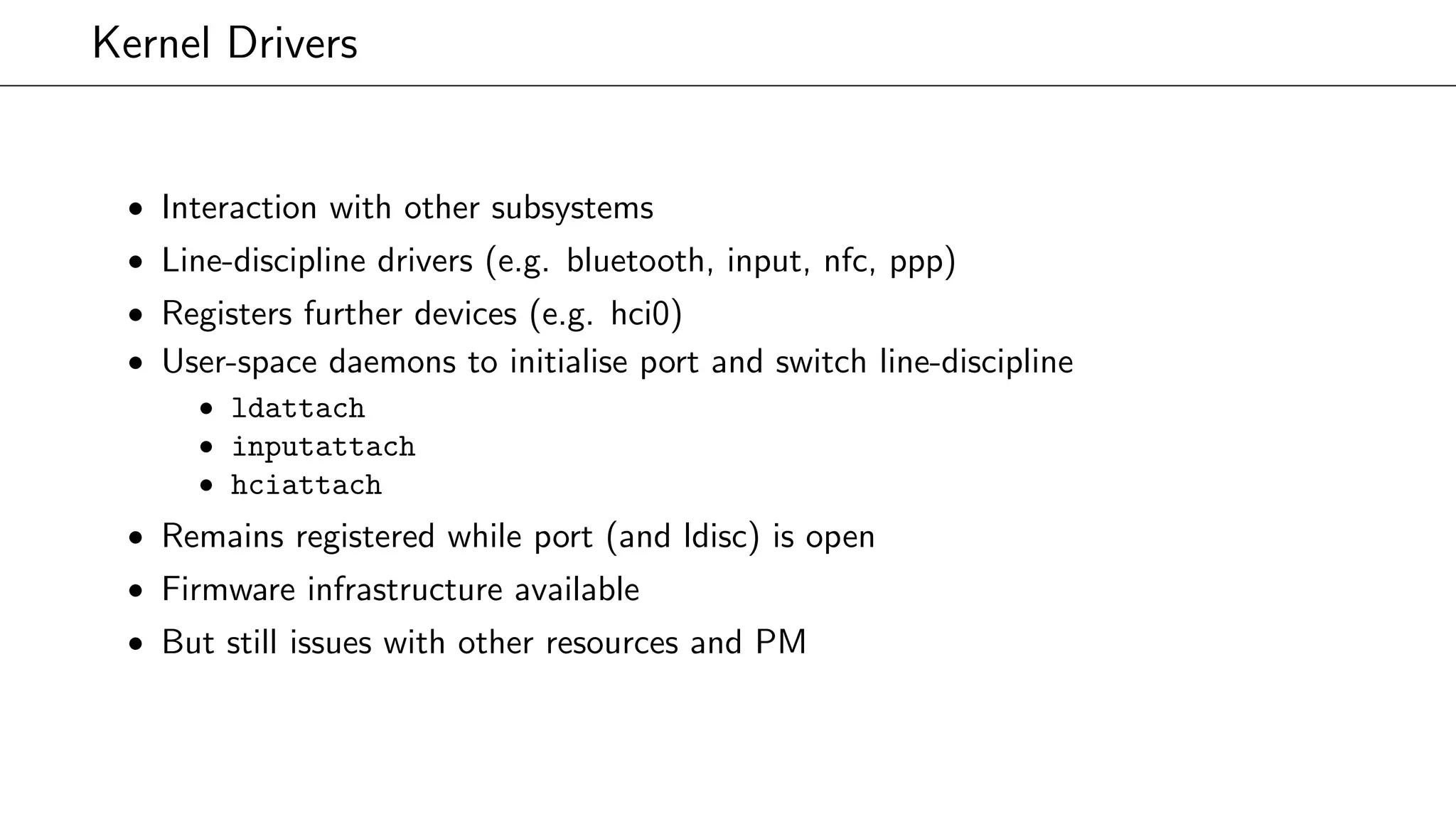
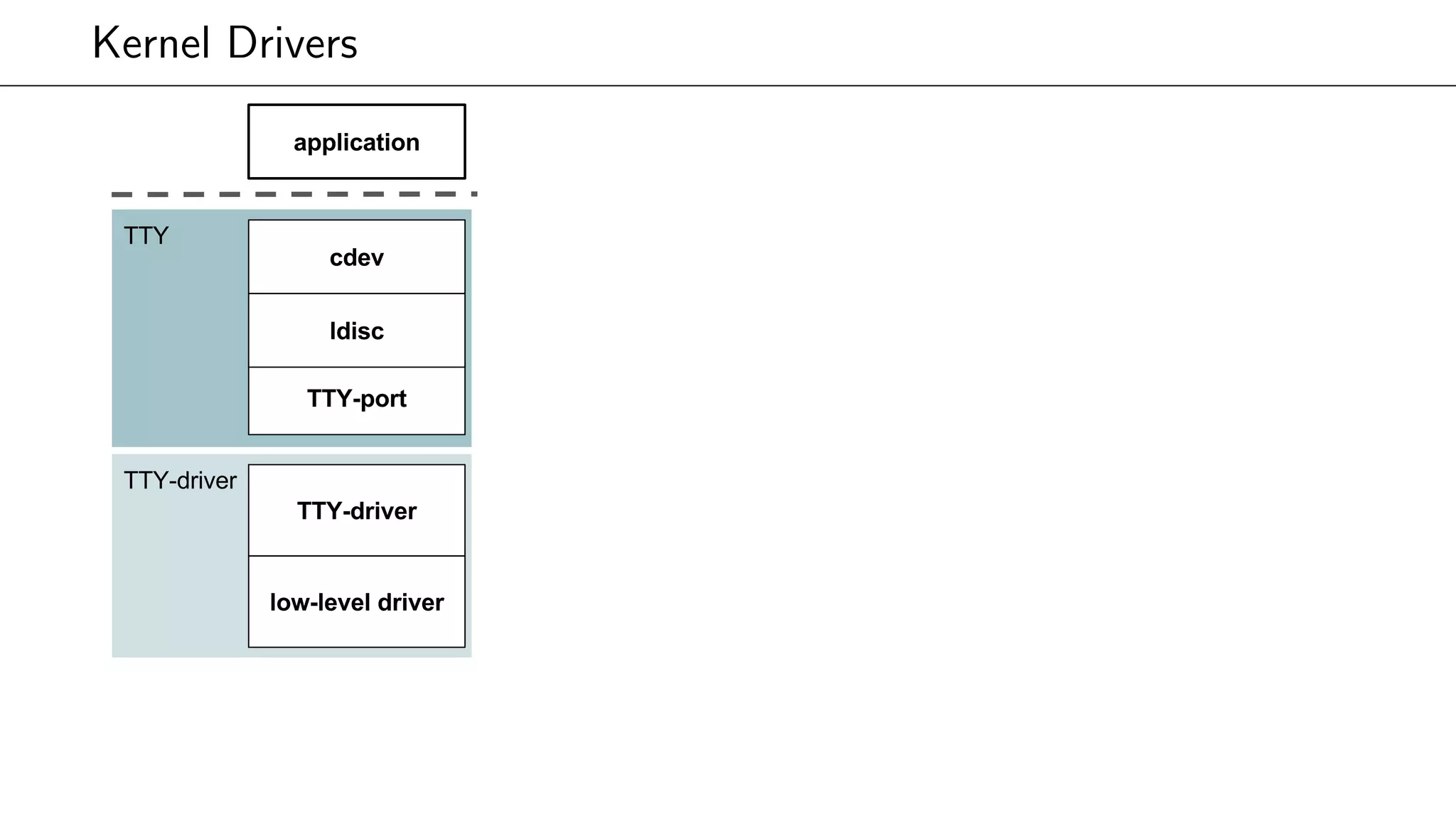
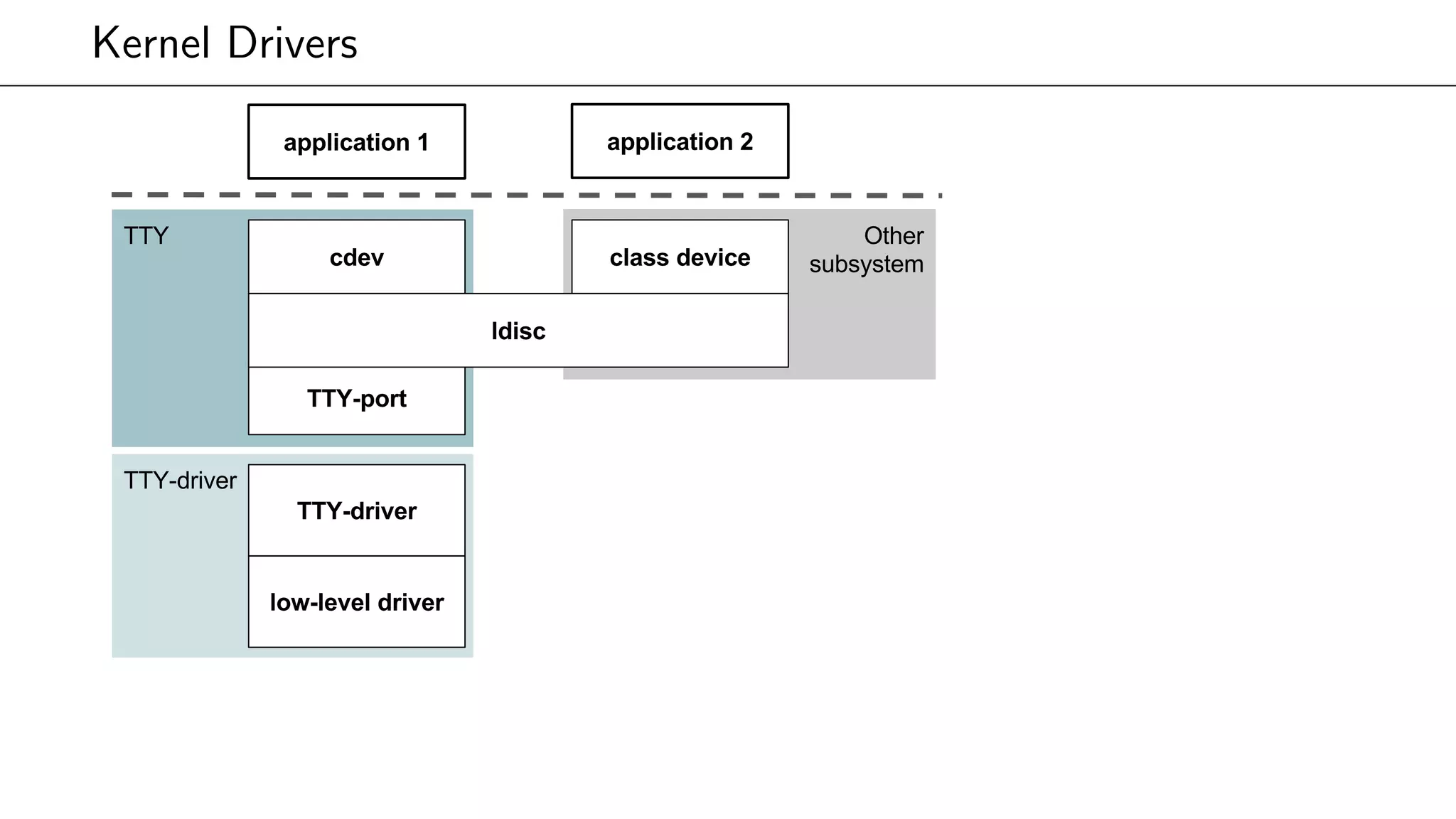
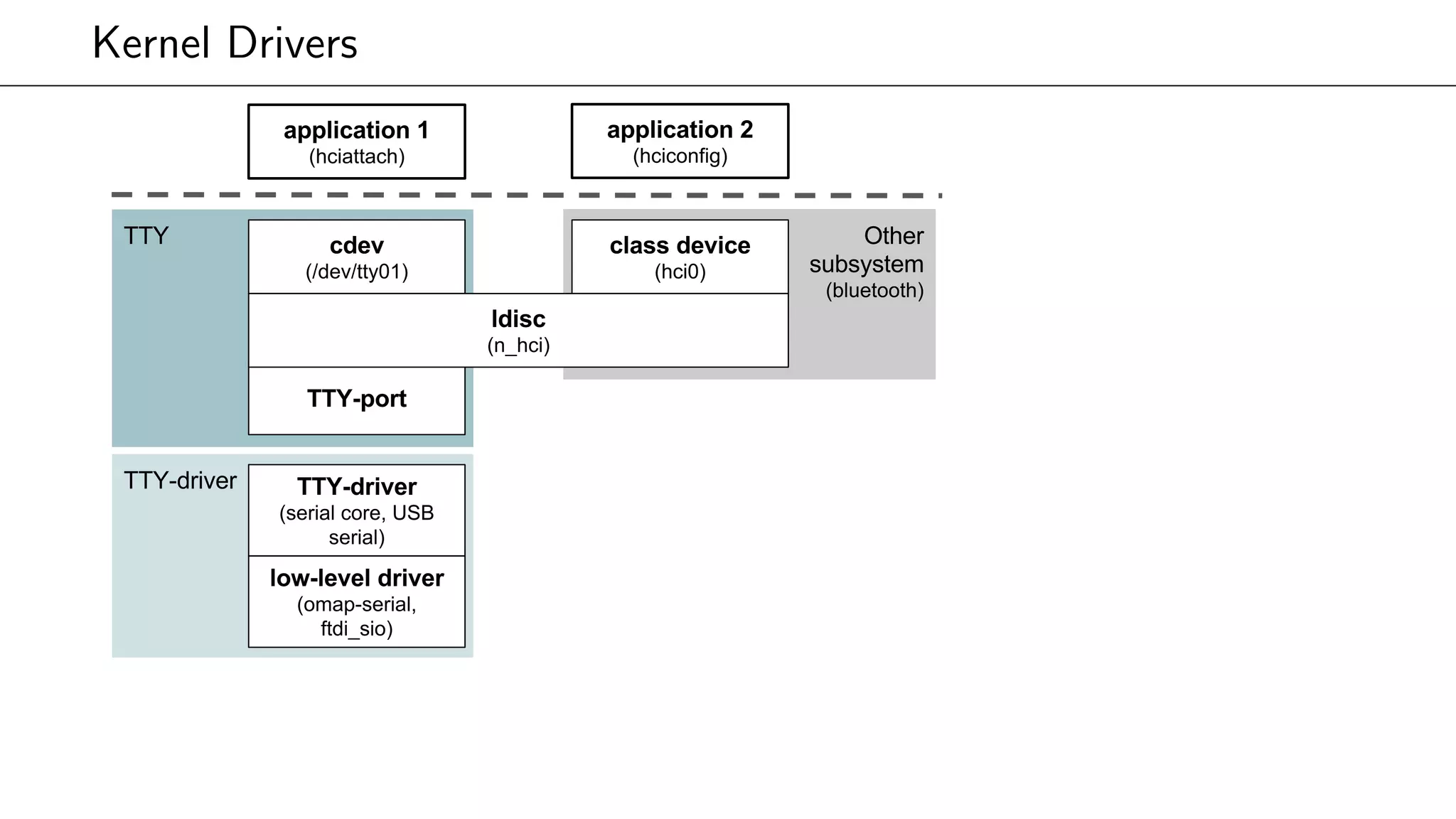
Kernel Drivers
• Interaction with other subsystems
• Line-discipline drivers (e.g. bluetooth, input, nfc, ppp)
• Registers further devices (e.g. hci0)
• User-space daemons to initialise port and switch line-discipline
• ldattach
• inputattach
• hciattach
• Remains registered while port (and ldisc) is open
• Firmware infrastructure available
• But still issues with other resources and PM
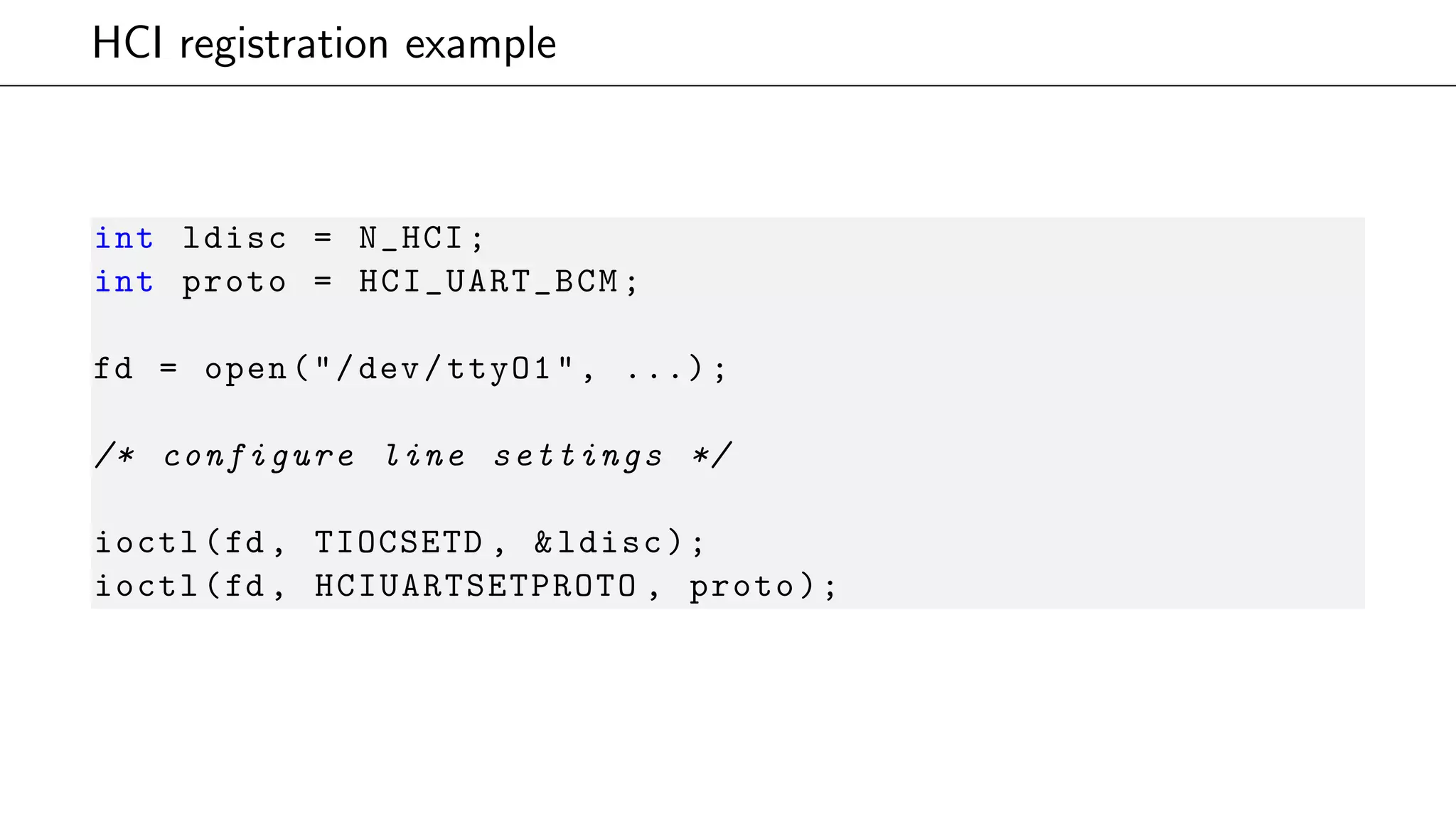
HCI registration example
int ldisc = N_HCI;
int proto = HCI_UART_BCM;
fd = open("/dev/ttyO1", ...);
/* configure line settings */
ioctl(fd , TIOCSETD , &ldisc);
ioctl(fd , HCIUARTSETPROTO , proto);
Kernel Drivers
Kernel Drivers
Kernel Drivers
Problems with ldisc drivers
• Description (what, where, how?) and discovery
• Encoded in user space rather than firmware (DT, ACPI)
• User-space daemons
• Description and lookup of associated resources
• GPIOs and interrupts (e.g. reset, wakeup)
• Pinctrl
• Regulators
• Clocks
• Power management
• GPIOs, regulators, clocks...
• Open port may prevent underlying device from runtime suspending
• Firmware loading
• GPIO (e.g. reset) interaction
The Serial Device Bus
• The Serial Device Bus (serdev)
• By Rob Herring (Linaro)
• Bus for UART-attached devices
• Replace ti-st driver and UIM daemon
• Earlier efforts (power management)
• Merged in 4.11
• Enabled for serial core only in 4.12 (due to lifetime issues)
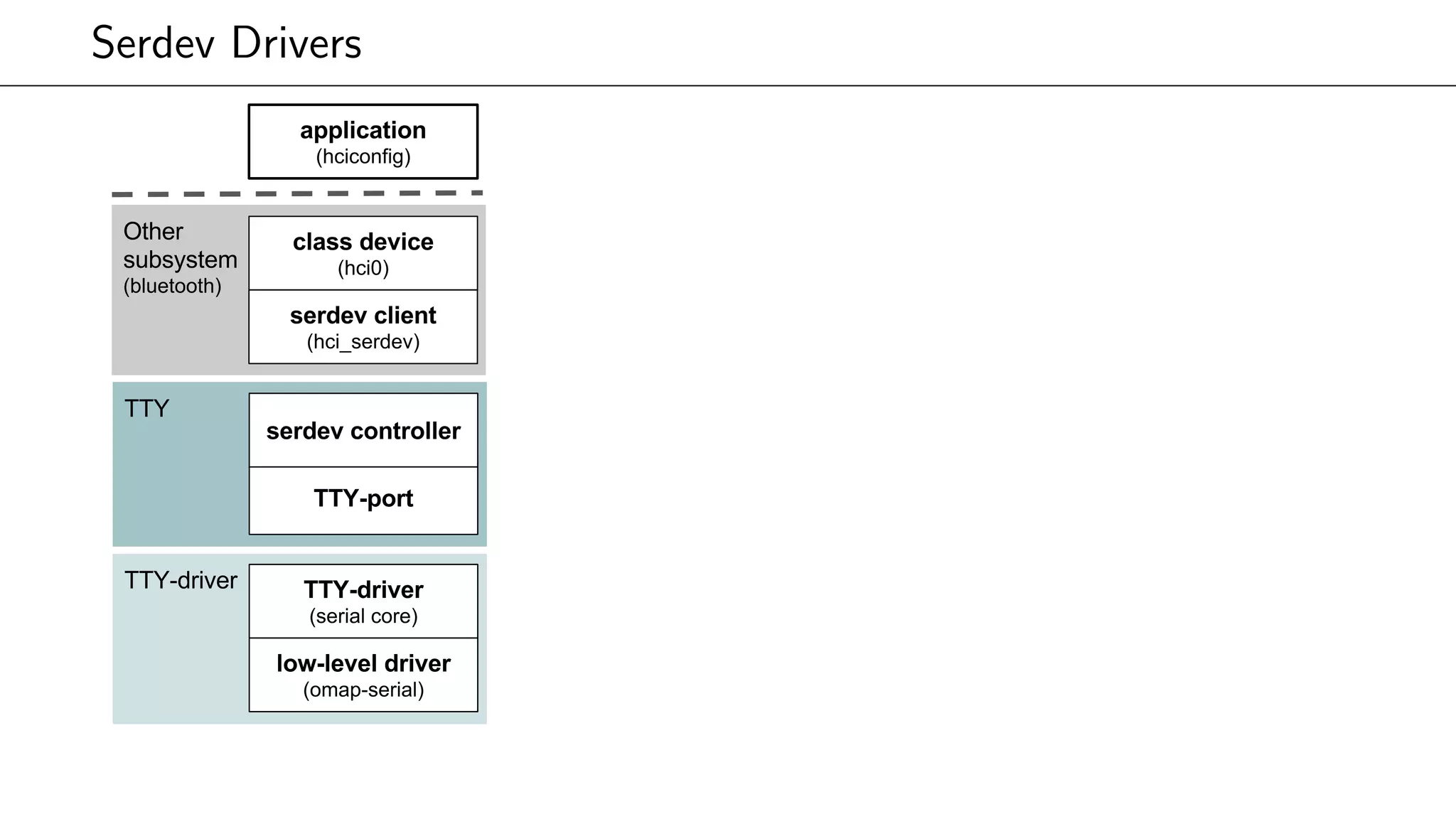
Serdev Overview
• New ”serial” bus type
• Serdev controllers
• Serdev clients (a.k.a. slaves or devices)
• Serdev TTY-port controller
• The only controller implementation
• Registered by TTY-driver when there are clients
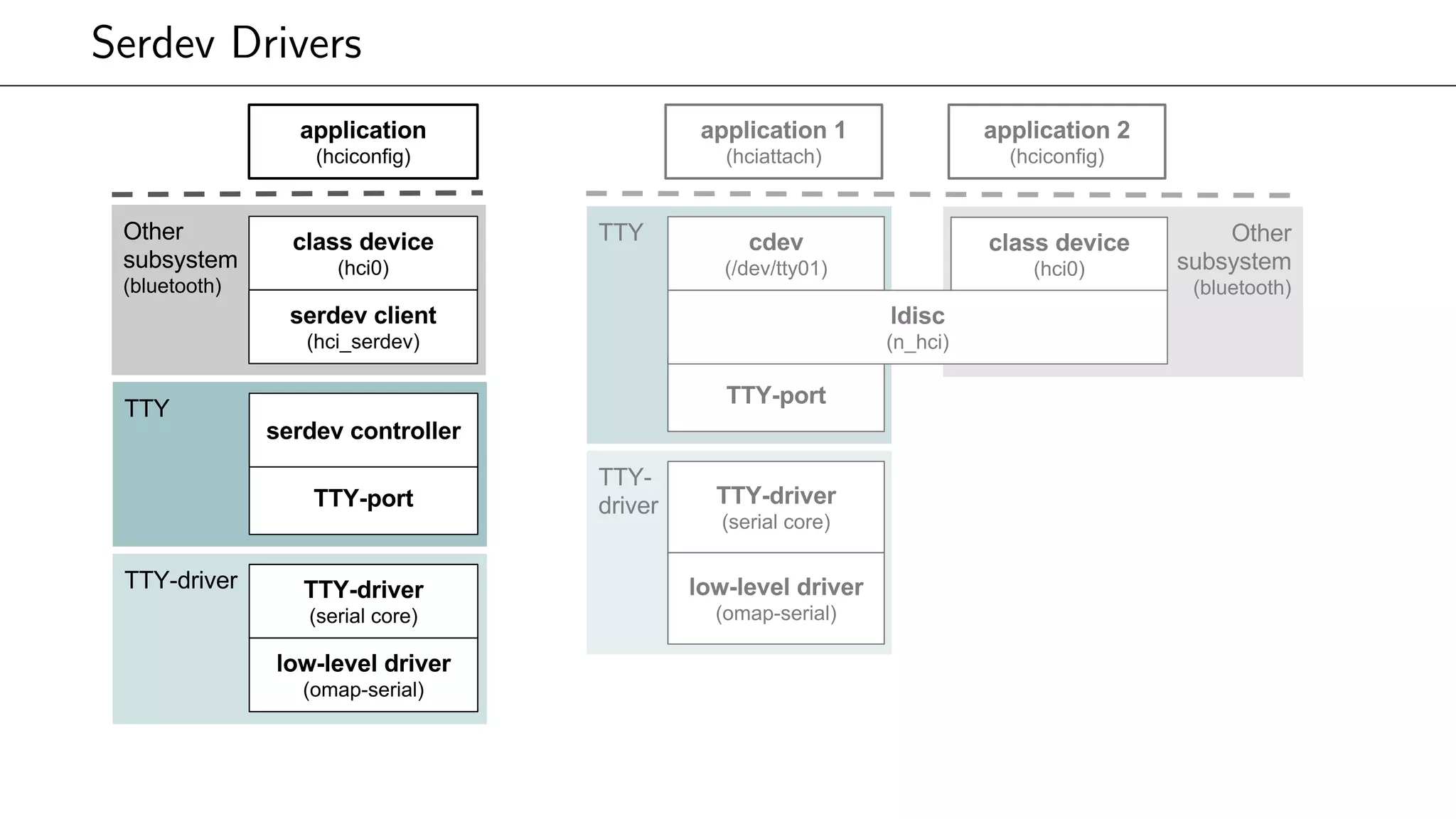
• Controller replaces TTY character device
• Clients described by firmware (Device Tree)
Serdev Drivers
Serdev Drivers
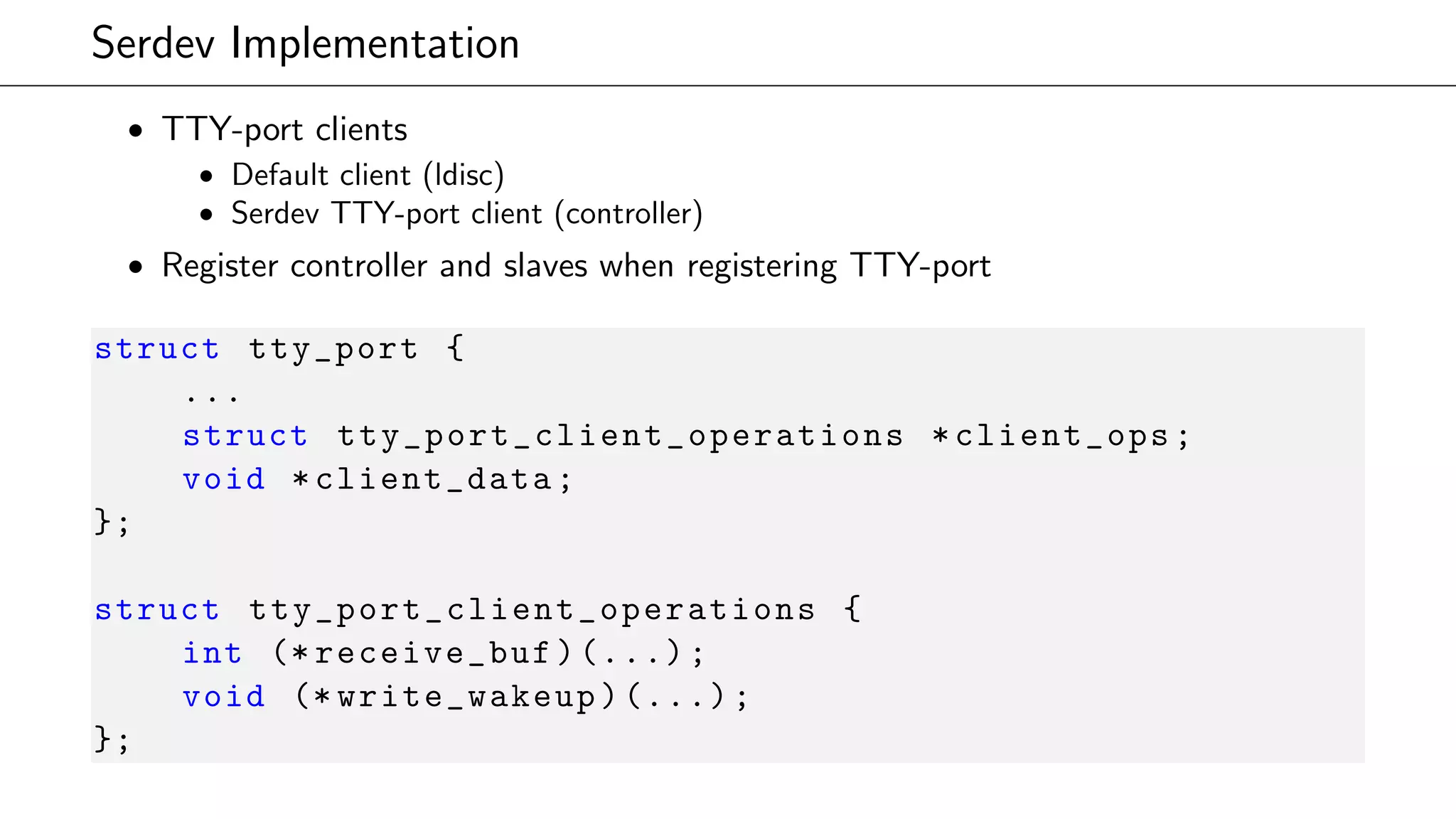
Serdev Implementation
• TTY-port clients
• Default client (ldisc)
• Serdev TTY-port client (controller)
• Register controller and slaves when registering TTY-port
struct tty_port {
...
struct tty_port_client_operations *client_ops;
void *client_data;
};
struct tty_port_client_operations {
int (* receive_buf)(...);
void (* write_wakeup)(...);
};
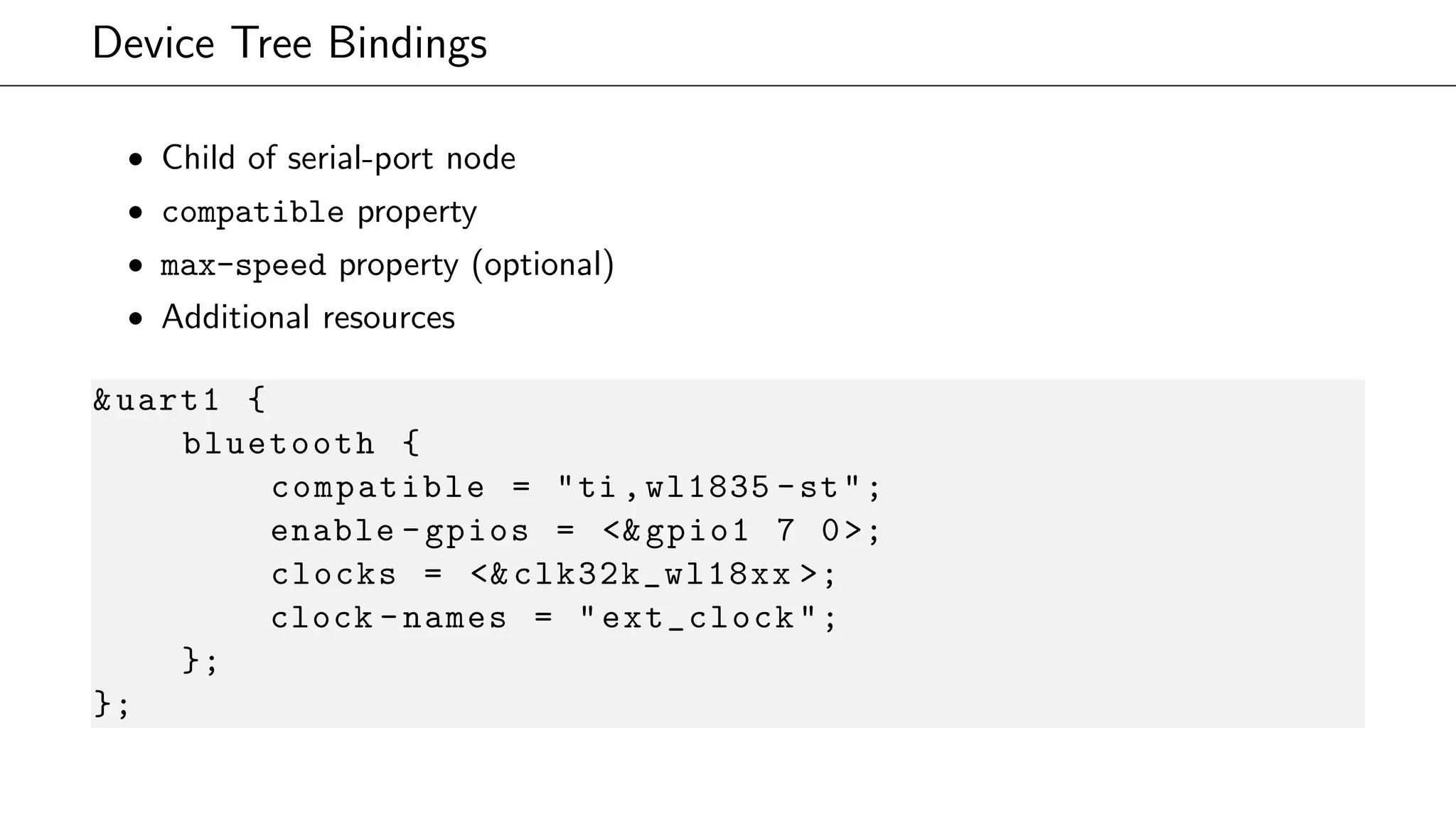
Device Tree Bindings
• Child of serial-port node
• compatible property
• max-speed property (optional)
• Additional resources
&uart1 {
bluetooth {
compatible = "ti ,wl1835 -st";
enable -gpios = <&gpio1 7 0>;
clocks = <&clk32k_wl18xx >;
clock -names = "ext_clock";
};
};
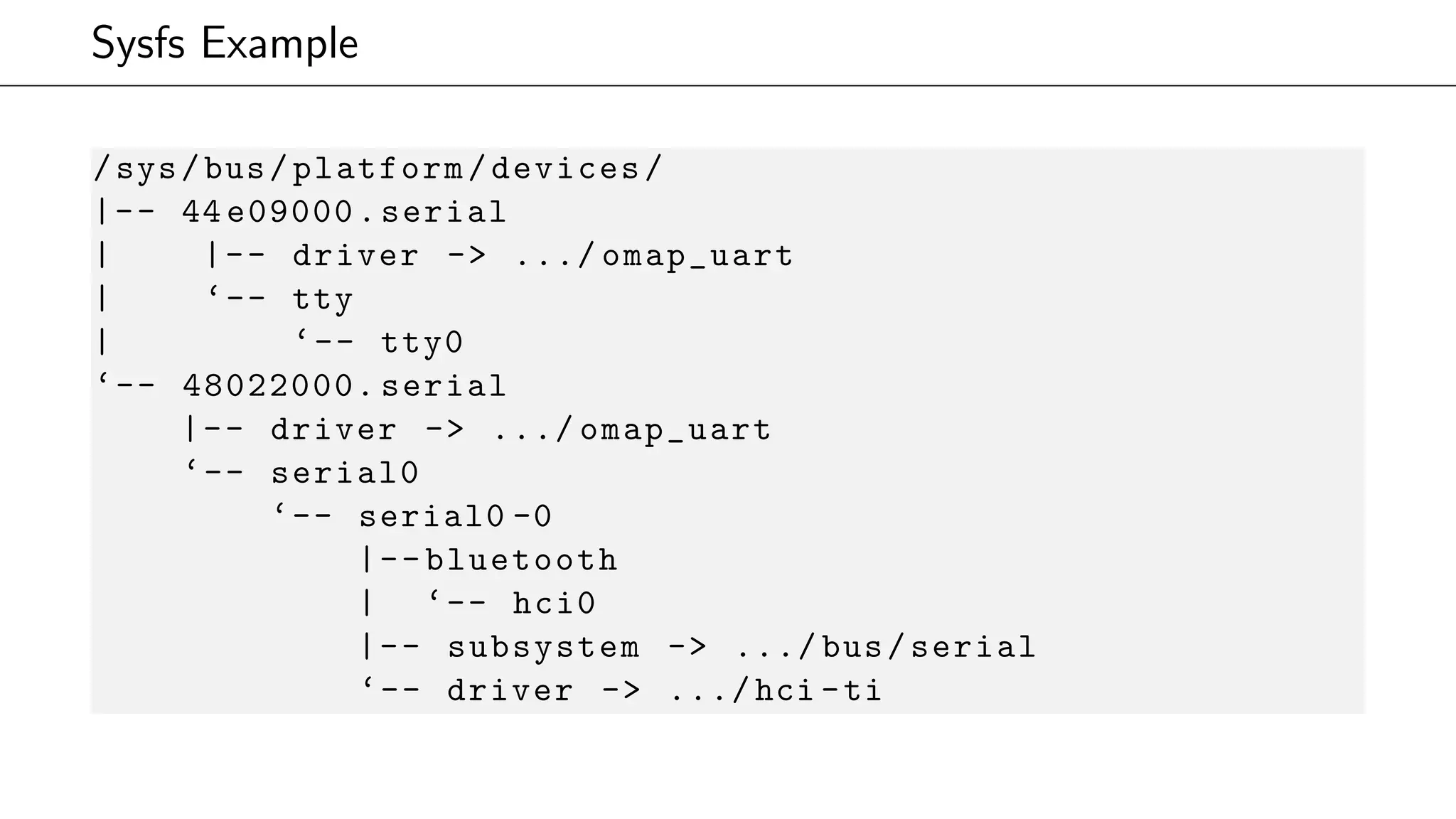
Sysfs Example
/sys/bus/platform/devices/
|-- 44 e09000.serial
| |-- driver -> .../ omap_uart
| ‘-- tty
| ‘-- tty0
‘-- 48022000. serial
|-- driver -> .../ omap_uart
‘-- serial0
‘-- serial0 -0
|--bluetooth
| ‘-- hci0
|-- subsystem -> .../ bus/serial
‘-- driver -> .../hci -ti
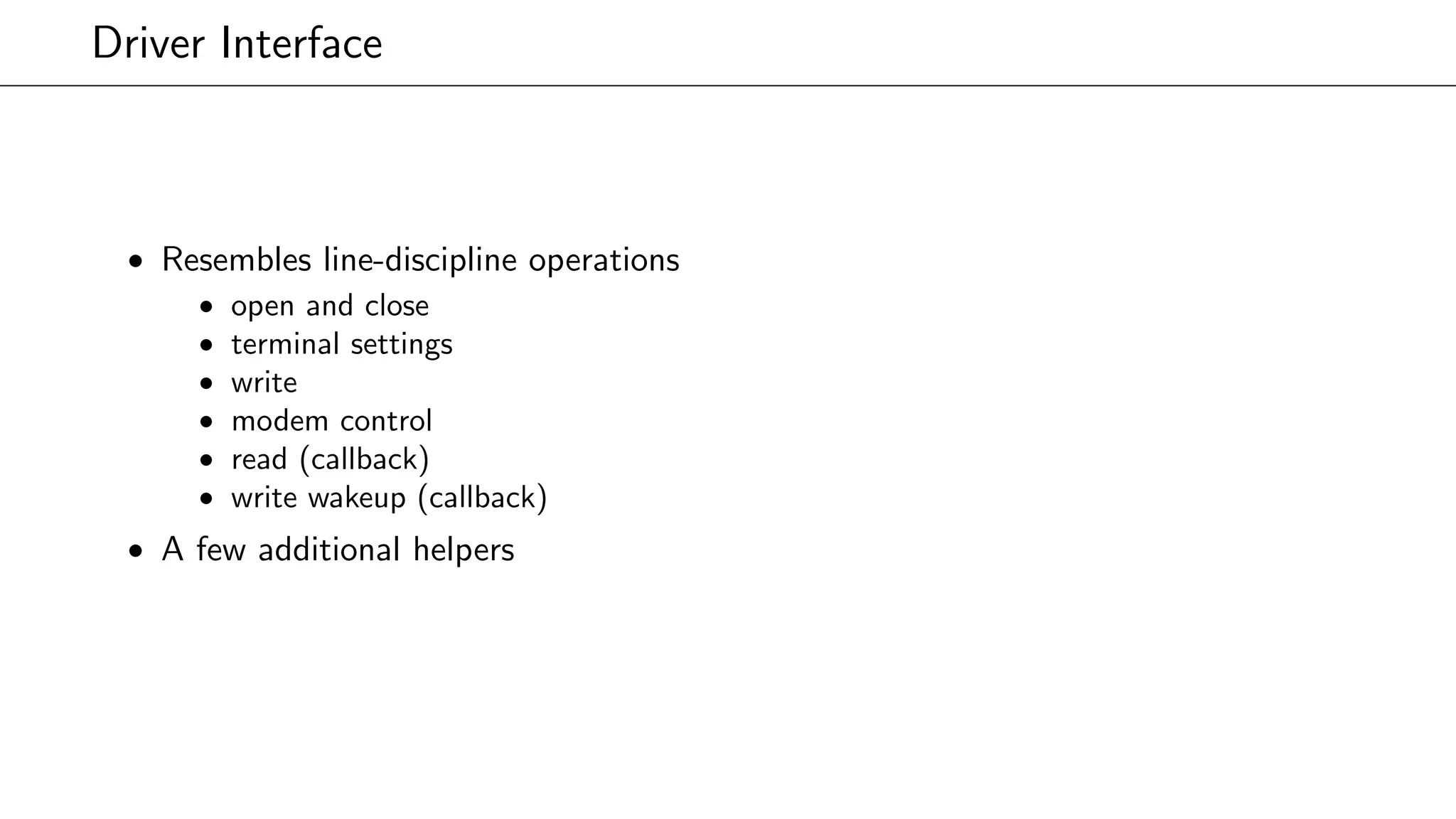
Driver Interface
• Resembles line-discipline operations
• open and close
• terminal settings
• write
• modem control
• read (callback)
• write wakeup (callback)
• A few additional helpers
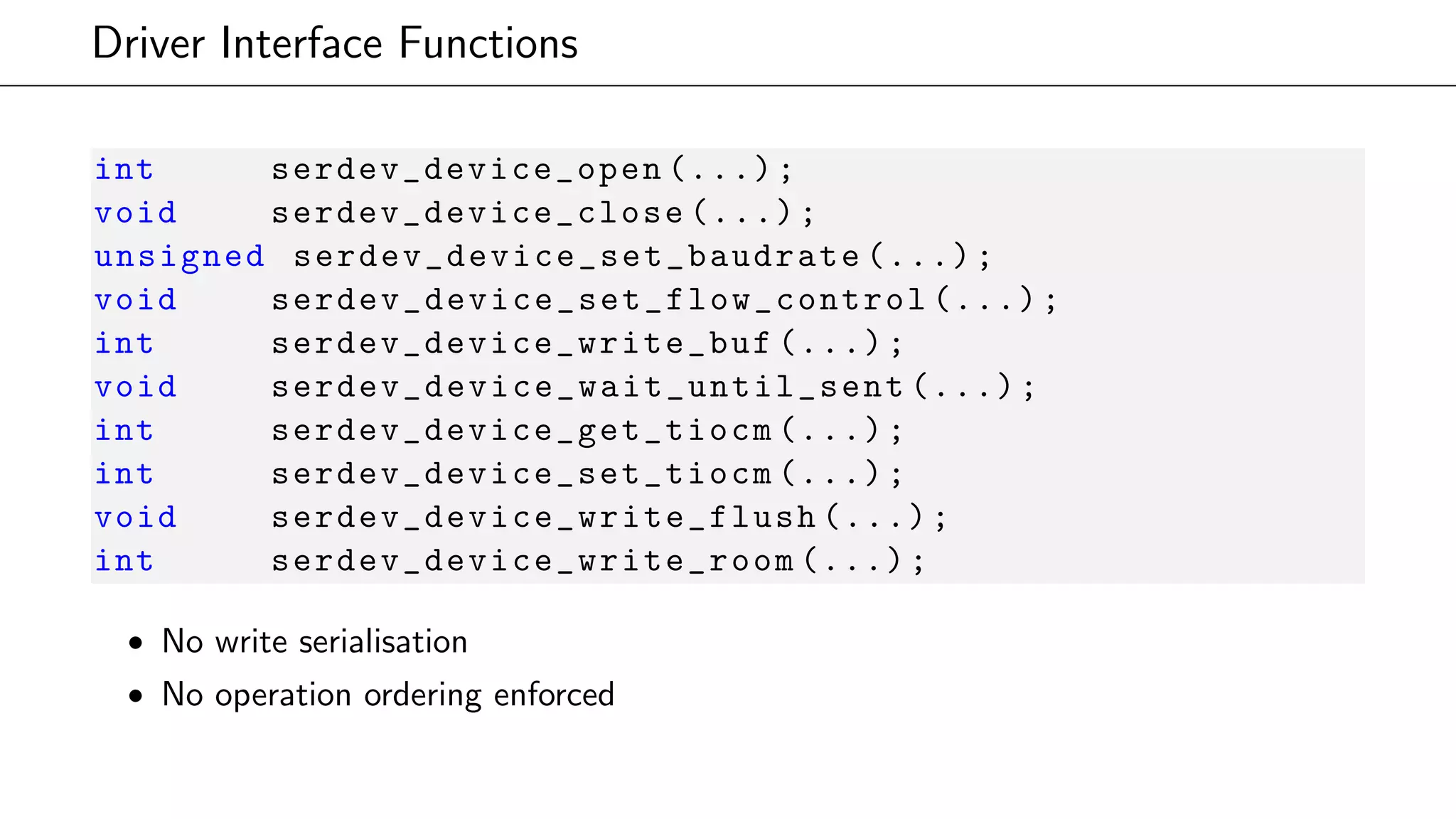
Driver Interface Functions
int serdev_device_open (...);
void serdev_device_close (...);
unsigned serdev_device_set_baudrate (...);
void serdev_device_set_flow_control (...);
int serdev_device_write_buf (...);
void serdev_device_wait_until_sent (...);
int serdev_device_get_tiocm (...);
int serdev_device_set_tiocm (...);
void serdev_device_write_flush (...);
int serdev_device_write_room (...);
• No write serialisation
• No operation ordering enforced
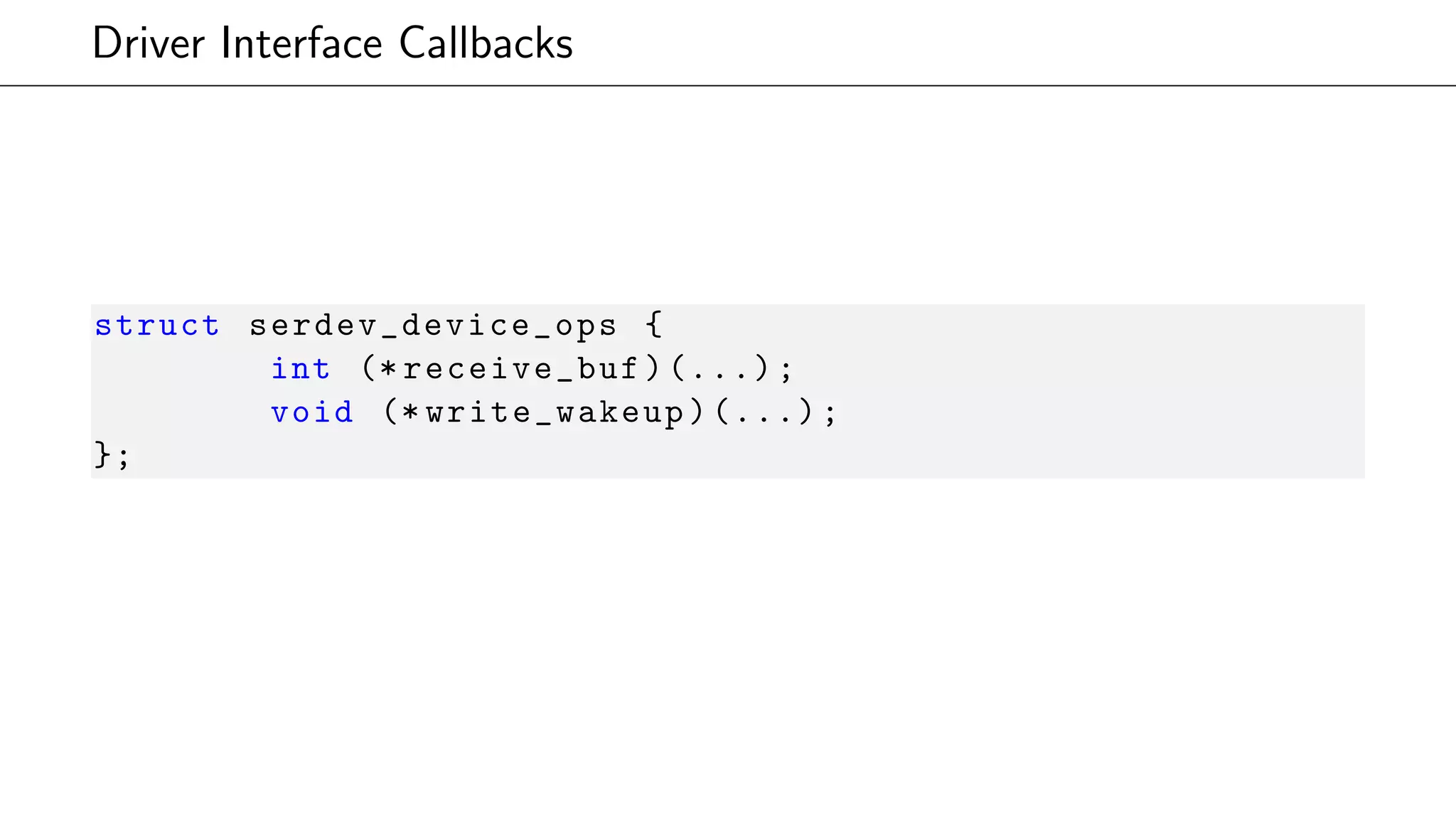
Driver Interface Callbacks
struct serdev_device_ops {
int (* receive_buf)(...);
void (* write_wakeup)(...);
};
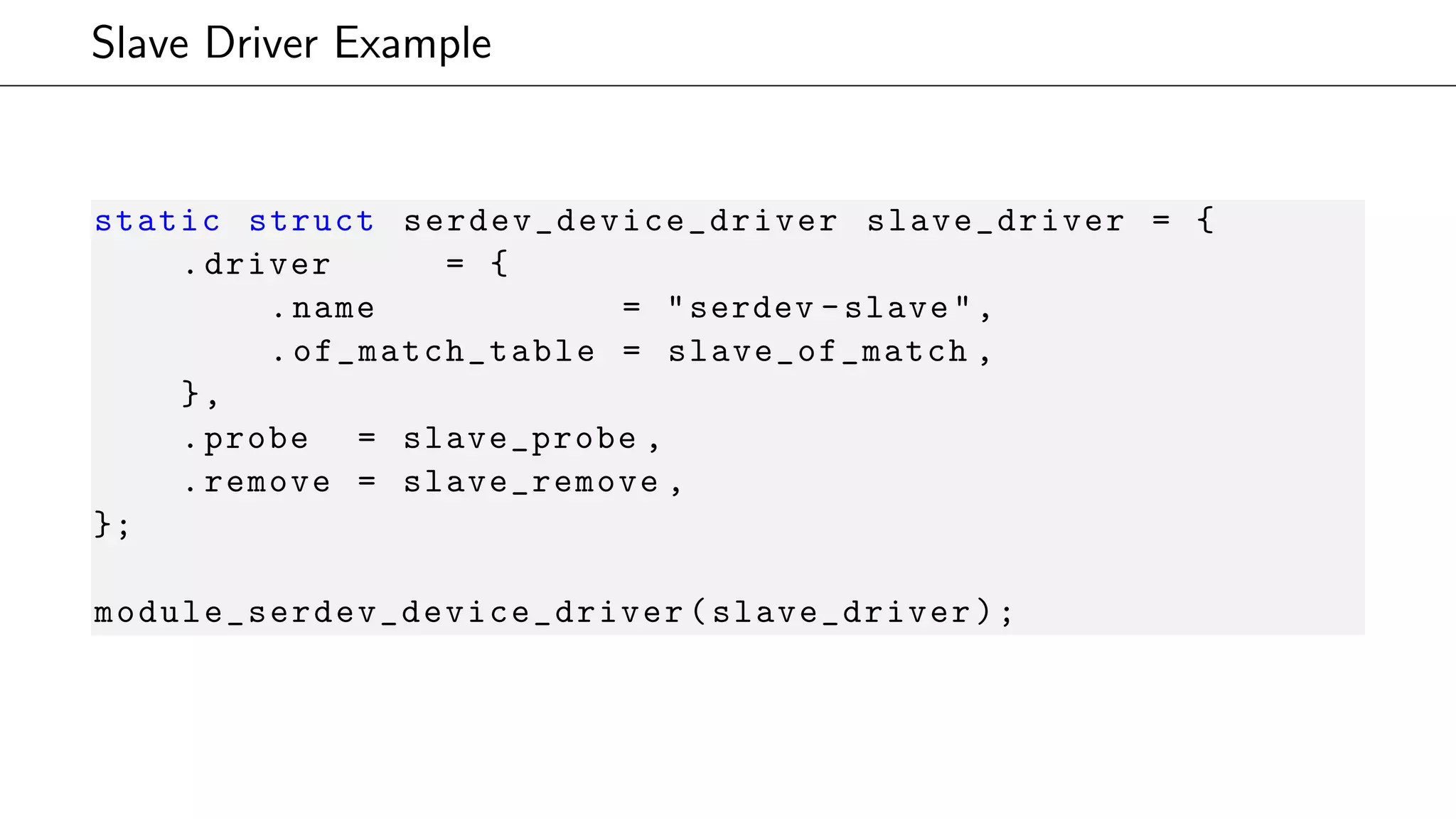
Slave Driver Example
static struct serdev_device_driver slave_driver = {
.driver = {
.name = "serdev -slave",
. of_match_table = slave_of_match ,
},
.probe = slave_probe ,
.remove = slave_remove ,
};
module_serdev_device_driver (slave_driver);
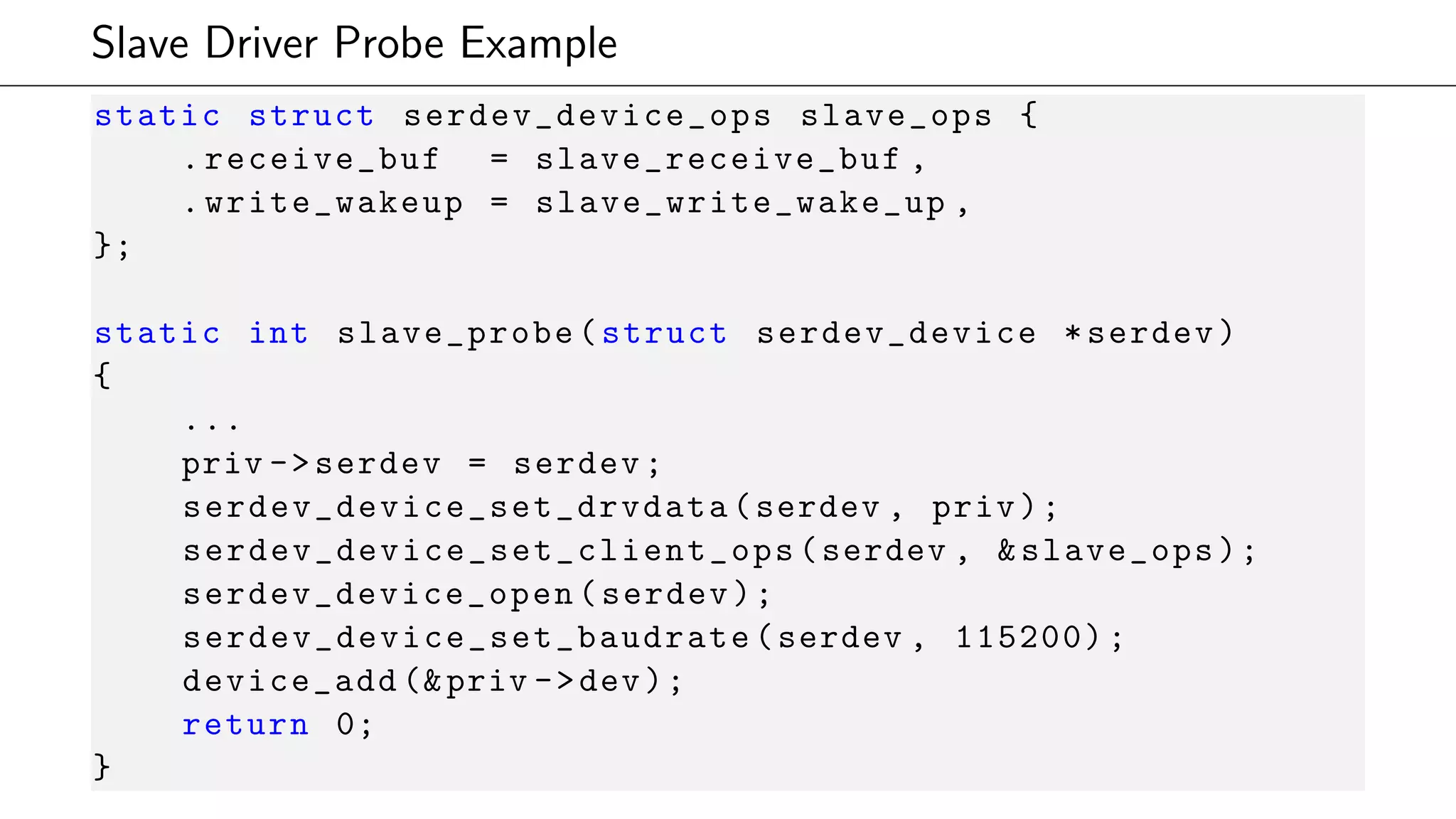
Slave Driver Probe Example
static struct serdev_device_ops slave_ops {
.receive_buf = slave_receive_buf ,
.write_wakeup = slave_write_wake_up ,
};
static int slave_probe(struct serdev_device *serdev)
{
...
priv ->serdev = serdev;
serdev_device_set_drvdata (serdev , priv);
serdev_device_set_client_ops (serdev , &slave_ops);
serdev_device_open (serdev);
serdev_device_set_baudrate (serdev , 115200);
device_add (&priv ->dev);
return 0;
}
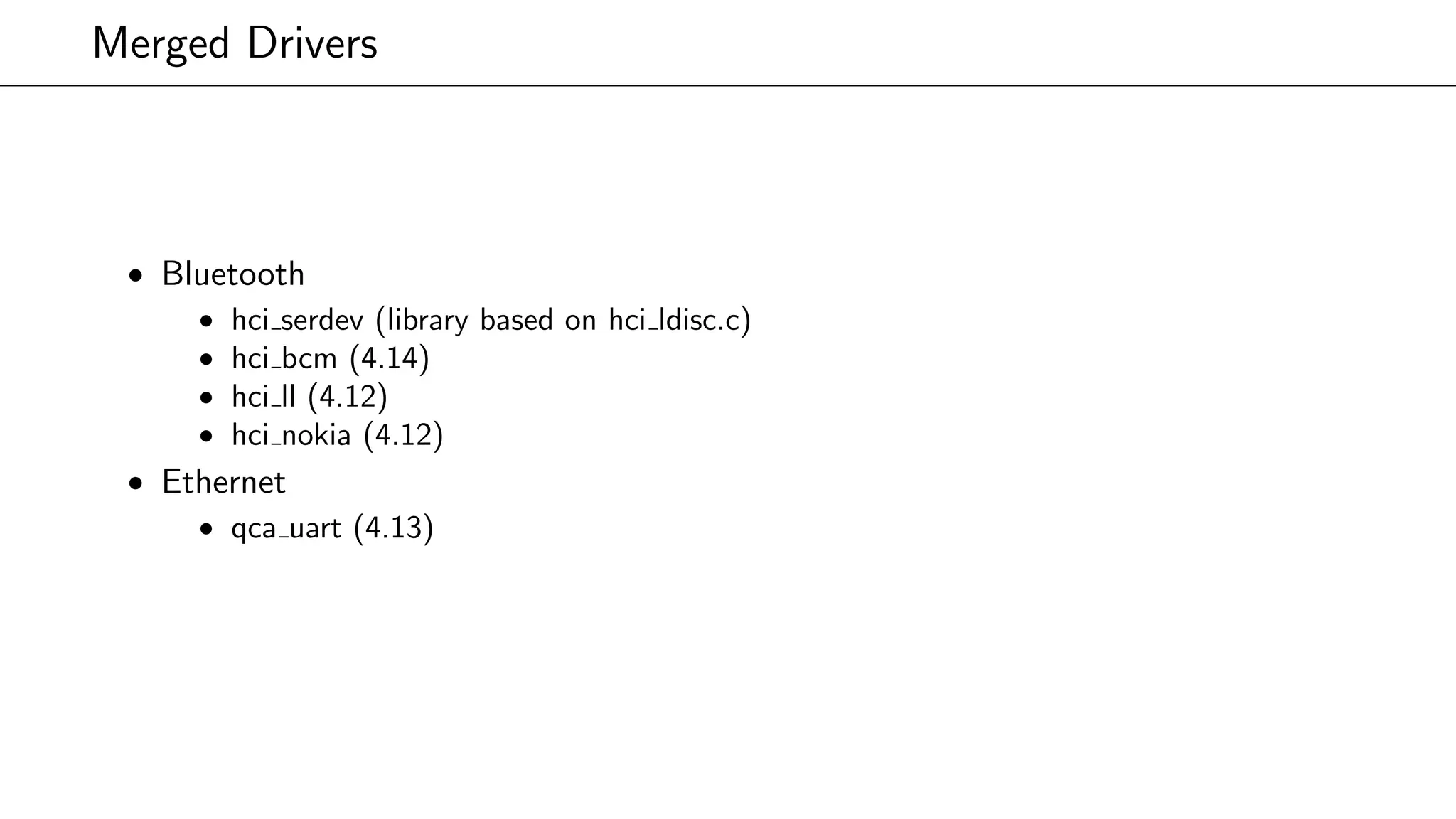
Merged Drivers
• Bluetooth
• hci serdev (library based on hci ldisc.c)
• hci bcm (4.14)
• hci ll (4.12)
• hci nokia (4.12)
• Ethernet
• qca uart (4.13)
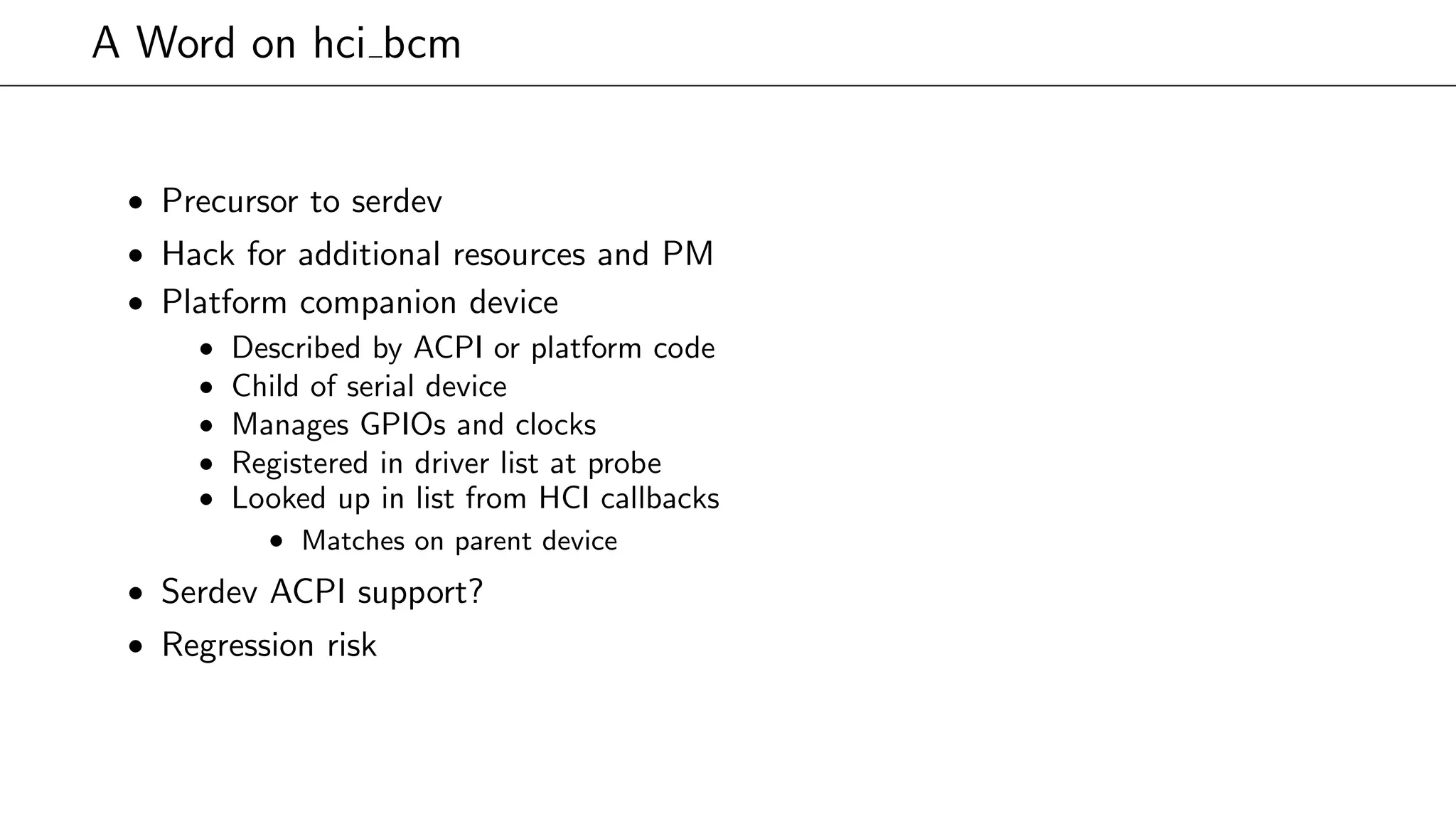
A Word on hci bcm
• Precursor to serdev
• Hack for additional resources and PM
• Platform companion device
• Described by ACPI or platform code
• Child of serial device
• Manages GPIOs and clocks
• Registered in driver list at probe
• Looked up in list from HCI callbacks
• Matches on parent device
• Serdev ACPI support?
• Regression risk
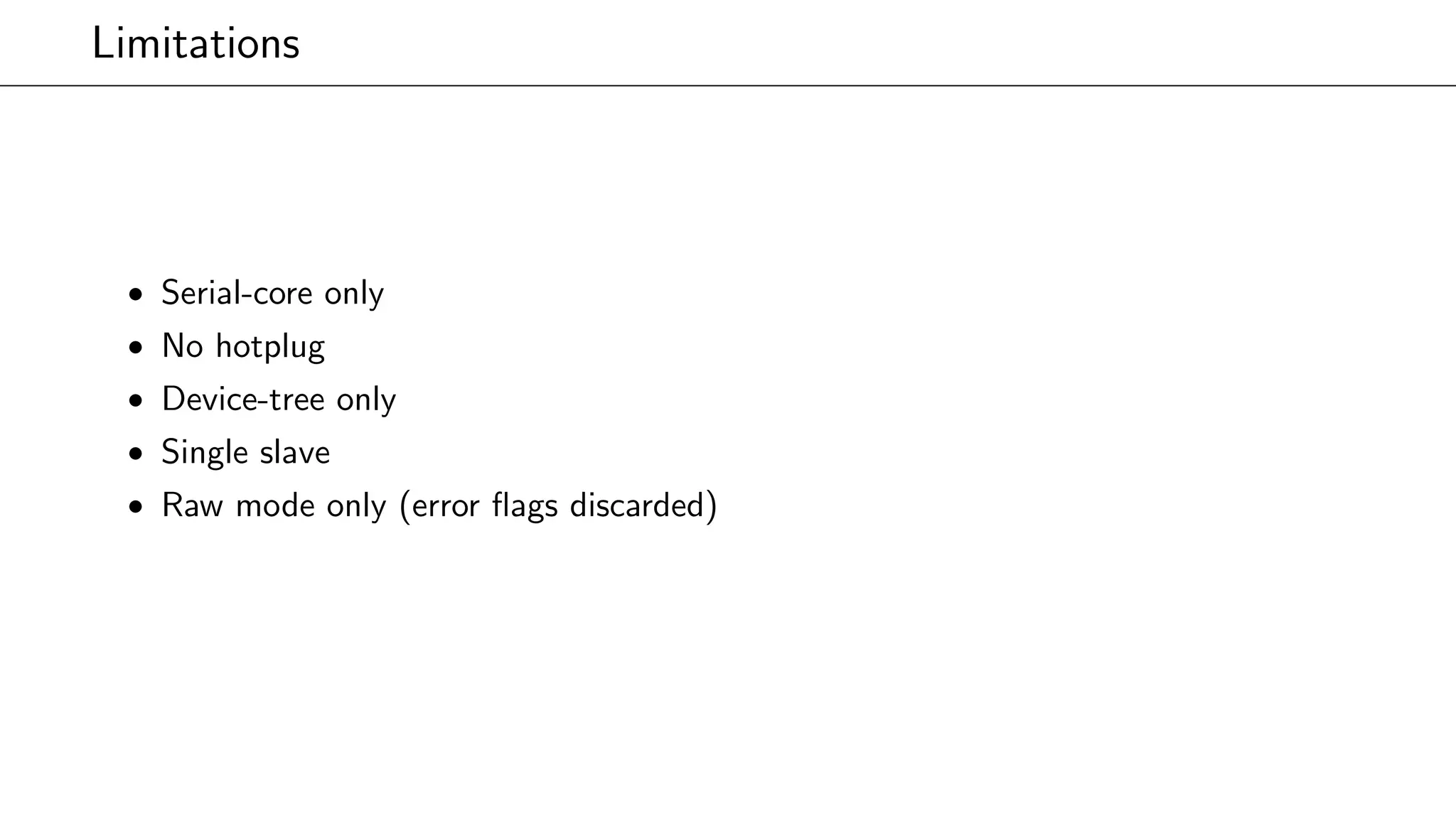
Limitations
• Serial-core only
• No hotplug
• Device-tree only
• Single slave
• Raw mode only (error flags discarded)
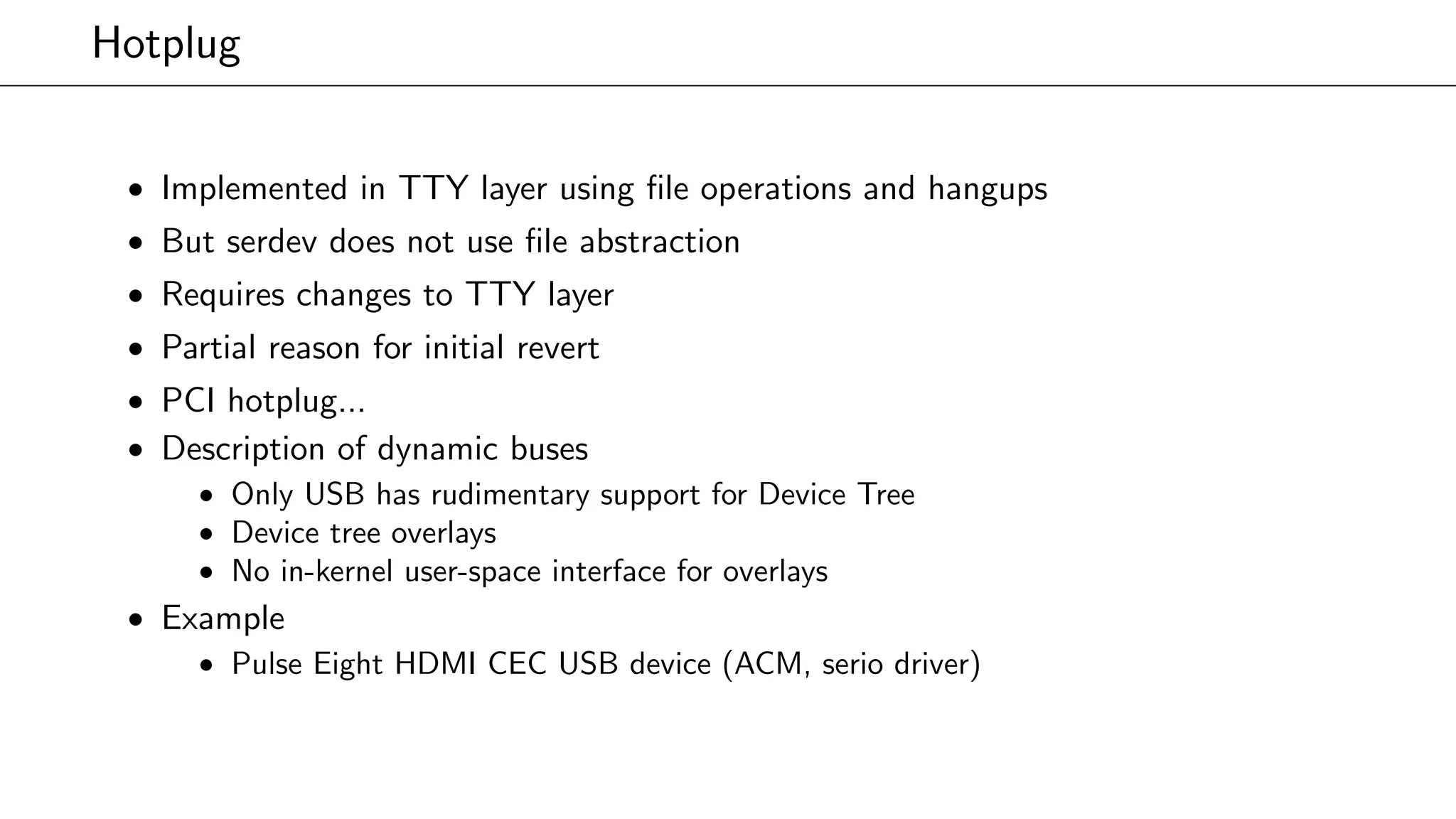
Hotplug
• Implemented in TTY layer using file operations and hangups
• But serdev does not use file abstraction
• Requires changes to TTY layer
• Partial reason for initial revert
• PCI hotplug...
• Description of dynamic buses
• Only USB has rudimentary support for Device Tree
• Device tree overlays
• No in-kernel user-space interface for overlays
• Example
• Pulse Eight HDMI CEC USB device (ACM, serio driver)
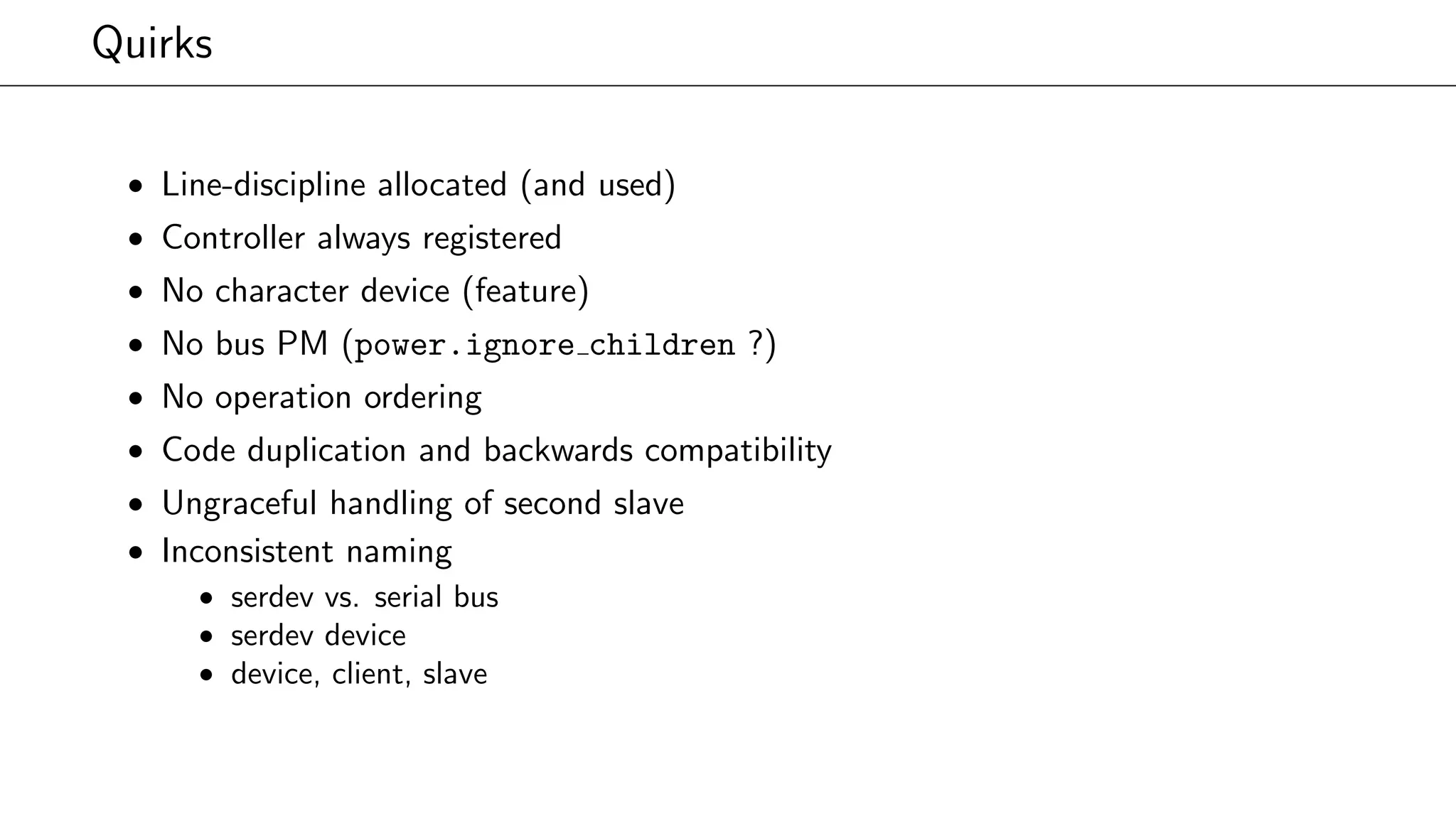
Quirks
• Line-discipline allocated (and used)
• Controller always registered
• No character device (feature)
• No bus PM (power.ignore children ?)
• No operation ordering
• Code duplication and backwards compatibility
• Ungraceful handling of second slave
• Inconsistent naming
• serdev vs. serial bus
• serdev device
• device, client, slave
In the Works
• ACPI support
• ”[RFC 0/3] ACPI serdev support” (September 7)
• BCM2E39 Bluetooth device (regression?)
In the Works
• ACPI support
• ”[RFC 0/3] ACPI serdev support” (September 7)
• BCM2E39 Bluetooth device (regression?)
• Mux support
• ”[PATCH 0/6] serdev multiplexing support” (August 16)
• Utilising new mux subsystem
• Adds reg property (mux index)
• Has issues (no flushing, and no locking?!)
• max9260 I2C-controller slave driver
• Basic parity support (no error handling)
In the Works
• ACPI support
• ”[RFC 0/3] ACPI serdev support” (September 7)
• BCM2E39 Bluetooth device (regression?)
• Mux support
• ”[PATCH 0/6] serdev multiplexing support” (August 16)
• Utilising new mux subsystem
• Adds reg property (mux index)
• Has issues (no flushing, and no locking?!)
• max9260 I2C-controller slave driver
• Basic parity support (no error handling)
• RAVE slave driver
• ”[PATCH v7 1/1] platform: Add driver for RAVE Supervisory Processor”
(September 6)
In the Works
• ACPI support
• ”[RFC 0/3] ACPI serdev support” (September 7)
• BCM2E39 Bluetooth device (regression?)
• Mux support
• ”[PATCH 0/6] serdev multiplexing support” (August 16)
• Utilising new mux subsystem
• Adds reg property (mux index)
• Has issues (no flushing, and no locking?!)
• max9260 I2C-controller slave driver
• Basic parity support (no error handling)
• RAVE slave driver
• ”[PATCH v7 1/1] platform: Add driver for RAVE Supervisory Processor”
(September 6)
• w2sg and w2cbw GPS and WiFi/BT slave drivers
• ”[RFC 0/3] misc: new serdev based drivers for w2sg00x4 GPS module and
w2cbw003 wifi/bluetooth” (May 21)
Future Work
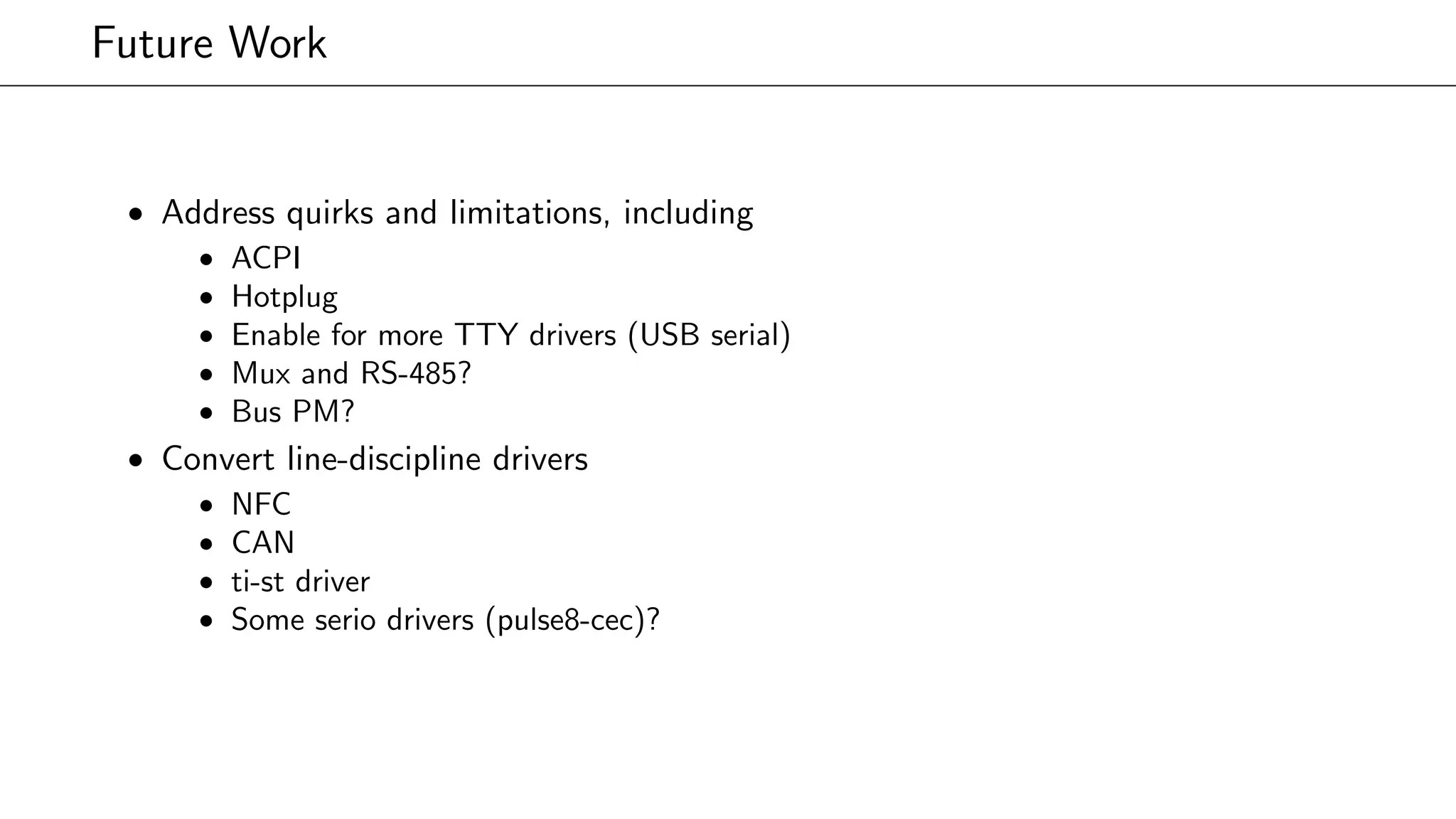
• Address quirks and limitations, including
• ACPI
• Hotplug
• Enable for more TTY drivers (USB serial)
• Mux and RS-485?
• Bus PM?
• Convert line-discipline drivers
• NFC
• CAN
• ti-st driver
• Some serio drivers (pulse8-cec)?
Further Reading
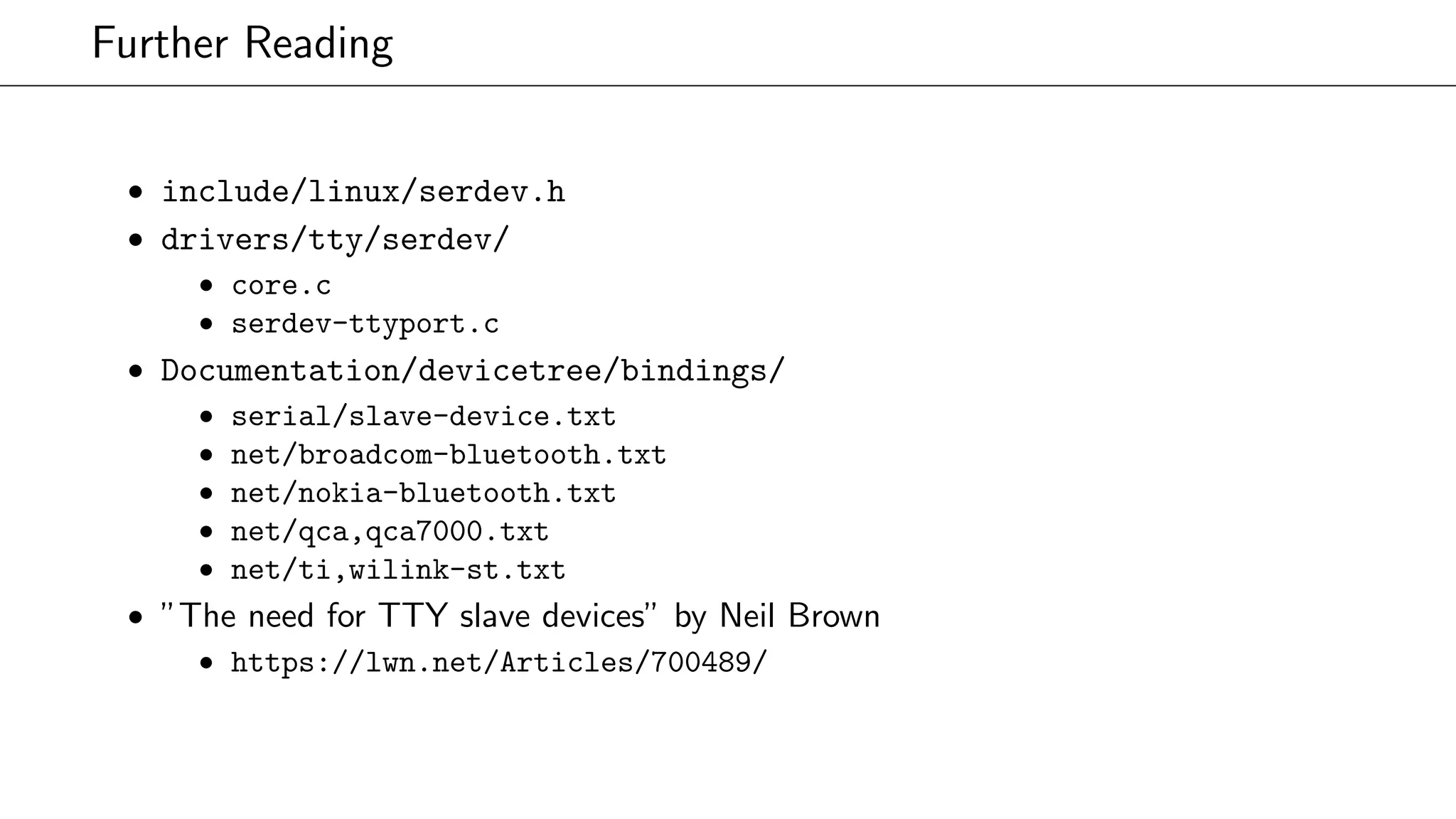
• include/linux/serdev.h
• drivers/tty/serdev/
• core.c
• serdev-ttyport.c
• Documentation/devicetree/bindings/
• serial/slave-device.txt
• net/broadcom-bluetooth.txt
• net/nokia-bluetooth.txt
• net/qca,qca7000.txt
• net/ti,wilink-st.txt
• ”The need for TTY slave devices” by Neil Brown
• https://lwn.net/Articles/700489/
Thanks!
johan@hovoldconsulting.com
johan@kernel.org

Kernel Recipes 2017 - The Serial Device Bus - Johan Hovold

  • 1.
    The Serial DeviceBus Johan Hovold Hovold Consulting AB johan@hovoldconsulting.com johan@kernel.org September 29, 2017
  • 2.
    Introduction • UARTs andRS-232 have been around since 1960s • USB, PCIe, Firewire, Thunderbolt • Common interface for Bluetooth, NFC, FM Radio and GPS • TTY-layer abstracts serial connection • Character-device interface (e.g. /dev/ttyS1) • But no (good) way to model associated resources (PM) • GPIOs and interrupts • Regulators • Clocks • Audio interface • Kernel support limited to line-discipline ”drivers” • Requires user-space to configure and initialise
  • 3.
    Outline • TTY Layer •Problems with line-discipline drivers • Serdev implementation • Serdev interfaces • Serdev limitations • Future work
  • 4.
    TTY Layer • Characterdevice • Line disciplines • I/O processing • Canonical mode • Echos • Errors • Signals on input • TTY-ports • Input buffering • Abstraction layer (e.g. open()) • TTY-drivers
  • 5.
    User Space Drivers •Description • In user space • Port • Associated resources • GPIOs and interrupts (accessible) • Regulators • Clocks • Power management • Firmware loading
  • 6.
    Kernel Drivers • Interactionwith other subsystems • Line-discipline drivers (e.g. bluetooth, input, nfc, ppp) • Registers further devices (e.g. hci0) • User-space daemons to initialise port and switch line-discipline • ldattach • inputattach • hciattach • Remains registered while port (and ldisc) is open • Firmware infrastructure available • But still issues with other resources and PM
  • 7.
    HCI registration example intldisc = N_HCI; int proto = HCI_UART_BCM; fd = open("/dev/ttyO1", ...); /* configure line settings */ ioctl(fd , TIOCSETD , &ldisc); ioctl(fd , HCIUARTSETPROTO , proto);
  • 8.
  • 9.
  • 10.
  • 11.
    Problems with ldiscdrivers • Description (what, where, how?) and discovery • Encoded in user space rather than firmware (DT, ACPI) • User-space daemons • Description and lookup of associated resources • GPIOs and interrupts (e.g. reset, wakeup) • Pinctrl • Regulators • Clocks • Power management • GPIOs, regulators, clocks... • Open port may prevent underlying device from runtime suspending • Firmware loading • GPIO (e.g. reset) interaction
  • 12.
    The Serial DeviceBus • The Serial Device Bus (serdev) • By Rob Herring (Linaro) • Bus for UART-attached devices • Replace ti-st driver and UIM daemon • Earlier efforts (power management) • Merged in 4.11 • Enabled for serial core only in 4.12 (due to lifetime issues)
  • 13.
    Serdev Overview • New”serial” bus type • Serdev controllers • Serdev clients (a.k.a. slaves or devices) • Serdev TTY-port controller • The only controller implementation • Registered by TTY-driver when there are clients • Controller replaces TTY character device • Clients described by firmware (Device Tree)
  • 14.
  • 15.
  • 16.
    Serdev Implementation • TTY-portclients • Default client (ldisc) • Serdev TTY-port client (controller) • Register controller and slaves when registering TTY-port struct tty_port { ... struct tty_port_client_operations *client_ops; void *client_data; }; struct tty_port_client_operations { int (* receive_buf)(...); void (* write_wakeup)(...); };
  • 17.
    Device Tree Bindings •Child of serial-port node • compatible property • max-speed property (optional) • Additional resources &uart1 { bluetooth { compatible = "ti ,wl1835 -st"; enable -gpios = <&gpio1 7 0>; clocks = <&clk32k_wl18xx >; clock -names = "ext_clock"; }; };
  • 18.
    Sysfs Example /sys/bus/platform/devices/ |-- 44e09000.serial | |-- driver -> .../ omap_uart | ‘-- tty | ‘-- tty0 ‘-- 48022000. serial |-- driver -> .../ omap_uart ‘-- serial0 ‘-- serial0 -0 |--bluetooth | ‘-- hci0 |-- subsystem -> .../ bus/serial ‘-- driver -> .../hci -ti
  • 19.
    Driver Interface • Resemblesline-discipline operations • open and close • terminal settings • write • modem control • read (callback) • write wakeup (callback) • A few additional helpers
  • 20.
    Driver Interface Functions intserdev_device_open (...); void serdev_device_close (...); unsigned serdev_device_set_baudrate (...); void serdev_device_set_flow_control (...); int serdev_device_write_buf (...); void serdev_device_wait_until_sent (...); int serdev_device_get_tiocm (...); int serdev_device_set_tiocm (...); void serdev_device_write_flush (...); int serdev_device_write_room (...); • No write serialisation • No operation ordering enforced
  • 21.
    Driver Interface Callbacks structserdev_device_ops { int (* receive_buf)(...); void (* write_wakeup)(...); };
  • 22.
    Slave Driver Example staticstruct serdev_device_driver slave_driver = { .driver = { .name = "serdev -slave", . of_match_table = slave_of_match , }, .probe = slave_probe , .remove = slave_remove , }; module_serdev_device_driver (slave_driver);
  • 23.
    Slave Driver ProbeExample static struct serdev_device_ops slave_ops { .receive_buf = slave_receive_buf , .write_wakeup = slave_write_wake_up , }; static int slave_probe(struct serdev_device *serdev) { ... priv ->serdev = serdev; serdev_device_set_drvdata (serdev , priv); serdev_device_set_client_ops (serdev , &slave_ops); serdev_device_open (serdev); serdev_device_set_baudrate (serdev , 115200); device_add (&priv ->dev); return 0; }
  • 24.
    Merged Drivers • Bluetooth •hci serdev (library based on hci ldisc.c) • hci bcm (4.14) • hci ll (4.12) • hci nokia (4.12) • Ethernet • qca uart (4.13)
  • 25.
    A Word onhci bcm • Precursor to serdev • Hack for additional resources and PM • Platform companion device • Described by ACPI or platform code • Child of serial device • Manages GPIOs and clocks • Registered in driver list at probe • Looked up in list from HCI callbacks • Matches on parent device • Serdev ACPI support? • Regression risk
  • 26.
    Limitations • Serial-core only •No hotplug • Device-tree only • Single slave • Raw mode only (error flags discarded)
  • 27.
    Hotplug • Implemented inTTY layer using file operations and hangups • But serdev does not use file abstraction • Requires changes to TTY layer • Partial reason for initial revert • PCI hotplug... • Description of dynamic buses • Only USB has rudimentary support for Device Tree • Device tree overlays • No in-kernel user-space interface for overlays • Example • Pulse Eight HDMI CEC USB device (ACM, serio driver)
  • 28.
    Quirks • Line-discipline allocated(and used) • Controller always registered • No character device (feature) • No bus PM (power.ignore children ?) • No operation ordering • Code duplication and backwards compatibility • Ungraceful handling of second slave • Inconsistent naming • serdev vs. serial bus • serdev device • device, client, slave
  • 29.
    In the Works •ACPI support • ”[RFC 0/3] ACPI serdev support” (September 7) • BCM2E39 Bluetooth device (regression?)
  • 30.
    In the Works •ACPI support • ”[RFC 0/3] ACPI serdev support” (September 7) • BCM2E39 Bluetooth device (regression?) • Mux support • ”[PATCH 0/6] serdev multiplexing support” (August 16) • Utilising new mux subsystem • Adds reg property (mux index) • Has issues (no flushing, and no locking?!) • max9260 I2C-controller slave driver • Basic parity support (no error handling)
  • 31.
    In the Works •ACPI support • ”[RFC 0/3] ACPI serdev support” (September 7) • BCM2E39 Bluetooth device (regression?) • Mux support • ”[PATCH 0/6] serdev multiplexing support” (August 16) • Utilising new mux subsystem • Adds reg property (mux index) • Has issues (no flushing, and no locking?!) • max9260 I2C-controller slave driver • Basic parity support (no error handling) • RAVE slave driver • ”[PATCH v7 1/1] platform: Add driver for RAVE Supervisory Processor” (September 6)
  • 32.
    In the Works •ACPI support • ”[RFC 0/3] ACPI serdev support” (September 7) • BCM2E39 Bluetooth device (regression?) • Mux support • ”[PATCH 0/6] serdev multiplexing support” (August 16) • Utilising new mux subsystem • Adds reg property (mux index) • Has issues (no flushing, and no locking?!) • max9260 I2C-controller slave driver • Basic parity support (no error handling) • RAVE slave driver • ”[PATCH v7 1/1] platform: Add driver for RAVE Supervisory Processor” (September 6) • w2sg and w2cbw GPS and WiFi/BT slave drivers • ”[RFC 0/3] misc: new serdev based drivers for w2sg00x4 GPS module and w2cbw003 wifi/bluetooth” (May 21)
  • 33.
    Future Work • Addressquirks and limitations, including • ACPI • Hotplug • Enable for more TTY drivers (USB serial) • Mux and RS-485? • Bus PM? • Convert line-discipline drivers • NFC • CAN • ti-st driver • Some serio drivers (pulse8-cec)?
  • 34.
    Further Reading • include/linux/serdev.h •drivers/tty/serdev/ • core.c • serdev-ttyport.c • Documentation/devicetree/bindings/ • serial/slave-device.txt • net/broadcom-bluetooth.txt • net/nokia-bluetooth.txt • net/qca,qca7000.txt • net/ti,wilink-st.txt • ”The need for TTY slave devices” by Neil Brown • https://lwn.net/Articles/700489/
  • 35.