Getting Started with Intel IoT Developer Kit – Dev 
kit 
Setup, Installing, Hello World and Sensors testing 
Sulamita Garcia – Developer Evangelist - @sulagarcia 
Munich, October 18 2014
Agenda 
• Devkit components: hardware and software 
• Setting up Galileo/Edison 
• Setting up developer environment 
• Running sample codes 
• Creating your application 
• Dev kit library (MRAA) and sensors repository (UPM)
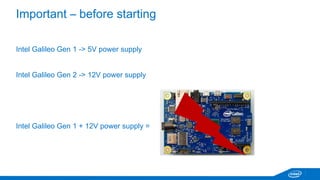
Important – before starting 
Intel Galileo Gen 1 -> 5V power supply 
Intel Galileo Gen 2 -> 12V power supply 
Intel Galileo Gen 1 + 12V power supply =
Devkit components
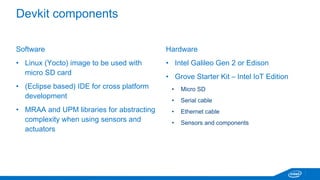
Dev kit components 
Software 
• Linux (Yocto) image to be used with 
micro SD card on Galileo; already 
installed on Edison 
• IDEs for cross platform development 
• MRAA and UPM libraries for abstracting 
complexity when using sensors and 
actuators 
Hardware 
• Intel Galileo Gen 2 or Edison 
• Grove Starter Kit – Intel IoT Edition 
• Micro SD 
• Serial cable 
• Ethernet cable 
• Sensors and components
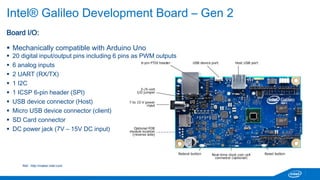
Intel® Galileo Development Board – Gen 2 
Board I/O: 
 Mechanically compatible with Arduino Uno 
 20 digital input/output pins including 6 pins as PWM outputs 
 6 analog inputs 
 2 UART (RX/TX) 
 1 I2C 
 1 ICSP 6-pin header (SPI) 
 USB device connector (Host) 
 Micro USB device connector (client) 
 SD Card connector 
 DC power jack (7V – 15V DC input) 
Ref.: http://maker.intel.com
Intel® Edison module 
• 22 nm Intel® SoC that includes a dual-core, dual-threaded Intel® Atom™ CPU at 500 MHz 
• 32-bit Intel® Quark™ microcontroller at 100 MHz 
• 1 GB LPDDR3 POP memory 
• Flash storage 4 GB eMMC 
• WiFi and Bluetooth® Low Energy 
• 35.5 × 25.0 × 3.9 mm (1.4 × 1.0 × 0.15 inches) 
• 40 GPIOs: UART, I2C, SPI, I2S, GPIO(PWM), USB, Sd card 
Ref.: http://maker.intel.com
Intel® Edison - Arduino Expansion Board 
Board I/O: Compatible with Arduino Uno (except only 
4 PWM instead of 6 PWM) 
 20 digital input/output pins including 4 pins as PWM outputs 
 6 analog inputs 
 1 UART (RX/TX) 
 1 I2C 
 1 ICSP 6-pin header (SPI) 
 Micro USB device connector OR (via mechanical switch) 
dedicated standard size USB host Type-A connector 
 Micro USB device (connected to UART) 
 SD Card connector 
 DC power jack (7V – 15V DC input) 
Ref.: http://maker.intel.com
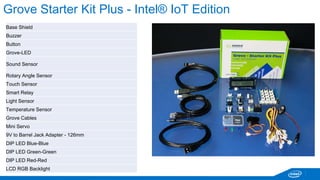
Grove Starter Kit Plus - Intel® IoT Edition 
Base Shield 
Buzzer 
Button 
Grove-LED 
Sound Sensor 
Rotary Angle Sensor 
Touch Sensor 
Smart Relay 
Light Sensor 
Temperature Sensor 
Grove Cables 
Mini Servo 
9V to Barrel Jack Adapter - 126mm 
DIP LED Blue-Blue 
DIP LED Green-Green 
DIP LED Red-Red 
LCD RGB Backlight
Extra sensors available depending on your project 
SEN04031P Grove - Piezo Vibration Sensor 
SEN01111P Grove - Air quality sensor 
SEN11425P Grove - 125KHz RFID Reader 
ACC90453O 4 pin grove adapter (5 per pack) 
KIT80949P Wireless Sensor Node - Solar Kit 
ROB08211P Grove Mini Servos 
SEN04051P Grove - 3-Axis Digital Accelerometer 
SEN11763P Grove - 3-Axis Digital Gyro 
SEN12753P Grove - 3-Axis Digital Compass 
COM22639P Grove - Relay 
COM05231P Grove - Slide Potentiometer
Important – before starting 
• The next session can save you a lot of time and trouble – which will count tomorrow 
when you are trying to finish your project 
• We will cover step by step how to get started 
• Your options: 
• C/C++ with Eclipse (recommended) 
• JavaScript with XDK (recommended) 
• Arduino (recommended) 
• Visual programming with Wyliodrin – if you are new to programming 
• Vi/terminal – if you are more comfortable with command line environment
Online documentation for reference 
This presentation: http://slidesha.re/1uuFgBH 
https://software.intel.com/en-us/iot/getting-started 
http://intel.com/edison/getstarted
Setting up the Galileo board
Setup the Galileo board 
Distributed micro SD cards already prepared with latest image – just plug them in 
Why do we need a micro SD and an image? 
- Provide easy way to permanently store application on board 
- Provides extra libraries and bindings 
- Supports multiple programming languages 
Note: For future updates, please refer to online documentation. 
Ref.: https://software.intel.com/en-us/iot-c-eclipse , Appendix
Setup the Edison board 
Distributed Edison already updated 
If not, update software: https://communities.intel.com/docs/DOC-23192
Setting up the developer environment
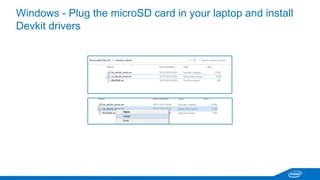
Connect the SD card in your computer – copy the IDE 
file correspondent to your OS; for Windows, copy win-driver 
too
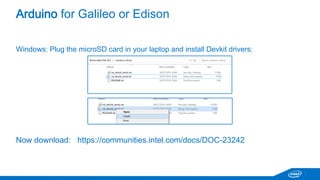
Windows & Arduino – extract and install the contents of win-driver
Now connect your environment 
microUSB <-> USB 
Ref.: https://communities.intel.com/docs/DOC-23147
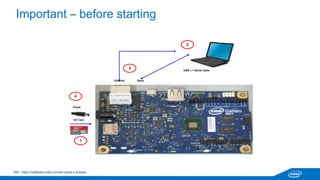
Now connect your environment 
USB <-> Serial cable 
Ethernet 
Power 
SD Card 
Serial 
3 
1 
2 
4 
Ref.: https://software.intel.com/en-us/iot-c-eclipse
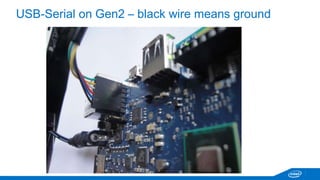
USB-Serial on Gen2 – black wire means ground
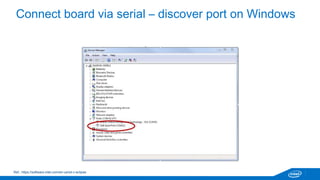
Connect board via serial – discover port on Windows 
Ref.: https://software.intel.com/en-us/iot-c-eclipse
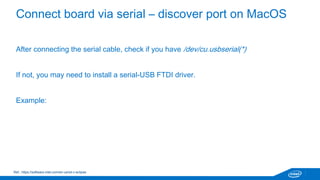
Connect board via serial – discover port on MacOS 
After connecting the serial cable, check if you have /dev/cu.usbserial(*) 
If not, you may need to install a serial-USB FTDI driver. 
Example: 
Ref.: https://software.intel.com/en-us/iot-c-eclipse
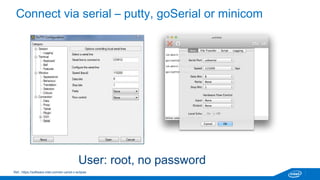
Connect via serial – putty, goSerial or minicom 
User: root, no password 
Ref.: https://software.intel.com/en-us/iot-c-eclipse
Connecting Edison – configure_edison --setup 
Configure password 
Configure wifi 
Galileo should automatically set up an IP address.
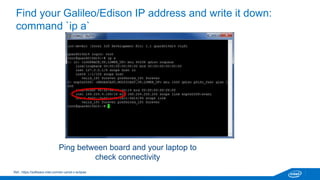
Find your Galileo/Edison IP address and write it down: 
command `ip a` 
Ping between board and your laptop to 
check connectivity 
Ref.: https://software.intel.com/en-us/iot-c-eclipse
Shortcut – if you feel comfortable with vi 
If you have experience coding directly from the command line, you have: 
• Busybox/vi 
• Gcc 
• Python 
• Node.js 
But we will continue with the IDEs, keep paying attention  
Vim: https://github.com/IntelOpenDesign/MakerNode/tree/master/iotkd_libs
Time to chose your path: 
C/C++: 
• Eclipse 
Javascript: 
• XDK 
Arduino 
• Arduino IDE for Galileo 
Visual Programming (Blocky) 
• Wyliodrin
Arduino for Galileo/Edison
Arduino for Galileo or Edison 
https://communities.intel.com/docs/DOC-23242
C/C++/Eclipse
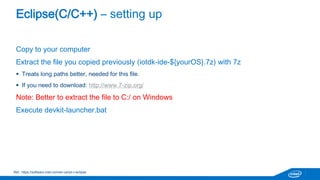
Eclipse(C/C++) – setting up 
Copy to your computer 
Extract the file you copied previously (iotdk-ide-${yourOS}.7z) with 7z 
 Treats long paths better, needed for this file. 
 If you need to download: http://www.7-zip.org/ 
Note: Better to extract the file to C: on Windows 
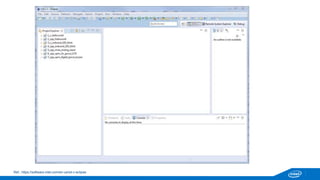
Execute devkit-launcher.bat 
Ref.: https://software.intel.com/en-us/iot-c-eclipse
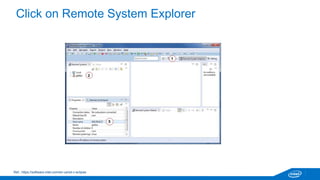
Click on Remote System Explorer 
Ref.: https://software.intel.com/en-us/iot-c-eclipse
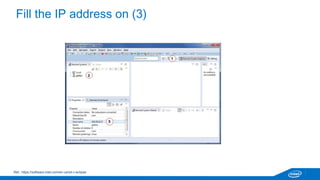
Fill the IP address on (3) 
Ref.: https://software.intel.com/en-us/iot-c-eclipse
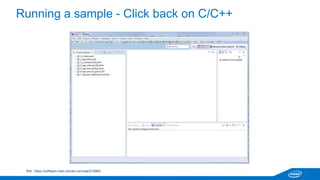
Running a sample - Click back on C/C++ 
Ref.: https://software.intel.com/en-us/node/519969
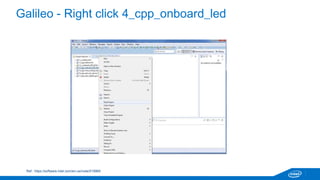
Galileo - Right click 4_cpp_onboard_led 
Ref.: https://software.intel.com/en-us/node/519969
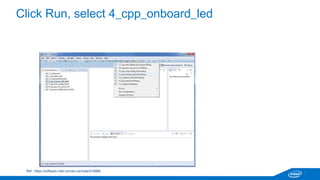
Click Run, select 4_cpp_onboard_led 
Ref.: https://software.intel.com/en-us/node/519969
JavaScript/Node.js/XDK
Install the file copied from the SD card, XDK directory 
Ref.: https://software.intel.com/en-us/html5/xdk-iot
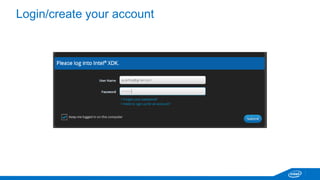
Login/create your account
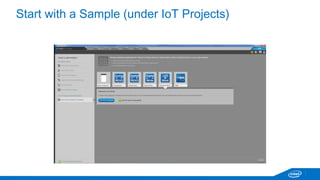
Start with a Sample (under IoT Projects) – click on “Use this 
Template”
Should look like this
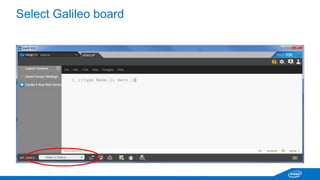
Select Galileo/Edison board
Toggle the console
Click Manage your daemon/IoT device menu in the bottom 
taskbar. Select sync PC time w/ clock on target board to 
avoid computer and device timing issues.
Click Install/Build to fetch node modules specified in 
package.json and install them on device; 1st time click Build
Click Upload to upload the current project to the Galileo 
board
Click Run to run the project on the device. The LED should 
be blinking.
Devkit library (MRAA) and sensor repository (UPM)
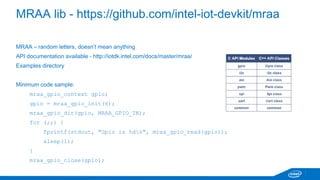
MRAA lib - https://github.com/intel-iot-devkit/mraa 
MRAA – random letters, doesn’t mean anything 
API documentation available - http://iotdk.intel.com/docs/master/mraa/ 
Examples directory 
Minimum code sample: 
mraa_gpio_context gpio; 
gpio = mraa_gpio_init(6); 
mraa_gpio_dir(gpio, MRAA_GPIO_IN); 
for (;;) { 
fprintf(stdout, "Gpio is %dn", mraa_gpio_read(gpio)); 
sleep(1); 
} 
mraa_gpio_close(gpio);
UPM repository - https://github.com/intel-iot-devkit/upm 
List of supported sensors in C++ 
API documentation - http://iotdk.intel.com/docs/master/upm/ 
Examples directory 
Minimum code example: 
upm::GroveTemp* s = new upm::GroveTemp(0); 
std::cout << s->name() << std::endl; 
for (int i=0; i < 10; i++) { 
std::cout << s->value() << std::endl; 
sleep(1); 
}
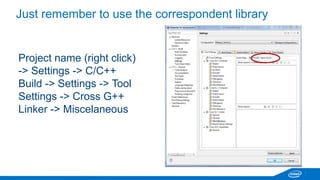
Just remember to use the correspondent library 
Project name (right click) 
-> Settings -> C/C++ 
Build -> Settings -> Tool 
Settings -> Cross G++ 
Linker -> Miscelaneous
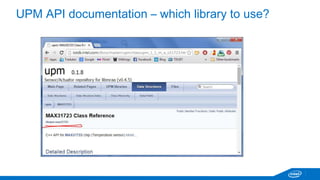
UPM API documentation – which library to use?
Creating new app
If using Eclipse
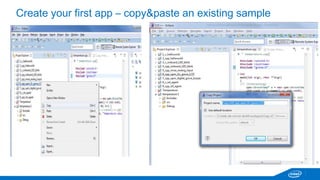
Create your first app – copy&paste an existing sample
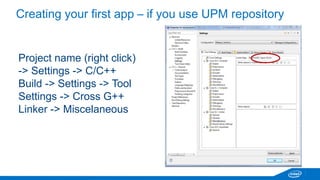
Creating your first app – if you use UPM repository 
Project name (right click) 
-> Settings -> C/C++ 
Build -> Settings -> Tool 
Settings -> Cross G++ 
Linker -> Miscelaneous
If using XDK
Node.js 
Find the library name – example: libupm-grove 
-> replace “lib” for “js” and you have it: jsupm_grove 
Code: 
require(“jsupm_grove”);
If using Python
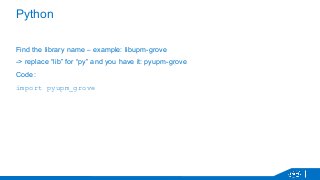
Python 
Find the library name – example: libupm-grove 
-> replace “lib” for “py” and you have it: pyupm-grove 
Code: 
import pyupm_grove
If using Arduino
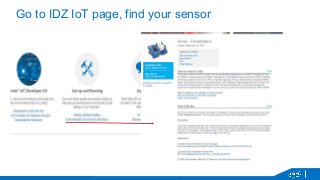
Go to IDZ IoT page, find your sensor
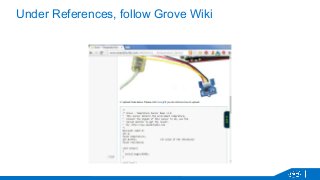
Under References, follow Grove Wiki
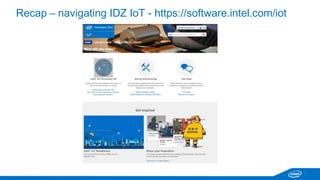
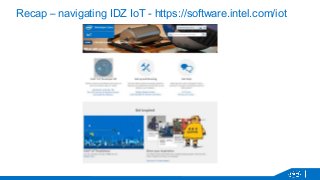
Recap – navigating IDZ IoT - https://software.intel.com/iot
Now, who has problems??? 

Getting started with Intel IoT Developer Kit

  • 1.
    Getting Started withIntel IoT Developer Kit – Dev kit Setup, Installing, Hello World and Sensors testing Sulamita Garcia – Developer Evangelist - @sulagarcia Munich, October 18 2014
  • 2.
    Agenda • Devkitcomponents: hardware and software • Setting up Galileo/Edison • Setting up developer environment • Running sample codes • Creating your application • Dev kit library (MRAA) and sensors repository (UPM)
  • 3.
    Important – beforestarting Intel Galileo Gen 1 -> 5V power supply Intel Galileo Gen 2 -> 12V power supply Intel Galileo Gen 1 + 12V power supply =
  • 4.
  • 5.
    Dev kit components Software • Linux (Yocto) image to be used with micro SD card on Galileo; already installed on Edison • IDEs for cross platform development • MRAA and UPM libraries for abstracting complexity when using sensors and actuators Hardware • Intel Galileo Gen 2 or Edison • Grove Starter Kit – Intel IoT Edition • Micro SD • Serial cable • Ethernet cable • Sensors and components
  • 6.
    Intel® Galileo DevelopmentBoard – Gen 2 Board I/O:  Mechanically compatible with Arduino Uno  20 digital input/output pins including 6 pins as PWM outputs  6 analog inputs  2 UART (RX/TX)  1 I2C  1 ICSP 6-pin header (SPI)  USB device connector (Host)  Micro USB device connector (client)  SD Card connector  DC power jack (7V – 15V DC input) Ref.: http://maker.intel.com
  • 7.
    Intel® Edison module • 22 nm Intel® SoC that includes a dual-core, dual-threaded Intel® Atom™ CPU at 500 MHz • 32-bit Intel® Quark™ microcontroller at 100 MHz • 1 GB LPDDR3 POP memory • Flash storage 4 GB eMMC • WiFi and Bluetooth® Low Energy • 35.5 × 25.0 × 3.9 mm (1.4 × 1.0 × 0.15 inches) • 40 GPIOs: UART, I2C, SPI, I2S, GPIO(PWM), USB, Sd card Ref.: http://maker.intel.com
  • 8.
    Intel® Edison -Arduino Expansion Board Board I/O: Compatible with Arduino Uno (except only 4 PWM instead of 6 PWM)  20 digital input/output pins including 4 pins as PWM outputs  6 analog inputs  1 UART (RX/TX)  1 I2C  1 ICSP 6-pin header (SPI)  Micro USB device connector OR (via mechanical switch) dedicated standard size USB host Type-A connector  Micro USB device (connected to UART)  SD Card connector  DC power jack (7V – 15V DC input) Ref.: http://maker.intel.com
  • 9.
    Grove Starter KitPlus - Intel® IoT Edition Base Shield Buzzer Button Grove-LED Sound Sensor Rotary Angle Sensor Touch Sensor Smart Relay Light Sensor Temperature Sensor Grove Cables Mini Servo 9V to Barrel Jack Adapter - 126mm DIP LED Blue-Blue DIP LED Green-Green DIP LED Red-Red LCD RGB Backlight
  • 10.
    Extra sensors availabledepending on your project SEN04031P Grove - Piezo Vibration Sensor SEN01111P Grove - Air quality sensor SEN11425P Grove - 125KHz RFID Reader ACC90453O 4 pin grove adapter (5 per pack) KIT80949P Wireless Sensor Node - Solar Kit ROB08211P Grove Mini Servos SEN04051P Grove - 3-Axis Digital Accelerometer SEN11763P Grove - 3-Axis Digital Gyro SEN12753P Grove - 3-Axis Digital Compass COM22639P Grove - Relay COM05231P Grove - Slide Potentiometer
  • 11.
    Important – beforestarting • The next session can save you a lot of time and trouble – which will count tomorrow when you are trying to finish your project • We will cover step by step how to get started • Your options: • C/C++ with Eclipse (recommended) • JavaScript with XDK (recommended) • Arduino (recommended) • Visual programming with Wyliodrin – if you are new to programming • Vi/terminal – if you are more comfortable with command line environment
  • 12.
    Online documentation forreference This presentation: http://slidesha.re/1uuFgBH https://software.intel.com/en-us/iot/getting-started http://intel.com/edison/getstarted
  • 13.
    Setting up theGalileo board
  • 14.
    Setup the Galileoboard Distributed micro SD cards already prepared with latest image – just plug them in Why do we need a micro SD and an image? - Provide easy way to permanently store application on board - Provides extra libraries and bindings - Supports multiple programming languages Note: For future updates, please refer to online documentation. Ref.: https://software.intel.com/en-us/iot-c-eclipse , Appendix
  • 15.
    Setup the Edisonboard Distributed Edison already updated If not, update software: https://communities.intel.com/docs/DOC-23192
  • 16.
    Setting up thedeveloper environment
  • 17.
    Connect the SDcard in your computer – copy the IDE file correspondent to your OS; for Windows, copy win-driver too
  • 18.
    Windows & Arduino– extract and install the contents of win-driver
  • 19.
    Now connect yourenvironment microUSB <-> USB Ref.: https://communities.intel.com/docs/DOC-23147
  • 20.
    Now connect yourenvironment USB <-> Serial cable Ethernet Power SD Card Serial 3 1 2 4 Ref.: https://software.intel.com/en-us/iot-c-eclipse
  • 21.
    USB-Serial on Gen2– black wire means ground
  • 22.
    Connect board viaserial – discover port on Windows Ref.: https://software.intel.com/en-us/iot-c-eclipse
  • 23.
    Connect board viaserial – discover port on MacOS After connecting the serial cable, check if you have /dev/cu.usbserial(*) If not, you may need to install a serial-USB FTDI driver. Example: Ref.: https://software.intel.com/en-us/iot-c-eclipse
  • 24.
    Connect via serial– putty, goSerial or minicom User: root, no password Ref.: https://software.intel.com/en-us/iot-c-eclipse
  • 25.
    Connecting Edison –configure_edison --setup Configure password Configure wifi Galileo should automatically set up an IP address.
  • 26.
    Find your Galileo/EdisonIP address and write it down: command `ip a` Ping between board and your laptop to check connectivity Ref.: https://software.intel.com/en-us/iot-c-eclipse
  • 27.
    Shortcut – ifyou feel comfortable with vi If you have experience coding directly from the command line, you have: • Busybox/vi • Gcc • Python • Node.js But we will continue with the IDEs, keep paying attention  Vim: https://github.com/IntelOpenDesign/MakerNode/tree/master/iotkd_libs
  • 28.
    Time to choseyour path: C/C++: • Eclipse Javascript: • XDK Arduino • Arduino IDE for Galileo Visual Programming (Blocky) • Wyliodrin
  • 29.
  • 30.
    Arduino for Galileoor Edison https://communities.intel.com/docs/DOC-23242
  • 31.
  • 32.
    Eclipse(C/C++) – settingup Copy to your computer Extract the file you copied previously (iotdk-ide-${yourOS}.7z) with 7z  Treats long paths better, needed for this file.  If you need to download: http://www.7-zip.org/ Note: Better to extract the file to C: on Windows Execute devkit-launcher.bat Ref.: https://software.intel.com/en-us/iot-c-eclipse
  • 33.
  • 34.
    Click on RemoteSystem Explorer Ref.: https://software.intel.com/en-us/iot-c-eclipse
  • 35.
    Fill the IPaddress on (3) Ref.: https://software.intel.com/en-us/iot-c-eclipse
  • 36.
    Running a sample- Click back on C/C++ Ref.: https://software.intel.com/en-us/node/519969
  • 37.
    Galileo - Rightclick 4_cpp_onboard_led Ref.: https://software.intel.com/en-us/node/519969
  • 38.
    Click Run, select4_cpp_onboard_led Ref.: https://software.intel.com/en-us/node/519969
  • 39.
  • 40.
    Install the filecopied from the SD card, XDK directory Ref.: https://software.intel.com/en-us/html5/xdk-iot
  • 41.
  • 42.
    Start with aSample (under IoT Projects) – click on “Use this Template”
  • 43.
  • 44.
  • 45.
  • 46.
    Click Manage yourdaemon/IoT device menu in the bottom taskbar. Select sync PC time w/ clock on target board to avoid computer and device timing issues.
  • 47.
    Click Install/Build tofetch node modules specified in package.json and install them on device; 1st time click Build
  • 48.
    Click Upload toupload the current project to the Galileo board
  • 49.
    Click Run torun the project on the device. The LED should be blinking.
  • 50.
    Devkit library (MRAA)and sensor repository (UPM)
  • 51.
    MRAA lib -https://github.com/intel-iot-devkit/mraa MRAA – random letters, doesn’t mean anything API documentation available - http://iotdk.intel.com/docs/master/mraa/ Examples directory Minimum code sample: mraa_gpio_context gpio; gpio = mraa_gpio_init(6); mraa_gpio_dir(gpio, MRAA_GPIO_IN); for (;;) { fprintf(stdout, "Gpio is %dn", mraa_gpio_read(gpio)); sleep(1); } mraa_gpio_close(gpio);
  • 52.
    UPM repository -https://github.com/intel-iot-devkit/upm List of supported sensors in C++ API documentation - http://iotdk.intel.com/docs/master/upm/ Examples directory Minimum code example: upm::GroveTemp* s = new upm::GroveTemp(0); std::cout << s->name() << std::endl; for (int i=0; i < 10; i++) { std::cout << s->value() << std::endl; sleep(1); }
  • 53.
    Just remember touse the correspondent library Project name (right click) -> Settings -> C/C++ Build -> Settings -> Tool Settings -> Cross G++ Linker -> Miscelaneous
  • 54.
    UPM API documentation– which library to use?
  • 55.
  • 56.
  • 57.
    Create your firstapp – copy&paste an existing sample
  • 58.
    Creating your firstapp – if you use UPM repository Project name (right click) -> Settings -> C/C++ Build -> Settings -> Tool Settings -> Cross G++ Linker -> Miscelaneous
  • 59.
  • 60.
    Node.js Find thelibrary name – example: libupm-grove -> replace “lib” for “js” and you have it: jsupm_grove Code: require(“jsupm_grove”);
  • 61.
  • 62.
    Python Find thelibrary name – example: libupm-grove -> replace “lib” for “py” and you have it: pyupm-grove Code: import pyupm_grove
  • 63.
  • 64.
    Go to IDZIoT page, find your sensor
  • 65.
  • 66.
    Recap – navigatingIDZ IoT - https://software.intel.com/iot
  • 67.
    Now, who hasproblems??? 