Locking in Linux kernel
Galois @ USTC Linux Users Group
zyf11@mail.ustc.edu.cn
Slides are powered by
OpenOffice.org+Linux+GNU+X31-150$
Copyright © 2005 Galois Y.F. Zheng
Permissions is granted to copy, distribute and/or modify this
document under the terms of the GNU Free Documentation
License, Version 1.2 or any later version published by the
Free Software Foundation; with no Invariant Sections, no
Front-Cover Texts, and no Back-Cover Texts. A copy of the
license can be downloaded from GNU's home:
http://www.gnu.org/licenses/fdl.txt
Locking in Linux kernel
• OS review: Kernel Control Paths
• Locking in Linux
• Locking and Coding
• Conclusions
OS review: Kernel Control Paths
• CPU is stupid, running endlessly!
• But the codes in RAM is intelligent.
(They compete for CPU resources.)
• We people control the codes.
cpu, operating system, and human
2
1
3
4
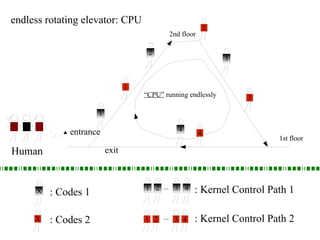
2nd floor
1
3
4
2
“CPU” running endlessly
endless rotating elevator: CPU
X : Codes 1
X : Codes 2
entrance
exit
1st floor
Human
2 31 4...
: Kernel Control Path 1
1 2 3 4... : Kernel Control Path 2
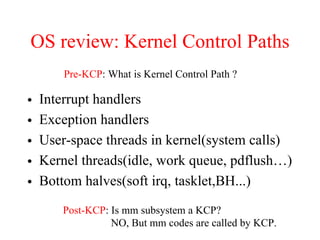
OS review: Kernel Control Paths
• Interrupt handlers
• Exception handlers
• User-space threads in kernel(system calls)
• Kernel threads(idle, work queue, pdflush…)
• Bottom halves(soft irq, tasklet,BH...)
Pre-KCP: What is Kernel Control Path ?
Post-KCP: Is mm subsystem a KCP?
NO, But mm codes are called by KCP.
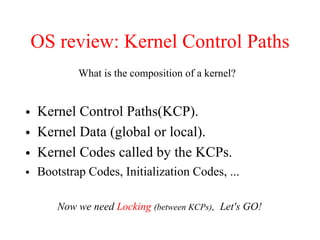
OS review: Kernel Control Paths
• Kernel Control Paths(KCP).
• Kernel Data (global or local).
• Kernel Codes called by the KCPs.
• Bootstrap Codes, Initialization Codes, ...
What is the composition of a kernel?
Now we need Locking (between KCPs), Let's GO!
Locking in Linux kernel
• OS review: Kernel Control Paths
• Locking in Linux
• Locking and Coding
• Conclusions
Locking in Linux
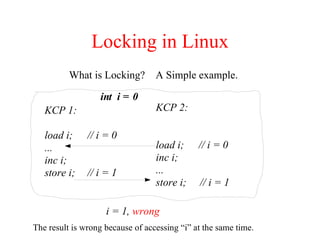
What is Locking? A Simple example.
KCP 1:
load i; // i = 0
...
inc i;
store i; // i = 1
KCP 2:
load i; // i = 0
inc i;
...
store i; // i = 1
The result is wrong because of accessing “i” at the same time.
int i = 0
i = 1, wrong
Locking in Linux
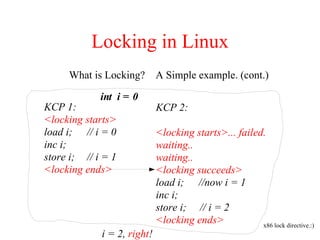
What is Locking? A Simple example. (cont.)
KCP 1:
<locking starts>
load i; // i = 0
inc i;
store i; // i = 1
<locking ends>
KCP 2:
<locking starts>... failed.
waiting..
waiting..
<locking succeeds>
load i; //now i = 1
inc i;
store i; // i = 2
<locking ends>
int i = 0
i = 2, right!
x86 lock directive.:)
Locking in Linux
Another example...
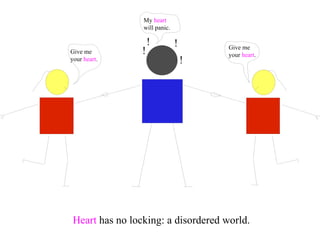
Heart has no locking: a disordered world.
Give me
your heart.
Give me
your heart.
My heart
will panic.
!
!!
!
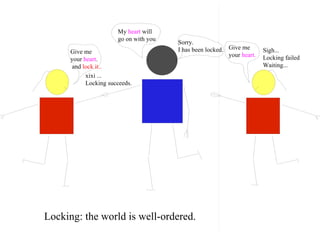
Locking: the world is well-ordered.
Give me
your heart.
and lock it..
Give me
your heart.
My heart will
go on with you
Sigh...
Locking failed
Waiting...
Sorry.
I has been locked.
xixi ...
Locking succeeds.
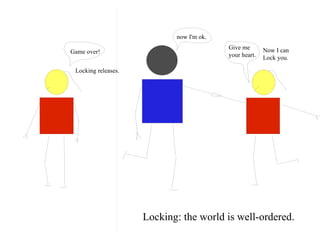
Locking: the world is well-ordered.
Game over!
Give me
your heart.
Now I can
Lock you.
now I'm ok.
Locking releases.
Now we know that
locking
makes the world romantic and beautiful.
Locking in Linux
• What is Locking. (cont.)
– Shared Data
– Does Code need locking ? - Yes, surprising!
• Critical Regions
– Concurrency caused by Kernel Control Paths
• Race Conditions ? - Must be avoided.
– Now we needs Synchronization . - Locking.
Locking in Linux
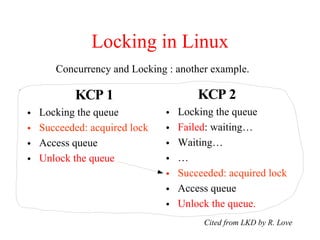
KCP 1
• Locking the queue
• Succeeded: acquired lock
• Access queue
• Unlock the queue
KCP 2
• Locking the queue
• Failed: waiting…
• Waiting…
• …
• Succeeded: acquired lock
• Access queue
• Unlock the queue.
Cited from LKD by R. Love
Concurrency and Locking : another example.
Locking in Linux
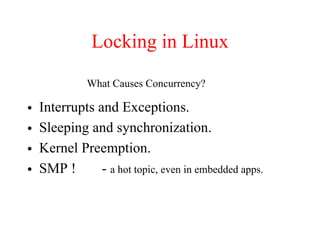
• Interrupts and Exceptions.
• Sleeping and synchronization.
• Kernel Preemption.
• SMP ! - a hot topic, even in embedded apps.
What Causes Concurrency?
Locking in Linux
Locking(Sync.) is important.
Let's get into the Locking details.
Locking in Linux
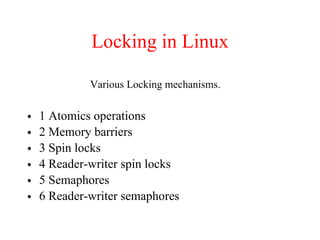
• 1 Atomics operations
• 2 Memory barriers
• 3 Spin locks
• 4 Reader-writer spin locks
• 5 Semaphores
• 6 Reader-writer semaphores
Various Locking mechanisms.
Locking in Linux
– 7 Condition(Completion) Variables
– 8 Sequence locks
– 9 Mask Interrupts(local and global)
– 10 Mask Bottom Halves
– 11 Disable Kernel Preemption
– 12 Read-Copy Update
–
– Big Kernel Lock - Historical, will be removed
– FUTEX ? - NO
Various Locking mechanisms. (cont.)
1 Atomics Operations
• atomic ops is for the concurrency caused by MP. not for other
concurrencies caused by preemption, sleep...
• atomic operations mechanisms(SMP env):
– cpu guaranteed atomic ops: read/write a byte, alined word...
– lock prefix: add, adc, and, cmpxchg, cmpxch8b, dec, inc, neg, not,
or, sbb, sub ,xor, xadd, btc,bts, btr
– xchg is automatically added lock prefix.
– cache coherency protocols.
1 Atomics Operations
<asm/atomic.h> <asm/bitops.h>
• atomic integer ops: (on atomic_t type v)
– atomic_read(v) v->counter not necessary
– atomic_set(v) v->counter not necessary
– atomic_add(i,v) v->counter+i lock;addl %1,%0
– ...
• atomic bitwise ops:
– set_bit(i,addr) set the i-th bit lock;btsl %1,%0
– clear_bit(i,addr) clear the i-th bit lock;btrl %1,%0
– test_and_set_bit lock;btsl %2,%1;sbbl %1,%0
– ...
• pseudo atomic bitwise ops: carefully!
– __set_bit(), __xxx() ..... there is no lock prefix.
2 Memory Barriers basics
• gcc optimizes instruction streams.
• 386 is strong ordering, where read and write are issued on the system
bus in the order they occur..but pentium 4 is processor ordering, by
which cpu could improve performance.
• memory barriers hardware technologies(x86):
– serializing instructions
• mov(to control register/debug register), wrmsr, invd, invlpg,
wbinvd,lgdt,lldt,lidt,ltr;
• cpuid,iret,rsm (non-previledged)
• sfence(store), mfence(all), lfence(load) (non-preveledged)
– io instructions, read/write to uncached memory, interrupt ocurrence,
lock prefix
– mtrr and pat could control memory ordering.
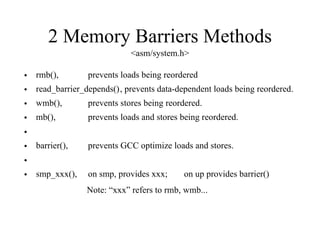
2 Memory Barriers Methods
<asm/system.h>
• rmb(), prevents loads being reordered
• read_barrier_depends(), prevents data-dependent loads being reordered.
• wmb(), prevents stores being reordered.
• mb(), prevents loads and stores being reordered.
•
• barrier(), prevents GCC optimize loads and stores.
•
• smp_xxx(), on smp, provides xxx; on up provides barrier()
Note: “xxx” refers to rmb, wmb...
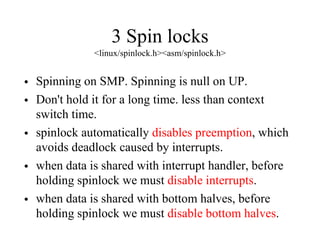
3 Spin locks
<linux/spinlock.h><asm/spinlock.h>
• Spinning on SMP. Spinning is null on UP.
• Don't hold it for a long time. less than context
switch time.
• spinlock automatically disables preemption, which
avoids deadlock caused by interrupts.
• when data is shared with interrupt handler, before
holding spinlock we must disable interrupts.
• when data is shared with bottom halves, before
holding spinlock we must disable bottom halves.
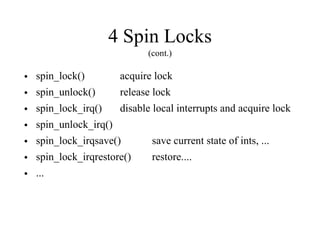
4 Spin Locks
(cont.)
• spin_lock() acquire lock
• spin_unlock() release lock
• spin_lock_irq() disable local interrupts and acquire lock
• spin_unlock_irq()
• spin_lock_irqsave() save current state of ints, ...
• spin_lock_irqrestore() restore....
• ...
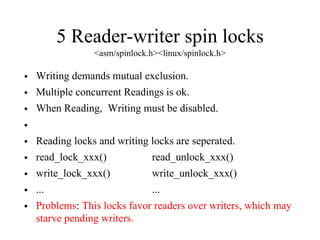
5 Reader-writer spin locks
<asm/spinlock.h><linux/spinlock.h>
• Writing demands mutual exclusion.
• Multiple concurrent Readings is ok.
• When Reading, Writing must be disabled.
•
• Reading locks and writing locks are seperated.
• read_lock_xxx() read_unlock_xxx()
• write_lock_xxx() write_unlock_xxx()
• ... ...
• Problems: This locks favor readers over writers, which may
starve pending writers.
6 Semaphores
<asm/semaphore.h><arch/xxx/kernel/semaphore.c>
• Checking (struct semaphore*)->count, dec&inc is spinlocked.
• when initial count > 1, it allows arbitrary number of lock
holders. when initial count = 1, it is binary semaphore, also
called mutex which is used in many places.
• It is sleeping locks.
• Threads may sleep while holding semaphores.
• Threads can't acquire semaphores while holding spin lock.
•
• down() threads get into uninterruptible state
• down_interruptible(), threads get into interruptible state
• up() inc count, if count<=0, wake up waiting thread
• ...
7 Reader-writer semaphores
<linux/rwsem.h>
• WE can understand it.
•
• down_read(), down_read_trylock()
• up_read()
• down_write(), down_write_trylock()
• up_write()
•
• NOTE: unlike rw-spinlock, we can downgrade from
writelock to readlock.
Spin locks VS. semaphores
(recommended)
• low overhead locking, spinlock
• short lock hold time , spinlock
• long lock hold time , semaphore
• for interrupt context use, spin lock
• sleep while holding lock, semaphore
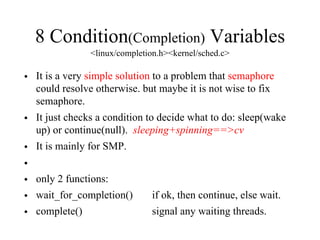
8 Condition(Completion) Variables
<linux/completion.h><kernel/sched.c>
• It is a very simple solution to a problem that semaphore
could resolve otherwise. but maybe it is not wise to fix
semaphore.
• It just checks a condition to decide what to do: sleep(wake
up) or continue(null). sleeping+spinning==>cv
• It is mainly for SMP.
•
• only 2 functions:
• wait_for_completion() if ok, then continue, else wait.
• complete() signal any waiting threads.
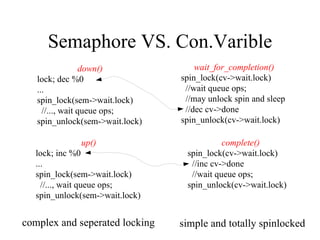
Semaphore VS. Con.Varible
down()
lock; dec %0
...
spin_lock(sem->wait.lock)
//..., wait queue ops;
spin_unlock(sem->wait.lock)
up()
lock; inc %0
...
spin_lock(sem->wait.lock)
//..., wait queue ops;
spin_unlock(sem->wait.lock)
wait_for_completion()
spin_lock(cv->wait.lock)
//wait queue ops;
//may unlock spin and sleep
//dec cv->done
spin_unlock(cv->wait.lock)
complete()
spin_lock(cv->wait.lock)
//inc cv->done
//wait queue ops;
spin_unlock(cv->wait.lock)
complex and seperated locking simple and totally spinlocked
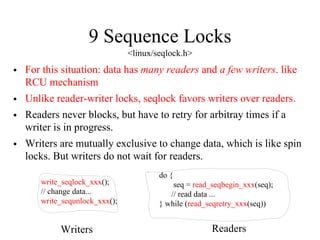
9 Sequence Locks
<linux/seqlock.h>
• For this situation: data has many readers and a few writers. like
RCU mechanism
• Unlike reader-writer locks, seqlock favors writers over readers.
• Readers never blocks, but have to retry for arbitray times if a
writer is in progress.
• Writers are mutually exclusive to change data, which is like spin
locks. But writers do not wait for readers.
do {
seq = read_seqbegin_xxx(seq);
// read data ...
} while (read_seqretry_xxx(seq))
write_seqlock_xxx();
// change data...
write_sequnlock_xxx();
Writers Readers
10 Mask interrupts(local and global)
<linux/interrupt.h><asm/system.h><kernel/irq/manage.c><asm/processor.h>
• Deal with CPU IF flag. which disable all interrupts of local
CPU (cli and sti instructions.)
• Masking PIC's irq line is another story. It makes serial
execution of same interrupt. but it could not prevent the
preemption from other interrupt.
• local_irq_disable(), local_irq_enable()
• Do you remember: spin_lock_irq() ? Disabling interrupts
are used with spin_lock().
•
• Global disabling: cruel! I don't know wheather removed. but
we can use synchronize_irq() to synchronize all CPUs.
11 Mask Bottom Halves
<linux/interrupt.h>
• when data is shared with bottom halves,
maybe we need to disable bottom halves.
•
• local_bh_disable(), local_bh_enable():
– calling add_preempt_count()
• spin_lock_bh()
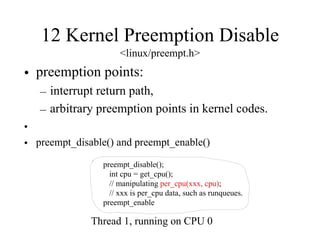
12 Kernel Preemption Disable
<linux/preempt.h>
• preemption points:
– interrupt return path,
– arbitrary preemption points in kernel codes.
•
• preempt_disable() and preempt_enable()
preempt_disable();
int cpu = get_cpu();
// manipulating per_cpu(xxx, cpu);
// xxx is per_cpu data, such as runqueues.
preempt_enable
Thread 1, running on CPU 0
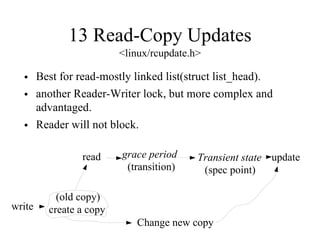
13 Read-Copy Updates
<linux/rcupdate.h>
• Best for read-mostly linked list(struct list_head).
• another Reader-Writer lock, but more complex and
advantaged.
• Reader will not block.
read grace period
(transition)
Transient state
(spec point)
update
write
Change new copy
(old copy)
create a copy
Big Kernel Lock: history
• Linux 2.0 - BKL about 1996 - SMP
• BSD/OS 4.x:
• FreeBSD 4.x: XXX – Giant (2000 -)
• goal : fine-grained locking
•
• Dragonfly BSD: forked from FreeBSD 4.x
• goal: lockless mem allocator and scheduling system
FUTEX
• Fast User Space Mutex
• It's for user-space threads synchronization.
• It's not a locking mechanism for kernel.
• It is implemented in kernel.
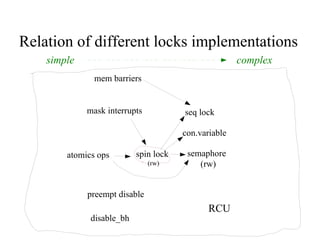
Relation of different locks implementations
atomics ops
mem barriers
spin lock
(rw)
semaphore
(rw)
con.variable
seq lockmask interrupts
preempt disable
disable_bh
RCU
simple complex
Locking in Linux kernel
• Kernel Control Paths
• Locking in Linux
• Locking and Coding
• Conclusions
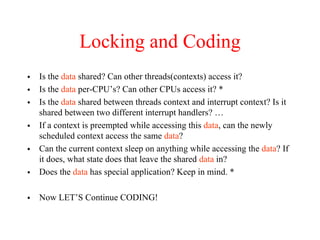
Locking and Coding
• Is the data shared? Can other threads(contexts) access it?
• Is the data per-CPU’s? Can other CPUs access it? *
• Is the data shared between threads context and interrupt context? Is it
shared between two different interrupt handlers? …
• If a context is preempted while accessing this data, can the newly
scheduled context access the same data?
• Can the current context sleep on anything while accessing the data? If
it does, what state does that leave the shared data in?
• Does the data has special application? Keep in mind. *
• Now LET’S Continue CODING!
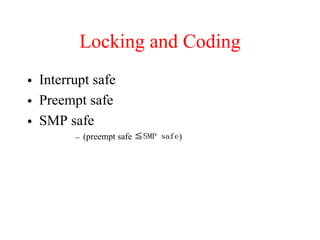
Locking and Coding
• Interrupt safe
• Preempt safe
• SMP safe
– (preempt safe ≦SMP safe)
Locking between various KCPs
• Exceptions..
• Interrupts..
• Bottom Halves..
• Kernel threads..
• System calls by user space threads..
1 between exception contexts
(UP:sleeping locks, SMP:+0)
• 1. Exception could not be caused in kernel. If any kernel
codes trigger an exception, this is a bug.
• 2. BUT page_fault and float-point registers exceptions
• 3. Exceptions could be caused by user-space codes.
• 4. According to 1st
item, exception contexts could not
trigger another exceptions, including page_fault and float-
point registers exceptions. But exception contexts could be
preempted by interrupts, and after interrupts return ,the
preempted exceptions continue on same CPU.
• 5 so we could conclude that sleeping locking are enough.
2 between interrupts contexts
(UP:mask local interrupts, SMP:+spinlock)
• Interrupts contexts have no kernel stack. It
could not sleep. Do not use sleeping locks.
• Same interrupt context runs serially on same
CPU because irq_desc->handler.ack() in do_IRQ() masks
the irq line. On UP, This situation is simple.
• Same or different interrupts could be
triggered on different CPUs, so SMP
requires spinlock to prevent race condition.
3 between Bottom Halves
(UP:null, SMP:+spinlock)
• Do not use old BH mechanism, it has poor performance and
has been removed in 2.6.
• Softirqs could not been preempted, except by interrupts. so
on UP, there is no race conditions.
• Bottom Halves could not sleep like interrupts for the same
reasons.
• Same or different softirqs could run on different CPUs.
• Tasklets are based on softirqs. Only different tasklets could
run on different CPUs.
• From above descriptions, we can conclude that on SMP
softirqs and different tasklets should be protected with
spinlocks, same tasklet could be used locklessly.
4 between exceptions and interrupts/bh
(UP: mask interrupts, SMP:+spinlocks)
• Interrupts could not be preempted by exceptions, if
this situation happens, this is a bug!
• So exceptions could disable interrupts to avoid
preemption by interrupts.
•
• bh is like interrupts, it is executed in interrupt
contexts.
• However, exceptions could use local_bh_disable()
to disable bottom halves.
5 between BottomHalves and interrupts
(UP: mask interrupts, SMP: spinlock)
• Bottom halves could use disabling interrupts
to avoid concurrency.
• for SMP, spinlock is necessary and enough.
6 between kernel threads and interrupts/bh
(UP: mask interrupts, SMP:+spinlock)
• Interrupts could preempt threads. so disable
interrupts to protect data used by threads.
• Because interrupts could not be preempted,
so we use spinlock.
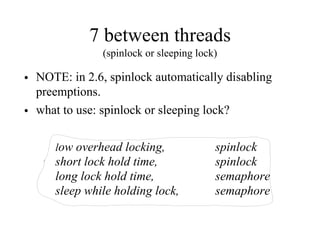
7 between threads
(spinlock or sleeping lock)
• NOTE: in 2.6, spinlock automatically disabling
preemptions.
• what to use: spinlock or sleeping lock?
low overhead locking, spinlock
short lock hold time, spinlock
long lock hold time, semaphore
sleep while holding lock, semaphore
8 between system calls
(spinning lock or sleeping lock)
• This is same as between kernel threads.
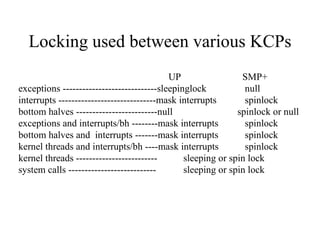
Locking used between various KCPs
UP SMP+
exceptions -----------------------------sleepinglock null
interrupts ------------------------------mask interrupts spinlock
bottom halves -------------------------null spinlock or null
exceptions and interrupts/bh --------mask interrupts spinlock
bottom halves and interrupts -------mask interrupts spinlock
kernel threads and interrupts/bh ----mask interrupts spinlock
kernel threads ------------------------- sleeping or spin lock
system calls --------------------------- sleeping or spin lock
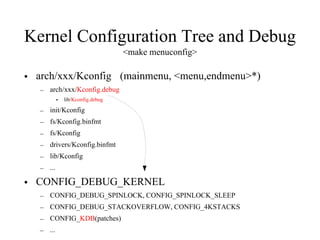
Kernel Configuration Tree and Debug
<make menuconfig>
• arch/xxx/Kconfig (mainmenu, <menu,endmenu>*)
– arch/xxx/Kconfig.debug
• lib/Kconfig.debug
– init/Kconfig
– fs/Kconfig.binfmt
– fs/Kconfig
– drivers/Kconfig.binfmt
– lib/Kconfig
– ...
• CONFIG_DEBUG_KERNEL
– CONFIG_DEBUG_SPINLOCK, CONFIG_SPINLOCK_SLEEP
– CONFIG_DEBUG_STACKOVERFLOW, CONFIG_4KSTACKS
– CONFIG_KDB(patches)
– ...
Locking in Linux kernel
• Kernel Control Paths
• Locking in Linux
• Locking and Coding
• Conclusions
Conclusions
• Locking or synchronization is a complex
problem, especially for large and/or complex
system.
• The problem caused by Locking in kernel is
not entirely predictive.
Locking: What is the problem?
• Implementing the actual locking in the code
to protect shared data is not hard.
• The tricky part is identifying the actual
shared data and corresponding critical
sections.
Cited from LKD, by R. Love
Locking: What is the problem?
• Deadlocks
• Priority Inversion
• Locking latency
• Locking: Coarse or fine-grained.
– Scalability VS. Overheads(performance).
– Not only Linux has the dilemma.
– Let’s keep close eyes at DragonflyBSD's progress
References
• Linux kernel source tree by Linus Torvalds and various
patches by hackers.
• Linux Kernel Development. by Robert Love.
• Understanding the Linux Kernel. by Daniel Bovet etc.
• www.freebsd.org/smp
• www.dragonflybsd.org
• .../kernel/Documents/*, google, gcc document...
• Pentium 4 software development document(3 volumes).
Thanks
• USTC BBS embedded board master: dj
• All the organizers and/or friends of the USTC 2005
developer workshop of embedded system.
• USTC Linux Users Group.
Happy Life, Happy Hacking.
THANKS

Kernel

  • 1.
    Locking in Linuxkernel Galois @ USTC Linux Users Group zyf11@mail.ustc.edu.cn Slides are powered by OpenOffice.org+Linux+GNU+X31-150$
  • 2.
    Copyright © 2005Galois Y.F. Zheng Permissions is granted to copy, distribute and/or modify this document under the terms of the GNU Free Documentation License, Version 1.2 or any later version published by the Free Software Foundation; with no Invariant Sections, no Front-Cover Texts, and no Back-Cover Texts. A copy of the license can be downloaded from GNU's home: http://www.gnu.org/licenses/fdl.txt
  • 3.
    Locking in Linuxkernel • OS review: Kernel Control Paths • Locking in Linux • Locking and Coding • Conclusions
  • 4.
    OS review: KernelControl Paths • CPU is stupid, running endlessly! • But the codes in RAM is intelligent. (They compete for CPU resources.) • We people control the codes. cpu, operating system, and human
  • 5.
    2 1 3 4 2nd floor 1 3 4 2 “CPU” runningendlessly endless rotating elevator: CPU X : Codes 1 X : Codes 2 entrance exit 1st floor Human 2 31 4... : Kernel Control Path 1 1 2 3 4... : Kernel Control Path 2
  • 6.
    OS review: KernelControl Paths • Interrupt handlers • Exception handlers • User-space threads in kernel(system calls) • Kernel threads(idle, work queue, pdflush…) • Bottom halves(soft irq, tasklet,BH...) Pre-KCP: What is Kernel Control Path ? Post-KCP: Is mm subsystem a KCP? NO, But mm codes are called by KCP.
  • 7.
    OS review: KernelControl Paths • Kernel Control Paths(KCP). • Kernel Data (global or local). • Kernel Codes called by the KCPs. • Bootstrap Codes, Initialization Codes, ... What is the composition of a kernel? Now we need Locking (between KCPs), Let's GO!
  • 8.
    Locking in Linuxkernel • OS review: Kernel Control Paths • Locking in Linux • Locking and Coding • Conclusions
  • 9.
    Locking in Linux Whatis Locking? A Simple example. KCP 1: load i; // i = 0 ... inc i; store i; // i = 1 KCP 2: load i; // i = 0 inc i; ... store i; // i = 1 The result is wrong because of accessing “i” at the same time. int i = 0 i = 1, wrong
  • 10.
    Locking in Linux Whatis Locking? A Simple example. (cont.) KCP 1: <locking starts> load i; // i = 0 inc i; store i; // i = 1 <locking ends> KCP 2: <locking starts>... failed. waiting.. waiting.. <locking succeeds> load i; //now i = 1 inc i; store i; // i = 2 <locking ends> int i = 0 i = 2, right! x86 lock directive.:)
  • 11.
  • 12.
    Heart has nolocking: a disordered world. Give me your heart. Give me your heart. My heart will panic. ! !! !
  • 13.
    Locking: the worldis well-ordered. Give me your heart. and lock it.. Give me your heart. My heart will go on with you Sigh... Locking failed Waiting... Sorry. I has been locked. xixi ... Locking succeeds.
  • 14.
    Locking: the worldis well-ordered. Game over! Give me your heart. Now I can Lock you. now I'm ok. Locking releases.
  • 15.
    Now we knowthat locking makes the world romantic and beautiful.
  • 16.
    Locking in Linux •What is Locking. (cont.) – Shared Data – Does Code need locking ? - Yes, surprising! • Critical Regions – Concurrency caused by Kernel Control Paths • Race Conditions ? - Must be avoided. – Now we needs Synchronization . - Locking.
  • 17.
    Locking in Linux KCP1 • Locking the queue • Succeeded: acquired lock • Access queue • Unlock the queue KCP 2 • Locking the queue • Failed: waiting… • Waiting… • … • Succeeded: acquired lock • Access queue • Unlock the queue. Cited from LKD by R. Love Concurrency and Locking : another example.
  • 18.
    Locking in Linux •Interrupts and Exceptions. • Sleeping and synchronization. • Kernel Preemption. • SMP ! - a hot topic, even in embedded apps. What Causes Concurrency?
  • 19.
    Locking in Linux Locking(Sync.)is important. Let's get into the Locking details.
  • 20.
    Locking in Linux •1 Atomics operations • 2 Memory barriers • 3 Spin locks • 4 Reader-writer spin locks • 5 Semaphores • 6 Reader-writer semaphores Various Locking mechanisms.
  • 21.
    Locking in Linux –7 Condition(Completion) Variables – 8 Sequence locks – 9 Mask Interrupts(local and global) – 10 Mask Bottom Halves – 11 Disable Kernel Preemption – 12 Read-Copy Update – – Big Kernel Lock - Historical, will be removed – FUTEX ? - NO Various Locking mechanisms. (cont.)
  • 22.
    1 Atomics Operations •atomic ops is for the concurrency caused by MP. not for other concurrencies caused by preemption, sleep... • atomic operations mechanisms(SMP env): – cpu guaranteed atomic ops: read/write a byte, alined word... – lock prefix: add, adc, and, cmpxchg, cmpxch8b, dec, inc, neg, not, or, sbb, sub ,xor, xadd, btc,bts, btr – xchg is automatically added lock prefix. – cache coherency protocols.
  • 23.
    1 Atomics Operations <asm/atomic.h><asm/bitops.h> • atomic integer ops: (on atomic_t type v) – atomic_read(v) v->counter not necessary – atomic_set(v) v->counter not necessary – atomic_add(i,v) v->counter+i lock;addl %1,%0 – ... • atomic bitwise ops: – set_bit(i,addr) set the i-th bit lock;btsl %1,%0 – clear_bit(i,addr) clear the i-th bit lock;btrl %1,%0 – test_and_set_bit lock;btsl %2,%1;sbbl %1,%0 – ... • pseudo atomic bitwise ops: carefully! – __set_bit(), __xxx() ..... there is no lock prefix.
  • 24.
    2 Memory Barriersbasics • gcc optimizes instruction streams. • 386 is strong ordering, where read and write are issued on the system bus in the order they occur..but pentium 4 is processor ordering, by which cpu could improve performance. • memory barriers hardware technologies(x86): – serializing instructions • mov(to control register/debug register), wrmsr, invd, invlpg, wbinvd,lgdt,lldt,lidt,ltr; • cpuid,iret,rsm (non-previledged) • sfence(store), mfence(all), lfence(load) (non-preveledged) – io instructions, read/write to uncached memory, interrupt ocurrence, lock prefix – mtrr and pat could control memory ordering.
  • 25.
    2 Memory BarriersMethods <asm/system.h> • rmb(), prevents loads being reordered • read_barrier_depends(), prevents data-dependent loads being reordered. • wmb(), prevents stores being reordered. • mb(), prevents loads and stores being reordered. • • barrier(), prevents GCC optimize loads and stores. • • smp_xxx(), on smp, provides xxx; on up provides barrier() Note: “xxx” refers to rmb, wmb...
  • 26.
    3 Spin locks <linux/spinlock.h><asm/spinlock.h> •Spinning on SMP. Spinning is null on UP. • Don't hold it for a long time. less than context switch time. • spinlock automatically disables preemption, which avoids deadlock caused by interrupts. • when data is shared with interrupt handler, before holding spinlock we must disable interrupts. • when data is shared with bottom halves, before holding spinlock we must disable bottom halves.
  • 27.
    4 Spin Locks (cont.) •spin_lock() acquire lock • spin_unlock() release lock • spin_lock_irq() disable local interrupts and acquire lock • spin_unlock_irq() • spin_lock_irqsave() save current state of ints, ... • spin_lock_irqrestore() restore.... • ...
  • 28.
    5 Reader-writer spinlocks <asm/spinlock.h><linux/spinlock.h> • Writing demands mutual exclusion. • Multiple concurrent Readings is ok. • When Reading, Writing must be disabled. • • Reading locks and writing locks are seperated. • read_lock_xxx() read_unlock_xxx() • write_lock_xxx() write_unlock_xxx() • ... ... • Problems: This locks favor readers over writers, which may starve pending writers.
  • 29.
    6 Semaphores <asm/semaphore.h><arch/xxx/kernel/semaphore.c> • Checking(struct semaphore*)->count, dec&inc is spinlocked. • when initial count > 1, it allows arbitrary number of lock holders. when initial count = 1, it is binary semaphore, also called mutex which is used in many places. • It is sleeping locks. • Threads may sleep while holding semaphores. • Threads can't acquire semaphores while holding spin lock. • • down() threads get into uninterruptible state • down_interruptible(), threads get into interruptible state • up() inc count, if count<=0, wake up waiting thread • ...
  • 30.
    7 Reader-writer semaphores <linux/rwsem.h> •WE can understand it. • • down_read(), down_read_trylock() • up_read() • down_write(), down_write_trylock() • up_write() • • NOTE: unlike rw-spinlock, we can downgrade from writelock to readlock.
  • 31.
    Spin locks VS.semaphores (recommended) • low overhead locking, spinlock • short lock hold time , spinlock • long lock hold time , semaphore • for interrupt context use, spin lock • sleep while holding lock, semaphore
  • 32.
    8 Condition(Completion) Variables <linux/completion.h><kernel/sched.c> •It is a very simple solution to a problem that semaphore could resolve otherwise. but maybe it is not wise to fix semaphore. • It just checks a condition to decide what to do: sleep(wake up) or continue(null). sleeping+spinning==>cv • It is mainly for SMP. • • only 2 functions: • wait_for_completion() if ok, then continue, else wait. • complete() signal any waiting threads.
  • 33.
    Semaphore VS. Con.Varible down() lock;dec %0 ... spin_lock(sem->wait.lock) //..., wait queue ops; spin_unlock(sem->wait.lock) up() lock; inc %0 ... spin_lock(sem->wait.lock) //..., wait queue ops; spin_unlock(sem->wait.lock) wait_for_completion() spin_lock(cv->wait.lock) //wait queue ops; //may unlock spin and sleep //dec cv->done spin_unlock(cv->wait.lock) complete() spin_lock(cv->wait.lock) //inc cv->done //wait queue ops; spin_unlock(cv->wait.lock) complex and seperated locking simple and totally spinlocked
  • 34.
    9 Sequence Locks <linux/seqlock.h> •For this situation: data has many readers and a few writers. like RCU mechanism • Unlike reader-writer locks, seqlock favors writers over readers. • Readers never blocks, but have to retry for arbitray times if a writer is in progress. • Writers are mutually exclusive to change data, which is like spin locks. But writers do not wait for readers. do { seq = read_seqbegin_xxx(seq); // read data ... } while (read_seqretry_xxx(seq)) write_seqlock_xxx(); // change data... write_sequnlock_xxx(); Writers Readers
  • 35.
    10 Mask interrupts(localand global) <linux/interrupt.h><asm/system.h><kernel/irq/manage.c><asm/processor.h> • Deal with CPU IF flag. which disable all interrupts of local CPU (cli and sti instructions.) • Masking PIC's irq line is another story. It makes serial execution of same interrupt. but it could not prevent the preemption from other interrupt. • local_irq_disable(), local_irq_enable() • Do you remember: spin_lock_irq() ? Disabling interrupts are used with spin_lock(). • • Global disabling: cruel! I don't know wheather removed. but we can use synchronize_irq() to synchronize all CPUs.
  • 36.
    11 Mask BottomHalves <linux/interrupt.h> • when data is shared with bottom halves, maybe we need to disable bottom halves. • • local_bh_disable(), local_bh_enable(): – calling add_preempt_count() • spin_lock_bh()
  • 37.
    12 Kernel PreemptionDisable <linux/preempt.h> • preemption points: – interrupt return path, – arbitrary preemption points in kernel codes. • • preempt_disable() and preempt_enable() preempt_disable(); int cpu = get_cpu(); // manipulating per_cpu(xxx, cpu); // xxx is per_cpu data, such as runqueues. preempt_enable Thread 1, running on CPU 0
  • 38.
    13 Read-Copy Updates <linux/rcupdate.h> •Best for read-mostly linked list(struct list_head). • another Reader-Writer lock, but more complex and advantaged. • Reader will not block. read grace period (transition) Transient state (spec point) update write Change new copy (old copy) create a copy
  • 39.
    Big Kernel Lock:history • Linux 2.0 - BKL about 1996 - SMP • BSD/OS 4.x: • FreeBSD 4.x: XXX – Giant (2000 -) • goal : fine-grained locking • • Dragonfly BSD: forked from FreeBSD 4.x • goal: lockless mem allocator and scheduling system
  • 40.
    FUTEX • Fast UserSpace Mutex • It's for user-space threads synchronization. • It's not a locking mechanism for kernel. • It is implemented in kernel.
  • 41.
    Relation of differentlocks implementations atomics ops mem barriers spin lock (rw) semaphore (rw) con.variable seq lockmask interrupts preempt disable disable_bh RCU simple complex
  • 42.
    Locking in Linuxkernel • Kernel Control Paths • Locking in Linux • Locking and Coding • Conclusions
  • 43.
    Locking and Coding •Is the data shared? Can other threads(contexts) access it? • Is the data per-CPU’s? Can other CPUs access it? * • Is the data shared between threads context and interrupt context? Is it shared between two different interrupt handlers? … • If a context is preempted while accessing this data, can the newly scheduled context access the same data? • Can the current context sleep on anything while accessing the data? If it does, what state does that leave the shared data in? • Does the data has special application? Keep in mind. * • Now LET’S Continue CODING!
  • 44.
    Locking and Coding •Interrupt safe • Preempt safe • SMP safe – (preempt safe ≦SMP safe)
  • 45.
    Locking between variousKCPs • Exceptions.. • Interrupts.. • Bottom Halves.. • Kernel threads.. • System calls by user space threads..
  • 46.
    1 between exceptioncontexts (UP:sleeping locks, SMP:+0) • 1. Exception could not be caused in kernel. If any kernel codes trigger an exception, this is a bug. • 2. BUT page_fault and float-point registers exceptions • 3. Exceptions could be caused by user-space codes. • 4. According to 1st item, exception contexts could not trigger another exceptions, including page_fault and float- point registers exceptions. But exception contexts could be preempted by interrupts, and after interrupts return ,the preempted exceptions continue on same CPU. • 5 so we could conclude that sleeping locking are enough.
  • 47.
    2 between interruptscontexts (UP:mask local interrupts, SMP:+spinlock) • Interrupts contexts have no kernel stack. It could not sleep. Do not use sleeping locks. • Same interrupt context runs serially on same CPU because irq_desc->handler.ack() in do_IRQ() masks the irq line. On UP, This situation is simple. • Same or different interrupts could be triggered on different CPUs, so SMP requires spinlock to prevent race condition.
  • 48.
    3 between BottomHalves (UP:null, SMP:+spinlock) • Do not use old BH mechanism, it has poor performance and has been removed in 2.6. • Softirqs could not been preempted, except by interrupts. so on UP, there is no race conditions. • Bottom Halves could not sleep like interrupts for the same reasons. • Same or different softirqs could run on different CPUs. • Tasklets are based on softirqs. Only different tasklets could run on different CPUs. • From above descriptions, we can conclude that on SMP softirqs and different tasklets should be protected with spinlocks, same tasklet could be used locklessly.
  • 49.
    4 between exceptionsand interrupts/bh (UP: mask interrupts, SMP:+spinlocks) • Interrupts could not be preempted by exceptions, if this situation happens, this is a bug! • So exceptions could disable interrupts to avoid preemption by interrupts. • • bh is like interrupts, it is executed in interrupt contexts. • However, exceptions could use local_bh_disable() to disable bottom halves.
  • 50.
    5 between BottomHalvesand interrupts (UP: mask interrupts, SMP: spinlock) • Bottom halves could use disabling interrupts to avoid concurrency. • for SMP, spinlock is necessary and enough.
  • 51.
    6 between kernelthreads and interrupts/bh (UP: mask interrupts, SMP:+spinlock) • Interrupts could preempt threads. so disable interrupts to protect data used by threads. • Because interrupts could not be preempted, so we use spinlock.
  • 52.
    7 between threads (spinlockor sleeping lock) • NOTE: in 2.6, spinlock automatically disabling preemptions. • what to use: spinlock or sleeping lock? low overhead locking, spinlock short lock hold time, spinlock long lock hold time, semaphore sleep while holding lock, semaphore
  • 53.
    8 between systemcalls (spinning lock or sleeping lock) • This is same as between kernel threads.
  • 54.
    Locking used betweenvarious KCPs UP SMP+ exceptions -----------------------------sleepinglock null interrupts ------------------------------mask interrupts spinlock bottom halves -------------------------null spinlock or null exceptions and interrupts/bh --------mask interrupts spinlock bottom halves and interrupts -------mask interrupts spinlock kernel threads and interrupts/bh ----mask interrupts spinlock kernel threads ------------------------- sleeping or spin lock system calls --------------------------- sleeping or spin lock
  • 55.
    Kernel Configuration Treeand Debug <make menuconfig> • arch/xxx/Kconfig (mainmenu, <menu,endmenu>*) – arch/xxx/Kconfig.debug • lib/Kconfig.debug – init/Kconfig – fs/Kconfig.binfmt – fs/Kconfig – drivers/Kconfig.binfmt – lib/Kconfig – ... • CONFIG_DEBUG_KERNEL – CONFIG_DEBUG_SPINLOCK, CONFIG_SPINLOCK_SLEEP – CONFIG_DEBUG_STACKOVERFLOW, CONFIG_4KSTACKS – CONFIG_KDB(patches) – ...
  • 56.
    Locking in Linuxkernel • Kernel Control Paths • Locking in Linux • Locking and Coding • Conclusions
  • 57.
    Conclusions • Locking orsynchronization is a complex problem, especially for large and/or complex system. • The problem caused by Locking in kernel is not entirely predictive.
  • 58.
    Locking: What isthe problem? • Implementing the actual locking in the code to protect shared data is not hard. • The tricky part is identifying the actual shared data and corresponding critical sections. Cited from LKD, by R. Love
  • 59.
    Locking: What isthe problem? • Deadlocks • Priority Inversion • Locking latency • Locking: Coarse or fine-grained. – Scalability VS. Overheads(performance). – Not only Linux has the dilemma. – Let’s keep close eyes at DragonflyBSD's progress
  • 60.
    References • Linux kernelsource tree by Linus Torvalds and various patches by hackers. • Linux Kernel Development. by Robert Love. • Understanding the Linux Kernel. by Daniel Bovet etc. • www.freebsd.org/smp • www.dragonflybsd.org • .../kernel/Documents/*, google, gcc document... • Pentium 4 software development document(3 volumes).
  • 61.
    Thanks • USTC BBSembedded board master: dj • All the organizers and/or friends of the USTC 2005 developer workshop of embedded system. • USTC Linux Users Group.
  • 62.
    Happy Life, HappyHacking. THANKS