Locks: The BasicIdea
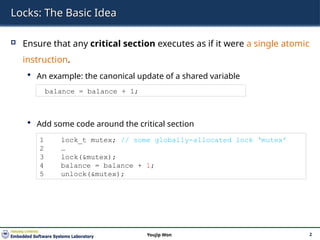
Ensure that any critical section executes as if it were a single atomic
instruction.
An example: the canonical update of a shared variable
Add some code around the critical section
2
Youjip Won
balance = balance + 1;
1 lock_t mutex; // some globally-allocated lock ‘mutex’
2 …
3 lock(&mutex);
4 balance = balance + 1;
5 unlock(&mutex);
3.
Locks: The BasicIdea
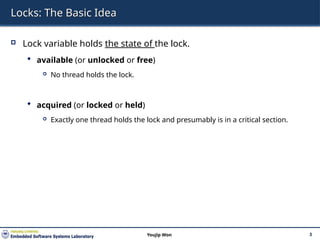
Lock variable holds the state of the lock.
available (or unlocked or free)
No thread holds the lock.
acquired (or locked or held)
Exactly one thread holds the lock and presumably is in a critical section.
3
Youjip Won
4.
The semantics ofthe lock()
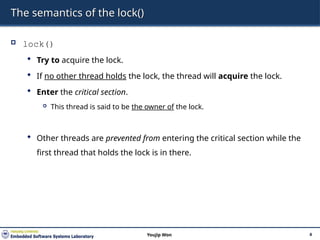
lock()
Try to acquire the lock.
If no other thread holds the lock, the thread will acquire the lock.
Enter the critical section.
This thread is said to be the owner of the lock.
Other threads are prevented from entering the critical section while the
first thread that holds the lock is in there.
4
Youjip Won
5.
Pthread Locks -mutex
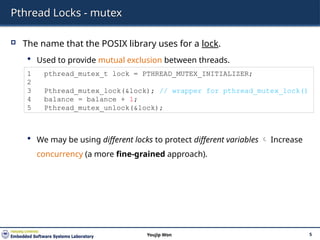
The name that the POSIX library uses for a lock.
Used to provide mutual exclusion between threads.
We may be using different locks to protect different variables Increase
concurrency (a more fine-grained approach).
5
Youjip Won
1 pthread_mutex_t lock = PTHREAD_MUTEX_INITIALIZER;
2
3 Pthread_mutex_lock(&lock); // wrapper for pthread_mutex_lock()
4 balance = balance + 1;
5 Pthread_mutex_unlock(&lock);
6.
Building A Lock
Efficient locks provided mutual exclusion at low cost.
Building a lock need some help from the hardware and the OS.
6
Youjip Won
7.
Evaluating locks –Basic criteria
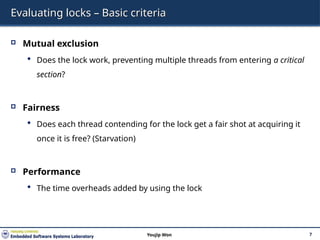
Mutual exclusion
Does the lock work, preventing multiple threads from entering a critical
section?
Fairness
Does each thread contending for the lock get a fair shot at acquiring it
once it is free? (Starvation)
Performance
The time overheads added by using the lock
7
Youjip Won
8.
Controlling Interrupts
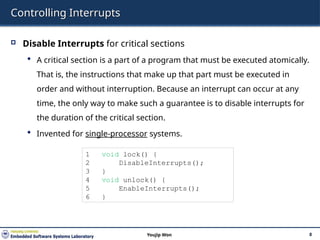
DisableInterrupts for critical sections
A critical section is a part of a program that must be executed atomically.
That is, the instructions that make up that part must be executed in
order and without interruption. Because an interrupt can occur at any
time, the only way to make such a guarantee is to disable interrupts for
the duration of the critical section.
Invented for single-processor systems.
8
Youjip Won
1 void lock() {
2 DisableInterrupts();
3 }
4 void unlock() {
5 EnableInterrupts();
6 }
9.
Why hardware supportneeded?
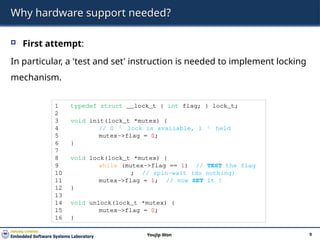
First attempt:
In particular, a 'test and set' instruction is needed to implement locking
mechanism.
9
Youjip Won
1 typedef struct __lock_t { int flag; } lock_t;
2
3 void init(lock_t *mutex) {
4 // 0 lock is available, 1 held
5 mutex->flag = 0;
6 }
7
8 void lock(lock_t *mutex) {
9 while (mutex->flag == 1) // TEST the flag
10 ; // spin-wait (do nothing)
11 mutex->flag = 1; // now SET it !
12 }
13
14 void unlock(lock_t *mutex) {
15 mutex->flag = 0;
16 }
10.
Why hardware supportneeded? (Cont.)
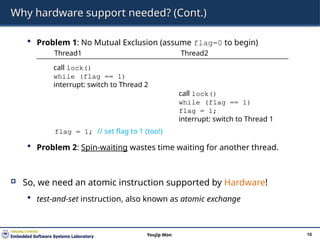
Problem 1: No Mutual Exclusion (assume flag=0 to begin)
Problem 2: Spin-waiting wastes time waiting for another thread.
So, we need an atomic instruction supported by Hardware!
test-and-set instruction, also known as atomic exchange
10
Youjip Won
Thread1 Thread2
call lock()
while (flag == 1)
interrupt: switch to Thread 2
call lock()
while (flag == 1)
flag = 1;
interrupt: switch to Thread 1
flag = 1; // set flag to 1 (too!)
11.
Test And Set(Atomic Exchange)
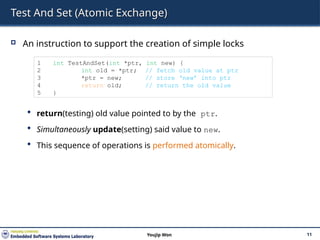
An instruction to support the creation of simple locks
return(testing) old value pointed to by the ptr.
Simultaneously update(setting) said value to new.
This sequence of operations is performed atomically.
11
Youjip Won
1 int TestAndSet(int *ptr, int new) {
2 int old = *ptr; // fetch old value at ptr
3 *ptr = new; // store ‘new’ into ptr
4 return old; // return the old value
5 }
12.
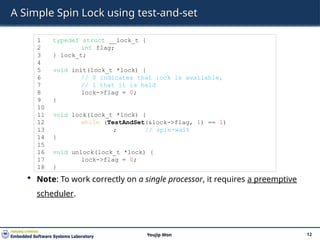
A Simple SpinLock using test-and-set
Note: To work correctly on a single processor, it requires a preemptive
scheduler.
12
Youjip Won
1 typedef struct __lock_t {
2 int flag;
3 } lock_t;
4
5 void init(lock_t *lock) {
6 // 0 indicates that lock is available,
7 // 1 that it is held
8 lock->flag = 0;
9 }
10
11 void lock(lock_t *lock) {
12 while (TestAndSet(&lock->flag, 1) == 1)
13 ; // spin-wait
14 }
15
16 void unlock(lock_t *lock) {
17 lock->flag = 0;
18 }
13.
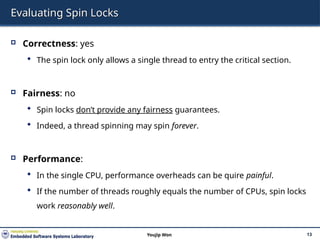
Evaluating Spin Locks
Correctness: yes
The spin lock only allows a single thread to entry the critical section.
Fairness: no
Spin locks don’t provide any fairness guarantees.
Indeed, a thread spinning may spin forever.
Performance:
In the single CPU, performance overheads can be quire painful.
If the number of threads roughly equals the number of CPUs, spin locks
work reasonably well.
13
Youjip Won
14.
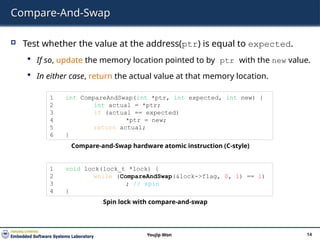
Compare-And-Swap
Test whetherthe value at the address(ptr) is equal to expected.
If so, update the memory location pointed to by ptr with the new value.
In either case, return the actual value at that memory location.
14
Youjip Won
1 int CompareAndSwap(int *ptr, int expected, int new) {
2 int actual = *ptr;
3 if (actual == expected)
4 *ptr = new;
5 return actual;
6 }
Compare-and-Swap hardware atomic instruction (C-style)
1 void lock(lock_t *lock) {
2 while (CompareAndSwap(&lock->flag, 0, 1) == 1)
3 ; // spin
4 }
Spin lock with compare-and-swap
15.
Compare-And-Swap (Cont.)
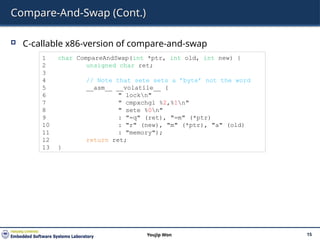
C-callablex86-version of compare-and-swap
15
Youjip Won
1 char CompareAndSwap(int *ptr, int old, int new) {
2 unsigned char ret;
3
4 // Note that sete sets a ’byte’ not the word
5 __asm__ __volatile__ (
6 " lockn"
7 " cmpxchgl %2,%1n"
8 " sete %0n"
9 : "=q" (ret), "=m" (*ptr)
10 : "r" (new), "m" (*ptr), "a" (old)
11 : "memory");
12 return ret;
13 }
16.
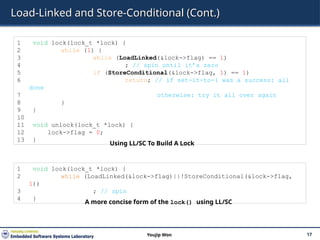
Load-Linked and Store-Conditional
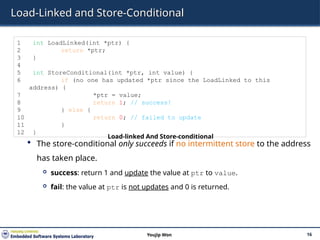
The store-conditional only succeeds if no intermittent store to the address
has taken place.
success: return 1 and update the value at ptr to value.
fail: the value at ptr is not updates and 0 is returned.
16
Youjip Won
1 int LoadLinked(int *ptr) {
2 return *ptr;
3 }
4
5 int StoreConditional(int *ptr, int value) {
6 if (no one has updated *ptr since the LoadLinked to this
address) {
7 *ptr = value;
8 return 1; // success!
9 } else {
10 return 0; // failed to update
11 }
12 }
Load-linked And Store-conditional
17.
Load-Linked and Store-Conditional(Cont.)
17
Youjip Won
1 void lock(lock_t *lock) {
2 while (1) {
3 while (LoadLinked(&lock->flag) == 1)
4 ; // spin until it’s zero
5 if (StoreConditional(&lock->flag, 1) == 1)
6 return; // if set-it-to-1 was a success: all
done
7 otherwise: try it all over again
8 }
9 }
10
11 void unlock(lock_t *lock) {
12 lock->flag = 0;
13 }
Using LL/SC To Build A Lock
1 void lock(lock_t *lock) {
2 while (LoadLinked(&lock->flag)||!StoreConditional(&lock->flag,
1))
3 ; // spin
4 }
A more concise form of the lock() using LL/SC
18.
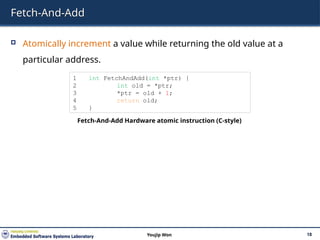
Fetch-And-Add
Atomically incrementa value while returning the old value at a
particular address.
18
Youjip Won
1 int FetchAndAdd(int *ptr) {
2 int old = *ptr;
3 *ptr = old + 1;
4 return old;
5 }
Fetch-And-Add Hardware atomic instruction (C-style)
19.
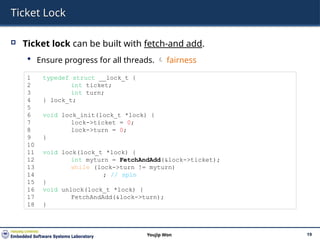
Ticket Lock
Ticketlock can be built with fetch-and add.
Ensure progress for all threads. fairness
19
Youjip Won
1 typedef struct __lock_t {
2 int ticket;
3 int turn;
4 } lock_t;
5
6 void lock_init(lock_t *lock) {
7 lock->ticket = 0;
8 lock->turn = 0;
9 }
10
11 void lock(lock_t *lock) {
12 int myturn = FetchAndAdd(&lock->ticket);
13 while (lock->turn != myturn)
14 ; // spin
15 }
16 void unlock(lock_t *lock) {
17 FetchAndAdd(&lock->turn);
18 }
20.
So Much Spinning
Hardware-based spin locks are simple and they work.
In some cases, these solutions can be quite inefficient.
Any time a thread gets caught spinning, it wastes an entire time slice
doing nothing but checking a value.
20
Youjip Won
How To Avoid Spinning?
We’ll need OS Support too!
21.
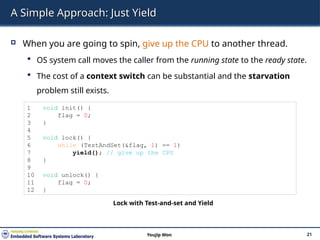
A Simple Approach:Just Yield
When you are going to spin, give up the CPU to another thread.
OS system call moves the caller from the running state to the ready state.
The cost of a context switch can be substantial and the starvation
problem still exists.
21
Youjip Won
1 void init() {
2 flag = 0;
3 }
4
5 void lock() {
6 while (TestAndSet(&flag, 1) == 1)
7 yield(); // give up the CPU
8 }
9
10 void unlock() {
11 flag = 0;
12 }
Lock with Test-and-set and Yield
22.
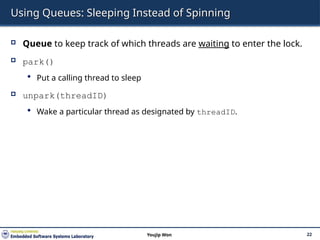
Using Queues: SleepingInstead of Spinning
Queue to keep track of which threads are waiting to enter the lock.
park()
Put a calling thread to sleep
unpark(threadID)
Wake a particular thread as designated by threadID.
22
Youjip Won
23.
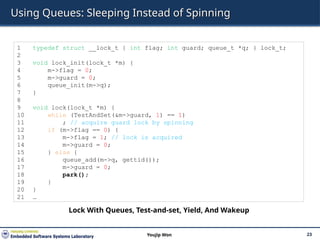
Using Queues: SleepingInstead of Spinning
23
Youjip Won
1 typedef struct __lock_t { int flag; int guard; queue_t *q; } lock_t;
2
3 void lock_init(lock_t *m) {
4 m->flag = 0;
5 m->guard = 0;
6 queue_init(m->q);
7 }
8
9 void lock(lock_t *m) {
10 while (TestAndSet(&m->guard, 1) == 1)
11 ; // acquire guard lock by spinning
12 if (m->flag == 0) {
13 m->flag = 1; // lock is acquired
14 m->guard = 0;
15 } else {
16 queue_add(m->q, gettid());
17 m->guard = 0;
18 park();
19 }
20 }
21 …
Lock With Queues, Test-and-set, Yield, And Wakeup
24.
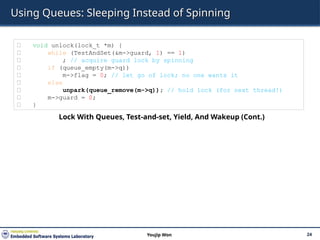
Using Queues: SleepingInstead of Spinning
24
Youjip Won
㉒ void unlock(lock_t *m) {
㉓ while (TestAndSet(&m->guard, 1) == 1)
㉔ ; // acquire guard lock by spinning
㉕ if (queue_empty(m->q))
㉖ m->flag = 0; // let go of lock; no one wants it
㉗ else
㉘ unpark(queue_remove(m->q)); // hold lock (for next thread!)
㉙ m->guard = 0;
㉚ }
Lock With Queues, Test-and-set, Yield, And Wakeup (Cont.)
25.
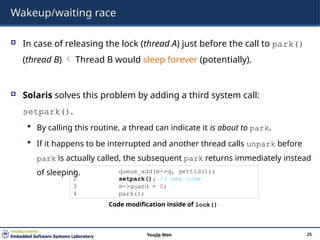
Wakeup/waiting race
Incase of releasing the lock (thread A) just before the call to park()
(thread B) Thread B would sleep forever (potentially).
Solaris solves this problem by adding a third system call:
setpark().
By calling this routine, a thread can indicate it is about to park.
If it happens to be interrupted and another thread calls unpark before
park is actually called, the subsequent park returns immediately instead
of sleeping.
25
Youjip Won
1 queue_add(m->q, gettid());
2 setpark(); // new code
3 m->guard = 0;
4 park();
Code modification inside of lock()
26.
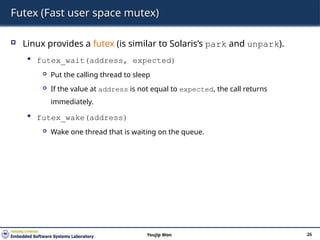
Futex (Fast userspace mutex)
Linux provides a futex (is similar to Solaris’s park and unpark).
futex_wait(address, expected)
Put the calling thread to sleep
If the value at address is not equal to expected, the call returns
immediately.
futex_wake(address)
Wake one thread that is waiting on the queue.
26
Youjip Won
27.
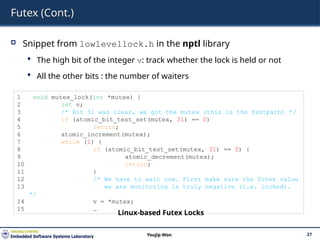
Futex (Cont.)
Snippetfrom lowlevellock.h in the nptl library
The high bit of the integer v: track whether the lock is held or not
All the other bits : the number of waiters
27
Youjip Won
1 void mutex_lock(int *mutex) {
2 int v;
3 /* Bit 31 was clear, we got the mutex (this is the fastpath) */
4 if (atomic_bit_test_set(mutex, 31) == 0)
5 return;
6 atomic_increment(mutex);
7 while (1) {
8 if (atomic_bit_test_set(mutex, 31) == 0) {
9 atomic_decrement(mutex);
10 return;
11 }
12 /* We have to wait now. First make sure the futex value
13 we are monitoring is truly negative (i.e. locked).
*/
14 v = *mutex;
15 …
Linux-based Futex Locks
28.
Futex (Cont.)
28
Youjip Won
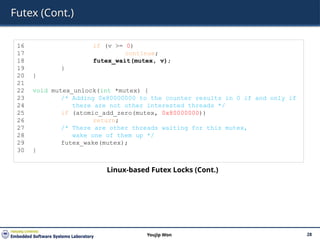
16if (v >= 0)
17 continue;
18 futex_wait(mutex, v);
19 }
20 }
21
22 void mutex_unlock(int *mutex) {
23 /* Adding 0x80000000 to the counter results in 0 if and only if
24 there are not other interested threads */
25 if (atomic_add_zero(mutex, 0x80000000))
26 return;
27 /* There are other threads waiting for this mutex,
28 wake one of them up */
29 futex_wake(mutex);
30 }
Linux-based Futex Locks (Cont.)
29.
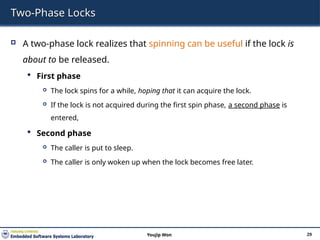
Two-Phase Locks
Atwo-phase lock realizes that spinning can be useful if the lock is
about to be released.
First phase
The lock spins for a while, hoping that it can acquire the lock.
If the lock is not acquired during the first spin phase, a second phase is
entered,
Second phase
The caller is put to sleep.
The caller is only woken up when the lock becomes free later.
29
Youjip Won
30.
Disclaimer: Thislecture slide set was initially developed for Operating System course in
Computer Science Dept. at Hanyang University. This lecture slide set is for OSTEP book
written by Remzi and Andrea at University of Wisconsin.
30
Youjip Won