Character Device (example)
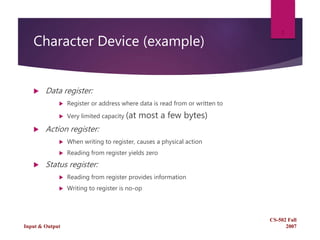
 Data register:
 Register or address where data is read from or written to
 Very limited capacity (at most a few bytes)
 Action register:
 When writing to register, causes a physical action
 Reading from register yields zero
 Status register:
 Reading from register provides information
 Writing to register is no-op
CS-502 Fall
2007Input & Output
2
Overview
• What is I/O?
• Principles of I/O hardware
• Principles of I/O software
The I/O Subsystem
• The largest, most complex subsystem in OS
• Most lines of code
• Highest rate of code changes
• Where OS engineers most likely to work
• Difficult to test thoroughly
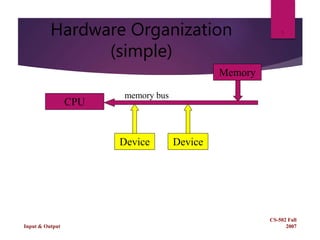
Hardware Organization
(simple)
CS-502 Fall
2007Input & Output
5
Device
CPU
Memory
memory bus
Device
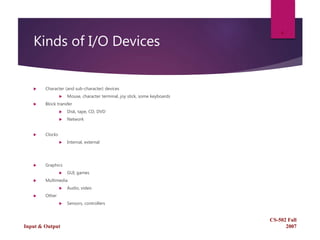
Kinds of I/O Devices
 Character (and sub-character) devices
 Mouse, character terminal, joy stick, some keyboards
 Block transfer
 Disk, tape, CD, DVD
 Network
 Clocks
 Internal, external
 Graphics
 GUI, games
 Multimedia
 Audio, video
 Other
 Sensors, controllers
CS-502 Fall
2007Input & Output
6
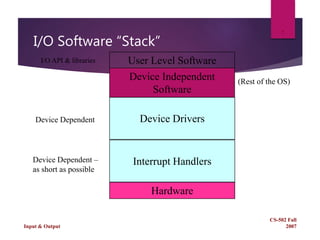
I/O Software “Stack”
CS-502 Fall
2007Input & Output
7
User Level Software
Device Independent
Software
Device Drivers
Interrupt Handlers
Hardware
I/O API & libraries
Device Dependent
Device Dependent –
as short as possible
(Rest of the OS)
Case study
Objectives
 To explore the history of the UNIX operating system from
which Linux is derived and the principles which Linux is
designed upon
 To examine the Linux process model and illustrate how
Linux schedules processes and provides interprocess
communication
 To look at memory management in Linux
 To explore how Linux implements file systems and
manages I/O devices
Kernel Synchronization
 A request for kernel-mode execution can occur in two
ways:
 A running program may request an operating system service,
either explicitly via a system call, or implicitly, for example,
when a page fault occurs
 A device driver may deliver a hardware interrupt that causes
the CPU to start executing a kernel-defined handler for that
interrupt
 Kernel synchronization requires a framework that will
allow the kernel’s critical sections to run without
interruption by another critical section
Kernel Synchronization (Cont)
 Linux uses two techniques to protect critical sections:
1. Normal kernel code is nonpreemptible (until 2.4)
– when a time interrupt is received while a process is
executing a kernel system service routine, the kernel’s
need_resched flag is set so that the scheduler will run
once the system call has completed and control is
about to be returned to user mode
2. The second technique applies to critical sections that occur in an
interrupt service routines
– By using the processor’s interrupt control hardware to disable
interrupts during a critical section, the kernel guarantees that it
can proceed without the risk of concurrent access of shared
data structures
Kernel Synchronization (Cont)
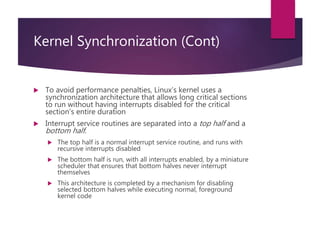
 To avoid performance penalties, Linux’s kernel uses a
synchronization architecture that allows long critical sections
to run without having interrupts disabled for the critical
section’s entire duration
 Interrupt service routines are separated into a top half and a
bottom half.
 The top half is a normal interrupt service routine, and runs with
recursive interrupts disabled
 The bottom half is run, with all interrupts enabled, by a miniature
scheduler that ensures that bottom halves never interrupt
themselves
 This architecture is completed by a mechanism for disabling
selected bottom halves while executing normal, foreground
kernel code
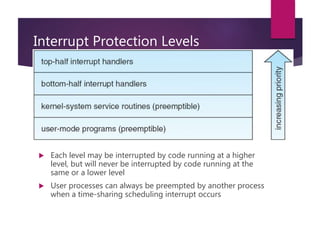
Interrupt Protection Levels
 Each level may be interrupted by code running at a higher
level, but will never be interrupted by code running at the
same or a lower level
 User processes can always be preempted by another process
when a time-sharing scheduling interrupt occurs
Process Scheduling Linux uses two process-scheduling algorithms:
 A time-sharing algorithm for fair preemptive scheduling between multiple
processes
 A real-time algorithm for tasks where absolute priorities are more
important than fairness
 A process’s scheduling class defines which algorithm to apply
 For time-sharing processes, Linux uses a prioritized, credit based
algorithm
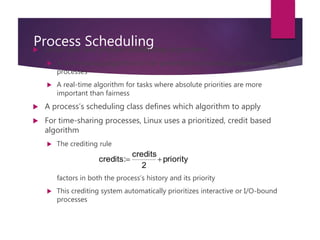
 The crediting rule
factors in both the process’s history and its priority
 This crediting system automatically prioritizes interactive or I/O-bound
processes
priority
2
credits
:credits 
Process Scheduling (Cont)
 Linux implements the FIFO and round-robin real-time
scheduling classes; in both cases, each process has a
priority in addition to its scheduling class
 The scheduler runs the process with the highest priority; for
equal-priority processes, it runs the process waiting the
longest
 FIFO processes continue to run until they either exit or block
 A round-robin process will be preempted after a while and
moved to the end of the scheduling queue, so that round-
robing processes of equal priority automatically time-share
between themselves
Symmetric Multiprocessing
 Linux 2.0 was the first Linux kernel to support SMP
hardware; separate processes or threads can execute in
parallel on separate processors
 To preserve the kernel’s nonpreemptible synchronization
requirements, SMP imposes the restriction, via a single
kernel spinlock, that only one processor at a time may
execute kernel-mode code
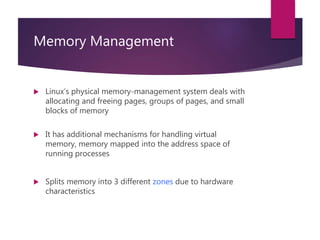
Memory Management
 Linux’s physical memory-management system deals with
allocating and freeing pages, groups of pages, and small
blocks of memory
 It has additional mechanisms for handling virtual
memory, memory mapped into the address space of
running processes
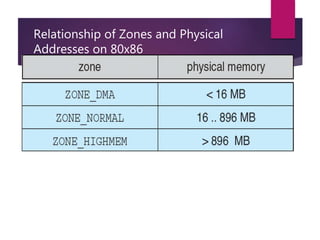
 Splits memory into 3 different zones due to hardware
characteristics
Relationship of Zones and Physical
Addresses on 80x86
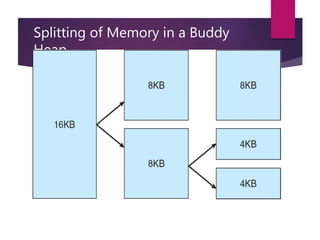
Splitting of Memory in a Buddy
Heap
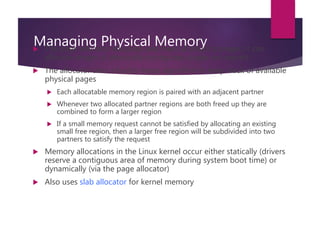
Managing Physical Memory The page allocator allocates and frees all physical pages; it can
allocate ranges of physically-contiguous pages on request
 The allocator uses a buddy-heap algorithm to keep track of available
physical pages
 Each allocatable memory region is paired with an adjacent partner
 Whenever two allocated partner regions are both freed up they are
combined to form a larger region
 If a small memory request cannot be satisfied by allocating an existing
small free region, then a larger free region will be subdivided into two
partners to satisfy the request
 Memory allocations in the Linux kernel occur either statically (drivers
reserve a contiguous area of memory during system boot time) or
dynamically (via the page allocator)
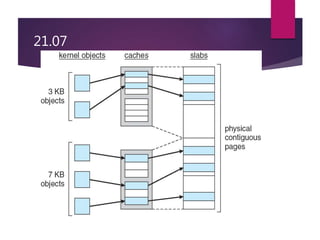
 Also uses slab allocator for kernel memory
21.07
Virtual Memory
 The VM system maintains the address space visible to each
process: It creates pages of virtual memory on demand, and
manages the loading of those pages from disk or their
swapping back out to disk as required
 The VM manager maintains two separate views of a process’s
address space:
 A logical view describing instructions concerning the layout of
the address space
 The address space consists of a set of nonoverlapping regions, each
representing a continuous, page-aligned subset of the address space
 A physical view of each address space which is stored in the
hardware page tables for the process
Virtual Memory (Cont)
 Virtual memory regions are characterized by:
 The backing store, which describes from where the pages for
a region come; regions are usually backed by a file or by
nothing (demand-zero memory)
 The region’s reaction to writes (page sharing or copy-on-
write)
 The kernel creates a new virtual address space
1. When a process runs a new program with the exec system
call
2. Upon creation of a new process by the fork system call
Virtual Memory (Cont)
 On executing a new program, the process is given a new,
completely empty virtual-address space; the program-
loading routines populate the address space with virtual-
memory regions
 Creating a new process with fork involves creating a
complete copy of the existing process’s virtual address space
 The kernel copies the parent process’s VMA descriptors, then
creates a new set of page tables for the child
 The parent’s page tables are copied directly into the child’s, with
the reference count of each page covered being incremented
 After the fork, the parent and child share the same physical
pages of memory in their address spaces
Virtual Memory (Cont)
 The VM paging system relocates pages of memory from
physical memory out to disk when the memory is needed
for something else
 The VM paging system can be divided into two sections:
 The pageout-policy algorithm decides which pages to write
out to disk, and when
 The paging mechanism actually carries out the transfer, and
pages data back into physical memory as needed
Virtual Memory (Cont)
 The Linux kernel reserves a constant, architecture-
dependent region of the virtual address space of every
process for its own internal use
 This kernel virtual-memory area contains two regions:
 A static area that contains page table references to every
available physical page of memory in the system, so that
there is a simple translation from physical to virtual
addresses when running kernel code
 The reminder of the reserved section is not reserved for any
specific purpose; its page-table entries can be modified to
point to any other areas of memory
Executing and Loading User Programs
 Linux maintains a table of functions for loading programs; it gives
each function the opportunity to try loading the given file when an
exec system call is made
 The registration of multiple loader routines allows Linux to support
both the ELF and a.out binary formats
 Initially, binary-file pages are mapped into virtual memory
 Only when a program tries to access a given page will a page fault
result in that page being loaded into physical memory
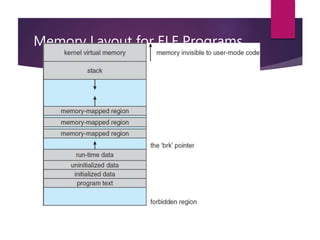
 An ELF-format binary file consists of a header followed by several
page-aligned sections
 The ELF loader works by reading the header and mapping the
sections of the file into separate regions of virtual memory
Memory Layout for ELF Programs
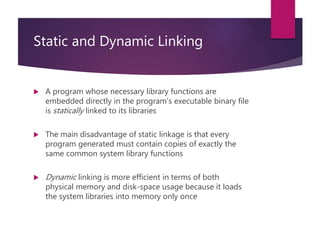
Static and Dynamic Linking
 A program whose necessary library functions are
embedded directly in the program’s executable binary file
is statically linked to its libraries
 The main disadvantage of static linkage is that every
program generated must contain copies of exactly the
same common system library functions
 Dynamic linking is more efficient in terms of both
physical memory and disk-space usage because it loads
the system libraries into memory only once
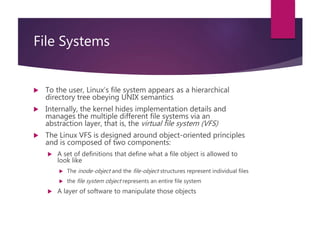
File Systems
 To the user, Linux’s file system appears as a hierarchical
directory tree obeying UNIX semantics
 Internally, the kernel hides implementation details and
manages the multiple different file systems via an
abstraction layer, that is, the virtual file system (VFS)
 The Linux VFS is designed around object-oriented principles
and is composed of two components:
 A set of definitions that define what a file object is allowed to
look like
 The inode-object and the file-object structures represent individual files
 the file system object represents an entire file system
 A layer of software to manipulate those objects
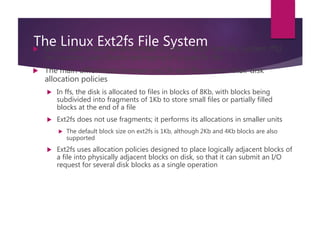
The Linux Ext2fs File System Ext2fs uses a mechanism similar to that of BSD Fast File System (ffs)
for locating data blocks belonging to a specific file
 The main differences between ext2fs and ffs concern their disk
allocation policies
 In ffs, the disk is allocated to files in blocks of 8Kb, with blocks being
subdivided into fragments of 1Kb to store small files or partially filled
blocks at the end of a file
 Ext2fs does not use fragments; it performs its allocations in smaller units
 The default block size on ext2fs is 1Kb, although 2Kb and 4Kb blocks are also
supported
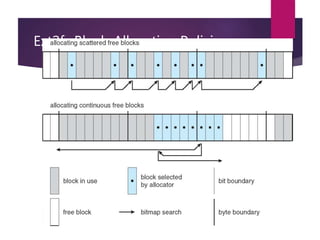
 Ext2fs uses allocation policies designed to place logically adjacent blocks of
a file into physically adjacent blocks on disk, so that it can submit an I/O
request for several disk blocks as a single operation
Ext2fs Block-Allocation Policies
The Linux Proc File System
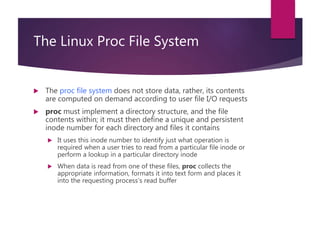
 The proc file system does not store data, rather, its contents
are computed on demand according to user file I/O requests
 proc must implement a directory structure, and the file
contents within; it must then define a unique and persistent
inode number for each directory and files it contains
 It uses this inode number to identify just what operation is
required when a user tries to read from a particular file inode or
perform a lookup in a particular directory inode
 When data is read from one of these files, proc collects the
appropriate information, formats it into text form and places it
into the requesting process’s read buffer
Input and Output
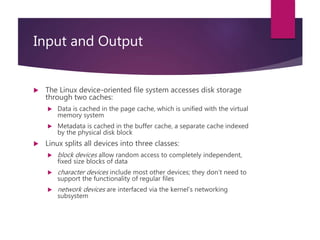
 The Linux device-oriented file system accesses disk storage
through two caches:
 Data is cached in the page cache, which is unified with the virtual
memory system
 Metadata is cached in the buffer cache, a separate cache indexed
by the physical disk block
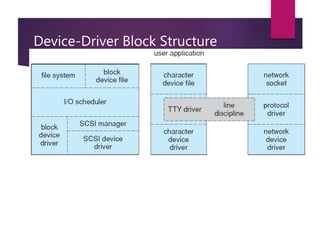
 Linux splits all devices into three classes:
 block devices allow random access to completely independent,
fixed size blocks of data
 character devices include most other devices; they don’t need to
support the functionality of regular files
 network devices are interfaced via the kernel’s networking
subsystem
Device-Driver Block Structure
Block Devices
 Provide the main interface to all disk devices in a system
 The block buffer cache serves two main purposes:
 it acts as a pool of buffers for active I/O
 it serves as a cache for completed I/O
 The request manager manages the reading and writing of
buffer contents to and from a block device driver
Character Devices
 A device driver which does not offer random access to
fixed blocks of data
 A character device driver must register a set of functions
which implement the driver’s various file I/O operations
 The kernel performs almost no preprocessing of a file
read or write request to a character device, but simply
passes on the request to the device
 The main exception to this rule is the special subset of
character device drivers which implement terminal
devices, for which the kernel maintains a standard
interface
Interprocess Communication
 Like UNIX, Linux informs processes that an event has
occurred via signals
 There is a limited number of signals, and they cannot
carry information: Only the fact that a signal occurred is
available to a process
 The Linux kernel does not use signals to communicate
with processes with are running in kernel mode, rather,
communication within the kernel is accomplished via
scheduling states and wait.queue structures
Passing Data Between Processes
 The pipe mechanism allows a child process to inherit a
communication channel to its parent, data written to one
end of the pipe can be read a the other
 Shared memory offers an extremely fast way of
communicating; any data written by one process to a shared
memory region can be read immediately by any other
process that has mapped that region into its address space
 To obtain synchronization, however, shared memory must be
used in conjunction with another Interprocess-
communication mechanism
Shared Memory Object
 The shared-memory object acts as a backing store for
shared-memory regions in the same way as a file can act
as backing store for a memory-mapped memory region
 Shared-memory mappings direct page faults to map in
pages from a persistent shared-memory object
 Shared-memory objects remember their contents even if
no processes are currently mapping them into virtual
memory
Network Structure
 Networking is a key area of functionality for Linux.
 It supports the standard Internet protocols for UNIX to UNIX
communications
 It also implements protocols native to nonUNIX operating
systems, in particular, protocols used on PC networks, such as
Appletalk and IPX
 Internally, networking in the Linux kernel is implemented by
three layers of software:
 The socket interface
 Protocol drivers
 Network device drivers
Network Structure (Cont)
 The most important set of protocols in the Linux
networking system is the internet protocol suite
 It implements routing between different hosts anywhere on
the network
 On top of the routing protocol are built the UDP, TCP and
ICMP protocols
Security
 The pluggable authentication modules (PAM) system is
available under Linux
 PAM is based on a shared library that can be used by any
system component that needs to authenticate users
 Access control under UNIX systems, including Linux, is
performed through the use of unique numeric identifiers
(uid and gid)
 Access control is performed by assigning objects a
protections mask, which specifies which access modes—
read, write, or execute—are to be granted to processes
with owner, group, or world access
Security (Cont)
 Linux augments the standard UNIX setuid mechanism in
two ways:
 It implements the POSIX specification’s saved user-id
mechanism, which allows a process to repeatedly drop and
reacquire its effective uid
 It has added a process characteristic that grants just a subset
of the rights of the effective uid
 Linux provides another mechanism that allows a client to
selectively pass access to a single file to some server
process without granting it any other privileges
Io sy.stemppt

Io sy.stemppt

  • 2.
    Character Device (example) Data register:  Register or address where data is read from or written to  Very limited capacity (at most a few bytes)  Action register:  When writing to register, causes a physical action  Reading from register yields zero  Status register:  Reading from register provides information  Writing to register is no-op CS-502 Fall 2007Input & Output 2
  • 3.
    Overview • What isI/O? • Principles of I/O hardware • Principles of I/O software
  • 4.
    The I/O Subsystem •The largest, most complex subsystem in OS • Most lines of code • Highest rate of code changes • Where OS engineers most likely to work • Difficult to test thoroughly
  • 5.
    Hardware Organization (simple) CS-502 Fall 2007Input& Output 5 Device CPU Memory memory bus Device
  • 6.
    Kinds of I/ODevices  Character (and sub-character) devices  Mouse, character terminal, joy stick, some keyboards  Block transfer  Disk, tape, CD, DVD  Network  Clocks  Internal, external  Graphics  GUI, games  Multimedia  Audio, video  Other  Sensors, controllers CS-502 Fall 2007Input & Output 6
  • 7.
    I/O Software “Stack” CS-502Fall 2007Input & Output 7 User Level Software Device Independent Software Device Drivers Interrupt Handlers Hardware I/O API & libraries Device Dependent Device Dependent – as short as possible (Rest of the OS)
  • 8.
  • 9.
    Objectives  To explorethe history of the UNIX operating system from which Linux is derived and the principles which Linux is designed upon  To examine the Linux process model and illustrate how Linux schedules processes and provides interprocess communication  To look at memory management in Linux  To explore how Linux implements file systems and manages I/O devices
  • 10.
    Kernel Synchronization  Arequest for kernel-mode execution can occur in two ways:  A running program may request an operating system service, either explicitly via a system call, or implicitly, for example, when a page fault occurs  A device driver may deliver a hardware interrupt that causes the CPU to start executing a kernel-defined handler for that interrupt  Kernel synchronization requires a framework that will allow the kernel’s critical sections to run without interruption by another critical section
  • 11.
    Kernel Synchronization (Cont) Linux uses two techniques to protect critical sections: 1. Normal kernel code is nonpreemptible (until 2.4) – when a time interrupt is received while a process is executing a kernel system service routine, the kernel’s need_resched flag is set so that the scheduler will run once the system call has completed and control is about to be returned to user mode 2. The second technique applies to critical sections that occur in an interrupt service routines – By using the processor’s interrupt control hardware to disable interrupts during a critical section, the kernel guarantees that it can proceed without the risk of concurrent access of shared data structures
  • 12.
    Kernel Synchronization (Cont) To avoid performance penalties, Linux’s kernel uses a synchronization architecture that allows long critical sections to run without having interrupts disabled for the critical section’s entire duration  Interrupt service routines are separated into a top half and a bottom half.  The top half is a normal interrupt service routine, and runs with recursive interrupts disabled  The bottom half is run, with all interrupts enabled, by a miniature scheduler that ensures that bottom halves never interrupt themselves  This architecture is completed by a mechanism for disabling selected bottom halves while executing normal, foreground kernel code
  • 13.
    Interrupt Protection Levels Each level may be interrupted by code running at a higher level, but will never be interrupted by code running at the same or a lower level  User processes can always be preempted by another process when a time-sharing scheduling interrupt occurs
  • 14.
    Process Scheduling Linuxuses two process-scheduling algorithms:  A time-sharing algorithm for fair preemptive scheduling between multiple processes  A real-time algorithm for tasks where absolute priorities are more important than fairness  A process’s scheduling class defines which algorithm to apply  For time-sharing processes, Linux uses a prioritized, credit based algorithm  The crediting rule factors in both the process’s history and its priority  This crediting system automatically prioritizes interactive or I/O-bound processes priority 2 credits :credits 
  • 15.
    Process Scheduling (Cont) Linux implements the FIFO and round-robin real-time scheduling classes; in both cases, each process has a priority in addition to its scheduling class  The scheduler runs the process with the highest priority; for equal-priority processes, it runs the process waiting the longest  FIFO processes continue to run until they either exit or block  A round-robin process will be preempted after a while and moved to the end of the scheduling queue, so that round- robing processes of equal priority automatically time-share between themselves
  • 16.
    Symmetric Multiprocessing  Linux2.0 was the first Linux kernel to support SMP hardware; separate processes or threads can execute in parallel on separate processors  To preserve the kernel’s nonpreemptible synchronization requirements, SMP imposes the restriction, via a single kernel spinlock, that only one processor at a time may execute kernel-mode code
  • 17.
    Memory Management  Linux’sphysical memory-management system deals with allocating and freeing pages, groups of pages, and small blocks of memory  It has additional mechanisms for handling virtual memory, memory mapped into the address space of running processes  Splits memory into 3 different zones due to hardware characteristics
  • 18.
    Relationship of Zonesand Physical Addresses on 80x86
  • 19.
    Splitting of Memoryin a Buddy Heap
  • 20.
    Managing Physical MemoryThe page allocator allocates and frees all physical pages; it can allocate ranges of physically-contiguous pages on request  The allocator uses a buddy-heap algorithm to keep track of available physical pages  Each allocatable memory region is paired with an adjacent partner  Whenever two allocated partner regions are both freed up they are combined to form a larger region  If a small memory request cannot be satisfied by allocating an existing small free region, then a larger free region will be subdivided into two partners to satisfy the request  Memory allocations in the Linux kernel occur either statically (drivers reserve a contiguous area of memory during system boot time) or dynamically (via the page allocator)  Also uses slab allocator for kernel memory
  • 21.
  • 22.
    Virtual Memory  TheVM system maintains the address space visible to each process: It creates pages of virtual memory on demand, and manages the loading of those pages from disk or their swapping back out to disk as required  The VM manager maintains two separate views of a process’s address space:  A logical view describing instructions concerning the layout of the address space  The address space consists of a set of nonoverlapping regions, each representing a continuous, page-aligned subset of the address space  A physical view of each address space which is stored in the hardware page tables for the process
  • 23.
    Virtual Memory (Cont) Virtual memory regions are characterized by:  The backing store, which describes from where the pages for a region come; regions are usually backed by a file or by nothing (demand-zero memory)  The region’s reaction to writes (page sharing or copy-on- write)  The kernel creates a new virtual address space 1. When a process runs a new program with the exec system call 2. Upon creation of a new process by the fork system call
  • 24.
    Virtual Memory (Cont) On executing a new program, the process is given a new, completely empty virtual-address space; the program- loading routines populate the address space with virtual- memory regions  Creating a new process with fork involves creating a complete copy of the existing process’s virtual address space  The kernel copies the parent process’s VMA descriptors, then creates a new set of page tables for the child  The parent’s page tables are copied directly into the child’s, with the reference count of each page covered being incremented  After the fork, the parent and child share the same physical pages of memory in their address spaces
  • 25.
    Virtual Memory (Cont) The VM paging system relocates pages of memory from physical memory out to disk when the memory is needed for something else  The VM paging system can be divided into two sections:  The pageout-policy algorithm decides which pages to write out to disk, and when  The paging mechanism actually carries out the transfer, and pages data back into physical memory as needed
  • 26.
    Virtual Memory (Cont) The Linux kernel reserves a constant, architecture- dependent region of the virtual address space of every process for its own internal use  This kernel virtual-memory area contains two regions:  A static area that contains page table references to every available physical page of memory in the system, so that there is a simple translation from physical to virtual addresses when running kernel code  The reminder of the reserved section is not reserved for any specific purpose; its page-table entries can be modified to point to any other areas of memory
  • 27.
    Executing and LoadingUser Programs  Linux maintains a table of functions for loading programs; it gives each function the opportunity to try loading the given file when an exec system call is made  The registration of multiple loader routines allows Linux to support both the ELF and a.out binary formats  Initially, binary-file pages are mapped into virtual memory  Only when a program tries to access a given page will a page fault result in that page being loaded into physical memory  An ELF-format binary file consists of a header followed by several page-aligned sections  The ELF loader works by reading the header and mapping the sections of the file into separate regions of virtual memory
  • 28.
    Memory Layout forELF Programs
  • 29.
    Static and DynamicLinking  A program whose necessary library functions are embedded directly in the program’s executable binary file is statically linked to its libraries  The main disadvantage of static linkage is that every program generated must contain copies of exactly the same common system library functions  Dynamic linking is more efficient in terms of both physical memory and disk-space usage because it loads the system libraries into memory only once
  • 30.
    File Systems  Tothe user, Linux’s file system appears as a hierarchical directory tree obeying UNIX semantics  Internally, the kernel hides implementation details and manages the multiple different file systems via an abstraction layer, that is, the virtual file system (VFS)  The Linux VFS is designed around object-oriented principles and is composed of two components:  A set of definitions that define what a file object is allowed to look like  The inode-object and the file-object structures represent individual files  the file system object represents an entire file system  A layer of software to manipulate those objects
  • 31.
    The Linux Ext2fsFile System Ext2fs uses a mechanism similar to that of BSD Fast File System (ffs) for locating data blocks belonging to a specific file  The main differences between ext2fs and ffs concern their disk allocation policies  In ffs, the disk is allocated to files in blocks of 8Kb, with blocks being subdivided into fragments of 1Kb to store small files or partially filled blocks at the end of a file  Ext2fs does not use fragments; it performs its allocations in smaller units  The default block size on ext2fs is 1Kb, although 2Kb and 4Kb blocks are also supported  Ext2fs uses allocation policies designed to place logically adjacent blocks of a file into physically adjacent blocks on disk, so that it can submit an I/O request for several disk blocks as a single operation
  • 32.
  • 33.
    The Linux ProcFile System  The proc file system does not store data, rather, its contents are computed on demand according to user file I/O requests  proc must implement a directory structure, and the file contents within; it must then define a unique and persistent inode number for each directory and files it contains  It uses this inode number to identify just what operation is required when a user tries to read from a particular file inode or perform a lookup in a particular directory inode  When data is read from one of these files, proc collects the appropriate information, formats it into text form and places it into the requesting process’s read buffer
  • 34.
    Input and Output The Linux device-oriented file system accesses disk storage through two caches:  Data is cached in the page cache, which is unified with the virtual memory system  Metadata is cached in the buffer cache, a separate cache indexed by the physical disk block  Linux splits all devices into three classes:  block devices allow random access to completely independent, fixed size blocks of data  character devices include most other devices; they don’t need to support the functionality of regular files  network devices are interfaced via the kernel’s networking subsystem
  • 35.
  • 36.
    Block Devices  Providethe main interface to all disk devices in a system  The block buffer cache serves two main purposes:  it acts as a pool of buffers for active I/O  it serves as a cache for completed I/O  The request manager manages the reading and writing of buffer contents to and from a block device driver
  • 37.
    Character Devices  Adevice driver which does not offer random access to fixed blocks of data  A character device driver must register a set of functions which implement the driver’s various file I/O operations  The kernel performs almost no preprocessing of a file read or write request to a character device, but simply passes on the request to the device  The main exception to this rule is the special subset of character device drivers which implement terminal devices, for which the kernel maintains a standard interface
  • 38.
    Interprocess Communication  LikeUNIX, Linux informs processes that an event has occurred via signals  There is a limited number of signals, and they cannot carry information: Only the fact that a signal occurred is available to a process  The Linux kernel does not use signals to communicate with processes with are running in kernel mode, rather, communication within the kernel is accomplished via scheduling states and wait.queue structures
  • 39.
    Passing Data BetweenProcesses  The pipe mechanism allows a child process to inherit a communication channel to its parent, data written to one end of the pipe can be read a the other  Shared memory offers an extremely fast way of communicating; any data written by one process to a shared memory region can be read immediately by any other process that has mapped that region into its address space  To obtain synchronization, however, shared memory must be used in conjunction with another Interprocess- communication mechanism
  • 40.
    Shared Memory Object The shared-memory object acts as a backing store for shared-memory regions in the same way as a file can act as backing store for a memory-mapped memory region  Shared-memory mappings direct page faults to map in pages from a persistent shared-memory object  Shared-memory objects remember their contents even if no processes are currently mapping them into virtual memory
  • 41.
    Network Structure  Networkingis a key area of functionality for Linux.  It supports the standard Internet protocols for UNIX to UNIX communications  It also implements protocols native to nonUNIX operating systems, in particular, protocols used on PC networks, such as Appletalk and IPX  Internally, networking in the Linux kernel is implemented by three layers of software:  The socket interface  Protocol drivers  Network device drivers
  • 42.
    Network Structure (Cont) The most important set of protocols in the Linux networking system is the internet protocol suite  It implements routing between different hosts anywhere on the network  On top of the routing protocol are built the UDP, TCP and ICMP protocols
  • 43.
    Security  The pluggableauthentication modules (PAM) system is available under Linux  PAM is based on a shared library that can be used by any system component that needs to authenticate users  Access control under UNIX systems, including Linux, is performed through the use of unique numeric identifiers (uid and gid)  Access control is performed by assigning objects a protections mask, which specifies which access modes— read, write, or execute—are to be granted to processes with owner, group, or world access
  • 44.
    Security (Cont)  Linuxaugments the standard UNIX setuid mechanism in two ways:  It implements the POSIX specification’s saved user-id mechanism, which allows a process to repeatedly drop and reacquire its effective uid  It has added a process characteristic that grants just a subset of the rights of the effective uid  Linux provides another mechanism that allows a client to selectively pass access to a single file to some server process without granting it any other privileges