Linux Internal By:- BOSS Team Member CDAC-chennai
Linux Internal Introduction
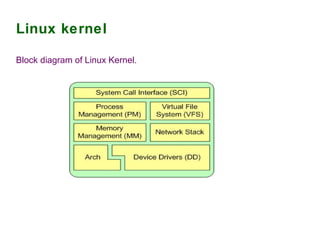
Kernel
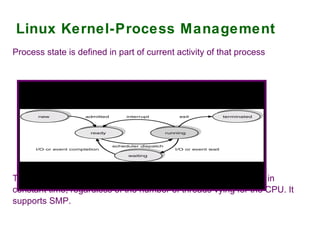
Process Management
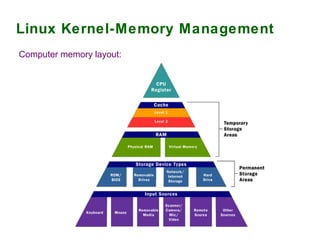
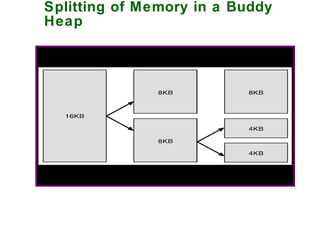
Memory Management
File System
Device Driver
Network Stack
Architecture-dependent code
Introduction Operating System is a software designed to control the hardware of a system in order to allow users and application programs to make use of it.
Linux is a  free operating system based on UNIX standards.
LINUX® is a registered trademark of Linus Torvalds.
Features of Linux. Multiprogramming
Multi-user
Secure
Fast
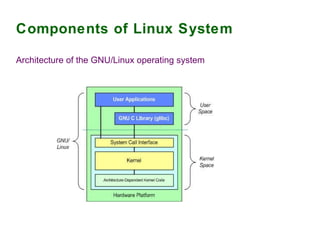
Components of Linux System Architecture of the GNU/Linux operating system
Components of a Linux System (Cont.)‏ When Linux is running in main memory,the it is divided in to two parts  1) User space.  2) Kernel space. User's applications are running in user space.
Kernel is running in kernel space. The  system libraries (e.g. glibc)  define a standard set of functions through which applications interact with the kernel, and which implement much of the operating-system functionality that does not need the full privileges of kernel code.
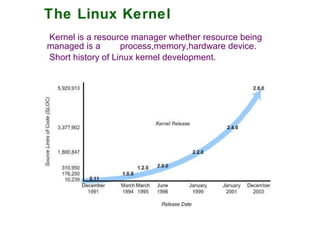
The Linux Kernel Kernel is a resource manager whether resource being managed is a  process,memory,hardware device.
Short history of Linux kernel development.
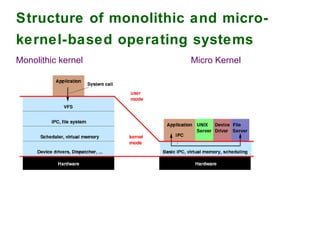
Linux Kernel Types of Kernel Monolithic Kernel.  (e.g. Linux kernel)‏
Micro kernel  (e.g. Windows NT kernel,Mach kernel etc.)‏
Structure of monolithic and micro-kernel-based operating systems Monolithic kernel  Micro Kernel
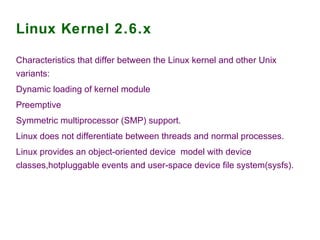
Linux Kernel 2.6.x Characteristics that differ between the Linux kernel and other Unix variants: Dynamic loading of kernel module
Preemptive
Symmetric multiprocessor (SMP) support.
Linux does not differentiate between threads and normal processes.
Linux provides an object-oriented device  model with device classes,hotpluggable events and user-space device file system(sysfs).

Linux internal