Monolithic Kernel
ARAVIND J
18MCS1004
VIT-CC
What is Kernel?
• A core component of Operating System without which OS can't work.
• Kernel is the nervous system of OS.
• It is the central core of Operating System.
• It controls everything in OS including I/O Management, Process Management and so on.
• It is a bridge between applications and the actual data processing done at the hardware level.
• It acts as an interface between the user applications and the hardware.
Responsibilities of Kernel
1. Central Processing Unit
The Kernel takes responsibility for deciding at anytime which of the many running
programs should be allocated to the processors.
2. Random Access Memory
Random Access memory is used to store both program instructions and data. Often
multiple programs will want access to memory, frequently demanding more memory than the
computer has available. The Kernel is responsible for deciding which memory each process can
use, and determining what to do when not enough memory is available.
3. Input/output Devices
The Kernel allocates requests from applications to perform I/O to an appropirate device
and provides convenient methods for using the device.
4. Memory Management
The Kernel has full access to the system's memory and must allow processes to safely
access this memory as they require it.
5.Device Management
A Kernel must maintain a list of available devices. This list may be known in advance
configured by the user or detected by the operating system at run time (normally called plug and
play)
Features provided by Kernel
1) Scheduling of Process (Dispatching)
2) Interprocess Communication
3) Process Synchronization
4) Context Switching
5) Manipulation of Process Control Blocks
6) Interrupt Handling
7) Process Creation and Destruction
8) Process Suspension and Resumption
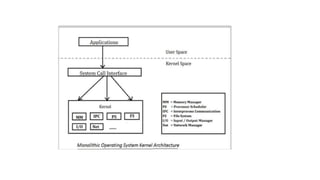
Monolithic Kernel
Monolithic Kernels run every basic system services like process and memory management,
interrupt handling and I/O Communication, file system etc in Kernel space.
They are used by Unix, Linux like Operating systems. Since there is less software involved it is
faster.
Every component of the Operating system is contained in the kernel and can directly
communicate with each other simply by using function calls. The Kernel typically executes with
unrestricted access to the computer system.
This approach provides rich and powerful hardware access.
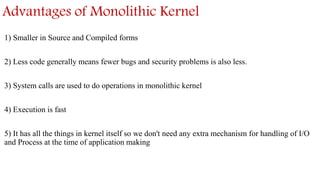
Advantages of Monolithic Kernel
1) Smaller in Source and Compiled forms
2) Less code generally means fewer bugs and security problems is also less.
3) System calls are used to do operations in monolithic kernel
4) Execution is fast
5) It has all the things in kernel itself so we don't need any extra mechanism for handling of I/O
and Process at the time of application making
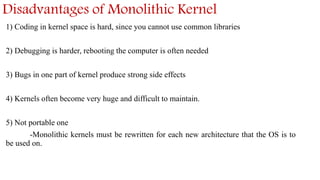
Disadvantages of Monolithic Kernel
1) Coding in kernel space is hard, since you cannot use common libraries
2) Debugging is harder, rebooting the computer is often needed
3) Bugs in one part of kernel produce strong side effects
4) Kernels often become very huge and difficult to maintain.
5) Not portable one
-Monolithic kernels must be rewritten for each new architecture that the OS is to
be used on.
THANK YOU

Monolithic kernel

  • 1.
  • 2.
    What is Kernel? •A core component of Operating System without which OS can't work. • Kernel is the nervous system of OS. • It is the central core of Operating System. • It controls everything in OS including I/O Management, Process Management and so on. • It is a bridge between applications and the actual data processing done at the hardware level. • It acts as an interface between the user applications and the hardware.
  • 4.
    Responsibilities of Kernel 1.Central Processing Unit The Kernel takes responsibility for deciding at anytime which of the many running programs should be allocated to the processors. 2. Random Access Memory Random Access memory is used to store both program instructions and data. Often multiple programs will want access to memory, frequently demanding more memory than the computer has available. The Kernel is responsible for deciding which memory each process can use, and determining what to do when not enough memory is available. 3. Input/output Devices The Kernel allocates requests from applications to perform I/O to an appropirate device and provides convenient methods for using the device.
  • 5.
    4. Memory Management TheKernel has full access to the system's memory and must allow processes to safely access this memory as they require it. 5.Device Management A Kernel must maintain a list of available devices. This list may be known in advance configured by the user or detected by the operating system at run time (normally called plug and play)
  • 6.
    Features provided byKernel 1) Scheduling of Process (Dispatching) 2) Interprocess Communication 3) Process Synchronization 4) Context Switching 5) Manipulation of Process Control Blocks 6) Interrupt Handling 7) Process Creation and Destruction 8) Process Suspension and Resumption
  • 7.
    Monolithic Kernel Monolithic Kernelsrun every basic system services like process and memory management, interrupt handling and I/O Communication, file system etc in Kernel space. They are used by Unix, Linux like Operating systems. Since there is less software involved it is faster. Every component of the Operating system is contained in the kernel and can directly communicate with each other simply by using function calls. The Kernel typically executes with unrestricted access to the computer system. This approach provides rich and powerful hardware access.
  • 9.
    Advantages of MonolithicKernel 1) Smaller in Source and Compiled forms 2) Less code generally means fewer bugs and security problems is also less. 3) System calls are used to do operations in monolithic kernel 4) Execution is fast 5) It has all the things in kernel itself so we don't need any extra mechanism for handling of I/O and Process at the time of application making
  • 10.
    Disadvantages of MonolithicKernel 1) Coding in kernel space is hard, since you cannot use common libraries 2) Debugging is harder, rebooting the computer is often needed 3) Bugs in one part of kernel produce strong side effects 4) Kernels often become very huge and difficult to maintain. 5) Not portable one -Monolithic kernels must be rewritten for each new architecture that the OS is to be used on.
  • 11.