INTRODUCTION TO
Machine Learning
Presented By :
Amreen Khanum D
2
Content
 What is Machine Learning
 Applications of Machine Learning
 Features of Machine Learning
 Classification of Machine Learning
 Supervised Learning
 Unsupervised Learning
 Reinforcement Learning
3
What is Machine Learning?
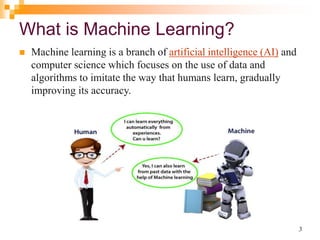
 Machine learning is a branch of artificial intelligence (AI) and
computer science which focuses on the use of data and
algorithms to imitate the way that humans learn, gradually
improving its accuracy.
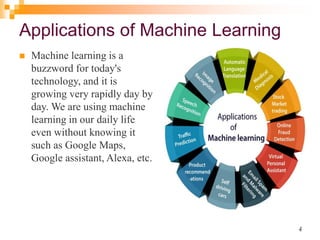
Applications of Machine Learning
 Machine learning is a
buzzword for today's
technology, and it is
growing very rapidly day by
day. We are using machine
learning in our daily life
even without knowing it
such as Google Maps,
Google assistant, Alexa, etc.
4
5
Features of Machine Learning:
 Machine learning uses data to detect various patterns in a
given dataset.
 It can learn from past data and improve automatically.
 It is a data-driven technology.
 Machine learning is much similar to data mining as it also
deals with the huge amount of the data.
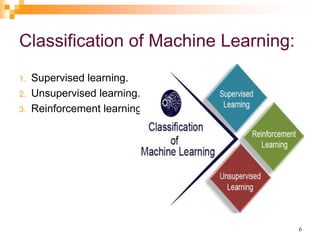
Classification of Machine Learning:
1. Supervised learning.
2. Unsupervised learning.
3. Reinforcement learning.
6
7
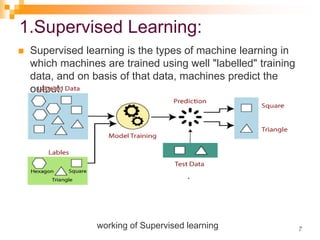
 Supervised learning is the types of machine learning in
which machines are trained using well "labelled" training
data, and on basis of that data, machines predict the
output.
working of Supervised learning
1.Supervised Learning:
8
Supervised learning can be further divided into two types of
problems:
1. Classification:
Classification algorithms are used when the output variable is
categorical, which means there are two classes such as Yes-No,
Male-Female, True-false, etc.
Example: Decision Tree , K-Nearest Neighbours, Naïve Bayes.
2.Regression:
Regression algorithms are used if there is a relationship between
the input variable and the output variable. It is used for the
prediction of continuous variables, such as Weather forecasting,
Market Trends, etc.
Example: Linear Regression, Logistic Regression.
9
2.Unsupervised Learning:
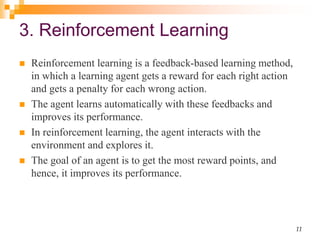
 Unsupervised learning is a type of machine learning in which
models are trained using unlabeled dataset and are allowed to
act on that data without any supervision.
 The goal of unsupervised learning is to find the underlying
structure of dataset, group that data according to similarities,
and represent that dataset in a compressed format.
Working of unsupervised learning
The unsupervised learning algorithm can be further
categorized into two types of problems:
1.Clustering:
Clustering is a method of grouping the objects into clusters such
that objects with most similarities remains into a group and has
less or no similarities with the objects of another group.
Example: K-means clustering.
2.Association:
An association rule is an unsupervised learning method which is
used for finding the relationships between variables in the large
database. It determines the set of items that occurs together in the
dataset. Association rule makes marketing strategy more
effective. Such as people who buy X item (suppose a bread) are
also tend to purchase Y (Butter/Jam) item.
Example: Apriori algorithm.
10
3. Reinforcement Learning
 Reinforcement learning is a feedback-based learning method,
in which a learning agent gets a reward for each right action
and gets a penalty for each wrong action.
 The agent learns automatically with these feedbacks and
improves its performance.
 In reinforcement learning, the agent interacts with the
environment and explores it.
 The goal of an agent is to get the most reward points, and
hence, it improves its performance.
11
THANK YOU
12

introduction to machine learning pdf.ppt

  • 1.
  • 2.
    2 Content  What isMachine Learning  Applications of Machine Learning  Features of Machine Learning  Classification of Machine Learning  Supervised Learning  Unsupervised Learning  Reinforcement Learning
  • 3.
    3 What is MachineLearning?  Machine learning is a branch of artificial intelligence (AI) and computer science which focuses on the use of data and algorithms to imitate the way that humans learn, gradually improving its accuracy.
  • 4.
    Applications of MachineLearning  Machine learning is a buzzword for today's technology, and it is growing very rapidly day by day. We are using machine learning in our daily life even without knowing it such as Google Maps, Google assistant, Alexa, etc. 4
  • 5.
    5 Features of MachineLearning:  Machine learning uses data to detect various patterns in a given dataset.  It can learn from past data and improve automatically.  It is a data-driven technology.  Machine learning is much similar to data mining as it also deals with the huge amount of the data.
  • 6.
    Classification of MachineLearning: 1. Supervised learning. 2. Unsupervised learning. 3. Reinforcement learning. 6
  • 7.
    7  Supervised learningis the types of machine learning in which machines are trained using well "labelled" training data, and on basis of that data, machines predict the output. working of Supervised learning 1.Supervised Learning:
  • 8.
    8 Supervised learning canbe further divided into two types of problems: 1. Classification: Classification algorithms are used when the output variable is categorical, which means there are two classes such as Yes-No, Male-Female, True-false, etc. Example: Decision Tree , K-Nearest Neighbours, Naïve Bayes. 2.Regression: Regression algorithms are used if there is a relationship between the input variable and the output variable. It is used for the prediction of continuous variables, such as Weather forecasting, Market Trends, etc. Example: Linear Regression, Logistic Regression.
  • 9.
    9 2.Unsupervised Learning:  Unsupervisedlearning is a type of machine learning in which models are trained using unlabeled dataset and are allowed to act on that data without any supervision.  The goal of unsupervised learning is to find the underlying structure of dataset, group that data according to similarities, and represent that dataset in a compressed format. Working of unsupervised learning
  • 10.
    The unsupervised learningalgorithm can be further categorized into two types of problems: 1.Clustering: Clustering is a method of grouping the objects into clusters such that objects with most similarities remains into a group and has less or no similarities with the objects of another group. Example: K-means clustering. 2.Association: An association rule is an unsupervised learning method which is used for finding the relationships between variables in the large database. It determines the set of items that occurs together in the dataset. Association rule makes marketing strategy more effective. Such as people who buy X item (suppose a bread) are also tend to purchase Y (Butter/Jam) item. Example: Apriori algorithm. 10
  • 11.
    3. Reinforcement Learning Reinforcement learning is a feedback-based learning method, in which a learning agent gets a reward for each right action and gets a penalty for each wrong action.  The agent learns automatically with these feedbacks and improves its performance.  In reinforcement learning, the agent interacts with the environment and explores it.  The goal of an agent is to get the most reward points, and hence, it improves its performance. 11
  • 12.