Kenya Tourism in an LEDC
Kenya is located on Africa’s East coast.  It’s location, on the equator also brings many advantages such as warm seas, and a favourable climate.
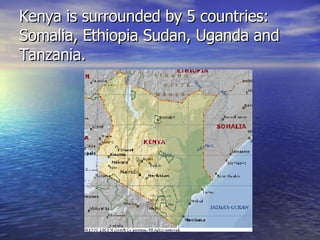
Kenya is surrounded by 5 countries: Somalia, Ethiopia Sudan, Uganda and Tanzania.
Every year Kenya is visited by thousands of tourists because it has many attractions, such as: Mount Kenya Mombassa Beach Maasai Mara Game Park Marsabit National Reserve Lake Turkana Safari opportunities
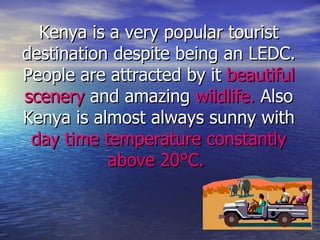
Kenya is a very popular tourist destination despite being an LEDC. People are attracted by it  beautiful   scenery  and amazing  wildlife.  Also Kenya is almost always sunny with  day time temperature constantly above 20 °C.
Kenya many nature reserve means that many safaris have been established over the years, these are: Aberdares Safari Tsavo Safari Rift Valley Safari   Samburu Safari Amboseli Safari Kilimanjaro Safari
The advantages of tourism for the Kenyan environment are: Greater awareness about the need for conservation of natural beauty, wildlife and ancient monuments. Income provided by tourism pays for the management of conservations and repairs
The economic advantages for Kenya are: Creates foreign exchange from overseas visitors Creates employment for locals and therefore raises the domestic economy Improvements for tourists, e.g. airports, roads and water supplies, also benefit locals
The social and cultural advantages of tourism in Kenya are: The cultures and traditions of local people may be preserved Employment opportunities encourage more people to stay in the country- can reduce rural to urban migration to cities like Nairobi
The environmental disadvantages of tourism in Kenya: Building of hotels and roads destroy habitats Increase of noise pollution Footpath and soil erosion increased by frequent visitors. Increase of pollution, litter and untreated waste.
The economic disadvantages of tourism in Kenya: Full benefits of tourism not gained by country as only about 15% of holiday money reaches them. Numbers of visitors fluctuates. Jobs are unskilled, poorly paid and seasonal. Local people lose livelihoods in areas of tourist facilities.
The social and cultural disadvantages of tourism in Kenya: Local traditions disappear as locals imitate visitors- people learn to speak English. Tourists treat local people badly and look down on them. Locals can feel patronised by or sometimes envious of the wealth tourists possess.
The solution – ‘Green Tourism’ ‘ Green Tourism ’ is  eco-friendly tourism  that is  sustainable . It emphasis on protecting the environment and involves the local people making decisions about their land and living. In Kenya the Maasai land that is used for nature reserves is now being rented out for around £1000 a year. Now the Maasai are vital to the success of these smaller less environmentally damaging tourist developments.
Now revise Eselenkei in detail.

Kenya Tourism

  • 1.
  • 2.
    Kenya is locatedon Africa’s East coast. It’s location, on the equator also brings many advantages such as warm seas, and a favourable climate.
  • 3.
    Kenya is surroundedby 5 countries: Somalia, Ethiopia Sudan, Uganda and Tanzania.
  • 4.
    Every year Kenyais visited by thousands of tourists because it has many attractions, such as: Mount Kenya Mombassa Beach Maasai Mara Game Park Marsabit National Reserve Lake Turkana Safari opportunities
  • 5.
    Kenya is avery popular tourist destination despite being an LEDC. People are attracted by it beautiful scenery and amazing wildlife. Also Kenya is almost always sunny with day time temperature constantly above 20 °C.
  • 6.
    Kenya many naturereserve means that many safaris have been established over the years, these are: Aberdares Safari Tsavo Safari Rift Valley Safari Samburu Safari Amboseli Safari Kilimanjaro Safari
  • 7.
    The advantages oftourism for the Kenyan environment are: Greater awareness about the need for conservation of natural beauty, wildlife and ancient monuments. Income provided by tourism pays for the management of conservations and repairs
  • 8.
    The economic advantagesfor Kenya are: Creates foreign exchange from overseas visitors Creates employment for locals and therefore raises the domestic economy Improvements for tourists, e.g. airports, roads and water supplies, also benefit locals
  • 9.
    The social andcultural advantages of tourism in Kenya are: The cultures and traditions of local people may be preserved Employment opportunities encourage more people to stay in the country- can reduce rural to urban migration to cities like Nairobi
  • 10.
    The environmental disadvantagesof tourism in Kenya: Building of hotels and roads destroy habitats Increase of noise pollution Footpath and soil erosion increased by frequent visitors. Increase of pollution, litter and untreated waste.
  • 11.
    The economic disadvantagesof tourism in Kenya: Full benefits of tourism not gained by country as only about 15% of holiday money reaches them. Numbers of visitors fluctuates. Jobs are unskilled, poorly paid and seasonal. Local people lose livelihoods in areas of tourist facilities.
  • 12.
    The social andcultural disadvantages of tourism in Kenya: Local traditions disappear as locals imitate visitors- people learn to speak English. Tourists treat local people badly and look down on them. Locals can feel patronised by or sometimes envious of the wealth tourists possess.
  • 13.
    The solution –‘Green Tourism’ ‘ Green Tourism ’ is eco-friendly tourism that is sustainable . It emphasis on protecting the environment and involves the local people making decisions about their land and living. In Kenya the Maasai land that is used for nature reserves is now being rented out for around £1000 a year. Now the Maasai are vital to the success of these smaller less environmentally damaging tourist developments.
  • 14.