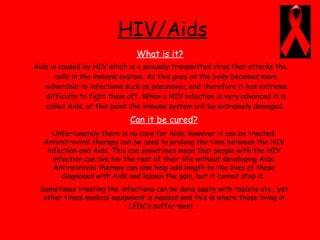
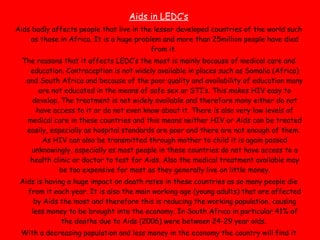
HIV/AIDS disproportionately impacts less developed countries (LEDCs) for several reasons:
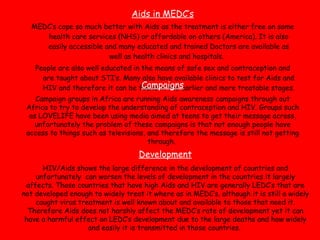
1) Contraception and education about safe sex and STIs is not widely available, making transmission of HIV much more likely.
2) Treatment for HIV/AIDS is not widely accessible or affordable in LEDCs, so the virus cannot be treated as easily.
3) HIV can be passed from mother to child, especially in LEDCs where access to health clinics for testing is limited.
4) HIV/AIDS is reducing the working population in severely impacted countries in Africa, lowering economic productivity and development.


![Montserrat[1][1]](https://cdn.slidesharecdn.com/ss_thumbnails/montserrat11-091220042014-phpapp01-thumbnail.jpg?width=640&height=640&fit=bounds)


![Course Work Skills[1].Annotated Photos](https://cdn.slidesharecdn.com/ss_thumbnails/courseworkskills1-annotatedphotos-090430055838-phpapp02-thumbnail.jpg?width=640&height=640&fit=bounds)


