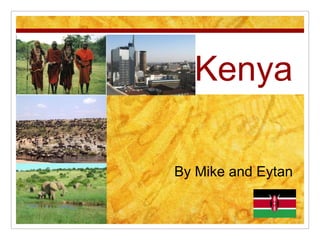
KenyaBy Mike and Eytan
AgendaIntroduction to KenyaKenyansociety and cultureBusiness in KenyaCasestudyQuestionanswersession
Introduction to KenyaGeography  HistoryGovernmentEconomyEducationPeopleLanguagesReligionArtFood
GeographyMapEthnic groupsBig citiesLandscapes
Map
Ethnic groups
Big citiesNairobiPopulation: 2.9 MioMombasaPopulation: 1 MioNakuruPopulation: 500, 000
Landscapes
Landscapes
Landscapes
Landscapes
HistoryColonial historyPost-colonial historyOrigins of the country's name
Colonial historyThe Berlin conference in 1885 marked the beginning of the British rule in Kenya.The purpose of imperial system was to integrate administration and development of economy.The British settled on fertile grounds of Kenya which led to imposition of rule and restrictions of Kenyan people.
Post-colonial historyAttained it‘s independence in 1963.The first president Jomo Kenyatta.In 1964, joined the commonwealth.One- party government.New player on the international business world.
Origins of the country's nameThe country is named after mount KenyaAvery significant landmark in kenyaSecond highest among the mountain peaks of Africa.Pronunced as ‘‘Kenia‘‘ in the beginning.
GovernmentKenya is a presidential representative democratic republic with a multi-party system.Executive power is exercised by the head of state.Legislative power which is vested in the National assembly.The Judiciary is independent.
EconomyGDP(at Market Price. $ 41.36 billion Purchasing Power Parity, 2007). Annual growth rate(Estimate for 2007 = 7.2%).Industry (petroleum products, grain and sugar milling, cement, light manufacturing and  tourism).Natural resources(Wildlife, land (5% arable).Agricultural produce (tea, coffee, sugarcane).
EducationThe education system consist of; early childhood education, primary, secondary and college.Early childhood education takes at least three years.primary eight years(KCPE).secondary four(KCSE).  university four or six years depending on the course.Grade A A- B+ B B- C+ C C- D+ D D- E Points 12 11 10 9 8 7 6 5 4 3 2 1
PeopleThe Kenya tribesWhat occupation do Kenyans have?Famous people from Kenya
The Tribes in KenyaKikuyu tribeLuhya tribeMaasai tribeOther tribes
Kikuyu tribeMost populous enthic group in Kenya.They are found in the fertile central highlands and are also the most economically active ethnic group in Kenya.The Kikuyu man is referred to as a mũthuuri (meaning someone who can choose or discern evil from good).the Kikuyu woman is called a mũtumia (meaning someone who retains family secrets and practices).
Luhya tribeThe second largest ethnic group in Kenya.The Luhya are found in the fertile highlands of Western Kenya.Luhyas are one of the most culturally, politically and economically active ethnic groups in Kenya.The Luhya people practice male circumcision.
Maasai tribeThe Maasai are an indigenous African ethnic group of semi-nomadic people located in Kenya and northern Tanzania.They famous as cattle herders and warriors.Their cattle is what makes good life to them becuase it provides milk and meat as their best food.
Other tribesKambaMeruKisiiSamburuTeso
What occupation do Kenyans have?Three quarters of the Kenya people work in agriculture. Kenya is a main exporter of coffee and tea.Kenya also has a small industrial sectorTourism is rapidly growing as a sector and is now the main source of foreign income
Famous people from KenyaJomo Kenyatta First president
Famous people from KenyaRichard Leakey  Paleontologist, archaeologist.
Famous people from KenyaProf. WanagariMaathaiNobel prize winner 2008
Famous people from KenyaPaul Tergat successful long-distance runners of all time
LanguagesOfficial languages: Swahili, EnglishOver 61 languages spoken in KenyaA few word:
ReligionThe majority of the Kenya people are Christians Often mixed with traditional beliefs45% are Protestant and 33% Roman Catholic10% are Muslimindigenous beliefs 10% other 2%
Art
Art
Art
Food
Food
Kenyan Society and CultureDimension of TrompenarsRelationshipsConcept of timeLow and High context communicatorBody language
Dimension of trompenars
RelationshipsDeep concern for familyIndividual empowerment and decision making are rareWarm and hospitable especially to touristPeople look after each otherBeing alone is considered suspicious
Concept of timeWhat is time?Only punctual for opportunitiesBut don’t be late for a dateWalk fastVery flexible with dead linesPolychronic
Low and High context Kenyans are very context-driven communicatorsSpeaks with metaphors and storiesUse of body languageAvoid confrontation
Body languages and gesturesEye contact not maintain when speaking with elder or seniorBeckon someone with the forefinger is very insultingPointing is rudeNever speak with hand in the pocketIn public formal is important
Notion of SpaceKenyan are very close to each otherSeat nearest as possible in buses, restaurants.
Business in KenyaCommunication styleMeeting and greetingBusiness meetingsGift giving
Communication styleKenyans will always attempt to deliver the message in a sensitive way.Kenyans often use metaphors, analogies and stories to make a point.Kenyans may gesture for emphasis when speaking.Kenyans may offer what they believe is the expected response  to their business partner.
Meeting and greetingHandshakes are the most common greeting in business.Men should wait for a woman to extend her and first. Titles are important.Wait to be invited before moving to a first name basis.Business cards are exchanged without formal ritual.Present and receive business cards with two hands.
Business meetingsMeeting schedules may be structured or not .Devote time to small talk in order to get to know your hosts and vice-versa.Meetings seldom have scheduled ending times.Kenyans value tradition.
Case studyhttp://www.thedailyshow.com/video/index.jhtml?title=Oliver%27s-Travels---Kenya&videoId=217666
Question/Answer session
Karibu KenyaHakunaMatata!

Kenya Presentation